


New species of the genera Ingaseius Barbosa et al. and Leonacarus Manzanilla et al. (Acari: Phytoseiidae) from Peru
Muñoz Marticorena, Jorge L.  1
and Ferla, Noeli Juarez
2
1
and Ferla, Noeli Juarez
2
1✉ Centro Internacional de Investigación para la Sustentabilidad, Universidad Nacional de Cañete CIIS - UNDC, Lunahuaná-Lima, Perú.
2Laboratório de Acarologia, Universidade do Vale do Taquari, Lajeado, RS, Brazil.
2026 - Volume: 66 Issue: 4 pages: 1063-1077
https://doi.org/10.24349/aeak-eodiZooBank LSID: 79040D36-727D-4698-81AC-24868324BD90

Original research
Keywords
Abstract
Introduction
The best studied predatory mites belong to the family Phytoseiidae; they are mostly found on cultivated plants and natural vegetation (McMurtry et al. 2015). Peruvian mites of this family have been reported by Guanilo and Martinez (2007), Guanilo et al. (2008a, b) and Marticorena and Berrio (2014).
Cañete Province, located in southern Lima Region, is characterized by a marked altitudinal gradient, extending from coastal areas to higher inter-Andean elevations in the middle and upper basin of the Cañete River. The province comprises numerous small settlements and villages, where smallholder farmers predominate, managing family-based agricultural systems mainly in small-scale plots (Cabrera et al. 2005). Mite communities in this region remain poorly documented, despite the ecological importance of phytoseiid mites in regulating pest populations in agricultural crops (Guanilo et al. 2012). One new species in each of the phytoseiid genera Ingaseius Barbosa, Rocha and Ferla and Leonacarus Manzanilla, García-París and Aponte was recently discovered in the area.
The monotypic genus Ingaseius was originally described from Brazil based on Ingaseius silvaticus Barbosa, Rocha and Ferla, 2014, collected from Inga sp. (Fabaceae). The genus Leonacarus is a replacement name for Phyllodromus De Leon, which was described from the United States of America to include Leonacarus leiodis (De Leon, 1959), collected from Waltheria americana L. (Malvaceae). Two other species were included in that genus: L. trisetatus (Moraes and Melo 1997) collected in the state of Pernambuco, Brazil from Solanum erianthum D. Don. (Solanaceae) and L. mocovi (Döker & Rossetti, in Döker et al. 2026a), collected in Santa Fe, Argentina from Croton urucurana Baill. (Euphorbiaceae). The objective of this manuscript is to describe these new species and to present a dichotomous key for the identification of species of Leonacarus.
Material and methods
Leaves from both cultivated and wild plants were collected between 2023 and 2025 to determine the phytoseiid species. Leaf samples were collected from 14 settlements in the study area at altitudes ranging from 100 to 700 m a.s.l. Mean annual temperature and mean total annual precipitation were 20.31 °C and 19.30 mm, respectively, at the lower altitude, and 21.11 °C and 21.23 mm, respectively, at the higher altitude, based on ten years of climatic records (SENAMHI, 2026).
Specimens of the new species were collected and preserved in 70% ethanol and subsequently mounted in Hoyer's medium for examination under phase contrast (Leica DM750) and differential interference contrast (Olympus BX53 DIC) optical microscopy. Identification at the genus level followed the taxonomic concepts of Chant and McMurtry (2007). Adenotaxy and poroidotaxy were based on Athias-Henriot (1975); setal nomenclature followed Lindquist & Evans (1965), as adapted to Phytoseiidae by Rowell et al. (1978) for the dorsal idiosoma and by Chant & Yoshida-Shaul (1991) for the ventral surface.
All measurements of the dorsal and ventral shields, setae, and legs are given in micrometers; for each structure, the mean is followed by its range in parentheses. Dorsal shield length was measured along the midline from the anterior to the posterior margin; and width was measured at its widest point. The ventrianal shield length was measured along the midline, and width was measured at the levels of the anus and setae JV2. Genital shield length was measured along the midline, and width at the level of setae st5. Illustrations were prepared from images of holotype and paratype specimens, taken with a digital camera (Canon) attached to a differential interference contrast microscope (Olympus BX53). Image stacking was performed using Helicon Focus, and final plates were assembled using Adobe Illustrator.
Results
Ingaseius Barbosa, Rocha & Ferla, 2014
Ingaseius catapayensis Marticorena & Ferla n. sp.
ZOOBANK: F28CD40E-7A82-4F43-8B77-870F23479A37
Diagnosis
Idiosomal setal pattern 10A: 7B/JV–3: ZV–3, with r3 and R1 inserted in unsclerotized integument. Dorsal shield smooth, with a few anterolateral striae; with seven pairs of solenostomes (gd1, gd2, gd4, gd5, gd6, gd8 and gd9) and 13 pairs of poroids (id2, id4, id5, id6, idm2, idm3, idm5, idm6, is1, idx, idl1, idl3 and idl4). Setae j1, z2, s4, S2, Z4 and Z5 robust and serrate, the first of which is short; other dorsal shield setae smooth, needle-like, and slightly shorter than j1. Setae J2 and Z1 absent. Sternal shield smooth, with two pairs of setae (st1, st2) and two pairs of poroids (iv1, iv2); posterior margin slightly concave; with a pair of conspicuous posterolateral projections; setae st3 and st4 each inserted on a rounded platelet. Ventrianal shield reduced, with a pair of pre-anal setae (JV2) and a pair of small solenostomes (gv3) posterolateral to JV2. Peritreme extending to the region between j1 and j3. Macrosetae absent. Spermatheca with calyx funnel-shaped, 26 (22–29) long.
Description
Adult female (n = 4)
(Figures 1– 3)
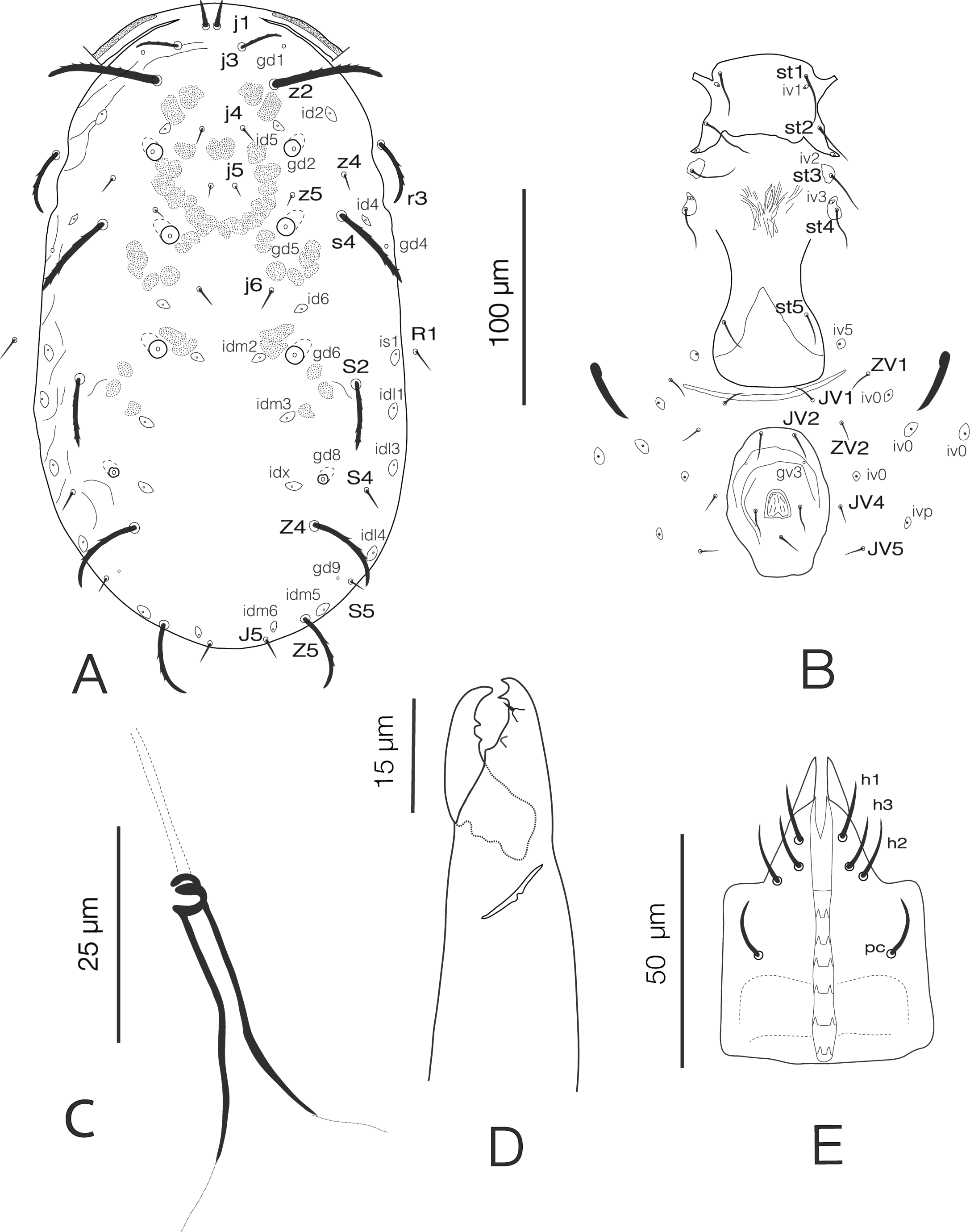
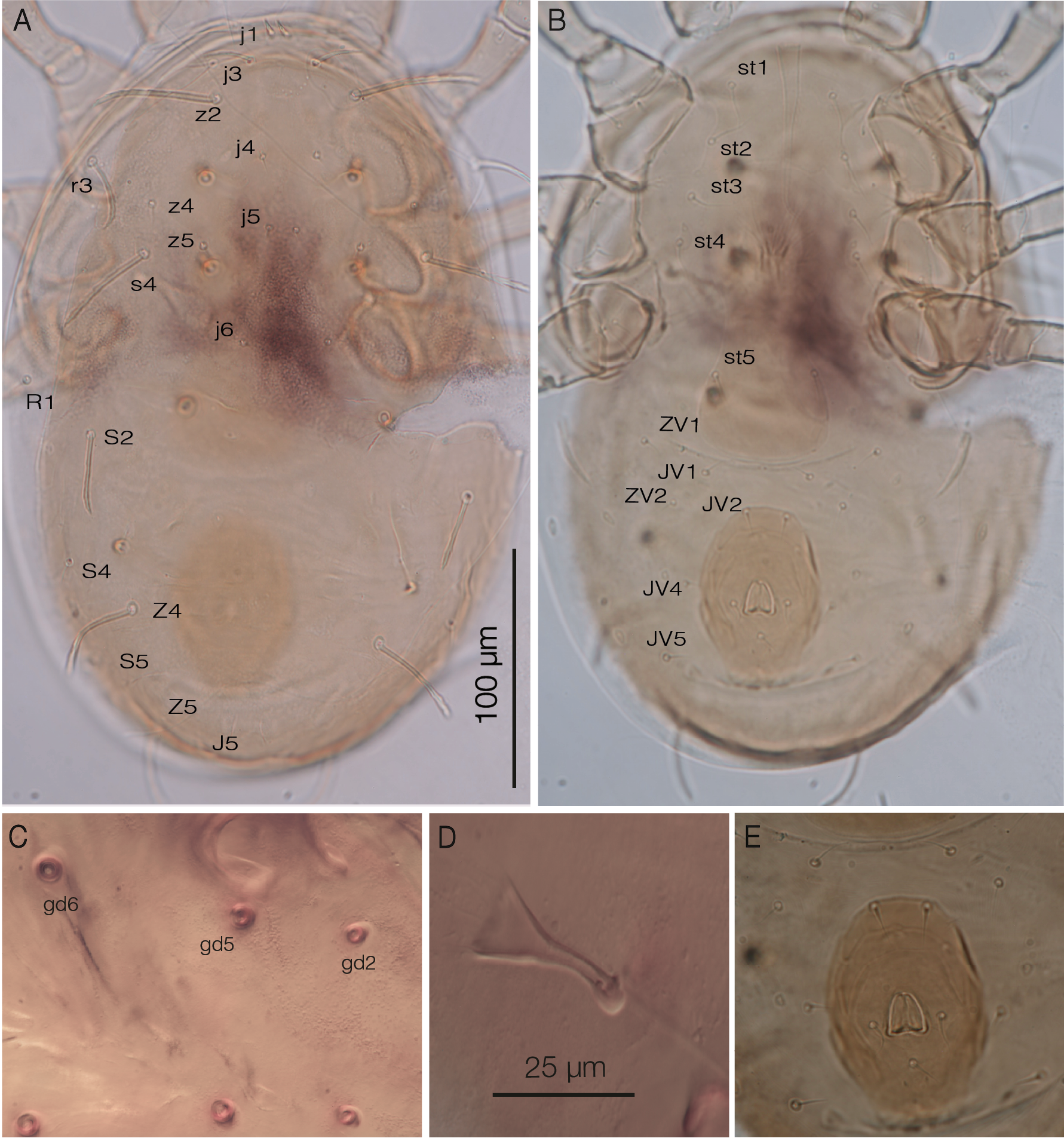
Dorsal idiosoma (Figures 1A; 2A, C). Dorsal shield 283 (278–292) long and 157 (155–160) wide at level of s4; with 17 pairs of setae (setal pattern 10A: 7B; with r3 and R1 inserted in unsclerotized integument), seven pairs of solenostomes (gd1, gd2, gd4, gd5, gd6, gd8 and gd9) and 13 pair of poroids (id2, id4, id5, id6, idm2, idm3, idm5, idm6, is1, idx, idl1, idl3 and idl4). Dorsal muscle scars (sigilla) mostly clustered in the central region of the podosoma; shield almost completely smooth, with a few anterolateral striae. Setal lengths: j1 10 (9–11), j3 18 (14–20), j4 7 (6–8), j5 6 (5–7), j6 9 (8-10), J5 4 (3–5), z2 49 (46–50), z4 10, z5 8 (7–9), s4 42 (41–45), Z4 36 (35–37), Z5 30 (29–31), S2 28 (26–30), S4 9 (8–10), S5 6 (5–6), r3 29 (26–31) and R1 10. Setae j1, j3, z2, s4, S2, Z4, Z5 and r3 robust and serrate, with rounded apex (z2 the most robust of all setae); setae j4, j5, j6, J5, z4, z5, S4, S5 and R1 shorter, needle-like and smooth. Each seta shorter than the distance to the next seta of the same series.
Peritrematal shield (Figure 1A). Fused to dorsal shield at level of j1. Peritreme extending to region between j1-j3.
Ventral idiosoma (Figures 1B, E; 2B, E). Sternal shield smooth, with two pairs of setae (st1–st2) and two pairs of poroids (iv1 and iv2); setae st3 and st4 each on a discrete, rounded platelet; distances between sternal setae: st1–st1 40, st2–st2 57 (52–68), st5–st5 40 (37–41) and st1–st3 46 (45–48); posterior margin slightly concave medially; with a pair of conspicuous posterolateral projections. Setae st3 and st4 each inserted on a rounded platelet, the latter also bearing poroid iv3. Genital shield smooth, with posterior margin slightly rounded; bearing st5; length 111 (105–116), width at level of st5 40 (37–43); poroid iv5 inserted in unsclerotized integument, posterolateral to st5; with a slender, transverse platelet behind the genital shield, longer than the maximum width of the shield. A pair of slender metapodal platelets is present on the soft integument posterior to coxae IV; the anterior end of each platelet is slightly broader than the remainder. Ventrianal shield with a few striae parallel to margin, ovoid, reduced, 66 (61–70) long, 48 (43–50) wide at level of para-anal setae, with a pair of preanal setae (JV2) and a pair of small pores (gv3) posterolateral JV2. Unsclerotized integument of opisthogaster with five pairs of setae (JV1, JV4, JV5, ZV1 and ZV2) and five pairs of poroids (four pairs of ivo and ivp). All opisthogastric setae aciculate and smooth; setal lengths: JV1 12 (10–14), JV2 13 (11–14), JV4 8 (6–9), JV5 10 (8–10), ZV1 10 and ZV2 11(10–11).
Gnathosoma (Figure 1D, E). Setae h1 16 (15–17), h2 14 (13–15), h3 15 (13–17) and pc 18 (16–19) long. Deutosternal groove narrow, with seven transverse rows of denticles; the first smooth and each of the others with one denticle at each end. Chelicera with dorsal and antiaxial poroids visible. Fixed cheliceral digit 21 (20–22) long, with three teeth in addition to apical tooth and setiform pilus dentilis; movable digit 19 (18–21) long, with two teeth in addition to the apical tooth.
Spermatheca (Figures 1C, 2D). Calyx funnel-shaped, 26 (22–29) long. Atrium c shaped and development. Major duct about half as wide as diameter of tubular section of calyx; minor duct not visible.
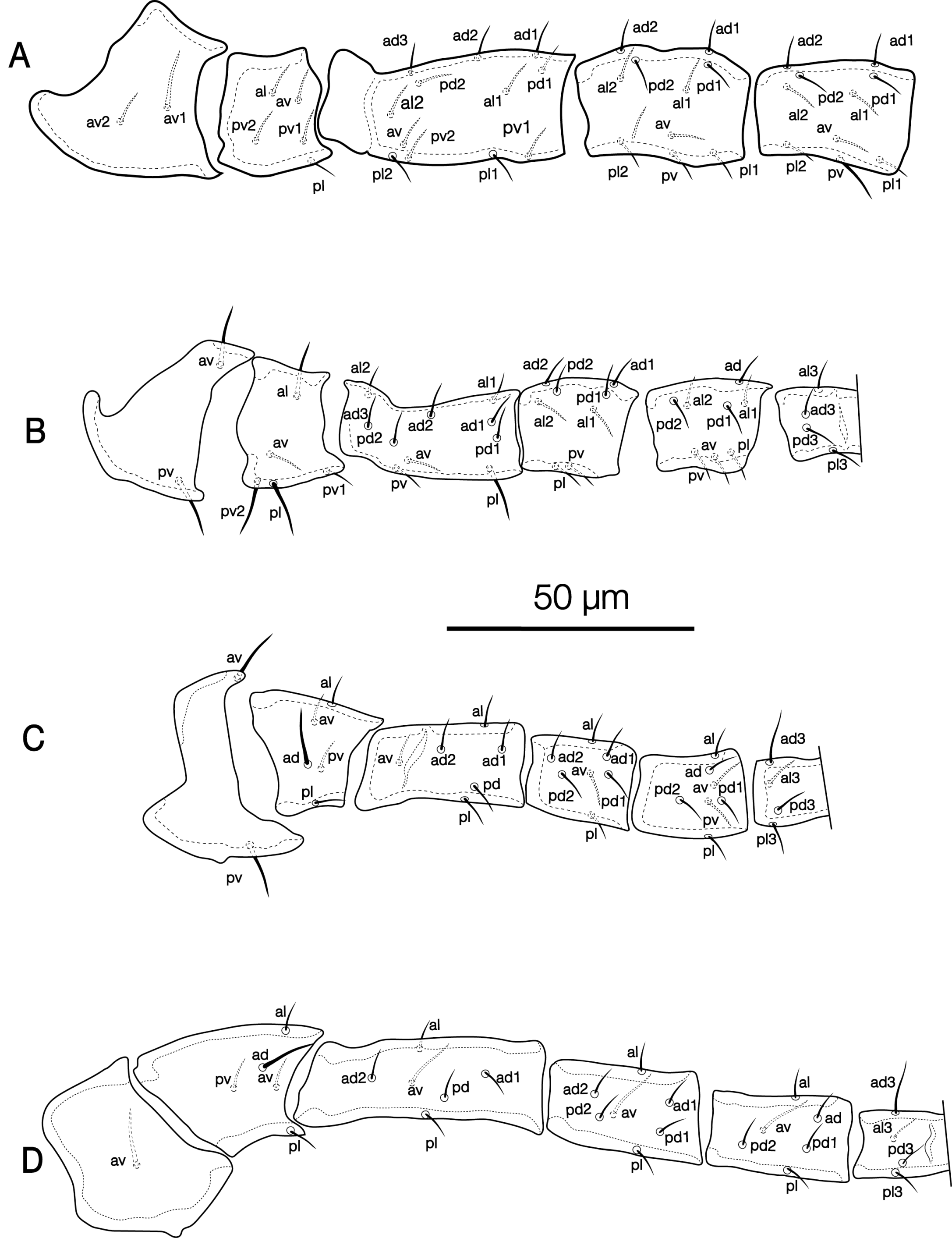
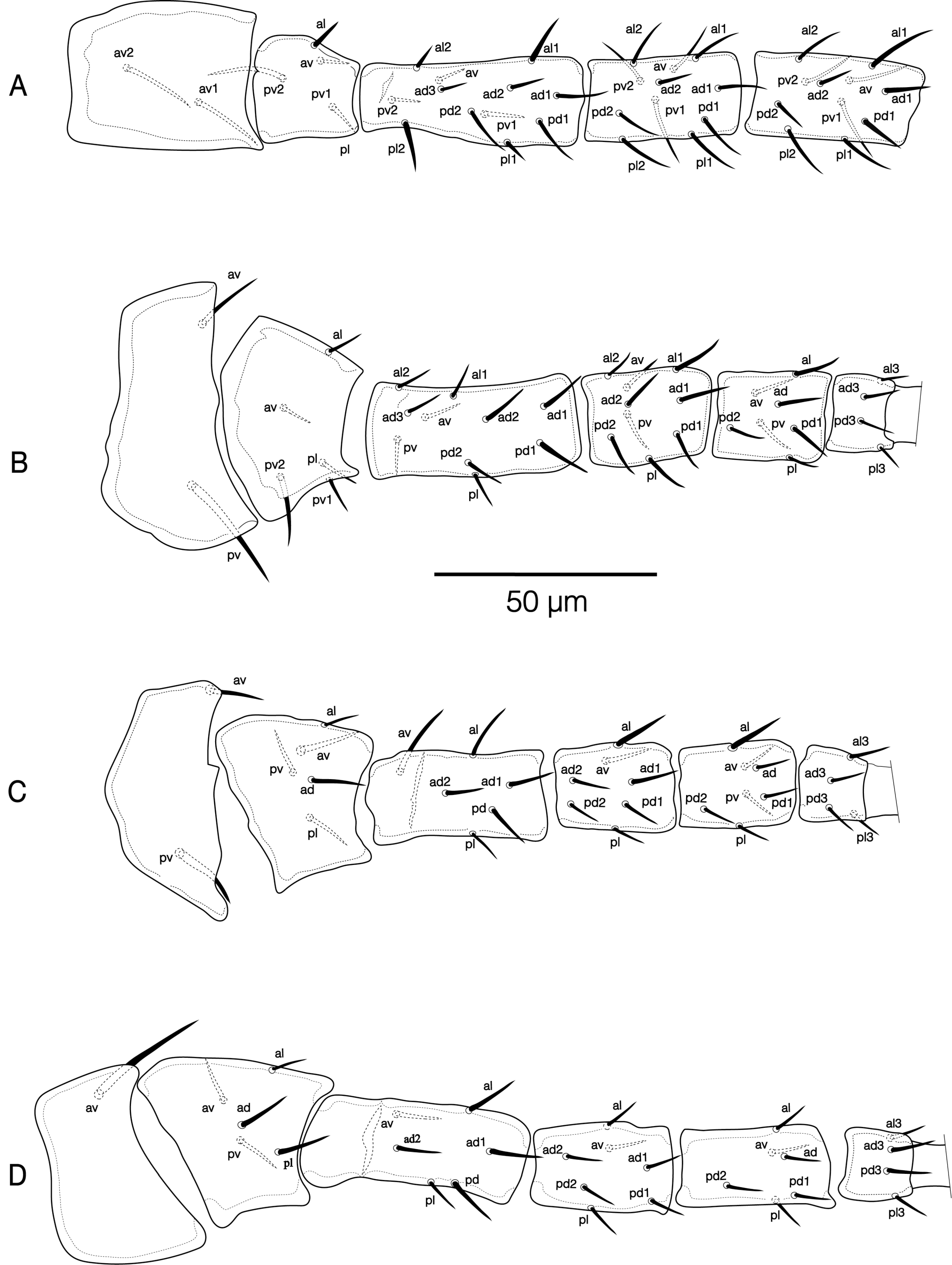
Legs (Figures 3A-D). Length of legs I–IV 237 (230–248), 200 (195–204), 185 (185–186), and 243 (236–246), respectively. Leg chaetotaxy as follows: coxa I: 2; trochanter I: 1, 0/1, 0/2, 1; femur I: 2, 3/1, 2/2, 2; genu I: 2, 2/ 1, 2/1, 2; tibia I: 2, 2/1, 2/1, 2; coxa II: 2; trochanter II: 1, 0/1, 0/2, 1; femur II: 2, 3/1, 2/1, 1; genu II: 2, 2/0, 2/1, 1; tibia II: 1, 1/1, 2/1, 1; coxa III: 2; trochanter III: 1, 1/1, 0/1, 1; femur III: 1, 2/1, 1/0, 1; genu III: 1, 2/1, 2/0, 1; tibia III: 1, 1/1, 2/1, 1; trochanter IV: 1, 1/1, 0/1, 1; femur IV: 1, 2/1, 1/0, 1; genu IV: 1, 2/1, 2/0, 1; tíbia IV: 1, 1/1, 2/0, 1. Macrosetae absent.
Adult male (unknown)
Specimens examined
Female holotype and three female paratypes collected by J.L. Muñoz Marticorena from Inga feuilleei DC (Fabaceae) on 10-XII-2025 in Cañete, Lima (12°55′18″S, 76°06′37″W; 557 m above sea level), Perú. Type specimens deposited at the International Research Center for Sustainability (Laboratory of Entomological Control of Agricultural Pests, Universidad Nacional de Cañete), Lunahuaná, Lima, Peru.
Etymology
The specific epithet is derived from Catapalla, a village in Lunahuaná District, Lima Region, Peru, where the type specimens were collected.
Remarks
The new species described herein is similar to I. silvaticus, from which it differs in the dimensions of several dorsal setae, adenotaxy (pattern of solenostomes and poroids) and other characters. In the new species, the dorsal shield is smaller and some dorsal setae are shorter, particularly Z4, Z5 and S2; conversely, j4 and z5 are slightly longer. Also, it possesses the solenostome gd5 and poroids 1dm1, is1 and idx, all of which are absent in I. silvaticus. In addition, pores gd2, gd5, gd6 and gd8 are very evident (crateriform), and each is associated with a pocket-shaped invagination. Neither these pores nor their associated invaginations are evident in I. silvaticus, except, apparently, for the small gd6 pore depicted in the original description.
Ventral idiosoma with sternal shield bearing two pairs of setae, st3 inserted on a pair of platelets separate from the shield; in I. silvaticus the sternal shield bears three pairs of setae, with st3 on narrow posterolateral extensions of the shield. Another distinguishing character is the shorter peritreme, extending to the region between setae j1-j3 in I. catapayensis, whereas in I. silvaticus it reaches the level of seta j1. In addition, the dentition of the fixed cheliceral digit differs between the two species. The new species bears two teeth in addition to the apical tooth, whereas I. silvaticus bears a single, distal subapical tooth.
Both species were collected from plants of the genus Inga (Fabaceae), but they differ in geographic location and ecological context. The Peruvian species was collected in an area considered part of the Andean coastal region, near the Pacific Ocean, whereas the Brazilian species was found in the Atlantic Forest (Mata Atlântica) biome, near the Atlantic Ocean.
Leonacarus Manzanilla, García-París and Aponte, 2006
Leonacarus Manzanilla et al. 2006: 98 (replacement name, given the existence of Phyllodromus Jiménez de la Espada, 1875, a group of frogs).
Phyllodromus De Leon, 1959: 260.
Amblyseius (Phyllodromus) Karg, 1983: 313.
Leonacarus canetensis Marticorena and Ferla n. sp.
ZOOBANK: 78F6CB47-391C-4D5A-A277-84A4DE079263
(Figures 4 - 7)
Diagnosis
Idiosomal setal pattern 10A: 9B/JV –3: ZV, with r3 and R1 inserted in unsclerotized integument. Dorsal shield smooth, except for scant striae posteriad J2; with five pairs of solenostomes (gd1, gd2, gd4, gd6 and gd9) and 16 pairs of poroids (id1, id2, id4, id5, id6, idm1–idm6, idx, is1, idl1, idl3 and idl4). Lateral margins with slight but distinct constriction at level of R1. Setae j1, j3, z2, z4, s4, S2, S4, S5, Z4, Z5, r3 and R1 rod-shaped, blunt, smooth, except for Z5, which is slightly serrate at the apex; remaining idiosomal setae distinctly shorter, needle-shaped and smooth. Sternal shield smooth, with three pairs of setae (st1, st2 and st3) and two pairs of poroids (iv1, iv2). Ventrianal shield cup-shaped, with the anterior margin slightly convex and a discreet anterolateral constriction; faint medial, transverse striae anterior to the anal opening, two pairs of preanal setae and a pair of small pores (gv3) located well posterior and slightly lateral to the JV2. Only one of the ten specimens examined possessed a single JV3 seta on the ventrianal shield. All ventral setae are smooth. The peritreme extends anteriorly to the level of j3. Macrosetae are absent. The calyx is deep bell-shaped, 19 (17–21) long; with the atrium incorporated into the base of calyx.
Description
Adult female (n = 10)
(Figures 4–6)
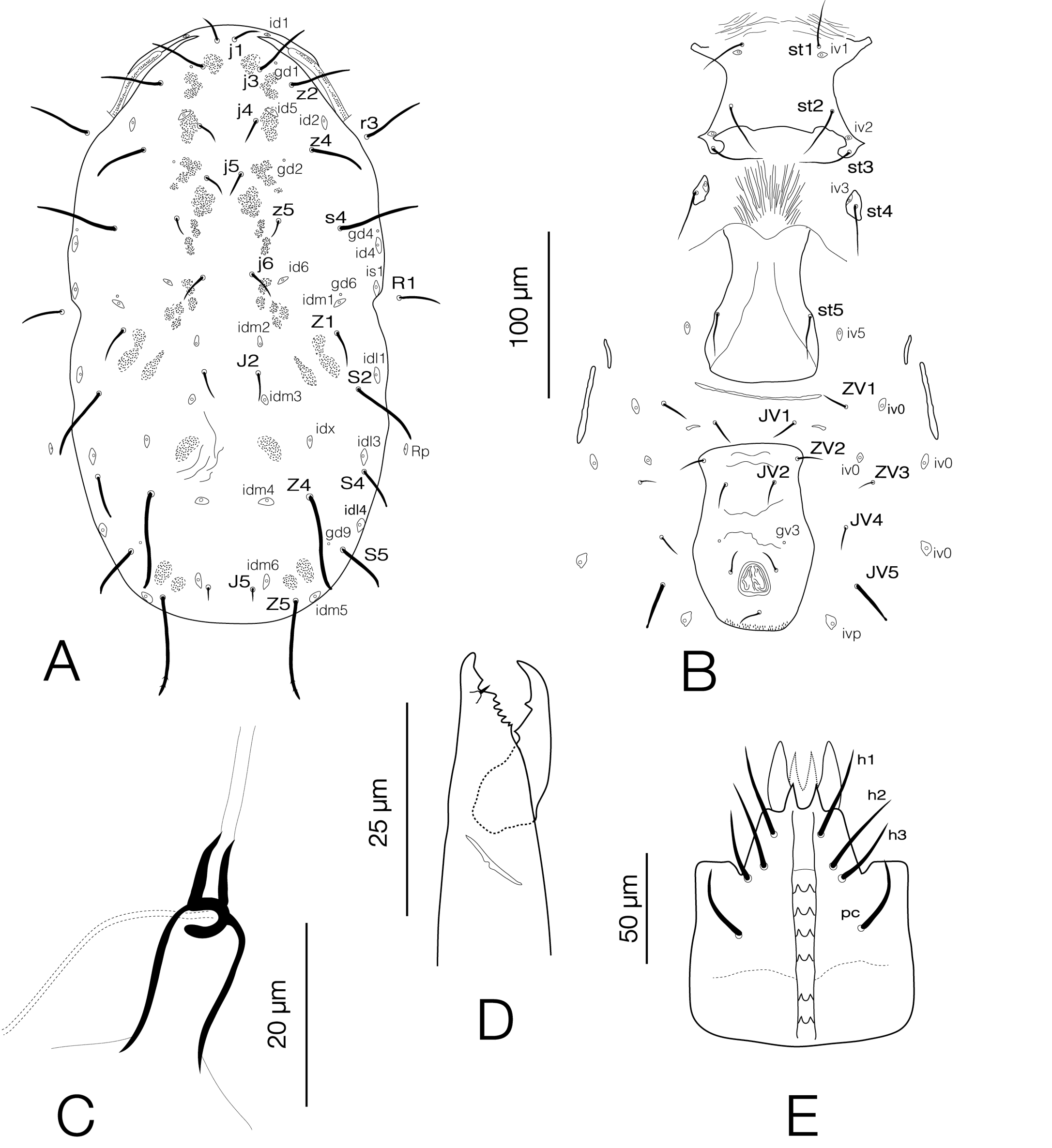
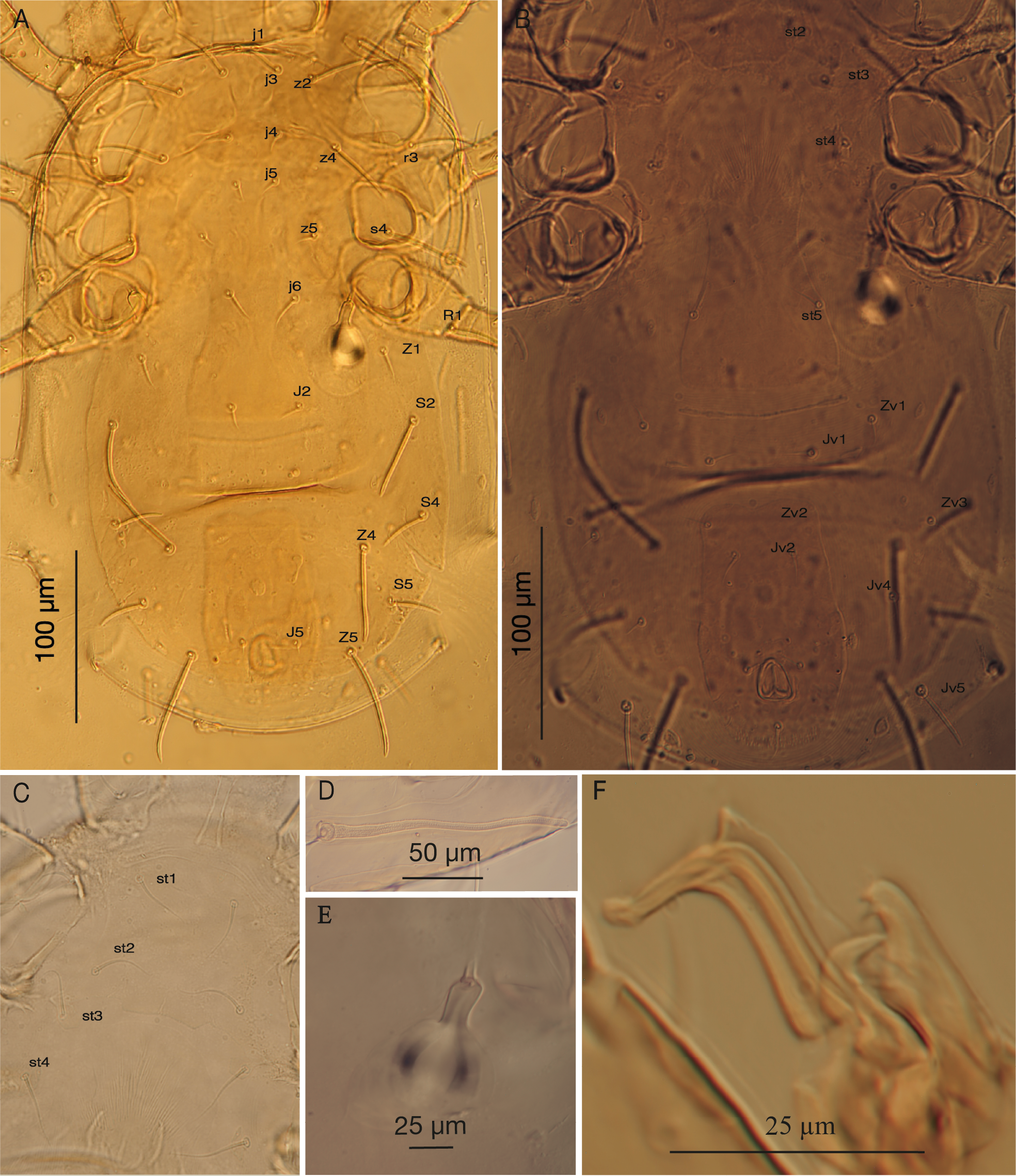
Dorsal idiosoma (Figures 4A; 6A). Dorsal shield 368 (356–385) long and 180 (160–195) wide at level of s4, mostly smooth, with sparce striae restricted to the posterior medial area, behind J2; lateral margins with a slight but distinct constriction at the level of R1; with 19 pairs of setae (setal pattern 10A: 9B; with r3 and R1 inserted in unsclerotized integument), five pairs of solenostomes (gd1, gd2, gd4, gd6 and gd9) and 16 pairs of poroids (id1, id2, id4, id5, id6, idm1–idm6, idx, is1, idl1, idl3 and idl4). Dorsal muscle scars (sigilla) distributed across the shield, clustered predominantly in the podosomal region but also visible in the opisthosomal region. Setal length: j1 17 (14–20), j3 35 (34–37), j4 14 (13–15), j5 13 (12–14), j6 20 (20-22), J2 17 (15–20), J5 6 (5–7), z2 40 (35–42), z4 40 (35–42), z5 13 (12–15), Z1 21 (19–23), Z4 52 (46–59), Z5 58 (51–63), s4 50 (45-53), S2 48 (38–55), S4 28 (25–30), S5 30 (28–33), r3 39 (35–42) and R1 29 (26–33). Setae j1, j3, z2, z4, s4, S2, S4, S5, Z4, Z5, r3 and R1 rod-shaped, smooth, except Z5, slightly serrate at the apex; other idiosomal setae distinctly shorter, acicular and smooth. Unsclerotized integument with a pair of poroids lateral to the opisthonotal region of the dorsal shield (Rp).
Peritrematal shield (Figure 4A; 5D). Fused to dorsal shield at level between j1 and j3. Peritreme bearing two continuous rows of microvilli along their entire length and extending anteriorly to level of j3.
Ventral idiosoma (Figure 4B; 5B, C). Sternal shield smooth, with three pairs of setae (st1–st3) and with two pairs of poroids (iv1 and iv2); seta st4 inserted in metasternal platelets; distances between sternal setae: st1–st1 41 (38–45), st2–st2 59 (55–65), st3–st3 73 (70–76), st5–st5 57 (52–62) and st1–st3 61(57–65); posterior margin concave, but with the median section projecting slightly; with a pair of conspicuous, distally rounded posterolateral projections, each bearing a st3 seta. Metasternal plates present, each bearing a st4 seta and an iv3 poroid. Genital shield smooth, with the posterior margin slightly rounded, and bearing st5; length 123 (120–126), width at level of st5 58 (52–65); poroid iv5 inserted in the unsclerotized integument, posterolateral to st5; with a slender, transverse platelet behind the genital shield, approximately as long as maximum width of the latter, followed by a pair of platelets laterad of JV1. With two pairs of slender metapodal platelets on the unsclerotized integument behind coxa IV, the anterior platelet about half as long as the posterior pair. Ventrianal shield with few faint medial, transverse striae anteriad anal opening; cup-shaped, with anterior margin slightly convex and discreet anterolateral constriction, 109 (102–113) long, 53 (50–58) wide at ZV2 level and 60 (55–62) wide at level of para-anal setae; with two pairs of setae (JV1, JV2) in addition to circumanal setae (similar to each other), and with a pair of small pores (gv3) well posterior and slightly laterad JV2; distance between solenostomes 38 (35-40). The JV3 seta was present on only one side of the ventrianal shield in one of the ten specimens examined. Unsclerotized integument of opisthogaster with five pairs of setae (JV1, JV4, JV5, ZV1 and ZV3) and five pairs of poroids (four pairs of ivo and ivp). All opisthogastric setae are aciculate and smooth, except JV5, which is slightly stout and has a small distal knob; setal lengths: JV1 16 (14–20), JV2 15 (13–18), JV4 11 (10–14), JV5 30 (28–32), ZV1 14 (12–16), ZV2 14 (11–18) and ZV3 10 (9–12).
Gnathosoma (Figure 4D, E). Setae h1 20 (19–22), h2 20 (18–22), h3 23 (20–27) and pc 22 (19–25) long. Deutosternal groove narrow, with seven transverse rows of denticles; the first smooth and each of the others with one denticle at each end. Chelicera with dorsal antiaxial poroid visible. Fixed cheliceral digit 23 (22–25) long, with seven teeth in addition to apical tooth and setiform pilus dentilis; movable digit 21 (19–23) long, with two teeth in addition to the apical tooth.
Spermatheca (Figure 4C-5E). Calyx deep bell-shaped; atrium incorporated at the base of the calyx. Major duct tubular, thin-walled. Minor duct visible.
Legs (Figure 6A-D). Length of legs I–IV 280 (260–300), 227 (208–238), 212 (202–230), and 270 (250–290), respectively. Legs (Figure 3). Length of legs I–IV 237 (230–248), 200 (195–204), 185 (185–186), and 243 (236–246), respectively. Leg chaetotaxy as follows: coxa I: 2; trochanter I: 1, 0/1, 0/2, 1; femur I: 2, 3/1, 2/2, 2; genu I: 2, 2/ 2, 2/1, 2; tibia I: 2, 2/2, 2/1, 2; coxa II: 2; trochanter II: 1, 0/1, 0/2, 1; femur II: 2, 3/1, 2/1, 1; genu II: 2, 2/1, 2/1, 1; tibia II: 1, 1/1, 2/1, 1; coxa III: 2; trochanter III: 1, 1/1, 0/1, 1; femur III: 1, 2/1, 1/0, 1; genu III: 1, 2/1, 2/0, 1; tibia III: 1, 1/1, 2/1, 1; trochanter IV: 1, 1/1, 0/1, 1; femur IV: 1, 2/1, 1/0, 1; genu IV: 1, 2/1, 2/0, 1; tibia IV: 1, 1/1, 2/0, 1. Macrosetae absent.
Adult male (n = 3)
(Figure 7)
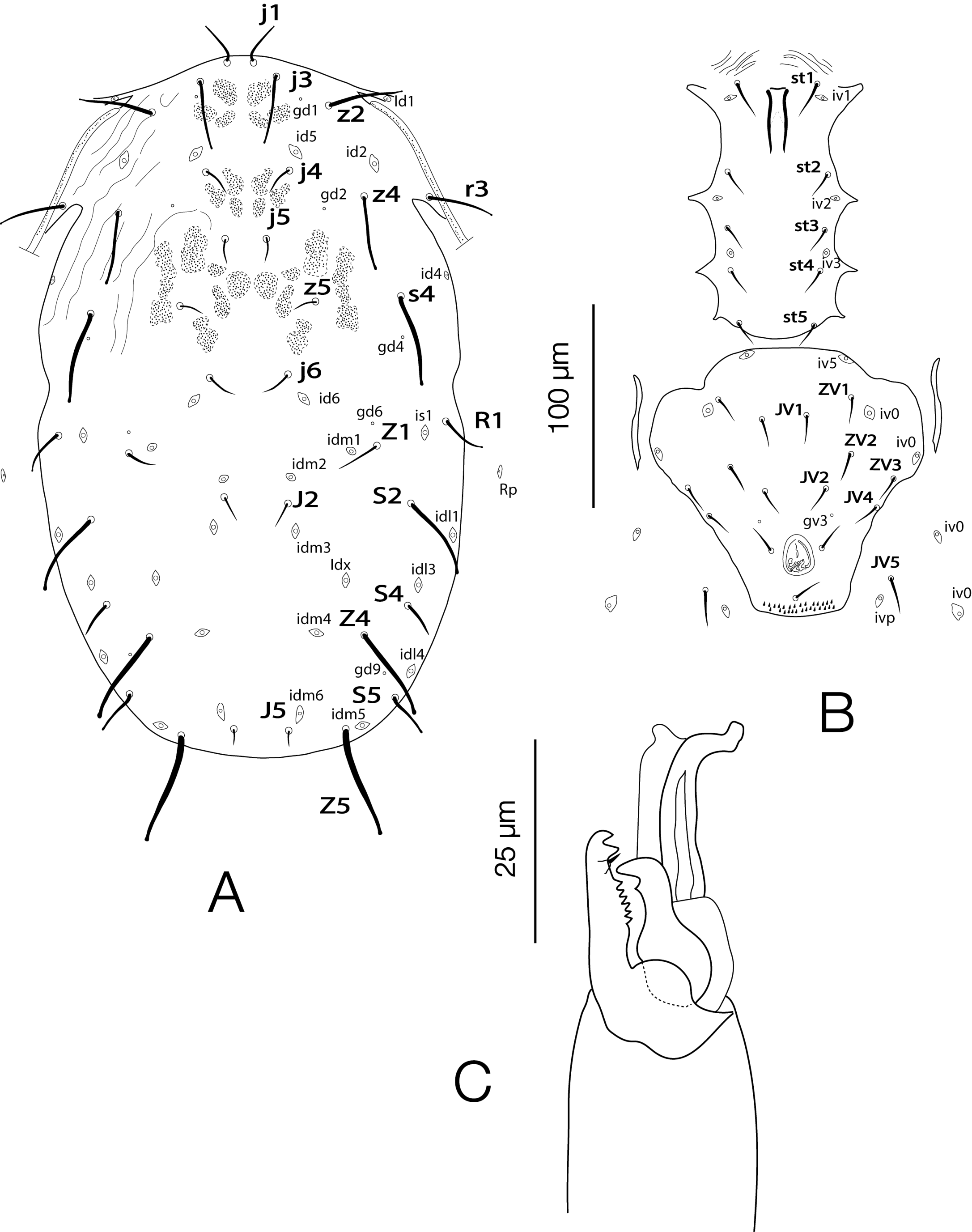
Dorsal idiosoma (Figure 7A). Dorsal shield 317 (316–318) long and 185 (182–188) wide at level of s4; with 19 pairs of setae (same setal pattern as female, but with r3 and R1 inserted in the dorsal shield), six pairs of solenostomes (gd2, gd3, gd6 and gd9) and 13 pairs of distinguishable poroids (sensillae) (id2, id4, idm1–idm6, idx, is1, idl1, idl3 and idl4); Dorsal muscle scars (sigilla) visible on the podosomal region; dorsal shield mostly smooth, with striae restricted to anterolateral region. Dorsal setal pattern as in adult female. Setal length: j1 17 (16–18), j3 31 (30–33), j4 14 (13–14), j5 13 (12–14), j6 16 (15-16), J2 13 (12–14), J5 13 (12–14), z2 32 (33–36), z4 34 (32–37), z5 12 (12–13), Z1 16 (15–17), Z4 44 (44–45), Z5 49 (48–50), s4 42 (40–45), S2 38 (36–40), S4 18 (15–20), S5 18 (15–21), r3 30 (28–31) and R1 21 (20–21). Setae j3, z2, z4, s4, S2, S5, Z4, Z5, r3 and R1 rod-shaped, smooth, with a tiny terminal knob; setae j1 and S4 stout, acicular and smooth; remaining idiosomal setae distinctly shorter, acicular and smooth. Unsclerotized integument with a pair of poroids in unsclerotized integument laterad opisthonotal region of dorsal shield (Rp).
Peritrematal shield. (Figure 7A). Fused to the dorsal shield at a level between setae z2 and z4. The peritreme bear two continuous rows of microvilli along most of its their length, except near the stigma and extends anteriorly to level of z2.
Ventral idiosoma (Figures 7B). All ventral setae are acicular, smooth and much shorter than the distance to the most proximal seta. Sternogenital shield smooth, with five pairs of setae (st1–st5) and three pairs of poroids iv1–iv3. Distances between sternal setae: st1–st1 41 (40–42), st2–st2 52 (51–52), st3–st3 53 (52–54), st5–st5 42 (40–45) and st1–st3 75 (74–75). With one pair of slender, slightly curved metapodal platelets, each with a subterminal constriction suggestive of a fusion between a short anterior and a longer posterior platelet. Ventrianal shield subtriangular, smooth, 133 (130–138) long, width at level of ZV2 120 (110–131) and width at level of para-anal setae 61 (57–65); with six pairs of preanal setae (JV1, JV2, JV4, ZV1, ZV2 and ZV3) in addition to the circumanal setae (similar to one another), a pair of solenostomes (gv3) and three pairs of poroids (iv5 and two pairs of ivo); distance between solenostomes 43 (42-44). Unsclerotized integument of the opisthogaster with seta JV5 and two pairs of poroids (ivo and ivp). Two pairs of ivo and one pair of ivp poroids.
Gnathosoma (Figures 5F; 7C). Setae h1 22 (21–23), h2 20 (19–20), h3 25 (24–25) pc 21 (20–22) long. Deutosternum as in adult female, except for the first two transverse lines, which are smooth and devoid of denticles. Fixed cheliceral digit 22 (20–23) long, with a large subapical tooth followed by six small teeth in addition to the apical tooth, and a setiform pilus dentilis; movable digit 20 (18–22) long, with a single subapical tooth in addition to apical tooth, and L-shaped spermatodactyl with ventrally bent foot.
Legs. Length of legs I–IV 280 (260–300), 227 (208–238), 212 (202–230), and 270 (250–290), respectively. Macrosetae are absent.
Specimens examined
Female holotype; nine female paratypes and three male paratypes collected by J.L. Muñoz Marticorena from Inga feuilleei DC. on 10-XII-2025, in Cañete, Lima, (12°55′18″S, 76°06′37″W; 557 m above sea level), Peru. All deposited at the International Research Center for Sustainability (Laboratory of Entomological Control of Agricultural Pests, Universidad Nacional de Cañete), Lunahuaná, Lima, Peru.
Etymology
The specific epithet refers to Cañete Province, Lima Region, Peru, the type locality.
Remarks
Females and males of the new species described herein most closely resemble L. leiodis, but the latter differ by having a basically striate/reticulate dorsal shield; Z4 slightly over half as long as its distance to Z5; peritreme with 4–6 rows of microvilli; and id1 and Rp absent. Males of L. leiodis differ from those of the new species by having gd1, gd5, id6, idm2, idm3, idm5 and idl4. Both species were collected from plants of the genus Waltheria (Malvaceae), differing in geographic location and ecological context: the Peruvian species was collected from W. ovata in an area considered part of the Andean coastal region, whereas the species from the United States (Florida) and Cuba was collected from W. americana, in North America and the Caribbean regions, respectively.
Females of the new species are also similar to those of L. trisetatus, but the latter differ by having dorsal shield with a pattern composed of roundish to elongate elements next to J2; seta JV1 on ventrianal shield; and setae S4 and S5 only about one fourth as long as distance to each other.
Similarly, females of the new species are similar to those of L. mocovi (species originally described under Phyllodromus De Leon, 1959 and transferred to Leonacarus by Döker et al. 2026b), the latter differing by having several dorsal shield setae with a distinct subapical expansion (lanceolate); gd4, id1, id4, idm2, is1 and Rp absent; setae S4 and S5 at most about a third as long as distance to each other; and JV5 similar to other opisthogastric setae, sharp tipped.
Key to the world species of Leonacarus based on adult females
1. With three pairs of preanal setae on the ventrianal shield (JV1, JV2 and ZV2)
...... L. trisetatus Moraes, Melo & Gondim; Brazil
— With two pairs of preanal setae on the ventrianal shield (JV2 and ZV2)
...... 2
2.. Dorsal shield mostly irregularly striate, reticulate next to J2; seta Z4 about as long as distance between its base and the base of S5
...... L. leiodis (De Leon); United States of America
—Dorsal shield mostly smooth, with scant striae next to J2; seta Z4 at least about 1.5 times as long as distance between its base and the base of S5
...... 3
3. Several of the longer dorsal shield setae widening slightly toward the tip; setae S4 and S5 at most about a third as long as distance to each other
...... L. mocovi (Döker & Rossetti); Argentina
— Longer dorsal shield setae of about uniform diameter; setae S4 and S5 at least about half as long as distance to each other
...... L. canetensis Marticorena & Ferla n. sp.; Peru
Acknowledgements
We express our sincere gratitude to Dr. Gilberto Jose De Moraes of the Department of Entomology and Acarology, ESALQ-USP, Piracicaba-SP, Brazil, for his valuable guidance and for sharing his research expertise throughout the development of this study.
References
- Athias-Henriot C. 1975. Nouvelles notes sur les Amblyseiini. II - Le relevé organotaxique de la face dorsale adulte (Gamasides protoadéniques, Phytoseiidae). Acarologia, 17 (1): 20-29.
- Barbosa M. F. de C., Rocha M. D. S., Ferla N. J. (2014). A new genus and species of phytoseiid mite (Acari: Phytoseiidae) from the Brazilian Atlantic Forest. Zootaxa, 3795(1), 91-95. https://doi.org/10.11646/zootaxa.3795.1.10
- Cabrera V.E., Hildebrand P.E., Jones J.W., 2005. Modelling the effect of household composition on the welfare of limited-resource farmers in Coastal Cañete, Peru. Agricultural Systems, 86(2), pp.207-222. https://doi.org/10.1016/j.agsy.2004.08.009
- Chant D.A., McMurtry J.A. 2007. Illustrated keys and diagnoses for the genera and subgenera of the Phytoseiidae of the world (Acari: Mesostigmata). West Bloomfield, Indira Publishing House, 219 pp.
- Chant D.A., Yoshida-Shaul E. 1991. Adult ventral setal patterns in the family Phytoseiidae (Acari: Gamasina). International Journal of Acarology, 17: 187-199. https://doi.org/10.1080/01647959108683906
- De Leon D. 1959. Two new genera of phytoseiid mites with a note on Proprioseius meridionalis Chant (Acarina: Phytoseiidae). Entomological News, 70(10), páginas.
- Döker I, Rossetti O.C., Atchia I., Gasparro-Brewer J., Daud R.D., Bolton S.J. 2026a. Redescription of Phyllodromus leiodis De Leon (Parasitiformes: Phytoseiidae) based on paratypes and description of a new species from Argentina. Systematic and Applied Acarology, 31(3), 455-470. https://doi.org/10.11158/saa.31.3.10
- Döker I., Rossetti O.C., Atchia I., Gasparro-Brewer J., Daud R.D. & Bolton S.J. (2026b) Leonacarus mocovi (Döker & Rossetti, 2026) comb. nov. (Acari: Phytoseiidae). Systematic & Applied Acarology, 31(6), 913. https://doi.org/10.11158/saa.31.3.10
- Guanilo A.D., Martínez N. 2007. Predadores asociados a Panonychus citri McGregor (Acari: Tetranychidae) en la costa central del Perú. Ecología Aplicada, 6(1-2), 117-129. https://doi.org/10.21704/rea.v6i1-2.348
- Guanilo A.D., Moraes G.J. de, Knapp M. 2008a. Phytoseiid mites (Acari: Phytoseiidae) of the subfamily Amblyseiinae Muma from Peru, with descriptions of four new species. Zootaxa 1880:1-47. https://doi.org/10.11646/zootaxa.1880.1.1
- Guanilo A.D., Moraes G.J. de, Knapp M. 2008b. Phytoseiid mites (Acari: Phytoseiidae) of the subfamilies Phytoseiinae Berlese and Typhlodrominae Wainstein from Peru, with descriptions of two new species. Zootaxa 1729:49-60. Zootaxa, 1729 (1), 49-60. https://doi.org/10.11646/zootaxa.1729.1.5
- Guanilo A.D., Moraes G. J. de, Flechtmann C.H.W., Knapp M. 2012. Phytophagous and fungivorous mites (Acari: Prostigmata, Astigmata) from Peru. International Journal of Acarology, 38(2), 120-134. https://doi.org/10.1080/01647954.2011.595735
- Jiménez de la Espada, M. 1875. Vertebrados del viaje al Pacífico verificado de 1862 a 1865 por una comisión de naturalistas enviada por el Gobierno Español. Batracios. Madrid: Imprenta Miguel Giniesta, ii + 208 pp. + 7 pls. https://doi.org/10.5962/bhl.title.5769
- Karg W. 1983. Systematische untersuchung der Gattungen und Untergattungen der Raubmilben familie Phytoseiidae Berlese, 1916, mit der Beschreibung von 8 neuen Arten. Mitt. Zool. Mus. Berlin 59: 293-328. https://doi.org/10.1002/mmnz.4830590203
- Lindquist E. E., Evans G. O. 1965. Taxonomic concepts in the Ascidae, with a modified setal nomenclature for the idiosoma of the Gamasina (Acarina: Mesostigmata). Memoirs of the Entomological Society of Canada, 47, 1-64. https://doi.org/10.4039/entm9747fv
- Manzanilla J., García-París, M. & Aponte, O. (2006) Proposal of a new name for Phyllodromus DeLeon, 1959 (Acari: Phytoseiidae), a junior homonym of Phyllodromus Jiménez de la Espada, 1875 (Anura: Dendrobatidae). Florida Entomologist, 89, 98. https://doi.org/10.1653/0015-4040(2006)89%5B98:POANNF%5D2.0.CO;2
- McMurtry J.A., Sourassou N.F., Demite P.R. 2015. The Phytoseiidae (Acari: Mesostigmata) as biological control agents. En D. Carrillo, G. J. de Moraes & J. E. Peña (Eds.), Prospects for Biological Control of Plant Feeding Mites and Other Harmful Organisms (Progress in Biological Control, Vol. 19, pp. 133-149). Springer International Publishing https://doi.org/10.1007/978-3-319-15042-0_5
- Moraes G.J. de, Melo E.L., Gondim Jr M.G.C. 1997. Description of a new species of phytoseiid mite from northeastern Brazil and redescription of Neoseiulus gracilis (Acari, Phytoseiidae). Florida Entomologist, 80, 319-324. https://doi.org/10.2307/3495765
- Moraes G.J. de, McMurtry J.A., Denmark, H.A., Campos, C.B. 2004. A revised catalog of the mite family Phytoseiidae. Zootaxa, 434: 1-494. https://doi.org/10.11646/zootaxa.434.1.1
- Muñoz Marticorena J. L., Rodriguez Berrío A. 2014. Ácaros asociados al cultivo del aguacate (Persea americana Mill) en la Costa Central de Perú. Agronomia Costarricense, 38(1). https://doi.org/10.15517/rac.v38i1.15206
- National Service of Meteorology and Hydrology of Peru (SENAMHI). Historical meteorological data from Pacarán and Cañete stations [Internet]. Lima: SENAMHI; [cited 2026 Apr 14]. Available from: https://www.senamhi.gob.pe/site/descarga-datos/
- Rowell, H.L., Chant, D.A., Hansell R.I.C. 1978. The determination of setal homologies and setal patterns on the dorsal shield in the family Phytoseiidae (Acarina: Mesostigmata). The Canadian Entomologist, 110, 859-876. https://doi.org/10.4039/Ent110859-8
to post any comment or correction.


2026-05-14
Date accepted:
2026-09-19
Date published:
2026-10-16
Edited by:
Kreiter, Serge

This work is licensed under a Creative Commons Attribution 4.0 International License
2026 Muñoz Marticorena, Jorge L. and Ferla, Noeli Juarez
 Download article
Download the citation
RIS with abstract
(Zotero, Endnote, Reference Manager, ProCite, RefWorks, Mendeley)
RIS without abstract
BIB
(Zotero, BibTeX)
TXT
(PubMed, Txt)