


Effect of temperature on the biological and demographic parameters of two citrus pests: Eutetranychus orientalis (Klein) and Panonychus citri (McGregor) (Acarina: Tetranychidae)
Chouikhi, Sabrine  1
; Cherif, Asma
2
; Sahraoui, Hajer
3
and Grissa Lebdi, Kaouthar
4
1
; Cherif, Asma
2
; Sahraoui, Hajer
3
and Grissa Lebdi, Kaouthar
4
1✉ Arid and Oases Cropping Laboratory LR16IRA02, Arid Lands Institute, 4119, Medenine, Tunisia & Faculty of Sciences of Gabès, University of Gabès, Tunisia.
2Arid and Oases Cropping Laboratory LR16IRA02, Arid Lands Institute, 4119, Medenine, Tunisia.
3Citrus Technical Center, Beni Khalled, Nabeul, Tunisia.
4Laboratoire d’Entomologie-Acarologie, Institut National Agronomique de Tunisie, 43 Avenue Charles Nicolle, 1082, Cité Mahrajène, Tunis, Tunisia.
2025 - Volume: 65 Issue: 1 pages: 255-264
https://doi.org/10.24349/0opt-vvo6Original research
Keywords
Abstract
Introduction
Several herbivorous mites may damage citrus cultivation including the Tetranychidae species as the oriental mite, Eutetranychus orientalis (Klein) (Acari: Tetranychidae) and the red citrus mite, Panonychus citri (McGregor) (Acari: Tetranychidae) (Chouikhi et al. 2022; Gazoly et al. 2024). In fact, E. orientalis, is a major pest of citrus-growing areas in many countries in Asia, the Middle East and Africa, particularly in the Mediterranean basin (Ferragut et al. 2013; Yalçın et al. 2023). While, P. citri is one of the most destructive citrus pests worldwide (Pan et al. 2023). Eutetranychus orientalis affects mainly citrus fruit, in particular lemons, oranges and mandarins in Tunisia (Lebdi Grissa and Khoufi 2012). However, its impact extends beyond citrus cultivation, affecting a diverse array of crops such as carob, palm, walnut, almond, pear, grapevine, castor, quince, as well as various vegetables and ornamental plants (Migeon and Dorkeld 2024). Symptoms of E. orientalis can be detected as soon as the female begins to lay her eggs on the upper surface of the leaf, along the midrib (Lebdi Grissa and Khoufi 2012). High mite densities can cause fruit fall and branches die (Vela et al. 2017). The complete development cycle generally lasts between 10 and 12 days, with a female longevity ranging from one to three weeks. Several generations (up to 30) per year can be detected under optimal conditions (Aljboori and Al Dahwi 2020). In Tunisia, this mite spends the winter hidden in the citrus tree and resumes its activity in summer and autumn, when it carries out three to five overlapping generations (Lebdi Grissa 2010). Panonychus citri was not only a citrus pest, but also can damage over a hundred different plants, including peach, pear and prickly ash (Migeon and Dorkeld 2024). This mite causes extensive defoliation and a pale appearance of immature fruit, which affects the quantity and quality of citrus fruit (sugar content, weight and appearance) (Hu et al. 2010). Panonychus citri is able to produce up to 19 generations per year, mainly between April and October (Raoufi et al. 2022). In Tunisia, this mite is active mainly in autumn, winter (depending on weather conditions) and spring (Lebdi Grissa 2010).
Climate change is significantly affecting citrus production by favoring the geographical spread of harmful mites and modifying their life cycles (Alahyane 2023). Temperature is the main environmental factor affecting their survival, reproduction and development (Metwally 2019). Global warming may expand their range; improve winter survival, reproduction and dispersal, altering population dynamics and their interactions with the environment and natural enemies (Skendžić et al. 2021). The present study aimed to determine the biological and demographic parameters of E. orientalis and P. citri at various temperatures regimes under controlled conditions in order to adapt effective management strategies, especially in the context of climate change.
Material and methods
Mite cultures
The initial colony of the two phytophagous mites, E. orientalis and P. citri were collected from citrus greenhouse and field cultivation located respectively at the Citrus Technical Centre in el Gobba and Manzel bouzelfa (Governorate of Nabeul, Tunisia). The two mites were reared on plants of bitter orange under greenhouse conditions, at the National Agronomic Institute of Tunisia as described by Da Camara et al. (2015). This study evaluated the effect of different temperature levels on the biological characteristics of E. orientalis (30 and 35 °C) and P. citri (25 and 30 °C) at 50% relative humidity (RH) and a 16:8 photoperiod. The selected temperature ranges correspond to field conditions in the governorate of Nabeul (Tunisia) which promote the optimal development of these mite pests. The thermal differences were chosen based on the thermal requirements of each mite species, considering their activity and the damage they caused in citrus orchards in Tunisia, as well as the field dynamics study conducted by Lebdi (2010). To do so, two experiments were performed: in the first one, we evaluated the development time from eggs to adult emergence of the two studied mites, whereas, in the second experiment we studied some biological parameters of fertilized females of both species. For both experiments, fresh citrus leaf discs containing mobile mite stages were used More details were described in the paper published by Lebdi-Grissa (2003).
Experiment 1
Fresh, young citrus leaves were placed up side down on water-saturated cotton in Petri dishes, each containing a single leaf disc. These dishes were maintained in a climate chamber regulating temperature, humidity, and photoperiod. Ten females of E. orientalis and ten females of P. citri were introduced onto each leaf disc. Five replications were considered for each mite species. After 24 hours, the females were removed, and the eggs laid were counted. The Petri dishes were then inspected daily to record the emergence of adults. Immature survival was calculated as the ratio of the number of emerged adults to the number of eggs laid, providing a reliable measure of survival per fertilized female.
Experiment 2
Forty fertilized E. orientalis and P. citri females were randomly selected and placed on a citrus leaf. After 24 hours, the females were removed. In fact, to obtain fertilized females at the same age, the laid eggs were monitored until the emergence of males was observed near teleochrysalis to fertilize females once emerged. The fertilized neonate females (one day-old) were then placed individually on citrus leaf discs and inspected daily. Each alive female was transferred to a new leaf disc and their longevity was therefore registered. Additionally, the number of laid eggs was counted daily and stored until hatching to determine female fertility and fecundity and to assess the sex ratio.
For both experiments, some biological parameters as longevity, fecundity, fertility, and sex ratio were studied. Longevity referred to the adult lifespan of the fertilized female, covering pre-oviposition, oviposition, and post-oviposition phases. Fecundity was the number of eggs laid, while fertility was the percentage of eggs that hatch. The sex ratio indicated the proportion of adult females in the offspring (Liu et al. 2019). These parameters influenced the population dynamics of E. orientalis and P. citri, and were used to assess their demographic characteristics according to Birch (1948). The intrinsic rate of natural increase (rm) of a population was determined as follow:
\[r m=\sum_{x=0}^k e^{-m x} I x m x\]
Where, k is the maximum value reached by age x. Ix (Age-specific survival) is the probability that a female born will reach age x. which indicates the probability of an individual surviving to a given age. mx (Age-specific fecundity) is the average number of female eggs laid by a female at age x and represents the reproductive capacity of females at each age.
The net reproduction rate (R0) corresponds to number of eggs that develop into females at each generation, or to the population multiplication factor at each generation. \(\mathbf{R}_{\mathbf{0} }=\sum \mathbf{I}_{\mathbf{x} } \mathbf{m}_{\mathbf{x} }\)
Each generation has a duration T, which is the time needed for the population to increase by a factor R0.
\(T=\ln R_0 / r_m\)
Proportion of individuals of age x (Cx): This is the proportion of individuals of age x in the total population.
\(\mathbf{C}_{\mathbf{x} }=e^{-r m x} \mathbf{I} \mathbf{x} / \sum e^{-r m x} I x\)
Finite rate of increase (λ): This is the increase in the number of individuals per unit of time.
\(\lambda=e^{\mathrm{rm} }\)
Number by which the population was multiplied per unit of time (*Nt): \(\mathbf{N}_{\mathrm{t} }=\mathbf{N}_0 * \lambda\)
Gross reproduction rate (G.R.R.): This is the average number of female eggs laid by a female through all the reproductive ages. G.R.R \(=\sum \mathbf{m}_{\mathbf{x} }\)
Doubling time (T2): This is the time taken for a population to double its size. \(T 2=\ln 2 / r_m\)
Statistical analysis
Data analysis was performed using SPSS.22 software. Prior to performing linear models, dataset was subjected to normality verification via the Shapiro-Wilk test (p\textgreater=0.05) to assess the distribution of the data. For each mite species separately, one-way analysis was performed followed by Tukey's HSD test (p < 0.05) to compare means at 5% to assess the effect of temperature on the development time, longevity, fertility, and fecundity. For sex ratio, means were compared using Chi-square test (α=0.05). Comparison between the two mite species regarding the studied parameters was also performed at 30 °C.
Results
Experiment 1
Development time
Pre-imaginal development period of E. orientalis females was longer than that it of males at 30 (12.1 ± 0.59 and 11.3± 0.73 days respectively for females and males) and 35 °C (10.79 ± 0.45 and 10.24 ± 0.7 days respectively for females and males) (Figure 1). Temperature had a significant effect on the development time of pre-imaginal stages between male and female E. orientalis at both 30 °C (F = 0.693; p = 0.409) and 35 °C (F = 2.924; p = 0.105). However, temperature significantly influenced pre-imaginal development for both males (F = 18.775; P < 0.0001) and females (F= 6.067; p = 0.018). Likewise, the temperature significantly affected the pre-imaginal development of P. citri males (F = 436.072; P < 0.0001) and females (F = 479.896; P < 0.0001) at 25 °C and 30 °C, respectively (Figure 1).
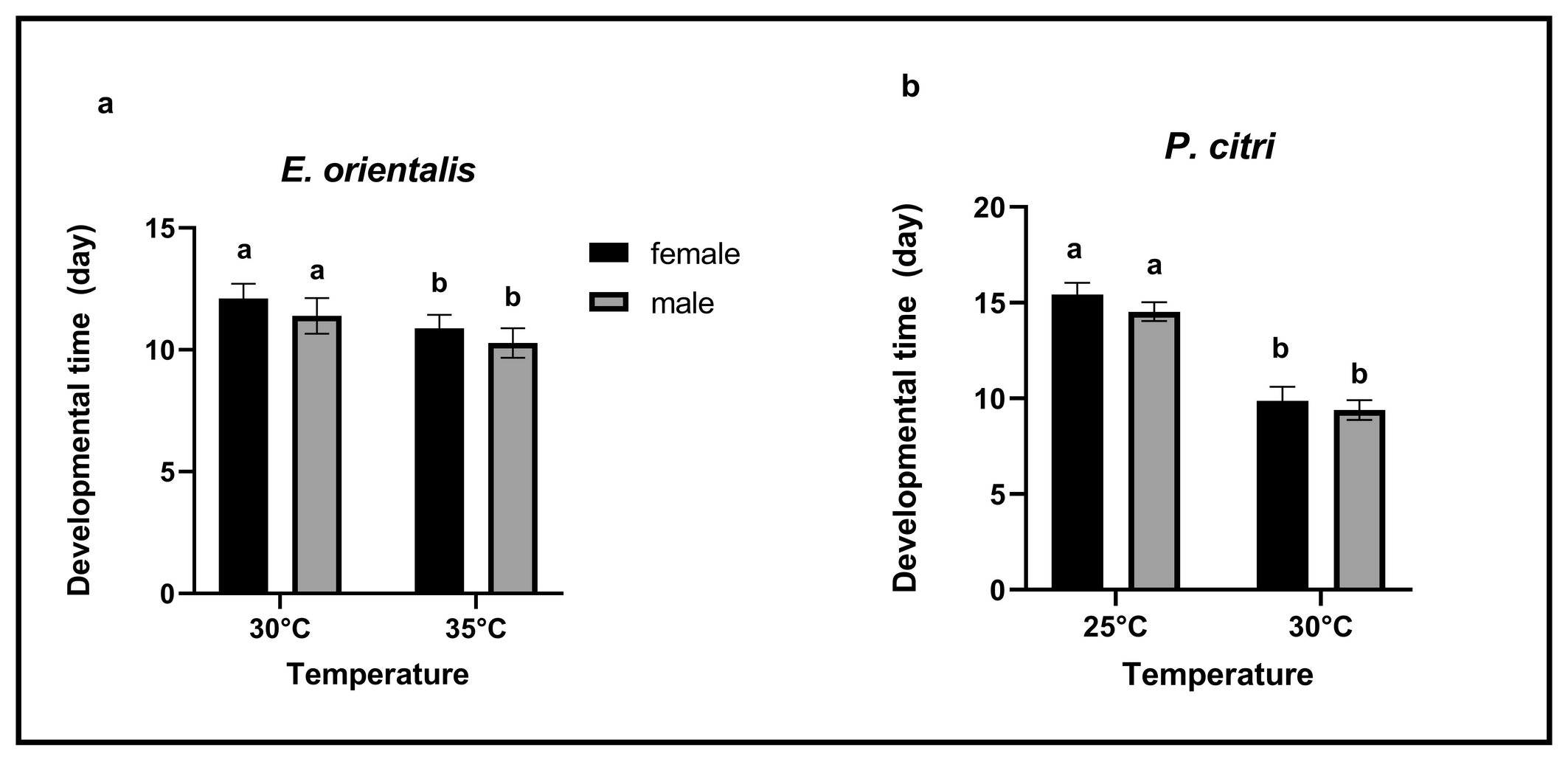
The decrease in developmental time with increasing temperature indicates an acceleration of the life cycle, which may lead to an increase in the number of generations per year, thus increasing the potential for the establishment and proliferation of E. orientalis and P. citri in high-temperature environments.
Effect of temperature variation on the viability of eggs and mortality of larvae and protonymphs
Download as
Mortality of E. orientalis (%)
Mortality of P. citri (%)
Temperature
30°C
35°C
25°C
30°C
Deutonymphs
2.38 c
6.44 b
0.56 b
1.18 b
Protonymphs
5.71 bc
16.37 ab
3.95 a
5.11 b
Larvae
16.66 ab
20.46 ab
13.55 a
7.48 ab
eggs
15.23 a
24.56 a
31.07 a
14.56 a
F
3.602
2.112
4.545
4.223
P
0.021
0.122
0.006
0.014
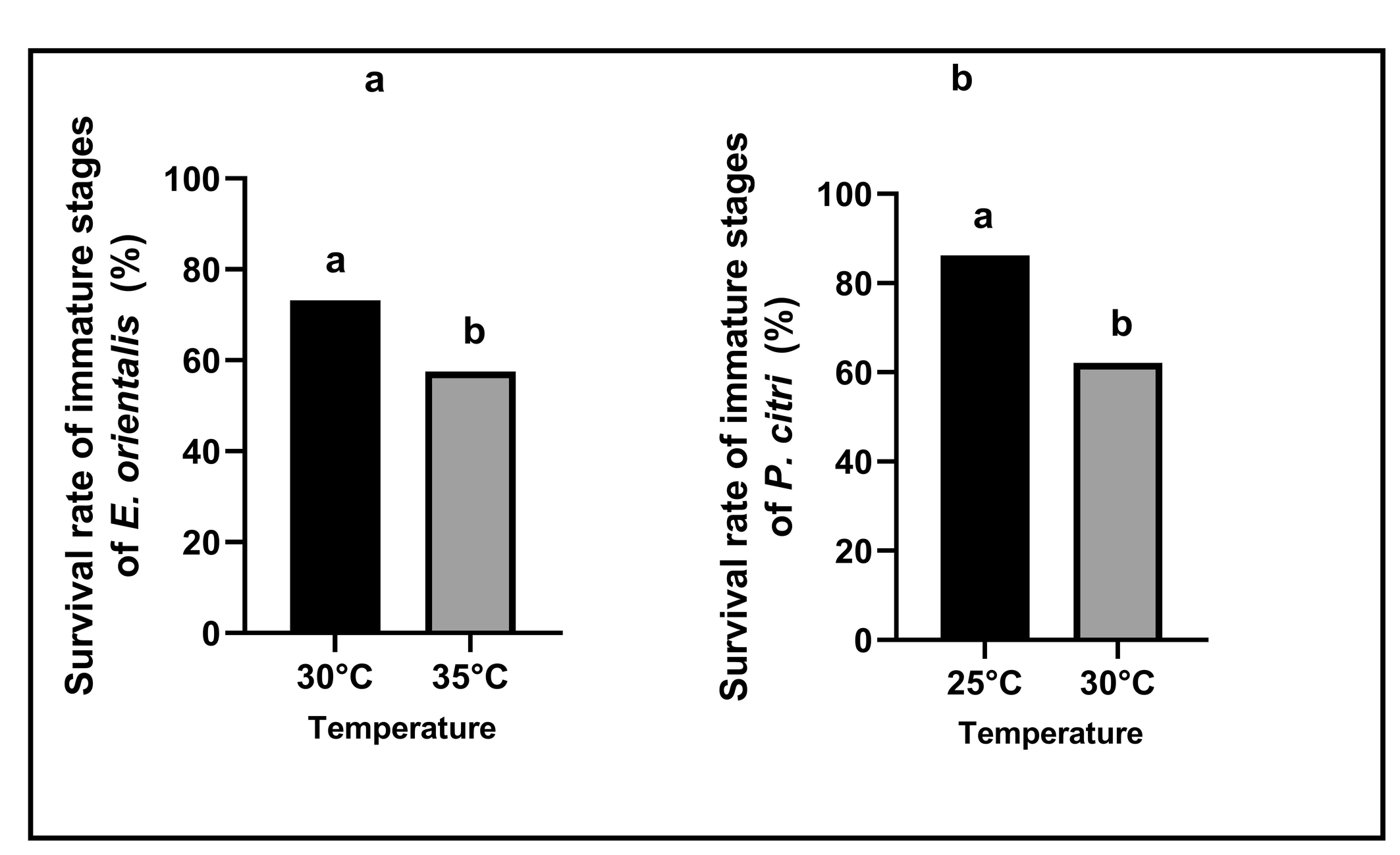
Temperature significantly affected the viability of eggs and the immature stages for both mite's species E. orientalis (F = 6.844; P= 0.011) and P. citri (F = 6.406; p = 0.013) (Table 1, Figure 2). The mortality of eggs and immature stages at high temperatures reflects the developmental limits of the two mite species. Conversely, the increased survival of juveniles could intensify population dynamics and favor severe infestations.
Experiment 2
Effect of temperature on some biological parameters of fertilized females for both mite species
Development time of females
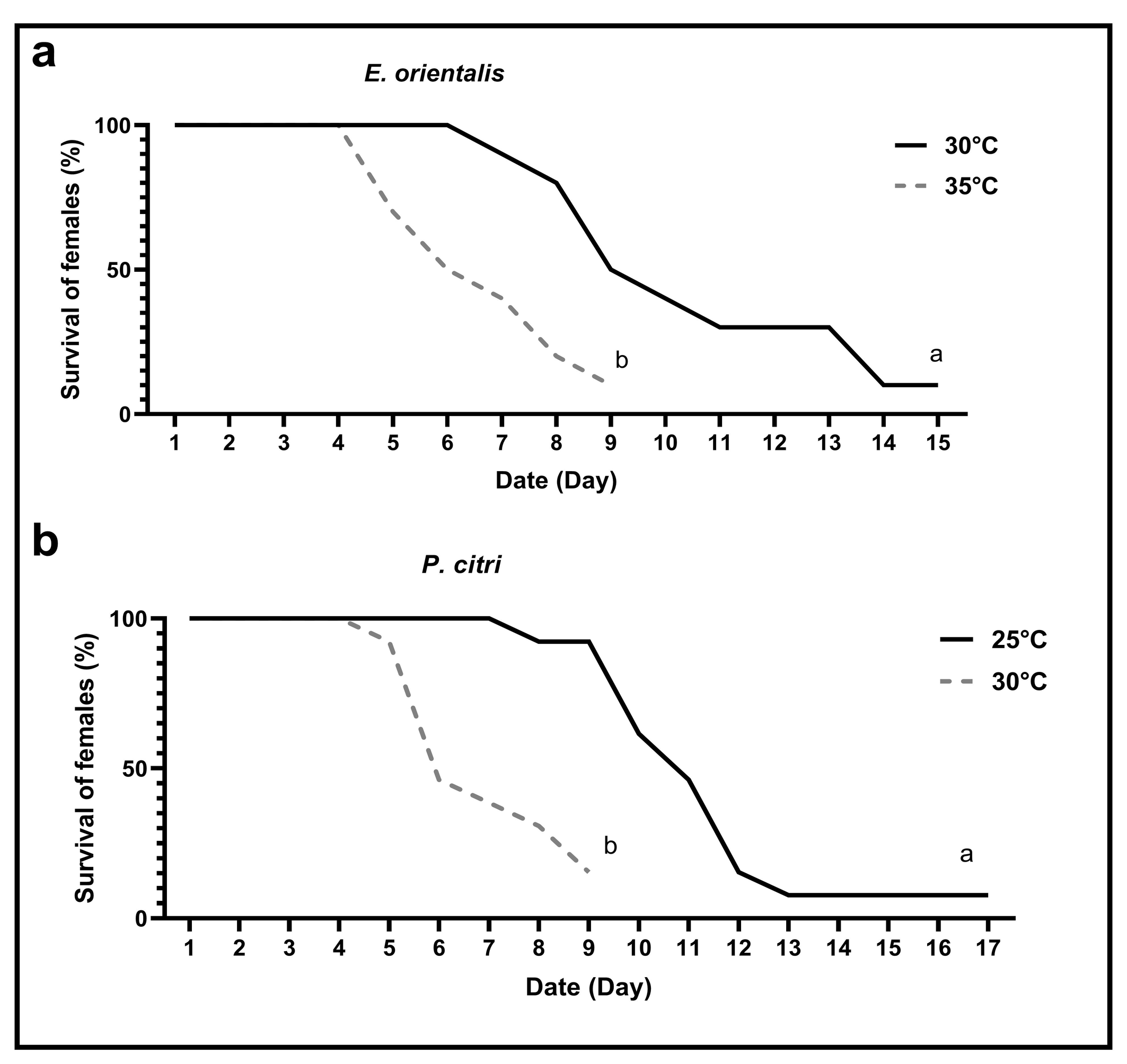
Our results indicated that the survival of E. orientalis and P. citri fertilized females were significantly affected by the increase of the temperature values (Figure 3). It was 15 and 9 days respectively at 30 °C and 35 °C for E. orientalis fertilized females (F = 11.923; p = 0.003) (Figure 3). Panonychus citri fertilized females were able to survive up 17 days at 25 °C compared to 9 days at 30 °C (F = 25.969; P < 0.001) (Figure 3). Furthermore, a significant difference in female longevity was observed between the two species at 30 °C. Females of E. orientalis were able to survive significantly longer than those of P. citri (F = 12.272; p = 0.002).
Pre-oviposition, oviposition and senescence
Our data showed that temperature significantly affected the oviposition of E. orientalis (F = 10.10; p = 0.005) and P. citri (F = 12.564; p = 0.002) fertilized females (Table 2).
Download as Means within a column followed by the same letter are not significantly different by the Duncan’s test (P<0.05).
* sex ratio results were compared via Chi-square test (α=0.05).
Biological parameters
E. orientalis
P. citri
30°C
35°C
25°C
30°C
Female longevity
9.7±2.83 a
5.9±1.7 b
10.5 ± 2.27 a
6.23 ± 1.6 b
Preoviposition period
1.4±0.49
1.1±0.3
1.46 ± 0.63
1.07 ± 0.26
Oviposition period
7.3±2.61 a
4.3±1.1 b
7.62 ± 2.76 a
4.3 ± 1.68 b
Postoviposition period
1±0.89 a
0.5±0.8 b
1.38 ± 1.27 a
0 .84 ± 0.76 b
Eggs/female/day
2.1
2.88
1.9
2.2
Total eggs
21 a
17.1 a
19.5 a
13.6 b
Fertility (eggs /female)
17.1 a
12.9 a
16.7 a
9.38 b
Fertility (%)
81.43% a
75.44% a
85.4% a
68.92% b
Sex ratio*
65% a
64.28% a
69% a
73.03% a
Fecundity, fertility, sex ratio
The fecundity rate of E. orientalis was not significantly affected by temperature variation (30 °C and 35 °C) (F = 0.0741; p = 0.401), whereas for P. citri, its fecundity was significantly higher at 25 °C compared to 30 °C (F = 4.868; p = 0.037) (Table 2). There is no significant effect of temperature on the sex ratio of the two mite species (Table 2).
Total fecundity and fecundity/female were higher at 25 °C, while fecundity/female/day was higher at 30 °C (Table 2). Statistical analysis indicated that temperature had a highly significant effect on female fertility (F = 9.919; p = 0.004).
When comparing the two species at 30 °C, no significant difference was observed in fecundity (F = 3.116; p = 0.092), whereas a significant difference for fertility between the species (F = 4.661; p = 0.043).
The significant reduction in the lifespan of females at high temperatures reduces the oviposition period and, consequently, the reproductive potential of populations. For E. orientalis, the longer lifespan compared with P. citri at 30 °C could confer an adaptive advantage, favoring more prolonged infestation in warm conditions. The stable sex ratio over the temperature range indicates that reproductive capacity is maintained, allowing the population to regenerate efficiently despite thermal fluctuations.
Demographic parameters of the survival and fertility table (rm, R0, T, T2)
The intrinsic rate of natural increase (rm) of E. orientalis was 0.17 day-1 at 30 °C and 0.14 day-1 at 35 °C. In fact, the population increases from 1.19 individuals per individual per day (rate of increase λ) at 30 °C to 1.15 individuals per individual per day at 35 °C. At 30 °C, the population doubling time is estimated at 2.45 days, whereas at 35 °C, it is 2.65 days. The gross reproduction rate is 18.87 eggs at 30 °C and 13.61 eggs at 35 °C. The net reproduction rate was 9.54 females and 2.27 females at 30 and 35 °C respectively. Under these conditions, the generation time was 4.02 days at 30 °C and 2.78 days at 35 °C. Concerning P. citri, the intrinsic natural growth rate is 0.12 day-1 at 25 °C and 0.15 day-1 at 30 °C. The population increases from 1.13 individuals per day (λ growth rate) at 25 °C to 1.17 at 30 °C. The population doubled in 2.77 days at 25 °C and 2.53 days at 30 °C. The gross reproduction rate is 16.15 eggs at 25 °C and 11.31 at 30 °C. The net reproduction rate was 11.28 and 6.1 females at 25 and 30 °C respectively. Generation time was 4.5 days at 25 °C and 3.65 days at 30 °C (Table 3).
Download as (The finite rate of increase (λ= e-rm) indicates the number of females which replace each female each day. The doubling time (T2 = ln2/rm) represents the time needed to double the size of the population. GRR represents the gross reproductive rate, r: intrinsic rate of increase, T: mean generation time and the net reproductive rate R0 = (∑ I x mx) corresponds to number of eggs that develop into females at each generation).
Temperature
rm (day-1)
λ
T2 (days)
GRR (eggs)
R0 (females)
T (days)
E. orientalis
30°C
0.172
1.19
2.45
18.87
9.54
4.02
35°C
0.141
1.15
2.65
13.61
2.27
2.78
P. citri
25°C
0.125
1.13
2.77
16.15
11.28
4.50
30°C
0.159
1.17
2.53
11.31
6.10
3.65
Discussion
In this study, temperature significantly influenced the development time of Eutetranychus orientalis females and males at 30 °C and 35 °C. Previousely, Imani and Shishehbor (2009) reported that development from egg to adult took 12.4 days at 30 °C, although no development was observed at 35 °C on Albizia lebbeck. Similarly, Metwally et al. (2019) recorded development times of 11.5 ± 1 days and 9.9 ± 1.2 days for females and males of E. orientalis, respectively, on Phaseolus vulgaris leaf discs at 30 ± 2 °C with 60 ± 5% relative humidity. More recently, Aljboori and Al Dahwi (2020) found a development time of 11 days on lemon leaves at 25 ± 2 °C with 50–60% relative humidity. These variations likely stem from population adaptation to higher temperatures (Aspaly et al. 2007).
Ahmed (2020) highlighted that egg-to-adult development time for E. orientalis females varied significantly among grapevine cultivars, with the shortest duration observed on King Rubi (16.4 days at 25 °C and 8.3 days at 30 °C) and the longest on Crimson Seedless (19.2 days at 25 °C and 10.2 days at 30 °C). Yalçin et al. (2022) reported limited effects of host plant species on immature developmental stages, except for teleiochrysalis and the overall development period. Our results showed that immature survival declined with increasing temperatures, with 42.4% mortality observed, contrasting with the findings of Imani and Shishehbor (2009), who recorded 100% mortality at 35 °C. Additionally, they noted that mortality of immature stages increased from 19.6% at 20 °C to 100% at 35 °C, with eggs being the most vulnerable stage. Aljboori and Al Dahwi (2020) also observed a 34% mortality rate at 25 ± 2 °C.
For P. citri, our data indicated that temperature significantly affected developmental time, with faster development observed at 30 °C than at 25 °C. Females and males emerged 5.5 and 5.1 days earlier, respectively, at 30 °C. This aligns with findings of Lebdi Grissa (2003), who reported that adult males emerged earlier than females, a common trait in Tetranychidae due to protandry. Kasap (2009) observed development times of 12.2 days at 25 °C and 9.8 days at 30 °C with 65 ± 10% relative humidity, which are consistent with the current findings at 30 °C. Variations in development time may be attributed to differences in host plants. For instance, Zanardi et al. (2015) reported development durations of 12.3–13.5 days for females and 11.1–12.6 days for males on different citrus species at 25 ± 1 °C.
Contrastingly, Mohajer et al. (2022) documented a longer pre-adult period of 16.5 ± 0.4 days under laboratory conditions at 25 ± 1 °C, 65 ± 5% relative humidity, and a 16:8 light-dark photoperiod. Their study also found that immature survival was higher at 25 °C than at 30 °C, suggesting that elevated temperatures negatively affect survival rates. For P. citri, immature survival ranged from 70.2% to 80.7% at 25 °C (Mohajer et al. 2022).
The longevity of E. orientalis adult females observed in this study is consistent with findings at a constant temperature of 28 °C, where females survived for 8 days on orange leaves (Assari et al. 2004). Ahmed (2020) reported longer lifespans on grape cultivars, with females living 14.2 days on King Rubi, 13.43 days on Thompson Seedless, and 12.33 days on Crimson Seedless at 30 °C. Female fecundity in E. orientalis did not significantly vary with temperature. Assari (2004) and Saeedi (2006) reported fecundities of 17 eggs/female at 30 °C and 28 °C, respectively. Similarly, Imani and Shishehbor (2009) recorded an average fecundity of 16.33 eggs/female at 30 °C. Host plant effects were noted by Yalçin et al. (2022), who found that E. orientalis laid 15.92 eggs on mandarins and 29.78 eggs on lemons. Conversely, Ahmed (2024) showed that Balady and Adalia lemon varieties grafted onto sour orange reduced female longevity (3.6 days) and fecundity (4.6–5.5 eggs/female) at 30 ± 1 °C with 55 ± 5% relative humidity.
For P. citri, temperature significantly affected female longevity and oviposition, both decreasing as temperature increased from 25 °C to 30 °C. Zanardi et al. (2015) reported longevities of 10.2–13.4 days and oviposition periods of 8.5–11.4 days at 25 ± 1 °C, 60 ± 10% relative humidity, on citrus leaves. Liu et al. (2019) similarly observed variations in longevity (11.9–12.7 days) and oviposition duration (10.6–11.2 days) with different fertilizer treatments at 28 ± 3 °C. Differences among studies may result from host plant variability, local populations, or experimental conditions. Total fecundity and fertility per female were higher at 25 °C, while daily fecundity was greater at 30 °C. Kasap (2009) observed total egg production of 25.6 eggs at 25 °C compared to 16.6 eggs at 30 °C, indicating optimal performance at 25 °C.
Our results show the tested temperatures did not influence the female-to-male sex ratio of the offspring. Studies on Tetranychidae generally report a sex ratio of approximately 3 females to 1 male (Fahim et al. 2020). However, certain environmental factors, such as colony density or resource scarcity, may shift ratios toward males. According to (Gotoh et al. 2015) temperature is an essential factor influencing the sex ratio of spider mites. Females have better dispersal and survival abilities than males under harsh conditions. As a result, their sex ratio was increasingly biased toward females at extremely low or high temperatures (Ristyadi et al. 2021).
The intrinsic growth rate (rₘ) of P. citri increased from 0.125 day⁻¹ at 25 °C to 0.159 day⁻¹ at 30 °C, aligning with Kasap (2009), who reported rₘ values of 0.148 and 0.160 day⁻¹ at 25 °C and 30 °C, respectively.
Our findings indicate that the biological and demographic parameters of E. orientalis and P. citri are significantly influenced by temperature. The observed variations are likely driven not only by temperature effects but also by other factors, such as population adaptation, host plant specificity, and potential genetic traits. This differential sensitivity to temperature between the two mite species highlights the importance of considering these factors when developing effective biological control strategies within integrated pest management (IPM) programs targeting E. orientalis and P. citri.
A thorough understanding of the mite's life cycle and optimal development conditions is essential for effective management, allowing the right time to intervene by targeting the most vulnerable stages or females with reproductive potential. Thus, our study has been linked to the increase in temperature, taking into account that there are current climate changes, particularly the increase in temperature, which influence the dynamics of mites. Therefore, it is necessary to study these parameters in the context of future climate projections to adapt control strategies. Several research studies have already integrated climate models to predict changes in the distribution of these pests and to develop effective preventive measures (Kayaba and Sameshima 2023). For example, modelling the distribution of the predatory mite Neoseiulus californicus (McGregor) in China showed that climate change would alter its habitat zones, requiring the development of strains more resistant to high temperatures to maintain its effectiveness in biological control (Chen et al. 2022). In this context, if E. orientalis demonstrates a greater adaptation to high temperatures and lower relative humidity, this could significantly impact the effectiveness of biocontrol strategies relying on naturally occurring predatory mites, necessitating further research on their thermal tolerance and adaptability.
Acknowledgments
Our work was made possible thanks to the support of the Citrus Technical Center in Beni Khaled, Nabeul, Tunisia.
Disclosure statement
The authors declare that they have no conflict of interest.
References
- Ahmed I.A. 2020. Comparative biology and life table parameters of citrus brown mite Eutetranychus orientalis (Acari: Tetranychidae) on different grapevine cultivars. Egypt. J. Plant Prot. Res. Inst., 3: 159-166.
- Ahmed M.M. 2024. The influence of rootstock used in grafted lemon on population and life table parameters of Eutetranychus orientalis (Klein) (Acari: Tetranychidae). Persian J. Acarol., 13(2): 283-304. https://doi.org/10.22073/pja.v13i2.83823.
- Alahyane H., Ouknin M., Mounir A., Majidi L. 2023. Impact of climate change on the insect and mite pests of Moroccan citrus; Climate Change and the Economic Importance and Damages of Insects. IGI Global, p.48-72. https://doi.org/10.4018/978-1-6684-4824-3.ch003
- Aljboori H.K., Al Dahwi S.S. 2020. Biological study of oriental spider mite Eutetranychus orientalis (Klein) in laboratory on grapefruit and lemon leaves. Plant Arch., 20(1): 384-388.
- Aspaly G., Stejskal V., Pekár S., Hubert J. 2007. Temperature-dependent population growth of three species of stored product mites (Acari: Acaridida). Exp. Appl. Acarol., 42: 37-46. https://doi.org/10.1007/s10493-007-9074-1
- Assari M.J., Kamali K., Arbabi M., Zamany A.A. 2004. Biology of oriental citrus mite, Eutetranychus orientalis Klein (Acari: Tetranychidae) on the different varieties of orange in natural and laboratory condition in Bam; 16th Iranian Plant Protection Congress, Tabriz-Iran. p. 281.
- Birch L. 1948. The intrinsic rate of natural increase of an insect population. J. Anim. Ecol., 17(1): 15-26. https://doi.org/10.2307/1605
- Chen L., Jiang C., Zhang X., Song C., Wang R., Wang X., Li Q. 2022. Prediction of the potential distribution of the predatory mite Neoseiulus californicus (McGregor) in China under current and future climate scenarios. Sci. Rep., 12(1): 11807. https://doi.org/10.1038/s41598-022-15308-1
- Chouikhi S., Sahraoui H., Grissa K.L. 2022. Dynamics of three phytophagous mites Tetranychus urticae, Panonychus citri and Eutetranychus orientalis (Acari, Tetranychidae) on citrus in Tunisia. J. Oasis Agric. Sustain. Dev., 4(2):185-191. https://doi.org/10.56027/JOASD.spiss242022
- Da Camara C.A., Akhtar Y., Isman M.B., Seffrin R.C., Born F.S. 2015. Repellent activity of essential oils from two species of Citrus against Tetranychus urticae in the laboratory and greenhouse. Crop Prot., 74: 110-115. https://doi.org/10.1016/j.cropro.2015.04.014
- Fahim S.F., Momen F.M., El-Saiedy E.S.M. 2020. Life table parameters of Tetranychus urticae (Trombidiformes: Tetranychidae) on four strawberry cultivars. Persian J. Acarol., 9(1): 43-56. https://doi.org/10.22073/pja.v9i1.54771.
- Ferragut F., Navia D., Ochoa R. 2013. New mite invasions in citrus in the early years of the 21st century. Exp. Appl. Acarol., 59: 145-164. https://doi.org/10.1007/s10493-012-9635-9
- Gazoly A., Afifi A.A.M., Ali F.S., Ahmed M.M. 2024. Life table parameters and predation rate of Neoseiulus californicus (Acari: Phytoseiidae) feeding on Panonychus citri and Eutetranychus orientalis (Acari: Tetranychidae). Persian J. Acarol., 13(2): 265-282. https://doi.org/10.22073/pja.v13i2.83614.
- Gotoh T., Moriya D., Nachman G. 2015. Development and reproduction of five Tetranychus species (Acari: Tetranychidae): Do they all have the potential to become major pests?. Exp. Appl. Acarol., 66: 453-479. https://doi.org/10.1007/s10493-015-9919-y
- Hu J., Wang C., Wang J., You Y., Chen F. 2010. Monitoring of resistance to spirodiclofen and five other acaricides in Panonychus citri collected from Chinese citrus orchards. Pest Manag. Sci., 66(9): 1025-1030. https://doi.org/10.1002/ps.1978
- Imani Z., Shishehbor P. 2009. Effect of temperature on life history and life tables of Eutetranychus orientalis (Klein) (Acari: Tetranychidae). Syst. Appl. Acarol., 14(1): 11-18. https://doi.org/10.11158/saa.14.1.2
- Kasap İ. 2009. The biology and fecundity of the citrus red mite Panonychus citri (McGregor) (Acari: Tetranychidae) at different temperatures under laboratory conditions. Turk. J. Agric. For., 33(6): 593-600. https://doi.org/10.3906/tar-0902-41
- Kayaba N., Sameshima R. 2023. Improved methods for estimating effective accumulated temperature for pest forecasting. J. Agric. Meteorol., 79(2): 69-76. https://doi.org/10.2480/agrmet.D-22-00026
- Lebdi Grissa K. 2003. Etude éco-démographique des acariens phytophages, Tetranychus urticae, Panonychus ulmi, Eotetranychus pruni et du prédateur, Neoseiulus californicus (Acari, Tetranychidae, Phytoseiidae) et lutte biologique en vergers de pommiers [Phd Thesis]. Tunis : Institut National Agronomique de Tunisie. pp. 278.
- Lebdi Grissa K. 2010. Les acariens phytophages inféodés aux agrumes et les moyens alternatifs de lutte, Fiche de résultats de recherche, Institut National Agronomique de Tunisie. p. 2-10.
- Lebdi Grissa K., Khoufi A. 2012. Bio-ecology of phytophagous mites on Citrus; 7th EURAAC Symposium Vienna-Austria, abstracts: 92.
- Liu Z., Xu C., Beattie G.A., Zhang X., Cen Y. 2019. Influence of different fertilizer types on life table parameters of citrus red mite, Panonychus citri (Acari: Tetranychidae). Syst. Appl. Acarol., 24(11): 2209-2218. https://doi.org/10.11158/saa.24.11.11
- Metwally A., Abdallah A., El-Hady A. 2019. Effect of temperature degrees on the duration of the phytophagous mite, Eutetranychus orientalis complex (klein) (acari: Tetranychidae) when fed on green bean (Phaseolus vulgaris L.). Al-Azhar J. Agric. Res., 44(2): 172-179. https://doi.org/10.21608/ajar.2019.102950
- Migeon A., Dorkeld F. Spider Mites Web: a comprehensive database for the Tetranychidae [Internet]. [16 December 2024]. Montpellier: INRA/CBGP. Available from: http://www1.montpellier.inra.fr/CBGP/spmweb/
- Mohajer S.S., Golizadeh A., Hassanpour M., Fathi S.A.A., Sedaratian-Jahromi A., Abedi Z. 2022. Interaction between biological parameters of Panonychus citri (Acari: Tetranychidae) and some phytochemical metabolites in different citrus species. Bull. Entomol. Res., 112 (4): 509-519. https://doi.org/10.1017/S0007485321001048
- Pan D., Xia M.H., Luo Q.J., Liu X.Y., Li C.Z., Yuan G.R., Wang J.J., Dou W. 2023. Resistance of Panonychus citri (McGregor) (Acari: Tetranychidae) to pyridaben in China: monitoring and fitness costs. Pest Manag. Sci. 79(3): 996-1004. https://doi.org/10.1002/ps.7270
- Raoufi H., Jafari S., Ghadamyari M., Arbabi M. 2022. Lethal and sublethal effects of fenazaquin and acequinocyl on demographic and some biochemical parameters of Panonychus citri (McGregor) (Acari: Tetranychidae). Int. J. Acarol., 48(1): 27-35. https://doi.org/10.1080/01647954.2021.2009569
- Ristyadi D.W.I., He X.Z., Wang Q. 2021. Response to thermal environment in Tetranychus ludeni (Acari: Tetranychidae). Syst. Appl. Acarol., 26(5): 942-953. https://doi.org/10.11158/saa.26.5.9
- Saeedi K. 2006. An investigation on the biology and evaluation of economic importance of oriental red mite, Eutetranychus orientalis (Klein) in Kohgiloyeh-Va-Boyerahmad province, 17th Iranian Plant Protection Congress. p. 200.
- Skendžić S., Zovko M., Živković I. P., Lešić V., Lemić, D. 2021. The impact of climate change on agricultural insect pests. Insects, 12(5): 440. https://doi.org/10.3390/insects12050440
- Vela J.M., Wong E., Jaques J.A., Ledesma C., Boyero J.R. 2017. Mite diversity (Acari: Tetranychidae, Tydeidae, Iolinidae, Phytoseiidae) and within-tree distribution in citrus orchards in southern Spain, with special reference to Eutetranychus orientalis. Exp. Appl. Acarol., 73: 191-207. https://doi.org/10.1007/s10493-017-0180-4
- Yalçin K., Döker İ., Kazak C. 2022. Impact of citrus species on the biological characteristics and life table parameters of Eutetranychus orientalis (Klein) (Acari: Tetranychidae). Exp. Appl. Acarol., 27(1): 107-117. https://doi.org/10.11158/saa.27.1.11
- Yalçın K., Döker İ., Kazak C. 2023. Comparative biological parameters of the predatory mites, Amblyseius swirskii Athias-Henriot and Euseius scutalis (Athias-Henriot) on the invasive pest Eutetranychus orientalis (Klein). J. Plant Dis. Protect., 130(6): 1273-1279. https://doi.org/10.1007/s41348-023-00781-1
- Zanardi O.Z., Bordini G.P., Franco A.A., de Morais M.R., Yamamoto P.T. 2015. Development and reproduction of Panonychus citri (Prostigmata: Tetranychidae) on different species and varieties of citrus plants. Exp. Appl. Acarol., 67: 565-581. https://doi.org/10.1007/s10493-015-9968-2
 to post any comment or correction.


2024-12-26
Date accepted:
2025-03-26
Date published:
2025-03-31
Edited by:
Marčić, Dejan

This work is licensed under a Creative Commons Attribution 4.0 International License
2025 Chouikhi, Sabrine; Cherif, Asma; Sahraoui, Hajer and Grissa Lebdi, Kaouthar
 Download article
Download the citation
RIS with abstract
(Zotero, Endnote, Reference Manager, ProCite, RefWorks, Mendeley)
RIS without abstract
BIB
(Zotero, BibTeX)
TXT
(PubMed, Txt)