


Functional and numerical responses of Cydnoseius negevi (Swirski & Amitai) to three invasive pests
Barghout, Marwa  1
; El-Behery, Huda
2
; Döker, Ismail
3
; Ramadan, Mahmoud
4
and Zidan, Islam
5
1National Research Centre (NRC), Agricultural and Biological Research Institute, Pests and Plant Protection Department, Acarology Lab. 33 El-Bohouth St., Dokki, P.O. 12622, Giza, Egypt.
2National Research Centre (NRC), Agricultural and Biological Research Institute, Pests and Plant Protection Department, Acarology Lab. 33 El-Bohouth St., Dokki, P.O. 12622, Giza, Egypt.
3✉ Çukurova University, Faculty of Agriculture, Department of Plant Protection, Acarology Lab. Adana, Türkiye.
4National Research Centre (NRC), Agricultural and Biological Research Institute, Pests and Plant Protection Department, Acarology Lab. 33 El-Bohouth St., Dokki, P.O. 12622, Giza, Egypt.
5✉ National Research Centre (NRC), Agricultural and Biological Research Institute, Pests and Plant Protection Department, Acarology Lab. 33 El-Bohouth St., Dokki, P.O. 12622, Giza, Egypt.
2026 - Volume: 66 Issue: 4 pages: 1088-1097
https://doi.org/10.24349/tuus-fp9uOriginal research
Keywords
Abstract
Introduction
Agricultural systems worldwide are increasingly challenged by arthropod pests that compromise crop productivity and quality, particularly in high-value protected cultivation environments (Rathee et al. 2018). Among these systems, year-round production environments such as hydroponics are especially vulnerable to rapid pest population growth due to stable climatic conditions and abundant host resources (Roberts et al. 2020). Economically important agricultural pests, including the two-spotted spider mite, Tetranychus urticae Koch (Prostigmata: Tetranychidae), onion thrips, Thrips tabaci Lindeman (Thysanoptera: Thripidae), and the whitefly, Bemisia tabaci (Gennadius) (Hemiptera: Aleyrodidae) represent major constraints in these systems (Zhang 2003; Folorunso et al. 2021). These pests causing direct feeding damage as well as indirect effects through virus transmission and physiological disruption in plants (Qari et al. 2020).
Predatory mites of the family Phytoseiidae (Mesostigmata) play a crucial role in biological control of these pests due to their ability to suppress mite and small insect pest populations under greenhouse and protected cultivation conditions (Dalir et al. 2021; Ramadan et al. 2024). Several species, including Amblyseius swirskii Athias-Henriot, Phytoseiulus persimilis Athias-Henriot, and Neoseiulus cucumeris (Oudemans), have been successfully implemented for the control of thrips, whiteflies, and spider mites in various cropping systems (Abbey et al. 2019).
The effectiveness of predatory mites in regulating pest populations depends partly on their functional and numerical responses. The functional response describes how the number of prey consumed by an individual predator changes with prey density, whereas the numerical response describes how predator reproduction and population growth change with prey availability (Holling 1965). Together, these responses provide complementary information for evaluating predator performance and prey suitability in biological control. A prey species may be readily consumed but may not support high predator reproduction, making it important to assess both responses when comparing prey suitability (Fathipour et al. 2017, 2020; Shirvani et al. 2023).
Cydnoseius negevi Swirski & Amitai is a generalist phytoseiid mite distributed across the Middle East, recognized for its broad prey range and adaptability to arid environments (Zain El Abidin et al. 2024). Previous studies have demonstrated its predatory potential against various mite pests, including T. urticae (El-Banhawy et al. 1999; El-Laithy et al. 2021), the Old-World date mite, Oligonychus afrasiaticus (McGregor) (Negm et al. 2014; Alatawi et al. 2018), the mango red spider mite, Oligonychus punicae (= Oligonychus mangiferus (Rhaman & Sapra, 1940), Mushtaq et al. 2022) (Fahim and Momen 2022), and eriophyid mites (Abou-Awad et al. 2021; Elkholy et al. 2022). Additionally, it has shown effectiveness against insect pests such as thrips and whiteflies (Sanad and Hassan 2019; El-Laithy et al. 2021; Elkholy et al. 2022; Ramadan et al. 2024). However, comparative quantitative assessments of its predatory performance against multiple invasive pests remain limited. Moreover, although prey preference has been investigated under mixed prey conditions, comprehensive evaluations of functional and numerical responses across taxonomically distinct prey still lacking for C. negevi. This represents a significant gap in understanding its ecological role and its potential contribution to integrated management in high-value protected cultivation systems.
Addressing this gap, the present study evaluates and compares the functional and numerical responses of C. negevi females exposed to varying densities of three economically important pests: T. urticae, T. tabaci, and B. tabaci. By estimating key predation parameters under controlled laboratory conditions, this research provides a detailed assessment of the predator's capacity to suppress different pest species and contributes to its potential integration into biological control programs targeting complex pest communities in agricultural systems.
Material and methods
Plant locality
Green Batavia lettuce, Lactuca sativa var. capitata L. (Asteraceae) and curly kale, Brassica oleracea var. sabellica L. (Brassicaceae) were cultivated and collected from a small-scale private hydroponic production system, located in Gamaiet Ahmed Orabi, Al Qalyubia Governorate, Egypt (30°14′06.8″ N, 31°31′29.0″ E). The total cultivated area was approximately 14,000 m² (1.3 ha). Plants were grown under standard commercial hydroponic practices, and no chemical pesticides were applied to allow the natural establishment of pest populations.
Predatory species collection
Cydnoseius negevi individuals collected from low-growing weeds at the same hydroponic locality. Morphological identification was performed using the most recent keys of Egyptian phytoseiid mites by Abo-Shnaf and de Moraes (2014), and taxonomic confirmation was carried out by the third author.
To obtain synchronized individuals, 50 gravid females were isolated for 24h on Acalypha marginata L. (Euphorbiaceae) leaf discs placed on water-saturated cotton pads in Petri dishes for oviposition. Eggs were monitored daily, and supplied with fresh castor bean pollen, Ricinus communis L. (Euphorbiaceae), until adult emergence. Newly emerged females were mated for 24h and, after five days, were individually transferred to the experimental arenas and starved for 24h prior to experiments.
Pest species collection and identification
Various developmental stages of T. urticae and T. tabaci collected from heavily infested L. sativa var. capitata and B. oleracea var. sabellica leaves, respectively. Adults of B. tabaci collected from heavily infested B. oleracea var. sabellica leaves. Fresh leaves were transported from the collection site to the laboratory in paper bags. The specimens were mounted on microscope slides for morphological examination and identified based on their diagnostic characteristics using published taxonomic literature (Bolland et al. 1998; EPPO 2004; Mound and Masumoto 2005).
Experimental procedures
Experiments were conducted using 5-cm L. sativa var. capitata leaf discs placed up-side-down on moist cotton pads in Petri dishes (7 cm in diameter). All experiments were performed under laboratory conditions of 27° ± 2°C, 60 ± 5% RH, and 16:8 photoperiod. Gravid C. negevi females aged five days after mating were used to ensure uniform physiological status and reproductive activity across treatments. Prey densities (1, 5, 10, 20, 40, and 80 individuals) were established by carefully transferring the required number of prey individuals onto each leaf disc using a fine brush under a stereomicroscope. The experimental design comprised 360 experimental units (3 prey species, 6 prey densities and 20 replicates). Prey individuals were selected from homogeneous infestation sources to minimize variation in size and developmental stage. Prey individuals consisted of protonymphs of T. urticae, first instar larvae of T. tabaci, and the eggs of B. tabaci. These prey stages were selected to standardize the assays and facilitate comparisons of the functional and numerical responses of C. negevi.
Preliminary trials were conducted to estimate daily predation rates and determine the appropriate prey density range for the functional response assays. In addition, prey-only observations were conducted for 24 h without predators to check prey survival under the experimental conditions. All prey individuals were alive after transfer to the arenas, and escape was rarely observed. However, no quantitative data on prey mortality or escape were collected. Each mated C. negevi female was individually introduced into an experimental arena using a fine brush and exposed to above mentioned prey densities. After the 24 h exposure period, predators were carefully removed, and the number of prey consumed was recorded by counting dead individuals for functional response analysis. In addition, the number of eggs laid by each female was recorded for numerical response analysis. Each density was replicated twenty times. Replicates in which the predator was lost due to escape or mortality were excluded from the statistical analysis.
Statistical Analysis
Functional response analysis was conducted in two steps. First, the functional response type was determined using a binomial generalized linear model (GLM) with polynomial logistic regression following Juliano (2001). The proportion of prey consumed (Ne/N0) was modeled as a function of initial prey density (N0 ) using the following polynomial logistic equation:
\[\frac{N_e}{N_0}=\frac{\exp \left(P_0+P_1 N_0+P_2 N_0^2+P_3 N_0^3\right)}{1+\exp \left(P_0+P_1 N_0+P_2 N_0^2+P_3 N_0^3\right)} (1)\]
where Ne is the number of preys consumed and N0 is the initial prey density, and P0, P1, P2, P3 represent the intercept and linear, quadratic, and cubic coefficients, respectively. The sign and significance of the linear coefficient (P1) were used to determine the functional response type, with a significantly negative P1 indicating a Type II functional response and a significantly positive P1 indicating a Type III response.
Second, after determining response type, parameter estimation was performed using Rogers' random predator equation (Rogers, 1972), which accounts for prey depletion during the experimental period.
\[N_e=N_0\left(1-\exp \left(-a\left(T-T_h N_e\right)\right)\right) (2)\]
where a is the instantaneous attack rate, Th is the handling time, and T is the total experimental duration. Parameter estimation was performed using nonlinear regression implemented in the Frair package in R (Pritchard et al. 2017). Confidence intervals (95%) were generated using non-parametric bootstrap with 1000 replicates.
The relationship between oviposition and prey consumption was used to estimate the numerical response of C. negevi. Predicted prey consumption (Ne_pred) was obtained from Rogers' Type II functional response model using estimated parameters (a and h). The values were solved numerically using a root-finding algorithm for each initial prey density (N0 ).
A generalized linear model (GLM) with a Poisson error distribution and log link function was used to analyze the numerical response (egg production). Model dispersion was assessed using the ratio of residual deviance to Pearson's chi-square statistics. No evidence of overdispersion was detected (dispersion < 1 for all prey species), confirming the suitability of the Poisson model. Wald z-tests were used to assess the significance of model coefficients. All analyses were conducted in R (R Core Team, 2026), with and statistical significance set at α = 0.05.
Results
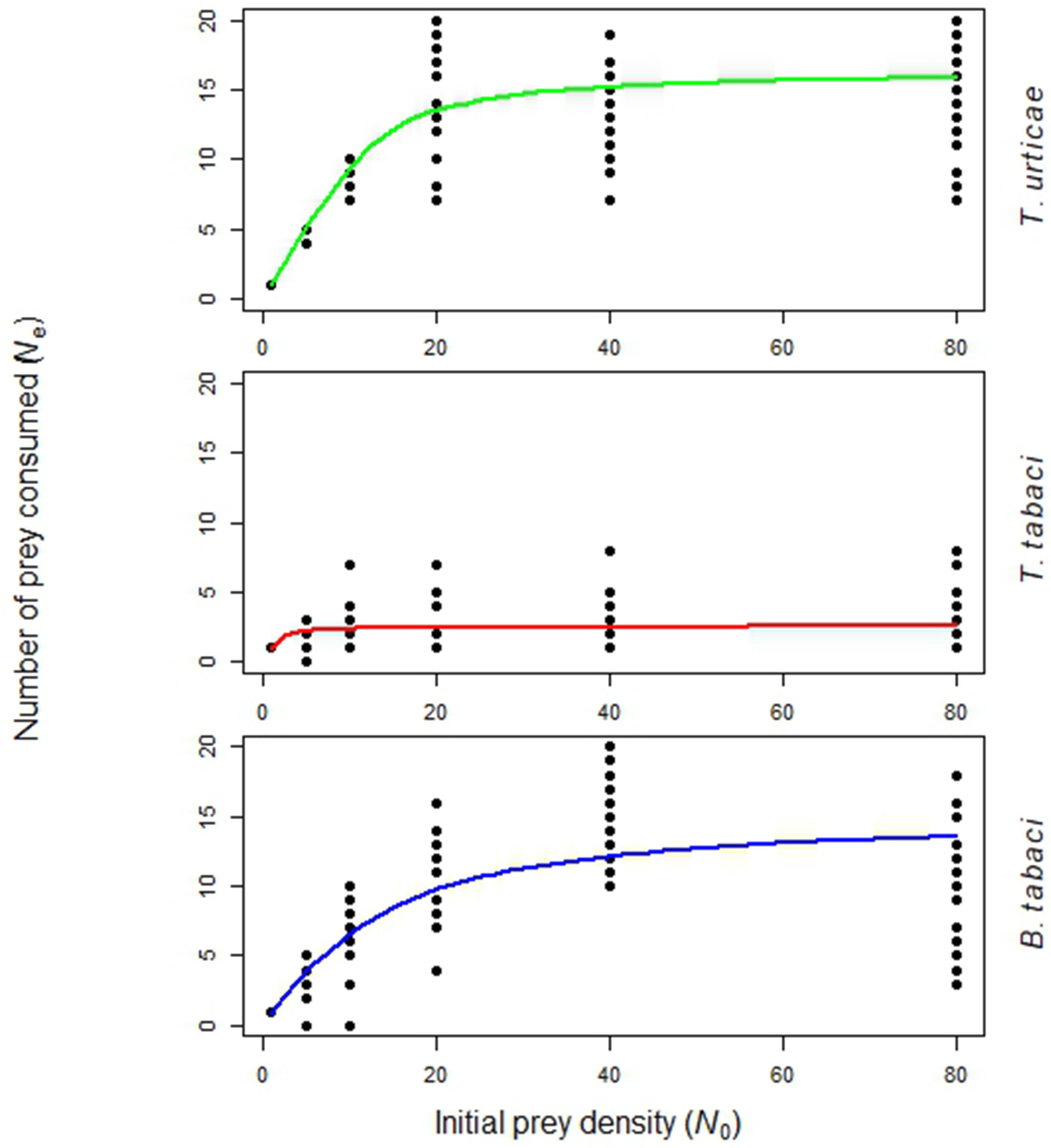
The logistic regression analysis showed that the proportion of prey consumed by adult female C. negevi was significantly affected by prey density for all three prey species (T. urticae, T. tabaci, and B. tabaci) after 24 h of exposure (Table 1). For all prey species, the linear coefficient (P1 ) was significantly negative, indicating that the proportion of prey consumed decreased with increasing prey density. This pattern is consistent with a Type II functional response. Higher-order terms were significant for T. tabaci and B. tabaci, suggesting curvature in the response. Functional response curves were fitted using the Rogers' random predator equation showed a hyperbolic increase with in prey consumption with increasing prey density (Fig. 1).
Download as
Prey
Parameter
Coefficient
± SE
χ2
P value
T. urticae
P0
4.58
± 0.64
51.2
< 0.0001
P1
-0.231
± 0.06
13.61
0.0002
P2
0.003
± 0.002
3.47
0.063
P3
0
± 0.00
1.44
0.23
T. tabaci
P0
0.483
± 0.29
2.86
0.01
P1
-0.191
± 0.04
24.76
< 0.0001
P2
0.004
± 0.001
10.34
0.001
P3
0
± 0.00
7.18
0.007
B. tabaci
P0
1.73
± 0.29
34.95
< 0.0001
P1
-0.15
± 0.03
20.32
< 0.0001
P2
0.003
± 0.00
12.54
0
P3
0
± 0.00
12.4
0
Parameter estimates obtained from Rogers' model are presented in Table 2. The attack rate (α) differed among prey species and was highest for T. urticae (0.261 ± 0.030 h¹), followed by T. tabaci (0.177 ± 0.104 h¹), and lowest for B. tabaci (0.079 ± 0.007 h¹).
Download as
Prey
α ± SE h -1
95% CI
Th ± SE (h)
95% CI
T/Th
T. urticae
0.261 ± 0.030
0.177 - 0.33
1.462 ± 0.050
1.319 - 1.60
16.44
T. tabaci
0.177 ± 0.104
0.01 - 0.33
9.396 ± 0.741
7.544 - 11.44
2.55
B. tabaci
0.079 ± 0.007
0.057 - 0.098
1.590 ± 0.080
1.363 - 1.83
15.09
Handling time (Th) was longest for T. tabaci (9.396 ± 0.741 h), whereas considerably shorter values were recorded for T. urticae (1.462 ± 0.050 h) and B. tabaci (1.590 ± 0.080 h). Accordingly, the maximum predation rate (T/Th) was highest for T. urticae (16.44 T/Th), followed by B. tabaci (15.09 T/Th), and lowest for T. tabaci (2.55 T/Th), indicating greater predation efficiency on T. urticae (Table 2). Bootstrap-derived 95% confidence intervals (BCa, n = 1000) indicated distinct differences between some prey species, although partial overlap was observed between T. urticae and T. tabaci for attack rate estimates.
Similarly, generalised linear models (GLMs) indicated that the numerical response of C. negevi varied significantly among prey species (Table 3). When feeding on T. tabaci, the numerical response was positive but not statistically significant (Estimate = 0.3530, Z= 1.043, P= 0.297), indicating no significant increase in egg production with increasing prey density.
Download as
Prey
Predictor
Estimate
SE
z value
P value
T. urticae
Intercept
-294791
0.53355
-5525
< 0.0001
Ne_pred
0.20307
0.04643
4374
< 0.0001
T. tabaci
Intercept
-19096
0.785
-2433
0.015
Ne_pred
0.353
0.3384
1043
0.297
B. tabaci
Intercept
-0.73241
0.24991
-2931
0.00338
Ne_pred
0.04967
0.02017
2463
0.01377
In contrast, a strong and highly significant positive numerical response was observed when feeding on T. urticae (Estimate = 0.20307, Z = 4.374, P= 1.22 × 10⁻⁵). A significant but weaker positive response was also detected for B. tabaci (Estimate = 0.04967, z = 2.463, p = 0.01377), indicating that predator reproduction increased with prey density, although to a lesser extent than with T. urticae.
Discussion
Understanding predator–prey interactions is fundamental for evaluating the effectiveness of biological control agents. The functional response describes the relationship between prey density and the rate of prey consumption by a predator, whereas the numerical response reflects changes in predator reproduction or population growth in response to prey availability. These responses play a crucial role in shaping population dynamics and community structure (Holling 1959a, b; Kalinkat et al. 2023). Three classical functional response types have been described: Type I (linear increase until saturation), Type II (hyperbolic increase limited by handling time), and Type III (sigmoidal response characterized by low predation at low prey densities followed by acceleration and stabilization). Among arthropod predators, Type II and Type III responses are most frequently reported (Holling 1959a, b, 1961; Hassell, 1978). The present study demonstrates that C. negevi exhibits a Type II functional response when feeding on T. tabaci, T. urticae, and B. tabaci. Functional response of phytoseiid mites particularly against T. urticae, have been widely studied, and although variation exists among predator–prey systems, Type II responses are most commonly reported (Fan and Petitt 1994; Badii et al. 2004; Fathipour et al. 2017, 2020; Nouri-Miri et al. 2025; Santana et al. 2026; Sayed et al. 2026).
The negative and significant linear coefficients obtained from logistic regression analyses provide strong statistical support for this response type. This pattern reflects a rapid increase in prey consumption at low prey densities, followed by a decelerating rate of increase as prey density rises due to constraints imposed by handling time. Similar Type II responses have previously been reported for C. negevi against T. urticae (Rasmy et al. 2014), O. afrasiaticus (Alatawi et al. 2018), and Aceria melongenus (Zaher & Abou-Awad) (Eriophyidae) (Abou-Awad et al. 2021).
Variation in attack rate and handling time among prey species indicates that prey species strongly influence the predatory efficiency of C. negevi. The highest attack rate and shortest handling time that observed for T. urticae suggest that this prey is more readily located and processed, possibly due to its mobility, vulnerability, or spatial distribution on host plants. Previous studies have similarly shown that immature stages of T. urticae particularly protonymphs are highly susceptible to predation and may lack effective defensive behaviours (Dittmann 2015; Ramadan et al. 2024).
It should be noted that although T. urticae is classified as a complex-web-producing species (Saito, 1983, 1985), silk production varies with developmental stage. Immature stages produce thinner silk lines than adult females (Clotuche et al. 2012). In the present study, only protonymphs were used as prey, and no visible webbing was observed during the 24-h prey exposure period before predator release. However, the possible presence of fine silk threads cannot be excluded. Although female C. negevi has been reported to forage on prey associated with dense webbing produced by O. afrasiaticus (Mirza et al. 2018), its response to webbing produced by T. urticae remains insufficiently understood. Further studies are therefore needed to determine whether prey-produced silk affects the foraging efficiency of C. negevi under different prey developmental stages and webbing densities.
In contrast, the lower attack rate recorded for B. tabaci may be attributed to prey morphological traits that reduce capture efficiency. These findings are consistent with Ramadan et al. (2024), who reported a clear preference of C. negevi for T. urticae over B. tabaci in both free- and non-choice experiments. This further supports the conclusion that T. urticae represents the most suitable prey for maximizing the predator's functional response under laboratory conditions.
The significantly longer handling time observed for T. tabaci indicates that more time is required for successful capture and consumption of this prey. Such increased handling time can substantially reduce maximum predation rates at high prey densities, thereby, reducing overall predation efficiency. In addition, thrips larvae are known to exhibit active defensive behaviours, including rapid movement and physical resistance during predator attacks, which may reduce feeding success in phytoseiid mites (Vangansbeke et al. 2023; Beretta et al. 2024).
Ramadan et al. (2024) also documented similar defensive behaviours of F. occidentalis larvae against C. negevi in both free- and non-choice tests. In the present study, at the high prey densities (20, 40 and 80), T. tabaci larvae were frequently observed surviving after 24h on the moist cotton surfaces (personal observation), suggesting active avoidance or interference with predation, which likely contributed to increased handling time and reduced predation efficiency.
In contrast, shorter handling times observed for T. urticae and B. tabaci indicate more efficient prey processing, which may enhance predator performance under fluctuating field conditions. These findings are consistent with Rasmy et al. (2014), who reported that higher predation efficiency in phytoseiid mites is associated with increased attack rates and reduced handling times when feeding on T. urticae.
The present study also revealed prey-dependent variation in the numerical response of C. negevi. The absence of a significant numerical response whom feeding on T. tabaci suggests that this prey does not adequately support the predator population growth. In contrast, significant positive numerical responses observed for T. urticae and B. tabaci indicate that increasing prey density promotes increased reproductive output. This enhances the predator's capacity to track prey population. Such a trait widely considered a key characteristic of effective biological control agents.
As conclusion, the observed variation in functional response parameters indicate the importance of prey identity and prey-specific traits in shaping predator–prey interactions. From a biological control perspective, the relatively high attack rate and low handling time observed for T. urticae indicate that C. negevi is particularly effective against this pest, whereas its efficiency against T. tabaci may be limited by longer handling times despite moderate attack rates.
Overall, these findings support the potential of C. negevi as a biological control agent against multiple pest species; however, its effectiveness is likely to vary depending on prey species and density. Further studies under semi-field and field conditions are recommended to validate these laboratory-based results and to evaluate predator performance under more realistic and complex ecological conditions.
Acknowledgements
We are sincerely thanking the National Research Centre (NRC) for funding this study.
Funding
This study was funded by the National Research Centre (NRC) projects No. 13050505 and 13050119 (2023-2026).
References
- Abbey M., Anderson N.O., Yue C., Schermann M., Phelps N., Venturelli P., Vickers Z. 2019. Lettuce (Lactuca sativa) production in northern latitudinal aquaponic growing conditions. HortScience, 54, 1757-1761. https://doi.org/10.21273/HORTSCI14088-19
- Abo-Shnaf R.I.A., de Moraes G.J. 2014. Phytoseiid mites (Acari: Phytoseiidae) from Egypt, with new records, descriptions of new species, and a key to species. Zootaxa, 3865, 1-71. https://doi.org/10.11646/zootaxa.3865.1.1
- Abou-Awad B.A., Farahat B.M., Hassan D.M., Afia S.I. 2021. Functional and Numerical Responses of Cydnoseius negevi (Swirskii & Amitai) on Aceria melongenus (Zaher & Abou-Awad) (Acari: Phytoseiidae: Eriophyidae) infesting Eggplant. Middle East Journal of Agriculture Research, 10, 945-953. https://doi.org/10.36632/mejar/2021.10.3.61
- Alatawi F.J., Zain ul Abidin S., Mirza J.H., Kamran M. 2018. Functional response of the predatory mite Cydnoseius negevi (Swirski & Amitai) (Acari: Phytoseiidae) to the Oligonychus afrasiaticus (Mcgregor) and Tetranychus urticae Koch (Acari: Tetranychidae). Asian Journal of Agriculture and Biology, 6, 265-277.
- Badii M.H., Hernández-Ortiz M., Flores A.E., Landeros J. 2004. Prey stage preference and functional response of Euseius hibisci to Tetranychus urticae (Acari: Phytoseiidae, Tetranychidae). Experimental and Applied Acarology, 34, 263-273. https://doi.org/10.1007/s10493-004-1180-8
- Beretta G.M., Zandbergen L., Deere J.A., Messelink G.J., Cárdenas K.M., Janssen A. 2024. Predator-prey interactions: How thrips avoid predation. Biological Control, 188, 105437. https://doi.org/10.1016/j.biocontrol.2023.105437
- Bolland H.R., Gutierrez J., Flechtmann C.H.W. 1998. World Catalogue of the Spider Mite Family (Acari: Tetranychidae). Brill, Leiden, 392 pp. https://doi.org/10.1163/9789004630536
- Clotuche G., Mailleux A.C., Deneubourg J.L., Detrain C., Hance T. 2012. The silk road of Tetranychus urticae: is it a single or a double lane′. Experimental and Applied Acarology, 56, 345-354. https://doi.org/10.1007/s10493-012-9520-6
- Dalir S., Hajiqanbar H., Fathipour Y., Khanamani M. 2021. A comprehensive picture of foraging strategies of Neoseiulus cucumeris and Amblyseius swirskii on western flower thrips. Pest Management Science, 77, 5418-5429. https://doi.org/10.1002/ps.6581
- Dittmann L. 2015. Aggregation as an anti-predator response in the two-spotted spider mite T. urticae. Master Thesis, Universität für Bodenkultur, Wien (BOKU). https://abstracts.boku.ac.at/download.php?dataset_id=12965&property_id=107
- El-Banhawy E.M., Hafez S.M., Saber S.A. 1999. Effect of the nymph prey density of the two spotted spider mite Tetranychus urticae Koch (Acari: Phytoseiidae) on the consumption and reproduction rates of the predacious mite Cydnoseius negevi (Swirski & Amitai) in absence and presence of nymphs of the white fly Bemisia tabaci (Genn.). Anzeiger für Schädlingskunde, 72, 55-56. https://doi.org/10.1007/BF02771098
- Elkholy S., Aboelfadel M., Walash E. 2022. Biology, life table and efficacy of predatory mite, Cydnoseius negevi (Acari: Phytoseiidae) for controlling some pests on Solanum melongena in Egypt. Acarines: Journal of the Egyptian Society of Acarology, 16, 23-28. https://doi.org/10.21608/ajesa.2022.291544
- El-Laithy A.Y.M., Elseedy E.M., Hussein H.E. 2021. Efficacy of the predatory mite Cydnoseius negevi (Swirskii & Amitai) (Acari: Phytoseiidae) as a shared predator for sucking pests on sweet pepper in a net house in Egypt. Systematic and Applied Acarology, 26, 1856-1866. https://doi.org/10.11158/saa.26.10.3
- EPPO 2004. Bemisia tabaci. EPPO Bulletin, 34, 281-288. https://doi.org/10.1111/j.1365-2338.2004.00729.x
- Fahim S.F., Momen F.M. 2022. Biology and life table parameters of some phytoseiid mites fed on Oligonychus mangiferus (Acari: Tetranychidae). Persian Journal of Acarology, 11, 263-274.
- Fan Y., Petitt F.L. 1994. Functional response of Neoseiulus barkeri Hughes on two-spotted spider mite (Acari: Tetranychidae). Experimental and Applied Acarology, 18, 613-621. https://doi.org/10.1007/BF00051724
- Fathipour Y., Karimi M., Farazmand A., Talebi A.A. 2017. Age-specific functional response and predation rate of Amblyseius swirskii (Phytoseiidae) on two-spotted spider mite. Systematic and Applied Acarology, 22, 159-169. https://doi.org/10.11158/saa.22.2.1
- Fathipour Y., Maleknia B., Bagheri A., Soufbaf M., Reddy G.V.P. 2020. Functional and numerical responses, mutual interference, and resource switching of Amblyseius swirskii on two-spotted spider mite. Biological Control, 146, 104266. https://doi.org/10.1016/j.biocontrol.2020.104266
- Folorunso E.A., Roy K., Gebauer R., Bohatá A., Mraz J. 2021. Integrated pest and disease management in aquaponics: A metadata based review. Reviews in Aquaculture, 13, 971-995. https://doi.org/10.1111/raq.12508
- Hassell M.P. 1978. Functional Responses. In The Dynamics of Arthropod Predator-Prey. Systems Princeton University Press, 13, 28-49.
- Holling C.S. 1959a. The Components of predation as revealed by a study of small-mammal predation of the European Pine Sawfly. The Canadian Entomologist, 91, 293-320. https://doi.org/10.4039/Ent91293-5
- Holling C.S. 1959b. Some characteristics of simple types of predation and parasitism. The Canadian Entomologist, 91, 385-398. https://doi.org/10.4039/Ent91385-7
- Holling C.S. 1965. The functional response of predators to prey density and its role in mimicry and population regulation. Memoirs of the Entomological Society of Canada, 97, 5-60. https://doi.org/10.4039/entm9745fv
- Juliano S.A. 2001. Non-linear curve fitting: predation and functional response curves. In: Schneider, S.M. & Gurevitch, J. (Eds.), Design and Analysis of Ecological Experiments. New York, USA, Chapman and Hall, pp. 178-196. https://doi.org/10.1093/oso/9780195131871.003.0010
- Kalinkat G., Rall B.C., Uiterwaal S.F., Uszko W. 2023. Empirical evidence of type III functional responses and why it remains rare. Frontiers in Ecology and Evolution, 11, 1033818. https://doi.org/10.3389/fevo.2023.1033818
- Mirza J.H., Kamran M., Alatawi F.J. 2018. Response of the predatory mite Cydnoseius negevi (Acari: Phytoseiidae) to webbing of the date palm mite, Oligonychus afrasiaticus (Acari: Tetranychidae), on date palm fruits and leaves. Experimental and Applied Acarology, 75, 445-455. https://doi.org/10.1007/s10493-018-0281-8
- Mound L.A., Masumoto M. 2005. The genus Thrips (Thysanoptera, Thripidae) in Australia, New Caledonia and New Zealand. Zootaxa, 1020, 1-64. https://doi.org/10.11646/zootaxa.1020.1.1
- Negm M.W., Fahad J.A., Yousif N.A. 2014. Biology, predation, and life table of Cydnoseius negevi and Neoseiulus barkeri (Acari: Phytoseiidae) on the old world date mite, Oligonychus afrasiaticus (Acari: Tetranychidae). Journal of Insect Science, 14, 1-6. https://doi.org/10.1093/jisesa/ieu039
- Nouri-Miri M., Kheradmand K., Saboori A., Fathipour, Y. 2025. Age-gender-specific functional and age-specific numerical responses of Neoseiulus californicus (Acari: Phytoseiidae) on two-spotted spider mite. Experimental and Applied Acarology, 94, 5. https://doi.org/10.1007/s10493-024-00969-6
- Pritchard D.W., Paterson R.A., Bovy H.C., Barrios-O'Neill D. 2017. Frair: an R package for fitting and comparing consumer functional responses. Methods in Ecology and Evolution, 8, 1528-1534. https://doi.org/10.1111/2041-210X.12784
- Qari S.H., Khalil A.H., Abdelfattah N.A.H., Shehawy A.A. 2020. Effect of different plant extracts and nanoparticles on Thrips tabaci (Lind.) (Thysanoptera: Thripidae) under field conditions and their allelopathic potential on the onion, Allium cepa L. using bioassays and RAPD analysis. Egyptian Journal of Biological Pest Control, 30, 1-8. https://doi.org/10.1186/s41938-020-00216-1
- R Core Team. (2026). R: A language and environment for statistical computing (version 4.3.0). Free Software Foundation. https://www.r-project.org/
- Ramadan M.M., Zidan I.M., Barghout, M.E. 2024. Non-choice vs. Free-choice: when and how Cydnoseius negevi (Swirski and Amitai) female attack its prey′. Egyptian Journal of Biological Pest Control, 34, 48. https://doi.org/10.1186/s41938-024-00810-7
- Rasmy A.H., Abou-Elella G.M., Osman, M. A. 2014. Functional response of the phytoseiid mite Typhlodromus negevi Swirski and Amitai to the two-spotted spider mite Tetranychus urticae (Acari: Tetranychidae). Archives of Phytopathology and Plant Protection, 47, 1327-1334. https://doi.org/10.1080/03235408.2013.840106
- Rogers D. 1972. Random search and insect population models. Journal of Animal Ecology, 41, 369-383. https://doi.org/10.2307/3474
- Saito Y. 1983. The concept of ''life types» in Tetranychinae: An attempt to classify the spinning behaviour of Tetranychinae. Acarologia, 24, 377-391.
- Saito Y. 1985. Life types of spider mites. In: Helle, W. and Sabelis, M. W. (eds.), Spider Mites: Their Biology, Natural Enemies and Control, Vol. 1A, pp. 253-264. Elsevier, Amsterdam.
- Santana R., Pérez Salinas R., Mangui J., Ortiz-Tirado P., Telenchana N., López-Villacís C. 2026. Functional response of the predatory mite Amblydromalus limonicus to Tetranychus urticae (Acari: Phytoseiidae, Tetranychidae). Acarologia, 66, 543-551. https://doi.org/10.24349/y3eo-3v5m
- Sayed A.M., Xu X., Abdelhady M.A. 2026. Functional and numerical response comparison of Neoseiulus californicus (McGregor) (Acari: Phytoseiidae) to Frankliniella occidentalis (Pergande) and Tetranychus urticae Koch. Egyptian Journal of Biological Pest Control, 36, 22. https://doi.org/10.1186/s41938-026-00899-y
- Shirvani Z., Döker I., Karut K., Kazak C. 2023. Foraging behavior of Amblyseius swirskii (Acari: Phytoseiidae) feed on the invasive pest Tetranychus evansi (Acari: Tetranychidae) on tomato. Systematic and Applied Acarology, 28, 223-235. https://doi.org/10.11158/saa.28.2.6
- Rathee M., Singh N., Dalal P.K., Mehra S. 2018. Integrated pest management under protected cultivation: A review. Journal of Entomology and Zoology Studies, 6, 1201-1208.
- Roberts J.M., Bruce T.J.A., Monaghan J.M., Pope T.W., Leather S.R., Beacham A.M. 2020. Vertical farming systems bring new considerations for pest and disease management. Annals of Applied Biology, 176, 226-232. https://doi.org/10.1111/aab.12587
- Vangansbeke D., Van Doren E., Duarte M.V., Pijnakker J., Wäckers F., De Clercq P. 2023. Why are phytoseiid predatory mites not effectively controlling Echinothrips americanus′. Experimental and Applied Acarology, 90, 1-17. https://doi.org/10.1007/s10493-023-00803-5
- Zain El Abidin S., Mirza J.H., Kamran M., Alatawi F.J. 2024. Ontogenetic development and full morphological re-description of Cydnoseius negevi (Swirski and Amitai 1961) (Acari: Phytoseiidae). International Journal of Acarology, 50, 39-52. https://doi.org/10.1080/01647954.2024.2303415
- Zhang Z.Q. 2003. Mites of Greenhouses: Identification, biology and Control. Wallingford, UK, CABI publishing, 244 pp.
 to post any comment or correction.


2026-08-14
Date accepted:
2026-10-21
Date published:
2026-11-09
Edited by:
Kreiter, Serge

This work is licensed under a Creative Commons Attribution 4.0 International License
2026 Barghout, Marwa; El-Behery, Huda; Döker, Ismail; Ramadan, Mahmoud and Zidan, Islam
 Download article
Download the citation
RIS with abstract
(Zotero, Endnote, Reference Manager, ProCite, RefWorks, Mendeley)
RIS without abstract
BIB
(Zotero, BibTeX)
TXT
(PubMed, Txt)