


Life history of Oligonychus tylus Baker & Pritchard (Acari: Tetranychidae) on five host plants along the western Indian coastline
Joshi, Manish J.  1
; Muralidharan, Chandera M.
2
; Negm, Mohamed W.
3
and Patel, Prakash S.
4
1✉ Department of Entomology, C. P. College of Agriculture, Sardarkrushinagar Dantiwada Agricultural University, Sardarkrushinagar, 385-506, India.
2Datepalm Research Station, Sardarkrushinagar Dantiwada Agricultural University, Mundra, 370-42, India.
3Department of Plant Protection, Faculty of Agriculture, Assiut University, 71526 Assiut, Egypt.
4Department of Entomology, C. P. College of Agriculture, Sardarkrushinagar Dantiwada Agricultural University, Sardarkrushinagar, 385-506, India.
5
2026 - Volume: 66 Issue: 4 pages: 1078-1087
https://doi.org/10.24349/0gdx-xve2Original research
Keywords
Abstract
Introduction
The date palm, Phoenix dactylifera L. (Arecales: Arecaceae), is an important horticultural crop which thrives well in the world's hot arid regions (Chao and Krueger 2007). It is one of the important arid horticulture trees of Western India where its commercial cultivation occurs on the coastal belt of Western Gujarat, more specifically in the Kachchh district of Gujarat, where there are about 2.0 million palms mainly of seedling origin. In Kachchh, it is popularly referred to as ''Kalpavriksha of Kachchh'' as it is an important fruit tree of the State's arid and semi-arid regions due to its high tolerance to abiotic environmental stresses. This region enjoys the monopoly of having commercial cultivation of date palm, spreading over 19,387 ha with a fresh date production of 184,832 Metric Tons during 2024-25 (Anonymous 2025).
The date palm, being evergreen with its peculiar morphology, offers shelter and food for a wide variety of arthropod pests and their natural enemies. Diseases and pests posing a yield loss of 30% are the key biotic constraints that hinder the cultivation and production of date palm (El-Juhany and Loutfy 2010; Faleiro and Al-Shawaf, 2018; Golakiya et al. 2025). Although the number of date palm pest species appears to be large, a few species of mites are considered major economically important pests (Negm et al. 2015; El-Shafie et al. 2018; El-Shafie et al. 2022). Mite infestation and damage to date palms were first recorded in Israel, in the southern valley, in the late 1970s (Gerson et al. 1983) and fifteen species of phytophagous mites have been reported from various date palm growing areas of the world (El-Shafie 2012; El-Shafie et al. 2022).
Recently, incidence of mite, Oligonychus tylus (Baker & Pritchard) has been reported in date palm groves of Kachchh in Gujarat, India (Muralidharan et al. 2020). This mite was only known from Mauritius, where it was collected from Panicum maximum (Gramineae) (Baker and Pritchard 1960). In 1979 subeconomic infestations of O. tylus were found at Eilat (Israel) (Gerson et al. 1983). Oligonychus tylus infestation and considerable loss in date palm nuts by shriveling and drying was observed in Kachchh. These plant feeders cause various types of direct damage such as loss of chlorophyll, appearance of stippling or bronzing of all kinds of leaves and fruits, stunting of growth and reduction of yield / marketable products. Webbings caused by spider mites hamper photo-synthetic activity (Bostanian et al. 2003; Dutta et al. 2012), induce biotic stress to their host plant and adversely affect many physiological and biochemical processes (Sivritepe et al. 2009).
The biology of O. tylus on different hosts under Indian conditions is still unknown. Previous studies showed that the population growth parameters of Oligonychus spp. such as developmental rate, longevity and fecundity depend on the environmental conditions such as temperature, relative humidity and host plants (Gotoh and Nagata 2001; Ben Chaaban et al. 2012).
Given the value of date palm and the extent of the mites, detailed knowledge on various aspects of pest management becomes important. Hence, comprehensive research was therefore carried out with the objectives of studying comparative biology and life table parameter of O. tylus on different hosts. This study represents the first comparative assessment of the developmental biology and life-table parameters of O. tylus on date palm and four associated graminaceous crops under Indian coastal conditions.
Material and methods
Experimental conditions and mite colony
Oligonychus tylus adults were collected from date palm, Phoenix dactylifera L. at the Date Palm Research Station, S.D. Agricultural University, Mundra, India (longitude 22.8395°N, latitude 69.7213°E, 14m). Climatically, the area is representative of semi-arid conditions, featuring low annual rainfall (~353 mm) and large diurnal temperature variation. The predominant soils of the region are sandy to sandy-loam with some salinity and low moisture-holding capacity; date palms have been successfully grown in such soils at this station. The colony was maintained on date palm leaf discs (5-6 cm) placed on filter paper in plastic Petri dish having small holes on the cover for proper aeration. All leaves were placed ventral side up. Leaves discs were replaced with new ones when needed to maintain vitality. The experiments were carried out under the environmental conditions of 28 ± 2 °C, 70 ± 5% RH, and 16:8 h L:D photoperiod. The biology of the O. tylus was studied on five different hosts, viz., sorghum (Sorghum bicolor), sugarcane (Saccharum officinarum), pearl millet (Pennisetum glaucum), maize (Zea mays) and date palm (Phoenix dactylifera). Sorghum, maize and date palm are documented hosts, whereas pearl millet and sugarcane are widely grown poaceous crops in the region that share the grass-feeding habit of the species but have no confirmed record for it. Together, these hosts cover annual cereals, a perennial grass and a palm, allowing us to compare host suitability across plant types. All host plants were raised in plastic pots (20 cm diameter × 20 cm height) except date palm at rate of 10-12 seeds per pot, filled with fertilized field soil and kept in net house. After 20 days, fresh leaves of different hosts were collected and used for leaf disc/ piece preparation. All plants were irrigated at the same time (1-day interval), and no fertilizers and pesticides were applied during the different studies.
Development of immature stages
Eggs of O. tylus were obtained from a stock culture reared on date palm and used to compare the biology of the mite across different hosts. One egg was transferred for each leaf disc/ piece (5-6 cm) using a brush and up to 30 replicates were made for each host. Leaf discs (5–6 cm) were prepared fresh on the day of use from newly collected / same-day-harvested leaves and replaced every 48 hours to maintain turgidity. Plants of all five hosts were raised and sampled concurrently under identical irrigation and nutrient regimes to reduce host-independent variation in leaf condition. Petri dishes were examined at 12-hour intervals using a stereoscopic binocular microscope to monitor the different developmental stages. The developmental duration of eggs, larvae, protonymphs, and deutonymphs was recorded. The measurement of body length and width of different life stages of the mites were recorded with the help of a standardized ocular micrometer fitted to a stereoscopic binocular microscope and following observations were recorded.
Adult longevity and offspring survival
Sixty deutonymphs were randomly selected from the colony, and each individual was placed separately on a leaf disc (2–5 cm in diameter) to develop into an adult. . A female and a male were paired on a new leaf disc for 24 hours and then the male was removed. Females were paired with males to ensure mating, and thirty females that subsequently produced female offspring were considered mated and selected for the experiment. A new leaf disc was replaced for the female every 24 hours until the female died. The number of eggs laid on each leaf disc was recorded and the eggs were allowed to develop into adults. The number of eggs hatched, the number of offspring that developed into adults, sex ratio, female oviposition period and female longevity were also recorded.
Life table study
For life table study, when the female mites reached adult stage, they were transferred one at a time on to a new leaf disc with a single young male (30 replications). Eggs were collected and used for life table study. 100 eggs/neonates were reared individually under controlled conditions on each host plant until adult death. Daily survival and, for females, daily fecundity (number of eggs/offspring produced per surviving female) were recorded throughout the cohort's life. From these raw data, standard life-table columns were derived: x = age interval (days), lx = age-specific survival rate (proportion of the original cohort alive at age x), and mx = age-specific fecundity (mean number of female offspring produced per female alive at age x).
Population parameters
Following Birch (1948), the population growth parameters were calculated as:
• Net reproductive rate: R0 = Σ (lx · mx) — the mean number of female offspring produced by an individual female over her lifetime.
• Intrinsic rate of natural increase (rm): obtained iteratively by solving the Euler–Lotka equation (Σ e\^ (−rm · x) · lx · mx = 1) using Excel's Goal Seek/Solver function typically solved numerically.
• Mean generation time (T): T = ln(R0) / rm — the time required for the population to increase by a factor of R0.
• Population doubling time (Dt): Dt = ln(2) / rm.
Only female individuals and female-derived offspring counts were used in these calculations, consistent with the traditional Birch (1948) female age-specific approach; male developmental and survival data were not incorporated into the life-table parameters.
Statistical analysis
All data were analyzed using IBM SPSS Statistics for Windows, Version 26.0 (IBM Corp., 2019). Biological parameters were compared among the five host plants using one-way analysis of variance (ANOVA), followed by Tukey's HSD post-hoc test for multiple comparisons among means. The proportion of female progeny per replicate was similarly compared among host plants by one-way ANOVA to test for host-plant effects on sex ratio. Life table parameters were estimated using the age-specific survivorship (lx) and fecundity (mx) data for each host plant. Since each host-plant treatment consisted of a single cohort life table, standard errors and statistical comparisons for these parameters obtained using the jackknife pseudo-value technique (Meyer et al. 1986), followed by one-way ANOVA and Tukey's HSD post-hoc test performed for each parameter. Differences among treatment means were considered statistically significant at p < 0.05 in all analyses.
Results
Download as * Measured in diameter; n (no. of individuals): 30
Date palm
Pearl millet
Sugarcane
Maize
Sorghum
Sr. No.
Life stages
Length
Width
Length
Width
Length
Width
Length
Width
Length
Width
1
Egg*
0.121 ± 0.009
-
0.121 ± 0.012
-
0.121 ± 0.010
-
0.120 ± 0.013
-
0.122 ± 0.010
-
2
Larva
0.191 ± 0.009
0.138 ± 0.014
0.189 ± 0.021
0.136 ± 0.019
0.191 ± 0.017
0.136 ± 0.019
0.188 ± 0.025
0.135 ± 0.020
0.190 ± 0.019
0.137 ± 0.018
3
Protonymph
0.280 ± 0.020
0.171 ± 0.015
0.279 ± 0.022
0.168 ± 0.015
0.280 ± 0.018
0.170 ± 0.014
0.278 ± 0.025
0.167 ± 0.015
0.279 ± 0.021
0.169 ± 0.014
4
Deutonymph
0.319 ± 0.027
0.221 ± 0.019
0.316 ± 0.028
0.219 ± 0.021
0.318 ± 0.029
0.220 ± 0.020
0.315 ± 0.028
0.218 ± 0.021
0.317 ± 0.028
0.219 ± 0.020
5
Adult (Male)
0.351 ± 0.024
0.237 ± 0.030
0.348 ± 0.024
0.236 ± 0.028
0.350 ± 0.024
0.237 ± 0.028
0.347 ± 0.022
0.235 ± 0.029
0.349 ± 0.023
0.237 ± 0.029
6
Adult (Female)
0.448 ± 0.029
0.324 ± 0.024
0.446 ± 0.031
0.321 ± 0.023
0.447 ± 0.028
0.323 ± 0.023
0.445 ± 0.030
0.320 ± 0.024
0.447 ± 0.029
0.322 ± 0.026
Comparative biology of O. tylus was carried out on five hosts viz., sorghum, date palm, maize, pearl millet and sugarcane (Table 1 and 2). The egg is completely round and crystalline in color, changing to waxy yellow as it matures. The measurements of the various life stages of O. tylus (egg, larva, protonymph, deutonymph, and adult male and female) were broadly similar across the five host plants, with only marginal differences in length and width (Table 1). For instance, egg diameter ranged narrowly from 0.120 ± 0.013 mm (maize) to 0.122 ± 0.010 mm (sorghum), and adult female length ranged from 0.445 ± 0.030 mm (maize) to 0.448 ± 0.029 mm (date palm). This consistency across host plants suggests that body-size parameters of O. tylus are relatively conserved and less sensitive to host-plant identity than the developmental and reproductive traits.
Download as Note: Values are mean ± SD of n = 30 replicates per host plant. Within a row, means followed by the same superscript letter are not significantly different (Tukey’s HSD, p > 0.05); means followed by different letters differ significantly (p < 0.05). *indicates a significant one-way ANOVA (p < 0.05); ns = not significant (all hosts share letter “a”).
Biological trait
Date palm
Pearl millet
Sugarcane
Maize
Sorghum
F-value
p-value
Incubation period
5.05 ± 0.64c
5.71 ± 0.58ab
5.22 ± 0.56c
6.03 ± 0.52a
5.39 ± 0.65bc
13,24
<0.001 *
Larval period
2.91 ± 0.64c
3.47 ± 0.54ab
3.13 ± 0.62bc
3.72 ± 0.61a
3.24 ± 0.51bc
8,39
<0.001 *
Nymphochrysalis period
0.60 ± 0.16b
0.72 ± 0.25ab
0.63 ± 0.19b
0.85 ± 0.26a
0.68 ± 0.23b
5,86
<0.001 *
Protonymphal period
3.02 ± 0.59c
3.43 ± 0.43ab
3.15 ± 0.67bc
3.66 ± 0.43a
3.24 ± 0.48bc
6,73
<0.001 *
Deutochrysalis period
0.68 ± 0.24c
0.93 ± 0.30ab
0.77 ± 0.25bc
1.05 ± 0.28a
0.81 ± 0.28bc
8,45
<0.001 *
Deutonymphal period
2.58 ± 0.54c
3.14 ± 0.54ab
2.73 ± 0.59c
3.48 ± 0.60a
2.96 ± 0.49bc
12,11
<0.001 *
Teleiochrysalis period
0.59 ± 0.14b
0.72 ± 0.24ab
0.62 ± 0.14b
0.81 ± 0.25a
0.67 ± 0.21ab
5,41
<0.001 *
Total developmental period
15.43 ± 1.35d
18.12 ± 0.92b
16.24 ± 1.07cd
19.59 ± 1.36a
16.99 ± 1.05c
59,05
<0.001 *
Pre-oviposition period
1.26 ± 0.51a
0.91 ± 0.38b
1.02 ± 0.49ab
0.82 ± 0.31b
0.97 ± 0.42ab
4,53
0.002 *
Oviposition period
7.18 ± 0.83a
6.35 ± 0.70bc
6.87 ± 0.69a
6.01 ± 0.66c
6.78 ± 0.71ab
12,23
<0.001 *
Post-oviposition period
1.19 ± 0.27a
0.97 ± 0.32bc
1.07 ± 0.26ab
0.84 ± 0.33c
1.02 ± 0.33abc
5,41
<0.001 *
Adult longevity (male)
4.23 ± 0.89a
3.73 ± 0.74ab
3.98 ± 0.90ab
3.53 ± 0.66b
3.87 ± 0.85ab
3,14
0.016 *
Adult longevity (female)
9.63 ± 0.99a
8.22 ± 0.75cd
8.97 ± 0.77b
7.67 ± 0.86d
8.76 ± 0.84bc
23,26
<0.001 *
Total life span (male)
19.67 ± 1.49d
21.86 ± 1.17b
20.23 ± 1.25cd
23.12 ± 1.46a
20.86 ± 1.19c
32,54
<0.001 *
Total life span (female)
25.07 ± 1.37c
26.35 ± 1.44ab
25.21 ± 1.26c
27.26 ± 1.85a
25.75 ± 1.49bc
10,89
<0.001 *
Fecundity (No. of eggs)
23.87 ± 4.49a
15.23 ± 4.30b
20.93 ± 5.13a
14.13 ± 4.04b
17.13 ± 4.82b
23,71
<0.001 *
Egg hatchability (%)
87.12 ± 5.62a
80.59 ± 7.26bc
85.24 ± 5.26ab
78.80 ± 8.72c
82.32 ± 6.76abc
7,33
<0.001 *
Sex ratio (% Female)
79.88 ± 2.67a
76.51 ± 8.13a
78.68 ± 4.79a
75.90 ± 6.75a
76.95 ± 10.00a
1,68
0.157 ns
Host plant significantly influenced the duration of all pre-imaginal developmental stages of O. tylus (Table 2; one-way ANOVA, p < 0.001). Development was consistently the fastest on date palm and the slowest on maize across every stage (5.05 ± 0.64 days on date palm vs. 6.03 ± 0.52 days on maize; F = 13.24), larval period (2.91 vs. 3.72 days; F = 8.39). Consequently, the total developmental period was the shortest on date palm (15.43 ± 1.35 days) and the longest on maize (19.59 ± 1.36 days), a difference of over four days (F = 59.05, p < 0.001). Sugarcane and sorghum supported intermediate development times, while pearl millet was slightly slower than sugarcane and sorghum but still faster than maize, and Tukey's HSD grouping confirmed that date palm and maize represented the two statistically distinct extremes for most traits. Reproductive performance followed a similar pattern to development, with date palm again the most favorable host and maize the least favorable. Pre-oviposition period was the longest on date palm (1.26 ± 0.51 days), oviposition period was also the longest on date palm (7.18 ± 0.83 days), yielding the highest fecundity of 23.87 ± 4.49 eggs/female, significantly greater than on all other hosts (F = 23.71, p < 0.001) and nearly 70% higher than the lowest value recorded on maize (14.13 ± 4.04 eggs/female). Egg hatchability mirrored this trend, being highest on date palm (87.12 ± 5.62%) and lowest on maize (78.80 ± 8.72%; F = 7.33, p < 0.001). Adult longevity, both male and female, was likewise significantly affected by host (p ≤ 0.016), with females living longer on date palm (9.63 ± 0.99 days) and shorter on maize (7.67 ± 0.86 days). Interestingly, total female lifespan was greatest on maize (27.26 ± 1.85 days) despite its lower fecundity and shorter adult longevity, a result attributable to its markedly prolonged developmental period. The proportion of females among offspring did not differ significantly among host plants (F = 1.68, p = 0.157), with female-biased sex ratios recorded on all hosts, ranging from 1:3.15 (maize) to 1:3.97 (date palm), indicating that host plant influenced developmental and reproductive rates but not progeny sex allocation.
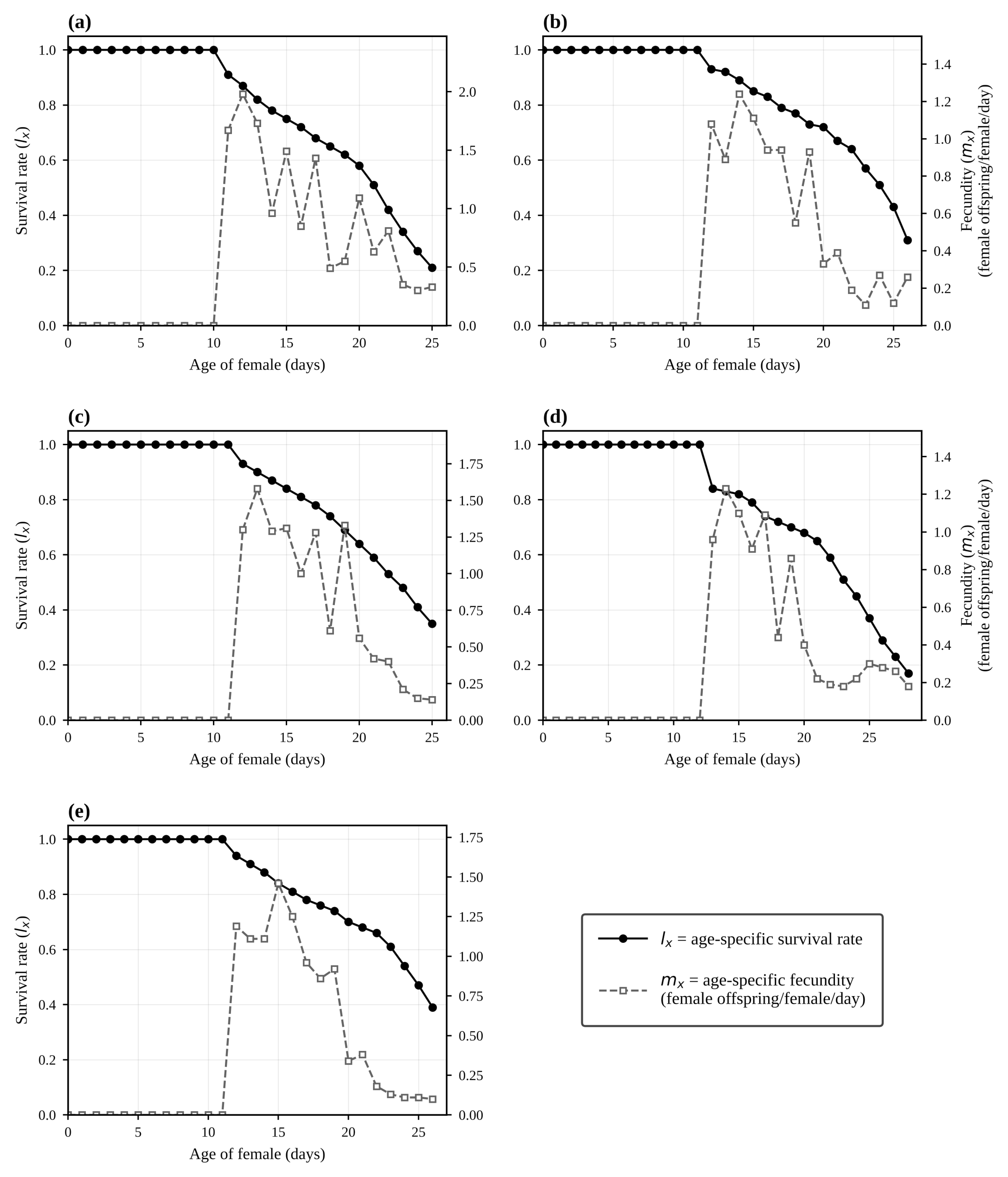
The life table parameters derived using the jackknife pseudo-value technique (Table 3) reinforced the pattern seen in the biological data. The net reproductive rate (R0) was the highest on date palm (10.33 ± 0.49 females/female/generation) and the lowest on maize (6.17 ± 0.31), with sugarcane also supporting a comparably high R0 (9.06 ± 0.37) not statistically different from date palm. The intrinsic rate of natural increase (rm) was likewise significantly the greatest on date palm (0.0844 ± 0.0015 females/female/day) and the lowest on maize (0.0558 ± 0.0015). Consistent with these findings, mean generation time (T) was the shortest on date palm (14.99 ± 0.11 days) and the longest on maize (16.74 ± 0.09 days), while population doubling time (Dt) was correspondingly the fastest on date palm (4.45 ± 0.08 days) and the slowest on maize (6.37 ± 0.17 days). Collectively, these parameters identify date palm as the most suitable host and maize as the least suitable for population growth of O. tylus, with pearl millet, sugarcane, and sorghum supporting intermediate performance. The age-specific survivorship (lx) and fecundity (mx) curves (Fig. 1) further illustrated these host-plant effects. Survivorship declined more gradually and persisted over a longer age interval on date palm, corresponding to its higher reproductive output, whereas the survivorship curve for maize declined earlier, consistent with its shorter oviposition period and lower fecundity. Peak fecundity (mx) was reached earliest and at the highest magnitude on date palm, whereas the fecundity curve for maize showed a lower and delayed peak, mirroring the reduced R0 and rm values obtained for this host.
Download as Values are mean ± SE. Means within a column followed by the same letter are not significantly different (Tukey’s HSD test, P > 0.05). Where, R0: Net reproductive rate; rm: Intrinsic rate of natural increase; T: Mean generation time; Dt: Population doubling time.
Treatment
R0 (No./female/lifetime)
rm (females/female/day)
T (Days)
Dt (Days)
Date palm
10.33 ± 0.49a
0.0844 ± 0.0015a
14.99 ± 0.11c
4.45 ± 0.08d
Pearl millet
7.43 ± 0.29b
0.0627 ± 0.0011b
15.97 ± 0.07b
5.52 ± 0.09b
Sugarcane
9.06 ± 0.37a
0.0674 ± 0.0011b
15.76 ± 0.07b
4.95 ± 0.08c
Maize
6.17 ± 0.31c
0.0558 ± 0.0015c
16.74 ± 0.09a
6.37 ± 0.17a
Sorghum
8.28 ± 0.33b
0.0667 ± 0.0011b
15.79 ± 0.06b
5.17 ± 0.08b
Discussion
The present study demonstrated clear host-dependent variation in the development of Oligonychus tylus. The duration of the immature period (egg to adult emergence) differed significantly among host plants, indicating that host species can strongly influence developmental performance. Such variation may arise from differences in host nutritional quality, plant physiology, tissue characteristics, and other environmental conditions associated with the host plant (Helle and Sabelis 1985; Awmack and Leather 2002; Beckerman et al. 2006). Similar host-dependent variation has been reported in other Oligonychus species. Ben Chaaban et al. (2011b) observed differences in developmental duration of O. afrasiaticus among date palm cultivars, while El-Halawany et al. (2013) reported variations in development of the same species among different developmental stages of date palm. The present findings therefore support the general pattern that hosts plant species can substantially modify developmental performance in tetranychid mites. Because the colony was maintained on date palm prior to the experiment, mites were not pre-acclimated to the alternate hosts for a full generation; this is acknowledged as a limitation
Host plant also influenced survival and reproductive performance of O. tylus. Differences in longevity, egg hatchability, and sex ratio among hosts indicate that host suitability extends beyond developmental rate and affects the ability of females to survive and produce viable offspring. In the present study, egg hatchability was highest on date palm (87.12 ± 5.62%) and lowest on maize (78.80 ± 8.72%), suggesting greater reproductive viability on date palm. Comparable host-related differences in egg hatchability have been reported for O. afrasiaticus, with higher hatchability on some date palm cultivars than others (Ben Chaaban et al. 2010). Likewise, variation in sex ratio has been reported in Oligonychus species according to host plant and cultivar (Manjunatha 1988; Deshmukh 2000; Chundawat 2006; Ben Chaaban et al. 2012). The variation in survival and reproductive parameters may be related to differences in host nutritional quality and physical and chemical characteristics. Host plants can affect herbivorous arthropods through nutritional composition, allelochemicals, tissue hardness, and other structural traits that influence feeding and resource acquisition (Bengston 1970; Archer et al. 1986; Kerguelen and Hoddle 2000; Kasap 2003; Kafil et al. 2007; Vásquez et al. 2008). Thus, a suitable host should not only permit completion of development but also support survival and successful reproduction. Fecundity showed a distinct host-dependent response, with date palm supporting greater reproductive output than the less suitable hosts. This pattern is consistent with observations in related Oligonychus species, where female fecundity varies considerably among host plants and date palm cultivars (Ben Chaaban et al. 2010; Ben Chaaban et al. 2012; El-Halawanyet al. 2020). For example, O. afrasiaticus females showed higher fecundity and longevity on the Bartamoda cultivar than on Zaghlol, while Ben Chaaban et al. (2010) also documented substantial differences in fecundity among date palm cultivars. These observations, together with the present results, suggest that variation in host nutritional quality and suitability can directly influence reproductive investment. The pre-oviposition period and female longevity observed in the present study further indicate that reproductive performance is closely linked with host species. Previous studies have similarly demonstrated variation in pre-oviposition period and female longevity among date palm cultivars (Ben Chaaban et al. 2010; Ben Chaaban et al. 2011b). Collectively, the reproductive parameters indicate that a host capable of supporting rapid development and prolonged reproductive activity is likely to provide greater opportunities for population increase.
In contrast, although females survived longer on maize, the slower development, lower fecundity, and lower egg hatchability suggest that maize was comparatively less suitable for population establishment and increase. Such variation among host plants in developmental rate, longevity, and reproductive performance is well documented in tetranychid mites, and longer adult survival does not necessarily correspond to greater population growth potential (Li and Liu, 2022). Longevity alone does not necessarily indicate host suitability, which depends on development, survival, reproduction, and offspring viability. Host-dependent differences in population growth, including intrinsic rate of increase and net reproductive rate, have been reported in Oligonychus species (Gutierrez 1977; Vásquez et al. 2008; Ben Chaaban et al. 2011a). A higher intrinsic rate of increase indicates greater potential for population multiplication and build-up under favorable conditions.
Overall, the findings demonstrate substantial host-dependent variation in the biological performance of O. tylus, highlighting the importance of host plant identity in determining its population dynamics. However, these conclusions should be interpreted within the limitations of the experimental conditions. The study was conducted under controlled laboratory conditions using detached leaf discs; therefore, field-based investigations are required to validate host suitability under commercial cultivation conditions and to determine the influence of season, temperature, natural enemies, plant age, cultivar, dispersal, and other ecological factors on mite abundance and crop damage. Such studies will help clarify the extent to which the laboratory-demonstrated biological advantages on date palm translate into population build-up and economic risk under field conditions.
References
- Anonymous. 2025. Annual report [Internet]. Gandhinagar: Directorate of Horticulture, Agriculture Farmers Welfare and Cooperation Department, Government of Gujarat. Available from: https://doh.gujarat.gov.in/Home/HorticultureCultivation
- Archer T.L., Bynum E.D., Peterson G.C. 1986. Influence of sorghum maturity on abundance and damage potential of Banks grass mite, Oligonychus pratensis (Banks). Exp. Appl. Acarol., 2: 217-222. https://doi.org/10.1007/BF01193953
- Awmack C.S., Leather S.R. 2002. Host plant quality and fecundity in herbivorous insects. Annu. Rev. Entomol., 47 (1): 817-844. https://doi.org/10.1146/annurev.ento.47.091201.145300
- Baker E.W., Pritchard E.A. 1960. The tetranychoid mites of Africa. Hilgardia, 29: 455-574. https://doi.org/10.3733/hilg.v29n11p455
- Beckerman A.P., Benton T.G., Lapsley C.T., Koesters N. 2006. How effective are maternal effects at having effects' Proc. R. Soc. B. Biol. Sci., 273 (1585): 485-493. https://doi.org/10.1098/rspb.2005.3315
- Bengston M. 1970. Effect of different varieties of the apple host on the development of T. urticae (Koch). Queensl. J. Agric. Anim. Sci., 27: 95-114.
- Birch L.C. 1948. The intrinsic rate of natural increase of an insect population. J. Anim. Ecol., 17: 15-26. https://doi.org/10.2307/1605
- Bostanian N.J., Trudeau M., Lasnier J. 2003. Management of the two-spotted spider mite, Tetranychus urticae (Acari: Tetranychidae) in eggplant fields. Phytoprotection, 84: 1-8. https://doi.org/10.7202/007439ar
- Ben Chaaban S., Chermiti B. 2010. Oligonychus afrasiaticus (Acarina: Tetranychidae). Seasonal abundance and life history of the old-world mite on various date palm cultivars in Segdoud oasis, South Tunisia. African J. Plant Sci. Biotech., 4 (2): 59-63.
- Ben Chaaban S., Chermiti B., Kreiter S. 2011a. Oligonychus afrasiaticus and phytoseiid predators' seasonal occurrence on date palm Phoenix dactylifera (Deglet Noor cultivar) in Tunisian oases. Bull. Insectology, 64 (1): 15-21. https://doi.org/10.1673/031.011.13601
- Ben Chaaban S., Chermiti B., Kreiter S. 2011b. Comparative demography of the spider mite, Oligonychus afrasiaticus, on four date palm varieties in southwestern Tunisia. J. Insect Sci., 11: 144. https://doi.org/10.1673/031.011.13601
- Ben Chaaban S., Chermiti B., Kreiter S. 2012. Effects of host plants on distribution, abundance, developmental time and life table parameters of Oligonychus afrasiaticus (McGregor) (Acari: Tetranychidae). Pap. Avulsos Zool., 52 (10): 121-132. https://doi.org/10.1590/S0031-10492012001000001
- Chao C.C., Krueger R.R. 2007. The date palm (Phoenix dactylifera L.): overview of biology, uses, and cultivation. Hortic. Sci., 45: 1077-1082. https://doi.org/10.21273/HORTSCI.42.5.1077
- Chundawat G.S. 2006. Bioecology and management of sorghum mite, Oligonychus indicus Hirst (Acarina: Tetranychidae) on sorghum [PhD Thesis]. Udaipur: Maharana Pratap University of Agriculture and Technology. pp. 1-127.
- Deshmukh S.Y. 2000. Ecology and control of Oligonychus indicus Hirst (Acarina: Tetranychidae) on sorghum [MSc (Agri.) Thesis]. Navsari: Gujarat Agricultural University.
- Dutta N.K., Alam S.N., Uddin M.K., Mahmudunnabi M., Khatun M.F. 2012. Population abundance of red spider mite in different vegetables along with its spatial distribution and chemical control in brinjal, Solanum melongena L. Bangladesh J. Agricult. Res., 37 (3): 399-404. https://doi.org/10.3329/bjar.v37i3.12083
- El-Halawany A., Ahmad N., Amer A. 2020. Biological aspects of date palm dust mite, Oligonychus afrasiaticus (McGregor) (Acari: Tetranychidae) on fronds of three date palm cultivars. Egypt. Acad. J. Biol. Sci. A, Entomol., 13 (1): 89-98. https://doi.org/10.21608/eajbsa.2020.74534
- El-Halawany A.S.H. 2013. Biology and life table parameters of the date palm dust mite, Oligonychus afrasiaticus (McGregor) (Acari: Tetranychidae) as affected by host and controlled conditions. Acarine, 7: 19-24. https://doi.org/10.21608/ajesa.2013.4919
- El-Juhany M., Loutfy I. 2010. Degradation of date palm trees and date production in Arab countries: causes and potential rehabilitation. Aust. J. Basic Appl. Sci., 4: 3998-4010.
- El-Shafie H.A.F. 2012. Review: list of arthropod pests and their natural enemies identified worldwide on date palm, Phoenix dactylifera L. Agric. Biol. J. N. Am., 3: 516-524. https://doi.org/10.5251/abjna.2012.3.12.516.524
- El-Shafie H.A.F. 2022. The old-world date palm mite Oligonychus afrasiaticus (McGregor, 1939) (Acari: Tetranychidae), a major fruit pest: biology, ecology, and management. CABI Reviews, 17: 020. https://doi.org/10.1079/cabireviews202217020
- El-Shafie H.A.F., Abdel-Banat B.M.A., Alhajhoj M.R. 2018. Arthropod pests of date palm and their management. CABI Reviews, 13: 1-18. https://doi.org/10.1079/PAVSNNR201712049
- Falerio J.R., Al-Shawaf A.M. 2018. Management of key insect pests of date palm. In: El-Boussini M., Falerio J.R. (Eds). Date palm pests and diseases integrated management guide. Beirut: ICARDA. p. 51-74.
- Gerson O., Venezian A., Blumberg D. 1983. Phytophagous mites on date palms in Israel. Fruits, 38: 133-135.
- Golakiya B.B., Sharma K.M., Baidiyavadra D.A., Muralidharan C.M., Dharva M.D. 2025. Population dynamics of red palm weevil, Rhynchophorus ferrugineus Olivier in date groves of Kachchh-India. J. Ent. Res., 49 (3): 611-614. https://doi.org/10.5958/0974-4576.2025.00106.3
- Gotoh T., Nagata, T. 2001. Development and reproduction of Oligonychus coffeae (Acari: Tetranychidae) on tea. Int. J. Acarol., 27 (4) : 293-298. https://doi.org/10.1080/01647950108684269
- Helle W., Sabelis M.W. 1985. Reproductive strategies. In: Helle W., Sabelis M.W. (Eds). Spider mites: their biology, natural enemies and control, Volume 1A. Amsterdam: Elsevier. p. 265-278.
- Hussain A.A. 1969. Biology of Paratetranychus afrasiaticus McG. infesting date palm in Iraq. B. Ent. Soc. Egypt, 33: 221-225.
- IBM Corp. 2019. IBM SPSS Statistics for Windows, Version 26.0 [Internet]. Armonk (NY): IBM Corp. Available from: https://www.ibm.com/products/spss-statistics
- Kafil M., Allahyari H., Saboori A. 2007. Effect of host plants on developmental time and life table parameters of Amphitetranychus viennensis (Acari: Tetranychidae). Exp. Appl. Acarol., 42 (4): 273-281. https://doi.org/10.1007/s10493-007-9095-9
- Kalaitzaki A., Amara A., Dervisoglou S., Perdikis D., Tzobanoglou D., Koufakis I., Tsagkarakis A. 2023. Effect of host plant species and temperature on the development and survival of the plant bug Closterotomus trivialis (Costa) (Hemiptera: Miridae). Phytoparasitica, 51 (1): 19-28. https://doi.org/10.1007/s12600-022-01030-1
- Kasap I. 2003. Life history of hawthorn spider mite Amphitetranychus viennensis (Acarina: Tetranychidae) on various apple cultivars and at different temperatures. Exp. Appl. Acarol., 31 (1-2): 79-91. https://doi.org/10.1023/B:APPA.0000005141.45970.f7
- Kerguelen V., Hoddle M.S. 2000. Comparison of the susceptibility of several cultivars of avocado to the persea mite, Oligonychus perseae (Acari: Tetranychidae). Sci. Hortic., 84: 101-114. https://doi.org/10.1016/S0304-4238(99)00103-X
- Li Y.Y., Liu H. 2022. Life history traits of spider mites and their relationship: A test of trade-off theory. Zoosymposia, 21: 23-33. https://doi.org/10.11646/zoosymposia.21.1.3
- Manjunatha M. 1988. Bioecology of sorghum spider mite, Oligonychus indicus Hirst (Acari: Tetranychidae) and estimation of crop losses due to it in sorghum [PhD Thesis]. Bangalore: University of Agricultural Sciences. pp. 1-225.
- Meyer J.S., Ingersoll C.G., McDonald L.L., Boyce M.S. 1986. Estimating uncertainty in population growth rates: jackknife vs. bootstrap techniques. Ecology, 67: 1156-1166. https://doi.org/10.2307/1938671
- Muralidharan C.M., Badiyavadra D.A., Sharma K.M., Srinivasa N. 2020. First incidence of a spider mite, Oligonychus tylus (Baker & Pritchard), in date palm (Phoenix dactylifera L.) groves of Kachchh in Gujarat, India. J. Plant. Crops., 48 (2): 137-141. https://doi.org/10.25081/jpc.2020.v48.i2.6373
- Negm M.W., Moraes G.J. de, Perring T.M. 2015. Mite pests of date palms. In: Wakil W., Faleiro J.R., Miller T.A. (Eds). Sustainable pest management in date palm: current status and emerging challenges. Dordrecht: Springer Science + Business Media. p. 347-389. https://doi.org/10.1007/978-3-319-24397-9_12
- Sivritepe N., Kumral N.A., Erturk U., Yerlikaya C., Kumral A. 2009. Responses of grapevines to two-spotted spider mite mediated biotic stress. J. Biol. Sci., 9 (4): 311-318. https://doi.org/10.3923/jbs.2009.311.318
- Vásquez C., Aponte O., Morales J., Sanabria M.E., Garcia G. 2008. Biological studies of Oligonychus punicae (Acari: Tetranychidae) on grapevine cultivars. Exp. Appl. Acarol., 45: 59-69. https://doi.org/10.1007/s10493-008-9154-x
 to post any comment or correction.


2026-05-05
Date accepted:
2026-10-15
Date published:
2026-11-09
Edited by:
Migeon, Alain

This work is licensed under a Creative Commons Attribution 4.0 International License
2026 Joshi, Manish J.; Muralidharan, Chandera M.; Negm, Mohamed W. and Patel, Prakash S.
 Download article
Download the citation
RIS with abstract
(Zotero, Endnote, Reference Manager, ProCite, RefWorks, Mendeley)
RIS without abstract
BIB
(Zotero, BibTeX)
TXT
(PubMed, Txt)