


Predatory potential of Ceraeochrysa cubana (Hagen) (Neuroptera: Chrysopidae) against Raoiella indica Hirst (Acari: Tenuipalpidae)
Rodrigues, Iasmym de Cássia A.  1
; Rêgo, Adriano S.
2
; Viteri, Luis O.
3
; Amaral, Ester A.
4
; Araujo, Raimunda N.L.
5
and Teodoro, Adenir V.
6
1
; Rêgo, Adriano S.
2
; Viteri, Luis O.
3
; Amaral, Ester A.
4
; Araujo, Raimunda N.L.
5
and Teodoro, Adenir V.
6
1Programa de Pós-Graduação em Ciências Agrárias, Universidade Estadual do Maranhão, Cidade Universitária Paulo VI, 65054-970, São Luís, Maranhão, Brazil.
2Programa de Pós-Graduação em Ciências Agrárias, Universidade Estadual do Maranhão, Cidade Universitária Paulo VI, 65054-970, São Luís, Maranhão, Brazil.
3Programa de Pós-Graduação em Produção Vegetal, Universidade Federal do Tocantins (UFT), 77402-970, Gurupi, Tocantins, Brazil.
4Programa de Pós-Graduação em Ciências Agrárias, Universidade Estadual do Maranhão, Cidade Universitária Paulo VI, 65054-970, São Luís, Maranhão, Brazil.
5Programa de Pós-Graduação em Ciências Agrárias, Universidade Estadual do Maranhão, Cidade Universitária Paulo VI, 65054-970, São Luís, Maranhão, Brazil.
6Programa de Pós-Graduação em Ciências Agrárias, Universidade Estadual do Maranhão, Cidade Universitária Paulo VI, 65054-970, São Luís, Maranhão, Brazil & Embrapa Tabuleiros Costeiros, Av. Gov. Paulo Barreto de Menezes, 3250, 49025-040, Aracaju, Sergipe, Brazil.
2026 - Volume: 66 Issue: 4 pages: 890-900
https://doi.org/10.24349/qvg0-xzzkOriginal research
Keywords
Abstract
Introduction
The red palm mite, Raoiella indica Hirst (Acari: Tenuipalpidae), is a major pest of coconut plantations in tropical regions (Melo et al. 2018). In invaded areas, R. indica has expanded its host range to more than 120 plant species and is widely distributed across the Neotropical region, threatening economically important crops such as coconut (Cocos nucifera L.), banana (Musa spp.), palm species [e.g., Euterpe oleracea Mart., Elaeis guineensis Jacq., Copernicia prunifera (Miller) H. E. Moore], and ornamental plants [e.g., Heliconia bihai (L.) L., Alpinia purpurata (Vieill.) K. Schum.] (Carrillo et al. 2012a; Rodrigues and Irish 2012; Otero-Colina et al. 2016; Gomez-Moya et al. 2017; Melo et al. 2018; Amaro et al. 2021; Souza et al. 2023; Leite et al. 2024). Infested plant hosts commonly exhibit leaf yellowing and tissue necrosis (Melo et al. 2018). In tropical countries, pesticides remain the most common control measure against R. indica (Rodrigues and Peña 2012), which can lead to environmental contamination, increased production costs, risks to human and animal health, and the development of pest resistance (Rodrigues and Peña 2012; Jumbo et al. 2019; Raja et al. 2025).
Biological control is a cornerstone of sustainable agriculture, providing environmentally sound alternatives for pest management. Green lacewings (Neuroptera: Chrysopidae) are widely recognized for their effectiveness in suppressing populations of a variety of pest arthropods (Jumbo et al. 2019; Martins et al. 2021; Barbosa et al. 2025; Porto et al. 2025; Viteri et al. 2026). Chrysopidae larvae are voracious predators that feed primarily on soft-bodied arthropods, including scale insects, aphids, whiteflies, psyllids, psocids, thysanopterans, as well as eggs and early instars of lepidopterans and mites (McEwen et al. 2001; Albuquerque et al. 2012; Machado and Martins 2022). Adults of only a few green lacewings genera are predators, most are glyco-pollenophagous, feeding on nectar, pollen, and/or honeydew (Albuquerque et al. 2012; Villa et al. 2016; Villa et al. 2019). In addition, green lacewings possess strong searching ability, high voracity, substantial reproductive potential, tolerance to certain insecticides, and are relatively easy to rear in mass-production systems (McEwen et al. 2001; Albuquerque et al. 2012), traits that enhance their suitability for biological control programs. Owing to the predatory habits of their immature stages, Chrysopidae play a strategic role in maintaining the stability of agroecosystems (McEwen et al. 2001; Dami et al. 2023).
Within this family, species of the genus Ceraeochrysa Adams represent an important group of Neotropical green lacewings with potential for biological control. This genus is the largest within the tribe Chrysopini and comprises 62 species distributed throughout the New World (Sosa-Duque and Tauber 2021). Species of Ceraeochrysa exhibit several traits that may enhance their effectiveness as biological control agents, including defensive strategies against natural enemies such as larval camouflage using debris such as prey remains, waxy secretions, exuviae, and plant material, as well as chemical protection of eggs and behavioral adaptations in adults that facilitate escape from spider webs (López-Arroyo et al. 1999; Albuquerque et al. 2001). Furthermore, representatives of this genus include species with potential for mass production and application in biological control programs (Tauber et al. 2000; Albuquerque et al. 2001).
Despite the recognized potential of green lacewings as biological control agents, the literature addressing their application in the management of R. indica remains limited (Carrillo et al. 2012b; Jumbo et al. 2019; Palomares-Pérez et al. 2021ab; Viteri et al. 2026). Ceraeochrysa cubana (Hagen) (Neuroptera: Chrysopidae) stands out as a widely distributed green lacewing in the Americas, ranging from South to North America and commonly occurring in Brazilian agroecosystems, where it has been frequently associated with pest suppression (Tauber et al. 2000; Albuquerque et al. 2001; Freitas and Penny 2001; Rugno et al. 2021). Nevertheless, information on its predatory performance against R. indica has not yet been evaluated. Accordingly, this study investigates the predatory capacity of C. cubana to control R. indica.
Materials and methods
Obtaining and identification of Ceraeochrysa cubana and Raoiella indica
Adult and immature stages of C. cubana were collected in a commercial plantation of the green dwarf coconut (Cocos nucifera L.) variety located in Paço do Lumiar (02°29′ 02.5'' S; 044°06′ 29.8'' W), Maranhão state, Brazil. The plantation was treated with commercial insecticides and acaricides recommended for coconut cultivation [e.g., fenpyroximate and abamectin (Agrofit 2026)]. Larvae and adults of Chrysopidae were collected in the field and individually placed in glass test tubes (8.0 cm × 2.0 cm) sealed with hydrophilic cotton plugs at the opening. The specimens were then transported to the Entomology Laboratory of the Maranhão State University (UEMA) (02°34′ 58.2'' S; 044°12′ 29.6'' W), in São Luís city, Maranhão state, Brazil, for sorting, taxonomic identification, and the establishment of a stock colony.
Green lacewing specimens were identified using dichotomous keys (Freitas and Penny 2001; Freitas et al. 2009; Sosa-Duque and Tauber 2021) based on external morphological characters and genitalia structures. Additionally, coconut palm leaflets infested with R. indica were collected from the same plantations described above. Adult females of R. indica were mounted on microscope slides using Hoyer's medium and left to dry for seven days. Identification was carried out using a phase-contrast microscope (Axio Scope A1, Carl Zeiss, Germany) and relevant dichotomous keys. Voucher specimens of C. cubana (deposit number: 20) and R. indica (deposit number: 88) were deposited in the Iraci Paiva Coelho Entomological Collection (CIPC) at UEMA. The stock colony of C. cubana was maintained, and all experiments were conducted under laboratory conditions (25 ± 2 °C, a 12:12 h (L:D) photoperiod, and 70 ± 10% relative humidity).
Stock colony of Ceraeochrysa cubana
Adults of C. cubana were sexed and placed in 12-L plastic cages (36 × 25 × 23 cm) with a mesh-covered (white voile fabric) lid and a lateral opening (9 cm in diameter) fitted with a 5-cm voile sleeve to allow handling of the insects (Santos et al. 2022). Inside each cage, a 100-mL plastic container holding a flexible polyurethane sponge and hydrophilic cotton - both saturated with distilled water - was provided. Sheets of white A4 paper were attached to the inner side walls of the cages to serve as an oviposition substrate for C. cubana females. Additionally, Parafilm M® strips coated with an artificial diet composed of honey, brewer's yeast, and fructose (1:1:1) were affixed to the inner cage surfaces using adhesive tape (Santos et al. 2022). The stock colony was maintained every two days by replacing the diet and distilled water and removing dead adults. The sex ratio was kept at 1:2 (male:female), totaling 10 males and 20 females per cage.
During the oviposition period, the eggs obtained were individually placed in covered Petri dishes (9 cm in diameter × 1.5 cm deep) containing cotton moistened with distilled water and eggs of Ephestia (Anagasta) kuehniella (Zeller) (Lepidoptera: Pyralidae) ad libitum for larval feeding, which were replenished every two days. The prepupal and pupal stages were maintained under the same conditions until adult emergence. After emergence, adults of the same age were placed in cages, as described above. Approximately five days after emergence, males and females were distinguished, allowing the establishment of new cages at a density of one male to two females, as described above.
Predatory capacity of Ceraeochrysa cubana
Predation by first-, second-, and third-instar larvae of C. cubana to adult females of R. indica was evaluated under laboratory conditions using experimental procedures described by Jumbo et al. (2019). Petri dishes (10 cm in diameter) containing a cleaned 12-cm² section of coconut leaflet, forming a 4-cm-diameter arena, were placed upside-down on a layer of solidified agar. Adult females of R. indica were carefully transferred to the exposed leaflet surface using a fine, soft-bristle brush.
Prey densities were 5, 10, 20, 30, 40, 50, 80, 120, and 160 females of R. indica for first-instar C. cubana; 50, 100, 150, 200, 300, 400, 500, and 600 for second instars; and 100, 150, 200, 300, 400, 500, 600, and 700 for third instars. The minimum and maximum prey densities for each C. cubana instar were established in preliminary tests. Newly hatched C. cubana larvae were starved for 24 h before being individually introduced into the experimental arenas. Predators were added to the experimental arenas 30 min after prey transfer. Each arena was covered with perforated Parafilm® to prevent predators from escaping. The number of prey consumed was recorded 24 h after predator release, and prey were not replaced. Each prey density was replicated 10 times per larval instar. Prey consumption was defined as the predation of adult female mites showing partial or total body content loss. Dead individuals with intact bodies were rare and excluded from analysis, as their mortality was unrelated to predation.
Statistical analyses
The functional response was estimated based on logistic regression of the proportion of prey consumed as a function of prey density, using the CATMOD procedure of the SAS statistical software (SAS 2008). In this analysis, the cubic model (Juliano 2001) with the polynomial function was fitted:
\[\frac{N_e}{N_0}=\frac{\exp \left(P_0+P_1 N_0+P_2 N_0^2+P_3 N_0^3\right)}{1+\exp \left(P_0+P_1 N_0+P_2 N_0^2+P_3 N_0^3\right)} (1),\]
where Ne and N0 are the number prey attacked and the initial prey density respectively; the P0 is the intercept and the coefficients P1 (linear), P2 (quadratic), and P3 (cubic) are associated with the slope of the curve. The type of functional response is determined by the signs of P1 and P2; thus, a significantly negative linear coefficient (P1 < 0) indicates a type II functional response (the proportion of prey consumed declines monotonically with increasing initial prey density). A significantly positive (P1 > 0) linear coefficient indicates a type III functional response (density-dependent consumption) (Juliano 2001).
Because experiments were conducted without prey replacement for 24 h, the random predator equation (Juliano 2001) was used to describe type II and type III functional responses, as follows:
\[\mathrm{N}_{\mathrm{e} }=\mathrm{N}_0\left\{1-\exp \left[\alpha\left(\mathrm{T}_{\mathrm{h} } \mathrm{ N}_{\mathrm{e} }-\mathrm{T}\right)\right]\right\} (2),\]
\[\mathrm{N}_{\mathrm{e} }=\mathrm{N}_0\left\{1-\exp \left[\left(\mathrm{d}+\mathrm{bN}_0\right)\left(\mathrm{T}_{\mathrm{h} } \mathrm{ N}_{\mathrm{e} }-\mathrm{T}\right) /\left(1+\mathrm{cN}_0\right)\right]\right\} (3),\]
where Nₑ = number of prey attacked, T = exposure time (24 h), N₀ = initial prey density, α = attack rate, defined as the rate at which predator–prey encounters result in successful attacks and reflecting the predator's search efficiency, and Th = handling time, representing the total time a predator spends locating, attacking, subduing, consuming, and digesting prey. The coefficients α, b, c, and d are constants associated with the attack rate. The maximum consumption rate was estimated based on the reciprocal of Tₕ (1/Tₕ) and compared using 95% confidence intervals. Subsequently, the parameters Tₕ (handling time) and α (attack rate) of the functional response were estimated using nonlinear least-squares regression with the PROC NLIN procedure in SAS (2008), as described by Juliano (2001). The Rogers' random predator equation was fitted using the Marquardt optimization algorithm with a maximum of 1,000 iterations. The PARMS statement was used to specify the initial parameter values, and the BOUNDS statement was used to constrain parameter estimates to positive values. Because the Rogers' equation is implicit in the number of prey consumed, predicted values were obtained using an iterative Newton–Raphson procedure implemented within PROC NLIN until convergence. Model convergence was confirmed when the convergence criterion implemented in PROC NLIN was satisfied. Finally, model adequacy was assessed by visually comparing observed and predicted prey consumption values generated from the fitted model. It should be noted that the absence of prey replacement may have led to prey depletion during the experiment, potentially influencing parameter estimates. Differences in α and Tₕ among instars were considered significant when their 95% confidence intervals did not overlap. Furthermore, differences in prey consumption among predator larval stages were determined by Tukey's test (P < 0.05) using GraphPad Prism 8.1 software (GraphPad Software Inc. 2019).
Results
Download as Negative and positive linear terms (P1) denote types II and III functional responses, respectively.
Predator stage
Parameter
Estimate
SE
x2
p
1st instar
Intercept (P0)
5.047
0.424
141.59
<0.0001
Linear (P1)
-0.123
0.016
57.16
<0.0001
Quadratic (P2)
1.2x10⁻³
1.8x10⁻⁴
48.27
<0.0001
Cubic (P3)
4.2x10⁻⁶
6.1x10⁻⁷
47.71
<0.0001
2nd instar
Intercept (P0)
0.968
0.34
8.12
0.0044
Linear (P1)
0.053
0.004
182.37
<0.0001
Quadratic (P2)
-1.8x10⁻⁴
1.2x10⁻⁵
225.11
<0.0001
Cubic (P3)
1.4x10⁻⁷
1x10⁻⁸
201.57
<0.0001
3rd instar
Intercept (P0)
1.997
0.2792
51.13
<0.0001
Linear (P1)
0.032
0.002
190.9
<0.0001
Quadratic (P2)
-1x10⁻⁴
5.7x10⁻⁶
349.05
<0.0001
Cubic (P3)
8.1x10⁻⁸
4.2x10⁻⁹
373.9
<0.0001
The predatory behavior of C. cubana in response to increasing densities of R. indica females was dependent on prey density and predator instar. The logistic regression analysis of prey consumed yielded a negative linear coefficient for the first instar, indicating a type II functional response; however, the second and third instars showed positive linear coefficients, suggesting a tendency toward a type III functional response rather than a definitive classification (Table 1).
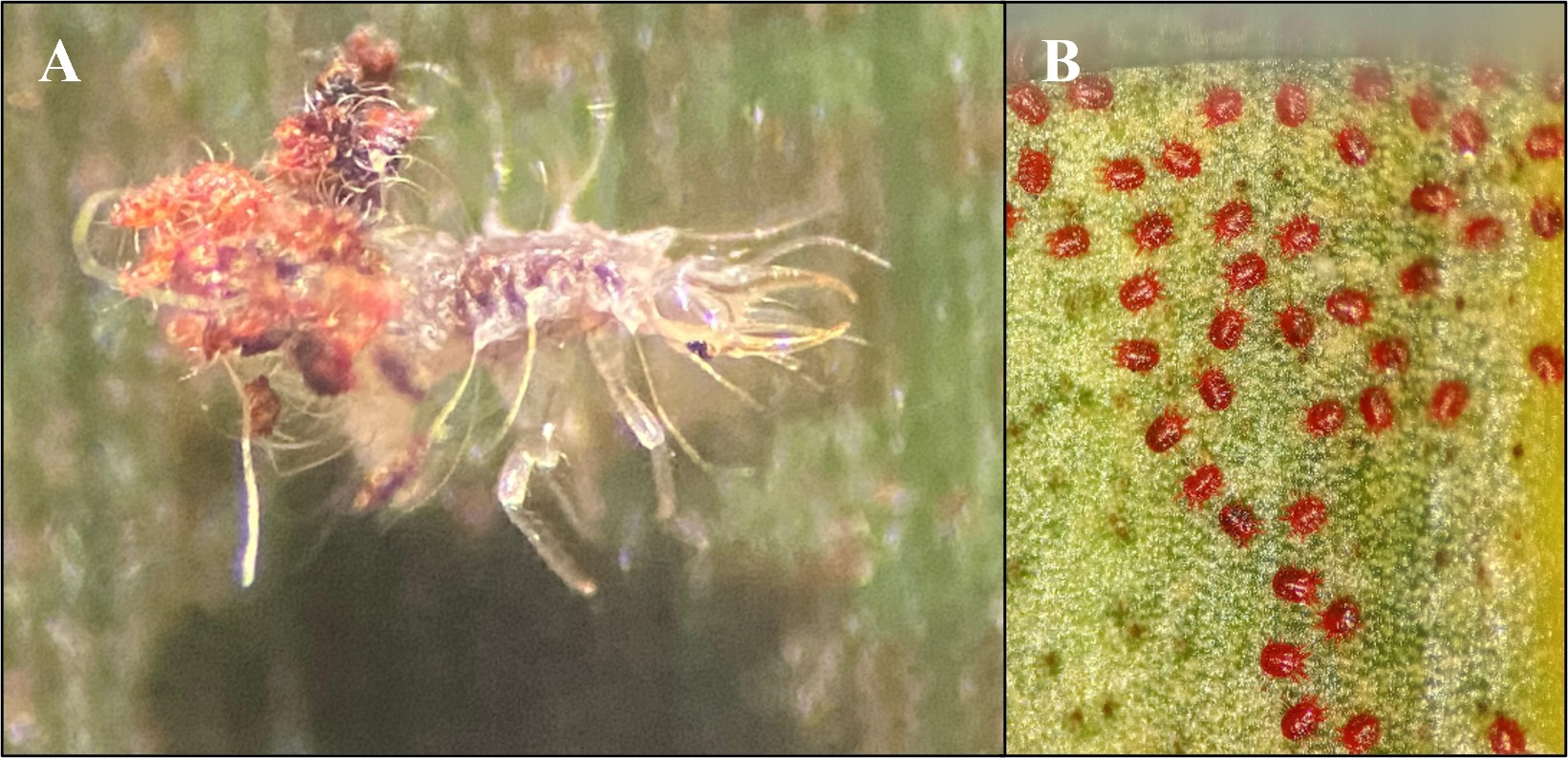
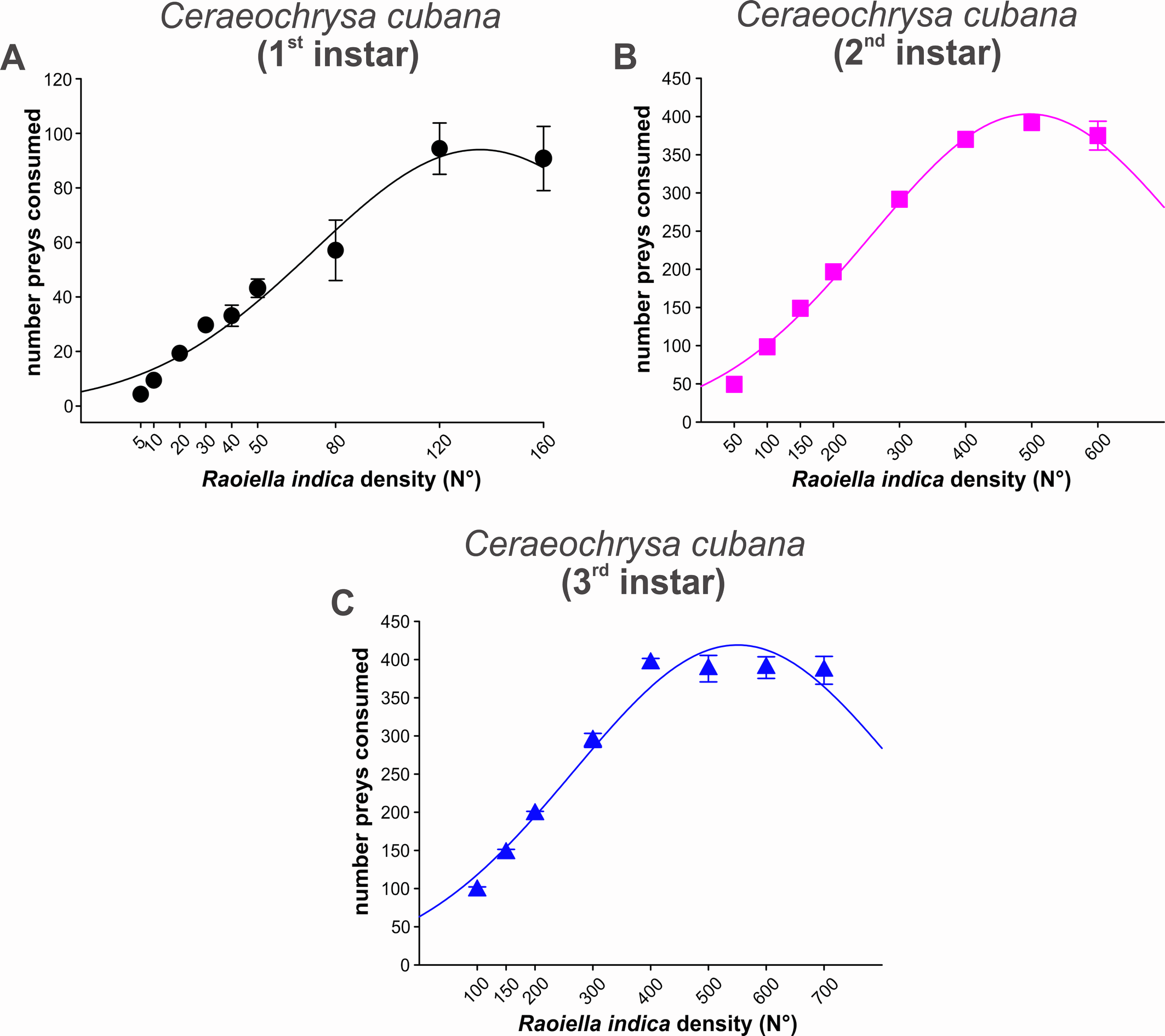
The first instar of C. cubana reached maximum consumption at a prey density of 120, consuming 94.4 ± 0.42 adult females of R. indica (Figures 1, 2A). The second instar consumed 392 ± 8.43 individuals when offered 500 prey, with a tendency toward reduced consumption at higher densities (Figure 2B). A similar trend was observed in the third instar, which consumed 395 ± 5.83 prey when offered 400 individuals (Figure 2C).
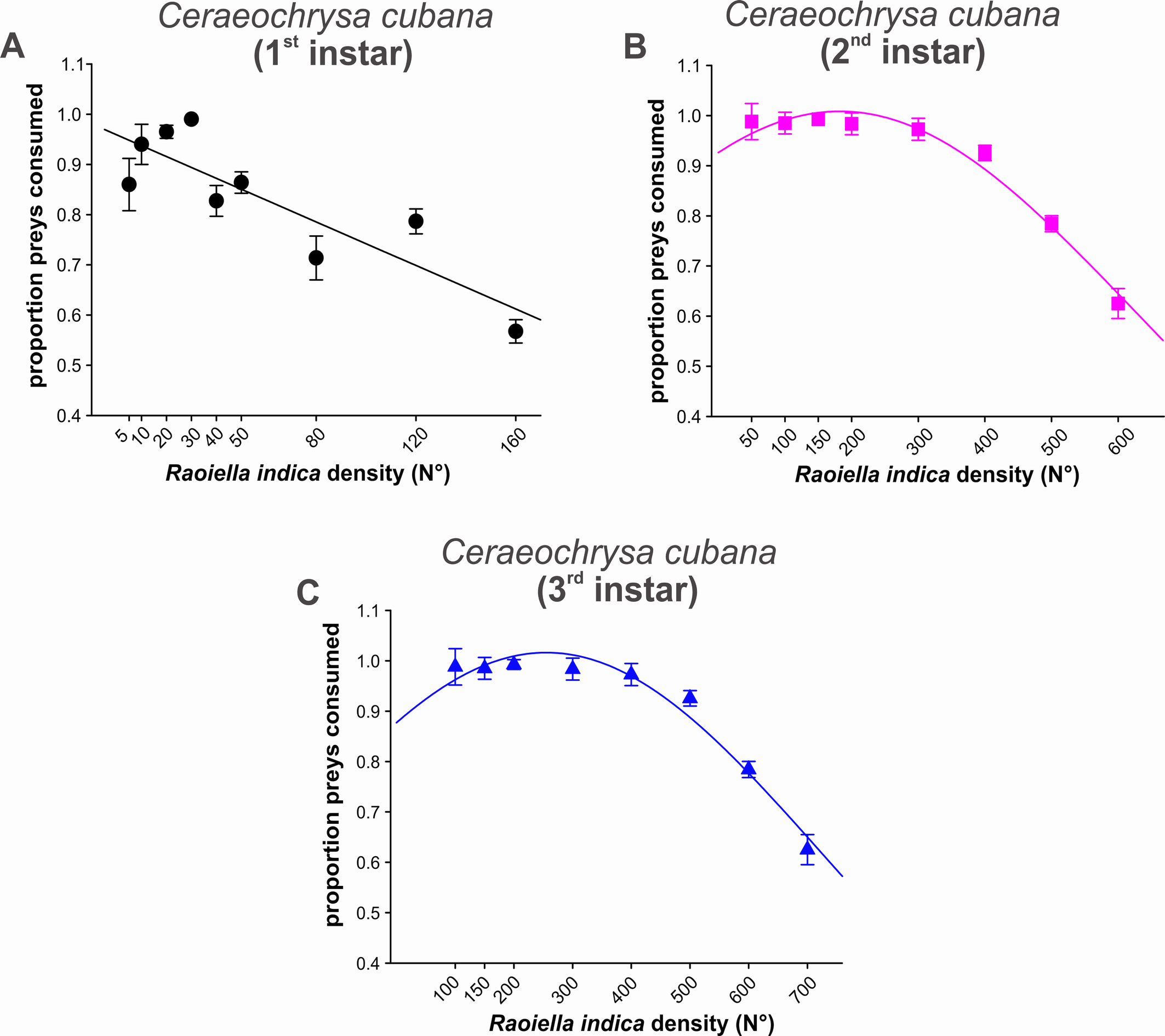
Furthermore, the functional response types observed in our study were further supported by the proportion of R. indica consumed (Ne/N0) by the three instars of C. cubana. Data on the proportion consumed indicated an approximately linear trend for the first instar (Figure 3A), whereas a declining trend was observed for the second (Figure 3B) and third instars (Figure 3C) as prey density increased; these patterns are consistent with a type II response for the first instar and suggest a density-dependent feeding response for the second and third instars rather than a strict functional response classification.
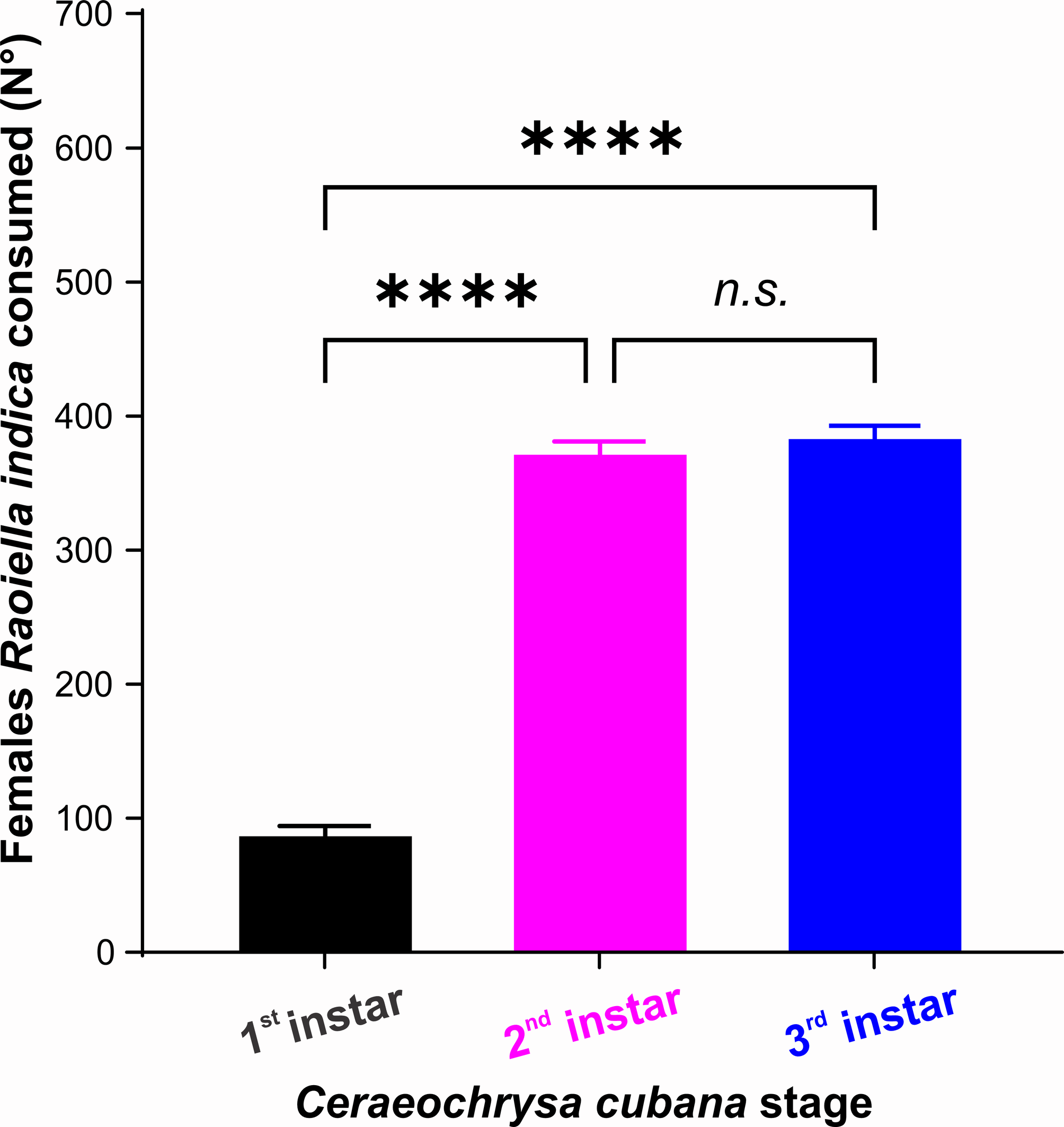
The total consumption of C. cubana also differed among the predator's larval instars when exposed to higher prey densities. The first larval instar consumed approximately one quarter of the R. indica females eaten by the second and third instars, which did not show significant differences between themselves (Figure 4).
Estimates of the attack rate (α) and handling time (Th) revealed significant differences among the larval instars of C. cubana. Among the three instars, the second instar exhibited the highest attack rate, indicating greater capture efficiency (Table 2). Although handling time was longer in the first and second instars, the third instar achieved the highest maximum consumption rate (1/Th), demonstrating the greatest overall predatory efficiency (Table 2).
Download as Different lowercase letters within the same parameter indicate statistically significant differences based on the 95% confidence interval.
Predator stage
a’ ± SE (95%CI)
Th ± SE (95%CI)
(1/Th) ± SE (95%CI)
1st
0.0013 ± 0.000044 a
5.0705 ± 0.0116 a
0.197 a
(0.00125 - 0.00142)
(5.0475 - 5.0935)
(0.196 - 0.198)
2nd
0.0022 ± 0.000083 b
1.3858 ± 0.00834 b
0.721 b
(0.0021 - 0.00239)
(1.3692 - 1.4024)
(0.713 – 0.730)
3rd
0.0016 ± 0.000083 c
1.1564 ± 0.0025 c
0.864 c
(0.00145 - 0.00178)
(1.1514 - 1.1614)
(0.861 - 0.868)
Discussion
The predatory capacity of C. cubana on R. indica adult females is influenced by both larval instar and prey density, affecting the functional response type and the key parameters that define predatory efficiency. Also, all larval instars of C. cubana are capable of preying upon adult females of R. indica, with consumption increasing progressively with predator development.
The potential of natural enemies as biological control agents is commonly assessed through functional response studies (Holling 1959; Barbosa et al. 2025; Porto et al. 2025). The number of prey attacked by a predator as a function of prey density defines its functional response, which may exhibit three patterns in relation to prey density: linear (type I), decelerating to a plateau (type II), or sigmoid (type III) (Holling 1959, 1965). Type II functional responses, as observed in the first-instar larvae of C. cubana, are commonly associated with limited prey-handling capacity and reduced searching efficiency at higher prey densities, which may limit their regulatory potential under outbreak conditions (Jumbo et al. 2019; Viteri et al. 2026). In contrast, second- and third-instar larvae of C. cubana exhibited positive logistic coefficients; however, their classification as a type III functional response should be interpreted with caution, as the graphical patterns do not fully exhibit a classical sigmoid shape (Holling 1959).
The experiments were conducted without prey replacement over the 24 h period, which may have led to prey depletion, particularly at higher densities and consumption rates. This can alter prey availability over time and influence estimates of key functional response parameters, such as attack rate and handling time. Although Rogers' random predator equation is appropriate for non-replacement designs (Juliano 2001; Rosenbaum and Rall 2018), the resulting estimates should be interpreted with caution, as they reflect predator performance under confined microcosm conditions rather than continuous field foraging.
Green lacewings are widely recognized as generalist predators with high larval voracity and developmental plasticity, which underpin their importance in biological control systems (McEwen et al. 2001; Albuquerque et al. 2012). Among biological control agents, they are regarded as promising regulators of R. indica populations (Jumbo et al. 2019; Viteri et al. 2026). Jumbo et al. (2019) demonstrated that Ceraeochrysa caligata (Banks) (= Ceraeochrysa cornuta Navás) (Neuroptera: Chrysopidae) preys upon eggs, immature stages, and adult females of R. indica. In contrast to the present study, first-, second-, and third-instar larvae of C. caligata exhibited a type II functional response when exposed to increasing densities of R. indica females, characterized by inverse density-dependence prey mortality. Similarly, Viteri et al. (2026) evaluated the consumption of increasing densities of R. indica adult females by the three larval instars of Chrysoperla externa (Hagen) (Neuroptera: Chrysopidae). Their results indicated that first- and third-instar larvae of C. externa exhibited a type II functional response, reflecting high predation efficiency at low prey densities, whereas second-instar larvae displayed a type III functional response (Viteri et al. 2026).
Comparable stage-dependent patterns have also been reported in other chrysopids (Martins et al. 2021; Bharathi et al. 2025). For instance, Chrysoperla zastrowi sillemi (Esben-Peterson) feeding on the red spider mite Oligonychus coffeae (Nietner) (Acari: Tetranychidae) showed strong instar-dependent predation, with third-instar larvae exhibiting the highest consumption rates. In that study, all larval instars displayed a type II functional response across prey stages (Bharathi et al. 2025).
Dami et al. (2023) emphasize that the main factors determining a predator's functional response include the attack rate (α), handling time (Th), and the duration of prey exposure to the predator. Regarding the attack rate, C. cubana exhibited higher values in second-instar larvae than in the first and third instars, indicating enhanced searching efficiency at this developmental stage. In contrast, Jumbo et al. (2019) reported no significant variation in attack rate among larval instars of C. caligata when preying on R. indica females, suggesting a more uniform searching efficiency across developmental stages. Viteri et al. (2026) reported relatively elevated attack rates in the early instars of C. externa, particularly at low prey densities, reinforcing that attack rate is highly species- and instar-dependent.
The handling time (Th) is one of the most critical components in determining the success of a natural enemy. The reduction in Th observed for second- and third-instar larvae of C. cubana larvae indicates that, as the predator develops, it becomes capable of processing prey more quickly, allowing a larger fraction of its time to be dedicated to active searching. In contrast, Jumbo et al. (2019) reported no significant differences in handling time among larval instars of C. caligata when feeding on R. indica females, suggesting similar handling performance across developmental stages. Likewise, reduced handling times in advanced instars of C. externa have been documented, reinforcing the general pattern that predator maturation enhances prey-handling efficiency (Viteri et al. 2026).
The higher average maximum consumption of R. indica females by second- and third-instar larvae of C. cubana (Figure 4) reflects an increased predatory capacity associated with larval development, particularly due to larger body size, enhanced mobility, and higher nutritional requirements prior to pupation (McEwen et al. 2001; Viteri et al. 2026). Similar increases in predation rates during the final instar have been reported in other studies (Cuello et al. 2019; Luna-Espino et al. 2020).
From an applied perspective, our results indicate that second- and third-instar larvae of C. cubana exhibit strong density-dependent predation, particularly at high prey densities. These findings suggest that these developmental stages have a greater predation potential than first-instar larvae and may be relevant for future evaluations of the species in integrated pest management programs. However, confinement factors (small arenas, high encounter rates, and the absence of structural complexity or prey refuges) may overestimate predatory performance under laboratory conditions compared to natural conditions, and consumption estimates may include partially consumed prey. Therefore, further studies under semi-field and field conditions are needed to determine whether this laboratory-observed predation potential translates into effective pest suppression. Management practices that enhance green lacewing survival and development, such as the reduced use of broad-spectrum pesticides and habitat management, may further enhance the capacity of C. cubana to effectively suppress R. indica populations.
In conclusion, C. cubana shows promising laboratory predatory potential against adult females of R. indica, with second- and third-instar larvae being more efficient predators, although their functional response classification remains suggestive rather than definitive for a type III response.
Acknowledgements
This study was financed in part by the Coordenação de Aperfeiçoamento de Pessoal de Nível Superior - Brasil (CAPES) – Finance Code 001. We also thank the coconut producers for granting access to the areas used for the collection of C. cubana and R. indica.
References
- Albuquerque G.S., Tauber C.A., Tauber M.J. 2001. Chrysoperla externa and Ceraeochrysa spp.: potential for biological control in the New World tropics and subtropics. In: McEwen P.K., New T.R., Whittington A.E. (Eds). Lacewings in the crop environment. Cambridge: Cambridge University Press. p. 408-423. https://doi.org/10.1017/CBO9780511666117.025
- Albuquerque G.S., Tauber C.A., Tauber M.J. 2012. Green Lacewings (Neuroptera: Chrysopidae): Predatory Lifestyle. In: Panizzi A.R., Parra J.R.P. (Eds). Insect Bioecology and Nutrition for Integrated Pest Management. Boca Raton: CRC Press. p. 594-631.
- Agrofit. 2026. Database of information on agrochemical and related products registered with the Ministry of Agriculture and Livestock (MAPA). Available from: https://agrofit.agricultura.gov.br/agrofit_cons/principal_agrofit_cons
- Amaro G., Fidelis E.G., Silva R.S., Medeiros C.M. 2021. Current and potential geographic distribution of red palm mite (Raoiella indica Hirst) in Brazil. Ecol. Inform., 65: 101396. https://doi.org/10.1016/j.ecoinf.2021.101396
- Barbosa E.P., dos Santos J.A., de Oliveira Cabral E., Dami B.G., Alves F.B., Lima V.O., Braghini A., Vacari A.M. 2025. Functional response of Chrysoperla externa (Neuroptera: Chrysopidae) to two-spotted spider mite, Tetranychus urticae (Acari: Tetranychidae): Implications for biological control. Bull. Entomol. Res., 115(5): 545-549. https://doi.org/10.1017/S0007485325000343
- Bharathi N.S, Sujatha K., Rabeesh T.P. 2025. Predatory potential and functional responses of Chrysoperla zastrowi sillemi Esben‑Peterson (Neuroptera: Chrysopidae) against the red spider mite, Oligonychus coffeae Nietner (Acarina: Tetranychidae), a major pest of tea. J. Basic Appl. Zool. 86:47. https://doi.org/10.1186/s41936-025-00470-5
- Carrillo, D., Amalin, D., Hosein, F., Roda, A., Duncan, R.E., Peña, J.E. 2012a. Host plant range of Raoiella indica (Acari: Tenuipalpidae) in areas of invasion of the New World. Exp. Appl. Acarol., 57: 271-289. https://doi.org/10.1007/s10493-011-9487-8
- Carrillo D., Howard J.F., Verle-Rodrigues J., Peña J.E. 2012b. A review of the natural enemies of the red palm mite, Raoiella indica (Acari: Tenuipalpidae). Exp. Appl. Acarol., 57: 347-360. https://doi.org/10.1007/s10493-011-9499-4
- Cuello E.M., Andorno A.V., Hernandez C.M., Lopez S.N. 2019. Prey consumption and development of the indigenous lacewing Chrysoperla externa feeding on two exotic Eucalyptus pests. Biocontrol Sci. Technol., 29: 1159-1171. https://doi.org/10.1080/09583157.2019.1660958
- Dami B.G., Santos J.A., Barbosa E.P., Rodriguez-Saona C., Vacari A.M. 2023. Functional response of 3 green lacewing species (Neuroptera: Chrysopidae) to Leucoptera coffeella (Lepidoptera: Lyonetiidae). J. Insect Sci., 23(3): 1-8. https://doi.org/10.1093/jisesa/iead038
- Freitas S., Penny N.D. 2001. The green lacewings (Neuroptera: Chrysopidae) of Brazilian agro-ecosystems. Proc. Calif. Acad. Sci., 52: 245-395.
- Freitas S., Penny N.D., Adams P.A. 2009. A revision of the New World genus Ceraeochrysa (Neuroptera: Chrysopidae). Proc. Calif. Acad. Sci., 60: 503-610.
- GraphPad Software Inc. 2019. GraphPad Prism 8.1. La Jolla, CA, USA.
- Gómez-Moya C.A., Lima T.P.S., Morais E.G.F., Gondim Júnior M.G.C., Moraes G.J. 2017. Hosts of Raoiella indica Hirst (Acari: Tenuipalpidae) native to the Brazilian Amazon. J. Agric. Sci., 9: 86-94. https://doi.org/10.5539/jas.v9n4p86
- Holling C.S. 1959. Some characteristics of simple types of predation and parasitism. Can. Entomol., 91: 385-398. https://doi.org/10.4039/Ent91385-7
- Holling C.S. 1965. The functional response of predators to prey density and its role in mimicry and population regulation. Mem. Entomol. Soc. Can., 97(Suppl S45): 5-60. https://doi.org/10.4039/entm9745fv
- Juliano S.A. 2001. Non-linear curve fitting: Predation and functional response curves. In: Scheiner S.M., Gurevitch J. (Eds). Design and analysis of ecological experiments, vol 2. New York: Chapman and Hall. p. 178-196. https://doi.org/10.1093/oso/9780195131871.003.0010
- Jumbo L.O.V., Teodoro A.V., Rêgo A.S., Haddi K., Galvão A.S., Oliveira E.E. 2019. The lacewing Ceraeochrysa caligata as a potential biological agent for controlling the red palm mite Raoiella indica. PeerJ, 7: e7123. https://doi.org/10.7717/peerj.7123
- Leite R.A., dos Santos C.G., de Souza I.V., Ledo C.A.S., Guzzo E.C. 2024. Resistance of dwarf Cocos nucifera L. (Arecaceae) cultivars to Raoiella indica Hirst (Acari: Tenuipalpidae). Exp. Appl. Acarol., 92: 203-215. https://doi.org/10.1007/s10493-023-00890-4
- López-Arroyo J.I., Tauber C.A., Tauber M.J. 1999. Comparative life histories of the predators Ceraeochrysa cincta, C. cubana, and C. smithi (Neuroptera: Chrysopidae). Ann. Entomol. Soc. Am., 92(2): 208-217. https://doi.org/10.1093/aesa/92.2.208
- Luna-Espino H.M., Jiménez-Pérez A., Castrejón-Gómez V.R. 2020. Assessment of Chrysoperla comanche (Banks) and Chrysoperla externa (Hagen) as biological control agents of Frankliniella occidentalis (Pergande) (Thysanoptera: Thripidae) on tomato (Solanum lycopersicum) under glasshouse Conditions. Insects, 11(2): 87. https://doi.org/10.3390/insects11020087
- McEwen P.K., New T.R., Whittington A.E. 2001. Lacewings in the crop environment. Cambridge: Cambridge University Press. pp. 564 https://doi.org/10.1017/CBO9780511666117
- Machado R.J.P., Martins C.C. 2022. The extant fauna of Neuroptera (Insecta) from Brazil: diversity, distribution and history. Rev. Bras. Entomol., 66(spe): e20220083. https://doi.org/10.1590/1806-9665-rbent-2022-0083
- Martins F.M., Franzin M.L., Perez A.L., Schmidt J.M., Venzon M. 2021. Is Ceraeochrysa cubana a coffee leaf miner predator? Biol. Control, 160, 104691. https://doi.org/10.1016/j.biocontrol.2021.104691
- Melo J.W.S., Navia D., Mendes J.A., Filgueiras R.M.C., Teodoro A.V., Ferreira J.M.S., Guzzo E.C., Souza I.V., Mendonça R.S., Calvet É.C., Neto A.A., Gondim M.G.C., Morais E.G.F., Godoy M.S., Santos J.R., Silva R.I.R., Silva V.B., Norte R.F., Oliva A.B., Santos R.D.P., Domingos C.A. 2018. The invasive red palm mite, Raoiella indica Hirst (Acari: Tenuipalpidae), in Brazil: range extension and arrival into the most threatened area, the Northeast Region. Int. J. Acarol., 44: 146-149. https://doi.org/10.1080/01647954.2018.1474945
- Otero-Colina G., González-Gómez R., Martínez-Bolaños L., Otero-Prevost L.G., López-Buenfil J.A., Escobedo-Graciamedrano R.M. 2016. Infestation of Raoiella indica Hirst (Trombidiformes: Tenuipalpidae) on host plants of high socio-economic importance for tropical America. Neotrop. Entomol., 45: 300-309. https://doi.org/10.1007/s13744-016-0368-z
- Palomares-Pérez M., Contreras-Bermúdez Y., Grifaldo-Alcántara F., García-García R.E., Bravo-Núñez M., Arredondo-Bernal H.C. 2021a. Development of Ceraeochrysa cincta (Neuroptera: Chrysopidae) fed with Raoiella indica (Acari: Tenuipalpidae). Int. J. Trop. Insect Sci., 41: 1169-1176. https://doi.org/10.1007/s42690-020-00302-9
- Palomares-Pérez M., Contreras-Bermúdez Y., Grifaldo-Alcántara P.F., García-García R.E., Bravo-Núñez M., Arredondo-Bernal H.C. 2021b. Predation capacity and larval development of Ceraeochrysa claveri (Neuroptera: Chrysopidae) fed with Raoiella indica (Acari: Tenuipalpidae). Rev. FCA UNCuy., 53(2): 225-231. https://doi.org/10.48162/rev.39.055
- Porto D.P., Marucci R.C., dos Santos A., Palhari N.B., Abreu C.S., de Souza B. 2025. Potential of lacewings (Neuroptera: Chrysopidae) as predators of the red gum lerp psyllid Glycaspis brimblecombei (Hemiptera: Aphalaridae) in Eucalyptus. Neotrop. Entomol., 54(85). https://doi.org/10.1007/s13744-025-01295-1
- Raja R.K., Kumar S.P., Balasubramani G., Sankaranarayanan C., Liu B., Hazir S., Narayanan M. 2025. An updated review on green synthesized nanoparticles to control insect pests. J. Pest. Sci., 98: 31-50. https://doi.org/10.1007/s10340-024-01863-1
- Rodrigues J.C.V., Peña J.E. 2012. Chemical control of the red palm mite, Raoiella indica (Acari: Tenuipalpi¬dae) in banana and coconut. Exp. Appl. Acarol., 57: 317-329. https://doi.org/10.1007/s10493-011-9493-x
- Rodrigues J.C.V., Irish B.M. 2012. Effect of coconut palm proximities and Musa spp. germplasm resistance to colonization by Raoiella indica (Acari: Tenuipalpidae). Exp. Appl. Acarol., 57: 309-316. https://doi.org/10.1007/s10493-011-9484-y
- Rosenbaum B., Rall B.C. 2018. Fitting functional responses: Direct parameter estimation by simulating differential equations. Methods Ecol. Evol., 9: 2076-2090. https://doi.org/10.1111/2041-210X.13039
- Rugno G.R., Cuervo J.G.B., Garcia A.G., Qureshi J., Yamamoto P.T. 2021. Abundance and diversity of lacewings in grower operated organic and conventional pest management programs for Diaphorina citri (Hemiptera: Liviidae). Crop Prot., 146: 105682. https://doi.org/10.1016/j.cropro.2021.105682
- SAS. 2008. SAS/STAT User's guide, 9.2. edn., Cary, North Carolina
- Santos A.C.B., Rêgo A.S., Lemos R.N.S., Dias G.S., Lopes G.S. 2022. Biological aspects of Ceraeochrysa everes (Neuroptera: Chrysopidae) fed on pink hibiscus mealybug. Rev. Caatinga, 35(2): 363-370. https://doi.org/10.1590/1983-21252022v35n212rc
- Sosa-Duque F.J., Tauber C.A. 2021. The Neotropical green lacewing genus Ceraeochrysa Adams (Neuroptera: Chrysopidae)-new synonymies and combinations, a new species, and an updated key to species. Zootaxa, 4970(1): 001-052. https://doi.org/10.11646/zootaxa.4970.1.1
- Souza I.V., Ferreira M.J.R., Lyra-Lemos R.P., Guzzo E.C. 2023. Plants harbouring the red palm mite Raoiella indica Hirst (Acari: Tenuipalpidae) in Alagoas State, Northeast Brazil, with novel host associations. Syst. Appl. Acarol. 28(6): 1179-1184. https://doi.org/10.11158/saa.28.6.12
- Tauber C.A., De Leon T., Penny N.D., Tauber M.J. 2000. The Genus Ceraeochrysa (Neuroptera: Chrysopidae) of America North of Mexico: Larvae, Adults, and Comparative Biology. Ann. Entomol. Soc. Am., 93: 1195-1221. https://doi.org/10.1603/0013-8746(2000)093%5B1195:TGCNCO%5D2.0.CO;2
- Villa M., Santos S.A.P., Benhadi-Marín J., Mexia A., Albino A., Pereira J.A. 2016. Life-history parameters of Chrysoperla carnea s.l. fed on spontaneous plant species and insect honeydews: importance for conservation biological control. BioControl, 61: 533-543. https://doi.org/10.1007/s10526-016-9735-2
- Villa M., Somavilla I., Santos S.A.P., López-Sáez J.A., Pereira J.A. 2019. Pollen feeding habits of Chrysoperla carnea s.l. adults in the olive grove agroecosystem. Agric. Ecosyst. Environ., 283:106573. https://doi.org/10.1016/j.agee.2019.106573
- Viteri L.O., Lira V.A., Freitas G.S., Farias A.P., Rêgo A.S., Oliveira E.E., Teodoro A.V. 2026. Chrysoperla externa (Neuroptera: Chrysopidae) as a potential biological control agent of Raoiella indica (Acari: Tenuipalpidae). Entomol. Exp. Appl., 174: 335-342. https://doi.org/10.1111/eea.70059
 to post any comment or correction.


2026-03-06
Date accepted:
2026-09-22
Date published:
2026-10-02
Edited by:
Castro, Elizeu B.

This work is licensed under a Creative Commons Attribution 4.0 International License
2026 Rodrigues, Iasmym de Cássia A.; Rêgo, Adriano S.; Viteri, Luis O.; Amaral, Ester A.; Araujo, Raimunda N.L. and Teodoro, Adenir V.
 Download article
Download the citation
RIS with abstract
(Zotero, Endnote, Reference Manager, ProCite, RefWorks, Mendeley)
RIS without abstract
BIB
(Zotero, BibTeX)
TXT
(PubMed, Txt)