


A review of occurrences, molecular characterisation, and bioecology studies on Euseius citrifolius Denmark and Muma: an emerging biological control agent in Neotropical Region
Hernandes, Leticia Molina  1
and Lofego, Antonio Carlos
2
1
and Lofego, Antonio Carlos
2
1✉ Graduation Program in Biodiversity, São Paulo State University (UNESP), Institute of Biosciences, Humanities and Exact Sciences, São José do Rio Preto 15054-000, São José do Rio Preto, São Paulo, Brazil.
2Department of Biological Sciences, Graduation Program in Biodiversity, São Paulo State University (UNESP), Institute of Biosciences, Humanities and Exact Sciences, São José do Rio Preto 15054-000, São José do Rio Preto, São Paulo, Brazil.
2026 - Volume: 66 Issue: 4 pages: 909-928
https://doi.org/10.24349/1031-yup9Review
Keywords
Abstract
Introduction
The family Phytoseiidae is composed of several predatory species, with some ones used in biological control. These mites are naturally found on the leaves of various plants, where they find food and shelter (Moraes and Flechtmann 2008). Many of these mites feed not only on prey (which are largely phytophagous mites), but also on pollen, plant exudates, and fungi (McMurtry and Croft 1997). The genus Euseius is a good representative of this type of predator, classified by McMurtry et al. 2013 as type IV predatory mites, that is, generalist predators that use pollen as an important part of their diet. The species Euseius citrifolius Denmark and Muma was described from specimens collected in Paraguay by Denmark and Muma in 1970, and since then, many records of this species have been noted in the Neotropics, especially in Brazil (Lofego et al. 2024; Demite et al. 2026). These records often show co-occurrences with several species of phytophagous mites (Oliveira et al. 2012; Montes et al. 2012; Barroso et al. 2019). This species has a rapid life cycle that completes in seven days, from egg to adult stage, although it may be faster depending on its diet (Furtado and Moraes 1998). Some studies demonstrate that E. citrifolius performs well in preying on some species of phytophagous mites, especially those belonging to the family Tenuipalpidae (De Vis et al. 2006; Cardoso et al. 2010; Cano 2020; Amaral 2022). Considering these characteristics, E. citrifolius could be a promising species for use in integrated pest management programs, whether in augmentative biological control or especially for conservation control. According to Tixier (2018), to implement conservation biological control, it is necessary to study certain characteristics of predatory mites, including the presence of the predator on reservoir plants and its dispersal capacity between reservoir plants and the crops. According to Bellini et al. (2008), E. citrifolius was present not only on cultivated rubber trees but also on spontaneous euphorbiaceous plants within the crop. In coffee cultivation, Ferla et al. (2023) also found that this predator was present both on coffee and in intercropped plants. Furthermore, Araújo et al. (2022) demonstrated that the abundance of predators, including E. citrifolius, is positively influenced by the heterogeneity and complexity of the habitat in rubber tree plantations. Thus, as suggested by these studies and following the proposition of Tixier (2018), E. citrifolius seems to have some of the characteristics necessary to be implemented in conservation biological control programs.
In this scenario, considering its widespread and frequent occurrence, its good predatory capacity against pest mites, its presence in cultivated and uncultivated plants, and its presence in a variety of climates and habitats in South America and especially in Brazil, E. citrifolius emerges as a predatory species of great importance for conservative biological control of agricultural pests. However, despite these attributes, there is no literature review study for this species that could provide a basis and direction for further studies. In this context, this study aimed to fill this gap, seeking to evaluate what is already consolidated knowledge, and knowledge gaps.
Material and methods
Searches were conducted using the keyword ''Euseius citrifolius'' in the following databases: Scielo, PubMed, Database Phytoseiidae (Available on: https://www.lea.esalq.usp.br/phytoseiidae  ), and Capes Periodicals. Scientific articles, theses, and dissertations were considered to obtain the data. To better assess the topics of the studies on E. citrifolius, the information found was classified into three categories: occurrence and distribution, morphological and molecular characterization, and bioecology. Publications available up to December 18, 2025, were considered.
Some studies were considered in more than one category. The term ''occurrence'' is used for the related presence of the species in plants.
The geographical coordinates were taken directly from the studies when available, or approximate coordinates were used when only the name of the collection site was provided. Geographic data were disregarded when they were nonspecific to the species or when they were too broad. The map was created using the QGIS 3.24.1 program.
The correct spelling of the scientific names of the plants mentioned in this study, as well as information on their family, plant type, and whether they are native or introduced, was verified and obtained from the REFLORA (Available on: https://reflora.jbrj.gov.br/consulta ) and Plant of the World Online – POWO (Available on: https://powo.science.kew.org ) platforms. To determine whether plant species are cultivated or not, the information was checked in POWO and in the National Register of Cultivars (RNC) (Available on: https://sistemas.agricultura.gov.br/snpc/cultivarweb/cultivares_registradas.php ?) for plants found in Brazil. Cultivated plants were defined as any plant maintained or planted by humans for various uses (Kinlock et al. 2025).
Results and discussion
A total of 104 publications with data related to E. citrifolius were found. The majority (89 – 85%) deal with some data about occurrence and/or distribution. Fifteen studies (13%) concerned morphological and molecular characterization, of which only two focused on molecular characterization. The remaining eight percent are biology studies, represented by only nine papers.
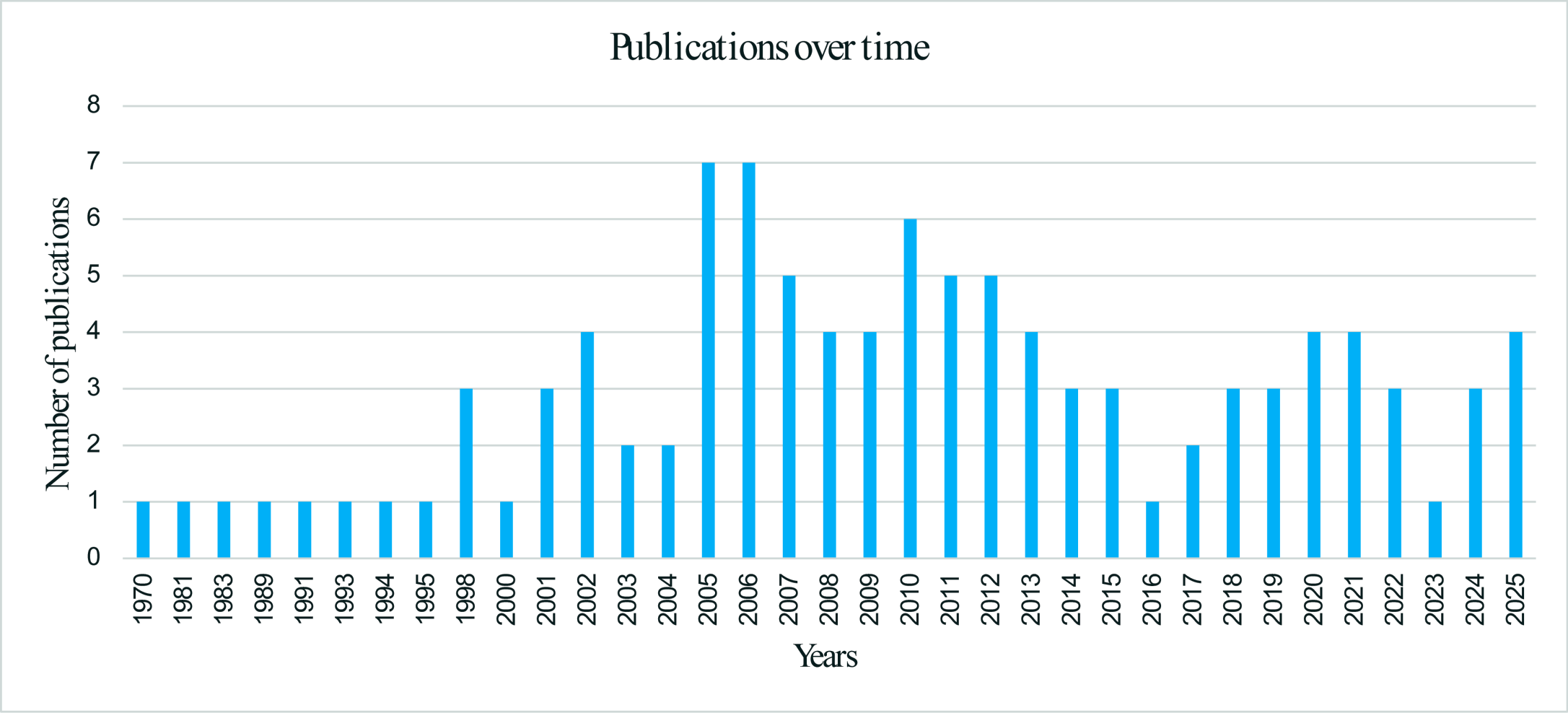
The first publication dates to 1970, containing a description and first reports of E. citrifolius in citrus orchards (Denmark and Muma 1970). It was not until 12 years later that another publication on the species was recorded, marking the first study of its biology (Moraes and McMurtry 1981). Since then, there have been a few publications, and from the 2000s onwards, publications have been produced every year, reaching up to 7 publications in a single year (Figure 1).
Across these 104 publications, approximately 160 researchers and more than 50 institutions worked with this species. Most of the publications originated from Brazilian groups or were produced in collaboration with them, notably involving the Acarology Laboratory at ESALQ, Piracicaba and the Acarology Laboratory at UNESP, São José do Rio Preto.
Occurrences and distribution
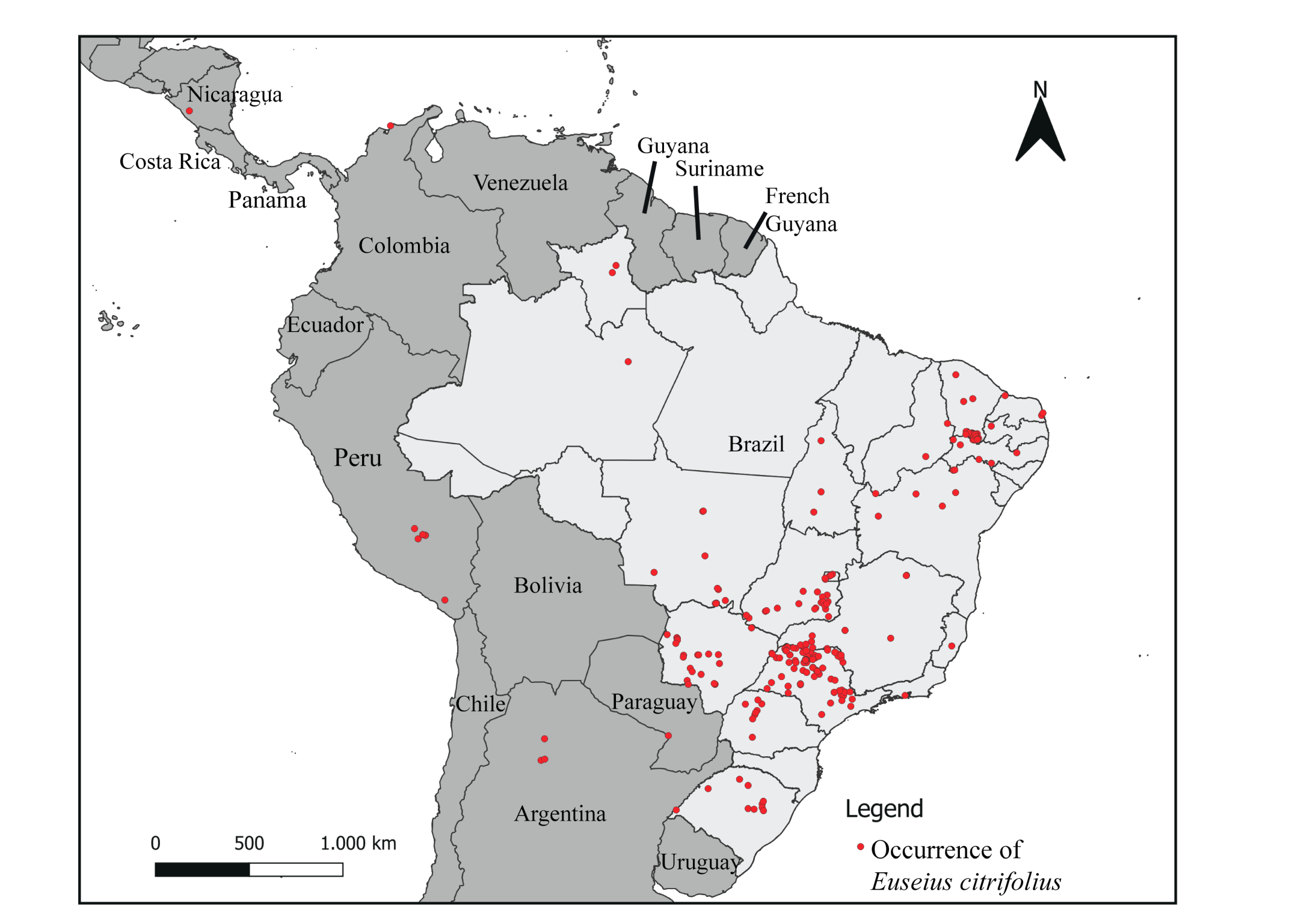
Eighty-nine studies containing information on the occurrence and geographic distribution of E. citrifolius were found and evaluated. These studies reveal records of this species only in South and Central American countries: Argentina, Brazil, Colombia, Paraguay, Peru, and Nicaragua. Most of them are from Brazil, with records in 19 of the 26 Brazilian states (Figure 2).
Of all the studies analyzed in this research, 84 contained information on the number of mites found; of these, 79 reported co-occurrence of E. citrifolius with other species of the same genus. In 60% of these studies, E. citrifolius was the most abundant mite compared to other species of the genus, such as Euseius alatus De Leon, Euseius concordis (Chant), and Euseius sibelius (De Leon) although these other species have been recorded in more or the same countries and regions as E. citrifolius. Thus, these data show that when present, E. citrifolius is quite abundant, and can co-occur with other predators.
Euseius citrifolius was found on 226 plant species, belonging to 56 families and 63 genera (Table 1). The most reported species are cultivated plants, only 21 are non-cultivated and native plants. Also, the species occurs more in native plants than introduced ones. Besides that, the most plants are trees or shrub/tree, but E. citrifolius can occurs in various types of plants like grasses, lianas and herbs (Table 1).
Download as
Host plant
Family
Type
Cultivated (C) vs Non cultivated plant (NC)
States/Country
Native (N) or Introduced (I)
Reference
Acalypha diversifolia
Euphorbiaceae
Shrub/Tree
C
São Paulo, Brazil
N
Buosi et al. 2006
Feres et al. 2007
Acalypha hispida
Euphorbiaceae
Shrub
C
Mato Grosso do Sul, Brazil
I
Furtado et al. 2014
Acrocomia aculeata
Arecaceae
Tree
C
São Paulo, Brazil
N
Demite et al. 2011
Gondim and Moraes, 2001
Actinostemon klotzschii
Euphorbiaceae
Shrubs/Tree
NC
São Paulo, Brazil
N
Demite et al. 2011, 2013, 2015
Feres et al. 2007
Buosi et al. 2006
Ageratum conyzoides
Asteraceae
Subshrub
C
São Paulo, Brazil
N
Bellini et al. 2005b
Aiphanes horrida
Arecaceae
Tree
C
São Paulo, Brazil
N
Gondim and Moraes, 2001
Alchornea glandulosa
Euphorbiaceae
Tree
C
São Paulo, Brazil
N
Buosi et al. 2006
Feres et al. 2007
Feres and Moraes, 1998
Amaranthus sp.
Amaranthaceae
-
-
São Paulo, Brazil
-
Rezende and Lofego, 2012
Amphilophium sp.
Bignoniaceae
Liana
-
São Paulo, Brazil
N
Bellini et al. 2005b
Anacardium humile
Anacardiaceae
Tree
C
Goiás, Brazil
N
Demite et al. 2017
Anacardium occidentale
Anacardiaceae
Tree
C
Bahia, Maranhão, Piaui, Brazil
N
Moraes et al. 1993
Ceará, Brazil
N
Moraes and McMurtry, 1983
Rio Grande do Norte, Brazil
N
Furtado et al. 2005
Andira inermis
Fabaceae
Tree
C
Mato Grosso do Sul, Brazil
N
Mendonça et al. 2019
Annona cherimola × Annona squamosa
Annonaceae
Shrub/ Tree
C
Bahia, Brazil
I
Sousa et al. 2015
Annona coriacea
Annonaceae
Shrub/ Tree
C
Minas Gerais, Brazil
N
Demite et al. 2017
Annona monticola
Annonaceae
Subshrub
C
Goiás, Brazil
N
Demite et al. 2017
Annona muricata
Annonaceae
Tree
C
Bahia, Brazil
I
Sousa et al. 2015
Annona sp.
Annonaceae
-
-
Ceará, Brazil
N
Furtado et al. 2005
São Paulo, Brazil
N
Demite et al. 2011
Rio Grande do Sul, Brazil
N
Ferla and Moraes, 2002b
Annona squamosa
Annonaceae
Shrub/ Tree
C
Pernambuco, Brazil
I
Moraes and McMurtry, 1983
Archontophoenix sp.
Arecaceae
Tree
C
Goiás, Mato Grosso do Sul, Paraná, Rio de Janeiro e São Paulo, Brazil
I
Barroso et al. 2019
Archontophoenix cunninghamiana
Arecaceae
Tree
C
São Paulo, Brazil
I
Gondim and Moraes, 2001
Aspidosperma subincanum
Apocynaceae
Tree
C
São Paulo, Brazil
N
Demite et al. 2011
Astronium sp.
Anacardiaceae
Shrub/ Tree
-
São Paulo, Brazil
N
Bellini et al. 2005b
Bactris gasipaes
Arecaceae
Tree
C
São Paulo, Brazil
N
Gondim and Moraes, 2001
Balfourodendron riedelianum
Rutaceae
Tree
C
São Paulo, Brazil
N
Castro and Moraes, 2010
Bambusa sp.
Poaceae
Bamboo
-
São Paulo, Brazil
I
Feres and Flechtmann, 1995
Demite et al. 2011
Feres and Moraes, 1998
Bauhinia sp.* *
Fabaceae
-
-
Minas Gerais, Brazil
N
Demite et al. 2017
Rio Grande do Sul, Brazil
N
Ferla and Moraes, 2002b
São Paulo, Brazil
N
Feres and Moraes, 1998
Bauhinia variegata
Fabaceae
Shrub/ Tree
C
São Paulo, Brazil
I
Daud et al. 2007
Bertholletia excelsa
Lecythidaceae
Tree
C
Mato Grosso, Brazil
N
Demite et al. 2021
Bixa orellana
Bixaceae
Shrub/ Tree
C
Mato Grosso do Sul, Brazil
N
Furtado et al. 2014
Brickellia longifolia
Asteraceae
Herb
NC
Mato Grosso, Brazil
-
Demite et al. 2009
Brugmansia suaveolens
Solanaceae
Shrub/ Tree
C
Paraná, Brazil
N
Furtado et al. 2006
Mato Grosso do Sul, Brazil
N
Furtado et al. 2014
Byrsonima coccolobifolia
Malpighiaceae
Shrub/ Tree
C
Minas Gerais, Brazil
N
Demite et al. 2017
Byrsonima intermedia
Malpighiaceae
Shrub
C
Mato Grosso do Sul, Brazil
N
Rezende and Lofego, 2011
Byrsonima sp.
Malpighiaceae
-
-
Minas Gerais, Brazil
N
Demite et al. 2017
Campomanesia pubescens
Myrtaceae
Subshrub/ Shrub
C
Goiás, Brazil
N
Rezende and Lofego, 2011
São Paulo, Brazil
N
Lofego et al. 2004
Capsicum pubescens
Solanaceae
Scrambling subshrub/ Shurb
C
Peru
N
Guanilo et al. 2008b
Capsicum sp.
Solanaceae
-
-
Peru
N
McMurtry and Moraes, 1989
São Paulo, Brazil
I
Bellini et al. 2005b
Carica papaya
Caricaceae
Tree
C
Pernambuco, Paraiba, Brazil
I
Moraes and McMurtry, 1983
São Paulo, Brazil
I
Moraes et al. 2013
Nicaragua
I
Moraes et al. 1991
Caryocar brasiliense
Caryocaraceae
Shrub/ Tree
C
Goiás, Brazil
N
Rezende and Lofego, 2011
Distrito Federal
N
Rezende and Lofego, 2011
Mato Grosso do Sul, Brazil
N
Rezende and Lofego, 2011
São Paulo, Brazil
N
Demite et al. 2011
Caryota mitis
Arecaceae
Tree
C
São Paulo, Brazil
I
Gondim and Moraes, 2001
Casearia sylvestris
Salicaceae
Shrub/ Tree
C
São Paulo, Brazil
N
Moraes et al. 2013
Cassia fistula
Fabaceae
Tree
C
São Paulo, Brazil
I
Feres et al. 2009
Cassia sp.
Fabaceae
Tree
-
Paraíba, Brazil
I
Moraes and McMurtry, 1983
Cecropia pachystachya
Urticaceae
Tree
C
Mato Grosso do Sul, Brazil
N
Furtado et al. 2014
São Paulo, Brazil
N
Daud et al. 2010
São Paulo, Brazil
N
Lofego et al. 2017
Cecropia sp.
Urticaceae
Tree
-
São Paulo, Brazil
-
Bellini et al. 2005b
Ceiba speciosa
Malvaceae
Tree
C
Rio Grande do Sul, Brazil
N
Ferla and Moraes, 2002b
Centrolobium tomentosum
Fabaceae
Tree
C
São Paulo, Brazil
N
Demite et al. 2011
Cestrum auriculatum
Solanaceae
Shrub
NC
Peru
N
Guanilo et al. 2008b
Chomelia obtusa
Rubiaceae
Shrub/ Tree
C
Goiás, Brazil
N
Demite et al. 2017
Chromolaena pedunculosa
Asteraceae
Subshrub/ Shrub
NC
Rio Grande do Sul. Brazil
N
Castro et al. 2024
Citrus sp.
Rutaceae
Tree
C
Pernambuco, Paraiba, Bahia, Brazil
N
Moraes and McMurtry, 1983
Paraguay
N
Denmark and Muma, 1970
Citrus x aurantium f. aurantium
Rutaceae
Tree
C
Manaus, Brazil
N
Ferreira et al. 2018
São Paulo, Brazil
N
Silva et al. 2012
Citrus x* latifolia*
Rutaceae
Tree
C
São Paulo, Brazil
N
Mineiro and Raga, 2020
Cochlospermum regium
Bixaceae
Perennial/ Tuberous geophyte
C
Minas Gerais, Brazil
N
Demite et al. 2017
Cocos nucifera
Arecaceae
Tree
C
Goiás, Mato Grosso do Sul, Paraná, Rio de Janeiro e São Paulo, Brazil
I
Barroso et al. 2019
São Paulo, Brazil
I
Oliveira et al. 2012
Codiaeum variegatum
Euphorbiaceae
Shrub/ Tree
C
Mato Grosso do Sul, Brazil
I
Furtado et al. 2014
Coffea arabica
Rubiaceae
Shrub/ Tree
C
Minas Gerais, Brazil
I
Abreu et al. 2014
Minas Gerais, Brazil
I
Silva et al. 2010
Minas Gerais, Brazil
I
Spongoski et al. 2005
São Paulo, Brazil
I
Mineiro et al. 2006a
São Paulo, Brazil
I
Mineiro et al. 2006b
São Paulo, Brazil
I
Mineiro et al. 2009
Coffea canephora
Rubiaceae
Shrub
C
São Paulo, Brazil
I
Mineiro et al. 2006a
São Paulo, Brazil
I
Mineiro et al. 2009
Copaifera langsdorffii
Fabaceae
Tree
C
São Paulo, Brazil
N
Demite et al. 2011
Cordyline fruticosa
Asparagaceae
Shrub/ Tree
C
Mato Grosso do Sul, Brazil
I
Furtado et al. 2014
Couroupita guianensis
Lecythidaceae
Tree
C
São Paulo, Brazil
N
Escobar – Garcia et al. 2024
Desmoncus orthacanthos
Arecaceae
Climber/Liana
NC
Mato Grosso do Sul, Brazil
N
Mendonça et al. 2019
Digitaria insularis
Poaceae
Perennial herb
C
São Paulo, Brazil
I
Rezende and Lofego, 2012
Dimorphandra mollis
Fabaceae
Tree
C
Goiás, Brazil
N
Rezende and Lofego, 2011
Diospyros kaki
Ebenaceae
Shrub/ Tree
C
Rio Grande do Sul, Brazil
I
Ferla and Moraes, 2002b
Dipteryx alata
Fabaceae
Tree
C
Minas Gerais, Brazil
N
Rezende and Lofego, 2012
Goiás, Brazil
N
Demite et al. 2017
São Paulo, Brazil
N
Demite et al. 2011
Dipteryx odorata
Fabaceae
Tree
C
Mato Grosso, Brazil
N
Demite et al. 2021
Erechtites sp.
Asteraceae
-
-
São Paulo, Brazil
N
Bellini et al. 2005b
Erythroxylum anguifugum
Erythroxylaceae
Shrub
C
Mato Grosso do Sul, Brazil
N
Mendonça et al. 2019
Erythroxylum cf. cuneifolium
Erythroxylaceae
Shrub
C
São Paulo, Brazil
N
Castro and Moraes, 2010
Erythroxylum deciduum
Erythroxylaceae
Shrub/ Tree
C
Goiás, Brazil
N
Rezende and Lofego, 2011
Erythroxylum sp.
Erythroxylaceae
-
-
Goiás, Brazil
N
Demite et al. 2017
Eucalyptus sp.
Myrtaceae
-
C
Ceará, Brazil
I
Rodrigues et al. 2020
Eugenia uniflora
Myrtaceae
Shrub/ Tree
C
Ceará, Brazil
N
Rodrigues et al. 2020
Eupatorium sp.
Asteraceae
-
-
São Paulo, Brazil
N
Bellini et al. 2005b
Euphorbia heterophylla
Euphorbiaceae
Annual herb
C
São Paulo, Brazil
N
Rezende and Lofego, 2012
São Paulo, Brazil
N
Bellini et al. 2008
São Paulo, Brazil
N
Feres and Nunes, 2001
Euphorbia hirta
Euphorbiaceae
Annual herb
C
São Paulo, Brazil
N
Rezende and Lofego, 2012
São Paulo, Brazil
N
Bellini et al. 2008
São Paulo, Brazil
N
Feres and Nunes, 2001
Euphorbia hyssopifolia
Euphorbiaceae
Annual herb
C
São Paulo, Brazil
N
Bellini et al. 2008
Euterpe edulis
Arecaceae
Tree
C
Goiás, Mato Grosso do Sul, Paraná, Rio de Janeiro e São Paulo, Brazil
N
Barroso et al. 2019
Ficus gomelleira
Moraceae
Tree
C
Mato Grosso do Sul, Brazil
N
Furtado et al. 2014
Ficus luschnathiana
Moraceae
Tree
C
Mato Grosso do Sul, Brazil
N
Mendonça et al. 2019
Fridericia platyphylla
Bignoniaceae
Scrambling shrub/ Liana
C
Mato Grosso, Brazil
N
Demite et al. 2009
Minas Gerais, Brazil
N
Demite et al. 2017
Fridericia triplinervia
Bignoniaceae
Liana
NC
São Paulo, Brazil
N
Demite et al. 2011
Fuirena umbellata
Cyperaceae
Helophyte
C
Mato Grosso do Sul, Brazil
N
Rezende and Lofego, 2011
Galipea jasminiflora
Rutaceae
Shrub/ Tree
C
São Paulo, Brazil
N
Demite et al. 2011
Genipa americana
Rubiaceae
Tree
C
Goiás, Brazil
N
Rezende and Lofego, 2011
São Paulo, Brazil
N
Castro and Vieira, 2011
Gossypium sp.
Malvaceae
-
-
Paraíba, Brazil
N
Moraes and McMurtry, 1983
Guarea guidonia
Maliaceae
Tree
C
Mato Grosso do Sul, Brazil
N
Furtado et al. 2014
Guarea sp.
Maliaceae
-
-
São Paulo, Brazil
N
Bellini et al. 2005b
Guazuma ulmifolia
Malvaceae
Tree
C
Mato Grosso do Sul, Brazil
N
Furtado et al. 2014
São Paulo, Brazil
Demite et al. 2011
Hancornia speciosa
Apocynaceae
Shrub/ Tree
C
Goiás, Brazil
N
Rezende and Lofego, 2011
Handroanthus impetiginosus
Bignoniaceae
Tree
C
São Paulo, Brazil
N
Demite et al. 2011
Heliconia sp.
Heliconiaceae
Herb
-
São Paulo, Brazil
N
Demite et al. 2011
Helicteres brevispira
Malvaceae
Shrub
NC
São Paulo, Brazil
N
Demite et al. 2011
Heliotropium sp.
Boraginaceae
-
-
São Paulo, Brazil
N
Bellini et al. 2005b
Heteropterys sp.* *
Malpighiaceae
-
-
São Paulo, Brazil
N
Feres and Moraes, 1998
Hevea brasiliensis
Euphorbiaceae
Tree
C
Mato Grosso, Brazil
N
Ferla and Moraes, 2002a
Mato Grosso, Brazil
N
Daud and Feres, 2013
Mato Grosso, Brazil
N
Demite and Feres, 2007
São Paulo, Minas Gerais, Mato Grosso, Brazil
N
Feres, 2000
São Paulo, Brazil
N
Bellini et al. 2005a
São Paulo, Brazil
N
Bellini et al. 2008
São Paulo, Brazil
N
Daud et al. 2010
São Paulo, Brazil
N
Demite and Feres, 2005
São Paulo, Brazil
N
Feres et al. 2002
São Paulo, Brazil
N
Hernandes and Feres, 2006
São Paulo, Brazil
N
Cardoso et al. 2010
São Paulo, Brazil
N
Zacarias and Moraes, 2001
Hibiscus x rosa-sinensis
Malvaceae
Shrub
C
Mato Grosso do Sul, Brazil
I
Furtado et al. 2014
Hura crepitans
Euphorbiaceae
Tree
C
São Paulo, Brazil
N
Zacarias and Moraes, 2001
Hymenaea courbaril
Fabaceae
Tree
C
Mato Grosso, Brazil
N
Demite et al. 2021
Hymenaea sp.
Fabaceae
Shrub/ Tree
-
Goiás, Brazil
N
Demite et al. 2017
Inga cf. marginata
Fabaceae
Tree
C
São Paulo, Brazil
N
Demite et al. 2011
Inga sp.
Fabaceae
Shrub/Tree
-
Rio Grande do Sul, Brazil
N
Ferla and Moraes, 2002b
Inga uraguensis
Fabaceae
Tree
C
Mato Grosso do Sul, Brazil
N
Furtado et al. 2014
Inga vera
Fabaceae
Tree
C
Mato Grosso do Sul, Brazil
N
Mendonça et al. 2019
Ixora coccinea
Rubiaceae
Shrub
C
São Paulo, Brazil
I
Feres et al. 2009
Jatropha curcas
Euphorbiaceae
Shrub/ Tree
C
Bahia, Ceará, Piaui, Tocantins, Minas Gerais, São Paulo, Brazil
I
Lofego et al. 2013
Jatropha gossypiifolia
Euphorbiaceae
Shrub
C
Piaui, Brazil
N
Lofego et al. 2013
Jatropha mollissima
Euphorbiaceae
Shrub/Tree
C
Ceará, Brazil
N
Lofego et al. 2013
Joannesia princeps
Euphorbiaceae
Tree
C
São Paulo, Brazil
N
Zacarias and Moraes, 2001
Khaya ivorensis
Meliaceae
Tree
C
Mato Grosso, Brazil
I
Demite et al. 2021
Kielmeyera sp.
Calophyllaceae
-
-
Goiás, Brazil
N
Demite et al. 2017
Lagerstroemia indica
Lythraceae
Shrub/Tree
C
São Paulo, Brazil
I
Feres et al. 2009
Lagerstroemia sp.
Lythraceae
Shrub/Tree
-
São Paulo, Brazil
I
Feres et al. 2009
Lantana sp.
Verbenaceae
-
-
São Paulo, Brazil
N
Bellini et al. 2005b
Luehea divaricata
Malvaceae
Tree
C
Rio Grande do Sul, Brazil
N
Ferla and Moraes, 2002b
Mabea fistulifera
Euphorbiaceae
Shrub/Tree
C
São Paulo, Brazil
N
Daud and Feres, 2005
São Paulo, Brazil
N
Demite et al. 2011
São Paulo, Brazil
N
Feres and Moraes, 1998
Maclura tinctoria
Moraceae
Tree
C
Mato Grosso do Sul, Brazil
N
Furtado et al. 2014
Malpighia glabra
Malpighiaceae
Shrub/Tree
C
Pernambuco, Brazil
I
Moraes and McMurtry, 1983
Mangifera indica
Anacardiaceae
Tree
C
Mato Grosso do Sul, Brazil
I
Furtado et al. 2014
Pernambuco, Brazil
I
Barbosa et al. 2005
Rio Grande do Sul, Brazil
I
Ferla and Moraes, 2002b
Manihot sp.
Euphorbiaceae
-
-
Paraíba, Brazil
N
Moraes and McMurtry, 1983
Matayba cf. guianensis
Sapindaceae
Shrub/Tree
C
São Paulo, Brazil
N
Demite et al. 2011
Megathyrsus maximum
Poaceae
Perennial/Rhizomatous geophyte
C
São Paulo, Brazil
I
Bellini et al. 2005b
São Paulo, Brazil
I
Lofego et al. 2009
Melinis minutiflora
Poaceae
Perennial/Annual herb
C
São Paulo, Brazil
I
Lofego et al. 2009
Miconia albicans
Melastomataceae
Shrub/Tree
C
Goiás, Brazil
N
Rezende and Lofego, 2011
São Paulo, Brazil
N
Feres and Moraes, 1998
Mimosa quadrivalvis
Fabaceae
Climbing shrub
NC
São Paulo, Brazil
N
Demite et al. 2011
Morus sp.
Moraceae
Shrub/Tree
C
Mato Grosso do Sul, Brazil
I
Furtado et al. 2014
Murraya paniculata
Rutaceae
Shrub/Tree
C
São Paulo, Brazil
I
Feres et al. 2009
Musa sp.
Musaceae
Herbaceous tree
C
Goiás, Mato Grosso do Sul, Paraná, Rio de Janeiro e São Paulo, Brazil
I
Barroso et al. 2019
Myracrodruon urundeuva
Anacardiaceae
Tree
NC
São Paulo, Brazil
N
Demite et al. 2011
Myrcia guianensis
Myrtaceae
Shrub/Tree
C
São Paulo, Brazil
N
Lofego et al. 2004
Neltuma juliflora
Fabaceae
Shrub/Tree
C
Colombia
N
Moraes et al. 1991
Neonotonia wightii
Fabaceae
Climbing perennial
C
Minas Gerais, Brazil
I
Rezende and Lofego, 2012
Nicandra physalodes
Solanaceae
Annual herb
C
Peru
N
Guanilo et al. 2008b
Nicotiana glauca
Solanaceae
Shrub/Tree
C
Tucuman, Argentina
N
Guanilo et al. 2008ª
Pernambuco, Brazil
I
Fiaboe et al. 2007
Ocimum sp.
Lamiaceae
-
-
Mato Grosso do Sul, Brazil
N
Furtado et al. 2014
Ocotea sp.
Lauraceae
Shrub/Tree
-
Rio Grande do Sul, Brazil
N
Ferla and Moraes, 2002b
Pachira aquatica
Malvaceae
Tree
C
São Paulo, Brazil
N
Feres et al. 2009
Pachystroma longifolium
Euphorbiaceae
Shrub/Tree
C
São Paulo, Brazil
N
Zacarias and Moraes, 2001
Palicourea rigida
Rubiaceae
Subshrub/ Shrub
C
Goiás, Brazil
N
Demite et al. 2017
Passiflora sp.
Passifloraceae
-
-
Mato Grosso do Sul, Brazil
N
Furtado et al. 2014
Paullinia pinnata
Sapindaceae
Scrambling shrub/ Liana
C
Mato Grosso do Sul, Brazil
N
Mendonça et al. 2019
Paullinia sp.
Sapindaceae
-
-
Mato Grosso do Sul, Brazil
N
Furtado et al. 2014
Persea americana
Lauraceae
Tree
C
Rio Grande do Sul, Brazil
I
Ferla and Moraes, 2002b
Persea sp.
Lauraceae
Shrub/Tree
-
Paraíba, Brazil
N
Moraes and McMurtry, 1983
Phoenix dactylifera
Arecaceae
Tree
C
São Paulo, Brazil
I
Gondim and Moraes, 2001
Phoenix roebelenii
Arecaceae
Shrub
C
Goiás, Mato Grosso do Sul, Paraná, Rio de Janeiro e São Paulo, Brazil
I
Barroso et al. 2019
Phyllanthus tenellus
Phyllanthaceae
Annual herb
NC
São Paulo, Brazil
N
Bellini et al. 2008
Physalis angulata
Solanaceae
Annual herb
NC
São Paulo, Brazil
I
Rezende and Lofego, 2012
Physalis sp.
Solanaceae
Shrub/Herb
-
Mato Grosso do Sul, Brazil
-
Furtado et al. 2014
Physocalymma scaberrimum
Lythraceae
Tree
C
Mato Grosso, Brazil
N
Conceição et al. 2021
Phytolacca dioica
Phytolaccaceae
Tree
C
Pernambuco, Brazil
N
Moraes and McMurtry, 1983
Rio Grande do Sul, Brazil
N
Ferla and Moraes, 2002b
Piper aduncum
Piperaceae
Shrub/Tree
C
São Paulo, Brazil
N
Bellini et al. 2005b
São Paulo, Brazil
N
Demite et al. 2011
Platypodium elegans
Fabaceae
Tree
C
São Paulo, Brazil
N
Demite et al. 2011
Plenckia populnea
Celastraceae
Shrub/Tree
C
Distrito Federal, Brazil
N
Rezende and Lofego, 2011
Plinia cauliflora
Myrtaceae
Tree
C
Ceará, Brazil
N
Rodrigues et al. 2020
Goiás, Brazil
N
Demite et al. 2017
São Paulo, Brazil
N
Demite et al. 2011
Mato Grosso do Sul, Brazil
N
Rezende and Lofego, 2011
Goiás, Brazil
N
Rezende and Lofego, 2011
Pouteria ramiflora
Sapotaceae
Tree
C
Minas Gerais, Brazil
N
Demite et al. 2017
Protium heptaphyllum
Burseraceae
Shrub/Tree
C
São Paulo, Brazil
N
Demite et al. 2011
Prunus persica
Rosaceae
Shrub/Tree
C
Rio Grande do Sul, Brazil
I
Ferla and Moraes, 2002b
São Paulo, Brazil
I
Baldo et al. 2018
São Paulo, Brazil
I
Montes et al. 2011
São Paulo, Brazil
I
Montes et al. 2012
Paraguay
I
Denmark and Muma, 1970
Pseudalbizzia inundata
Fabaceae
Tree
NC
Mato Grosso do Sul, Brazil
N
Mendonça et al. 2019
Pseudalbizzia niopoides
Fabaceae
Tree
NC
São Paulo, Brazil
N
Demite et al. 2011
Pseudobombax longiflorum
Malvaceae
Tree
C
Goiás, Brazil
N
Demite et al. 2017
Psidium guajava
Myrtaceae
Shrub/Tree
C
Pernambuco, Paraíba, Bahia, Brazil
I
Moraes and McMurtry, 1983
Ceará, Brazil
I
Rodrigues et al. 2020
Mato Grosso do Sul, Brazil
I
Furtado et al. 2014
Mato Grosso, Brazil
I
Demite et al. 2021
Rio Grande do Sul, Brazil
I
Ferla and Moraes, 2002b
São Paulo, Brazil
I
Demite et al. 2011
São Paulo, Brazil
I
Lofego et al. 2004
Paraguay
I
Denmark and Muma, 1970
Psidium myrsinites
Myrtaceae
Shrub/Tree
NC
Goiás, Brazil
N
Demite et al. 2017
Psidium sp.
Myrtaceae
-
-
Ceará, Brazil
N
Rodrigues et al. 2020
Psychotria carthagenensis
Rubiaceae
Shrub/Tree
C
Goiás, Brazil
N
Demite et al. 2017
Pyrostegia venusta
Bignoniaceae
Liana
C
São Paulo, Brazil
N
Demite et al. 2011
Qualea grandiflora
Vochysiaceae
Tree
C
Goiás, Brazil
N
Rezende and Lofego, 2011
Goiás, Brazil
N
Demite et al. 2017
São Paulo, Brazil
N
Demite et al. 2011
São Paulo, Brazil
N
Feres and Moraes, 1998
Qualea parviflora
Vochysiaceae
Shrub/Tree
C
Goiás, Brazil
N
Demite et al. 2017
Qualea sp.
Vochysiaceae
Shrub/Tree
-
São Paulo, Brazil
N
Demite et al. 2011
Rhamnidium elaeocarpum
Rhamnaceae
Tree
C
São Paulo, Brazil
N
Demite et al. 2011
Mato Grosso do Sul, Brazil
Furtado et al. 2014
Rhododendron sp.
Ericaceae
Shrub/Tree
-
São Paulo, Brazil
I
Moraes et al. 2013
Roystonea oleracea
Arecaceae
Tree
C
Minas Gerais, Brazil
I
Santana and Fletchmann, 1998
São Paulo, Brazil
I
Gondim and Moraes, 2001
Ruellia cf. brevifolia
Acanthaceae
Perennial/Shrub
NC
Mato Grosso, Brazil
N
Conceição et al. 2021
Salpichroa origanifolia
Solanaceae
Scrambling subshrub
NC
Tucuman, Argentina
N
Furtado et al. 2007
Salvertia convallariodora
Vochysiaceae
Shurb/Tree
C
Goiás, Brazil
N
Demite et al. 2017
Senegalia polyphylla
Fabaceae
Shrub/Tree
C
São Paulo, Brazil
N
Demite et al. 2011
Senna sp.
Fabaceae
-
-
Rio Grande do Sul, Brazil
N
Ferla and Moraes, 2002b
Siparuna guianensis
Siparunaceae
Shurb/Tree
C
São Paulo, Brazil
N
Demite et al. 2011
São Paulo, Brazil
N
Feres and Moraes, 1998
Solanum americanum
Solanaceae
Annual/Perennial herb
C
Bahia, Brazil
N
Fiaboe et al. 2007
Mato Grosso do Sul, Brazil
N
Furtado et al. 2014
Paraná, Brazil
N
Furtado et al. 2006
São Paulo, Brazil
N
Furtado et al. 2006
São Paulo, Brazil
N
Bellini et al. 2005b
Solanum betaceum
Solanaceae
Tree
C
Peru
N
Guanilo et al. 2008b
Solanum lycopersicum
Solanaceae
Scrambling shrub
C
Pernambuco, Brazil
I
Moraes and McMurtry, 1983
Paraná, Brazil
I
Furtado et al. 2006
Peru
N
Guanilo et al. 2008b
Mato Grosso do Sul, Brazil
I
Furtado et al. 2014
Solanum nigrum
Solanaceae
Annual/Perennial herb
C
Pernambuco, Brazil
I
Moraes and McMurtry, 1983
Peru
I
Guanilo et al. 2008b
Solanum paniculatum
Solanaceae
Shrub
C
Rio Grande do Norte, Brazil
N
Furtado et al. 2005
Mato Grosso do Sul, Brazil
N
Furtado et al. 2014
Solanum scuticum
Solanaceae
Shrub
C
Mato Grosso do Sul, Brazil
N
Furtado et al. 2014
Solanum sisymbriifolium
Solanaceae
Annual/Subshrub
C
São Paulo, Brazil
N
Furtado et al. 2006
Solanum sp.
Solanaceae
-
-
Peru
N
McMurtry and Moraes, 1989
Paraná, Brazil
N
Furtado et al. 2006
Sonchus sp.
Asteraceae
-
-
São Paulo, Brazil
I
Bellini et al. 2005b
Sorocea bonplandii
Moraceae
Shrub/Tree
C
Mato Grosso, Brazil
N
Conceição et al. 2021
Sterculia striata
Malvaceae
Tree
C
São Paulo, Brazil
N
Demite et al. 2011
Stryphnodendron adstringens
Fabaceae
Shrub/Tree
C
Goiás, Brazil
N
Rezende and Lofego, 2011
Distrito Federal, Brazil
N
Rezende and Lofego, 2011
Swietenia macrophylla
Meliaceae
Tree
C
Mato Grosso, Brazil
N
Demite et al. 2021
Syagrus romanzoffiana
Arecaceae
Tree
C
São Paulo, Brazil
N
Gondim and Moraes, 2001
Syzygium cumini
Myrtaceae
Tree
C
Ceará, Brazil
I
Rodrigues et al. 2020
Syzygium malaccense
Myrtaceae
Tree
C
Ceará, Brazil
I
Rodrigues et al. 2020
Tabebuia roseoalba
Bignoniaceae
Tree
C
São Paulo, Brazil
N
Feres et al. 2003
Tabebuia sp.
Bignoniaceae
Tree
-
São Paulo, Brazil
N
Feres et al. 2009
Tachigali vulgaris
Fabaceae
Tree
C
Goiás, Brazil
N
Rezende and Lofego, 2011
Terminalia argentea
Combretaceae
Shrub/Tree
C
Goiás, Brazil
N
Demite et al. 2017
São Paulo, Brazil
N
Buosi et al. 2006
Terminalia catappa
Combretaceae
Tree
C
Mato Grosso do Sul, Brazil
I
Furtado et al. 2014
Paraíba, Brazil
I
Moraes and McMurtry, 1983
Trema micranthum
Cannabaceae
Shrub/Tree
C
Mato Grosso do Sul, Brazil
N
Furtado et al. 2014
Trichilia claussenii
Meliaceae
Tree
C
São Paulo, Brazil
N
Moraes et al. 2013
Trichilia casaretti
Meliaceae
Tree
C
São Paulo, Brazil
N
Demite et al. 2011
São Paulo, Brazil
N
Demite et al. 2013
Tridax procumbens
Asteraceae
Subshrub
NC
São Paulo, Brazil
I
Rezende and Lofego, 2012
Urochloa brizantha
Poaceae
Perennial/ Rhizomatous geophyte
C
São Paulo, Brazil
I
Lofego et al. 2009
Urochloa eminii
Poaceae
Annual/Perennial herb
NC
São Paulo, Brazil
I
Rezende and Lofego, 2012
São Paulo, Brazil
I
Lofego et al. 2009
Vassobia breviflora
Solanaceae
Shrub/Tree
C
Salta, Argentina
N
Guanilo et al. 2008a
Paraná, Brazil
N
Furtado et al. 2006
Rio Grande do Sul, Brazil
N
Furtado et al. 2006
Vitis vinifera
Vitaceae
Liana
C
Pernambuco, Brazil
I
Moraes and McMurtry, 1983
Pernambuco, Brazil
I
Domingos et al. 2014
Vochysia rufa
Vochysiaceae
Shrub
C
Goiás, Brazil
N
Demite et al. 2017
Vochysia thyrsoidea
Vochysiaceae
Shrub/Tree
C
Goiás, Brazil
N
Demite et al. 2017
Xanthosoma sagittifolium
Araceae
Tuberous subshrub
C
Peru
N
Guanilo et al. 2008b
Xylopia aromatica
Annonaceae
Shrub/Tree
C
Goiás, Brazil
N
Rezende and Lofego, 2011
São Paulo, Brazil
N
Nuvoloni et al. 2011
Zanthoxylum monogynum subsp. monogynum
Rutaceae
Shrub/Tree
C
São Paulo, Brazil
N
Demite et al. 2011
Zanthoxylum rhoifolium
Rutaceae
Tree
C
São Paulo, Brazil
N
Demite et al. 2011
Zea mays
Poaceae
Annual herb
C
Bahia, Brazil
I
Moraes and McMurtry, 1983
Zeyheria montana
Bignoniaceae
Shrub/Tree
C
São Paulo, Brazil
N
Feres and Moraes, 1998
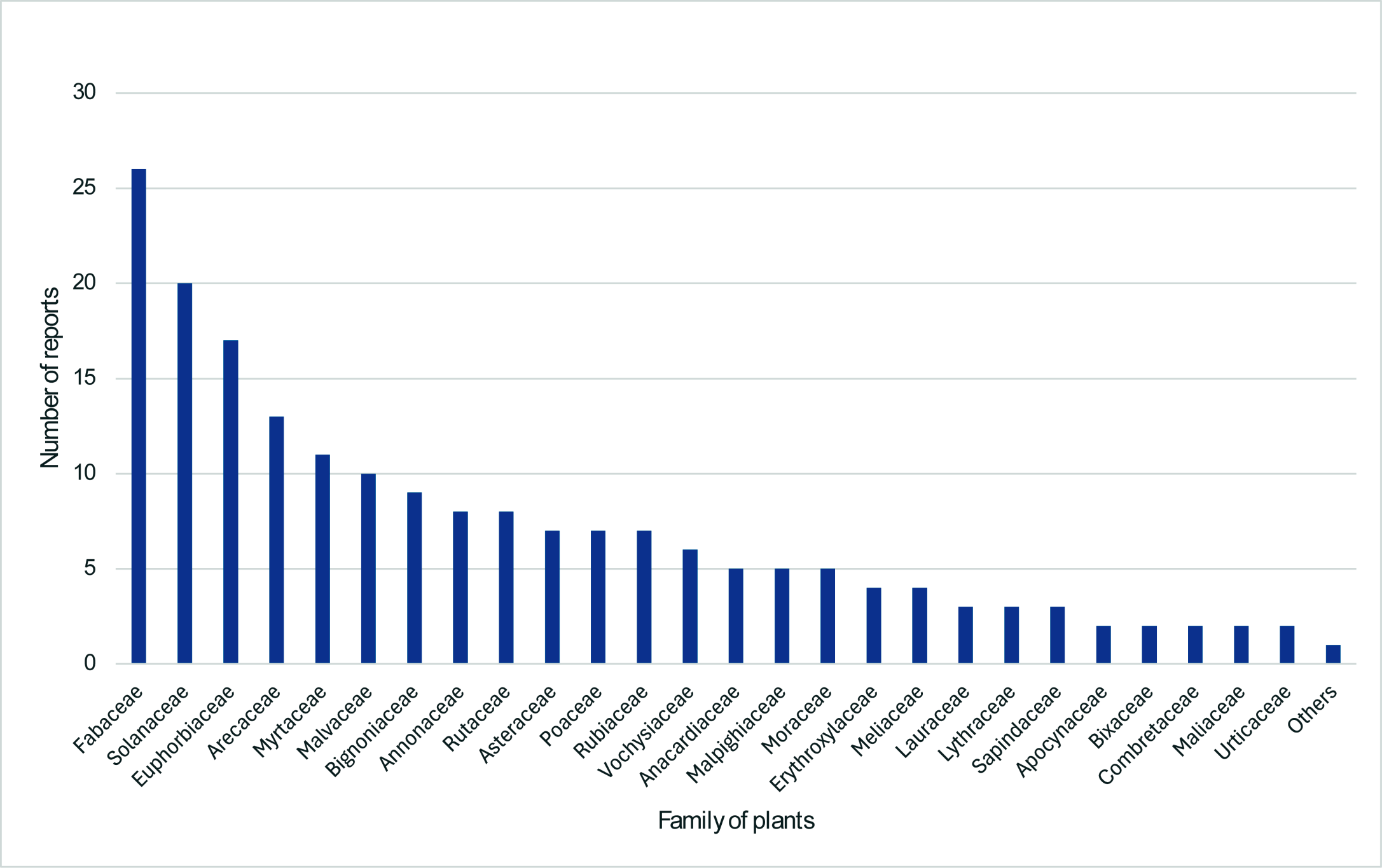
The families with the highest occurrence are Fabaceae, Solanaceae, Euphorbiaceae and Arecaceae (Figure 3). Among host plants, many are of economic importance, such as: coffee (Mineiro et al. 2006a, b), coconut (Barroso et al. 2019), citrus (Ferreira et al. 2018), banana (Barroso et al. 2019), rubber tree (Daud and Feres 2013), grapevine (Domingos et al. 2014), peach (Montes et al. 2011), jatropha (Lofego et al. 2013), guava (Denmark and Muma 1970) and tomato (Furtado et al. 2014). In the literature this species was more reported in rubber trees (12 reports), guava (8 reports), coffee (8 reports), citrus (5 reports) and peach (5 reports) (Table 1).
These plants, in monoculture systems, often present phytophagous mite pests, such as Raoiella indica Hirst on coconut and banana cultivars, Brevipalpus phoenicis (Geijskes) on citrus and coffee plantations, Tenuipalpus heveae Baker on rubber tree plantations, among others. E. citrifolius has previously been reported in the literature as co-occurring with all these species (Demite and Feres 2005; Bellini et al. 2008; Montes et al. 2012; Abreu et al. 2014; Mineiro and Raga 2020; Barroso et al. 2019; Ferla et al. 2023). In studies showing its co-occurrence with R. indica (Barroso et al. 2019) and in those with B. phoenicis (Montes et al. 2012; Abreu et al. 2014), E. citrifolius was the most abundant predatory mite. Furthermore, Montes et al. 2012 suggest that the presence of this predator in peach orchards may have accounted for the low density of phytophagous mites found in their study.
In addition, this predator occurs in several plants considered reservoirs and commonly used in intercropping systems, such as Inga edulis Mart. (Fabaceae) (Ferla et al. 2023), Swietenia macrophylla King (Meliaceae) (Demite et al. 2021), Urochloa brizantha (A.Rich.) R.D.Webster (Poaceae) (Lofego et al. 2009). Thus, understanding this predator's locomotion across different environments and plant communities, and especially its impact on pest species, is fundamental.
Morphological and molecular characterizations
Denmark and Muma (1970) described E. citrifolius from specimens collected in Asunción, Paraguay. Following this work, twelve other studies presented new morphological data, such as structural measurements of the populations studied and illustrations, for this species (Moraes and McMurtry 1983; Feres and Moraes 1998; Gondim and Moraes 2001; Noronha and Moraes 2002; Lofego et al. 2004; Guanilo et al. 2008 a, b; Lofego et al. 2009; Demite et al. 2017; Lofego et al. 2024; Castro et al. 2024). All these studies demonstrate the existence of intraspecific morphological variability, as initially observed by Noronha and Moraes (2002). The variation was less or equal to 10% in comparison with the original description for shields and about 10 or 15% for setaes, but always the difference was less than 10 µm. This difference could be considered a normal intraspecific variation (Tixier 2013).
Noronha and Moraes (2002) suggested that morphological variation may be linked to the geographical differentiation, with an effect of the location where the population was collected. This hypothesis is consistent with observations in literature for this species and shown in Table 2. These data (Table 2) show that in comparison with the original description population, the population of São Paulo, Peru and Argentina has the longer body length. Besides that, populations from the state of São Paulo tend to have slightly longer body length than populations from other regions of Brazil, especially in comparison with regions geographically more distant. One possible explanation for this is that abiotic factors like altitude, temperature, seasonality and precipitation can influence the body size (Yu et al. 2025; Tixier et al. 2003). The effect of temperature in morphology was demonstrated for Euseius concordis (Chant) (Lopes et al. 2018) and Amblydromalus limonicus (Garman & McGregor) (Vangansbeke et al. 2020). In both studies the mites have higher body length at low temperatures. This can explain part of the variation morphology found in this review.
In addition to local climatic characteristics, another factor that could explain the differences found would be the diet of these mites in natura. Ferreira et al. (2021) observed that for Neoseiulus tunus (De Leon), diet plays an important role in modifying morphological measurements, both of shields (ventrianal shield and width of dorsal shield) and setae. This same observation was made by Lopes et al. (2018) for E. concordis. Besides that, the host plants can influence in the morphological variation, as suggested for Typhlodromus (Anthoseius) recki Wainstein (Tixier et al. 2021) and Kampimodromus aberrans (Oudemans) (Tixier et al. 2003). Thus, given that morphological measurements can apparently vary with the environment in which an individual lives, characterizing the extent of this intraspecific variation is extremely important, as these measurements are used as diagnosis for species differentiation. Furthermore, it would be interesting to verify whether there are differences in bioecological parameters between these populations with different morphological traits.
Although morphological variability exists in E. citrifolius, molecular studies based on ITS1 and ITS2 markers also suggest that this represents intraspecific variation, given the low or nonexistent genetic difference between the populations studied (Noronha et al. 2003). However, molecular studies using other markers to provide taxonomic information, including for other populations, might be interesting to carry out.
Another molecular characterization of E. citrifolius was, conducted by Santos and Tixier (2018), in which they considered six molecular markers to elucidate the likely ancestral region and phylogenetic relationships of the Euseiini tribe. This study indicates that the ancestor of the genus Euseius is possibly from the Neotropical region. Furthermore, the authors classified as belonging to Clade I and with a higher occurrence in the plant families Euphorbiaceae, Rosaceae, Rutaceae, and Solanaceae. These same families were found here for E. citrifolius, but the highest records are Fabaceae, Solanaceae, Euphorbiaceae and Arecaceae. Across all these families, E. citrifolius is recorded on both cultivated plants (majority) and non-cultivated ones. Furthermore, the species was found on 30 native plant species belonging to the families Euphorbiaceae (15) and Solanaceae (15) (Table 1). These records align with the findings of Santos and Tixier (2018), indicating that these families may be associated with the center of diversification for Euseiini species in South America.
Download as *States of Brazil: PE= Pernambuco, BA= Bahia, CE= Ceará **States of Brazil: MS= Mato Grosso do Sul, MG= Minas Gerais, PB= Paraíba, PR= Paraná, RS= Rio Grade do Sul e SP= São Paulo LDS: Length of dorsal shield; WDS: Width of dorsal shield; WVAS – Z2 level: Width of ventrianal shield at Z2 level; WVAS: Width of ventrianal shield at anus level; LVAS: Length of ventrianal shield.
Denmark and Muma 1970
Moraes and Mcmurtry 1983
Moraes et al. 1991
Feres and Moraes 1998
Gondim and Moraes 2001
Noronha and Moraes 2002
Lofego et al. 2004
Guanilo et al. 2008b
Guanilo et al. 2008a
Lofego et al. 2009
Demite et al. 2017
Lofego et al. 2024
Castro et al. 2024
Morphological structure
Paraguay
PE, BA, CE, Brazil*
Nicaragua
São Paulo, Brazil
São Paulo, Brazil
Paratype
Rio Grande do Sul, Brazil
São Paulo, Brazil
São Paulo, Brazil
Argentina
Peru
São Paulo, Brazil
Minas Gerais and Goiás, Brazil
MS, MG, PB, PI, PR, RS, SP, Brazil**
Rio Grande do Sul, Brazil
LDS
315
315
306 (305- 307)
-
324 (315–331)
312
326 (317 - 338)
321 (313-327)
320 (313–335)
325 (313–338)
345 (330-363)
322 (315–337)
313 (297–330)
316 (293–342)
295-318
WDS
223
207
211
-
234 (229–237)
230
233 (22 1 - 246)
230 (224 - 240)
222 (205–243)
225 (225–225)
243 (225-263)
221 (215–230)
210 (202–235)
212 (191–235)
211-219
Setae
j1
28
25
23 (22- 24)
28 (27-30)
28 (26–32)
22
25 (24 - 27)
27 (26 - 27)
27 (23–30)
26 (24–30)
31 (27–35)
28 (27–29)
28 (25– 30)
26 (24–30)
25-26
j3
30
24
18 (17-19)
-
26 (24–29)
23
25 (22 - 27)
23 (22 - 24)
28 (23–35)
30 (29–32)
34 (29-37)
30 (28–31)
27 (23–31)
26 (21–33)
21-26
j4
7
13
12 (10-14)
13 (11-14)
13 (12–14)
13
12 (11 -14)
11 (11 - 12)
13 (13–15)
14 (13–15)
16 (14-18)
14 (13–15)
14 (12–15)
13 (10–16)
11-13
j5
8
13
12 (10-14)
12 (11-14)
14 (13–15)
13
12 (11 - 14)
12 (11 - 14)
13
13 (12–14)
16 (13-18)
15 (13–16)
14 (12–15)
13 (10–17)
9-14
j6
8
14
12
15 (14-16)
15 (14–16)
13
13 (11 - 14)
13 (11 - 14)
13 (13–15)
15 (14–16)
17 (15-18)
16 (15–17)
15 (13–16)
14 (11–17)
13
J2
8
14
12
-
16 (15–16)
14
14 (14 - 14)
14 (14 - 15)
15 (13–18)
16 (15–18)
17 (15-20)
16 (16–17)
16 (15–17)
15 (13–17)
14-17
J5
5
5
7 (6- 7)
-
7 (6–7)
5
5 (5 -7)
5 (5 - 5)
5
6 (6–7)
6 (6-7)
7 (6–9)
6 (6–7)
6 (5–8)
5-7
z2
20
17
14
-
21 (20–22)
18
18 (16 -20)
18 (16 - 19)
20 (18–23)
22 (21–23)
27 (22-30)
21 (20–22)
20 (18– 20)
19 (14–24)
20-21
z4
21
20
14 (14-15)
-
22 (20–23)
20
19 (16- 22)
17 (16 - 19)
22 (18–28)
25 (25–26)
29 (26-30)
24 (18–27)
23 (18–26)
21 (16–27)
24
z5
13
12
12
-
14 (13–15)
13
11 (11 -12)
12 (11 - 14)
13 (10–15)
14 (13–15)
15 (13-16)
15 (13–16)
14 (12–17)
13 (10–16)
13
Z1
13
14
12
-
15 (14–15)
13
14 (12 -14)
14 (12 - 14)
13 (13–15)
15 (13– 16)
18 (15-20)
15 (13–16)
14 (13–15)
14 (11–17)
13
Z4
17
16
13 (12-14)
-
18 (18–19)
15
16 (14 - 16)
15 (14 - 16)
18 (18–20)
18 (17–19)
19 (17-22)
19 (18–20)
17 (16–20)
16 (11–21)
17
Z5
64
56
50 (48- 53)
-
67 (65–70)
60
66 (59 - 70)
66 (62 - 70)
68 (63–75)
67 (63–73)
65 (62-68)
65 (60–70)
66 (60–73)
63 (56–70)
63
s4
39
33
24 (22-26)
-
35 (33–38)
31
33 (30 - 35)
30 (27 - 32)
36 (25–43)
39 (37–41)
38 (33-43)
40 (33–43)
36 (32–40)
34 (27–46)
39-40
S2
19
17
14 (12-17)
-
19 (18–20)
18
18 (16-19)
18 (16 -19)
18 (15–20)
19 (18–20)
22 (20–26)
20 (18–22)
19 (17–20)
18 (11–22)
18-20
S4
20
18
17 (14-19)
-
21 (19–22)
18
20 (16 - 22)
19 (16- 19)
22 (20–25)
21 (19–22)
25 (21–30)
23 (19–25)
21 (19–23)
20 (16–25)
18-21
S5
27
22
18 (17-19)
-
29 (27–32)
23
26 (19 - 30)
25 (22 - 27)
29 (25–33)
27 (26–30)
29 (28–30)
27 (25–32)
26 (23–29)
25 (19–32)
25-26
r3
11
17
14
18 (16-22)
20 (20–21)
18
18 (16-19)
18 (16-19)
18 (15–20)
17
20 (17– 21)
19 (15–21)
19 (18–22)
17 (14–21)
19
R1
8
13
11 (10-12)
15 (14-16)
15 (14–15)
13
13 (11 -14)
13 (11 - 14)
13 (10–15)
13
15 (13–17)
16 (14–20)
15 (13–16)
14 (10–16)
11-15
Sge I
-
-
-
-
19
18
16 (14-19)
15 (14- 16)
18
21 (20–23)
26 (20–31)
22 (20–24)
20 (18–21)
17 (14–19)
Sge II
-
-
21 (19-22)
-
24 (23–24)
19
20 (19 - 22)
20 (19 - 22)
23 (23–25)
24 (22–26)
25 (20–30)
22 (20–23)
22 (20–24)
20 (16–25)
Sge III
-
-
25 (24-26)
-
30 (29–31)
23
25 (19 - 27)
26 (24 - 28)
28 (28–30)
26 (26–27)
29 (24–35)
26 (25–27)
27 (24–30)
25 (22–32)
Sti III
-
-
22
-
24 (23–25)
20
21 (19- 22)
22 (20 - 24)
25 (23–25)
24 (24–25)
26 (23–29)
23 (22–24)
22 (19–24)
21 (17–25)
Sge IV
47
37
39 (36-41)
44 (41-46)
45 (43–48)
38
40 (32 - 43)
41 (38 - 46)
44 (40–45)
43 (42–45)
47 (40–53)
43 (41–44)
43 (40–47)
41 (35–49)
34-44
Sti IV
34
29
28 (26-31)
34 (32-35)
37 (35–38)
28
28 (27 - 30)
30 (27 - 32)
32 (28– 38)
31 (28–33)
33 (30–36)
32 (32–33)
32 (29–39)
30 (25–43)
26-30
St IV
58
53
50 (48-53)
60 (57 - 62)
63 (60–65)
51
56 (49 - 62)
55 (53 - 59)
61 (53–68)
59 (57–62)
60 (57–64)
56 (54–58)
60 (55–65)
57 (52–64)
50-53
ST1 - ST3
-
-
53
-
57 (56–57)
55
55 (51 - 57)
52(5 1 -54)
56 (55–58)
56 (54–57)
57 (53–63)
58 (54–61)
56 (54–59)
55 (48–59)
57-58
ST2- ST2
-
-
65
-
69 (69–70)
65
64 (62 - 65)
66 (65 - 68)
67 (65–70)
66 (62–68)
65 (55–74)
71 (68– 79)
67 (63–70)
67 (64–80)
71-72
ST5-ST5
-
-
70
-
76 (74–78)
72
70 (68 -73)
70 (68 - 73)
76 (73–80)
70 (66–77)
90 (87–95)
76 (72–83)
74 (67–81)
74 (64–84)
76-81
WVAS -Z2 level
-
-
50 (48-53)
-
51 (49–54)
48
54 (49 - 57)
50 (46 - 54)
50 (45–53)
52 (50–53)
53 (50–63)
55 (50–60)
51 (43– 56)
50 (45–62)
53-57
WVAS
-
-
66 (62-72)
-
75 (73–78)
72
75 (73 - 76)
75 (70 -76)
72 (68–75)
73 (65–78)
76 (70–85)
73 (70–77)
73 (70–76)
69 (60–76)
62-67
LVAS
-
-
93 (89-98)
-
106 (102–110)
100
102 (97 - 105)
103 (97 - 105)
102 (98–108)
102 (100– 105)
107 (98–118)
105 (102–108)
103 (100–114)
101 (90–107)
99
Calyx of spermatheca
-
-
21 (19-22)
-
18 (16–20)
18
21 (18 -24)
21 (19 - 22)
17 (15–20)
21 (20–21)
18 (15–21)
22 (21–23)
18 (16–22)
17 (14–19)
17-18
D.F
-
-
-
-
24
22
24 (22 - 27)
24 (22 - 24)
-
26 (25-26)
28 (27–29)
25 (24–27)
26 (25–26)
22 (22–25)
24-26
D.M
-
-
-
-
24
22
23 (22 - 24)
22 (22 - 23)
-
23
25 (24–26)
23 (21–24)
25 (24–26)
23 (22–24)
22-25
Download as
Prey
Prey stages
Predation rate (Prey consumed/female/day)
Reference
Brevipalpus phoenicis
Gravena et al. 1994
(5 prey offered)
Adult
2
(10 prey offered)
Adult
2.3
(15 prey offered)
Adult
3.1
(20 prey offered)
Adult
4.6
Oligonychus ilicis
Franco et al. 2010
(with web)
Egg
0.4 ± 0.22
Larvae
13.5 ± 0.52
Nymph
11.6 ± 1.0
Adult
5.9 ± 0.48
(without web)
Egg
3.8 ± 0.93
Larvae
22.4 ± 0.88
Nymph
14.3 ± 1.10
Adult
5.5 ± 0.48
Raoiella indica
Cano 2020
(10 eggs offered)
Egg
4.27 ± 1.58
(20 eggs offered)
Egg
17.1 ± 4.13
(40 eggs offered)
Egg
32.23 ± 0.79
(60 eggs offered)
Egg
33.63 ± 2.17
(80 eggs offered)
Egg
52.03 ± 4.50
Tenuipalpus heveae
Cardoso et al. 2010
Egg
0.4 ± 0.29
Larvae
8.8 ± 1.38
Nymph
6.6 ± 1.04
Adult
2.6 ± 0.63
Tenuipalpus heveae
Mobile stages
31.07 ± 1.03
Amaral 2022
Calacarus heveae
Mobile stages
21.07 ± 1.84
Eutetranychus banksi
Mobile stages
19.2 ± 2.49
Frankliniella sp.
Larvae
2.6 ± 0.3
De Vis et al. 2006
Bioecology
A total of nine studies on bioecological parameters related to E. citrifolius were found. Among them, only four evaluated the complete life cycle of this predatory mite (Moraes and McMurtry 1982; Furtado and Moraes 1998; Amaral 2022; Domingos et al. 2025). In these studies, E. citrifolius was able to complete its development cycle by feeding on the following phytophagous mites: Tetranychus urticae (Koch), Tetranychus pacificus McGregor, Mononychellus tanajoa (Bondar), Oligonychus punicae (Hirst) and Tenuipalpus heveae. Furthermore, Furtado and Moraes (1998) observed that when fed Typha angustifolia L. pollen, E. citrifolius had a shorter generation time and higher rates of reproduction, growth, oviposition, and longevity than when fed T. urticae and M. tanajoa. However, Amaral (2022), in a study with another population and with T. heveae as food, showed even higher rates of reproduction, growth, oviposition, and longevity than those found by Furtado and Moraes (1998) for prey and pollen. Domingos et al. (2025) also demonstrated that E. citrifolius has a higher reproduction rate when fed with O. punicae and T. urticae than with pollen from Ricinus communis L (Euphorbiaceae). Thus, although the populations tested were different and the conditions also, these studies demonstrate that E. citrifolius can complete its life cycle with a variety of foods, including mite pests and pollen.
Six other studies evaluating only E. citrifolius predation on the following prey: Brevipalpus phoenicis (Tenuipalpidae) (Gravena et al. 1994), Oligonychus ilicis (McGregor) (Tetranychidae) (Franco et al. 2010), Tenuipalpus heveae (Tenuipalpidae) (Cardoso et al. 2010; Amaral 2022), Raoiella indica (Tenuipalpidae) (Cano 2020), Calacarus heveae Feres (Eriophyidae) (Amaral 2022), Eutetranychus banksi McGregor (Tetranychidae) (Amaral 2022) and Frankliniella sp. (Thysanoptera: Thripidae) (De Vis et al. 2006) (Table 3). In all these studies, the authors demonstrated that E. citrifolius might possibly play an important role in the control of these pests. Among these studies and among the species tested, the highest predation rate was observed on R. indica (Cano 2020), with a consumption of 52.03 ± 4.50 eggs/female/day. This predation rate is like that found for the predatory mite Neoseiulus barkeri Hughes (56.2 ± 2.0) when fed on this same prey and which is commercially available for inundate biological control of this pest but does not occur naturally in Brazilian and neotropical agroecosystems (Filgueiras et al. 2020). Thus, these studies demonstrate the potential of E. citrifolius as a biological control agent.
Download as
Diet
Type
Oviposition rate (Eggs laid/female/day)
Reference
Tenuipalpus heveae
Mite
2 ± 0.1
Amaral 2022
Mabea fistulifera
Pollen
1.2 ± 0.12
Calacarus heveae
Mite
0.2 ± 0.07
Eutetranychus banksi
Mite
0.5 ± 0.13
Typha angustifolia
Pollen
1.5 ± 0.3
Ricinus communis
Pollen
0.7 ± 0.2
Opuntia cochenillifera
Pollen
1.6 ± 0.2
Syzygium jambos
Pollen
0.8 ± 0.3
Hevea brasiliensis
Nectar
0.1 ± 0.03
H. brasiliensis + O. cochenillifera
Nectar + Pollen
1.2 ± 0.19
Brevipalpus phoenicis
Mite
1.5 ± 0.1
De Vis et al. 2006
Tenuipalpus heveae
Mite
1.1 ± 0.1
Calacarus heveae
Mite
0.08 ± 0.01
Tetranychus urticae
Mite
0.9 ± 0.1
Oligonychus gossypii
Mite
0.5 ± 0.1
Typha angustifolia
Pollen
1.4 ± 0.1
Frankliniella sp.
Trips
0.6 ± 0.1
Raoiella indica
Mite Cano 2020
(10 eggs offered)
0.13 ± 0.13
(20 eggs offered)
0.80 ± 0.50
(40 eggs offered)
2.17 ± 0.26
(60 eggs offered)
1.37 ± 0.36
(80 eggs offered)
1.43 ± 0.22
De Vis et al. (2006) evaluated the oviposition and survival of E. citrifolius with different foods, namely: B. phoenicis, T. heveae, C. heveae, T. urticae, Oligonychus gossypii (Zacher) and T. angustifolia. They obtained slightly higher oviposition results when E. citrifolius was fed with mites of the family Tenuipalpidae than when fed with pollen from T. angustifolia or mites from the families Tetranychidae and Eriophyidae (Table 4). Similar results were found by Amaral (2022) in which, despite the wide variety of pollens tested (Table 4), E. citrifolius obtained higher oviposition when fed with the mite T. heveae (Tenuipalpidae). Available data demonstrate that the best predation rates for E. citrifolius were achieved when tests were conducted with a high prey density and when the offered prey was Tenuipalpidae. Biological data on this species when fed on T. heveae also demonstrate that this predatory mite could develop using only this prey as food and showed good growth, reproduction, and longevity rates.
In addition to occurring in various regions and hosts, as already indicated previously, studies with an ecological focus have indicated the capacity of E. citrifolius to occur in variable environmental conditions, being able to occur throughout the year in a given area, demonstrating adaptation to climatic variations that occur throughout the year (Lofego and Moraes 2006; Demite et al. 2011; Abreu et al. 2014). The species is also found in diverse biomes -such as Atlantic Forest, Amazon, Caatinga, Pantanal, and Cerrado (Zacarias and Moraes 2001; Lofego and Moraes 2006; Demite et al. 2011; 2017; Rezende and Lofego 2011; Mendonça et al. 2019; Conceição et al. 2021; Rodrigues et al. 2020), in well as in uncultivated areas (Feres et al. 2007; Lofego and Moraes 2006; Lofego et al. 2017; Demite et al. 2011; 2013), or more disturbed environments, such as agroecosystems and even urban areas (Daud and Feres 2005; Montes et al. 2012; Abreu et al. 2014; Lofego et al. 2013). Furthermore, studies show that E. citrifolius can be present in environments and on plants with insecticide applications (Hesketh and Sato 2023), showing a possible adaptability of this predator, as already shown for other predatory mites (Argolo et al. 2014; Salman et al. 2015; Serra et al. 2026). Bioecological data indicate that E. citrifolius is a resilient predatory mite that could exert pest control across diverse environment, making it a key species in conservation biological control. Other Euseius species have proven important in controlling multiple pests; for instance, Euseius stipulatus (Athias-Henriot) and Euseius sojaensis (Ehara) are significant in citrus orchard. Euseius stipulatus has been successfully used in classical biological control programs in Peru (Vásquez et al. 2023; Santana-Mayorga et al. 2025) and the United States (McMurtry et al. 2015). However, it yielded less successful results against E. banksi in Spanish citrus orchard, likely due to the consumption of alternative food sources and intraguild predation (Abad-Moyano et al. 2010; López-Olmos and Ferragut 2024). Euseius sojaensis has proven important for the conservation biological control of Panonychus citri (McGregor) (Acari: Tetranychidae) and Aculops pelekassi (Keifer) (Acari: Eriophyidae) in Japan, demonstrating population growth and successful pest control when supported by pollen-producing plants (Tsuchida and Masui, 2025). Meanwhile, Euseius amissibilis Meshkov showed promise in controlling Trialeurodes vaporariorum (Gennadius) (Hemiptera: Aleyrodidae) and Frankliniella occidentalis (Pergande) on greenhouse roses; however, in semi-field trials involving pollen, it failed to effectively control thrips while maintaining efficacy against whiteflies (Van Houten et al. 2016). Thus, understanding the field behavior of a predatory species, particularly a generalist like those in the Euseius genus, is crucial for establishing its effectiveness as a biological control agent. Therefore, further field studies on E. citrifolius are needed to better evaluate its role in maintaining control over phytophagous mites.
Conclusions
In general, this review demonstrates that most studies involving E. citrifolius focus on occurrence records, indicating a wide distribution in Brazil and with some records in other countries like: Argentina, Colombia, Paraguay, Peru and Nicaragua. We also observed that this predator is most commonly found on the plant families Fabaceae, Solanaceae, Euphorbiaceae, and Arecaceae and the species compiled in this review can be used as a guide for searching for this species in natura, or for choosing the best plants as reservoirs in integrated cropping programs.
There are also a good number of studies on morphological characterization, thus allowing the recognition of morphological variations and facilitating the identification of this species.
Bioecological studies have shown that, in addition to being frequent, E. citrifolius is often the most abundant predator in some environments. Furthermore, these studies demonstrate that this predator can complete its life cycle and have a population increase by consuming various types of prey and pollen. Judging by the studies already carried out, considering the frequency, abundance, and predation potential of phytophagous mites, it is presumed that E. citrifolius could play a role in the control of mite pests in some preserved environments and agroecosystems.
Despite this, important information is lacking for this predator to be used in pest control programs, such as field studies, with no studies having been performed, as well as more studies on food preferences. Since this predator is a generalist, it is also important to understand its predation potential in relation to different types of prey that have not yet been studied, to understand its possible range of action, as well as to verify its acceptance of alternative foods to improve mass breeding strategies and maintain the predator in the field.
Another gap in knowledge about this species is the molecular characterization of populations. In our searches, we found only one study on the subject, and in that study, only two nuclear markers were used. Thus, studies involving mitochondrial markers to better assess molecular differences between populations would be interesting.
Finally, we can conclude that E. citrifolius is an abundant species that have demonstrated a good predatory capacity, especially with Tenuipalpidae mites. This reinforces the potential of this species as a natural enemy of various agricultural pests and the importance of including it in pest management programs.
Acknowledgements
We would like to thank the Coordination Foundation for the Improvement of Higher Education Personnel (CAPES) – Finance Code 001 for the financial support of this study. Additionally, A.C. Lofego received a research productivity fellowship from CNPq [Proc. no. 310937/2025-6].
References
- Abad-Moyano R., Urbaneja A., Schausberger P. 2010. Intraguild interactions between Euseius stipulatus and the candidate biocontrol agents of Tetranychus urticae in Spanish clementine orchards: Phytoseiulus persimilis and Neoseiulus californicus. Exp. Appl. Acarol., 50: 23-34. https://doi.org/10.1007/s10493-009-9278-7
- Abreu F. A., Reis P. R., Marafeli P. P., Silva R. A., Bernardi L. F. O., Carvalho C. F. 2014. Influence of rainfall on mite abundance in coffee. Coffee Science, 9 (3): 329-335.
- Amaral F. S. R. 2022. Potencial de fitoseídeos (Acari: Phytoseiidae) como agentes de controle biológico de três espécies de ácaros fitófagos em seringueira. [Phd Thesis]. São Paulo: Unesp. pp. 92.
- Araújo F. G., Lima E. L., Costa, E., Daud R. D. 2022. Influence of natural vegetation conservation on the distribution of mites in rubber tree crops. Syst. Appl. Acarol., 27 (8):1629-1647. https://doi.org/10.11158/saa.27.8.13
- Argolo P.S., Jacas J.A., Urbaneja A. 2014. Comparative toxicity of pesticides in three phytoseiid mites with different life-style occurring in citrus: Euseius stipulatus, Neoseiulus californicus and Phytoseiulus persimilis. Exp. Appl. Acarol., 62(1): 33-46. https://doi.org/10.1007/s10493-013-9726-2
- Baldo F. B., Mineiro J. L. C., Raga A. 2018. Diversity and population dynamics of mites in peach and plum trees (Rosaceae) in the Southwest State of São Paulo, Brazil. Int. J. Acarol., 44 (2-3):129-137. https://doi.org/10.1080/01647954.2018.1436589
- Barbosa F. R., Gondim JR. M. G. C., Moreira W. A., Alencar J. A., Souza E. A., Silva C. S. B., Souza A. M., Miranda I. G. 2005.Arthropods-pest and predators associated with mango trees at the Vale do São Francisco, Northestern Brazil. Neotrop. Entomol, 34 (3): 471-474. https://doi.org/10.1590/S1519-566X2005000300016
- Barroso G., Rocha C. M., Moreira G. F., Hata F. T., Roggia S., Ventura M. U., Pasini A., Silva J. E. P., Holtz A. M., Moraes G. J. 2019.What is the southern limit of the distribution of red palm mite, Raoiella indica (Acari: Tenuipalpidae), in agricultural lands in Brazil? Fla. Entomol.,102 (3): 581-585. https://doi.org/10.1653/024.102.0334
- Bellini M. R., Feres R. J. F., Buosi R. 2008. Mites (Acari) from rubber trees (Hevea brasiliensis Muell. Arg., Euphorbiaceae) and spontaneous euphorbiaceous in rubber trees cultivation. Neotrop. Entomol., 37 (4); 463-471. https://doi.org/10.1590/S1519-566X2008000400016
- Bellini M. R., Moraes G. J., Feres R. J. F. 2005a. Mites (Acari) of two cultivation systems adopted in northwestern State São Paulo. Neotrop. Entomol., 34 (3): 475-484. https://doi.org/10.1590/S1519-566X2005000300017
- Bellini M. R., Moraes G. J., Feres R. J. F. 2005b.Weeds as alternative substrates to phytoseiids (Acari, Phytoseiidae) in rubber tree Hevea brasilienis, Muell. Arg. (Euphorbiaceae) cultivation. Rev. Bras. Zool., 22: 35-42. https://doi.org/10.1590/S0101-81752005000100005
- Buosi R., Feres R. J. F., Oliveira A. R., Lofego A. C., Hernandes F. A. 2006. Plant inhabiting mites (Acari) of the ''Estação Ecológica de Paulo de Faria'', State of São Paulo, Brazil. Biota Neotrop., 6. https://doi.org/10.1590/S1676-06032006000100009
- Cano L. M. G. 2020. Diversity and biological control of mites on banana plants in different regions of the state of São Paulo. [Master's thesis]. São Paulo: Instituto Biológico. pp.71.
- Cardoso M. S. M., Vieira M. R., Figueira J. C., Silva H. A. S. 2010. Predatory activity of Euseius citrifolius Denmark & Muma (Acari: Phytoseiidae) on Tenuipalpus heveae Baker (Acari: Tenuipalpidae). Arq. Inst. Biol.,77 (3): 471-476. https://doi.org/10.1590/1808-1657v77p4712010
- Castro E. B., Vieira M. R. 2011. Acarofauna (Arachnida, Acari) associated to Genipa americana L. (Rubiaceae) in Ilha Solteira, São Paulo. Rev. Biol. Neotrop., 8: 33-39. https://doi.org/10.5216/rbn.v8i1.13664
- Castro I. S., Azevedo, A. O., Vinhas N. A. N., Schlemer S. M., Wurlitzer W. B., Freitas E. M., Heiden G., Ferla N. J. 2024. Phytoseiid mites associated with Asteraceae plants in the Pampa biome with description of two new species. Int. J. Acarol., 50 (7): 570-586. https://doi.org/10.1080/01647954.2024.2387717
- Castro T. M. M. G., Moraes G. J. 2010. Diversity of phytoseiid mites (Acari: Mesostigmata: Phytoseiidae) in the Atlantic Forest of São Paulo. Syst. Biodivers., 8 (2): 301-307. 10.1080/14772001003801375 https://doi.org/10.1080/14772001003801375
- Conceição E. M., Demite P. R., Rezende J. M., Carniello M. A., Lofego A. C. 2021. Phytoseiidae (Acar: Parasitiformes: Mesostigmata) inhabiting native plants from three biomes in Mato Grosso State, Brazil, with description of a new species. Syst. Appl. Acarol., 26 (12): 2268-2286. https://doi.org/10.11158/saa.26.12.6
- Daud R. D., Feres R. J. F. 2005. Diversity and Fluctuation of Mites Population (Acari) on Mabea fistulifera Mart. (Euphorbiceae) in Two Semideciduos Forest Remnants in São José do Rio Preto, State of São Paulo, Brazil. Neotrop. Entomol., 34 (2): 191-201. https://doi.org/10.1590/S1519-566X2005000200007
- Daud R. D., Feres R. J. F. 2013. Community structure of mites (Arachnida: Acari) in six rubber tree clones. Int. J. Acarol., 39 (8): 589-596. https://doi.org/10.1080/01647954.2013.856470
- Daud R. D., Feres R. J. F., Buosi R. 2007. Mites (Acari: Arachnida) associated with Bauhinia variegata L. (Leguminosae) in northeast of State of São Paulo, Brazil. Neotrop. Entomol., 36 (2): 322-325. https://doi.org/10.1590/S1519-566X2007000200025
- Daud R. D., Silva E. R. O., Feres R. J. F. 2010. Influence of Cecropia pachystachya on the incidence of mites (Arachnida, Acari) and Leptopharsa heveae (Insecta, Hemíptera) in rubber tree plantations. Rev. Biol. Neotrop., 7 (2): 49-60.
- De Vis R. M. J., Moraes G. J., Bellini M. R. 2006. Mites (Acari) of Rubber Trees (Hevea brasiliensis Muell. Arg., Euphorbiaceae) in Piracicaba, State of São Paulo, Brazil. Neotrop. Entomol., 35: 112-120. https://doi.org/10.1590/S1519-566X2006000100015
- Demite P. R. Lofego A. C., Feres R. J. F. 2011. Phytoseiidae (Acari) in forest fragments in the State of São Paulo Brazil. Zootaxa, 3086: 31-56. https://doi.org/10.11646/zootaxa.3086.1.2
- Demite P. R., Dias M. A., Cavalcante A. C. C., Ramos M. V. V., Lofego A. C. 2017. Phytoseiid mites (Acari: Mesostigmata: Phytoseiidae) associated with Cerrado biome plants in Brazil, with description of a new species. Syst. Appl. Acarol., 22 (12): 2141-2177. https://doi.org/10.11158/saa.22.12.9
- Demite P. R., Feres R. J. F. 2005. Influence of neighboring vegetation in the distribution of mites in a rubber tree culture (Hevea brasiliensis Muell. Arg., Euphorbiaceae) in São José do Rio Preto, SP, Brazil. Neotrop. Entomol., 34 (5): 829-836. https://doi.org/10.1590/S1519-566X2005000500016
- Demite P. R., Feres R. J. F. 2007. Occurrence and fluctuation of mite populations associated with rubber tree crop neighbor of fragments of cerrado. Neotrop. Entomol., 36: 117-127. https://doi.org/10.1590/S1519-566X2007000100015
- Demite P. R., Feres R. J. F., Lofego A. C. 2015. Influence of agricultural environment on the plant mite community in forest fragments. Braz. J. Biol., 75 (2): 369-404. https://doi.org/10.1590/1519-6984.14913
- Demite P. R., Feres R. J. F., Lofego A. C., Oliveira A. R. 2009. Plant inhabiting mites (Acari) From the Cerrado biome of Mato Grosso State, Brazil. Zootaxa, 2061: 45-60. https://doi.org/10.11646/zootaxa.2061.1.3
- Demite P. R., Lofego A. C., Feres R. J. F. 2013. Mite (Acari; Arachnida) diversity of two native plants in fragments of a semideciduous seasonal forest in Brazil. Syst. Biodivers., 11 (2): 141-148. https://doi.org/10.1080/14772000.2013.806368
- Demite P. R., Moraes G. J., McMurtry J. A., Denmark H. A., Castilho R. C. 2026. Phytoseiidae Database [Internet]. Available from: \textless www.lea.esalq.usp.br/phytoseiidae>
- Demite P. R., Rezende J. M., Lofego A. C., Amaral F. S. R., Barreto M. R., Moraes G. J. 2021. Phytoseiid mites (Acari: Mesostigmata: Phytoseiidae) from Mato Grosso State, Central Western Brazil. An. Acad. Bras. Cienc., 93: e20200729. https://doi.org/10.1590/0001-3765202120200729
- Denmark H. A., Muma M. H.1970. Some phytoseiid mites of Paraguay (Phytoseiidae: Acarina). Fla. Entomol., 53 (4): 219-227. https://doi.org/10.2307/3493192
- Domingos C. A., Melo A. S., Matheus M. L. T., Oliveira J. E. M., Melo J. W. S., Gondim Jr M. G. C. 2025. Differences in the effects of pollen and prey-based diets on the biological performance of Euseius citrifolius (Acari: Phytoseiidae): an important predator for phytophagous mites management in grapevines. Exp. Appl. Acarol., 95, 16: 1-10. https://doi.org/10.1007/s10493-025-01044-4
- Domingos C. A., Melo J. W. S., Oliveira J. E. M., Gondim Jr., M. G. C. 2014. Mites on grapevines in northeast Brazil: occurrence, population dynamics and within plant distribution. Int. J. Acarol., 40 (2):145-151. https://doi.org/10.1080/01647954.2014.891651
- Escobar- Garcia H. A., Andrade D. J., Beard J. J., Ochoa R. 2024. Peacock mites on cannon-ball tree, Couroupita guianensis (Lecythidaceae) in the Southeast Region of Brazil. Acarologia, 64 (4): 1138-1148. https://doi.org/10.24349/a2ld-gvdp
- Feres R. J. F. 2000. Survey and naturalistic remarks on the acarological fauna (Acari, Arachnida) from Hevea spp. (Euphorbiaceae) in Brazil. Rev. Bras. Zool., 17:157-173. https://doi.org/10.1590/S0101-81752000000100011
- Feres R. J. F., Bellini M. R., Rossa-Feres D. C. 2003. Occurrence and diversity of mites (Acari, Arachnida) associated with Tabebuia roseo-alba (Ridl.) Sand (Bignoniaceae), from São José do Rio Preto, São Paulo State, Brazil. Rev. Bras. Zool., 20 (3): 373-378. https://doi.org/10.1590/S0101-81752003000300002
- Feres R. J. F., Buosi R., Daud R. D., Demite P. R. 2007. Ecological patterns of the mite community on euphorbiaceous plants from a Semidecidual forest remnant in the State of São Paulo. Biota Neotrop., 7 (2):185-194. https://doi.org/10.1590/S1676-06032007000200022
- Feres R. J. F., Flechtmann C. H. W. 1995. Mites (Acari) associated with bamboo (Bambusa sp.) in a woody area from northwestern São Paulo State, Brazil. Rev. Bras. Zool., 12 (3): 533-546. https://doi.org/10.1590/S0101-81751995000300008
- Feres R. J. F., Moraes G. J. 1998. Phytoseiid mites (Acari: Phytoseiidae) from woody areas in the State of Sao Paulo, Brazil. Syst. Appl. Acarol., 3:125-132. https://doi.org/10.11158/saa.3.1.20
- Feres R. J. F., Nunes M. A. 2001. Mites (Acari, Arachnida) associated with weed Euphorbiaceae in monoculture planting of the amazonian rubber tree (Hevea Braziliensis Muell. Arg., Euphorbiaceae) n Northwestern São Paulo State, Brazil. Rev. Bras. Zool., 18 (4): 1253-1264. https://doi.org/10.1590/S0101-81752001000400020
- Feres R. J. F., Rossa-Feres D., Daud R. D., Santos R. 2002. Mites diversity (Acari, Arachnida) from rubber tree (Hevea brasiliensis Muell. Arg., Euphorbiaceae) in Northwestern of São Paulo State, Brazil. Rev. Bras. Zool., 19: 137-144. https://doi.org/10.1590/S0101-81752002000100011
- Feres R. J. F., Vieira M. R., Daud R. D., Pereira Jr. E. G. Oliveira G. F., Dourado C. L. 2009. Mites (Arachnida, Acari) on ornamental plants in northwestern São Paulo, Brazil: occurrence and injury caused by phytophagous species. Rev. Bras. Entomol., 53 (3): 466-474. https://doi.org/10.1590/S0085-56262009000300024
- Ferla J. J., Araújo G. J., Venzon M., Nascimento P. H. M. G., Kalile M. O., Pancieri S. D., Cardoso A. C., Martins E. F., Ferla N. J., Pallini A. 2023. Intercropped Plants Provide a Reservoir of Predatory Mites in Coffee Crop. Agriculture, 13, 285: 1-14. https://doi.org/10.3390/agriculture13020285
- Ferla N. J., Moraes G. J. 2002a. Mites (Arachnida, Acari) on rubber tree (Hevea brasiliensis Muell. Arg.) in the State of Mato Grosso, Brazil. Rev. Bras. Zool., 19 (3): 867-888. https://doi.org/10.1590/S0101-81752002000300025
- Ferla N. J., Moraes G. J. 2002b. Predators mites (Acari) in native and cultivated plants of the State of Rio Grande do Sul, Brazil. Rev. Bras. Zool., 19 (4): 1011-1031. https://doi.org/10.1590/S0101-81752002000400006
- Ferreira C. T., Krug C., Garcia M. V.B., Moraes G. J. 2018. Leprosis mite and other mite species (Acari) associated to orange groves in Brazilian Central Amazon. Syst. Appl. Acarol., 23 (3): 449-462. https://doi.org/10.11158/saa.23.3.4
- Ferreira M. M, Nuvoloni F. M, Mondim A. S, Lofego A. C. 2021. Does diet affect morphological parameters of Neoseiulus tunus (De Leon) (Acari: Phytoseiidae)? Acarologia, 61 (2): 486-496. https://doi.org/10.24349/acarologia/20214443
- Fiaboe K. K. M., Gondim Jr. M.G.C., Moraes G.J., Ogol C. K. P. O. 2007. Knapp M. Surveys for natural enemies of the tomato red spider mite Tetranychus evansi (Acari: Tetranychidae) in northeastern and southeastern Brazil. Zootaxa, 1395: 33-58. https://doi.org/10.11646/zootaxa.1395.1.2
- Filgueiras R. M. C., Mendes J. A., Sousa-Neto E. P., Monteiro N. V., Melo J. W. S. 2020. Neoseiulus barkeri Hughes (Acari: Phytoseiidae) as a potential control agent for Raoiella indica Hirst (Acari: Tenuipalpidae). Syst. Appl. Acarol., 25 (4): 593-606. https://doi.org/10.11158/saa.25.4.1
- Franco R., Reis P. R., Zacarias M., Oliveira D. C. 2010. Influence of the Webbing Produced by Oligonychus ilicis (McGregor) (Acari: Tetranychidae) on Associated Predatory Phytoseiids. Neotrop. Entomol., 39: 97-100. https://doi.org/10.1590/S1519-566X2010000100013
- Furtado I. P., Kreiter S., Moraes G. J., De Tixier M. S., Flechtmann C. H. W., Knapp M. 2005. Plant mites (Acari) from Northeastern Brazil, with description of two new species of the family Phytoseiidae (Mesostigmata). Acarologia, 45 (2-3): 131-143.
- Furtado I. P., Moraes G. J. 1998. Biology of Euseius citrifolius, a candidate for the biological control of Mononychellus tanajoa (Acari: Phytoseiidae, Tetranychidae). Syst. Appl. Acarol., 3: 43. https://doi.org/10.11158/saa.3.1.6
- Furtado I. P., Moraes G. J., Kreiter S., Flechtmann C. H. W., Tixier M. S., Knapp M. 2014. Plant inhabiting phytoseiid predators of midwestern Brazil, with emphasis on those associated with the tomato red spider mite, Tetranychus evansi (Acari: Phytoseiidae, Tetranychidae). Acarologia, (4): 425-431. https://doi.org/10.1051/acarologia/20142138
- Furtado I. P., Moraes G. J., Kreiter S., Knapp M. 2006. Search for effective natural enemies of Tetranyhcus evansi in south and southeast Brazil. Exp. Appl. Acarol., 40: 157-174. https://doi.org/10.1007/s10493-006-9045-y
- Furtado I. P., Toledo S., Moraes G. J., Kreiter S., Knapp M. 2007. Search for effective natural enemies of Tetranychus evansi (Acari: Tetranychidae) in northwest Argentina. Exp. Appl. Acarol., 43 (2):121-127. https://doi.org/10.1007/s10493-007-9104-z
- Gondim Jr. M. G. C., Moraes G. J. 2001. Phytoseiid mites (Acari: Phytoseiidae) associated with palm trees (Arecaceae) in Brazil. Syst. Appl. Acarol., 6: 65-94. https://doi.org/10.11158/saa.6.1.11
- Gravena S., Benetoli I., Moreira P.H.R., Yamamoto P.T. 1994. Euseius citrifolius Denmark & Muma predation on citrus leprosis mite Brevipalpus phoenicis (Geijskes) (Acari: Phytoseiidae: Tenuipalpidae). An. Soc. Entomol. Brasil, 23(2): 209-218. https://doi.org/10.37486/0301-8059.v23i2.931
- Guanilo A. D., Moraes G. J., Knapp M. 2008a. Phytoseiid mites (Acari: Phytoseiidae) of the subfamily Amblyseiinae Muma from Peru, with description of four new species. Zootaxa, 1880: 1-47. https://doi.org/10.11646/zootaxa.1880.1.1
- Guanilo A. D., Moraes G. J., Toledo S., Knapp M. 2008b. Phytoseiid mites (Acari: Phytoseiidae) from Argentina, with description of a new species. Zootaxa, 1884: 1-35. https://doi.org/10.11646/zootaxa.1884.1.1
- Hernandes F. A., Feres R. J. F. 2006. Diversity and seasonal occurrence of mites (Acari) in a Rubber Tree Crop (Hevea brasiliensis, Muell. Arg.) in Northwestern São Paulo, Brazil. Neotrop. Entomol., 35 (4): 523-535. https://doi.org/10.1590/S1519-566X2006000400016
- Hesketh P. M., Sato M. E. 2023. Acaricide resistance in predatory mites of the genus Euseius (Acari: Phytoseiidae) and predation capacity on Brevipalpus yothersi (Acari: Tenuipalpidae). Crop Prot. 172: 106322. https://doi.org/10.1016/j.cropro.2023.106322
- Kinlock N.L., Adams D.W., Dawson W., Essl F., Kartesz J., Kreft H., Nishino M., Pergl J., Pyšek P., Weigelt P., van Kleunen M. 2025. Naturalization of ornamental plants in the United States depends on cultivation and historical land cover context. Ecography, 2025(12): e07748. https://doi.org/10.1002/ecog.07748
- Lofego A. C., Demite P. R., Moraes G. J., Kishimoto R. G. 2009. Phytoseiid mites on grasses in Brazil (Acari: Phytoseiidae). Zootaxa, 2240: 41-59. https://doi.org/10.11646/zootaxa.2240.1.3
- Lofego A. C., Moraes G. J. 2006. Mites (Acari) Associated to Myrtaceae in Areas of Cerrado in the State of São Paulo with Faunistic Analysis of Families Tarsonemidae and Phytoseiidae. Neotrop. Entomol., 35 (6): 731-746. https://doi.org/10.1590/S1519-566X2006000600003
- Lofego A. C., Moraes G. J., Castro L. A. 2004. Phytoseiid mites (Acari: Phytoseiidae) on Myrtaceae in the State of São Paulo, Brazil. Zootaxa, 516: 1-18. https://doi.org/10.11646/zootaxa.516.1.1
- Lofego A. C., Rezende J. M., Demite P. R., Feres R. J. F. 2017. Mite fauna associated with Cecropia pachystachya Trec. (Urticaceae) - the importance of the plant as reservoir and dissemination means for predatory mites. Syst. Appl. Acarol., 22 (10): 1780-1794. https://doi.org/10.11158/saa.22.10.16
- Lofego A. C., Rezende J. M., Verona R. L. C., Feres R. J. F. 2013. Mites (Acari) associated with three species of the genus Jatropha (Euphorbiaceae) in Brazil, with emphasis on Jatropha curcas. Syst. Appl. Acarol., 18 (4): 411-423. https://doi.org/10.11158/saa.18.4.10
- Lofego, A. C., Barbosa, M. F. D. C., Demite, P. R., Moraes, G. J. 2024. Phytoseiidae (Acari: Mesostigmata) of the subfamily Amblyseiinae from Brazil. Zootaxa, 5439 (1): 1-306. https://doi.org/10.11646/zootaxa.5439.1.1
- Lopes P. C., Kanno R. H., Sourassou N. F., Moraes G. J. 2018. Effect of temperature and diet on the morphology of Euseius concordis (Acari: Phytoseiidae). Syst. Appl. Acarol., 23 (7): 1322-1332. https://doi.org/10.11158/saa.23.7.9
- López-Olmos S., Ferragut F. 2024. Within-tree distribution and seasonal dynamics of Eutetranychus banksi and Euseius stipulatus (Acari: Tetranychidae, Phytoseiidae) on citrus: Implications for the biological control of the pest. Acarologia, 64(2): 480-498. https://doi.org/10.24349/pv5i-1hqj
- McMurtry J. A., Croft B. A. 1997. Life-styles of Phytoseiid mites and their roles in biological control. Annu. Rev. Entomol., 42: 291-321. https://doi.org/10.1146/annurev.ento.42.1.291
- McMurtry J. A., Moraes G. J. 1989. Some phytoseiid mites from Peru with descriptions of four new species (Acari: Phytoseiidae). Int. J. Acarol., 15 (3): 179-188. https://doi.org/10.1080/01647958908683843
- McMurtry J. A., Moraes G. J., Sourassou N. F. 2013. Revision of the lifestyles of phytoseiid mites (Acari: Phytoseiidae) and implications for biological control strategies. Syst. Appl. Acarol., 18 (4): 297-320. https://doi.org/10.11158/saa.18.4.1
- McMurtry J.A., Sourassou N.F., Demite P.R. 2015. The Phytoseiidae (Acari: Mesostigmata) as Biological Control Agents. In: Carrillo D., de Moraes G.J., Peña J.E. (Eds). Prospects for Biological Control of Plant Feeding Mites and Other Harmful Organisms. Cham: Springer International Publishing. p. 133-149. https://doi.org/10.1007/978-3-319-15042-0_5
- Mendonça A. L., Lofego A. C., Pott A., Daud R. D., Demite P. R. 2019. Phytoseiidae (Parasitiformes: Mesostigmata) from the Pantanal, Mato Grosso do Sul State, Brazil. Syst. Appl. Acarol., 24 (4): 587-612. https://doi.org/10.11158/saa.24.4.6
- Mineiro J. L. C., Raga A. 2020. Mites associated with Citrus latifolia (Rutaceae) from an orchard at Artur Nogueira municipality, São Paulo state, Brazil. Entomol. Commun., 2: ec02014. https://doi.org/10.37486/2675-1305.ec02014
- Mineiro J. L. C., Raga A., Sato M. E., Lofego A. C. 2009. Mites associated with coffee plants (Coffea spp.) in the state of São Paulo, Brazil. Part I. Mesostigmata. Biota Neotrop, 9(1): 37-46. https://doi.org/10.1590/S1676-06032009000100005
- Mineiro J. L. C., Sato M. E., Raga A., Arthur V., Gangani K. G., Barbosa F. V. 2006a. Diversity of mites (Arachnida: Acari) on five cultivars of two species of coffee (Coffea spp.) in Garça, state of São Paulo, Brazil. Arq. Inst. Biol, 73(3): 333-341. https://doi.org/10.1590/1808-1657v73p3332006
- Mineiro J. L. C., Sato M. E., Raga A., Arthur V., Moraes G. J., Sarreta F. O., Carrijo A. 2006b. Diversity of mites (Arachnida: Acari) on Coffea arabica L. cv. ′Mundo Novo′, in Jeriquara and Garça counties, state of São Paulo. Biota Neotrop, 6(2). https://doi.org/10.1590/S1676-06032006000200012
- Montes S. M. N. M., Raga A., Boliani A. C., Mineiro J. L. C., Santos P.C. 2011. Effect of fungicides on the mite fauna of Prunus persica L. cultivars in Presidente Prudente, SP, Brazil. J. Plant Prot. Res, 51(3): 285-293. https://doi.org/10.2478/v10045-011-0047-3
- Montes S. M. N. M., Raga A., Boliani A. C., Mineiro J. L. C., Santos P.C. 2012. Mite fauna (Arachnida: Acari) on peach cultivars in Presidente Prudente, São Paulo, Brazil. J. Plant Stud, 1(2): 173-179. https://doi.org/10.5539/jps.v1n2p173
- Moraes G. J., Alencar J. A., Lima J. L. S., Yaninek J. S., Delalibera Jr. I. 1993. Alternative plant habitats for common phytoseiid predators of the cassava green mite (Acari: Phytoseiidae, Tetranychidae) in northeast Brazil. Exp. Appl. Acarol, 17: 77-90. https://doi.org/10.1007/BF00156945
- Moraes G. J., Barbosa M. F. C., Castro T. M. M. G. 2013. Phytoseiidae (Acari: Mesostigmata) from natural ecosystems in the State of São Paulo, Brazil. Zootaxa, 3700(3): 301-347. https://doi.org/10.11646/zootaxa.3700.3.1
- Moraes G. J., McMurtry J. A. 1981. Biology of Amblyseius citrifolius (Denmark & Muma). Hilgardia, 49(1): 1-29. https://doi.org/10.3733/hilg.v49n01p029
- Moraes G. J., McMurtry J. A. 1983. Phytoseiid mites (Acarina) of northeastern Brazil with descriptions of four new species. Int. J. Acarol, 9(3): 131-148. https://doi.org/10.1080/01647958308683326
- Moraes G. J., Mesa N. C., Braun A. 1991. Some phytoseiid mites of Latin America (Acari: Phytoseiidae). Int. J. Acarol, 17(2): 117-139. https://doi.org/10.1080/01647959108683892
- Moraes G., Flechtmann, C. 2008. Manual de acarologia: Acarologia básica e ácaros de plantas cultivadas no Brasil. Ribeirão Preto: Holos, pp. 288.
- Noronha A. C. S., Moraes G. J. 2002. Intra and interpopulational morphological variations of Euseius citrifolius Denmark & Muma and Euseius concordis (Chant) (Acari, Phytoseiidae). Rev. Bras. Zool, 4(19): 1111-1122. https://doi.org/10.1590/S0101-81752002000400016
- Noronha A. C., Mota A, Moraes G. J., Coutinho L. L. 2003. Molecular characterization of mite populations of Euseius citrifolius Denmark & Muma and Euseius concordis (Chant) (Acari: Phytoseiidae) using sequences of the ITS1 and ITS2 regions. Neotrop. Entomol, 32(4): 591-596. https://doi.org/10.1590/S1519-566X2003000400009
- Nuvoloni F. M., Feres R. J. F., Demite P. R. 2011. Mites associated to Xylopia aromatica (Lam.) Mart. (Annonaceae) in urban and rural fragments of semidecidual forest. Rev. Bras. Entomol, 55(4): 571-577. https://doi.org/10.1590/S0085-56262011000400013
- Oliveira D. C., Moraes G. J., Dias C. T. S. 2012. Status of Aceria guerreronis Keifer (Acari: Eriophyidae) as a pest of coconut in the state of São Paulo, southeastern Brazil. Neotrop. Entomol, 41(4): 315-323. https://doi.org/10.1007/s13744-012-0051-y
- Rezende J. M., Lofego A. C. 2011. Phytoseiidae (Acari: Mesostigmata) on plants of the central region of the brazilian cerrado. Acarologia, 51(4): 449-463. https://doi.org/10.1051/acarologia/20112027
- Rezende J. M., Lofego A. C. 2012. Mites (Mesostigmata, Prostigmata, Astigmatina) associated with weeds among physic nut crops (Jatropha curcas L.: Euphorbiaceae) in Brazil. Syst. Appl. Acarol, 17(1): 15-26. https://doi.org/10.11158/saa.17.1.5
- Rodrigues J. K., Furtado I. P., Lofego A. C. 2020. Mites (Arachnida: Acari) associated with plants of family Myrtaceae from the Caatinga Domain, Brazil. Syst. Appl. Acarol., 25(5): 942-956. https://doi.org/10.11158/saa.25.5.14
- Salman S.Y., Aydınlı F., Ay R. 2015. Etoxazole resistance in predatory mite Phytoseiulus persimilis A.-H. (Acari: Phytoseiidae): Cross-resistance, inheritance and biochemical resistance mechanisms. Pestic. Biochem. Physiol., 122: 96-102. https://doi.org/10.1016/j.pestbp.2014.12.014
- Santana D. L. Q., Flechtmann C. H. W. 1998. Mite (Arthropoda, Acari) associates of palms (Arecaceae) in Brazil. I. Present status and new records. Rev. Bras. Zool, 15(4): 959-963. https://doi.org/10.1590/S0101-81751998000400014
- Santana Mayorga R.C., Vásquez Freitez C., Artieda Rojas J.R., Telenchana N. 2025. Measurement of the efficiency of predation of Phytoseiidae as biological control. Rev. Cient. Salud BIOSANA, 5(1): 64-75. https://doi.org/10.62305/biosana.v5i1.377
- Santos V. V., Tixier M. 2018. Integrative taxonomy approach for analysing evolutionary history of the tribe Euseiini Chant & McMurtry (Acari: Phytoseiidae). Syst. Biodivers, 16(3): 302-319. https://doi.org/10.1080/14772000.2017.1401562
- Serra G, Ripamonti L, Addanki VA, Tirello P, Duso C, Pozzebon A. 2026. Unexpected Persistence of the Predatory Mite Amblyseius andersoni Under Insecticide Exposure in Italian Apple Orchards. Insects, 17(3):338. https://doi.org/10.3390/insects17030338
- Silva E. A., Reis P. R., Zacarias M. S., Marafeli P. P. 2010. Fitoseídeos (Acari: Phytoseiidae) associados a cafezais e fragmentos florestais vizinhos. Ciênc. agrotec, 34(5): 1146-1153. https://doi.org/10.1590/S1413-70542010000500010
- Silva M. Z., Sato M. E., Oliveira C. A. L. 2012. Diversity and population dynamics of mites in citrus orchard. Bragantia, 71(2): 210-218. https://doi.org/10.1590/S0006-87052012005000013
- Sousa J. M., Gondim Jr. M. G. C., Lofego A. C., Moraes G. J. 2015. Mites on Annonaceae species in northeast Brazil and in the state of Para. Acarologia, 55(1): 5-18. https://doi.org/10.1051/acarologia/20152147
- Spongoski S., Reis P. R, Zacarias M. S. 2005. Acarofauna of cerrado's coffee crops in Patrocínio, Minas Gerais. Ciênc. agrotec, 29(1): 9-17. https://doi.org/10.1590/S1413-70542005000100001
- Tixier M.-S. 2018. Predatory Mites (Acari: Phytoseiidae) in Agro-Ecosystems and Conservation Biological Control: A Review and Explorative Approach for Forecasting Plant-Predatory Mite Interactions and Mite Dispersal. Front. Ecol. Evol., 6: 192. https://doi.org/10.3389/fevo.2018.00192
- Tixier M.-S. 2013. Statistical approaches for morphological continuous characters: a conceptual model applied to Phytoseiidae (Acari: Mesostigmata). Zool. Scr., 42(3): 327-334. https://doi.org/10.1111/zsc.12004
- Tixier M.-S., Kreiter S., Cheval B., Auger P. 2003. Morphometric variation between populations of Kampimodromus aberrans (Oudemans) (Acari: Phytoseiidae): Implications for the taxonomy of the genus. Invertebr. Syst., 17(2): 349-358. https://doi.org/10.1071/IS02004
- Tixier M.-S., Martinez S.P., Douin M. 2021. Markers of life history traits: variation in morphology, molecular and amino acid sequences within Typhlodromus (Anthoseius) recki Wainstein (Acari: Mesostigmata: Phytoseiidae). Biol. J. Linn. Soc., 132(1): 53-73. https://doi.org/10.1093/biolinnean/blaa103
- Tsuchida Y., Masui S. 2025. Cover crop providing windborne pollen enhances the efficacy of biocontrol of multiple pests by Euseius sojaensis in citrus orchards. J. Pest. Sci., 98: 1475-1484. https://doi.org/10.1007/s10340-024-01856-0
- Van Houten Y.M., Hoogerbrugge H., Oude Lenferink K., Knapp M., Bolckmans K.J.F. 2016. Evaluation of Euseius gallicus as a biological control agent of western flower thrips and greenhouse whitefly in rose. J. Acarol. Soc. Jpn., 25(S1): 147-159. https://doi.org/10.2300/acari.25.Suppl_147
- Vangansbeke D., Duarte M.V., Gobin B., Tirry L., Wäckers F., De Clercq P. 2020. Cold-born killers: exploiting temperature-size rule enhances predation capacity of a predatory mite. Pest. Manag. Sci., 76(5): 1841-1846. https://doi.org/10.1002/ps.5713
- Vásquez C., Colmenárez Y.C., Greco N., Ramos M. 2023. Current Status of Phytoseiid Mites as Biological Control Agents in Latin America and Experiences from Argentina Using Neoseiulus californicus. Neotrop. Entomol., 52(2): 240-250. https://doi.org/10.1007/s13744-023-01026-4
- Yu B., Pan X., Wu H., Liu D. 2025. Variations in body size and reproductive mode of oribatid mites along an altitudinal gradient in a temperate mountain region. Geoderma, 454: 117173. https://doi.org/10.1016/j.geoderma.2025.117173
- Zacarias M. S., Moraes G. J. 2001. Phytoseiid mites (Acari) associated with rubber trees and other euphorbiaceous plants in southeastern Brazil. Neotrop. Entomol, 30(4): 579-586. https://doi.org/10.1590/S1519-566X2001000400011
to post any comment or correction.


2026-04-16
Date accepted:
2026-09-15
Date published:
2026-10-07
Edited by:
Kreiter, Serge

This work is licensed under a Creative Commons Attribution 4.0 International License
2026 Hernandes, Leticia Molina and Lofego, Antonio Carlos
 Download article
Download the citation
RIS with abstract
(Zotero, Endnote, Reference Manager, ProCite, RefWorks, Mendeley)
RIS without abstract
BIB
(Zotero, BibTeX)
TXT
(PubMed, Txt)