


A new species of the genus Colopalpus Pritchard and Baker (Acari: Tenuipalpidae) from Saudi Arabia
Elgoni, Nasreldeen Ahmed  1
; Mirza, Jawwad Hassan
2
and Alatawi, Fahad Jaber
3
1
; Mirza, Jawwad Hassan
2
and Alatawi, Fahad Jaber
3
1Department of Plant Protection, College of Food and Agriculture Sciences, King Saud University, Riyadh, Saudi Arabia.
2Department of Plant Protection, College of Food and Agriculture Sciences, King Saud University, Riyadh, Saudi Arabia.
3✉ Department of Plant Protection, College of Food and Agriculture Sciences, King Saud University, Riyadh, Saudi Arabia.
2026 - Volume: 66 Issue: 4 pages: 901-908
https://doi.org/10.24349/vrsn-repkZooBank LSID: 555DB184-1B69-4D2D-BAFE-BE3A883D462B

Original research
Keywords
Abstract
Introduction
Colopalpus Pritchard & Baker, 1958 is a small genus in the family Tenuipalpidae with 11 described species reported; five species from Palearctic region, two species each from Neotropical and Oriental region, and one species from each Afrotropical and Australasian region (Castro et al. 2015; Arabuli 2025; Elgoni et al. 2025). Previously, Meyer (1979) synonymized the genus Colopalpus with Tenuipalpus. However, Castro et al. (2015) reestablished Colopalpus by updating its diagnosis, and Elgoni et al. (2025) provided a key to all of the known species of this genus. Colopalpus is represented by four species in Saudi Arabia (SA): Colopalpus alhagus (Khan, Kamran & Alatawi 2019), C. emeticae (Meyer 1979), C. neokeiensis (Khan, Kamran & Alatawi 2019), and C. reemensis Elgoni, Mirza & Alatawi, 2025. In this study, a new species Colopalpus neoemeticae sp. nov. is described and illustrated based on females and a male collected from Crotalaria sp. (Fabaceae) in Asir region, SA.
Material and methods
The specimens were collected by shaking the plant's vegetative parts over a white sheet of paper, and displaced mites were picked up with a fine-tip camel hair brush and preserved in small vials containing 70% ethanol. The specimens were mounted on glass slides in Hoyer's medium under a stereomicroscope (SZX10, Olympus, Tokyo, Japan) and identified to closely related species through the published key to world species by Elgoni et al. (2025). Images of different body parts were captured by using the Auto–montage Software System (SYNCROSCOPY®, Cambridge, UK) attached to the phase contrast microscope (Leica®, DM2500, Wetzlar, Germany). The legs and palp were hand-drawn using a camera lucida attached to a phase contrast microscope (Olympus®, BX51, Tokyo, Japan). The images and hand-drawings were then used to create illustrations with Adobe Illustrator software (Adobe Systems Inc., San Jose, CA, USA). The terminology for idiosoma follows Lindquist (1985) and Mesa et al. (2009). Legs chaetotaxy follows Lindquist (1985) as applied by Xu & Fan (2010), Seeman & Beard (2011) and Beard et al. (2016). All the measurements of morphological characters are provided in micrometers (μm), with those of the holotype followed by paratypes (in parentheses as ranges). All the specimens of the new species were deposited at the King Saud University Museum of Arthropods (KSMA, Acarology section), Department of Plant Protection, College of Food and Agriculture Sciences, King Saud University, Riyadh, Saudi Arabia.
Results
Family Tenuipalpidae Berlese 1913
Genus Colopalpus Pritchard & Baker 1958
Colopalpus Pritchard & Baker 1958: 258.
Type species — Colopalpus matthyssei Pritchard & Baker 1958: 259.
Reck 1959:128; Meyer 1979: 3; Castro et al. 2015: 311; Arabuli 2025: 613.
Diagnosis — Based on Castro et al. 2015; Arabuli 2025.
Colopalpus neoemeticae sp. nov.
ZOOBANK: EBBB3992-8652-45A3-8E85-15DBB274F2D2
Diagnosis
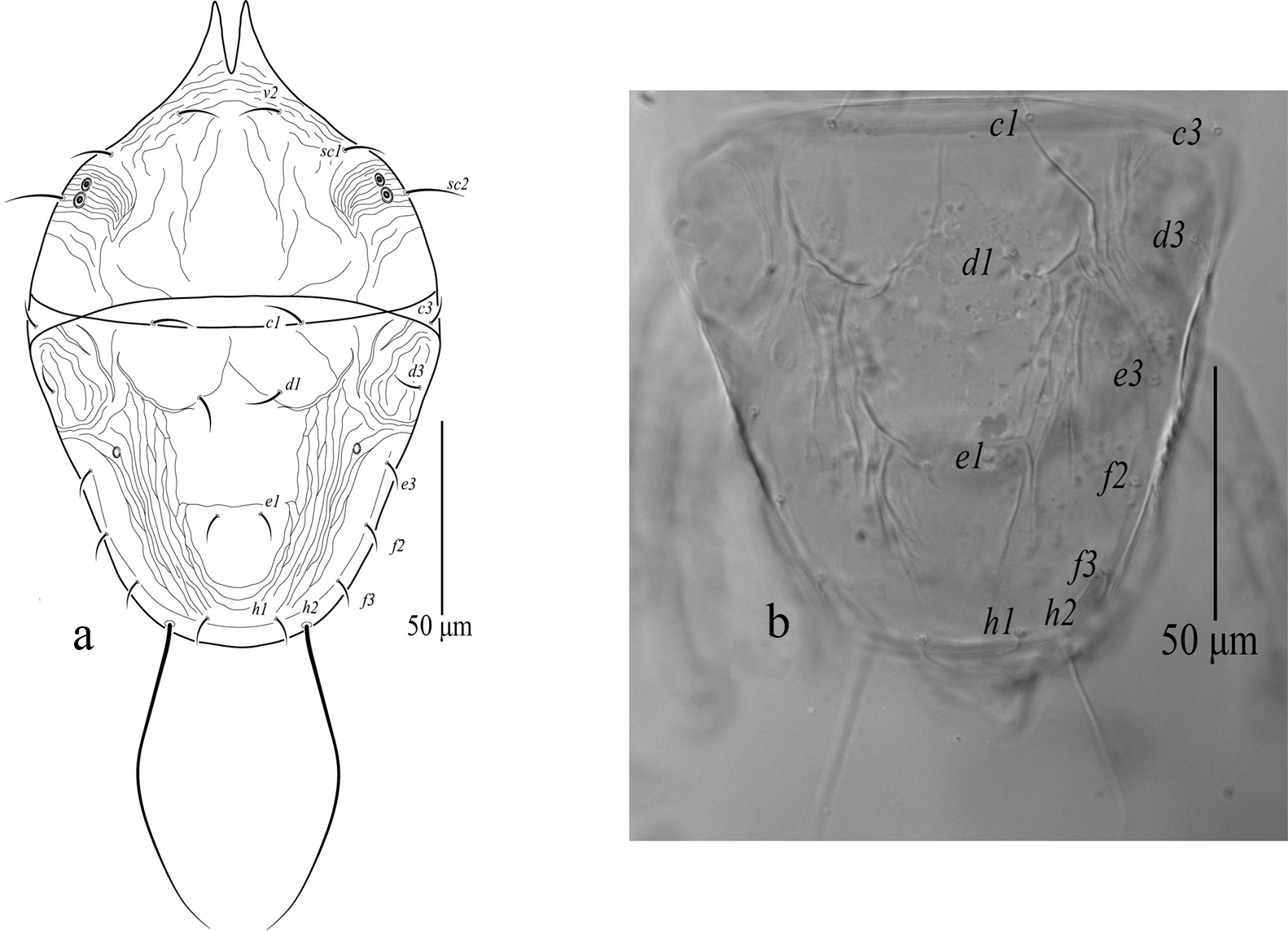
Prodorsum smooth medially; with irregular striae in sublateral and lateral area; hysterosoma medially with four regions of smooth cuticle; all dorsal setae smooth, slender; trochanter III with two setae; genua I-II with 3–3-setae; tibia IV with three setae; venter with two pairs of setae 3a1–2.
Description of female
(n=3, Figures 1–3)
Idiosoma — Elongate ovate, length of body from v2 to h1 160 (163–167); (including gnathosoma) 216 (220–225); width 100 (93–95) at the level of setae c3-c3.
Dorsum (Figure 1a-b) – Anterior margin of prodorsum with pointed forked projection, depth of notch 16 (13–15), without lateral lobe, prodorsum smooth medially, lateral and sublateral area with irregular striae, hysterosoma medially with four regions of smooth cuticle (Figure 1b), sublateral area with broken longitudinal striate, forming few longitudinal cells; three pairs of dorsocentral setae c1, d1, e1, seven pairs of dorsolateral setae; all dorsal setae short, smooth, slender, not more than 18 μm in length, except h2 elongate, flagellate and inserted in different plane to other hysterosomal setae. Hysterosomal pores present posterolateral close to setae e3; lengths of dorsal setae: v2 11 (10–11), sc1 11 (10–11), sc2 16 (16–18), c1 11 (10–11), c3 8 (7–10), d1 10 (7–10), d3 8 (8–10), e1 8 (7–8), e3 8 (7–8), f2 8 (8–10), f3 8 (8–10), h1 8 (7–8), h2 90 (87–92); distances between dorsal setae: v2-v2 25 (21–28), sc1-sc1 59 (57–61), sc2-sc2 87 (86–89), c1-c1 36 (34–36), c3-c3 100 (93–95), d1-d1 21 (20–26), d3-d3 93 (85–87), e1-e1 10 (10–11), e3-e3 75 (74–76), f2- f2 66 (66–69), f3- f3 50 (49–51), h1-h1 16 (15–16), h2-h2 34 (33–34), c1-d1 26 (31–33), d1-e1 34 (33–36), e1-h1 36 (33–34), c3-d3 20 (21–23), d3-e3 26 (25–26), e3-f2 18 (16–18), f2-f3 16 (20–21), f3-h2 15 (11–15), c1-c3 33 (25–28), d1-d3 34 (30–33), e1-e3 31 (33–34).
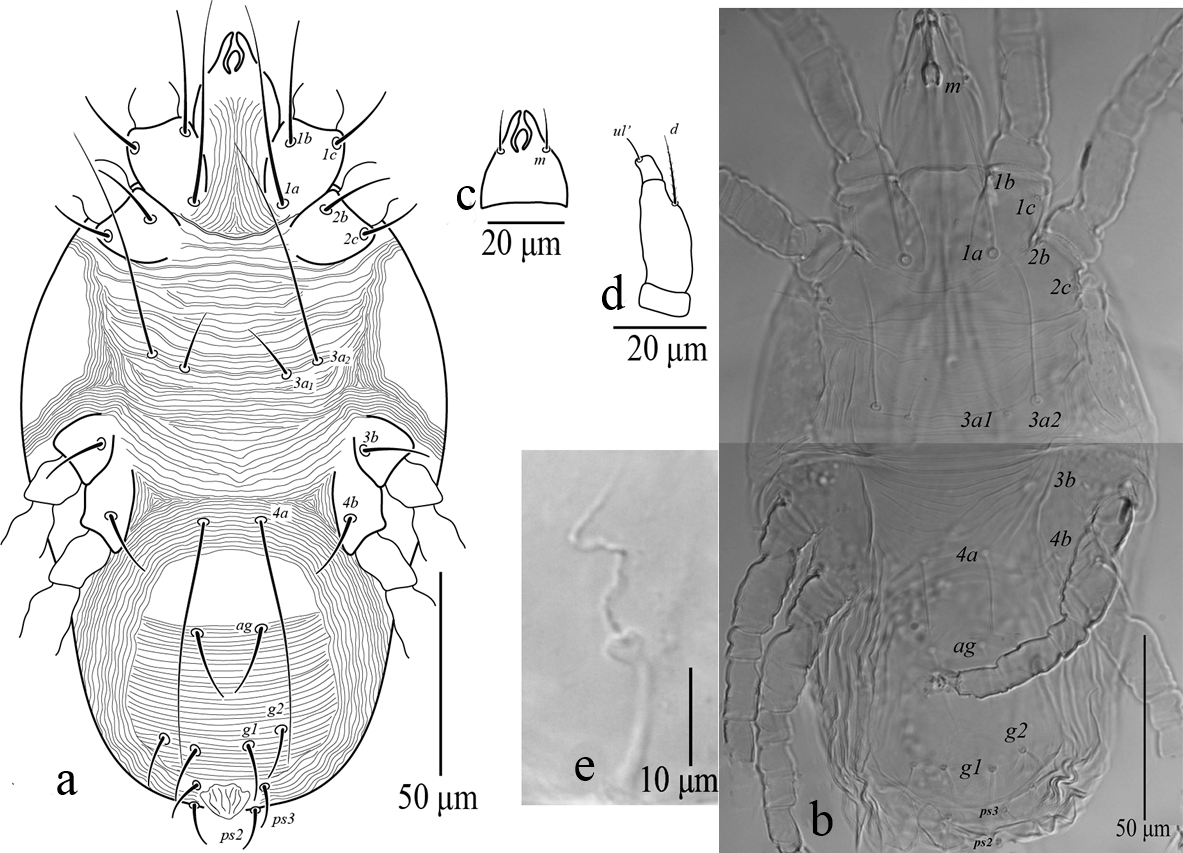
Venter — (Figure 2a-c, 2e) – Ventral cuticle between coxae III and IV with transverse striae, few longitudinal striae sublaterally; two pairs of seta 3a (3a1–2) and one pair of setae 4a; genital and ventral plate fused into one plate, weakly developed, with transverse striae posterior to setae ag, area anterior to setae ag smooth; spermathecal duct narrow, with one bulb (Figure 2e); measurements of ventral setae; 1a 52 (49–54), 1b 33 (30–33), 1c 18 (20–21), 2b 18 (16–17), 2c 16 (15–16), 3a1 15 (16–18), 3a2 57 (49–51), 3b 16 (15–16), 4a 62 (59–62), 4b 16 (15–18); one pair of aggenital setae ag 18 (15–16), ag-ag 13 (11–15); two pairs of genital setae, g1 15 (13–15), g2 13 (12–15), g1-g1 11 (8–13), g2-g2 28 (23–26); two pairs of pseudanal setae, ps2 10 (10–11), ps3 10 (11–13), ps2-ps2 15 (12–14), ps3–ps3 17 (18–23), ps2-ps3 8 (7–9). Setae 4a slightly longer than 3a2; aggenital setae longer than genital setae. All anterior and posterior ventral setae simple and smooth.
Gnathosoma — (Figure 2c-d) – Ventral infracapitulum (Figure 2c) with smooth setae m 10 (10–11), m-m 11 (13–15); palp three-segmented (Figure 2d); tarsus with one eupathidium, ul΄ 5 (5–8); palp second segment with one serrated dorsal seta d 8 (10–11).
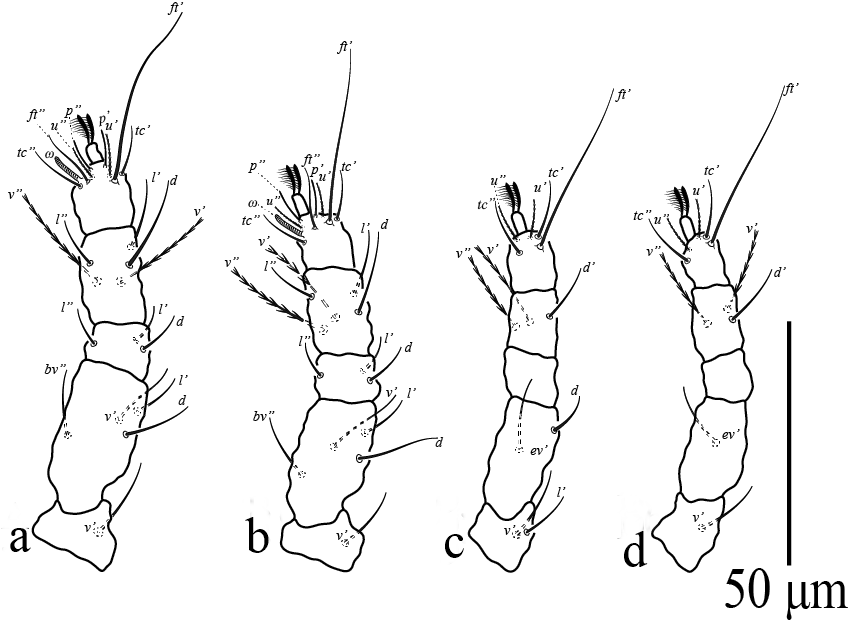
Legs — (Figure 3a-d) – Length of legs I–IV (without coxae): 87 (85–89), 80 (73–77), 79 (72–75), 82 (82–84). Leg I–IV setal count as follows (solenidia in parenthesis): coxae; 2–2–1–1, trochanters 1–1–2–1; femora 4–4–2–1; genua 3–3–0–0; tibiae 5–5–3–3; tarsi 8 (1ω)– 8 (1ω)–5–5; dorsal seta on femora I-III and genua I-II smooth, slender and inserted in dorsally; proral setae pζʹ-pζ″ on tarsi I-II short and inserted on lateral tubercles; tarsi I and II with each with one solenidion; tarsus I ω 7 (6–8), tarsus II ω 8 (7–8).
Description of male
(n=1, Figures 4–6)
Idiosoma Oval in shape, length of body from v2 to h1 139; (including gnathosoma) 180; width 80 at the level of setae c3-c3.
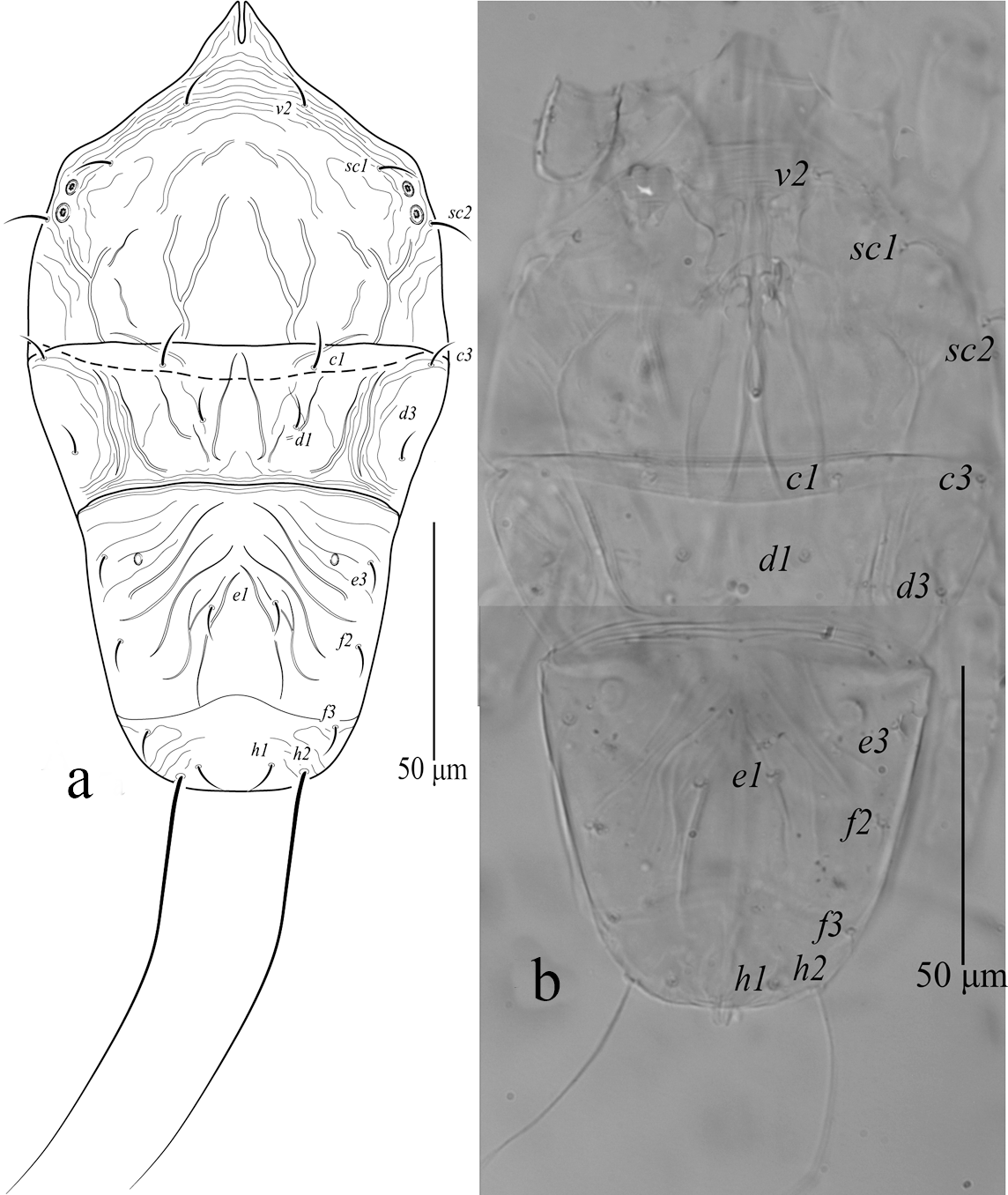
Dorsum — (Figure 4a-b) – Anterior margin of prodorsum with pointed projections, depth of notch 11, without lateral lobe, area anterior to setae v2 with transverse striae; prodorsum smooth medially, lateral and sublateral area with few irregular striae; hysterosomal divided into two regions by transverse striae posterior to setae d1, anterior region bearing setae c1, c3, d1, d3 and with oblique striae, medially, lateral with longitudinal striae, area around setae d3 smooth; the posterior region bearing setae e1, e3, f2, f3, h1, h2 with oblique striae; hysterosomal with three pairs of dorsocentral setae c1, d1, e1, and seven pairs of dorsolateral setae; all dorsal setae short smooth, slender, except h2 elongate, flagellate and inserted in different plane to other hysterosomal setae. Hysterosomal pores close to setae e3; lengths of dorsal setae: v2 8, sc1 8, sc2 9, c1 8, c3 7, d1 7, d3 6, e1 7, e3 5, f2 5, f3 5, h1 7, h2 98; distances between dorsal setae: v2-v2 23, sc1-sc1 54, sc2-sc2 77, c1-c1 29, c3-c3 80, d1-d1 18, d3-d3 67, e1-e1 13, e3-e3 54, f2-f2 49, f3-f3 38, h1-h1 15, h2-h2 21, c1-d1 13, d1-e1 36, e1-h1 33, c3-d3 20, d3-e3 21, e3-f2 16, f2-f3 15, f3-h2 8, c1-c3 23, d1-d3 23, e1-e3 25.
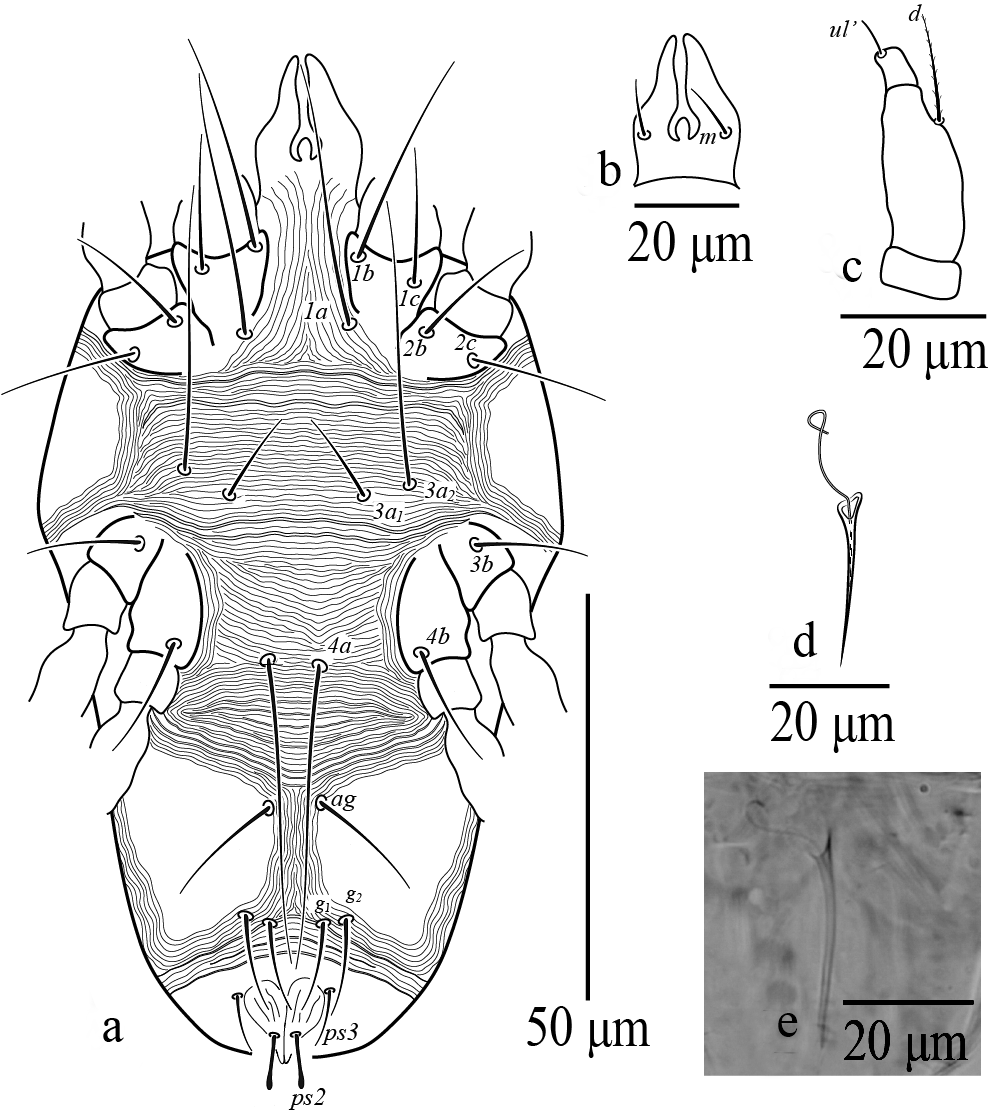
Venter — (Figure 5a-b, 5d-e) – Venter cuticle between 1a and ag with transverse striae, area between ag-g setae with longitudinal striae; lateral area to setae ag smooth; two pairs of seta 3a (3a1–2) and one pair of setae 4a present; measurement of ventral setae; 1a 33, 1b 28, 1c 17, 2b 16, 2c 17, 3a1 13, 3a2 35, 3b 15, 4a 37, 4b 16; one pair of aggenital setae ag 15, ag-ag 12; two pairs of genital setae, g1 12, g2 12, g1-g1 11, g2-g2 26; two pairs of pseudanal setae, ps2 10, ps3 10, ps2-ps2 13, ps3–ps3 15, ps2-ps3 8. Setae 4a are slightly longer than 3a2; aggenital setae longer than genital setae. All ventral setae simple and smooth. Aedeagus elongate, narrowly subulate (Figure 5d-e).
Gnathosoma – Palp three-segmented (Figure 5c); tarsus with one eupathidium, ul΄ 6; palps second segment with one serrated dorsal seta d 9; ventral infracapitulum with smooth setae m 12, m-m 13 (Figure 5b).
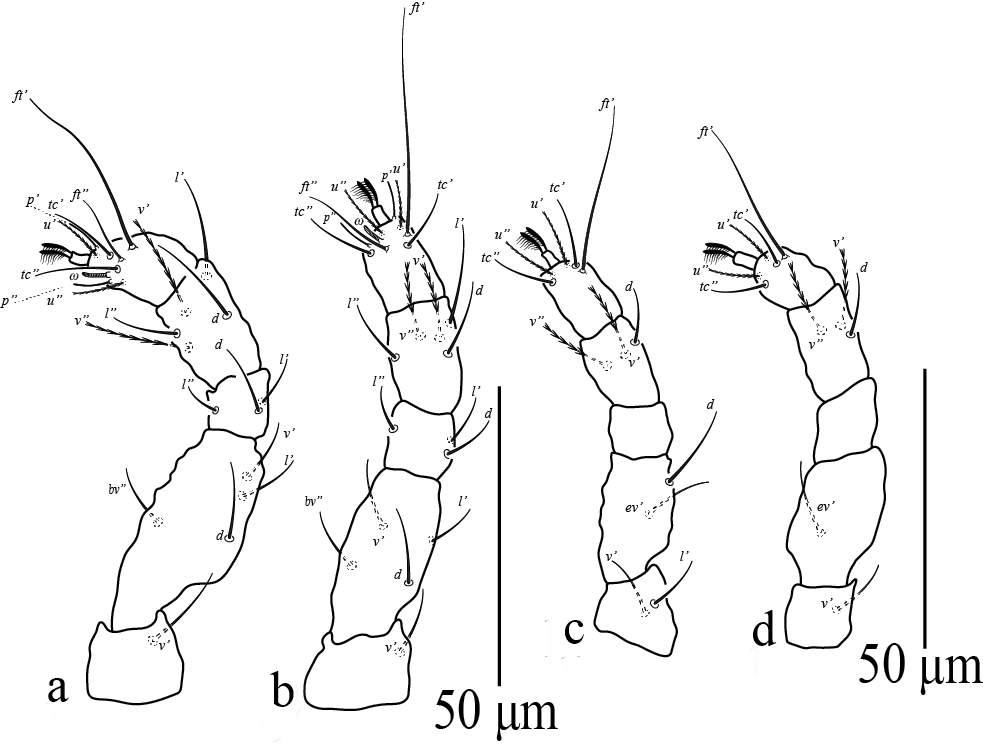
Legs — (Figure 6) – Length of legs I–IV (without coxae): 81, 77, 75, 76. Setal count as described in female. Dorsal seta on femora I-III and genua I-II smooth, slender and inserted in dorsally; proral setae pζʹ-pζ″ on tarsi I-II short, inserted on lateral tubercles tarsi I and II each with one solenidion; tarsus I ω 6 (6–7), tarsus II ω 6 (5–7).
Type material
Holotype (KSMAAS25-Ten-Col-H) and two paratype females (KSMAAS25-Ten-Col-P1–2), one male (KSMAAS25-Ten-Col-P3) Crotalaria sp. (Fabaceae), Asir, Saudi Arabia, 18°30.530″N, 42°20.033″E, 15 Sept. 2025, coll. E.M. Khan, N.A. Elgoni and H.M.S Ali.
Etymology
The species name (neoemeticae) is derived from the closely related species Colopalpus emeticae (Meyer).
Remarks
The new species Colopalpus neoemeticae sp. nov. is closely related to C. emeticae (Meyer 1979) because both have seven pairs of dorsolateral hysterosomal setae; one pair of setae 4a; palp three segmented; femora I-IV with 4–4–2–1 setae. However, the new species is distinguished from C. emeticae by hysterosoma with four regions ofsmooth cuticle (vs two plates); trochanter III with two setae (vs one seta); genua I-II with 3–3 setae (vs 2–2 setae) tibia IV with three setae (vs two setae); dorsal setae smooth (vs serrated); venter with two pairs of setae 3a1–2 (vs one pair 3a); palp tarsus with one eupathidium (vs two eupathidia in C. emeticae).
Acknowledgments
The authors wish to thank the Ongoing Research Funding program [ORF-2026-807], at King Saud University, Riyadh, Saudi Arabia, for funding this research. The authors are also thankful to Muneeb ur Rehman (Acarology Research Laboratory, King Saud University) for his technical support.
Funding
The authors would like to extend their sincere appreciation to the Ongoing Research Funding program, [ORF-2026-807], King Saud University, Riyadh, Saudi Arabia.
References
- Arabuli T. 2025. New species and new record of flat mites (Acari: Tenuipalpidae) from Georgia (Caucasus). Syst. Appl. Acarol., 30(3): 611-624. https://doi.org/10.11158/saa.30.3.8
- Beard, J.J., Otley, J. & Seeman, O.D. (2016) A review of Ultratenuipalpu (Trombidiformes: Tenuipalpidae) and related genera, with a new species from forest oak Allocasuarina torulosa (Aiton) (Casuarinaceae). Int. J. Acarol., 42(6): 285-302. https://doi.org/10.1080/01647954.2016.1183708
- Berlese A. 1913. Acarotheca Italica; Tipografia M. Ricci: Firenze, Italy. p 221.
- Castro E.B., Ochoa R., Feres R.J., Beard J.J., Bauchan G.R. 2015. Reinstatement of the genus Colopalpus Pritchard & Baker (1958) and re-description of Colopalpus matthyssei Pritchard & Baker (1958), the type species of the genus (Acari, Tenuipalpidae). Int. J. Acarol., 41(4): 310-328. https://doi.org/10.1080/01647954.2015.1031276
- Elgoni N.A., Mirza J.H., Alatawi F.J. 2025. New species and new combinations in the genus Colopalpus Pritchard & Baker (Acari: Tenuipalpidae) with a key to the world species. Int. J. Acarol., 51(6): 515-520. https://doi.org/10.1080/01647954.2025.2566348
- Khan E.M., Kamran M., Alatawi F.J. 2019. Flat mites (Acari: Tenuipalpidae) from Saudi Arabia: two new species, new records and key to all known species. J. Nat. Hist., 53(3-4): 185-208. https://doi.org/10.1080/00222933.2019.1581294
- Lindquist E.E. 1985. 1.1.1. Chapter. 1.1.1 external anatomy, phylogeny and systematics. In: Helle W., Sabelis M. (Eds). Spider mites. Their biology, natural enemies and control. Vol 1A. Elsevier, Science Publishing. P. 3-28.
- Mesa N.C., Ochoa R., Welbourn K.W., Evans G.A., de Moraes G.J. (2009) A catalog of the Tenuipalpidae (Acari) of the world with a key to genera. Zootaxa, 2098: 1-185. https://doi.org/10.11646/zootaxa.2098.1.1
- Meyer M.K.P. 1979. The Tenuipalpidae (Acari) of Africa with keys to the world fauna. Pretoria (South Africa): Entomol. Mem. Dept. Agri. Rep. SA., 50(1): 1-133.
- Pritchard A.E., Baker E.W. 1958. The false spider mites (Acarina: Tenuipalpidae). Uni. of Cali. Publ. Entomol., 14: 175-274.
- Reck G.F. 1959. A key to the tetranychoid mites. Fauna Trans. Caucasia Akad. Nauk Gruz. S.S.R., Tbilissi, Akademii Nauk Gruzinskoi SSR, 1: 152 p.
- Seeman O.D., Beard J.J. 2011. A new species of Aegyptobia (Acari: Tenuipalpidae) from Myrtaceae in Australia. Syst. Appl. Acarol., 16(1): 73-89. https://doi.org/10.11158/saa.16.1.10
- Xu Y., Fan Q.H. 2010. Tenuipalpus orilloi Rimando, a new record to the Chinese fauna (Acari: Tenuipalpidae). Syst. Appl. Acarol., 15(2): 135-138. https://doi.org/10.11158/saa.15.2.8
to post any comment or correction.


2026-02-05
Date accepted:
2026-09-01
Date published:
2026-10-07
Edited by:
Castro, Elizeu B.

This work is licensed under a Creative Commons Attribution 4.0 International License
2026 Elgoni, Nasreldeen Ahmed; Mirza, Jawwad Hassan and Alatawi, Fahad Jaber
 Download article
Download the citation
RIS with abstract
(Zotero, Endnote, Reference Manager, ProCite, RefWorks, Mendeley)
RIS without abstract
BIB
(Zotero, BibTeX)
TXT
(PubMed, Txt)