


Mites (Arachnida: Acariformes, Parasitiformes) in Pera Sweet Orange orchards (Citrus sinensis L. Osbeck) from Goiás State, Brazil
Reis, Júlia Almeida  1
; Falchi, Vanessa Leonel
2
and Daud, Rodrigo Damasco
3
1
; Falchi, Vanessa Leonel
2
and Daud, Rodrigo Damasco
3
1Programa de Pós-Graduação em Biodiversidade Animal, Universidade Federal Goiás (UFG), 74690-900, Goiânia, Goiás, Brazil & TEIA - Laboratório de Taxonomia, Ecologia e Interações de Aracnídeos, Departamento de Ecologia, Instituto de Ciências Biológicas, Universidade Federal de Goiás, UFG, Campus II, 74690-900, Goiânia, Goiás, Brazil.
2Programa de Pós-Graduação em Biodiversidade Animal, Universidade Federal Goiás (UFG), 74690-900, Goiânia, Goiás, Brazil & TEIA - Laboratório de Taxonomia, Ecologia e Interações de Aracnídeos, Departamento de Ecologia, Instituto de Ciências Biológicas, Universidade Federal de Goiás, UFG, Campus II, 74690-900, Goiânia, Goiás, Brazil.
3✉ Programa de Pós-Graduação em Biodiversidade Animal, Universidade Federal Goiás (UFG), 74690-900, Goiânia, Goiás, Brazil & TEIA - Laboratório de Taxonomia, Ecologia e Interações de Aracnídeos, Departamento de Ecologia, Instituto de Ciências Biológicas, Universidade Federal de Goiás, UFG, Campus II, 74690-900, Goiânia, Goiás, Brazil.
2026 - Volume: 66 Issue: 3 pages: 751-769
https://doi.org/10.24349/nyz4-jki2Original research
Keywords
Abstract
Introduction
Brazilian citriculture plays a major role in the national economy, as the country is among the world's leading citrus producers and exporters (USDA 2024). Although citrus crops are distributed across several states, the southeastern region concentrates most producers in Brazil (EMBRAPA 2024). In recent years, however, citrus cultivation has expanded to other regions, particularly in the state of Goiás, where production has increased significantly (EMBRAPA 2024). The citrus market in Goiás continues to grow due to fruit quality and favorable geographic conditions, as warmer and drier climates are more suitable for Pera sweet orange cultivation (Castro et al. 2014). Goiás is currently the largest orange producer in the Brazilian Midwest, with yields five times higher than those of Mato Grosso do Sul, the second-largest producer in the region (IBGE 2024). The main cultivated citrus species belong to the genera Citrus, Fortunella, and Poncirus (Rutaceae), which are characterized by arboreal trees bearing fleshy fruits from several cultivars (EMBRAPA 2024).
Pera sweet orange crops are predominantly cultivated in monoculture systems, which substantially reduce ecological niches. Under such conditions, few species are able to benefit from crop association or to survive and reproduce under intensive management practices (Tscharntke et al. 2005). Several arthropods, particularly phytophagous species, can colonize these crops, and their high population growth rates may lead to considerable economic losses for producers (Culliney et al. 2014). Among arthropod pests, phytophagous mites (Arachnida: Acariformes) are responsible for significant damage to agricultural crops (Moraes et al. 2024). These mites possess modified chelicerae that form stylets, allowing them to access the cytoplasmic contents of plant cells (Moraes et al. 2024). They are widely distributed and occur on numerous plant species in both cultivated and natural environments. Their feeding activity can damage leaves, flowers, fruits, and branches, and some species also act as vectors of plant pathogens (Druciarek and Tzanetakis 2025). The type and severity of symptoms vary according to species, population density, developmental stage, feeding site, and duration of infestation (Pinheiro et al. 2008).
In Brazilian citrus orchards, the main phytophagous mite species include: (i) Eriophyidae: Phyllocoptruta oleivora (Ashmead, 1879) (rust mite), Aceria sheldoni (Ewing, 1937) (egg mite), and Tegolophus brunneus Flechtmann, 1999 (brown mite); (ii) Tenuipalpidae: Brevipalpus yothersi Baker, 1949 (citrus leprosis mite); (iii) Tetranychidae: Panonychus citri (McGregor, 1916) (red mite) and Tetranychus mexicanus (McGregor, 1950) (Mexican mite); and (iv) Tarsonemidae: Polyphagotarsonemus latus (Banks, 1904) (tropical white mite) (Moraes et al. 2024).
Predatory mites, in turn, have received considerable attention in biodiversity surveys because of their potential use in biological control programs. These include both specialist species that prey on specific mite groups and generalist species with broad diets that include mites, insects, pollen, fungi, nematodes, and other resources (McMurtry et al. 2013). By regulating pest populations, predatory mites can reduce the need for pesticide applications in agroecosystems (Silva et al. 2004). In citrus crops, the most common predatory mites belong to the genera Iphiseiodes and Euseius (Phytoseiidae) (Reis et al. 2000a; Silva et al. 2012).
Given the extensive conversion of native habitats to agricultural land (Klink and Machado 2005) and the economic losses caused by phytophagous mites in different crops (Moraes et al. 2024), biodiversity inventories are essential for understanding the occurrence and population dynamics of mite species in orchards. In addition, knowledge of pest species and their natural enemies supports the development of more effective, economical, and environmentally sustainable integrated pest management programs. In this study, we present a survey of plant mite species in Pera sweet orange (Citrus sinensis L. Osbeck, Rutaceae) orchards from several farms in Goiás State, Brazil. Our inventory expands current knowledge of mite occurrence and distribution in Brazilian citrus cultivation, with emphasis on phytophagous and predatory species in the state of Goiás.
Material and methods
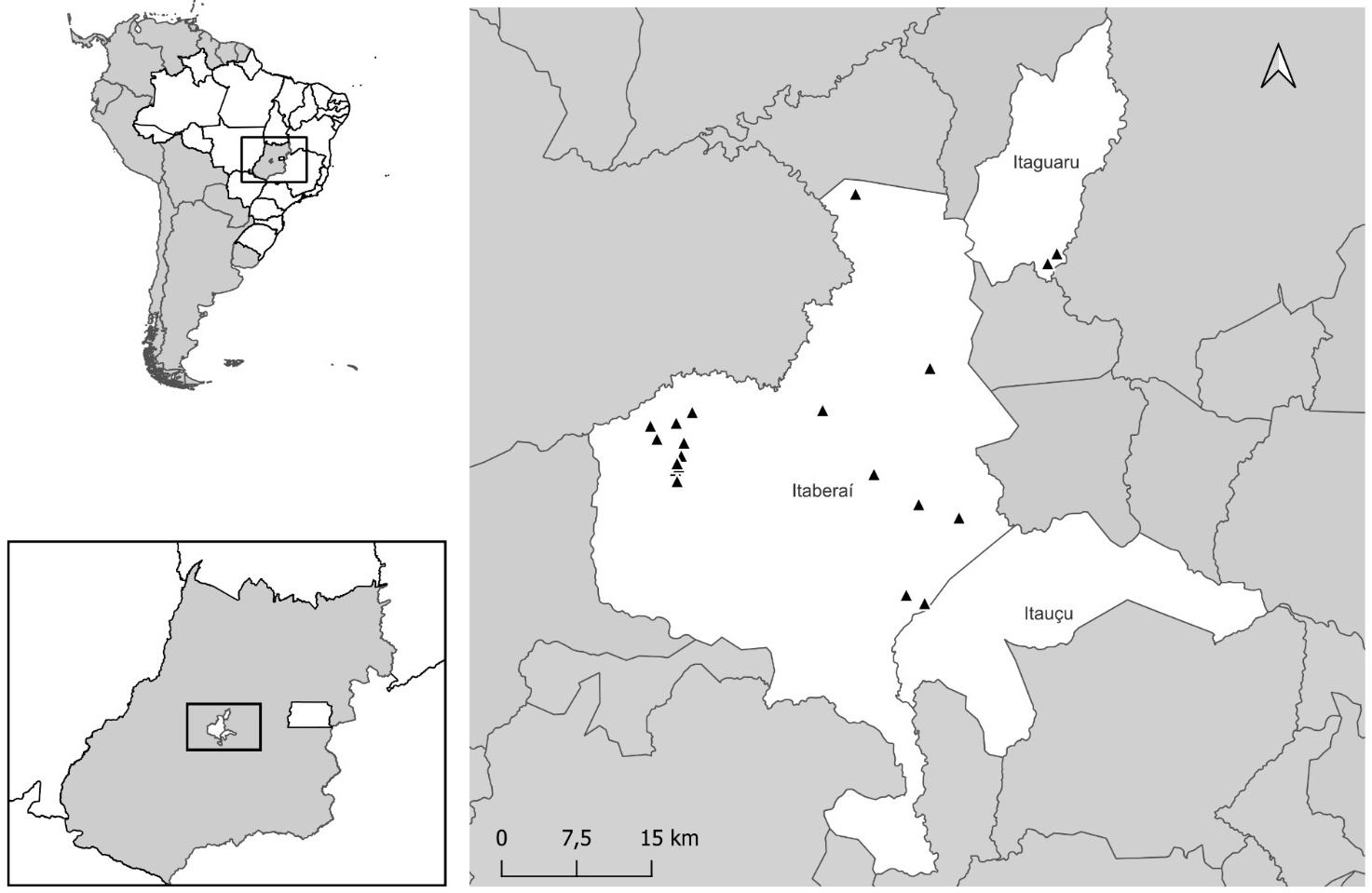
We sampled 20 rural farms producing Pera sweet orange located in the Cerrado domain, within the municipalities of Itaberaí, Itauçu, and Itaguaru, Goiás State, Brazil (Figure 1). Sampling was conducted between June and July 2019, corresponding to the dry and cold season in the Cerrado region (Oliveira and Marquis 2002). The selected farms represented a range of production systems and agricultural practices (Table 1). Seventeen farms followed conventional, intensive management practices, including the use of controlled irrigation systems and the periodic application of pesticides and inorganic fertilizers. The remaining farms operated under a Brazilian family farming structure, characterized by polyculture systems, lower environmental impact, and more sustainable production approaches (e.g., permaculture). Geographic coordinates of each orchard were recorded using a GPS device (Table 1).
Download as * Information concerning the pesticides applied in the orchards was provided by the rural producers from each property.
Orchard
Latitude
Longitude
Crop system
Pesticides*
Orchard 1
15°57’58’’ S
49°43’16’’ W
Monoculture
Abamectin; mineral oil; sulfur; acephate
Orchard 2
16°3’42’’ S
49°57’34’’ W
Polyculture (Papaya; passion fruit)
Abamectin; sulfur; azoxystrobin + cyproconazole; difenoconazole + petroleum naphtha
Orchard 3
16°2’54’’S
49°57’15’’ W
Monoculture
Abamectin; spirodiclofen; mineral oil
Orchard 4
16°3’56’’ S
49°46’25’’ W
Monoculture
Abamectin; spirodiclofen; sulfur; deltamethrin; acephate
Orchard 5
16°5’38’’ S
49° 43’ 54’’ W
Monoculture
Abamectin; spirodiclofen; sulfur; deltamethrin; acephate
Orchard 6
16°6’23’’ S
49°41’38’’ W
Monoculture
Abamectin; sulfur
Orchard 7
16°4’20’’S
49°57’29’’W
Polyculture (Mango; guariroba; corn; banana; pineapple)
Abamectin; mineral oil; sulfur; imidacloprid
Orchard 8
16°1’13’’S
49°58’59’’W
Monoculture
Abamectin; mineral oil; azoxistrobina; imidacloprid + beta-cyfluthrin; imidacloprid; trifloxystrobin + tebuconazole
Orchard 9
16°0’27’’S
49°56’38’’W
Monoculture
Sulfur
Orchard 10
16°3’19’’S
49°57’29’’W
Monoculture
Sulfur; imidacloprid; spiromesifen
Orchard 11
16°0’20’’S
49°49’18’’W
Monoculture
Abamectin; sulfur; imidacloprid; trifloxystrobin + tebuconazole; bifenthrin
Orchard 12
16°0’27’’S
49°50’17’’W
Monoculture
Abamectin; sulfur; imidacloprid; trifloxystrobin + tebuconazole; bifenthrin
Orchard 13
16°2’10’’S
49°57’6’’W
Monoculture
NA
Orchard 14
15°48’10’’S
49°47’27’’W
Polyculture (Corn)
Abamectin; sulfur; imidacloprid; trifloxystrobin + tebuconazole; bifenthrin
Orchard 15
15°51’31’’S
49°36’8’’W
Monoculture
Abamectin; sulfur; imidacloprid; trifloxystrobin + tebuconazole; bifenthrin
Orchard 16
15°52’5’’S
49°36’39’’W
Monoculture
Abamectin; sulfur; imidacloprid; trifloxystrobin + tebuconazole; bifenthrin
Orchard 17
16°1’57’’S
49°58’37’’W\
Monoculture
Abamectin; mineral oil; azoxystrobin + cyproconazole; imidacloprid + beta-cyfluthrin; imidacloprid; trifloxystrobin + tebuconazole
Orchard 18
16°10’44’’S
49°44’36’’W
Monoculture
NA
Orchard 19
16°11’12’’S
49°43’34’’W
Monoculture
NA
Orchard 20
16°1’3’’S
49°57’32’’W
Monoculture
Sulfur
In each citrus farm, we randomly sampled 20 leaves from the middle section of the canopy of five C. sinensis individuals. Each sampled plant was located at least 20 meters from the next one. Leaves extracted from each plant were placed in individual 1.5 L containers with 30% alcohol. Then, each container was shaken vigorously for 20 seconds to completely wash the leaves and remove the mites. Afterwards, the leaves were removed, and the sample was transferred to a 25-micrometer sieve, following Rezende and Lofego (2011). The mites retained on the sieve were transferred to plastic pots containing 70% alcohol, individualized by plant. Each pot was appropriately labeled to represent the mite assemblage of a different citrus tree sampled in the orchard.
In the laboratory, the samples were transferred to Petri dishes and observed under a stereomicroscope. All mites found were mounted on microscope slides with Hoyer's medium (Moraes et al. 2024). The mites were identified and quantified using phase-contrast microscopy and dichotomous keys for genus level (e.g., Amrine et al. 2003; Chant and McMurtry 2007; Mesa et al. 2009; Skvarla et al. 2014; Fan et al. 2016; Silva et al. 2016; Moraes et al. 2024) and species level (e.g., Pritchard and Baker 1955; Gutierrez and Schicha 1983; Mattos and Feres 2009; Xue et al. 2010; Beard et al. 2015; Beard et al. 2018; Lofego et al. 2024), as well as by consulting taxonomists. To validate the correct identification of species from the families Tenuipalpidae, Tarsonemidae, Tetranychidae, and Phytoseiidae, we sent material to the experts Aline D. Tassi (University of Florida, USA), Antonio C. Lofego (UNESP, São José do Rio Preto, São Paulo), Carlos H. W. Flechtmann (ESALQ, USP, Piracicaba, São Paulo), and Peterson R. Demite (Instituto Federal de Educação, Ciência e Tecnologia de Roraima, Bonfim, Roraima), respectively. The identification of Raoiella indica (Tenuipalpidae) was performed by Elizeu B. Castro (UNESP, Rio Claro, São Paulo). The feeding behavior of the plant mite species was determined according to McMurtry et al. (2013) and Moraes et al. (2024). All sampled specimens were deposited in the Zoological Collection of the Universidade Federal de Goiás (ZUFG).
Here, we present a list of plant mite species sampled in C. sinensis orchards in Goiás State, along with information on the number of individuals sampled (sampling date in parentheses), previous records in Brazilian citrus orchards, and the biomes and crop systems in which species previously recorded in citriculture were found. We also include general observations about the sampled taxa. The following abbreviations were adopted: (f) female, (m) male, and (i) immature (nymphs and larvae).
Results
We sampled 16,130 mites from 26 species, 24 genera, and 11 families in C. sinensis orchards in Goiás State, Brazil (Table 2). The recorded families were Acaridae (1 species), Cunaxidae (1), Eriophyidae (1), Iolinidae (1), Phytoseiidae (7), Stigmaeidae (2), Tarsonemidae (2), Tenuipalpidae (2), Tetranychidae (6), Tydeidae (2), and Winterschmidtiidae (1). Acaridae was not identified at the species level, while individuals from the Cunaxidae, Iolinidae, Stigmaeidae, and Winterschmidtiidae families were identified at the genus level.
Download as * Orchards where high populations of the mite species were recorded. ¹ Feeding behavior of identified species: UN (unknown); PR (Predatory); PH (Phytophagous), and MY (Mycophagous). ² Code of orchards sampled for mite collection according to Table 1. ³ Number of damaged individuals and immatures identified to the family level (NDI).
Mites
FB¹
Orchards²
Abundance
NDI³
Acaridae
UN
2, 3, 4, 5, 7, 8
6
2
Cunaxidae
PR
1, 17
2
0
Cunaxa sp.
Eriophyidae
196
Phyllocoptruta oleivora
PH
2, 4, 6, 7, 8, 9, 10, 12, 13, 14, 15, 18, 19
157
Iolinidae
0
Parapronematus sp.
UN
1, 16
5
Phytoseiidae
215
Amblyseius acalyphus
PR
1, 2, 8, 12
6
Amblyseius tamatavensis
PR
3, 5, 6, 8, 12, 20
14
Euseius concordis
PR
1, 2, 3, 5, 6, 7, 8, 9, 10, 11, 12, 13, 18, 19
175
Iphiseiodes zuluagai
PR
1, 2, 3*, 5, 6, 7, 9,10, 11, 12, 13, 17, 18, 19, 20
270
Neoseiulus idaeus
PR
18* ,19
28
Phytoscutus sexpilis
PR
3
1
Typhlodromips sp.
PR
6
1
Stigmaeidae
1
Agistemus sp.
PR
2
1
Zetzellia sp.
PR
19
1
Tarsonemidae
7
Fungitarsonemus sp. 1
UN
2, 7, 8, 13, 18, 19, 20
27
Fungitarsonemus sp. 2
UN
2, 19
2
Tenuipalpidae
27
Brevipalpus yothersi
PH
1, 2*, 9, 12, 13, 19
86
Raoiella indica
PH
7
1
Tetranychidae
6.192
Allonychus sp.
PH
4, 18
4
Eutetranychus banksi
PH
1, 2*, 3, 4, 6, 7, 9, 10, 12, 13, 14, 16, 18, 19, 20
2.449
Mononychellus sp.
PH
2, 4 ,19
3
Panonychus citri
PH
2, 3, 4, 6, 7, 8, 9, 10, 11, 12*, 13, 14, 16, 17, 18, 19, 20
4.569
Sonotetranychus sp.
PH
2
1
Tetranychus mexicanus
PH
1, 2, 3, 4, 6, 7, 8, 9, 10, 11, 12, 14, 15, 16, 18*, 19, 20
1.668
Tydeidae
2
Brachytydeus formosus
UN
2, 7, 13
3
Brachytydeus sp.
UN
3
2
Winterschimidtiidae
2
Czenspinskia sp.
MY
1, 2, 3
4
Total
9486
6644
Of the 16,130 mites sampled, 9,427 were identified at the species level. The remaining mites, including damaged individuals (n = 26) and immatures (n = 6,614), were quantified and identified at the family level (Table 2).
Among the identified mites, nine species were phytophagous, 10 were predatory, one was mycophagous, and six species had unknown feeding behavior (Table 2). Phytophagous mites were the most abundant in our samples, with 15,353 individuals (95.2%), while predatory mites were represented by 715 individuals (4.4%).
The synthesis is presented as a species list of mites sampled in citrus orchards from Goiás State, Brazil.
Acaridae Latreille, 1802
Unidentified species
Examined material — Itaberaí, Goiás – 2f (07-VI); 1f and 1i (21-VI); 2f and 2i (22-VII).
Cunaxidae Thor, 1902
Cunaxa Von Heyden, 1826
Cunaxa sp.
Examined material — Itaberaí, Goiás – 1f (29-VII) and 1 adult of undetermined sex (07-VII).
Eriophyidae Nalepa, 1898
Phyllocoptruta Keifer, 1938
Phyllocoptruta oleivora (Ashmead, 1879)
Examined material — Itaberaí – 7f, 1m and 5 adults of undetermined sex (07-VI); 6f and 1m (21-VI); 9f and 1m (07-VII); 89f and 14m (22-VII); 16f and 1m (30-VII); Itaguaru – 2f (29-VII); Itauçu – 4f and 1m (30-VII).
Previous records in citriculture — Amazonas – Iranduba (Ferreira et al. 2018) and Manaus (Bobot et al. 2006, 2011; Ferreira et al. 2018); Bahia – Cruz das Almas (Nascimento et al. 1977), locality not informed (Coelho et al. 1977) and Rio Real (Noronha et al. 2001); Minas Gerais – Comendador Gomes (Morais 2019), Frutal (Morais 2019), Janaúba (Damasceno 2008) and Prata (Morais 2019); Rio Grande do Sul – Arvorezinha (Horn et al. 2011) and Taquari (Azambuja and Silva 1982; Moraes et al. 1995); Rio de Janeiro – Itatiaia (Navia et al. 2021) and Seropédica (Cordeiro et al. 1991); Santa Catarina – Águas de Chapecó (Chiaradia 2001) and Chapecó (Chiaradia 2001); São Paulo – Barretos (Morais 2019), Bebedouro (Scarpellini and Santos 1997), Borebi (Morais 2019), Cajobi (Morais 2019), Cordeirópolis (Morais 2019), Descalvado (Silva et al. 2012), Gavião Peixoto (Morais 2019), Ibaté (Morais 2019), Itirapina (Morais 2019), Jaboticabal (Romano et al. 1977; Oliveira et al. 1982; Oliveira 1985), Jaguariúna (Albuquerque 2006), Limeira (Oliveira Filho et al. 1980; Mariconi et al. 1986; Rangel et al. 1993), locality not informated (Chiavegato 1968), Marília (Morais 2019), Mogi-Guaçú (Morais 2019), Monte Alto (Morais 2019), Piracicaba (Carvalho et al. 1980; Marques and Moraes 1991), Pirassununga (Morais 2019), Reginópolis (Morais 2019), Rincão (Morais 2019), Santo Antônio de Posse (Fogaça et al. 1991), Santa Fé do Sul (Barbara and Romagnoli 2019), São Manuel (Morais 2019), São Pedro (Raetano and Matuo 1999), Tabatinga (Morais 2019), Taiúva (Oliveira and Oliveira 1991), Taquaral (Morais 2019), Taquaritinga (Gravena et al. 2006),Tietê (Hamamura et al. 1989) and Urupês (Morais 2019); Sergipe – Santa Luzia do Itanhy (Navia et al. 2021) and Umbaúba (Carvalho et al. 2016; Silva et al. 2017; Teodoro et al. 2019; Carvalho et al. 2020; Martins et al. 2020).
Biomes — Amazon Forest (Bobot et al. 2006, 2011; Ferreira et al. 2018); Cerrado (Oliveira Filho et al. 1980; Oliveira et al. 1982; Mariconi et al. 1986; Hamamura et al. 1989; Rangel et al. 1993; Morais 2019); Atlantic Forest (Nascimento et al. 1977; Carvalho et al. 1980; Azambuja and Silva 1982; Cordeiro et al. 1991; Fogaça et al. 1991; Moraes et al. 1995; Chiaradia 2001; Albuquerque 2006; Gravena et al. 2006; Horn et al. 2011; Carvalho et al. 2016; Silva et al. 2017; Barbara and Romagnoli 2019; Morais 2019; Teodoro et al. 2019; Carvalho et al. 2020; Martins et al. 2020; Navia et al. 2021).
Crop systems — Monoculture (Oliveira Filho et al. 1980; Oliveira et al. 1982; Mariconi et al. 1986; Hamamura et al. 1989; Moraes et al. 1995; Raetano and Matuo 1999; Chiaradia 2001; Bobot et al. 2011; Horn et al. 2011; Silva et al. 2012; Carvalho et al. 2016; Ferreira et al. 2018; Barbara and Romagnoli 2019; Morais 2019; Teodoro et al. 2019; Carvalho et al. 2020; Martins et al. 2020); polyculture (Silva et al. 2017).
Observations — This species is commonly known as the citrus rust mite. Leaves and fruits display characteristic darkening when high infestations occur, which can result in yield and fruit weight losses in citrus crops, thus negatively impacting the fresh fruit trade (Chiavegato 1991). High humidity and temperature favor increases in P. oleivora populations (Vacante 2010; Moraes et al. 2024). Therefore, the low number of P. oleivora observed in the evaluated citrus crops can be explained by the fact that sampling was conducted during the driest and coldest season. A higher abundance of P. oleivora occurred in two orchards that adopted different production systems: 47 individuals were sampled in Orchard 2, a polyculture system, and 45 individuals in Orchard 12, a monoculture (Table 2).
Iolinidae Pritchard, 1956
Parapronematus Baker, 1965
Parapronematus sp.
Examined material — Itaberaí – 4f (07-VII); Itaguaru – 1f (29-VII).
Phytoseiidae Berlese, 1916
Amblyseius Berlese, 1914
Amblyseius acalyphus Denmark & Muma, 1973
Examined material — Itaberaí – 1f (07-VI); 1f (07-VII); 4f (22-VII).
Previous records in citriculture — Espírito Santo – Colatina (Demite et al. 2025b) – Roraima – Caracaraí (Figueirêdo et al. 2019) and Caroebe (Figueirêdo et al. 2019).
Biomes — Amazon Forest (Figueirêdo et al. 2019) and Atlantic Forest (Demite et al. 2025b).
Crop systems — Not available.
Observations — This marks the first record of A. acalyphus in citrus crops from Goiás State. This species is usually reported in native plants from more preserved natural vegetation remnants. Demite et al. (2017) recorded this predatory species on native Cerrado trees, such as Protium spruceanum Engl (Burseraceae), Bauhinia ungulata L. (Leguminosae), Psidium guajava L. (Myrtaceae) and Brosimum gaudichaudii Trécul (Moraceae), in a rural area in southeastern Goiás. In our study, A. acalyphus was found in low abundance and predominantly occurred in extensive citrus monocultures (Table 2).
Amblyseius tamatavensis Blommers, 1974
Examined material — Itaberaí – 5f (07-VI); 4f (21-VI); 4f (22-VII); 1f (30-VII).
Previous records in citriculture — Roraima – Amajari (Figueirêdo et al. 2019), Caroebe (Figueirêdo et al. 2019) and Pacaraima (Figueirêdo et al. 2019).
Biomes — Amazon Forest (Figueirêdo et al. 2019).
Crop systems — Not available.
Observations — First record of A. tamatavensis in citrus crops from Goiás State. This species was originally described from Citrus hystrix (Rutaceae) on Madagascar Island (Blommers 1974). Amblyseius tamatavensis is a native predatory species with documented potential to control Bemisia tabaci (Gennadius) (Hemiptera: Aleyrodidae) (Cavalcante et al. 2017). In the present study, A. tamatavensis was recorded exclusively in monoculture citrus orchards (Table 2).
Euseius De Leon, 1967
Euseius concordis (Chant, 1959)
Examined material — Itaberaí – 24f and 2m (07-VI); 27f and 2m (21-VI); 19f and 3m (07-VII); 55f and 7m (22-VII); 26f (30-VII). Itauçu – 9f and 1m (30-VII).
Previous records in citriculture — Roraima – Boa Vista (Marsaro Júnior et al. 2012), Caracaraí (Figueirêdo et al. 2019), Caroebe (Figueirêdo et al. 2019) and São João da Baliza (Figueirêdo et al. 2019); São Paulo – Descalvado (Silva et al. 2011; Silva et al. 2012), Jaboticabal (Silva et al. 2011) and Presidente Prudente (Sato et al. 2001).
Biomes — Amazon Forest (Marsaro Júnior et al. 2012; Figueirêdo et al. 2019); Cerrado (Silva et al. 2011; Silva et al. 2012).
Crop systems — Monoculture (Silva et al. 2011; Marsaro Júnior et al. 2012)
Observations — Euseius concordis is a predatory mite usually found associated with as Brevipalpus phoenicis (Geijskes) (Acari: Tenuipalpidae) and P. oleivora, what suggests its potential as a bioagent for controlling these pests on citrus crops (Moraes and McMurtry 1983). Euseius concordis was recorded in 14 of the 20 sampled orchards, two of which are polyculture systems (Table 2).
Iphiseiodes De Leon, 1966
Iphiseiodes zuluagai Denmark & Muma, 1972
Examined material — Itaberaí – 6f and 2m (07-VI); 6f and 4m (21-VI); 15f and 5m (07-VII); 174f, 42m and 1i (22-VII); 7f and 7m (30-VII). Itauçu – 1f (30-VII).
Previous records in citriculture — Amazonas – Manaus (Ferreira et al. 2018) and Iranduba (Ferreira et al. 2018); Espírito Santo – Colatina (Demite et al. 2025b); Minas Gerais – Lavras (Reis et al. 2000a; Reis et al. 2003); Rio Grande do Sul – Taquari (Horn et al. 2011) and Montenegro (Morais et al. 2007); Roraima – Boa Vista (Marsaro Júnior et al. 2012), Amajari (Figueirêdo et al. 2019), Caracaraí (Figueirêdo et al. 2019), Caroebe (Figueirêdo et al. 2019), Iracema (Figueirêdo et al. 2019), Mucajaí (Figueirêdo et al. 2019), Pacaraima (Figueirêdo et al. 2019) and Uiramutã (Figueirêdo et al. 2019); São Paulo – Descalvado (Silva et al. 2012), Piracicaba (Albuquerque and Moraes 2008; Zanardi et al. 2017) and Presidente Prudente (Sato et al. 2001); Sergipe – Umbaúba (Silva et al. 2017).
Biomes — Amazon Forest (Marsaro Júnior et al. 2012; Ferreira et al. 2018; Figueirêdo et al. 2019); Atlantic Forest (Reis et al. 2000a; Reis et al. 2003; Albuquerque and Moraes 2008; Silva et al. 2017; Demite et al. 2025b); Pampa (Horn et al. 2011); Cerrado (Silva et al. 2012; Zanardi et al. 2017).
Crop systems — Monoculture (Reis et al. 2000a; Morais et al. 2007; Marsaro Júnior et al. 2012; Silva et al. 2012; Zanardi et al. 2017; Ferreira et al. 2018); Polyculture (Silva et al. 2017).
Observations — High populations of I. zuluagai are usually reported in Brazilian citrus orchards (Reis et al. 2000a). Previous studies have evaluated the potential of this predatory mite to control mites from the Tenuipalpidae and Eriophyidae families (Yamamoto and Gravena 1996). Reis et al. (2003) recorded the predation efficacy of I. zuluagai on B. phoenicis under laboratory conditions. According to McMurtry et al. (2013), I. zuluagai is classified as a type III predator that consumes mites, pollen, and sweet compounds (Yamamoto and Gravena 1996; Reis et al. 2003). This species was the most frequently sampled predatory mite, being found in 15 of the 20 orchards evaluated. Of the 270 individuals sampled, 179 were found in only one orchard (Table 2).
Neoseiulus Hugles, 1948
Neoseiulus idaeus Denmark & Muma, 1973
Examined material — Itaberaí – 21f and 6m (30-VII). Itauçu – 1f (30-VII).
Previous records in citriculture — Bahia – Rio Real (Noronha et al. 1997); Pernambuco – Petrolina (Moraes and McMurtry 1983).
Biomes — Caatinga (Moraes and McMurtry 1983; Noronha et al. 1997); Atlantic Forest (Noronha et al. 1997).
Crop systems — Monoculture (Moraes and McMurtry 1983; Noronha et al. 1997).
Observations — This predatory mite is specialized on preying upon Tetranychidae mites, but it can also feed on pollen and other mite species (McMurtry et al. 2013), suggesting its potential as an agent in biocontrol of phytophagous pests on crops. Neoseiulus idaeus is typically found in arid environments, and low relative air humidity increases the survival rate of this species (Sousa Neto et al. 2020). This is consistent with the sampling period for this species in our study. This predatory mite was found in monoculture citrus crops, with 26 out of 27 samples coming from a single orchard (Table 2).
Phytoscutus Muma, 1961
Phytoscutus sexpilis Muma, 1961
Examined material — Itaberaí – 1f (22-VII).
Previous records in citriculture — Bahia – Rio Real (Noronha et al. 1997); Sergipe – Cristianópolis (Noronha et al. 1997).
Biomes — Caatinga and Atlantic Forest (Noronha et al. 1997).
Crop systems — Monoculture (Noronha et al. 1997).
Observations — Phytoscutus sexpilis was only previously recorded in Brazilian citrus orchards in the states of Bahia and Sergipe by Noronha et al. (1997). Thus, this is the first report of P. sexpilis in citrus crops in the state of Goiás and the Cerrado domain.
Typhlodromips De Leon, 1965
Typhlodromips sp.
Examined material — Itaberaí – 1f (21-VI).
Stigmaeidae Oudemans, 1931
Agistemus Summers, 1960
Agistemus sp.
Examined material — Itaberaí – 1f (22-VII).
Zetzellia Oudemans, 1927
Zetzellia sp.
Examined material — Itauçu – 1f (30-VII).
Tarsonemidae Canestrini & Fanzago, 1877
Fungitarsonemus Cromroy, 1958
Fungitarsonemus sp. 1
Examined material — Itaberaí – 2f (07-VI); 10f and 9m (22-VII); 3f and 2m (30-VII). Itauçu – 1m (30-VII).
Fungitarsonemus sp. 2
Examined material — Itaberaí – 1f (22-VII). Itauçu – 1f (30-VII).
Tenuipalpidae Berlese, 1913
Brevipalpus Donnadieu, 1875
Brevipalpus yothersi Baker, 1949
Examined material — Itaberaí – 81f (22-VII); 4f (07-VII). Itauçu – 1f (30-VII).
Previous records in citriculture — Amazonas – Manaus (Ferreira et al. 2018) and Iranduba (Ferreira et al. 2018); Bahia – Cruz das Almas (Ferreira et al. 2020); Mato Grosso do Sul – Terenos (Sánchez-Velázquez et al. 2015); Minas Gerais – Pouso Alegre (Sánchez-Velázquez et al. 2015) and Lavras (Sánchez-Velázquez et al. 2015); Pará – São José Castanhal (Sánchez-Velázquez et al. 2015) and Capitão Poço (Sánchez-Velázquez et al. 2015); Piauí – Teresina (Chabi-Jesus et al. 2018); Roraima – Normandia (Figueirêdo et al. 2019); São Paulo – São José do Rio Preto (Sánchez-Velázquez et al. 2015); Jaboticabal (Sanches et al. 2018; Andrade et al. 2019; Della Vechia et al. 2019; Amaral et al. 2020), Reginópolis (Andrade et al. 2010; Andrade et al. 2011), Taquaral (Andrade et al. 2018), Santa Cruz do Rio Pardo (Amaral et al. 2018; Bassanezi et al. 2019), Barretos and Jales (Amaral et al. 2018); Tocantins – Gurupi and Palmas (Sánchez-Velázquez et al. 2015).
Biomes — Amazon Forest (Sánchez-Velázquez et al. 2015; Ferreira et al. 2018; Figueirêdo et al. 2019); Atlantic Forest (Andrade et al. 2010; Sánchez-Velázquez et al. 2015; Amaral et al. 2018; Bassanezi et al. 2019; Ferreira et al. 2020); Cerrado (Sánchez-Velázquez et al. 2015; Andrade et al. 2018; Sanches et al. 2018; Andrade et al. 2019; Della Vechia et al. 2019; Amaral et al. 2020).
Crop systems — Monoculture (Andrade et al. 2011; Sánchez-Velázquez et al. 2015; Andrade et al. 2018; Chabi-Jesus et al. 2018; Ferreira et al. 2018; Sanches et al. 2018; Bassanezi et al. 2019); Polyculture (Sánchez-Velázquez et al. 2015).
Observations — Brevipalpus yothersi acts as a vector for CiLV-C virus in citrus crops, causing lesions in several plant organs, which can result in the death of the individual (Castillo et al. 2011; Ramos-González et al. 2018). Although it causes damage to citrus plants, we found low abundance of this phytophagous in the evaluated orchards. Orchard 2, a polyculture system, sheltered the higher B. yothersi abundance (78 individuals), but it also housed one of the higher mite species richness (14 species) in the samples (Table 2).
Raoiella Hirst, 1924
Raoiella indica Hirst, 1924
Examined material — Itaberaí – 1f (07-VI).
Previous records in citriculture — No records.
Biomes — No records.
Crop systems — No records.
Observations — This study reports the first record of R. indica in Brazilian citrus crops. However, this occurrence is probably accidental, since only one female was found in Orchard 7 (Table 2), a polyculture area with ''guariroba'' palm (Syagrus oleracea Becc., Arecaceae) and banana (Musa sp., Musaceae), both cultivated in the area (Table 1). Although R. indica has not been recorded on S. oleracea, this mite species can infest other plants in the family Arecaceae. On the other hand, this species is commonly associated with banana plants (Peña et al. 2012).
Tetranychidae Donnadieu, 1875
Allonychus Pritchard & Baker, 1955
Allonychus sp.
Examined material — Itaberaí – 1f and 1m (21-VI); 2i (30-VII).
Eutetranychus Banks, 1917
Eutetranychus banksi (McGregor, 1914)
Examined material — Itaberaí – 22f and 2m (07-VI); 3f and 3m (21-VI); 53f and 7m (07-VII); 1,621f, 298m and 3i (22-VII); 310f, 92m and 2i (30-VII). Itauçu – 32f and 1m (30-VII).
Previous records in citriculture — Amazonas – Manaus (Ferreira et al. 2018) and Iranduba (Ferreira et al. 2018); Rio Grande do Sul – Taquari (Horn et al. 2011); São Paulo – Descalvado (Silva et al. 2012); Sergipe – Umbaúba (Carvalho et al. 2016; Silva et al. 2017; Teodoro et al. 2019; Martins et al. 2020).
Biomes — Amazon Forest (Ferreira et al. 2018); Atlantic Forest (Horn et al. 2011); Cerrado (Silva et al. 2012; Carvalho et al. 2016; Silva et al. 2017; Teodoro et al. 2019; Martins et al. 2020).
Crop systems — Monoculture (Horn et al. 2011; Silva et al. 2012; Carvalho et al. 2016; Ferreira et al. 2018; Teodoro et al. 2019; Martins et al. 2020); Polyculture (Silva et al. 2017).
Observations — Eutetranychus banksi is commonly associated with citrus orchards and other agricultural crops in Brazil, where it is regarded as an economically important pest throughout the Americas (Gerson 2003). The species exhibits a highly aggregated spatial distribution, which hinders early detection and reduces the effectiveness of monitoring programs. This pattern can potentially increase foliar damage (López-Olmos and Ferragut 2024). In Spanish citrus agroecosystems, E. banksi has been reported as an invasive species capable of displacing resident tetranychid mites, leading to changes in community composition and dominance patterns (López-Olmos and Ferragut 2023). Eutetranychus banksi was found in 15 of the 20 sampled orchards. A total of 1,850 individuals were sampled in Orchard 2, a polyculture system in which papaya and passion fruit are also cultivated (Table 2).
Mononychellus Wainstein, 1971
Mononychellus sp.
Examined material — Itauçu – 3f (30-VII).
Panonychus Yokoyama, 1929
Panonychus citri (McGregor, 1916)
Examined material — Itaberaí – 380f and 54m (07-VI); 192f and 23m (21-VI); 8f and 2m (07-VII); 1734f, 337m and 6i (22-VII); 392f, 73m and 1i (29-VII); 520f, 47m and 3i (30-VII). Itaguaru – 6f (29-VII). Itauçu – 714f, 70m and 7i (30-VII).
Previous records in citriculture — Amazonas – Manaus (Bobot et al. 2011; Ferreira et al. 2018) and Iranduba (Ferreira et al. 2018); Minas Gerais – Viçosa (Matioli et al. 2009); São Paulo – Descalvado (Silva et al. 2012), Piracicaba (Ribeiro et al. 2014; Zanardi et al. 2015; Alves et al. 2018; Zanardi et al. 2018) and São Pedro (Raetano and Matuo 1999).
Biomes — Amazon Forest (Bobot et al. 2011; Ferreira et al. 2018), Atlantic Forest (Matioli et al. 2009; Ribeiro et al. 2014; Zanardi et al. 2018); Cerrado (Silva et al. 2012; Zanardi et al. 2015; Alves et al. 2018).
Crop systems — Monoculture (Raetano and Matuo 1999; Matioli et al. 2009; Bobot et al. 2011; Silva et al. 2012; Zanardi et al. 2015; Ferreira et al. 2018; Zanardi et al. 2018).
Observations — Panonychus citri is considered a key pest of citrus crops in several countries (Jamieson et al. 2005). In Brazil, P. citri is a sporadic pest during the autumn and winter (Flechtmann and Amante 1974; Silva et al. 2012). This mite causes silver spots on leaves during large infestations, leading to increased leaf drop and reduced plant production (Jamieson et al. 2005). Here, we found a great number of individuals during the coldest period of the year. Panonychus citri was sampled in 17 orchards (Table 2), with 1,858 individuals collected in orchard 2, where producers reported leaves with chlorotic spots symptoms and falling leaves.
Sonotetranychus Tuttle, Baker & Abbatiello, 1976
Sonotetranychus sp.
Examined material — Itaberaí – 1f (22-VII).
Tetranychus Dufour, 1832
Tetranychus mexicanus (McGregor, 1950)
Examined material — Itaberaí – 10f (07-VI); 193f, 77m and 2i (21-VI); 58f and 10m (07-VII); 479f and 49m (22-VII); 630f and 125m (30-VII). Itaguaru – 26f and 1m (29-VII). Itauçu – 7f and 1m (30-VII).
Previous records in citriculture — Amazonas – Manaus (Bobot et al. 2011; Ferreira et al. 2018) and Iranduba (Bobot et al. 2011; Ferreira et al. 2018); Rio Grande do Sul – Encantado (Horn et al. 2011), Arvorezinha (Horn et al. 2011) and Taquari (Horn et al. 2011); Sergipe – Umbaúba (Silva et al. 2015; Carvalho et al. 2016; Silva et al. 2017; Teodoro et al. 2019; Martins et al. 2020).
Biomes — Amazon Forest (Bobot et al. 2011; Ferreira et al. 2018); Atlantic Forest (Horn et al. 2011; Silva et al. 2015; Carvalho et al. 2016; Silva et al. 2017; Teodoro et al. 2019; Martins et al. 2020).
Crop systems — Monoculture (Horn et al. 2011; Silva et al. 2015; Carvalho et al. 2016; Ferreira et al. 2018; Teodoro et al. 2019; Martins et al. 2020); Polyculture (Silva et al. 2017).
Observations — A high abundance of T. mexicanus was found in the evaluated citrus orchards, with the highest numbers found in orchards 4, 14, and 18, from which 198, 368, and 757 individuals were collected, respectively (Table 2). Silva et al. (2016) found that population of T. mexicanus increases during dry periods, which align with our results for this species. Neoseiulus californicus (McGregor) is considered the most effective predator for controlling this phytophagous mite in crops (Moraes et al. 1986; McMurtry and Croft 1997).
Tydeidae Kramer, 1877
Brachytydeus Thor, 1931
Brachytydeus formosus (Cooreman, 1958)
Examined material — Itaberaí – 1f (07-VI); 2f (22-VII).
Previous records in citriculture — São Paulo – Descalvado (Silva et al. 2012); Rio Grande do Sul – Arvorezinha (Horn et al. 2011), Encantado (Horn et al. 2011) and Taquari (Horn et al. 2011).
Biomes — Cerrado (Silva et al. 2012); Atlantic Forest (Horn et al. 2011).
Crop systems — Monoculture (Horn et al. 2011; Silva et al. 2012).
Observations — Previously recorded as Lorryia formosa, Brachytydeus formosus is frequently found in Brazilian citrus orchards, although no economic damage has been attributed to this species in recent surveys (Horn et al. 2011; Silva et al. 2012). Here, B. formosus was recorded at low abundance in three citrus orchards. Two of these orchards had a polyculture system in which citrus plants were grown alongside other crops, such as passion fruit, papaya, mango, pineapple, gariroba, corn, and bananas (Table 2).
Brachytydeus sp.
Examined material — Itaberaí – 2f (22-VII).
Winterschimidtiidae Oudemans, 1923
Czenspinskia Oudemans, 1927
Czenspinskia sp.
Examined material — Itaberaí – 1f (07-VII); 3f (22-VII).
Discussion
The Tetranychidae and Phytoseiidae families showed the highest species richness and abundance, with 14,886 and 710 mites, and six and seven species sampled, respectively. The phytophagous species P. citri, E. banksi, and T. mexicanus were the most abundant mites in the evaluated citrus orchards, representing 53.8% of our samples.
Phytoseiidae, Stigmaeidae, and Iolinidae represented about 4.4% of the samples. These families consist of predatory species that feed on other mite species and insects (Moraes et al. 2024). Among predatory mites, Phytoseiidae were the most abundant and diverse, with I. zuluagai and E. concordis being the most representative species in the samples, accounting for 2.7% of the mites sampled in citrus crops.
Amblyseius acalyphus, A. tamatavensis, B. yothersi, E. banksi, E. concordis, I. zuluagai, B. formosus, N. idaeus, and T. mexicanus have been previously recorded in Goiás State, Brazil (Flechtmann and Moraes 2017; Demite et al. 2017, 2025a; Castro et al. 2025). Here, these species are reported for the first time in citrus orchards in the state. Additionally, P. citri, P. oleivora, and P. sexpilis were recorded for the first time in Goiás.
Panonychus citri was the most abundant phytophagous mite in citrus orchards in Goiás. This species is a secondary pest of Brazilian citrus (Oliveira et al. 2008). Its population increases under favorable weather conditions, especially when temperature and relative humidity are low (Flechtmann and Amante 1974; Silva et al. 2012). This increase is also associated with the extensive use of pesticides to control primary pests, which often have limited effects on secondary pests (Zanardi et al. 2018). Other Tetranychidae mites found at lower abundance in citrus orchards included T. mexicanus and E. banksi. These species are typically found in Brazilian citrus crops (Silva et al. 2012).
Although Tetranychidae mites were the most abundant phytophagous species in our samples, B. yothersi (Tenuipalpidae) and P. oleivora (Eriophyidae), which are considered the main citrus pests, are usually recorded in high numbers in Brazilian crops (Moraes et al. 2024). Brevipalpus yothersi acts as a vector of citrus leprosis virus (CiLV-C). Infection causes severe symptoms, including premature leaf and fruit drop, branch dieback, and significant yield losses in the year of transmission and the subsequent year (Moreira et al. 2022). In contrast, infestation by P. oleivora affect fruit appearance, reducing market value and interfering with the Pera sweet orange trade, especially exports (Chiavegato 1991). In our study, B. yothersi and P. oleivora were less abundant than Tetranychidae mites.
The Phytoseiidae family includes important predatory species that control phytophagous mites and insects in crops (McMurtry and Croft 1997; Reis et al. 2000b). In our study, Phytoseiidae was the most abundant and diverse predatory mite family in the sampled citrus orchards. Iphiseiodes zuluagai and E. concordis were the most abundant phytoseiid mites in our samples, and both species are commonly reported in high abundance in Brazilian citrus orchards (Reis et al. 2000a; Silva et al. 2012). Furthermore, I. zuluagai is known to be effective in controlling pest populations, such as P. oleivora, and is considered the most relevant predatory mite in citrus crops (Yamamoto and Gravena 1996; Reis et al. 2003). In contrast, some studies have identified E. concordis as a potential predator of B. phoenicis (Reis et al. 2000b; Silva et al. 2012).
Here, we report A. acalyphus for the first time in citrus orchards in Goiás State. Despite its low prevalence, previous studies have evaluated its potential to prey on citrus-associated mites, such as B. phoenicis, Tegolophus brunneus, and P. oleivora (Lofego and Moraes 2005; Morais 2019). Another phytoseiid species recorded in Goiás citrus crops, Amblyseius tamatavensis, has been suggested as a potential biocontrol agent for Bemisia tabaci on sweet pepper plants, reducing whitefly populations by approximately 80% under laboratory conditions (Cavalcante et al. 2017). Although B. tabaci is not a major citrus pest, the citrus blackfly Aleurocanthus woglumi causes significant damage to orchards (Gallo et al. 2002). Therefore, further studies are needed to evaluate the predation potential of A. tamatavensis on A. woglumi and the potential of A. acalyphus in citrus agroecosystems.
In addition to Phytoseiidae, species of the Stigmaeidae, especially those of the genera Agistemus and Zetzellia, are commonly found in citrus crops and may represent potential candidates for phytophagous mite biocontrol (Matioli et al. 2002).
Fauna inventories provide a more robust understanding of biodiversity in agroecosystems and support producers and specialists in adopting more effective and sustainable practices, such as biological control instead of chemical pesticides. Our study presents the first survey of mite species in C. sinensis orchards in Goiás State, contributing to knowledge of regional biodiversity. Among the 12 species identified at the species level, nine were recorded for the first time in citrus crops in the state. Furthermore, we report the first occurrence in Goiás of one predatory species, P. sexpilis, and two phytophagous species, P. citri and P. oleivora. Our results improve understanding of acarofauna in sweet orange crops and provide a valuable database for future biodiversity and pest management studies.
Acknowledgments
This research was financed by the Conselho Nacional de Desenvolvimento Científico e Tecnológico (CNPq, proc. 456538/2014-3). J. A. Reis received a scholarship from the Coordenação de Aperfeiçoamento de Pessoal de Nível Superior (CAPES). We are grateful to Aline D. Tassi (University of Florida, USA), Antonio C. Lofego (UNESP, São José do Rio Preto, São Paulo), Carlos H. W. Flechtmann (ESALQ, USP, Piracicaba, São Paulo), Peterson R. Demite (Instituto Federal de Educação, Ciência e Tecnologia de Roraima, Bonfim, Roraima) and Elizeu B. Castro (UNESP, Rio Claro, São Paulo) for their valuable assistance in confirming the identification of mite species. We also thank Danillo A.V. Santos-Granzotti and Maria Victória Cordeiro Gama for reviewing the manuscript.
References
- Albuquerque F.A. 2006. Diversidade de ácaros em cultivo orgânico de citros e na vegetação natural circundante, e perspectivas para a criação massal de Iphiseiodes zuluagai (Acari: Phytoseiidae) [PhD. Thesis]. Jaboticabal: Universidade Estadual Paulista Faculdade de Ciências Agrárias e Veterinárias. pp. 108.
- Albuquerque F.A.D., Moraes G.J. 2008. Perspectivas para a criação massal de Iphiseiodes zuluagai Denmark & Muma (Acari: Phytoseiidae). Neotrop. Entomol., 37: 328-333. https://doi.org/10.1590/S1519-566X2008000300013
- Alves E.B., Casarin N.F.B., Omoto C. 2018. Lethal and sublethal effects of pesticides used in Brazilian citrus groves on Panonychus citri (Acari: Tetranychidae). Arq. Inst. Biol., 85: e0622016. https://doi.org/10.1590/1808-1657000622016
- Amaral I., Melville C.C., Rocha C.M., Della Vechia J.F., Prado T.J., Andrade D.J. 2020. Sublethal effects of spirodiclofen on biological and demographic parameters of the citrus leprosis mite Brevipalpus yothersi (Acari: Tenuipalpidae). Pest Manag. Sci., 76(5): 1874-1880. https://doi.org/10.1002/ps.5718
- Amaral I., Moraes G.J., Melville C.C., Andrade D.J. 2018. Factors affecting prevailing population levels of Brevipalpus yothersi (Acari: Tenuipalpidae) in citrus areas affected by citrus leprosis in the State of São Paulo, Brazil. Exp. Appl. Acarol., 74: 395-402. https://doi.org/10.1007/s10493-018-0239-x
- Amrine J.W.Jr., Stasny T.A.H., Flechtmann C.H.W. 2003. Revised keys to world genera of Eriophyoidea (Acari: Prostigmata). West Bloomfield, Indira Publishing House.
- Andrade D.J., Lorençon J.R., Siqueira D.S., Novelli V.M., Bassanezi R.B. 2018. Space-time variability of citrus leprosis as strategic planning for crop management. Pest Manag. Sci., 74(8): 1798-1803. https://doi.org/10.1002/ps.4877
- Andrade D.J., Oliveira C.A.L., Santos N.C., Morais M.R. 2010. Differential toxicity of abamectin based products over Brevipalpus phoenicis (Geijskes, 1939) (Acari: Tenuipalpidae) mite in citrus. Rev. Bras. Frutic., 32: 82-89. https://doi.org/10.1590/S0100-29452010005000024
- Andrade D.J., Oliveira C.L., Pattaro F.C. 2011. Technical and economic evaluation of different types of control of Brevipalpus phoenicis (Acari: Tenuipalpidae) in citrus leprosis management. Zoosymposia, 6: 104-110. https://doi.org/10.11646/zoosymposia.6.1.18
- Andrade D.J., Ribeiro E.B., Morais M.R., Zanardi O.Z. 2019. Bioactivity of an oxymatrine-based commercial formulation against Brevipalpus yothersi Baker and its effects on predatory mites in citrus groves. Ecotoxicol. Environ. Saf., 176: 339-345. https://doi.org/10.1016/j.ecoenv.2019.03.118
- Azambuja M.D., Silva T.L. 1982. Flutuação populacional do ''ácaro da falsa ferrugem» Phyllocoptruta oleivora (Ashm., 1879) em citros, no Rio Grande do Sul. Agro. Sulriograndense, 18: 145-152.
- Barbara G., Romagnoli M.J. 2019. Sazonalidade dos principais ácaros na citricultura de uma fazenda localizada no município de Santa Fé Do Sul, SP. Agrarian Academy, 6: 315-326. https://doi.org/10.18677/Agrarian_Academy_2019a30
- Bassanezi R.B., Czermainski A.B.C., Laranjeira F.F., Moreira A.S., Ribeiro P.J., Krainski E.T., Amorim L. 2019. Spatial patterns of the Citrus leprosis virus and its associated mite vector in systems without intervention. Plant Pathol., 68(1): 85-93. https://doi.org/10.1111/ppa.12930
- Beard J.J., Ochoa R., Bauchan G.R., Pooley C., Dowling A.P.G. 2018. Raoiella of the world (Trombidiformes: Tetranychoidea: Tenuipalpidae). Zootaxa, 4501(1): 1-301. https://doi.org/10.11646/zootaxa.4501.1.1
- Beard J.J., Ochoa R., Braswell W.E., Bauchan G.R. 2015. Brevipalpus phoenicis (Geijskes) species complex (Acari: Tenuipalpidae)- a closer look. Zootaxa, 3944: 1-67. https://doi.org/10.11646/zootaxa.3944.1.1
- Blommers L. 1974. Species of the genus Amblyseius Berlese, 1914, from Tamatave, east Madagascar (Acarina: Phytoseiidae). Bull. Zool. Mus., 3: 143-148.
- Bobot T.D.E., Franklin E., Navia D., Gasnier T.R.J., Lofego A.C., Oliveira B.M. 2011. Mites (Arachnida, Acari) on Citrus sinensis L. Osbeck orange trees in the state of Amazonas, Northern Brazil. Acta Amazon., 41: 557-566. https://doi.org/10.1590/S0044-59672011000400013
- Bobot, T.E., Oliveira, B.M., Chilson, E.F., Oliveira, P.Y. 2006 Ácaros Eriophyoidea em pomares de laranja (Citrus sinensis) no município de Manaus, AM. In: Diversidade, taxonomia e manejo de ácaros neotropicais. Anais do I Simpósio Brasileiro de Acarologia; Viçosa, Minas Gerais: Universidade Federal de Viçosa. p. 202.
- Carvalho H.W.L., Martins C.R., Teodoro A.V., Soares Filho W.S., Passos O.S. 2016. Agronomical performance of ′Piemonte′ mandarin grafted on several rootstocks in the Brazilian Coastal Tablelands. Pesq. Agropec. Bras., 51(11): 1830-1838. https://doi.org/10.1590/s0100-204x2016001100005
- Carvalho H.W.L., Teodoro A.V., Barros I., Carvalho L.M., Soares Filho W.S., Girardi E.A., Pinto-Zevallos D.M. 2020. Rootstock-related improved performance of ′Pera′ sweet orange under rainfed conditions of Northeast Brazil. Sci. Hortic., 263: 109148. https://doi.org/10.1016/j.scienta.2019.109148
- Carvalho J.C., Tavares S., Marconato J.R., Brunelli Júnior H.C., Fagan R., Mariconi F.A.M., Miranda Filho J.B. 1980. Granulados sistêmicos no solo contra o ''ácaro da falsa ferrugem″, Phyllocoptruta oleivora (Ashm., 1879), em laranjeiras. An. Esc. Sup. Agric. Luiz de Queiroz, 37: 747-756. Available from: https://doi.org/10.1590/S0071-12761980000200012
- Castro E.B., Mesa N.C., Feres R.J.F., Moraes G.J., Ochoa R., Beard J.J., Demite P.R. 2025. Tenuipalpidae Database [Internet]. São José do Rio Preto: UNESP; [cited 6 Oct 2025]. Available from: http://www.tenuipalpidae.ibilce.unesp.br
- Castro M.C., Lopes J., Teixeira S. 2014. Municípios goianos: competitividade e concentração da fruticultura. Conjuntura Econômica Goiana, 29: 47-63. Goiás: Secretaria de Estado de Gestão e Planejamento, Instituto Mauro Borges.
- Cavalcante A.C.C., Mandro M.E., Paes E.R., Moraes G.J. 2017. Amblyseius tamatavensis Blommers (Acari: Phytoseiidae) a candidate for biological control of Bemisia tabaci (Gennadius) biotype B (Hemiptera: Aleyrodidae) in Brazil. Int. J. Acarol., 43(1): 10-15. https://doi.org/10.1080/01647954.2016.1225816
- Chabi-Jesus C., Ramos-González P.L., Tassi A.D., Guerra-Peraza O., Kitajima E.W., Harakava R., Freitas-Astúa J. 2018. Identification and characterization of citrus chlorotic spot virus, a new dichorhavirus associated with citrus leprosis-like symptoms. Plant Dis., 102(8): 1588-1598. https://doi.org/10.1094/PDIS-09-17-1425-RE
- Chant D.A., McMurtry J.A. 2007. Illustrated keys and diagnoses for the genera and subgenera of the Phytoseiidae of the world (Acari: Mesostigmata). Indira Publishing House.
- Chiaradia L.A. 2001. Flutuação populacional do ácaro da falsa-ferrugem Phyllocoptruta oleivora (Ashmead, 1879) (Acari, Eriophyidae) em pomares de citros da região oeste catarinense. Pesq. Agropec. Gaúcha, 7: 11-120.
- Chiavegato, L.G. 1968. Principais ácaros das plantas cítricas no estado de São Paulo. O Agronômico, 20: 11-12.
- Chiavegato L.G. 1991. Ácaros da cultura de citros. In: Rodríguez O., Viégas F., Pompeu Júnior J., Amaro A.A. (Eds). Citricultura Brasileira, 2nd ed. Fundação Cargill. p. 601-641.
- Coelho Y.S., Passos O.S., Sobrinho A.P.C. 1977 Época de ocorrência do ácaro da ''ferrugem» dos citros Phyllocoptruta oleivora, (Ashm.) no estado da Bahia. Embrapa/ CNPMF - Citros: Coletânea de pesquisas realizadas no estado da Bahia, p. 187-195.
- Cordeiro L.M., Perruso J.C., Leite W.W., Sampaio H.N., Cassino P.C.R. 1991 Monitoramento de pragas associadas às plantas citricas no Estado do Rio de Janeiro. In: XIII Congresso Brasileiro de Entomologia, I Simpósio Internacional Sobre Bicudo do Algodoeiro, II Encontro Sobre Cochonilha da Palma Forrageira, III Encontro Sobre Moscas-Das-Frutas; Recife, Pernambuco. p. 1840.
- Culliney T. 2014. Crop losses to arthropods. In: Pimentel D., Peshin R. Integrated Pest Management. Dordrecht: Springer. p. 201-225. https://doi.org/10.1007/978-94-007-7796-5_8
- Damasceno, M.R.A. 2008. Ácaros associados a espécies vegetais cultivados na região semi-árida de Minas Gerais, Brasil. [MSc Thesis]. Janaúba: Universidade Estadual de Montes Claros. pp. 131.
- Della Vechia J.F., Bassanezi R.B., Andrade D.J. 2019. Physicochemical and biological compatibility of insecticide mixtures with acaricide in the management of Brevipalpus yothersi. Syst. Appl. Acarol., 24(8): 1455-1464. https://doi.org/10.11158/saa.24.8.8
- Demite P.R., Dias M.A., Cavalcante A.C.C., Ramos M.V.V., Lofego A.C. 2017. Phytoseiid mites (Acari: Mesostigmata: Phytoseiidae) associated with Cerrado biome plants in Brazil, with description of a new species. Syst. Appl. Acarol., 22(12): 2141-2177. https://doi.org/10.11158/saa.22.12.9
- Demite P.R., Moraes G.J., McMurtry J.A., Denmark H.A., Castilho R.C. 2025a. Phytoseiidae Database [Internet]. Piracicaba: ESALQ/USP; [cited 6 Oct 2025]. Available from: \textless www.lea.esalq.usp.br/phytoseiidae>
- Demite P.R., Oliveira F.A.D., Gomes M.D.S., Moraes G.J.D., Holtz A.M., Moreira G.F. 2025b. Phytoseiid mites (Acari: Mesostigmata: Phytoseiidae) on wild and cultivated plants in Espírito Santo State, Brazil. Pap. Avulsos Zool., 65: e202565016. https://doi.org/10.11606/1807-0205/2025.65.016
- Druciarek T., Tzanetakis I.E. 2025. Invisible vectors, visible impact: The role of eriophyoid mites in emaravirus disease dynamics. Virology, 606: 110478. https://doi.org/10.1016/j.virol.2025.110478
- EMBRAPA. [no date]. Base de Dados dos Produtos [Internet]. Empresa Brasileira de Pesquisa Agropecuária. [cited 15 Aug 2024]. Available from: https://www.embrapa.br/mandioca-e-fruticultura/cultivos/citros
- Fan Q.H., Flechtmann C. H., Moraes G.J.D. 2016. Annotated catalogue of Stigmaeidae (Acari: Prostigmata), with a pictorial key to genera. Zootaxa, 4176(1): 1-199. https://doi.org/10.11646/zootaxa.4176.1.1
- Ferreira C.T., Krug C., Garcia M.V.B., Moraes G.J. 2018. Leprosis mite and other mite species (Acari) associated to orange groves in Brazilian Central Amazon. Syst. Appl. Acarol., 23(3): 449-462. https://doi.org/10.11158/saa.23.3.4
- Ferreira L.M., Nunes M.A., Sinico T.E., Soares A.J., Novelli V.M. 2020. Brevipalpus species vectoring citrus leprosis virus (Cilevirus and Dichorhavirus). J. Econ. Entomol., 113(4): 1628-1634. https://doi.org/10.1093/jee/toaa070
- Figueirêdo F.L., Fidelis E.G., Pereira R.S., Santos J.C., Negrini M., Oliveira D.C., Moraes G.J. 2019. Geographical distribution of Schizotetranychus hindustanicus and associated mites in Roraima, Brazil. Neotrop. Entomol., 48: 866-872. https://doi.org/10.1007/s13744-019-00704-6
- Flechtmann C.H.W., Amante E. 1974. ''Ácaro purpúreo» Panonychus citri (McGregor, 1916), praga dos citros. O Biológico, 40: 195-200.
- Flechtmann C.H.W., Moraes R.C.B. 2017. Tetranychidae Database [Internet]. Piracicaba: ESALQ/USP; [cited 6 Oct 2025]. Available from: http://www.lea.esalq.usp.br/tetranychidae
- Fogaça Jr. M.S., Nakano O., Frank, H. 1991. Avaliação da eficiência de Pyridaben (IBAS 9078 6 F) no controle do acaro da falsa ferrugem Phyllocoptruta oleivora Ash, 1879 (Acari, Eriophyidae) na cultura de citrus. In: XIII Congresso Brasileiro de Entomologia, I Simpósio Internacional sobre Bicudo do Algodoeiro, II Encontro sobre Cochonilha da Palma Forrageira, III Encontro sobre Moscas-das-Frutas; Recife, Pernambuco. p. 18.
- Gallo D., Nakano O., Silveira Neto S., Carvalho R.P.L., Baptista G.C., Berti Filho E., Parra J.R.P., Zucchi R.A., Alves S.B., Vendramim J.D., Marchini L.C., Lopes J.R.S., Omoto C. 2002. Entomologia agrícola. Piracicaba: FEALQ.
- Gerson U. 2003. Acarine pests of citrus: overview and non-chemical control. Syst. Appl. Acarol., 8: 3-12. https://doi.org/10.11158/saa.8.1.1
- Gravena S., Gravena R., Gravena A.R., Benvenga S.R., Silva J.L., Amorim L.C.S., Araújo Jr. N., Batistela M.J., Silva M.T.F., Massimo J.C. 2006. Campo demonstrativo de Sulfu M, em comparação com demais enxofres, no manejo do ácaro da falsa ferrugem, Phyllocoptruta oleivora Ashmead. Jaboticabal: Gravena Pesquisa, Consultoria e Treinamento.
- Gutierrez J., Schicha E. 1983. The spider mite family Tetranychidae (Acari) in New South Wales. Int. J. Acarol., 9(3): 99-116. https://doi.org/10.1080/01647958308683322
- Hamamura R., Rangel R.C., Arashiro F.Y., Clari A.I., Rangel M.C., Regitano E.B., Scarpari Filho J.A. 1989. Pulverização experimental de defensivos químicos no combate ao ácaro da falsa ferrugem Phyllocoptruta oleivora (Ashm., 1879) (Acari: Eriophyidae) em citros. An. Esc. Sup. Agric. Luiz de Queiroz, 46: 485-494. https://doi.org/10.1590/S0071-12761989000200013
- Horn T.B., Johann L., Ferla N.J. 2011. Ecological interactions between phytophagous and predaceous mites in citrus agroecosystems in Taquari Valley, Rio Grande do Sul, Brazil. Syst. Appl. Acarol., 16(2): 133-144. https://doi.org/10.11158/saa.16.2.2
- IBGE - Instituto Brasileiro de Geografia e Estatística. 2024. Produção agrícola - lavoura permanente - Goiás. Rio de Janeiro: IBGE.
- Jamieson L.E., Charles J.G., Stevens P.S., McKenna C.E., Bawden R. 2005. Natural enemies of citrus red mite (Panonychus citri) in citrus orchards. N. Z. Plant Prot., 58: 299-305. https://doi.org/10.30843/nzpp.2005.58.4267
- Klink C.A., Machado R.B. 2005. Conservation of the Brazilian Cerrado. Conserv. Biol., 19(3): 707-713. https://doi.org/10.1111/j.1523-1739.2005.00702.x
- Lofego A.C., Barbosa M.F.C., Demite P.R., Moraes G.J. 2024. Phytoseiidae (Acari: Mesostigmata) of the subfamily Amblyseiinae from Brazil. Zootaxa, 5439(1): 1-306. https://doi.org/10.11646/zootaxa.5439.1.1
- Lofego A.C., Moraes G.J. 2005. Taxa de oviposição dos predadores Amblyseius acalyphus e Amblyseius neochiapensis (Acari: Phytoseiidae) com diferentes tipos de alimento. Arq. Inst. Biol., 72(3): 379-382. https://doi.org/10.1590/1808-1657v72p3792005
- López-Olmos S., Ferragut F. 2023. The newcomer takes it all: the invader Texas citrus mite, Eutetranychus banksi (Acari: Tetranychidae), displaces the resident relatives in citrus agrosystems. Biol. Invasions, 25: 3171-3192. https://doi.org/10.1007/s10530-023-03099-z
- López-Olmos S., Ferragut F. 2024. Within-tree distribution and seasonal dynamics of Eutetranychus banksi and Euseius stipulatus (Acari: Tetranychidae, Phytoseiidae) on citrus: implications for the biological control of the pest. Acarologia, 64: 480-498. https://doi.org/10.24349/pv5i-1hqj
- Mariconi F.A.M., Motta R., Silva J.M., Takaoka M., Raizer A.J., Kato W.Y. 1986. Eficiência no combate ao ácaro da falsa ferrugem dos citros Phyllocoptruta oleivora (Ashmead, 1879). An. Esc. Sup. Agric. Luiz de Queiroz, 43: 751-762. https://doi.org/10.1590/S0071-12761986000200020
- Marques E., Moraes G.J. 1991. Eficiência de ácaros da família Phytoseiidae como predadores de ácaros fitófagos dos citros. In: XIII Congresso Brasileiro de Entomologia, I Simpósio Internacional Sobre Bicudo do Algodoeiro, II Encontro sobre Cochonilha Da Palma Forrageira, III Encontro Sobre Moscas-das-Frutas; Recife, Pernambuco. p. 29.
- Marsaro Júnior A.L., Sato M.E., Aguiar R.M., Vieira G.B., Silva Júnior R.J., Mineiro J.D.C. 2012. Efeito de acaricidas sobre Schizotetranychus hindustanicus (Hirst) (Acari: Tetranychidae) e ácaros predadores em citros no Estado de Roraima, Brasil. Arq. Inst. Biol., 79: 75-83. Available from: https://doi.org/10.1590/S1808-16572012000100011
- Martins C.R., Carvalho H.W.L., Teodoro A.V., Barros I., Carvalho L.M., Soares Filho W.D.S., Passos O.S. 2020. Performance of the pineapple sweet orange on different rootstocks. Biosci. J., 36(2): 458-472. https://doi.org/10.14393/BJ-v36n2a2020-46413
- Matioli A.L., Pallini A., Tavares M.G. 2009. Genetic similarity among Agistemus pallinii Matioli et al. (Acari: Stigmaeidae) found in citrus orchards in Viçosa, Minas Gerais State, Brazil. Neotrop. Entomol., 38: 262-266. https://doi.org/10.1590/S1519-566X2009000200015
- Matioli A.L., Ueckermann E.A., Oliveira C.D. 2002. Some stigmaeid and eupalopsellid mites from citrus orchards in Brazil (Acari: Stigmaeidae and Eupalopsellidae). Int. J. Acarol., 28(2): 99-120. https://doi.org/10.1080/01647950208684287
- Mattos V.M., Feres R.J.F. 2009. Padrão morfológico e ciclo de vida de Eutetranychus banksi (Acari: Tetranychidae) de diferentes locais e hospedeiros. Zoologia, 26(3): 427-442. https://doi.org/10.1590/S1984-46702009000300007
- McMurtry J.A., Croft B.A. 1997. Life-styles of phytoseiid mites and their roles in biological control. Annu. Rev. Entomol., 42(1): 291-321. 10.1146/annurev.ento.42.1.291 https://doi.org/10.1146/annurev.ento.42.1.291
- McMurtry J.A., De Moraes G.J., Sourassou N.F. 2013. Revision of the lifestyles of phytoseiid mites (Acari: Phytoseiidae) and implications for biological control strategies. Syst. Appl. Acarol., 18(4): 297-320. https://doi.org/10.11158/saa.18.4.1
- Mesa N.C., Ochoa R., Welbourn W.C., Evans G.A., Moraes G.J. 2009. A catalog of the Tenuipalpidae (Acari) of the World with a key to genera. Zootaxa, 2098(1): 1-185. https://doi.org/10.11646/zootaxa.2098.1.1
- Moraes G.J., Castilho R.C., Flechtmann C.H.W. 2024. Manual de acarologia: acarologia básica e ácaros de plantas cultivadas no Brasil. Piracicaba: Fundação de Estudos Agrários Luiz de Queiroz. https://doi.org/10.37856/9786589722588.fealq.2024.485
- Moraes G.J., McMurtry J.A. 1983. Phytoseiid mites (Acarina) of northeastern Brazil with descriptions of four new species. Int. J. Acarol.,9(3): 131-148. https://doi.org/10.1080/01647958308683326
- Moraes L.A.H., Porto O.M., Braun. J. 1995. Efeito de três doses de enxofre na população do ''ácaro da falsa ferrugem» Phyllocoptruta oleivora (Ashmead, 1879) (Acari, Eriophyidae) em citrus. Pesq. Agropec. Gaúcha, 1: 17-20.
- Morais M. R. D. 2019. Distribution, bioecology and management of the citrus brown mite Tegolophus brunneus Flechtmann (Acari: Eriophyidae) [PhD Thesis]. Jaboticabal: Universidade Estadual Paulista. p. 70-71.
- Morais M.R.D. 2019. Distribution, bioecology and management of the citrus brown mite Tegolophus brunneus Flechtmann (Acari: Eriophyidae) [PhD Thesis]. Jaboticabal: Universidade Estadual Paulista., pp. 70-71
- Morais R.M., Ott R., Ott A.P., Redaelli L.R. 2007. Spiders and predatory mites in the canopies of organically managed Montenegrina tangerine trees, in Montenegro County, RS. Neotrop. Entomol., 36(6): 939-948. https://doi.org/10.1590/S1519-566X2007000600017
- Moreira R.R., Machado F.J., Lanza F.E., Trombin V.G., Bassanezi R.B., Miranda M.P., Barbosa J.C., da Silva Junior G.J., Behlau F. 2022. Impact of diseases and pests on premature fruit drop in sweet orange orchards in São Paulo state citrus belt, Brazil. Pest Manag. Sci., 78: 2643-2656. https://doi.org/10.1002/ps.6894
- Nascimento A.S., Passos O.S., Costa J.M. 1977 Incidência do ''ácaro da ferrugem» Phyllocoptruta oleivora (Ashm. 1879) em diferentes densidades de plantio e variedades comerciais de citrus. In: Anais do IV Congresso Brasileiro de Fruticultura; Salvador, Bahia, p. 147-155.
- Navia D., Duarte M.E., Flechtmann, C. H. 2021. Eriophyoid mites (Acari: Prostigmata) from Brazil: an annotated checklist. Zootaxa, 4997(1): 1-152. https://doi.org/10.11646/zootaxa.4997.1.1
- Noronha A.C.S., Carvalho J.E.B., Caldas R.C. 2001. Diferentes manejos de solo sobre ácaros predadores em pomar de laranja. In: Anais do VII Simpósio de Controle Biológico; Poços de Caldas, Minas Gerais. p. [unknown page range].
- Noronha A.D.S., Carvalho J.D., Caldas R.C. 1997. Ácaros em citros nas condições de Tabuleiros Costeiros. Rev. Bras. Frutic., 19(3): 373-376.
- Oliveira C.A.L. 1985. Control of rust mite in citrus. Pesq. Agropec. Bras., 20(3): 277-289.
- Oliveira C.A.L., Mauro A.O., Kronka S.N. 1982. Comparação de métodos para estimativas da população do ácaro Phyllocoptruta oleivora (Ash. 1879) na cultura do citrus. An. Soc. Entomol. Bras., 11: 101-114. https://doi.org/10.37486/0301-8059.v11i1.267
- Oliveira C.D., Pattaro F.C., Yamamoto P.T. 2008. Citros: manejo de ácaros fitófagos na cultura. In: Manejo integrado de pragas dos citros. Piracicaba: ESALQ/USP. p. 81-125.
- Oliveira Filho J.C., Carvalho J.C., Tavares S., Marconato J.R., Fagan R., Brunelli Júnior H.C., Mariconi F.A.M. 1980. Ensaio de combate ao ácaro da falsa ferrugem Phyllocoptruta oleivora (Ashm., 1879), com granulados no solo. An. Esc. Sup. Agric. Luiz de Queiroz, 37: 595-602. https://doi.org/10.1590/S0071-12761980000200002
- Oliveira M.L., Oliveira C.A.L. 1991. Ação acaricida do flufenoxuron (Cascade 100) no controle do ácaro da ferrugem Phyllocoptruta oleivora e da leprose Brevipalpus phoenicis em citros. In: Anais do XIII Congresso Brasileiro De Entomologia, I Simpósio Internacional Sobre Bicudo do Algodoeiro, II Encontro Sobre Cochonilha Da Palma Forrageira, III Encontro Sobre Moscas-das-Frutas; Recife, Pernambuco. p. 13.
- Oliveira P.S., Marquis R.J. (Eds.). 2002. The cerrados of Brazil: ecology and natural history of a neotropical savanna. New York: Columbia University Press. https://doi.org/10.7312/oliv12042
- Peña J.E., Bruin J., Sabelis M.W. 2012. Biology and control of the red palm mite, Raoiella indica: an introduction. Exp. Appl. Acarol., 57: 211-213. https://doi.org/10.1007/s10493-012-9569-2
- Pinheiro K.F., Moreira A.N., Perez J.O., Moura M.D.C.S. 2008. Diversidade de ácaros em variedade de uva de vinho no Vale de São Francisco. In: III Congresso de Pesquisa e Inovação na Rede Norte Nordeste de Educação Tecnológica, Fortaleza.
- Pritchard A.E., Baker E.W. 1955. A revision of the spider mite family Tetranychidae. San Francisco: The Pacific Coast Entomological Society. 472 pp. https://doi.org/10.5962/bhl.title.150852
- Raetano C.G., Matuo T. 1999. Efeito da pulverização com turboatomizadores em diferentes condições operacionais no controle de ácaros em citros. An. Soc. Entomol. Bras., 28: 131-140. https://doi.org/10.1590/S0301-80591999000100014
- Ramos-González P.L., Chabi-Jesus C., Arena G.D., Tassi A.D., Kitajima E.W., Freitas-Astúa J., Freita-Astua J. 2018. Citrus leprosis: a unique multietiologic disease. Citrus Am., 1(1): 4-19.
- Rangel R.C., Hamamura R., Regitano E.B., Clari A.I., Mesquita L.F., Cardoso M.A.C., Mariconi F.A.M. 1993. Controle do ácaro da falsa ferrugem (Phyllocoptruta oleivora Ashm., 1879) por um juvenóide e outros defensivos agrícolas. Sci. Agric., 50: 58-62. https://doi.org/10.1590/S0103-90161993000100009
- Reis P.R., Chiavegato L.G., Alves E.B., Sousa E.O. 2000a. Ácaros da família Phytoseiidae associados aos citros no município de Lavras, Sul de Minas Gerais. An. Soc. Entomol. Bras., 29: 95-104. https://doi.org/10.1590/S0301-80592000000100012
- Reis P.R., Sousa E.O., Teodoro A.V., Pedro Neto M. 2003. Effect of prey density on the functional and numerical responses of two species of predaceous mites (Acari: Phytoseiidae). Neotrop. Entomol., 32: 461-467. https://doi.org/10.1590/S1519-566X2003000300013
- Reis P.R., Teodoro A.V., Pedro Neto M. 2000b. Atividade predatória de ácaros fitoseídeos sobre os estádios de desenvolvimento do ácaro da mancha-anular do cafeeiro (Acari: Phytoseiidae: Tenuipalpidae). An. Soc. Entomol. Bras., 29(3): 547-554 https://doi.org/10.1590/S0301-80592000000300017
- Rezende J.M., Lofego A.C. 2011. Phytoseiidae (Acari: Mesostigmata) on plants of the central region of the Brazilian Cerrado. Acarologia, 51(4): 449-463. https://doi.org/10.1051/acarologia/20112027
- Ribeiro L.D.P., Zanardi O.Z., Vendramim J.D., Yamamoto P.T. 2014. Comparative toxicity of an acetogenin-based extract and commercial pesticides against citrus red mite. Exp. Appl. Acarol., 64(1): 87-98. 10.1007/s10493-014-9810-2 https://doi.org/10.1007/s10493-014-9810-2
- Romano R., Oliveira C.A.L., Matuo T. 1977. Influência do Fenitrothion sobre o equilíbrio biológico da população do ácaro da falsa ferrugem Phyllocoptruta oleivora (Ashmead, 1879) dos citros. In: Anais do IV Congresso Brasileiro De Fruticultura; Salvador, Bahia. p. 137-145.
- Sanches J.J., Ferreira M.D.C., Andrade D.J.D. 2018. Impact of rainfalls on the acaricide propargite with and without addition of adjuvants for the control of the mite Brevipalpus yothersi. Rev. Bras. Frutic., 40: e-775. https://doi.org/10.1590/0100-29452018775
- Sánchez-Velázquez E.J., Santillán-Galicia M.T., Novelli V.M., Nunes M.A., Mora-Aguilera G., Valdez-Carrasco J.M., Freitas-Astúa J. 2015. Diversity and genetic variation among Brevipalpus populations from Brazil and Mexico. PLoS One, 10(7): e013386. https://doi.org/10.1371/journal.pone.0133861
- Sato M.E., Raga A., Cerávolo L.C., Souza Filho M.F., Rossi A.C., Moraes G.J.D. 2001. Effect of insecticides and fungicides on the interaction between members of the mite families Phytoseiidae and Stigmaeidae on citrus. Exp. Appl. Acarol., 25: 809-818. https://doi.org/10.1023/A:1020483515516
- Scarpellini J.R., Santos J.C.C. 1997. Efeito de acaricidas no controle do ácaro da falsa ferrugem dos citros Phyllocoptruta oleivora Ashmead, 1879 através de dois métodos de avaliação. Rev. Agric., 72: 351-361. https://doi.org/10.37856/bja.v72i3.1152
- Silva G.L.D., Metzelthin M.H., da Silva O.S., Ferla N.J. 2016. Catalogue of the mite family Tydeidae (Acari: Prostigmata) with the world key to the species. Zootaxa, 4135(1): 1-68. https://doi.org/10.11646/zootaxa.4135.1.1
- Silva J.D., Luchetti M.A., DeNegri J.D. 2004. Normas técnicas específicas para a produção integrada de citros no Brasil. Laranja, 25: 491-523.
- Silva M.Z.D., Sato M.E., Oliveira C.A.L.D. 2012. Diversidade e dinâmica populacional de ácaros em pomar cítrico. Bragantia, 71: 210-218. https://doi.org/10.1590/S0006-87052012005000013
- Silva M.Z.D., Sato M.E., Oliveira C.A.L.D., Rais D.S. 2011. Differential toxicity of pesticides used on citrus to Neoseiulus californicus, Euseius concordis and Brevipalpus phoenicis. Bragantia, 70: 87-95. https://doi.org/10.1590/S0006-87052011000100014
- Silva R.R.D., Teodoro A.V., Vasconcelos J.F., Martins C.R., Soares Filho W.D.S., Carvalho H.W.L.D., Guzzo E.C. 2015. Citrus rootstocks influence the population densities of pest mites. Cienc. Rural, 46(1): 1-6. https://doi.org/10.1590/0103-8478cr20150486
- Silva R.R.D., Vieira-Teodoro A., Martins C.R., Carvalho H.W.L.D., Santos-Silva S., Pimentel-Farias A., Guzzo E.C. 2017. Seasonal variation of pest mite populations in relation to citrus scion cultivars in northeastern Brazil. Acta Agron., 66(2): 290-295. https://doi.org/10.15446/acag.v66n2.55041
- Skvarla M.J., Fisher J.R., Dowling A.P. 2014. A review of Cunaxidae (Acariformes, Trombidiformes): Histories and diagnoses of subfamilies and genera, keys to world species, and some new locality records. ZooKeys, (418): 1-103. https://doi.org/10.3897/zookeys.418.7629
- Sousa Neto E.P., Mendes J.D.A., Filgueiras R.M.C., Lima D.B., Guedes R.N.C., Melo J.W.S. 2020. Effects of acaricides on the functional and numerical responses of the phytoseid predator Neoseiulus idaeus (Acari: Phytoseiidae) to spider mite eggs. J. Econ. Entomol. 113(4): 1804-1809. https://doi.org/10.1093/jee/toaa101
- Teodoro A.V., Carvalho H.W.L.D., Barros I.D., Carvalho L.M.D., Martins C.R., Soares Filho W.D.S., Passos O.S. 2019. Performance of ′Jaffa′ sweet orange on different rootstocks for orchards in the Brazilian Northeast. Pesq. Agropec. Bras., 55: e01665. https://doi.org/10.1590/s1678-3921.pab2020.v55.01665
- Tscharntke T., Klein A.M., Kruess A., Steffan-Dewenter I., Thies C. 2005. Landscape perspectives on agricultural intensification and biodiversity-ecosystem service management. Ecol. Lett., 8(8): 857-874. https://doi.org/10.1111/j.1461-0248.2005.00782.x
- USDA - United States Department of Agriculture - Foreign Agricultural Service. 2024. Citrus annual: Brazil (Report No. BR2024-0043). Washington, DC: USDA.
- Vacante V. 2010. Citrus mites: identification, bionomy and control. Wallingford: CABI. Cap. 8, p. 90-91 https://doi.org/10.1079/9781845934989.0000
- Xue X.F., Song Z.W., Hong X.Y. 2010. Review of Phyllocoptruta, with descriptions of two new species (Acari: Eriophyoidea). Ann. Entomol. Soc. Am., 103(5): 697-705. 10.1603/AN10019 https://doi.org/10.1603/AN10019
- Yamamoto P.T., Gravena S. 1996. Influência da temperatura e fontes de alimento no desenvolvimento e oviposição de Iphiseiodes zuluagai Denmark & Muma (Acari: Phytoseiidae). An. Soc. Entomol. Bras., 25(1): 109-115. https://doi.org/10.37486/0301-8059.v25i1.1098
- Zanardi O.Z., Bordini G.P., Franco A.A., Jacob C.R.O., Yamamoto P.T. 2017. Sublethal effects of pyrethroid and neonicotinoid insecticides on Iphiseiodes zuluagai Denmark and Muma (Mesostigmata: Phytoseiidae). Ecotoxicology, 26: 1188-1198. https://doi.org/10.1007/s10646-017-1844-x
- Zanardi O.Z., Bordini G.P., Franco A.A., Morais M.R., Yamamoto P.T. 2018. Spraying pyrethroid and neonicotinoid insecticides can induce outbreaks of Panonychus citri (Trombidiformes: Tetranychidae) in citrus groves. Exp. Appl. Acarol., 76(3): 339-354. https://doi.org/10.1007/s10493-018-0316-1
- Zanardi O.Z., Prado Ribeiro L., Ansante T.F., Santos M.S., Bordini G.P., Yamamoto P.T., Vendramim J.D. 2015. Bioactivity of a matrine-based biopesticide against four pest species of agricultural importance. Crop Prot., 67: 160-167. https://doi.org/10.1016/j.cropro.2014.10.010
 to post any comment or correction.


2025-11-05
Date accepted:
2026-06-26
Date published:
2026-08-31
Edited by:
Castro, Elizeu B.

This work is licensed under a Creative Commons Attribution 4.0 International License
2026 Reis, Júlia Almeida; Falchi, Vanessa Leonel and Daud, Rodrigo Damasco
 Download article
Download the citation
RIS with abstract
(Zotero, Endnote, Reference Manager, ProCite, RefWorks, Mendeley)
RIS without abstract
BIB
(Zotero, BibTeX)
TXT
(PubMed, Txt)