


Life cycle of the mite Podocinum sagax (Mesostigmata: Podocinidae) on two distinct prey: the free-living nematode Rhabditella axei (Rhabditidae) and the mite Thyreophagus cracentiseta (Astigmata: Acaridae)
González-Cano, Lina Marcela  1
; Godoy, Lucas Lorena
2
; Santos, Jandir Cruz
3
; de Moraes, Gilberto José
4
and Castilho, Raphael de Campos
5
1
; Godoy, Lucas Lorena
2
; Santos, Jandir Cruz
3
; de Moraes, Gilberto José
4
and Castilho, Raphael de Campos
5
1Escola Superior de Agricultura Luiz de Queiroz (ESALQ), Universidade de São Paulo (USP), Piracicaba, São Paulo, Brazil & Grupo de Investigación en Diversidad Biológica, Universidad Nacional de Colombia - sede Palmira, Palmira, Valle del Cauca, Colombia.
2Escola Superior de Agricultura Luiz de Queiroz (ESALQ), Universidade de São Paulo (USP), Piracicaba, São Paulo, Brazil.
3Independent researcher, Ontario, Canada.
4Escola Superior de Agricultura Luiz de Queiroz (ESALQ), Universidade de São Paulo (USP), Piracicaba, São Paulo, Brazil.
5✉ Escola Superior de Agricultura Luiz de Queiroz (ESALQ), Universidade de São Paulo (USP), Piracicaba, São Paulo, Brazil.
2026 - Volume: 66 Issue: 3 pages: 790-799
https://doi.org/10.24349/vt72-pyyzOriginal research
Keywords
Abstract
Introduction
Podocinidae Berlese (Mesostigmata: Phytoseioidea) is a small mite family containing 38 species, presently grouped in three genera, namely Africoseius Krantz (two species), Podocinella Evans & Hyatt (five species), and Podocinum Berlese (31 species) (Rueda-Ramírez et al. 2019; Barros et al. 2020). Most species have been described from Asia, which accounts for approximately 70% of the group's known diversity, although representatives have also been reported from Europe, Africa, Oceania, and the Americas (Evans and Hyatt 1957; Santos et al. 2017; Barros et al. 2020).
This group consists primarily of free-living edaphic mites, commonly recorded in humus and litter (Barros et al. 2020). They have been mentioned as predators of springtails, nematodes, and other mites (Lindquist et al. 2009; Rueda-Ramírez et al. 2019; Barros et al. 2020). Despite being quite frequent, they are usually not numerous, and information about their biology is limited.
As far as we know, only Wong (1967) provided an in-depth analysis of the biology of two podocinid species, Podocinum pacificum Berlese and Podocinum sagax (Berlese), collected from the USA. The comparative analysis of these species presented in that study is particularly valuable due to the overlap in their distribution ranges and habitats, as well as for the discovery of significant features such as the presence of both sexual and parthenogenetic reproduction within the same genus. That research provided an essential foundation for further investigations into the group and underscored the relative relevance of these mites in the dynamics of forest micro-communities.
However, there remains a clear need for further research, particularly on the interactions between P. sagax and other organisms, such as astigmatic mites and free-living nematodes, often found in the same habitat. The objective of this study was to evaluate the developmental cycle and the ability of P. sagax to prey upon soil species of those groups, namely the free-living nematode Rhabditella axei (Cobbold) (Rhabditidae) and the mite Thyreophagus cracentiseta Barbosa, OConnor & Moraes (Astigmata: Acaridae).
Materials and methods
Sampling and rearing of the predator and prey
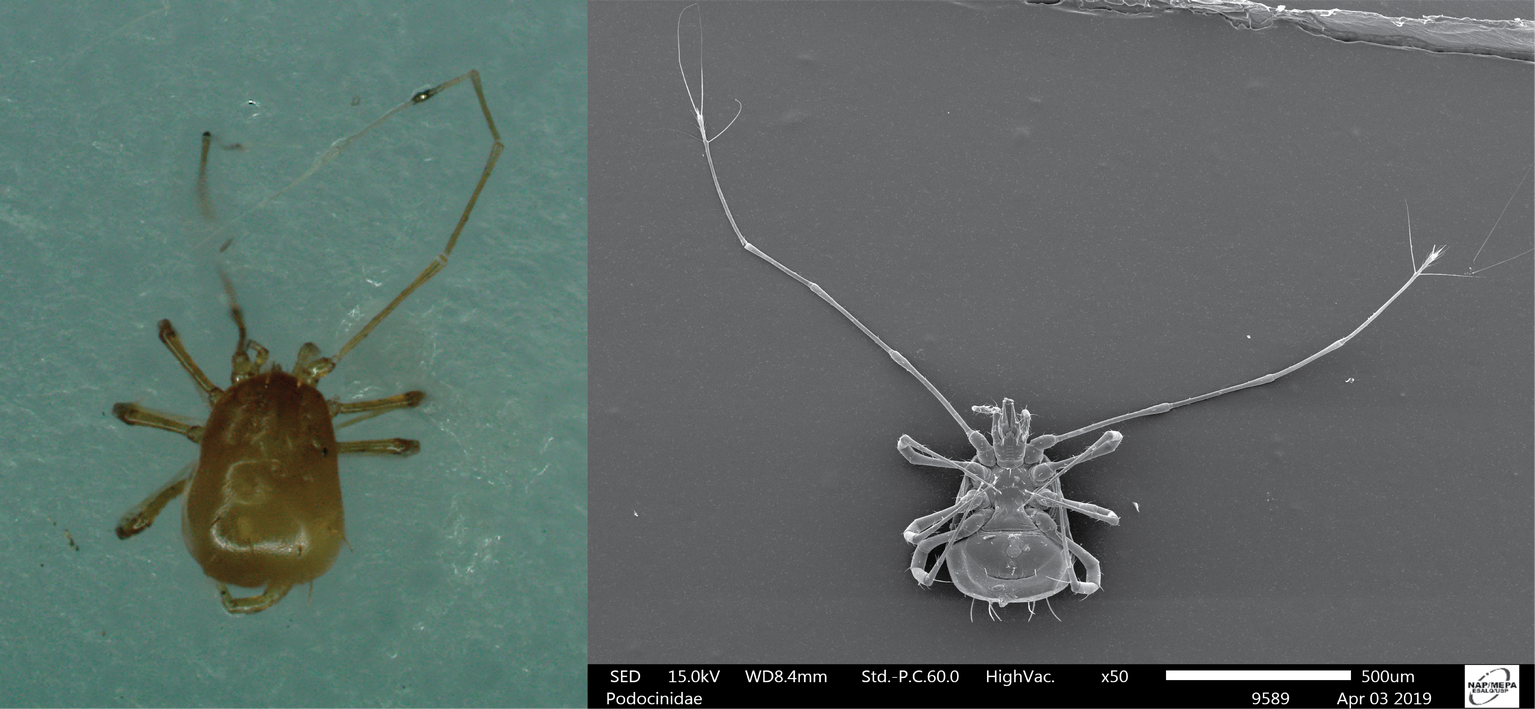
The population of P. sagax (Figure 1) used in this study was obtained from specimens collected from soil and associated litter of a garden at Escola Superior de Agricultura ''Luiz de Queiroz'' (ESALQ), Universidade de São Paulo (USP) (22°42′16.1″S, 47°38′00.9″W), Piracicaba, São Paulo State, Brazil. The mites were examined and identified using a phase-contrast microscope (Carl Zeiss Primo Star). Identification at the genus level was performed based on the key published by Barros et al. (2020), whereas species-level identification was carried out using the taxonomic key proposed by Yan et al. (2012) and the redescriptions provided by Santos et al. (2017).
In the laboratory, the stock colony was maintained in rearing units similar to those described by Freire and Moraes (2007), kept in a chamber at 25 ± 2 °C and 90 ± 10% RH, in the dark. The mites were fed a mixture of all developmental stages of R. axei offered on pieces of rotting green bean (Phaseolus vulgaris L., Fabaceae) pods.
A mixture of all developmental stages of R. axei was obtained from a colony started with specimens collected from manure at Piracicaba, Brazil, in 2010. The free-living nematode colonies were maintained in the laboratory on rotting green bean pods, which were placed in a reservoir filled with water replenished periodically to maintain humidity.
All developmental stages of T. cracentiseta were obtained from infested commercial chicken feed samples, collected in Piracicaba, Brazil, in 2012. Since then, laboratory colonies have been maintained on a mixture of wheat bran and brewer's yeast, spread on a plastic layer over a foam mat (about 1 cm thick), kept continuously moist, and placed inside a plastic tray (30 × 20 × 6 cm). This prey is commonly used in our laboratory as food for other predatory mite species.
Experimental procedure
The experimental unit consisted of a Petri dish (3 cm in diameter and 2 cm in height) whose base was covered by a solidified paste made from a mixture of gypsum and activated charcoal (9:1). The unit was kept moist by adding water to the absorbent base daily.
Each prey species tested (the free-living nematode R. axei or the mite T. cracentiseta) constituted a diet treatment. The P. sagax developmental cycle study was initiated with eggs laid within 12 hours by females transferred from the stock colony to experimental units provided with food (one female per unit). Once an egg was observed, the female was removed from the experimental unit, and any surplus eggs, when present, were also removed. After the predator larvae hatched, a mixture of all developmental stages of R. axei or T. cracentiseta, according to the respective diet treatment, was provided daily ad libitum. In the case of R. axei, a small piece of rotting green bean pod containing the free-living nematodes was transferred with forceps to each unit, whereas in the case of T. cracentiseta, individuals were transferred using a fine brush (No. 0.1).
For each diet treatment, 50 experimental units were established, each corresponding to a replicate. The experimental units were maintained at 25 ± 2ºC, 95 ± 5% RH, and in the dark.
The units were examined under a stereo microscope (Zeiss Stemi 305) at eight-hour intervals up to adulthood and at 24-hour intervals thereafter, until the death of the predators. Observations of the exuviae of each specimen determined the transition from egg to adult. Upon reaching adulthood, the mites exhibited sexual dimorphism, with males generally smaller and slimmer than females, facilitating pairing to ensure copulation. Pairing up was necessary because preliminary tests indicated that unmated females did not lay eggs. Males were paired with females from the same diet treatment. These pairs were maintained together for 24 h, after which the males were individually isolated and monitored daily to assess survival. Eggs deposited by females were counted, removed with a fine brush and discarded at each evaluation.
The biological parameters evaluated were the duration of each immature stage as well as of the total development time (from egg to adult); longevity of male and female adults; total longevity (from egg to death); pre-oviposition, oviposition, and post-oviposition periods; daily oviposition rate (eggs/female/day) and total egg production. For immature stage durations, only individuals that completed the respective stage were included in the analysis. Oviposition parameters were calculated only for females that reached adulthood, with oviposition and post-oviposition periods restricted to females that laid eggs.
The life table parameters, net reproductive rate (Ro), intrinsic rate of increase (r), daily population growth rate (λ), and mean generation time (T), were calculated following the age-stage, two-sex life table theory of Chi et al. (2020). Egg-to-adult survival was incorporated as the immature survival component, and adult survivorship was then calculated from adult emergence onward. Therefore, cumulative survivorship at each adult age was obtained by combining the proportion of individuals that survived from egg to adult emergence with the proportion of adults that remained alive up to that age; as in
\(l_x=S_{\text {egg-adult } } \times S_{\text {adult } }(x)\).
This approach follows the fertility life table logic described by Maia et al. (2000), in which cumulative survivorship includes immature-stage survival multiplied by adult-stage survival.
The intrinsic rate of increase (r) was obtained by numerically solving the Euler-Lotka equation, as recommended by Chi et al. (2023), rather than by approximate formulas. To enable statistical comparison of life table parameters between the two diet treatments, jackknife pseudo-values were generated by sequentially removing one individual at a time and recalculating the parameters, following the procedure outlined in Meyer et al. (1986) and commonly applied in life table studies.
Statistical analysis
All analyses were performed in R version 4.3.2 (R Core Team 2023). Biological parameters were compared between diets using the Wilcoxon rank-sum test because these variables did not meet the assumptions of parametric analysis. Effect sizes for these comparisons were expressed as the Wilcoxon effect size r. Life table parameters were compared between diets using jackknife pseudo-values, which were analyzed using Student's t-test following the standard approach adopted in fertility life table studies (Meyer et al. 1986; Maia et al. 2000). Effect sizes for life table parameters were expressed as Cohen's d. For all parameters, descriptive statistics were calculated as mean ± standard error (SE), and p-values were adjusted for multiple comparisons using the Benjamini–Hochberg procedure. Differences in sex ratios between diets were assessed through Fisher's exact test.
Results
Development, reproduction, and life table parameters
The duration of each developmental stage of P. sagax was similar on both prey species (Table 1), except for the short larval stage, which was significantly longer on R. axei than on T. cracentiseta. Nevertheless, the overall duration of the immature phase (egg to adult) was nearly identical on the two prey species, ranging from 7.8 (R. axei) to 8.0 (T. cracentiseta) days. Immature survivorship (percentage of individuals reaching adulthood) was numerically higher on T. cracentiseta (about 86%) than on R. axei (74%).
Download as
Biological parameter
Diet
p-value
r
Rhabditella axei
Thyreophagus cracentiseta
Egg stage duration
1.5 ± 0.11 (48)
1.6 ± 0.10 (50)
0.661
0.085
Larval stage duration
0.6 ± 0.04 (45)
0.4 ± 0.02 (50)
< 0.001*
0.419
Protonymphal stage duration
2.9 ± 0.26 (41)
3.3 ± 0.15 (48)
0.285
0.192
Deutonymphal stage duration
2.9 ± 0.38 (37)
2.7 ± 0.20 (43)
0.768
0.072
Egg to adult duration
7.8 ± 0.51 (37)
8.0 ± 0.19 (43)
0.768
0.067
Pre-oviposition period
3.9 ± 0.70
3.9 ± 0.28
0.35
0.257
Oviposition period
16.5 ± 2.59
11.6 ± 0.99
0.45
0.208
Post-oviposition period
1.7 ± 0.63
1.8 ± 0.53
0.52
0.182
♀ adult longevity
23.2 ± 2.50
18.4 ± 1.14
0.35
0.255
♂ adult longevity
16.2 ± 1.82
14.9 ± 0.94
0.835
0.042
Daily oviposition
0.8 ± 0.11
1.1 ± 0.08
0.285
0.3
Total oviposition
19.7 ± 3.25
19.3 ± 2.06
0.816
0.064
Sex ratio (♀:♂)
19♀:18♂ (≈ 1:1)
16♀:27♂ (1:1.7)
0.26
–
The same pattern of similarity was observed for the duration of each female adult phase based on the oviposition periods (pre-oviposition, oviposition, and post-oviposition), as well as for adult longevity. The adult male longevity of P. sagax was also approximately the same for both prey.
Also, in reproduction, the disparate prey species did not affect oviposition, which ranged from 0.8 (R. axei) to 1.1 (T. cracentiseta) eggs/female/day, resulting in a total of 19.7 (R. axei) to 19.3 (T. cracentiseta) eggs/female for the entire life cycle, despite the seemingly different sex ratios (not statistically significant). Out of the 100 eggs (both diets), 35 developed into females and 45 into males.
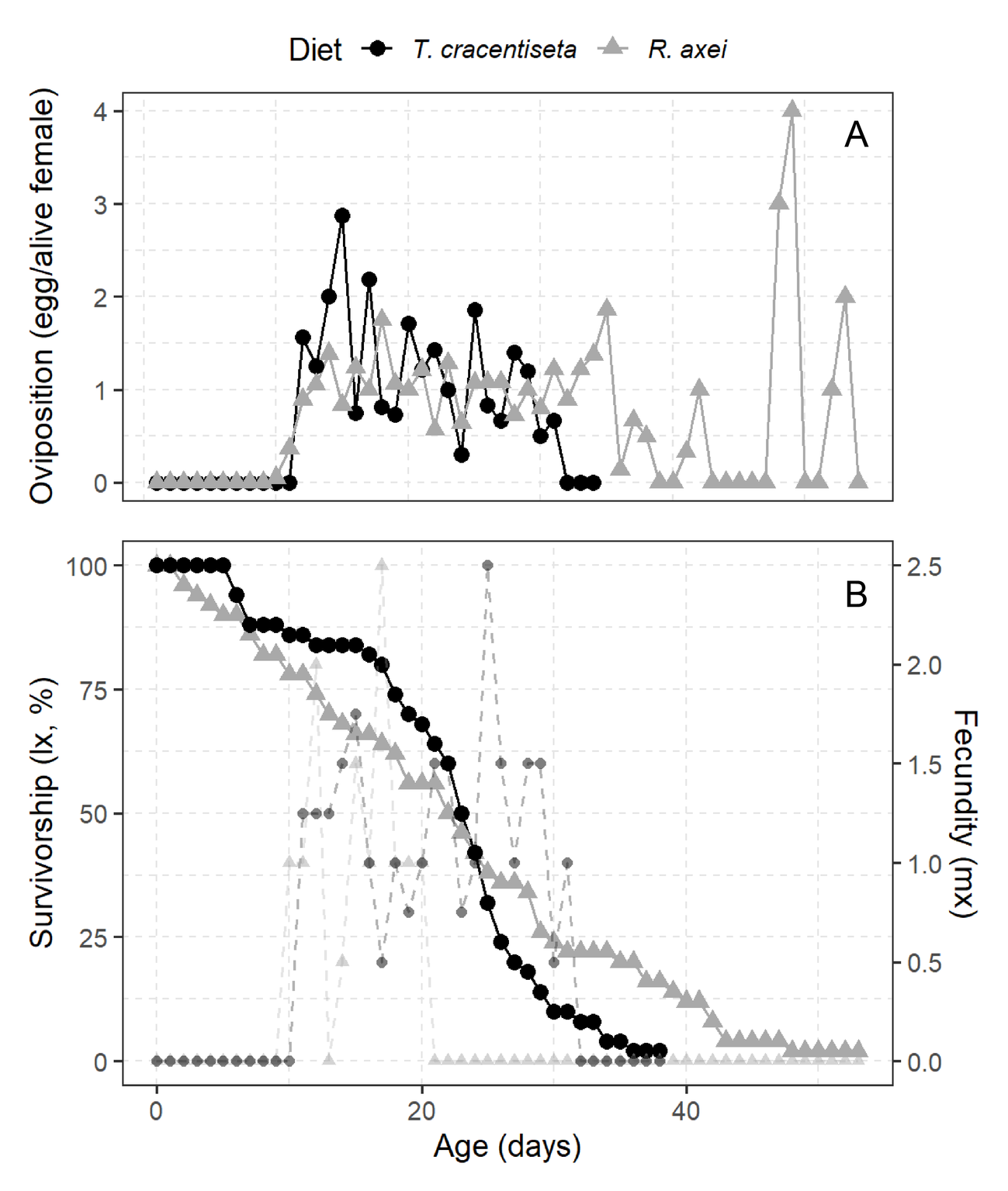
On both prey species, daily oviposition rates were somewhat variable over time (Figure 2A). Considering the period before 50% mortality of the mites (Figure 2B), the peak of oviposition rate occurred approximately seven days after adult emergence on T. cracentiseta and about nine days on R. axei.
The mortality rate of P. sagax on T. cracentiseta and R. axei reached 50% at 14 and 15 days after adult emergence, respectively (Figure 2B). Total mortality (100%) occurred 31 days after adult emergence for P. sagax fed on T. cracentiseta, and at 46 days after adult emergence in those fed on R. axei.
Life table parameters
No statistically significant differences were detected between diets for any life table parameter after correction for multiple comparisons, and effect sizes were weak (Table 2). Net reproductive rate (R₀) indicated a population increase of approximately 13–14 times per generation, whereas the intrinsic rate of increase (r) ranged from 0.163–0.228 females/female/day. The finite rate of increase (λ) corresponded to a daily growth of approximately 18–25%, and mean generation time (T) ranged from 12 to 19 days. Therefore, despite numerical differences between prey species, both diets provided comparable performance and supported positive population growth of P. sagax.
Download as
Diet
Ro
r
λ
T
Thyreophagus cracentiseta
13.80 ± 4.13
0.163 ± 0.0155
1.18 ± 0.02
18.58 ± 2.35
Rhabditella axei
13.01 ± 5.33
0.228 ± 0.0881
1.25 ± 0.10
12.32 ± 3.29
p–value
0.908
0.5
0.633
0.633
d
0.023
0.31
-0.144
-0.146
Discussion
The biological performance of P. sagax was largely similar on the two taxonomically distinct prey species offered as food. Although a significant difference was observed in larval duration, this finding should be interpreted cautiously because the larval stage was extremely brief and developmental transitions were recorded at 8-h intervals. Furthermore, the difference had no significant effect on the determined duration of the total immature phase or the overall developmental cycle, as the larval stage represented only a very small fraction of total development.
Under laboratory ambient temperature (without a specified value) and high humidity maintained by watering the substrate, Wong (1967) reported developmental durations for P. sagax of approximately 1.4, 0.5, 2.1, and 2.2 days for egg, larval, protonymphal, and deutonymphal stages, respectively, resulting in an average immature developmental time (egg to adult) of about 6.4 days when feeding on Neobeckerella sp. (Collembola: Hypogastruridae) or on the mite Tyrophagus sp. (Astigmata: Acaridae). Compared with the present study, immature development was numerically faster, primarily due to the shorter durations of the protonymphal and deutonymphal stages.
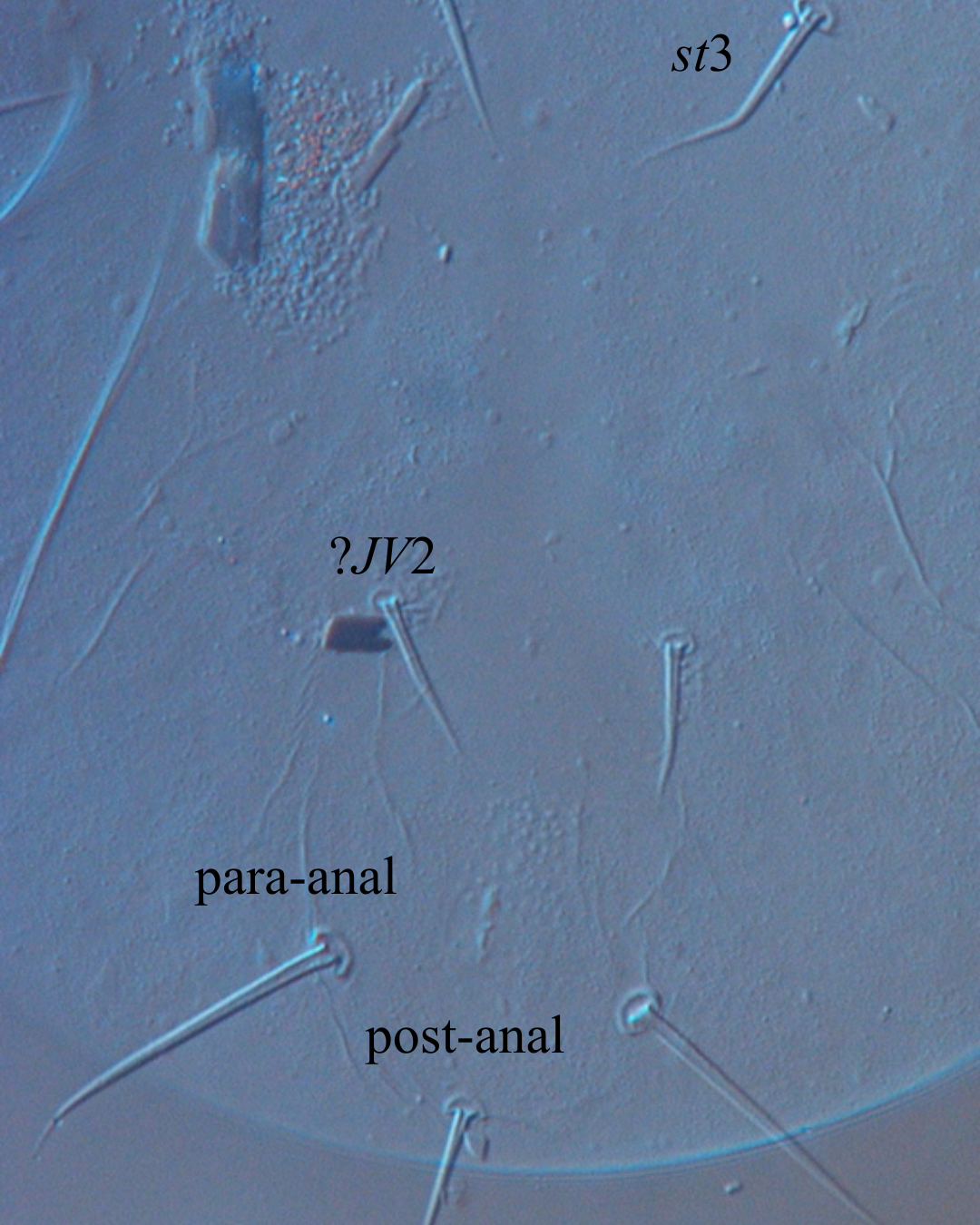
The extremely brief larval phase observed in both the present study and that of Wong (1967), together with the apparent absence of larval feeding, also observed in the present study, suggests that larvae rely primarily on egg reserves and have little need for waste elimination before ecdysis. In addition, larvae from our colony did not exhibit an evident anal opening (Figure 3). This finding raises the hypothesis that the reduction or absence of this structure may be developmentally associated with aphagy and a shortened larval period. However, histological studies are required to confirm whether such an association exists.
Evidence regarding the presence and morphology of the anal opening in Mesostigmata larvae is scarce in life-history studies. Additional morphological investigations are needed to determine whether anal reduction or closure is associated with aphagy in other mesostigmatid species. Furthermore, as noted by E.E. Lindquist (pers. comm., January 2019) upon examining photographs of one of the P. sagax larvae, only one (possibly JV2) of the four pairs (JV1, JV2, JV5, and ZV2) of opisthogastric setae typically present in mesostigmatid larvae appeared to be present, in addition to the two para-anal and one post-anal setae (Lindquist and Evans 1965). The euanal seta also appeared to be absent.
As for reproduction, Wong (1967) reported an oviposition rate of 0.7 egg per female per day for P. sagax, which was numerically lower than the values obtained in the present study. The associated similarities in oviposition and survivorship rates across developmental stages suggested comparable population-increase capacity among treatments. This interpretation was supported by the intrinsic rate of increase, which ranged from 0.163 to 0.228 female/female/day.
Wong (1967) concluded that P. sagax reproduces sexually based on the observation that unmated females maintained for 23–26 days did not oviposit, whereas mated females began laying eggs approximately three days after copulation and produced offspring of both sexes. According to that author, a single mating was sufficient to initiate oviposition, but continued egg production depended on repeated matings, as oviposition ceased about 10 days after male removal and resumed only after a male was reintroduced. In the same study, P. pacificum was found to reproduce by thelytokous parthenogenesis, indicating reproductive diversity within Podocinidae.
Preliminary observations in the present study likewise indicate that unmated P. sagax females did not oviposit, supporting Wong's (1967) conclusion that this species reproduces sexually. The high proportion of males observed in the present study also suggests that mating is necessary for oviposition. In contrast to Wong's (1967) findings, however, females in the present study continued laying eggs throughout the observation period without the need for male reintroduction, suggesting that a single mating may be sufficient to sustain oviposition for an extended period under the conditions evaluated.
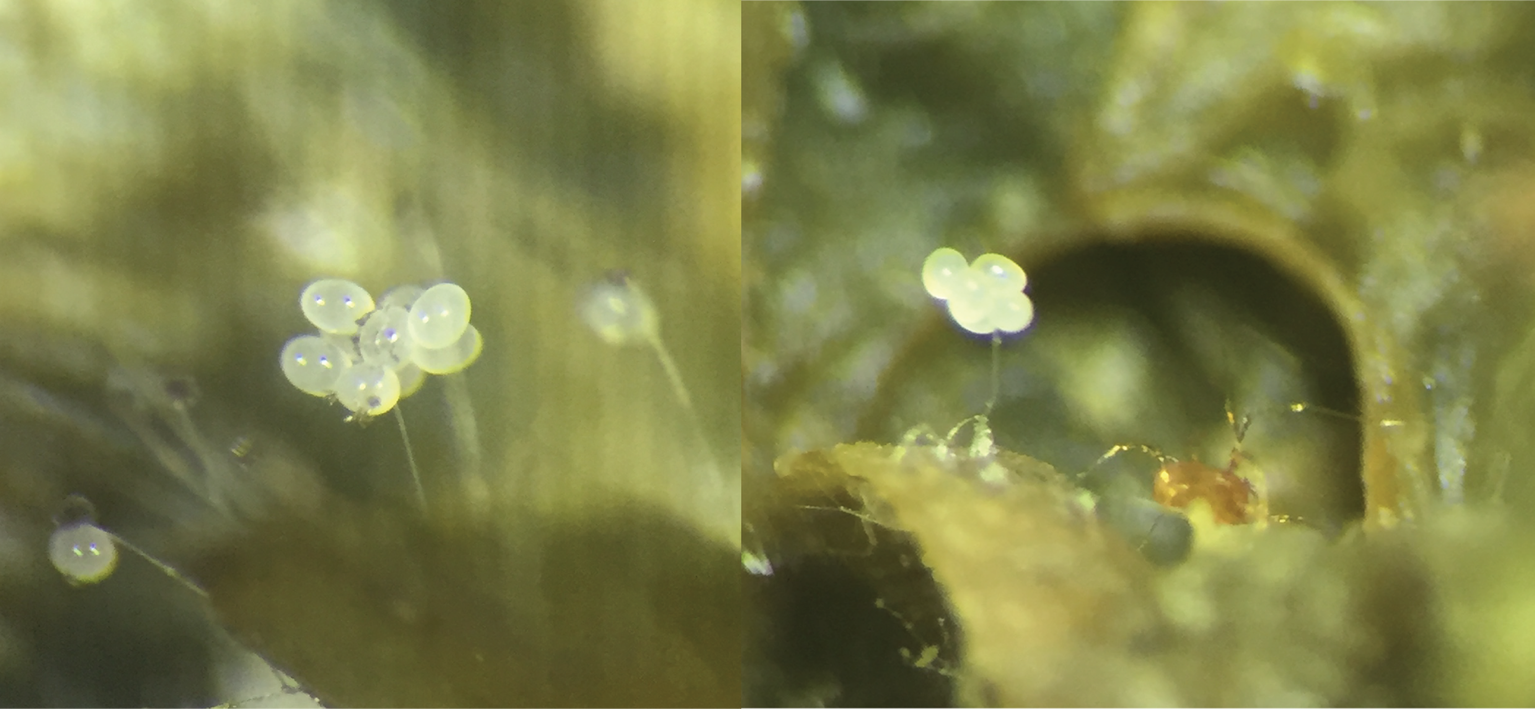
Another noteworthy characteristic observed in P. sagax was the deposition of eggs on thin, elevated stalks. This oviposition pattern was consistently observed both during colony maintenance and during experiments with the two prey species evaluated (Figure 4).
Some similarities were found when comparing our results with those of Phytoseiidae species, a family that, like Podocinidae, belongs to Phytoseioidea. Phytoseiidae is the most diverse family of Mesostigmata and the mite group most widely used in practical biological control (Moraes et al. 2025). Unlike Podocinidae, they are mostly plant inhabitants. Many phytoseiids complete the immature phase in 5–8 days at the same temperature used in the present study, with some species presenting a non-feeding larval stage (Laing 1968; Ali 1998; Escudero and Ferragut 2005; Hoque et al. 2008; Uddin et al. 2017), but most of them have feeding larvae. Furthermore, the intrinsic rates of increase (r) reported for some phytoseiid species, including Phytoseiulus persimilis Athias-Henriot, Neoseiulus californicus (McGregor), Cydnoseius negevi (Swirki & Amitai), and Neoseiulus barkeri Hughes, typically range from 0.15 to 0.35 female/female/day at 25–30 °C when provided with adequate prey (Escudero and Ferragut 2005; Hoque et al. 2008; Negm et al. 2014).
The similar biological performance of P. sagax when feeding on different prey groups in the present study, as well as in that of Wong (1967), suggests that this species is highly polyphagous. In particular, the ability of P. sagax to complete development and maintain positive population growth when feeding on either astigmatid mites, collembolans, or free-living nematodes indicates considerable trophic flexibility. The present study also provides the first detailed life-table parameters for P. sagax when feeding on a free-living nematode.
Conclusion
This study demonstrates that P. sagax can successfully complete its development and reproduce on both R. axei and T. cracentiseta under the conditions evaluated. Immature development lasted approximately eight days, and both diets supported positive population growth, with no significant differences in the main life-table parameters. These results indicate that both a free-living nematode and an astigmatid mite constitute suitable prey for P. sagax. In addition, the study confirms the requirement of mating for oviposition and provides evidence of a very brief, apparently non-feeding larval stage with an absent or reduced anal opening.
Given the limited knowledge of the behavioral and ecological aspects of Podocinidae, this study provides a valuable contribution to understanding the family's biology. It has important implications for further research on related environmental topics for the species P. sagax.
Acknowledgements
To the Minciencias (formerly Colciencias), Colombia, for the scholarship provided to the first author (Process Number# 860-2019), to FAPESP (São Paulo Research Foundation) for the scholarship provided to the second author (Process Number# 2024/21481-1), and to Conselho Nacional de Desenvolvimento Científico e Tecnológico (CNPq), Brazil (Process Number# 309433/2025-8 – CNPq researcher to the last author). This study was partially funded by the FAPESP, Brazil (Process Number #2017/12004-1 – part of BIOTA program).
References
- Ali F.S. 1998. Life tables of Phytoseiulus macropilis (Banks) (Gamasida: Phytoseiidae) at different temperatures. Exp. Appl. Acarol., 22: 335-342. https://doi.org/10.1023/A:1024560924642
- Barros A.R.A., Castilho R.C., Moraes, G.J. 2020. Catalogue of the mite family Podocinidae Berlese (Acari: Mesostigmata). Zootaxa, 4802: 141-156. https://doi.org/10.11646/zootaxa.4802.1.9
- Chi H., You M., Atlıhan R., Smith C.L., Kavousi A., Özgökçe M.S., Güncan A., Tuan S.-J., Fu J.-W., Xu Y.-Y., Zheng F.-Q., Ye B.-H., Chu D., Yu Y., Gharekhani G., Saska P., Gotoh T., Schneider M.I., Bussaman P., Gökçe A., Liu T.-X. 2020. Age-Stage, two-sex life table: an introduction to theory, data analysis, and application. Entom. Gener., 40: 103-124. https://doi.org/10.1127/entomologia/2020/0936
- Chi H., Kavousi A., Gharekhani G., Atlihan R., Salih Özgökçe M., Güncan A., Gökçe A., Smith C.L., Benelli G., Guedes R.N.C., Amir-Maafi M., Shirazi J., Taghizadeh R., Maroufpoor M., Xu Y.-Y., Zheng F.-Q., Ye B.-H., Chen Z.-Z., You M.-S., Fu J.-W., Li J.-Y., Shi M.-Z., Hu Z.-Q., Zheng C.-Y., Luo L., Yuan Z.-L., Zang L.-S., Chen Y.-M., Tuan S.-J., Lin Y.-Y., Wang H.-H., Gotoh T., Shaef Ullah M., Botto-Mahan C., De Bona S., Bussaman P., Gabre R.M., Saska P., Schneider M.I., Ullah F., Desneux, N. 2023. Advances in theory, data analysis, and application of the age-stage, two-sex life table for demographic research, biological control, and pest management. Entom. Gener., 43: 705-732. https://doi.org/10.1127/entomologia/2023/2048
- Escudero L.A., Ferragut F. 2005. Life-history of predatory mites Neoseiulus californicus and Phytoseiulus persimilis (Acari: Phytoseiidae) on four spider mite species as prey, with special reference to Tetranychus evansi (Acari: Tetranychidae). Biol. Control, 32: 378-384. https://doi.org/10.1016/j.biocontrol.2004.12.010
- Evans G.O., Hyatt K.H. 1957. The genera Podocinum Berl. and Podocinella gen. nov. (Acarina: Mesostigmata). Ann. Magaz. Nat. Hist., 10(120): 913-932. https://doi.org/10.1080/00222935708656095
- Freire R.A.P., Moraes G.J. 2007. Mass production of the predatory mite Stratiolaelaps scimitus (Womersley) (Acari: Laelapidae). Syst. Appl. Acarol., 12: 117-119. https://doi.org/10.11158/saa.12.2.4
- Hoque M.F., Islam W., Khalequzzaman M. 2008. Life tables of two-spotted spider mite Tetranychus urticae Koch (Acari: Tetranychidae) and its predator Phytoseiulus persimilis Athias-Henriot (Acari: Phytoseiidae). J. Bio-Sci., 16: 1-10. https://doi.org/10.3329/jbs.v16i0.3733
- Laing J.E. 1968. Life history and life table of Phytoseiulus persimilis Athias-Henriot. Acarologia, 10: 578-588.
- Lindquist E.E., Evans G.O. 1965. Taxonomic concepts in the Ascidae, with a modified setal nomenclature for the idiosoma of the Gamasina (Acarina: Mesostigmata). Mem. Entom. Soc. Canada, 47: 1-64. https://doi.org/10.4039/entm9747fv
- Lindquist E.E., Krantz G.W., Walter D.E. 2009. Order Mesostigmata. In: Krantz G.W., Walter D.E. (Eds.). A Manual of Acarology. Third Edition, Texas Tech University Press: Lubbock, Texas, pp. 124-232.
- Maia A.H.N., Luiz A.J.B., Campanhola C. 2000. Statistical inference on associated fertility life table parameters using jackknife technique: computational aspects. J. Econ. Entom., 93: 511-518. https://doi.org/10.1603/0022-0493-93.2.511
- Meyer J.S., Ingersoll C.G., McDonald L.L., Boyce M.S. 1986. Estimating uncertainty in population growth rates: jackknife vs. bootstrap techniques. Ecology, 67: 1156-1166. https://doi.org/10.2307/1938671
- Moraes G.J., Castilho R.C., Flechtmann C.H.W., Demite P.R., Halliday B. 2025. Progress in understanding the world mesostigmatic mites, with emphasis on the family Phytoseiidae (Acari: Mesostigmata). Acarologia, 65: 647-676. https://doi.org/10.24349/q3gy-1vyg
- Negm M.W., Alatawi F.J., Aldryhim Y.N. 2014. Biology, predation, and life table of Cydnoseius negevi and Neoseiulus barkeri (Acari: Phytoseiidae) on the old world date mite, Oligonychus afrasiaticus (Acari: Tetranychidae). J. Insect Sci., 14: 177. https://doi.org/10.1093/jisesa/ieu039
- R Core Team, 2023. R: A Language and Environment for Statistical Computing. R Foundation for Statistical Computing, Vienna, Austria.
- Rueda-Ramírez D., Santos J.C., Sourassou N.F., Demite P.R., Puerta-González A., Moraes G.J. 2019. Complementary description of Africoseius lativentris and placement of Africoseius in Podocinidae (Acari, Mesostigmata) based on molecular and morphological evidences. Syst. Appl. Acarol., 24: 2369-2394. https://doi.org/10.11158/saa.24.12.7
- Santos J.C., Martins J.P.I., Britto E.P.J., Moraes G.J. 2017. A new species of Podocinum (Acari: Podocinidae) from Brazil, and supplementary descriptions of three species of this genus. Zootaxa, 4290: 444-458. https://doi.org/10.11646/zootaxa.4290.3.2
- Uddin M.N., Alam M.Z., Miah M.R.U., Mian M.I.H., Mustarin K.E. 2017. Life table parameters of an indigenous strain of Neoseiulus californicus McGregor (Acari: Phytoseiidae) when fed Tetranychus urticae Koch (Acari: Tetranychidae). Entomol. Res., 47: 84-93. https://doi.org/10.1111/1748-5967.12202
- Wong C.L. 1967. A study of the biology of two species of Podocinidae (Acarina: Mesostigmata). Kansas Univ. Sci. Bull., 47: 575-600.
- Yan Y., Jin D.-C., Wu D., Guo J.-J., Guo X.-G. 2012. A revised checklist and key to the genus Podocinum Berlese (Acari: Podocinidae) with description of a new species from Tibet, Southwest China. Zootaxa, 3194: 35-48. https://doi.org/10.11646/zootaxa.3194.1.2
 to post any comment or correction.


2025-11-14
Date accepted:
2026-07-02
Date published:
2026-09-09
Edited by:
Roy, Lise

This work is licensed under a Creative Commons Attribution 4.0 International License
2026 González-Cano, Lina Marcela; Godoy, Lucas Lorena; Santos, Jandir Cruz; de Moraes, Gilberto José and Castilho, Raphael de Campos
 Download article
Download the citation
RIS with abstract
(Zotero, Endnote, Reference Manager, ProCite, RefWorks, Mendeley)
RIS without abstract
BIB
(Zotero, BibTeX)
TXT
(PubMed, Txt)