


Mites of the family Laelapidae Berlese (Parasitiformes: Mesostigmata) from Saudi Arabia; new genera and species records with an identification key to the reported species
Mirza, Jawwad Hassan  1
; Kamran, Muhammad
2
and Alatawi, Fahad Jaber
3
1
; Kamran, Muhammad
2
and Alatawi, Fahad Jaber
3
1Department of Plant Protection, College of Food and Agriculture Sciences, King Saud University, Riyadh, 11451, Saudi Arabia.
2Department of Plant Protection, College of Food and Agriculture Sciences, King Saud University, Riyadh, 11451, Saudi Arabia.
3✉ Department of Plant Protection, College of Food and Agriculture Sciences, King Saud University, Riyadh, 11451, Saudi Arabia.
2026 - Volume: 66 Issue: 3 pages: 673-697
https://doi.org/10.24349/ybi9-4dqhOriginal research
Keywords
Abstract
Introduction
The family Laelapidae Berlese is a cosmopolitan assemblage of mesostigmatic mites and encompasses a wide variety of species, with the highest diversity found in tropical and subtropical regions (Moraes et al. 2022). Species of Laelapidae have adapted to various environments, including temperate zones and extreme ecological habitats. The family includes free-living predators found in soil litter, as well as obligatory and facultative parasites of both vertebrates and invertebrates (Evans and Till 1966; Strong and Halliday 1994; Faraji and Halliday 2009; Lindquist and Moraza 2009). Several members of this family have been utilized in the biological control of edaphic or partially soil-dwelling pests (Moreira and Moraes 2015). Recently, a catalog of the free-living and arthropod-associated laelapids of the world was published, including updated family and generic diagnoses, as well as identification key to free living and arthropod associated laelapid genera (Moraes et al. 2022).
A total of eight genera and seven species of laelapid mites have been previously reported from Saudi Arabia (Fouly and Al-Rehiayani 2011, 2014; Elmoghazy 2016; Alatawi et al. 2018). Field trips in different regions of Saudi Arabia resulted in the collection of a considerable amount of laelapid specimens. The present study reports on the identification of new material as well as correction in some previously reported taxa for laelapid fauna in the region and the development of an identification key for the 15 known species from Saudi Arabia.
Materials and methods
Different provinces in Saudi Arabia were surveyed for laelapid mites, specifically soil-dwelling and insect-associated species. Mites were collected either by processing soil samples in Tullgren funnels or directly from insect specimens under the stereomicroscope in the laboratory. The mite specimens, after mounting on slides in Hoyer's medium, were examined under a phase-contrast microscope (DM2500, Leica, Germany). The images were taken using Auto-Montage software (Syncroscopy, Cambridge, UK) through a micropublisher camera attached to the compound microscope (DM2500, Leica®, Germany). The generic identification was made using Moraes et al. (2022), while species were identified using different published literature and diagnostic keys. The nomenclature used for the dorsal idiosomal chaetotaxy follows Lindquist and Evans (1965), and the notations for leg setae follow Evans (1963a, b). Notations for idiosomal pore-like structures (gland pores and poroids/lyrifissures) and peritrematal shield follow Athias-Henriot (1971). The notations on pore-like structures on the sternal shield and on the peritrematal shield region also follow modifications and additions by Johnston and Moraza (1991), adapted by Kazemi et al. (2014). All specimens have been deposited at the King Saud University Museum of Arthropods (KSMA) (Acarology section), Department of Plant Protection, College of Food and Agriculture Sciences, King Saud University.
Results and discussion
In the present study, a total of ten species from eight genera of the family Laelapidae are reported from various habitats and regions of Saudi Arabia (SA). Among them, four genera Dinogamasus Kramer 1898, Hypoaspisella Bernhard 1971, and Ololaelaps Berlese (1904a) and Persicolaelaps Kazemi & Beaulieu 2016 and eight species, i.e., Androlaelaps projecta Furman 1972, D. inflatus LeVeque 1930, Gaeolaelaps mirzakhaniae Kazemi & Khalesi (in Khalesi and Kazemi 2018), G. queenslandicus (Womersley 1956), G. presternalis (Willmann 1949), Hypoaspisella sclerotarsus (Costa 1968), Laelaspis calidus (Berlese 1923), and O. tasmanicus (Womersley 1956) are recorded as new to the mite fauna of Saudi Arabia. Hypoaspisella sclerotarsus is redescribed based on non-type females to complement the inadequate original description by Costa (1968). Additionally, the specimens of previously reported taxa belonging to the genera Androlaelaps, Gaeolaelaps, Gymnolaelaps, Hyperlaelaps, Hypoaspis, and Stratiolaelaps were also re-examined. It is concluded that the specimens of Gymnolaelaps sp. and Hyperlaelaps sp. were misidentified and corrected as A. projecta and Persicolaelaps sp. in the present study, respectively. After the present study, the known laelapid mite fauna of Saudi Arabia is now composed of 10 genera and 15 species.
Taxonomy
Genus Androlaelaps Berlese
Laelaps (Androlaelaps) Berlese 1903: 14
Type species — Laelaps (Iphis) hermaphrodita Berlese 1887; by original designation.
Diagnosis — Based on that of Evans and Till (1966) and Shaw (2014).
Until now, only one species, A. casalis, had been reported from Saudi Arabia (Fouly and Al-Rehiayani 2011; Elmoghazy 2016). In the present study, A. projecta Furman has been reported for the first time from SA. In addition, A. casalis has also been collected in the present study. The specimens were re-identified in this study as A. projecta, and information has been updated.
Androlaelaps projecta Furman
(Figure 1A-F)
Androlaelaps projecta Furman 1972: 54.
Gymnolaelaps sp. – Alatawi et al. 2018: 379; misidentification.
Androlaelaps projecta – Moraes et al. 2022:169.
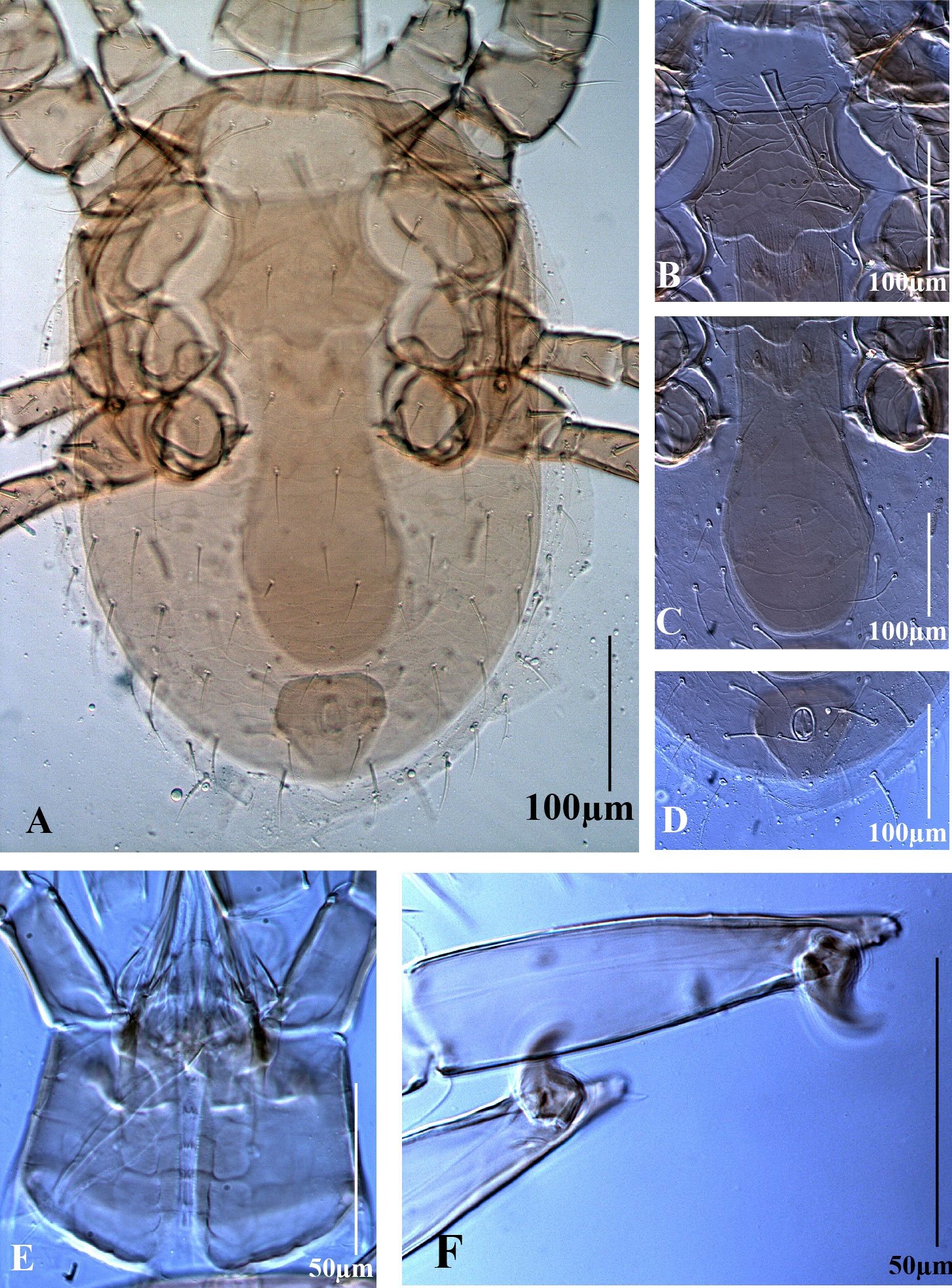
Material examined — One female, soil under Phoenix dactylifera (Arecaceae); two females, grasses (Poaceae), Imam Muhammad Ibn Saud University (IMISU), Riyadh, 24°48′0.0″N, 46°42′0.0″E, 01 Dec. 2010, coll. J. Basahih and W. Negm; one female, soil under P. dactylifera, IMISU, Riyadh, 24°48′0.0″N, 46°42′0.0″E, 6 Dec. 2011, coll. M. Kamran; one female, soil under Mangifera sp. (Anacardiaceae), Abu Areesh, Jazan, 16°52′42.0″N, 42°33′35.2″E, 16 May 2022, coll. M. Kamran, E.M. Khan, and N.A. Elgoni; one female, soil under Punica granatum (Lythraceae), Jouf, 29°46′56.9″N, 38°27′18.4″E, 29 May 2022, coll. E.M. Khan.
Remarks — A complementary description of A. projecta male and female has been recently provided by Abo-Shnaf et al. (2025). The morphological characters are similar to the original description (Furman 1972) and re-description (Joharchi and Negm 2020). The species was easily identified by the presence of two unpaired supernumerary setae Jx, a median projection on the posterior margin of the sternal shield, a genito-ventral shield adjacent to the anal shield, and setae av on the femur–tibia of leg II modified to a spur shape. Abo-Shnaf et al. (2025) differentiated A. projecta from A. aegypticus Hafez, EL-Badry, & Nasr (1982) mainly based on the shape of the posteromedian projection of the sternal shield, i.e., truncate vs rounded, respectively. The shape of this projection in the Saudi specimen does not appear completely round and match the Egyptian A. projecta provided by Joharchi and Negm (2020). However, Abo-Shnaf et al. (2025) considered it a misidentification of A. aegypticus, based on the rounded posteromedian projection of the sternal shield. The Saudi specimens are identified as A. projecta based on distinct morphological affiliation and its distinction from A. aegypticus.
Androlaelaps casalis (Berlese)
Iphis casalis Berlese 1887: 8.
Androlaelaps casalis – Zaher 1986: 181; Basha and Yousef 2000: 396.
Androlaelaps casalis casalis – Hughes 1976: 288.
Androlaelaps casalis – Moraes et al. 2022:137.
Material examined — Two females, grasses (Poaceae) IMISU, Riyadh, 24°48′0.0″N, 46°42′0.0″E, 6 Jun. 2011; 7 Apr. 2016, coll. J. Basahih and J. Mirza; one female and male, soil under Acacia sp. (Fabaceae), Taif, 21°38′33.2″N, 40°25′32.4″E, 6 May 2024, coll. M. Kamran; one female, soil under Mangifera sp. (Anacardiaceae), Jazan, 17°07′57.0″N 42°39′07.1″E, 24 Feb. 2025, coll. E.M. Khan, N.A. Elgoni and H.M.S. Ali.
Remarks — Androlaelaps casalis was previously reported from Sakaka and Qassim in SA (Fouly and Al-Rehiayani 2011; Elmoghazy 2016). In the present study, more specimens were collected from Riyadh, Jazan, and Taif. A complementary description has been recently provided by Abo-Shnaf et al. (2025) and four females specimens at hand do not morphologically vary from published descriptions.
Genus Cosmolaelaps Berlese
Laelaps (Cosmolaelaps) Berlese 1903: 13.
Type species — Laelaps claviger Berlese 1883 by original designation.
Diagnosis — Based on Moreira et al. (2014).
Two species of Cosmolaelaps, C. qassimensis Fouly & Al-Rehiayani and C. simplex (Berlese) have been reported from Saudi Arabia to date (Fouly and Al-Rehiayani 2011, 2014). In the present research, only C. qassimensis is again reported from Ahsa, Medina, Riyadh, and Tabuk regions of Saudi Arabia.
Cosmolaelaps qassimensis Fouly & Al-Rehiayani
(Figure 2A-D)
Cosmolaelaps qassimensis Fouly and Al-Rehiayani 2014: 263.
Cosmolaelaps qassimensis – Nasr and Momen 2016: 263.
Cosmolaelaps qassimensis – Moraes et al. 2022:217
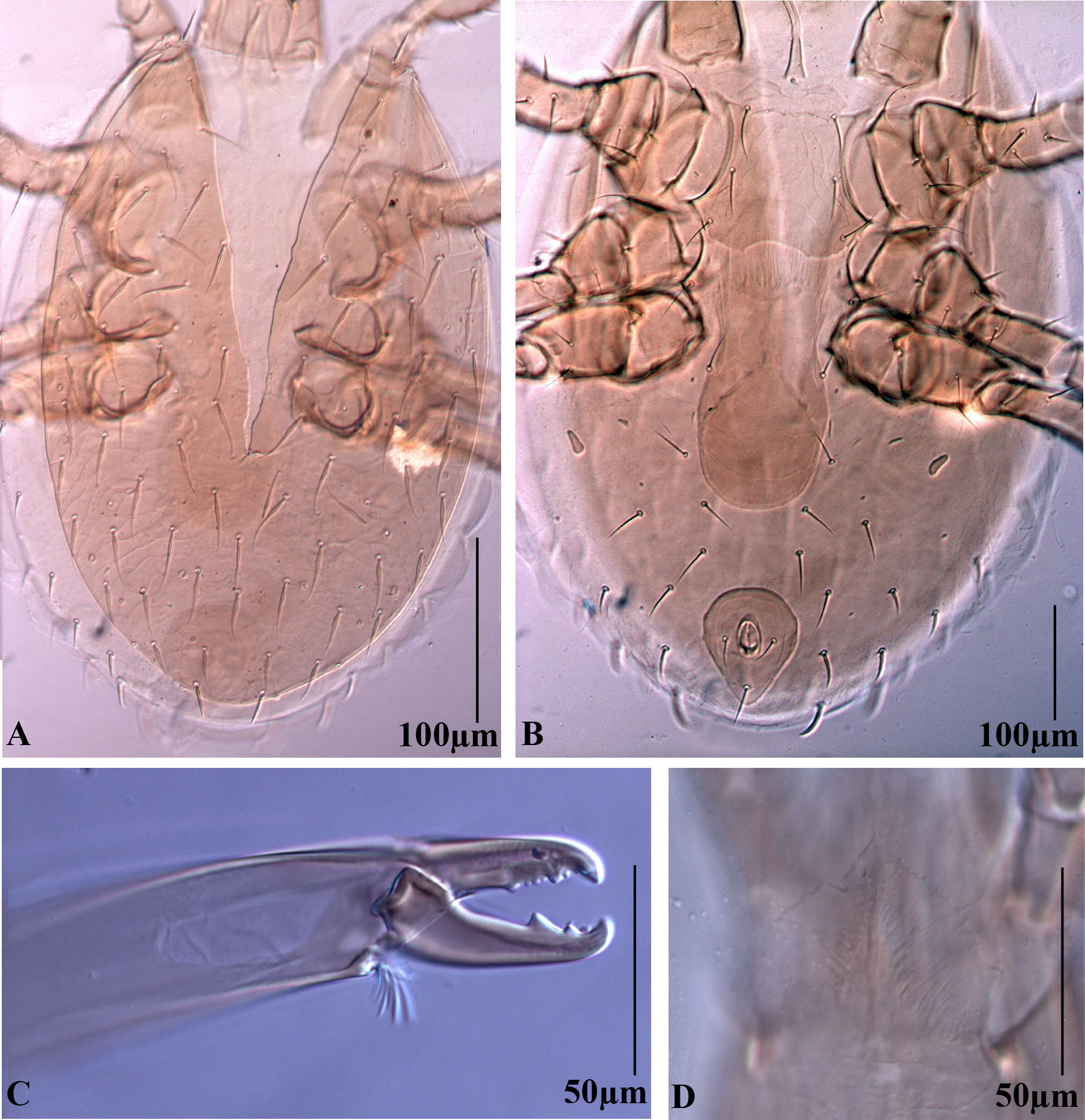
Material examined — One male soil debris under P. dactylifera, IMISU, Riyadh, 24°48′00.0″N, 46°42′00.0″E, 3 Aug. 2011, coll. J. Basahih and M. Kamran; one female, soil under P. dactylifera, IMISU, Riyadh, 24°48′00.0″N, 46°42′00.0″E, 6 Dec. 2011, coll. M. Kamran; three females, soil debris under P. dactylifera, Mubarik farm and Mutawa farm, Ahsa, 24°22′37.3″N, 49°37′16.1″E, 15 Jan. 2012, coll. M. Kamran, J. Basahih, and A. Gayed; one female, soil debris under P. dactylifera, Deesa Valley, Tabuk, 27°36′00.0″N, 36°25′00.0″E, 18 Oct. 2015, coll. H. Saqib; one female, soil debris under Citrus sp., Deesa Valley, Tabuk, 27°36′00.0″N, 36°25′0.0″E, 18 Oct. 2015, coll. H. Saqib.
Remarks — The specimens were identified as C. qassimensis in the present study, although they present a minor difference from the original description of the species, namely the presence of subequal J5 and Z5 setae, whereas C. qassimensis has J5 shorter, almost half the length of Z5. The original description of C. qassimensis reported j1 lanceolate, which appears stout in their illustrations, similar to one found in the current specimens of the species. It differs from C. simplex, another species reported from Saudi Arabia previously, by having stout j1 seta, which is paddle-like in C. simplex (redescription by Fouly et al. 1997).
Genus Dinogamasus Kramer
Dinogamasus Kramer 1898: 417
Type species — Dinogamasus crassipes Kramer 1898, by monotypy.
Diagnosis — Based on Lundqvist (1999).
The genus Dinogamasus is reported for the first time from Saudi Arabia, with the species D. inflatus collected from a carpenter bee, Xylocopa sp. (Hymenoptera: Apidae).
Dinogamasus inflatus LeVeque
(Figure 3A-D)
Dinogamasus inflatus LeVeque 1930: 14.
Dinogamasus inflatus – Van Eyndhoven 1964: 346; Costa 1966: 74; Lundqvist 1999: 75.
Dinogamasus inflatus – Moraes et al. 2022:231.
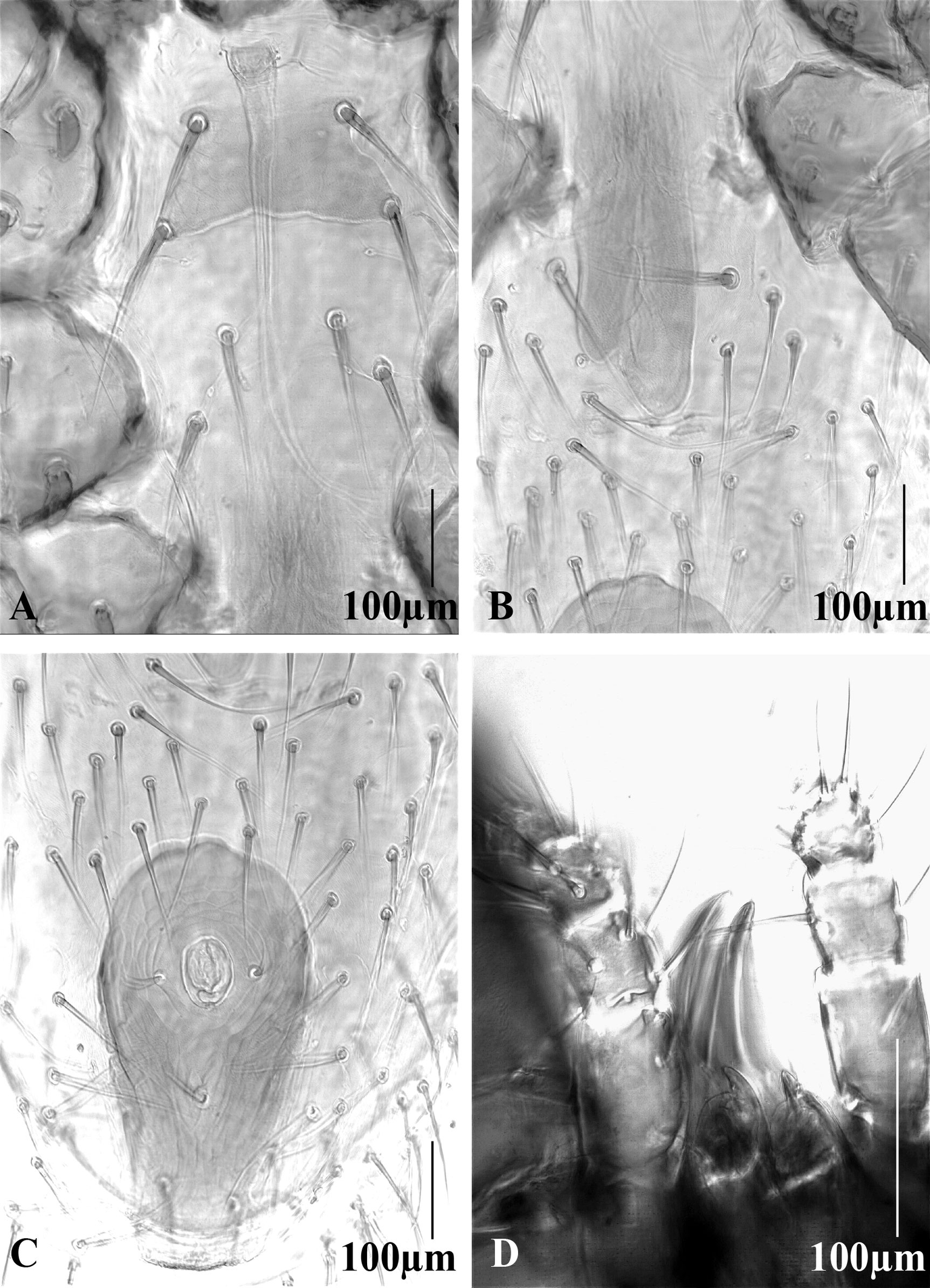
Specimens examined — Two females, Xylocopa sp, Tabuk, 27°29′00.0″N, 35°34′00.0″E, 11 Apr. 2015, coll. Shebl.
Remarks — Our specimens do not morphologically vary from the species description provided by Lundqvist (1999).
Genus Gaeolaelaps Evans & Till
Hypoaspis (Gaeolaelaps) Evans and Till 1966: 159.
Gaeolaelaps – Athias-Henriot 1968: 237; Joharchi et al. 2018: 27, 2021: 255; Mašán and Babaeian 2019: 502.
Type species — Laelaps aculeifer Canestrini 1884; by original designation (Evans and Till 1966).
Diagnosis — Based on Kazemi et al. (2014).
The widespread genus Gaeolaelaps has previously been reported from Saudi Arabia, albeit only with an unidentified species (Alatawi et al. 2018). These specimens are herein identified to the species level as G. mirzakhaniae Kazemi & Khalesi, G. praesternalis (Willmann), and G. queenslandicus (Womersley), and reported for the first time from Saudi Arabia.
Gaeolaelaps mirzakhaniae Kazemi & Khalesi
(Figure 4A-F)
Gaeolaelaps mirzakhaniae Kazemi and Khalesi, in Khalesi and Kazemi 2018: 629.
Gaeolaelaps mirzakhaniae – Joharchi and Negm 2020: 498; Kazemi 2020: 136.
Gaeolaelaps mirzakhaniae – Moraes et al. 2022:265.
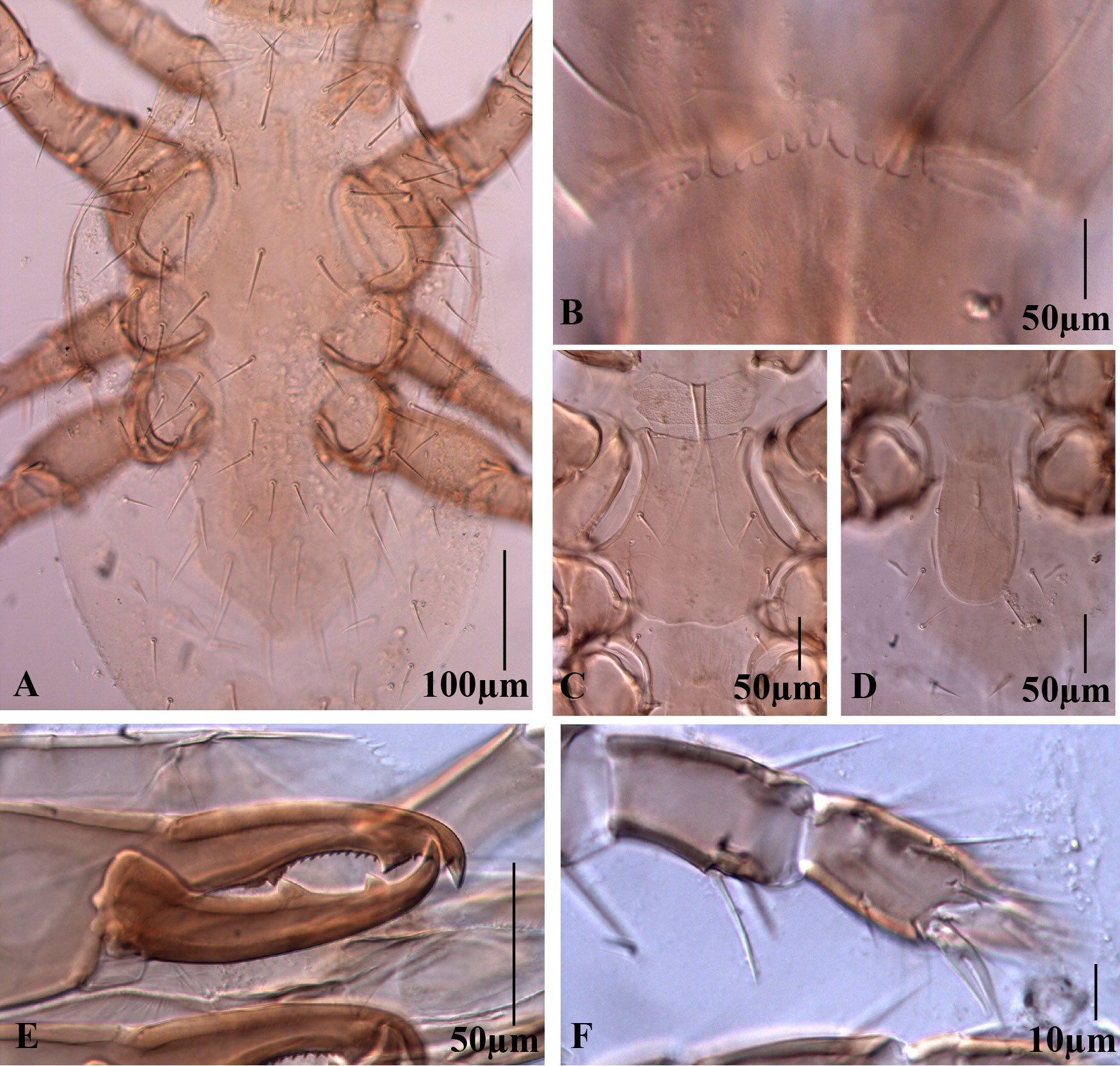
Specimens examined — One female soil under Citrus sp., Diriyah, Riyadh, 24°46′00.0″N, 46°31′00.0″E, 16 Jul. 2008, coll. J. Basahih; One female soil under Citurs sp., Derab farm, 19 Jan. 2009, coll. J. Basahih; one female soil under Citrus sp., Hayer, Riyadh, 24°24′00.0″N, 46°49′00.0″E, 3 Mar. 2009, coll. J. Basahih; one female soil under Citrus sp., Hayer, Riyadh, 24°24′00.0″N, 46°49′00.0″E, 31 Mar. 2009, coll. J. Basahih; one female soil debris under lemon (Rutaceae), Hayer, Ruwys, Riyadh, 24°24′00.0″N, 46°49′00.0″E, 13 Apr. 2009, coll. J. Basahih; one female, soil under Phoenix dactylifera (Arecaceae), Madina, 24°30′0.0″N, 39°37′0.0″E, 29 Jul. 2011, coll. J. Basahih; one female soil under P. dactylifera, Qassim, 26°01′0.0″N, 44°0′0.0″E, 31 Dec. 2011, coll. J. Basahih; nine females soil under P. dactylifera, Fiaz ul Dowsari farm, Wadi Dawasir, 20°27′00.0″N, 44°47′00.0″E, 26 Feb. 2012, coll. J. Basahih; three females, soil under P. dactylifera (Arecaceae), Khalid Ibrahim farm, Qassim, 24°22′00.0″N, 49°37′00.0″E, 11 Mar. 2012, coll. J. Basahih; one male soil debris under P. dactylifera, IMISU, Riyadh, 24°48′0.0″N, 46°42′0.0″E, 7 Jun. 2011, coll. S. AlNazari; one female, soil under P. dactylifera, IMISU, Riyadh, 24°48′00.0″N, 46°42′00.0″E, 12 Nov. 2011, coll. J. Basahih; three females, P. dactylifera, Qassim, 26°01′00.0″N, 44°0′00.0″E, 31 Dec. 2011, coll. W. Negm; eight females soil under Citrus sp., Deesa Valley, 27°36′0.0″N, 36°25′0.0″E, 18 Oct. 2015, coll. H.M.S. Mushtaq; two females, soil under P. dactylifera (Arecaceae), Quba, Madina, 24°26′19.5″N, 39°37′10.9″E, 01 May 2024, coll. E.M. Khan.
Remarks — The Saudi G. mirzakhaniae specimen morphologically resembles the original description of the species by Khalesi and Kazemi (2018) through distinct morphological characters including palp tarsal apotele two tined, female sternal shield medially smooth and laterally reticulated and longer peritremes reaching to mid of coxa I.
Gaeolaelaps praesternalis (Willmann)
(Figure 5A-E)
Hypoaspis praesternalis Willmann 1949: 115.
Hypoaspis praesternalis – Ryke 1963: 2
Hypoaspis (Gaeolaelaps) praesternalis – Saito and Takaku 2011: 88.
Gaeolaelaps praesternalis – Moraes et al. 2022:269.
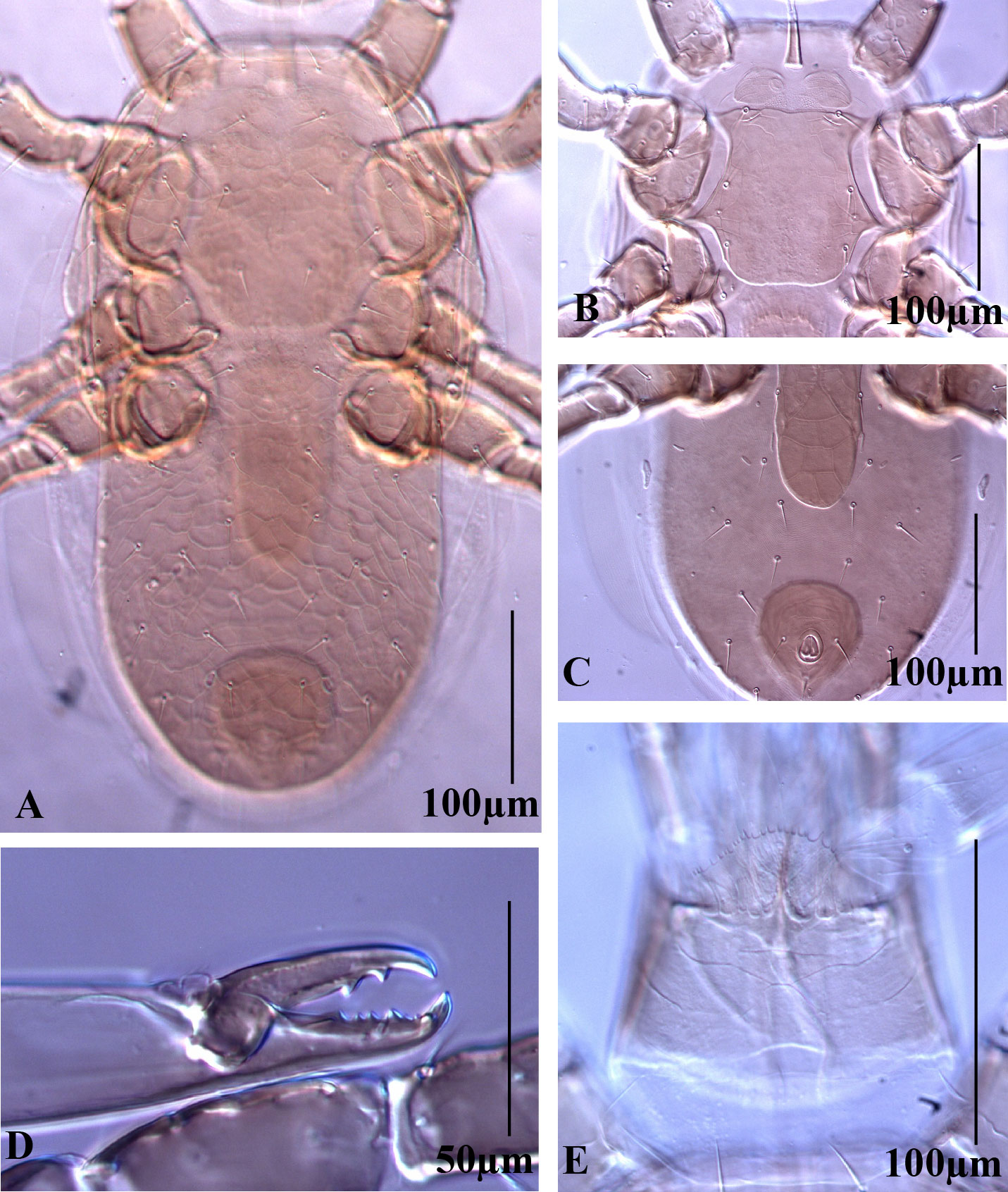
Specimens examined — Six females, soil under P. dactylifera, Rhodat-ul- Khoraim, Riyadh, 21°25′00.0″N, 47°17′00.0″E, 12 Jan. 2013, coll. M. Kamran; one female, Rhodat ul Khoraim, Riyadh, 21°25′00.0″N, 47°17′00.0″E, 20 Mar. 2013, coll. J. Basahih; one female, soil under Eruca sativa (Brassicaceae), Olia valley, 27°35′16.1″N, 47°43′30.3″E, 20 Apr. 2018, coll. M. Kamran, J. Basahih and J.H. Mirza.
Remarks — Gaeolaelaps praesternalis has been misidentified over the literature (Evans 1953; Evans and Till 1966; Joharchi et al. 2018; Joharchi et al. 2019). Recently, Joharchi and Negm (2020) provided differentiation of G. praesternalis with G. nolli. The specimens in the present study were identified to G. praesternalis with diagnostic characters provided by Saito and Takaku (2011) and Joharchi and Negm (2020) and identification keys of Karg (1971, 1993) and Kavianpour et al. (2018). These characters include length of dorsal setae and peritremes. However, reticulation on the genital shield of G. praesternalis in the present study provides a contrasting character state of smooth or weakly reticulated genital shield reported by Joharchi and Negm (2020).
Gaeolaelaps queenslandicus (Womersley)
(Figure 6A-G)
Androlaelaps queenslandicus Womersley 1956: 577.
Gaeolaelaps queenslandicus – Hyatt 1964: 472; Joharchi and Negm 2020: 499; Kazemi 2020: 137.
Gaeolaelaps queenslandicus – Moraes et al. 2022:271.
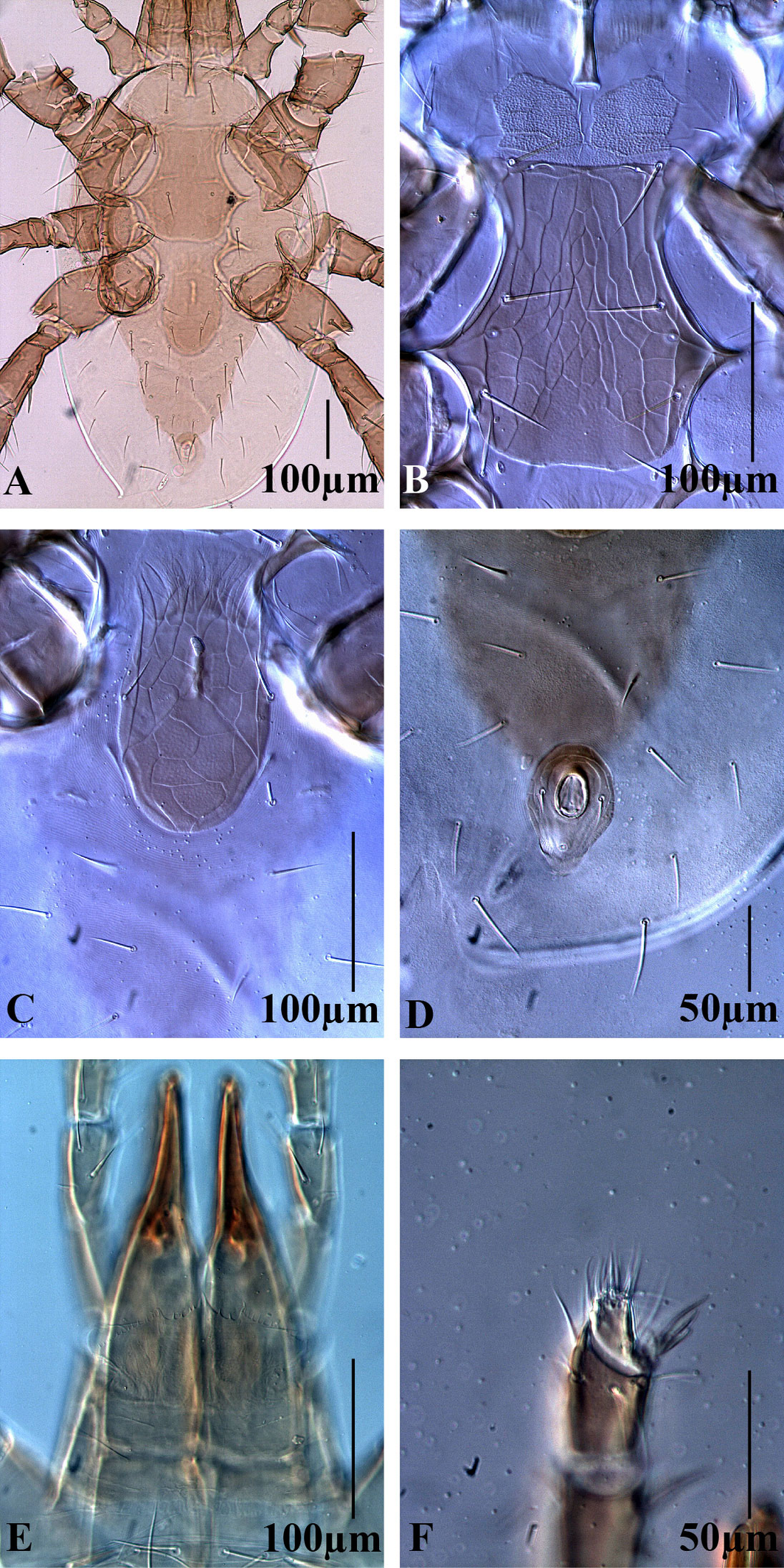
Specimens examined — One female, soil under P. dactylifera, Hayer, Ruwys, Riyadh, 24°24′00.0″N, 46°49′00.0″E, 13 Apr. 2009, coll. J. Basahih.
Remarks — Our specimen does not vary from the redescriptions of species by Costa (1966) and Nemati et al. (2018) and complementary description of the species by Abo-Shnaf et al. (2025).
Genus Persicolaelaps Kazemi & Beaulieu
(Figure 7A-C)
Persicolaelaps Kazemi and Beaulieu 2016: 488.
Hyperlaelaps sp. – Alatawi et al. 2018:380 (mis-identification).
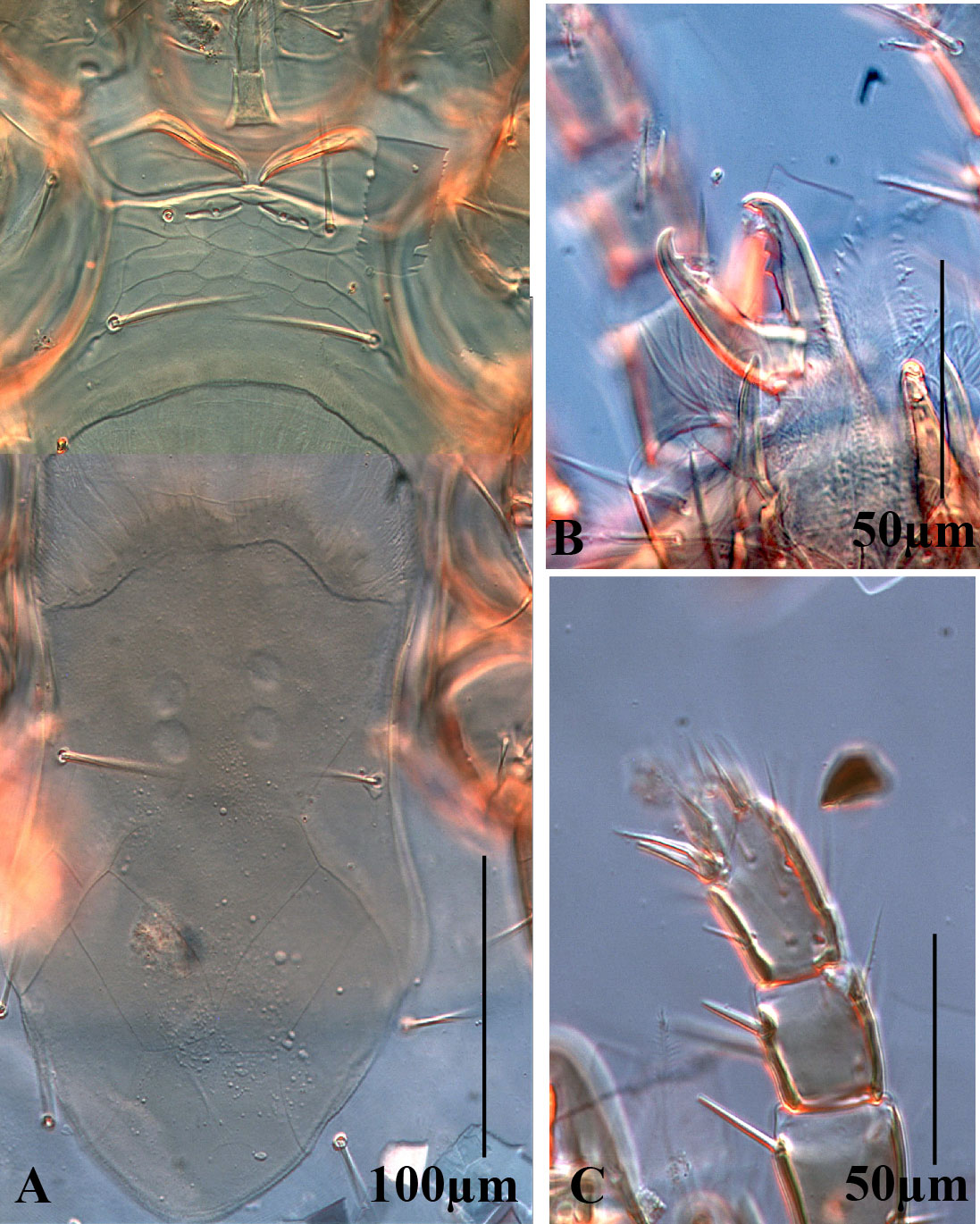
Type species — Persicolaelaps hallidayi Kazemi and Beaulieu, 2016, by monotypy
Specimens examined — One female, soil under P. dactylifera, IMISU, Riyadh, 24°48′00.0″N, 46°42′00.0″E, 24 Sept. 2011, coll. J. Basahih and M. Kamran.
Remarks — The single specimen was previously mis-identified as Hyperlaelaps sp. from Saudi Arabia (Alatawi et al. 2018). This record is corrected in the present study and its concluded that Hyperlaelaps has not been reported from Saudi Arabia. In the present observation, the specimen was re-run through the identification key for genera by Moraes et al. (2022). It keyed out at Persicolaelaps due to the diagnostic characters of St4 absent, genu III with 9 setae, genu IV with 10 setae, dorsal shield with short setae, presternal area with discrete platelets, soft ventral cuticle without UR and R setae, peritremes normal and deutosternal grooves with subequal denticles. The genus till this day is monotypic, and our specimen distinctly differ from it by the shape of the genital shield and JV3 off the anal shield. Other than Persicolaelaps, Moraes et al. (2022) mentioned Dinogamasus, Laelaspisella, Myrmozercon, Pogonolaelaps, and Reticulolaelaps, with St4 absent and genu IV with 10 setae. However, the current specimen has diagnostic differences from these genera. The authors suspect it as a new species of Persicolaelaps, but chose not to describe it due to lack of sufficient number of representative specimens.
Genus Laelaspis Berlese 1903
Laelaps (Laelaspis) Berlese 1903: 13
Laelaps (Laelaspis) – Berlese 1904b: 422.
Laelaspis – Berlese 1913 10
Type species — Iphis astronomicus Koch 1839, by original designation.
Diagnosis — Based on Moraes et al. 2022.
The genus Laelaspis has been previously known from Saudi Arabia with L. pennatus (Joharchi et al. 2012). In the present study, L. calidus Berlese is recorded for the first time from the country. Additionally, some specimens previously identified as L. pennatus have been misidentified, herein corrected as L. calidus, also based on additional material.
Laelaspis calidus Berlese
(Figures 8A-D, 9A-D)
Laelaspis calidus Berlese 1923: 255.
Laelaspis calidus – Hunter 1961: 676; Joharchi and Negm 2020: 503.
Gaeolaelaps praesternalis – Moraes et al. 2022:324.
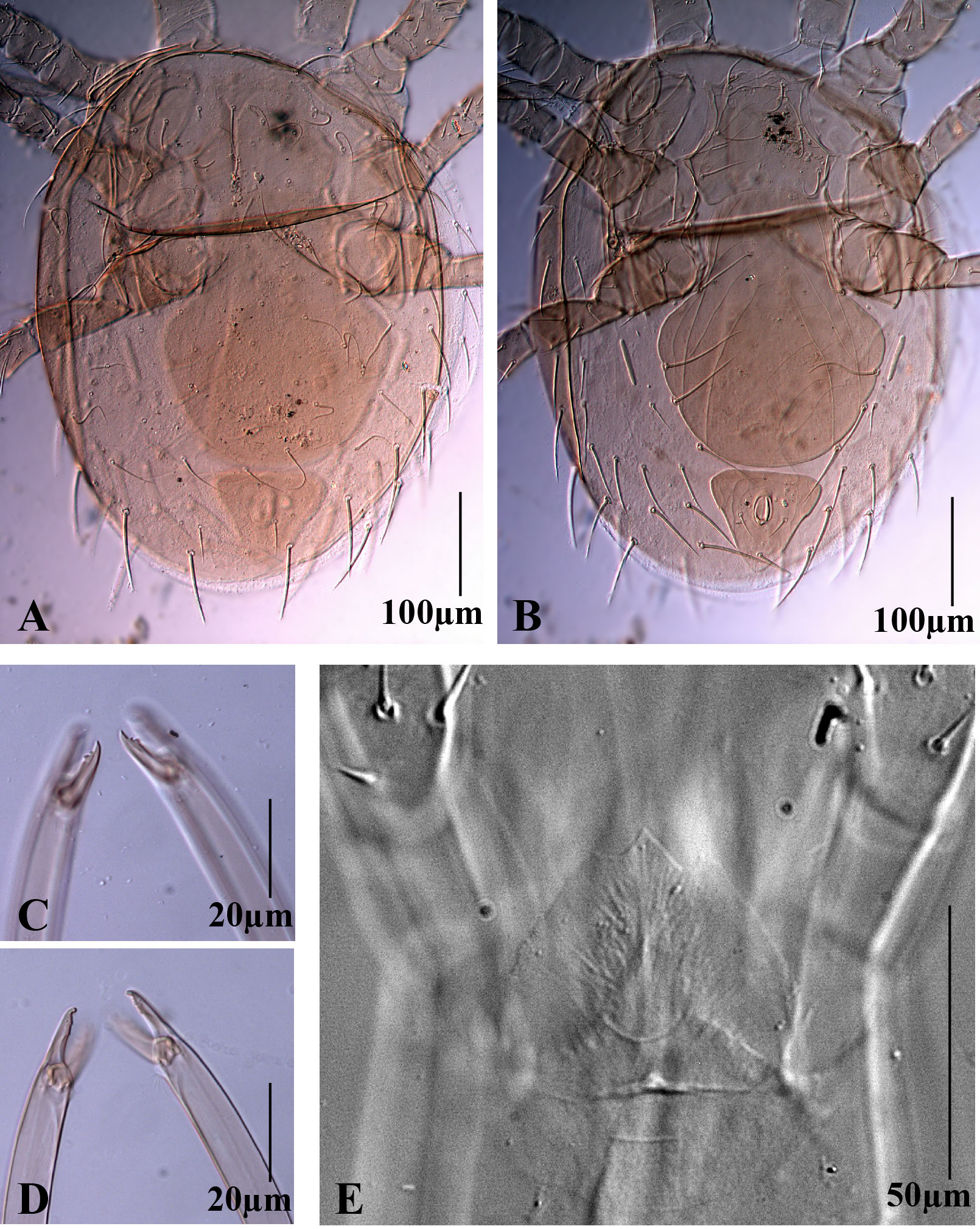
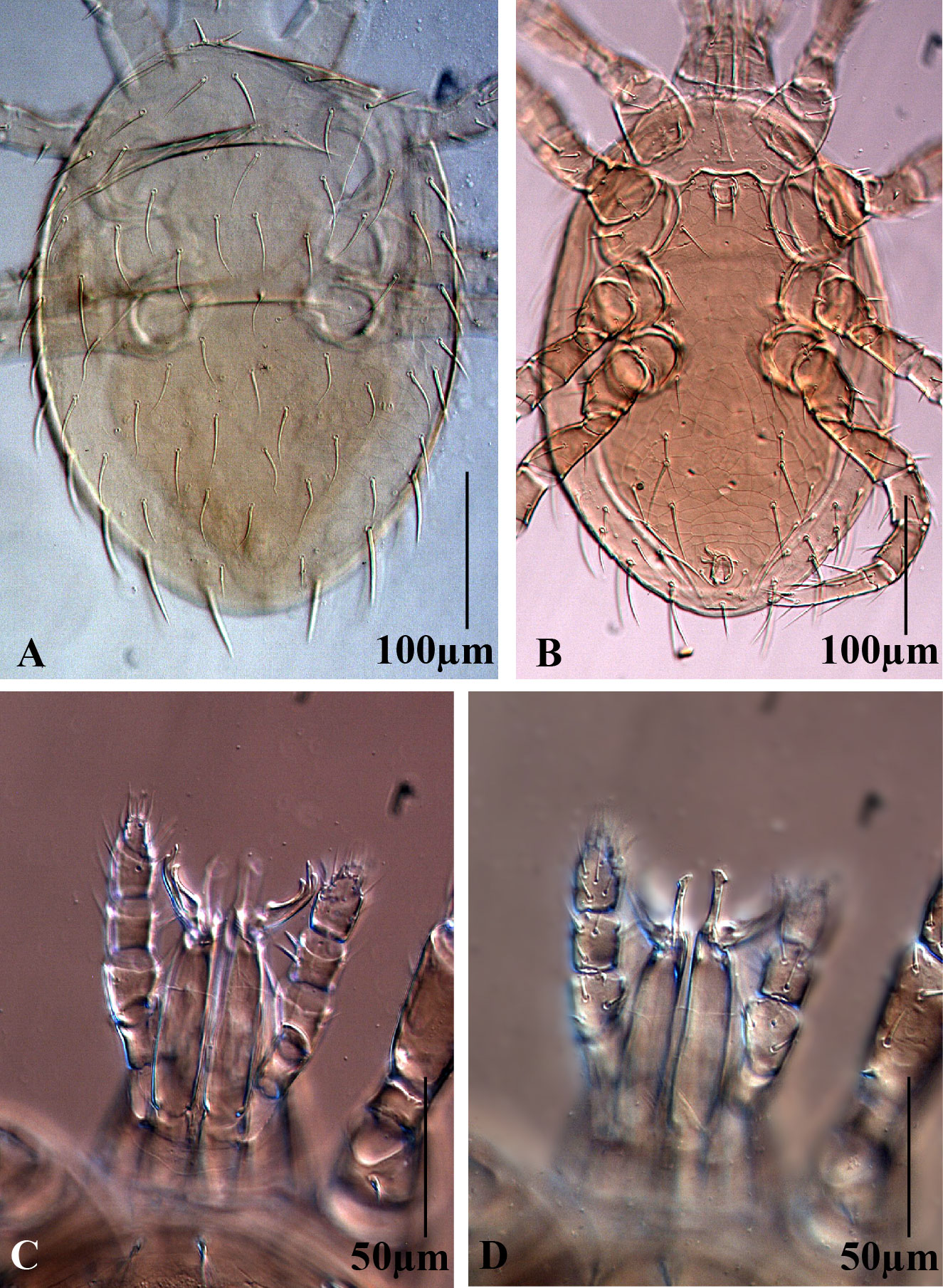
Material examined — Two females, P. dactylifera, student housing, King Saud University, Riyadh, 24°50′00.0″N, 46°33′00.0″E, coll. M. Kamran; one male, soil under P. dactylifera, Wadi Qureeza, Madina, 20 Oct. 2011; coll. J. Basahih; one female, soil under P. dactylifera, Diriyah, Riyadh, 24°44′47.1″N, 46°33′59.8″E, 24 Mar. 2016; coll. M. Kamran; one female, soil under P. dactylifera, and P. granatum, Khayber, Madina, 25°43′49.3″N, 39°16′21.9″E, 4 Nov. 2016, coll. M. Kamran and E.M. Khan.
Remarks — The identity of the species L. calidus in the present study was confirmed from van Aswegen and Loots (1970), Joharchi et al. (2012), and Joharchi and Negm (2020). None of these papers has observed the type specimen but provided key diagnostic characters, including morphology of chelicerae, comparative lengths of Z5 and J5, genitiventral shield, and serrated post-anal setae. The shape of the epistome with median and lateral projections resembles that described by van Aswegen and Loots (1970). However, in the present specimen, the median projection is small while the median projection is distinctly longer than lateral projections the by van Aswegen and Loots (1970).
Genus Ololaelaps Berlese
Ololaelaps Berlese 1904a: 260.
Pristolaelaps – Womersley 1956: 571 (Synonymized by Ryke 1962).
Type species — Laelaps (Hypoaspis) venetus Berlese 1903 by original designation
Diagnosis — Based on Moraes et al. 2022.
The genus is reported for the first time from Saudi Arabia with the species, O. tasmanicus (Womersley).
Ololaelaps tasmanicus (Womersley)
(Figure 10A-B)
Pristolaelaps tasmanicus Womersley 1956: 572, 1960: 35.
Ololaelaps paratasmanicus – Ryke 1962: 127 (synonymy by Babaeian et al. 2019: 352).
Ololaelaps tasmanicus – Babaeian et al. 2019: 352; Beaulieu et al. 2019: 5.
Ololaelaps tasmanicus – Moraes et al. 2022:356.
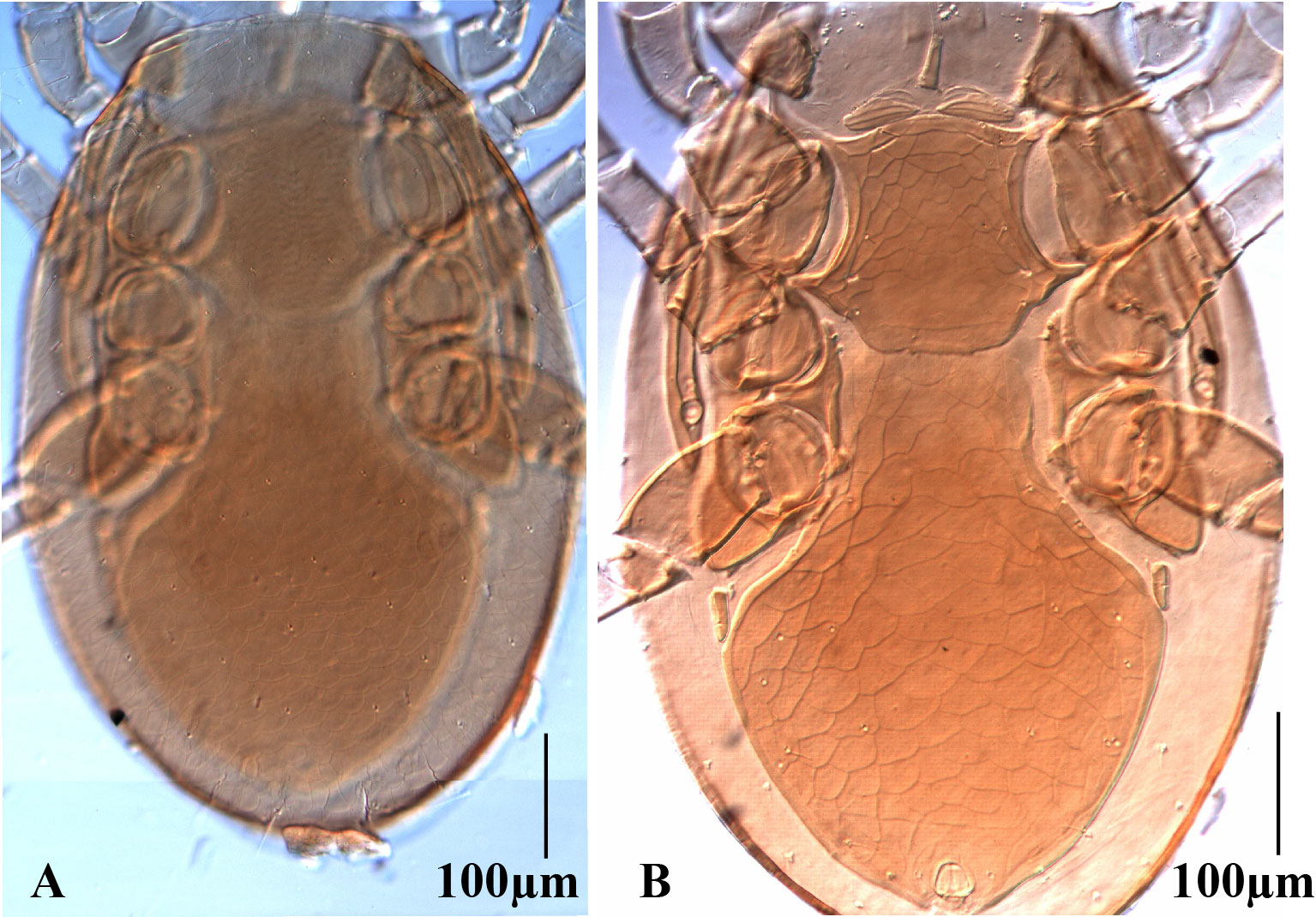
Specimens examined — One female, soil under date palm P. dactylifera, IMISU, Riyadh 24°48ʹ00.0″N, 46°42′00.0″E, 8 Nov. 2010, coll. M. Kamran.
Remarks — Our specimens of O. tasmanicus morphologically agree mostly with redescription of the species by Babaeian et al. (2019) based on the following diagnostic characters: sternal shield longer than wide (ratio length/width 1.3 in observed specimen), posterior margin more or less irregular medially, shield free of endopodals III–IV; post-stigmatal section of peritrematal shield short, free from adjacent exopodal shields. exopodal shield around coxa IV well expanded posteriorly. Some of the morphological characters were found in variation from Babaeian et al. (2019) redescriptions and images of the species reported from Egypt (Joharchi and Negm 2020). The posterior margin of the sternal shield of Saudi specimen is somewhat irregular as reported by Babaeian et al. (2019) but straight which is contrasting to the widely convex margin described by Babaeian et al. (2019); setae St4 and pore iv3 appears to be on the ventral integument on left while at the anterior edge of endopodal shield on right side in one specimen in contrast to poroid iv3 and seta St4 inserted on unsclerotised cuticle in type based redescription (Babaeian et al. 2019). These variations, if are intraspecific, could not be approved in the present study due to lack to enough representative specimens.
Genus Hypoaspisella Bernhard
Hypoaspis (Hypoaspisella) Bernhard, in Karg 1962: 64
Type species — Hypoaspis (Hypoaspisella) heyi Karg 1962, by monotypy.
Diagnosis — Based on Moraes et al. (2022).
Hypoaspisella sclerotarsus (Costa)
Hypoaspis sclerotarsus Costa 1968: 21.
Hypoaspis (Pneumolaelaps) sclerotarsa – Karg 1979: 88, 1982: 244.
Hypoaspis sclerotarsa – Munderloh 1996: 590.
Hypoaspisella sclerotarsus – Moraes et al. 2022: 312.
Specimens examined
Four females, soil debris under P. dactylifera, AlMutawa farm, Ahsa, 24°22′00.0″N, 49°37′00.0″E, 15 Jan. 2012, coll. J. Basahih, A. Gayed and M. Kamran; two females, soil debris under P. dactylifera, Deesa valley, Tabuk, 27°36′00.0″N, 36°25′00.0″E, 18 Oct. 2015, coll. M. Kamran and J.H. Mirza.
Complementary description of female (n=6)
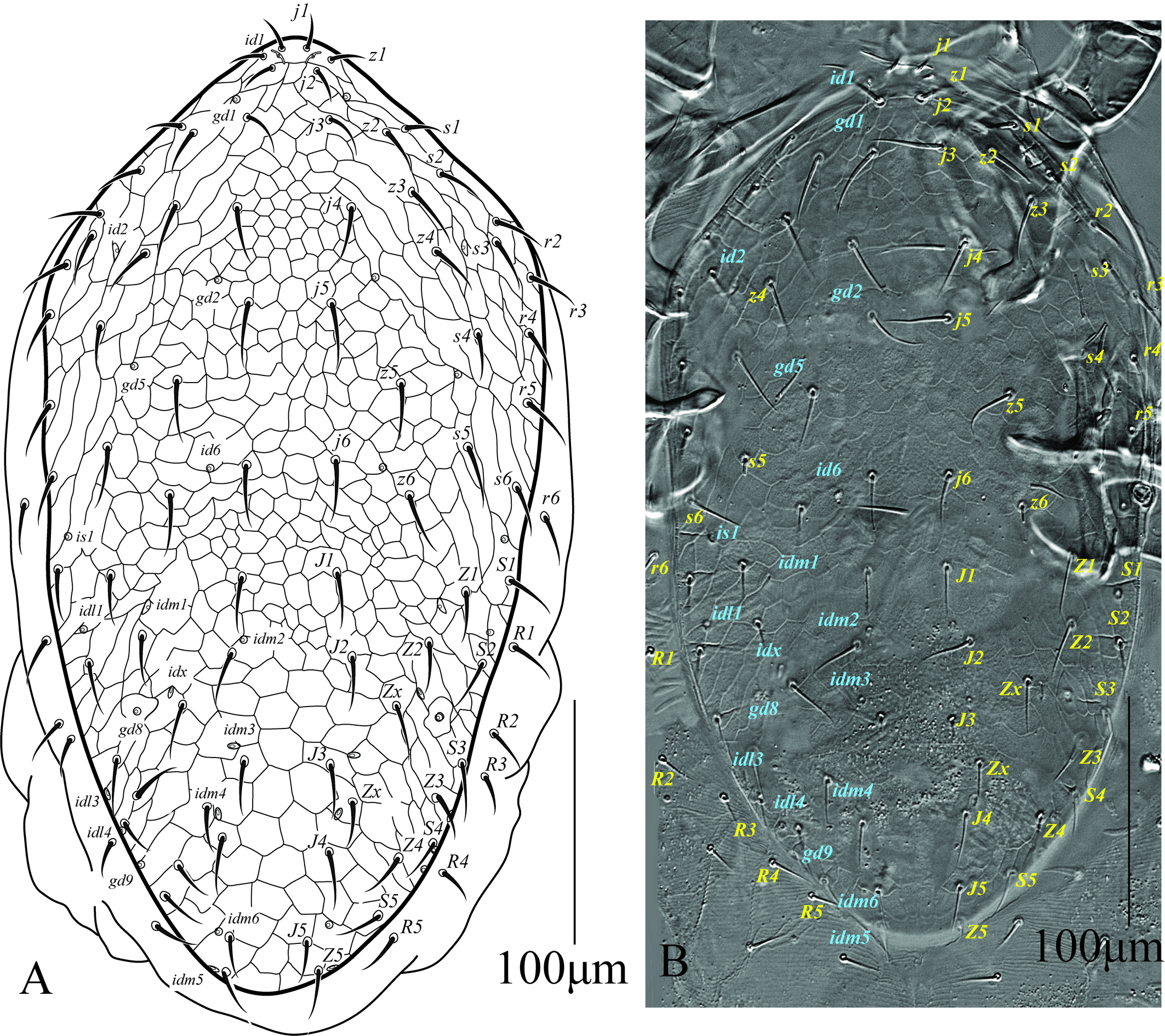
Dorsal idiosoma — (Figure 11A-B). Dorsal shield oval-shaped, tapering posteriorly, 375–381 long 198–210 wide at the level of r3, covering most of dorsal idiosoma, unsclerotized integument visible from r3 expanded beyond posterior margin of the shield, dorsal shield with weak reticulation, more distinct in opisthonotal and lateral regions. Shield bearing 39 pairs of setae, 22 pairs of podonotal setae 26–31 long and 17 pairs of opisthonotal setae 20–22 long, including two pairs of Zx setae, without supernumerary setae Jx. All setae short, not reaching base of next posterior setae, lengths of setae decreasing from anterior to posterior. Shield with 19 pairs of discernible pore-like structures, including 14 poroids (id1, id2, id6, idm1-idm6, idx, is1, idl1, idl3, idl4) and five gland openings (gd1–2, gd5, gd8–9). Dorsolateral soft integument bearing six pairs (nine pairs reported by Costa 1968) of setae, r6, R1–5 (16–18).
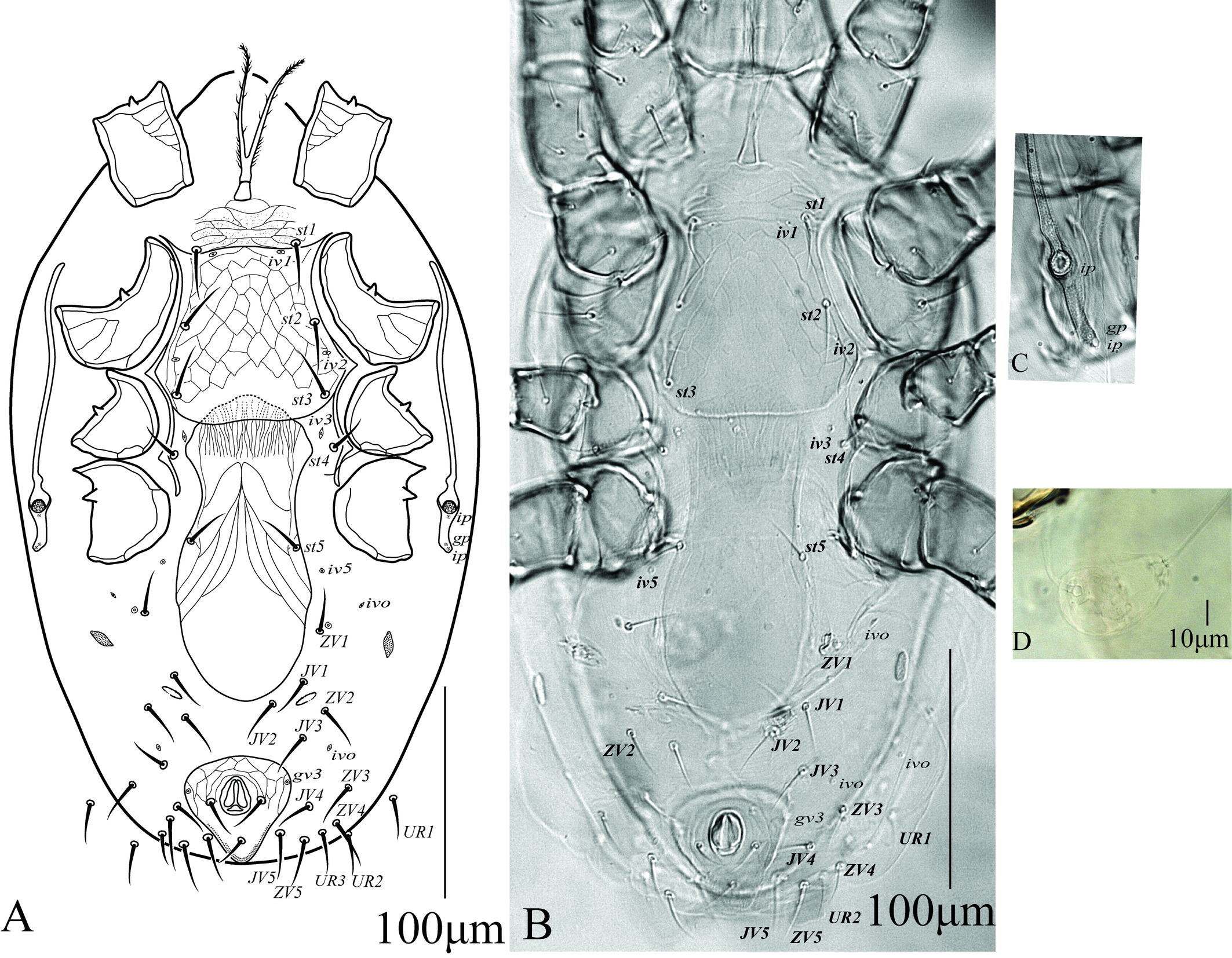
Ventral idiosoma — (Figure 12A-D). Tritosternum with paired pilose laciniae, fused basally; presternal area lightly sclerotized and granulate lineate. Sternal shield (length 80–86 narrowest between coxae II 75–77, widest 102–108), with more or less straight anterior and concave posterior margins; bearing two pairs of smooth setae, St2 25–27, St3 28–31; St1 22–25 off sternal shield, on poorly sclerotized cuticle (Figure 12A-B), one pair of lyrifissures (iv1) adjacent to setae st1, and a pair of slit-like poroids (iv2) between St2 and St3; setae not reaching base of next setae; sternal shield with reticulate ornamentation throughout, except medio posterior part faintly reticulated. Metasternal setae St4 26–28 and metasternal poroids (iv3) located on soft integument; metasternal platelets absent. Endopodal plates III/IV elongate, narrow and curved. Genital shield elongated, slightly expanded laterally past level of setae st5 with lateral notch at the level of ZV1, length 133–138, maximum width 59–67, posterior margin rounded, clearly separated from anal shield, the distance midline between posterior margin of genital shield and anterior margin of anal shield nearly 0.7 times as long as anal opening, surface laterally with elongate cells, posteriorly smooth; bearing a pair of simple setae st5 25–28; paragenital poroids iv5 located on soft cuticle lateral to shield near seta st5. Anal shield subtriangular, rounded anteriorly, length 52–56, width 61–65, completely lineate-reticulate, para-anal setae 20–21 almost as long as post-anal seta 19–20, cribrum small, with 2 irregular rows of spicules, mostly limited to region posterior to post-anal seta; anal poroids gv3 on anterolateral margin of anal shield. and 13 pairs of smooth subequal setae (seven pairs reported by Costa 1968) (Jv1–Jv5, Zv1–Zv5 and UR1–3) (46–51); UR setae are assumed to be absent in the original description and illustration of the species (Costa 1968). Peritreme extending anteriorly to posterior half of coxa II; peritrematal shield narrow, posterior to stigmatal opening bear one pair of gland pores (gp) two pairs of poroids (ip), free from exopodal shields (Figure 12C). Spermatheca of the laelapid type (Figure 12D).
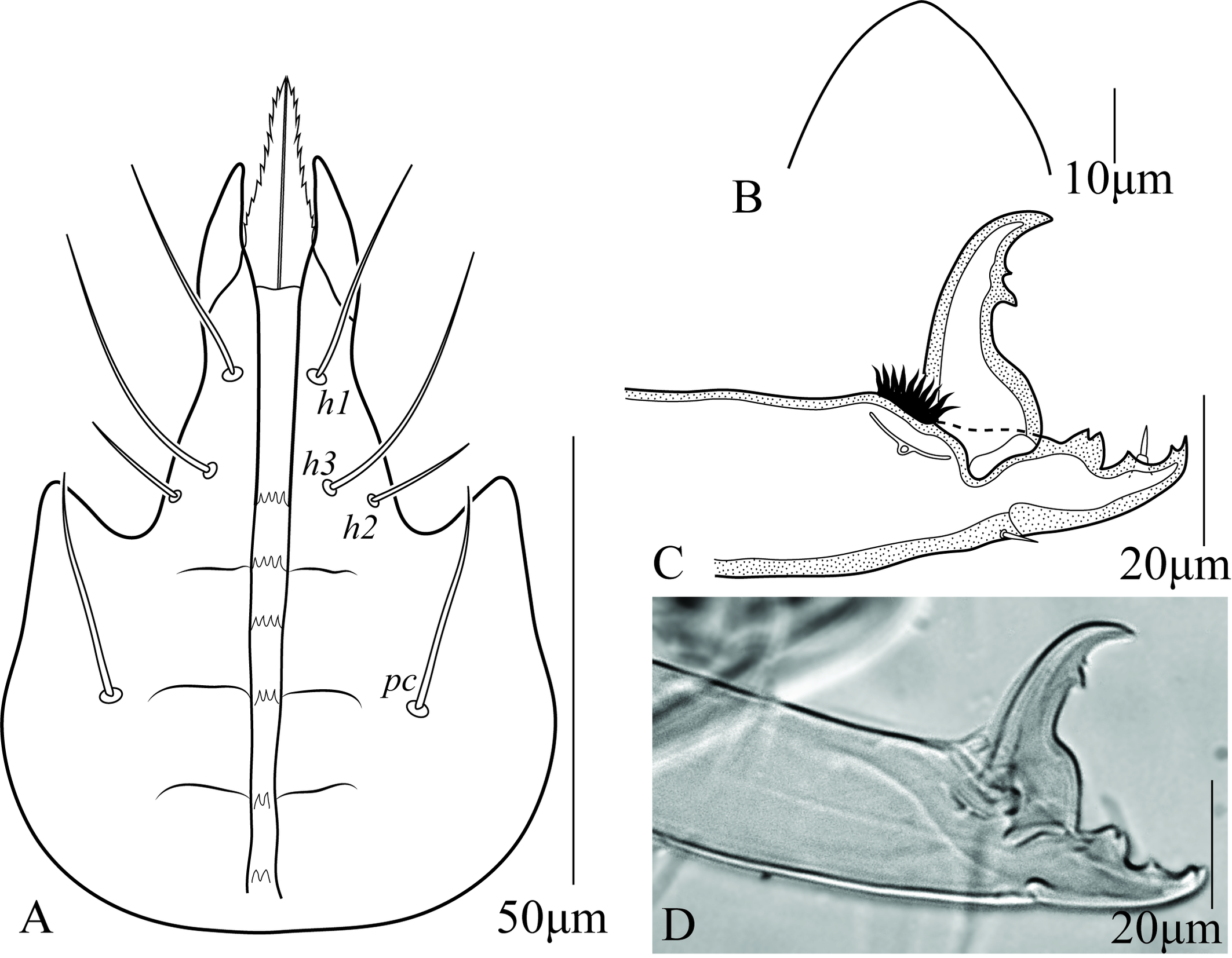
Gnathosoma — (Figure 13A-D). Hypostome with three pairs of hypostomal setae h1 25–28, h2 16–17, h3 32–35, and a pair of palpcoxal setae (pc) 15–19. Deutosternal groove narrow, with six transverse rows of 2–4 denticles, corniculi horn-like and parallel to each other, almost reaching mid-level of palp femur (Figure 13A). Palp chaetotaxy normal: trochanter 2, femur 5, genu 6, tibia 14, tarsus 15, all setae smooth and needle-like except al on femur and al1 and al2 on palp genu thickened; palp tarsal claw two-tined. Anterior edge of epistome arch-shaped and smooth (Figure 13B). Fixed digit of chelicera with four teeth including a small subapical offset tooth (gabelzhan), a mid-sized tooth proximal of (somewhat spine-like) pilus dentilis, followed by two teeth elevated on a shared base (appear as a large bifid tooth), dorsal cheliceral seta short and robust. Arthrodial brush present at base of movable digit, movable digit with two teeth and distinct cheliceral lyrifissure (Figures 13C-D).
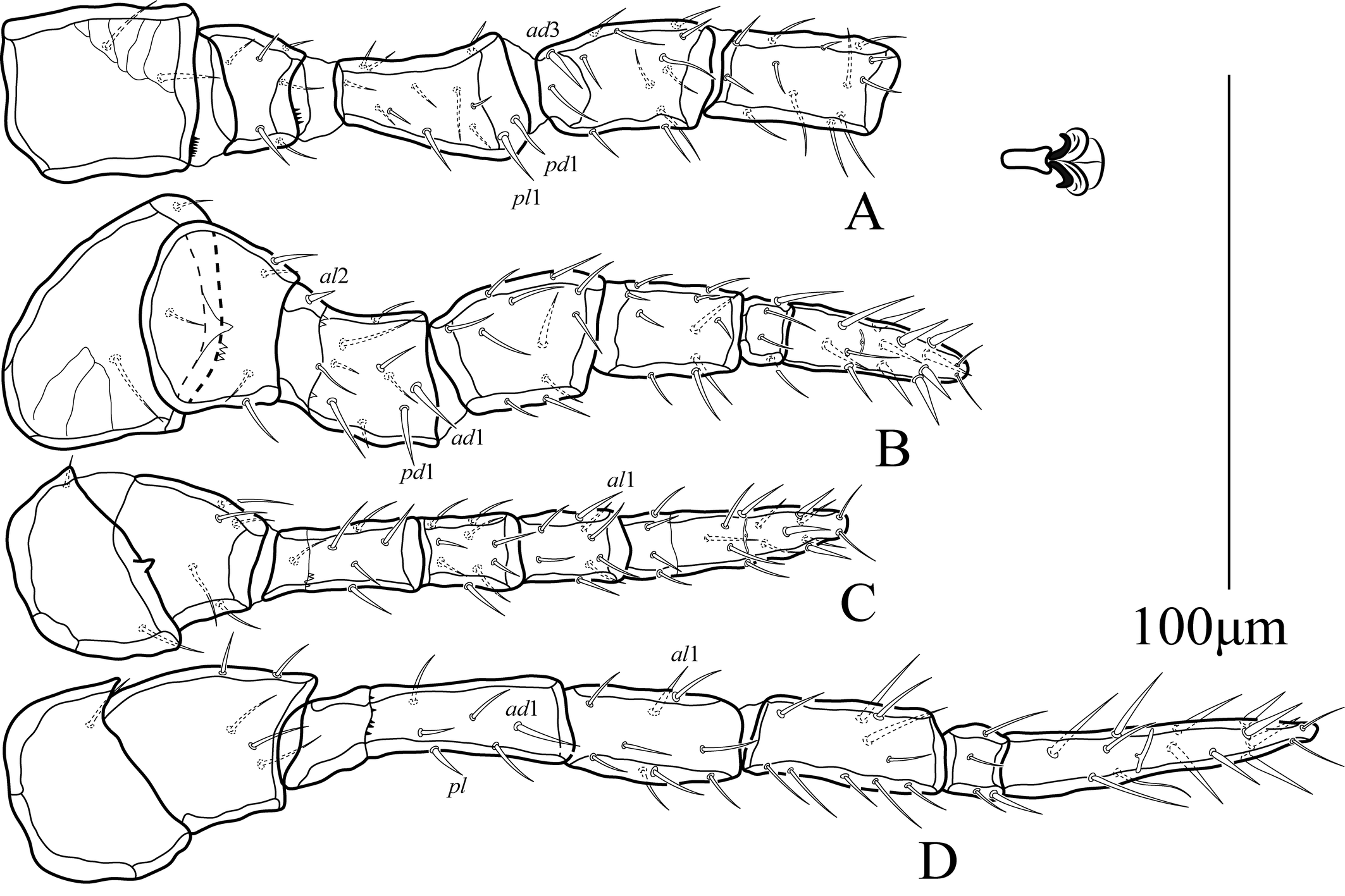
Legs (Figures 14A-D). Lengths of leg; Leg I 315 (312–317), Legs II 260 (258–365), Leg III 210 (208–211) shorter than legs I, and Leg IV 315 (310–316). Chaetotaxy: Leg I (Figure 14A): coxa 0 0/1 0/1 0, trochanter 1 0/2 1/1 1, femur 2 2/1 3/3 2, genu 2 3/2 3/1 2, tibia 2 3/2 3/1 2. Leg II (Figure 14B): coxa 0 0/1 0/1 0, trochanter 1 0/1 0/2 1, femur 2 3/1 2/2 1, genu 2 3/1 2/1 2, tibia 2 2/1 2/1 2. Leg III (Figure 14C): coxa 0 0/1 0/ 1 0, trochanter 1 1/1 0/1 1, femur 1 2/1 1/0 1, genu 2 2/1 2/1 1, tibia 2 1/1 2/1 1. Leg IV (Figure 14D): coxa 0 0/1 0/0 0, trochanter 1 1/1 0/1 1, femur 1 2/0 1/1 1, genu 2 2/ 1 3/0 1, tibia 1 2/1 3/1 2. All setae relatively fine and needle-like, except for few thicker setae, most conspicuously on femur I (pd1, pl1), femur II (al1, pd1, ad1), femur IV (pl, ad1), genu I (ad3), genu III-IV (al1) robust bases and those on tarsi. Tarsi II–IV with 18 setae, most setae on telotarsi robust, spine-like; all pre-tarsi with a well-developed ambulacral stalk, a pair of claws, and three rounded pulvillar lobes, extensively projecting beyond claws.
Key to genera (ten) and species (15) of the family Laelapidae from Saudi Arabia
1. Peritremes extremely short, cheliceral movable digit usually strongly curved and a reduced fixed digit, both digits with 0–2 small teeth: Dinogamasus Kramer; anal shield subequal in length to the genital shield, pv3 on femur I conical, moveable cheliceral digit strong, sickle-shaped
...... D. inflatus LeVeque
— Peritremes long, crossing the level of coxa II, cheliceral digit of varying lengths, but never reduced
...... 2
2. Epigynal shield large to extremely large, covering most of the opisthogastric region, bearing st5 and at least one additional pair of (Jv or Zv) setae
...... 3
— Epigynal shield of various sizes, bearing at most St5; epigynal shield rarely broadly abutting anal shield
...... 5
3. Anal shield fused to a broadly expanded epigynal shield: Ololaelaps Berlese; hypostomal setae sc shorter than h3 ; genito-ventianal shield with small, reticulated patterns, with metapodal plates, peritrematal shield and genitiventral free from each other
...... O. tasmanicus (Womersley)
— Anal and epigynal shields distinct
...... Laelaspis Berlese – 4
4. Fixed cheliceral digit with six teeth, post anal seta simpl
...... L. pennatus Joharchi and Halliday
— Fixed cheliceral digit with seven teeth, post anal seta serrate
...... L. calidus Berlese
5. Dorsal shield with several long setae near dorsal margin, or central and other marginal setae mid-sized: Hypoaspis Canestrini; dorsum with 35 pairs of simple setae, S4 whip-like
...... H. zaheri Fouly & Al-Rehiayani
— Dorsal shield with setae usually subequal in length, at most with moderately longer setae posteriorly or marginally
...... 6
6. Genu IV with nine setae, including one ventral and one pl (rarely with ten setae, including two ventrals or two pl); femora III–IV with six setae
...... 7
— Genu IV with 10 or 11 setae, including two ventrals or two pl, or if with nine setae, then femora III–IV with seven setae
...... 13
7. Dorsal setae with a distinct asymmetric lobe near the setal base; posterior opisthogastric setae and some leg setae often similarly shaped
...... Cosmolaelaps Berlese – 8
— Dorsal, opisthogastric and leg setae simple (except for possible spine like setae on legs)
...... 9
8. Seta j1 stout
...... C. qassimensis Fouly & Al-Rehiayani
— Seta j1 paddle like
...... C. simplex Berlese
9. Epistome with margin serrate; deutosternal groove usually relatively broad and with ten or more denticles per row, rarely fewer than five per row; epigynal shield typically mid-sized and distant from anal shield
...... Gaeolaelaps Evans & Till – 10
— Epistome with margin smooth, at most with few denticles apically; deutosternal groove narrow, with 2–10 denticles per row, rarely more (10–15); epigynal shield relatively large, typically close to anal shield, separated from it by about half length of anal shield: Hypoaspisella Bernhard; dorsal shield with 39 pairs of short setae, not reaching the bases of posterior setae, two pairs of Zx setae and without Jx setae in J series, fixed cheliceral digit with four teeth where proximal most two teeth elevated on a shared base, resembling a bifid structure
...... H. sclerotarsus (Costa)
10. Dorsal shield rounded posteriorly, covering the dorsum entirely
...... G. praesternalis (Willmann)
— Dorsal shield tapering posteriorly, not covering the dorsum entirely
...... 11
11. Setae j1 longer than z1
...... G. queenslandicus (Womersley)
— Setae j1 shorter than z1
...... 12
12. Dorsum with 39 pairs of setae, Zx2 and Zx3 present
...... G. mirzakhaniae Kazemi & Khalesi
— Dorsum with 37 pairs of setae, Zx2 and Zx3 absent
...... G. dactylifera (Fouly & Al-Rehiayani)
13. Chelicera with pilus dentilis usually inflated basall
...... Androlaelaps Berlese – 14
— Chelicera pilus dentilis normal, i.e., short and slender
...... 15
14. Sternal shield with posterior projection, epigynal shield reticulate
...... A. projecta Furman
— Sternal shield straight or concave posteriorly, epigynal shield reticulate or smooth
...... A. casalis (Berlese)
15. St4 present in female, dorsal setae spatulate distally: Stratiolaelaps Berlese; setae j1 and z1 equal in length; peritreme extending anteriorly at level of s1, post-anal and para-anal setae subequal in length
...... S. scimitus (Womersley)
— St4 absent in female, dorsal setae short and simple
...... Persicolaelaps Kazemi & Beaulieu
Declarations
Conflict of Interest
The authors declare no conflict of interest exists.
Funding
The authors would like to extend their sincere appreciation to the Ongoing Research Funding program [ORF-2026-807], King Saud University, Riyadh, Saudi Arabia, for funding this research.
Acknowledgement
The authors would like to extend their sincere appreciation Researcher Supporting Project, King Saud University, for funding the research. The authors also extend their appreciation to the subject editor and the reviewers, specially Dr. Frédéric Beaulieu, for the constructive comments, which improved the manuscript. The authors are also thankful to Muneeb ur Rehman (Acarology Lab. King Saud University) for his technical support.
References
- Abo-Shnaf R., Negm M.W., Joharchi O. 2025. Review of the family Laelapidae (Acari, Mesostigmata) in Egypt, and a key to the Egyptian species. Syst. Appl. Acarol., 30(7): 1098-1208. https://doi.org/10.11158/saa.30.7.3
- Alatawi F.J., Kamran M., Mirza, J.H. 2018. Mesostigmatic mites (Acari: Mesostigmata) of Saudi Arabia (excluding Phytoseioidea), new records and a key to the known species. Zootaxa, 4388(3): 373-394. https://doi.org/10.11646/zootaxa.4388.3.4
- Aswegen P.I.M.van, Loots G.C. 1970. A taxonomic study of the genus Hypoaspis Canestrini sens. lat. (Acari: Laelapidae) in the Ethiopian region. Publicacoes Culturais da Companhia de Oiamantes de Angola, 82: 169-213.
- Athias-Henriot C. 1968. L'appareil d'insémination laelapoïde (Acariens anactinotriches: Laelapoidea, ♀♀). Premières observations. Possibilité d'imploi à des fins taxonomiques. Bull. Sci. Bourgogne, 25: 229-274.
- Athias-Henriot C. 1971. La divergence néotaxique des Gamasides (Arachnides). Bull. Sci. Bourgogne, 28: 93-106.
- Babaeian E., Ghobari H., Samani K.M. 2019. Redescription of Ololaelaps tasmanicus (Womersley, 1956) and description of a new species of Ololaelaps Berlese (Acari: Laelapidae) from Iran. Zootaxa, 4629(3): 351-364. https://doi.org/10.11646/zootaxa.4629.3.3
- Basha A., Yousef, A.A. 2000. New species of Laelapidae and Ascidae in Egypt: Genera Androlaelaps and Blattisocius (Acari: Gamasida). Acarologia, 41(4): 395-402.
- Beaulieu F., Quintero-Gutiérrez E.J., Sandmann D., Klarner B., Widyastuti R., Cómbita-Heredia O., Scheu S. 2019. Review of the mite genus Ololaelaps (Acari, Laelapidae) and redescription of O. formidalis Berlese. ZooKeys, 853: 1-36. https://doi.org/10.3897/zookeys.853.29407
- Berlese A. 1883 Acari, Myriopoda et Scorpiones hucusque in Italia reperta, Fascicolo 4, 1-12 (text pages), pls. 1-10 [reprint by Junk, The Hague, 1979]. https://doi.org/10.5962/bhl.title.1589
- Berlese A. 1887. Acari, Myriopoda et Scorpiones Hucusque in Italia reperta, 38, 18 text pages + 10 plates. [reprint by Junk, The Hague, 1979].
- Berlese A. 1903 Diagnosi di alcune nuove specie di Acari italiani mirmecofili e liberi. Zoologischer Anzeiger, 27: 12-28.
- Berlese A. 1904a. Acari nuovi. Manipulus II. Redia, 1: 258-280.
- Berlese A. 1904b. Illustrazione iconografica degli acari mirmecofili. Redia, 1: 299-474.
- Berlese A. 1913. Acarotheca Italica. Fasciculi Ius et IIus. Firenze, 221 pp.
- Berlese A. 1916. Centuria seconda di Acari nuovi. Redia, 12: 125-177. https://doi.org/10.1007/BF02960167
- Berlese A. 1923. Centuria sesta di Acari nuovi. Redia, 15: 237-262.
- Bernhard F. 1971. Gangsystematik der Parasitiformes. Teil 81. Die Gattung Hypoaspis G. Canestrini 1885. (Eine systematische Studie aus dem Jahre 1955). Acarologie, 15: 2-10.
- Bregetova N.G. 1953. On the fauna of gamasid mites of the Far East. Parazitologischeskiy Sbornik Zoologicheskogo Instituta Akademii Nauk SSSR, 15: 302-338. [in Russian]
- Canestrini G. 1884. Acari nuovi o poco noti. I. Acari Italiani. II. Acari dell′Australia. Atti del Reale Istituto Veneto di Scienze, Lettere ed Arti, 2 (6): 693-724.
- Costa M. 1966. The present stage of knowledge of mesostigmatic mites in Israel (Acari, Mesostigmata). Isr. J. Zool., 15(2): 69-82.
- Costa M. 1968. Little known and new litter-inhabiting Laelapine mites (Acari, Mesostigmata) from Israel. Isr. J. Zool., 17: 1-30.
- Elmoghazy M.M.E. 2016. Survey and taxonomy of mites associated with fruit orchards trees from Sakaka governorate, Kingdom of Saudi Arabia. Intl. J. Agric. Biosci., 5(6): 341-346.
- Evans G.O., Till W.M. 1966. Studies on the British Dermanyssidae (Acari: Mesostigmata). Part II Classification. Bull. Brit. Mus. (Nat. Hist.), Zool., 14(5): 109-370.
- Evans G.O. 1963a. Observation on the chaetotaxy of the legs in the free-living Gamasina (Acari: Mesostigmata). Bull. Brit. Mus. (Nat. Hist.), Zool., 10: 277-303. https://doi.org/10.5962/bhl.part.20528
- Evans G.O. 1963b. Some observations on the chaetotaxy of the pedipalps in the Mesostigmata (Acari). Ann. Mag. Nat. Hist., Ser 13., 6: 513-527. https://doi.org/10.1080/00222936308651393
- Ewing H.E. .1933. New genera and species of parasitic mites of the superfamily Parasitoidea. Proc. U.S. Nat. Mus. (2971), 82(30): 1-14. https://doi.org/10.5479/si.00963801.82-2971.1
- Faraji F., Halliday B. 2009. Five new species of mites (Acari: Laelapidae) associated with large Australian cockroaches (Blattodea: Blaberidae). Intl. J. Acarol., 35(3): 245-264. https://doi.org/10.1080/01647950903059445
- Fouly A.H., Al-Rehiayani S.M. 2014. A new laelapid mite Cosmolaelaps qassimensis sp. nov. (Gamasida: Laelapidae) from agro-ecosystem in Saudi Arabia. J. Entomol., 11(5): 261-272. https://doi.org/10.3923/je.2014.261.272
- Fouly A.H., Al-Rehiayani S.M. 2011. Predaceous mites in Al-Qassim, Saudi Arabia, with description of two new laelapid species. J. Entomol., 8: 139-151. https://doi.org/10.3923/je.2011.139.151
- Fouly A.H., Childers C.C., Abou-Setta M.M. 1997. Redescription of Cosmolaelaps simplex Berlese (Acari: Laelapidae) with notes on its male. Intl J Acarol., 23(1): 33-37. https://doi.org/10.1080/01647959708684117
- Furman D.P. 1972. Laelapid mites (Laelapidae: Laelapinae) of Venezuela. Brigh. Young Univ. Sci. Bull., Biol. Ser., 17(3): 1-58.
- Hafez S.M., EL-Badry E.A., Nasr, A.K. 1982. Soil mites of the family Laelapidae in Egypt (Acari: Mesostigmata). Res. Bull., Fac. Agric., Ain Shams Univ., 1759: 1-15.
- Hughes A.M. 1976. The Mites of Stored Food and Houses. Ministry of Agriculture, Fisheries and Food, Technical Bulletin No. 9. Her Majesty's Stationery Office, London, 400 pp.
- Hunter P.E. 1961. The genus Laelaspis, with descriptions of three new species (Acarina: Laelaptidae). Ann. Entomol. Soc. America, 54: 672-683. https://doi.org/10.1093/aesa/54.5.672
- Hyatt K.H. 1964. A collection of Mesostigmata (Acari) associated with Coleoptera and Hemiptera in Venezuela. Bull. Brit. Mus. (Nat. Hist.), Zool., 11(7): 465-509. https://doi.org/10.5962/bhl.part.4723
- Joharchi O., Negm M.W. 2020. Soil-inhabiting mites of the family Laelapidae (Acari: Mesostigmata) from Assiut Governorate, Egypt. Zootaxa, 4759(4): 488-510. https://doi.org/10.11646/zootaxa.4759.4.2
- Joharchi O., Döker I., Khaustov V.A. 2021. Two new species and a new record of Gaeolaelaps Evans & Till (Acari: Laelapidae) from Altai Mountains, Russia. Zootaxa, 4949(2): 240-260. https://doi.org/10.11646/zootaxa.4949.2.2
- Joharchi O., Halliday B., Saboori A. 2012. Three new species of Laelaspis Berlese from Iran (Acari: Laelapidae), with a review of the species occurring in the Western Palearctic Region. J. Nat. Hist., 46: 1999-2018. https://doi.org/10.1080/00222933.2012.707240
- Joharchi O., Halliday B., Khaustov A.A., Ermilov S.G. 2018. Some soil-inhabiting mites from Zanzibar (Acari: Laelapidae). Zootaxa, 4514(1): 23-40. https://doi.org/10.11646/zootaxa.4514.1.2
- Joharchi O., Tolstikov A.V., Khaustov A.A., Khaustov V.A., Sarcheshmeh M.A. 2019. Review of some mites (Acari: Laelapidae) associated with ants and bumblebees in western Siberia. Zootaxa, 4613: 71-92. https://doi.org/10.11646/zootaxa.4613.1.3
- Johnston D.E., Moraza M.L. 1991. The idiosomal adenotaxy and poroidotaxy of Zerconidae (Mesostigmata: Zerconina). In: Dusbábek F., Bukva V. (Eds). Modern Acarology. Academia, Prague, vol. 2, pp 349-356.
- Karg W. 1962. Zur systematik und postembryonalen entwicklung der Gamasiden (Acarina, Parasitiformes) landwirtschaftlich genutzter böden. Mitteilungen aus dem Zoologischen Museum in Berlin, 38(1): 23-119. https://doi.org/10.1002/mmnz.4830380103
- Karg W. 1971. Acari (Acarina), Milben. Unterordnung Anactinochaeta (Parasitiformes). Die freilebenden Gamasina (Gamasides), Raubmilben. Die Tierwelt Deutschlands, 59: 1-475.
- Karg W. 1979. Die gattung Hypoaspis Canestrini, 1884 (Acarina, Parasitiformes). Zoologische Jahrbücher. Abteilung für Systematik, Geographie und Biologie der Tiere, 106: 65-104.
- Karg W. 1993. Raubmilben der Hypoaspididae, Laelapidae und Phytoseiidae auf dem Galapagos-Archipel (Acarina, Parasitiformes). Mitteilungen aus dem Zoologischen Museum in Berlin, 69: 261-284. https://doi.org/10.1002/mmnz.19930690207
- Kavianpour, M., Nemati, A. & Karimpour, Y. (2018) A new species of Gaeolaelaps Evans & Till (Mesostigmata: Laelapidae) from northwestern Iran with a key to the species with three-tined apotele. Int. J. Acarol., 44, 180-184. https://doi.org/10.1080/01647954.2018.1473490
- Kazemi S., Yazdanpanah S. 2013. Edaphic mesostigmatic mites (Acari) fauna of oak forests in Koohmare-Sorkhi region, Fars province, Iran. In: Abstract book of The Second International Conference on Agriculture and Natural Resources, Kermanshah, pp. 269-271.
- Kazemi S. 2020. A new species of Gaeolaelaps Evans and Till (Mesostigmata: Laelapidae) from mangrove forests in the Persian Gulf, and notes on gnathosomal structures of the genus and other laelapid genera. Int. J. Acarol., 146: 130-139. https://doi.org/10.1080/01647954.2020.1737223
- Kazemi S., Rajaei A., Beaulieu F. (2014) Two new species of Gaeolaelaps (Acari: Mesostigmata: Laelapidae) from Iran, with a revised generic concept and notes on significant morphological characters in the genus. Zootaxa, 3861(6): 501-530. https://doi.org/10.11646/zootaxa.3861.6.1
- Kazemi S., Beaulieu, F. 2016. A new genus and species of Laelapidae (Acari: Mesostigmata) from Iran. Zootaxa, 4200(4): 487-500. https://doi.org/10.11646/zootaxa.4200.4.2
- Khalesi T., Kazemi S. 2018. A new species and new record of Gaeolaelaps Evans & Till (Acari: Mesostigmata: Laelapidae) from Iran. Acarologia, 58: 628-639. https://doi.org/10.24349/acarologia/20184259
- Koch C.L. 1839. Deutschlands Crustaceen, Myriapoden und Arachniden. Ein Beitrag zur Deutschen Fauna. G.A.W. Herrich-Schäffer (Ed.) Manz, Regensberg, Heft 24. 36 unnumbered text pages + 24 plates.
- Kramer P. 1898. Gamasiden aus Deutsch-Ostafrik. Zoologischer Anzeiger, 21: 416-418.
- LeVeque N. 1930. Mites of the genus Dinogamasus (Dolaea) found in the abdominal pouch of African bees known as Mesotrichia or Koptorthosoma (Xylocopidae). American Mus. Novitates, 434: 1-19.
- Lindquist E.E., Evans G.O. 1965. Taxonomic concepts in the Ascidae, with a modified setal nomenclature for the idiosoma of the Gamasina (Acarina: Mesostigmata). Mem. Entomol. Soc. Canada, 47: 1-64. https://doi.org/10.4039/entm9747fv
- Lindquist E.E., Moraza M.L. 2009. Anystipalpus, Antennoseius and Vitzthumia: a taxonomic and nomenclatural conundrum of genera (Acari: Mesostigmata: Dermanyssina), with description of four species of Anystipalpus. Zootaxa, 2243: 1-39. https://doi.org/10.11646/zootaxa.2243.1.1
- Lundqvist L. (1999) Taxonomic revision of the genus Dinogamasus Kramer (Acari: Mesostigmata: Laelapidae). Entomologica Scandinavica, Supplement 54: 1-109.
- Mašán P., Babaeian E. 2019. A new myrmecophilous mite species of the genus Cosmolaelaps Berlese, 1903 (Acari, Mesostigmata, Laelapidae) from Central Europe (Slovakia). Zootaxa, 4647: 495-505. https://doi.org/10.11646/zootaxa.4647.1.31
- Moraes G.J.de, Moreira G.F., Freire R.A.P., Beaulieu F., Klompen H., Halliday B. 2022. Catalogue of the free-living and arthropod-associated Laelapidae Canestrini (Acari: Mesostigmata), with revised generic concepts and a key to genera. Zootaxa, 5184(1): 001-509. https://doi.org/10.11646/zootaxa.5184.1.1
- Moreira G.F., Moraes G.J. 2015. The potential of free-living laelapid mites (Mesostigmata: Laelapidae) as biological control agents. In: Carrillo D., Moraes G.J. de, Peña J.E. (Eds.) Prospects for Biological Control of Plant Feeding Mites and Other Harmful Organisms. Springer, Cham, pp. 77-102. https://doi.org/10.1007/978-3-319-15042-0_3
- Moreira G.F., Klompen H., Moraes G.J.de. 2014. Redefinition of Cosmolaelaps Berlese (Acari: Laelapidae) and description of five new species from Brazil. Zootaxa, 3764(3): 317-346. https://doi.org/10.11646/zootaxa.3764.3.4
- Munderloh E. 1996. Gamasina (Mesostigmata) in a dune transect at Spiekeroog (Germany, Lower Saxony). In: Mitchell R., Horn D.J., Needham G.R., Welbourn W.C. (Eds.) Acarology IX, Proceedings, Vol. 1, Ohio Biological Survey, Columbus, pp. 589-594.
- Nasr A.K., Nawar M.S. 1989. Two new species of laelapid mites in Egypt (Acari - Mesostigmata). Bull. Soc. Entomol. Égypte, 68: 75-84.
- Nasr A.K., Momen F.M. 2016. A new species of the genus Cosmolaelaps Berlese (Acari: Laelapidae) from Egypt. Acarologia, 56: 257-264. https://doi.org/10.1051/acarologia/20162238
- Nemati A., Gwiazdowicz D., Khalili-Moghadam A. 2018. On Androlaelaps elegantulus (Berlese) and Gaeolaelaps brevipilis (Hirschmann, Bernhard, Greim & Götz) with a key to the Gaeolaelaps mites of Iran. Int. J. Acarol., 44(6): 227-235. https://doi.org/10.1080/01647954.2018.1487997
- Ryke P.A.J. 1962. The genus Ololaelaps Berlese (Acarina: Laelaptidae). Revista de Biologia, 3: 124-130.
- Ryke P.A.J. 1963. Some free-living Hypoaspidinae (Acari: Mesostigmata) from South Africa. Revista de Biologia, 5: 1-15.
- Saito M., Takaku G. 2011. First record of Hypoaspis (Gaeolaelaps) praesternalis Willmann (Acari: Mesostigmata: Laelapidae) from Japan. J. Acarol. Soc. Japan, 20: 87-93. https://doi.org/10.2300/acari.20.87
- Shaw M.D. 2014. Haemolaelaps Berlese removed from synonymy with Androlaelaps Berlese (Acari: Laelapidae). Zootaxa, 3841(2): 285-292. https://doi.org/10.11646/zootaxa.3841.2.7
- Strong K.L., Halliday R.B. 1994. Three new species of Hypoaspis Canestrini (Acarina: Laelapidae) associated with large Australian cockroaches. J. Aust. Entomol. Soc., 33: 87-96. https://doi.org/10.1111/j.1440-6055.1994.tb00927.x
- Van Eyndhoven G.L. 1964. Acari of the genus Dinogamasus from Koptortosoma pubescens and K. aestuans (Hymenoptera). Tijdschr. Entomol, 107(6): 345-353.
- Vinarski M.V., Korallo-Vinarskaya N.P. 2016. An annotated catalogue of the gamasid mites associated with small mammals in Asiatic Russia. The family Laelapidae s. str. (Acari: Mesostigmata: Gamasina). Zootaxa, 4111(3): 223-245. https://doi.org/10.11646/zootaxa.4111.3.2
- Willmann C. 1949. Beitrage zur Kenntnis des Salzgebietes von Ciechocinek. 1. Milben aus den Salzwiesen und Salzmooren von Ciechocinek an der Weichsel. Veröffentlichungen aus dem Museum fur Natur-, Völker- und Handelskunde in Bremen, Reihe A, 1, 106-142.
- Womersley H. 1956. On some new Acarina-Mesostigmata from Australia, New Zealand and New Guinea. J. Linn. Soc. Lond., Zool., 42: 505-599. https://doi.org/10.1111/j.1096-3642.1956.tb02218.x
- Zaher M.A. 1986. Survey and Ecological Studies on Phytophagous, Predaceous and Soil Mites in Egypt. II-A: Predaceous and Nonphytophagous Mites (Nile Valley and Delta). Text. PL 480 Programme U.S.A., Project No. EG-ARS-30, Grant No. FG-EG-139, 567 pp.
- Zakhvatkin A.A. 1948 On the systematics of the genus Laelaps (Acarina, Parasitiformes) with discussion on its epidemiological importance. Parazitologicheskiy sbornik Zoologicheskogo Instituta Akademii Nauk SSSR, 10: 51-76. [in Russian]
 to post any comment or correction.


2026-04-06
Date accepted:
2026-07-09
Date published:
2026-07-21
Edited by:
Faraji, Farid

This work is licensed under a Creative Commons Attribution 4.0 International License
2026 Mirza, Jawwad Hassan; Kamran, Muhammad and Alatawi, Fahad Jaber
 Download article Download low definition
Download the citation
RIS with abstract
(Zotero, Endnote, Reference Manager, ProCite, RefWorks, Mendeley)
RIS without abstract
BIB
(Zotero, BibTeX)
TXT
(PubMed, Txt)