


Checklist of Oribatid Mites (Acari: Oribatida) from Uzbekistan
Obidov, Odiljon  1
; Kholmatov, Bakhtiyor
2
; Mirzaeva, Gulnara
3
and Chen, Jun
4
1
; Kholmatov, Bakhtiyor
2
; Mirzaeva, Gulnara
3
and Chen, Jun
4
1National Key Laboratory of Animal Biodiversity Conservation and Integrated Pest Management, Institute of Zoology, Chinese Academy of Sciences, 100101 Beijing, China & College of Life Sciences, University of Chinese Academy of Sciences, Beijing 100049, China & Fergana State University, Faculty of Life Sciences, Fergana 150100, Uzbekistan.
2Institute of Zoology, Academy of Sciences of the Republic of Uzbekistan, Tashkent 100053, Uzbekistan.
3Institute of Zoology, Academy of Sciences of the Republic of Uzbekistan, Tashkent 100053, Uzbekistan.
4✉ National Key Laboratory of Animal Biodiversity Conservation and Integrated Pest Management, Institute of Zoology, Chinese Academy of Sciences, 100101 Beijing, China & University of Chinese Academy of Sciences, Beijing 100049, China.
2026 - Volume: 66 Issue: 2 pages: 431-454
https://doi.org/10.24349/c3k3-ijfvOriginal research
Keywords
Abstract
Introduction
Among soil arthropods, oribatid mites (Acari: Oribatida) are especially abundant and frequently dominate terrestrial ecosystems, playing a critical role in organic matter decomposition, nutrient cycling, and the maintenance of soil health (Norton & Behan-Pelletier, 2009). Uzbekistan encompasses a range of climatic zones, from arid deserts to fertile valleys, and its diverse soils offer suitable habitats for soil microarthropods. Despite these favorable environmental conditions, oribatid mites in Uzbekistan remain comparatively understudied (Subías, 2022), particularly in contrast to regions where extensive research has been carried out. The primary aim of this study is to compile the first comprehensive checklist of oribatid mites recorded from Uzbekistan.
The earliest published record of oribatid mites from Uzbekistan is by Thor (1930), who described Scheloribates (Scheloribates) fimbriatus based on type material collected from the underside of stones in a fast-flowing spring at the foot of the Mogul-Tau Mountains (southwestern outpost of the Talas-Alatau Range), approximately 100 km south of Tashkent. Later, Krivolutsky (1966) examined specimens separated from soils in several regions of Uzbekistan, including Samarkand (Tahta-Koracha Pass), Kashkadarya (Muborak) and Tashkent region (Bo`stonliq). In this study, two new genera and six new species were described from Uzbekistan: Berlesezetes arenarius, Suctobelbella (Suctobelbella) tschabovskyi, Suctobelbella (Flagrosuctobelba) dargoltsiana, Ghilarovus humeridens, Diapterobates arnoldii and Hemileius (Simkinia) turanicus. The genera Ghilarovus and Simkinia were established with G. humeridens and H. (S.) turanicus as their respective type species, however, Simkinia was later treated as a subgenus.
Subsequent studies continued to expand knowledge of the oribatid fauna of Uzbekistan. Krivolutsky (1971) described Mystroppia rethejumi from sandy soils in the Fergana valley, while Sitnikova (1973) described Hermanniella similis from nut forest with meadowgrass in Bo`stonliq, Tashkent region. Bulanova-Zachvatkina (1978) introduced Thamnacarus longisetosus, initially collected from termite nests in Turkmenistan, with additional specimens later obtained from desert-pasture soils in Samarkand. Laskova and Koshanova (1980) compiled a checklist of 30 oribatid species from the irrigated lands around Nukus, Karakalpakstan. Koshanova (1981) produced a detailed list of 31 species from the same area, including an aquatic oribatid species (Hydrozetes sp.) collected from rice fields, which was the first record of this genus from Uzbekistan. Later, Koshanova and Krivolutsky (1984) described Hydrozetes amudariensis as a new species, while Shtanchaeva and Koshanova (1984) found Graptoppia (Graptoppia) nukusia and Oxyoppia (Dzarogneta) sadbinia in Nukus. Shtanchaeva and Koshanova (1987) documented intraspecific variability in Epilohmannia (Epilohmannia) cylindrica (Berlese, 1904) across its range, including populations from Karakalpakstan.
Further taxonomic work in the highlands of southern Uzbekistan was carried out by Tolstikov and his colleagues. Ljaschev and Tolstikov (1993) described Epidamaeus (Akrodamaeus) golosovae from mountain forests near Zinchob, Surkhandarya, at elevations of 1,500–1,600 m. Tolstikov and Lyashchev (1995) revised damaeid mites in Central Asia and redescribed Eubelba bulanovae (Subías, 2016), designating a neotype from the basin of the Kshtut River near Zinchob. Tolstikov (1995) also reported Eubelba flammeisetosa (Tolstikov, 1995) and Eubelba sarvari (Tolstikov, 1995), with type specimens collected from alpine meadows and mountain passes in Surkhandarya. These studies considerably expanded knowledge of oribatid mite diversity in the mountainous regions of southern Uzbekistan.
Parallel to these taxonomic studies, the ecological and parasitological significance of oribatid mites was also investigated in Uzbekistan. Nazarova (1970) documented their role as intermediate hosts for the parasitic helminths Moniezia expansa and Moniezia benedeni in desert-pasture zones. That study reported several oribatid species in Uzbekistan, including Scheloribates (Scheloribates) fimbriatus Thor, 1930, Scheloribates (Scheloribates) laevigatus (Koch, 1835), Scheloribates (Scheloribates) pallidulus latipes (Koch, 1844), Oribatula (Zygoribatula) skrjabini (Bulanova-Zachvatkina, 1967), and Scheloribates (Scheloribates) semidesertus Bulanova-Zachvatkina & Mahmudova, 1991. These examples illustrate that oribatid mites in Uzbekistan are not only integral to soil ecosystems but also function as intermediate hosts in parasitic life cycles.
In the present century, research on oribatid mites in Uzbekistan has advanced as follows. Shtanchaeva (2001) compiled a comprehensive catalog of oribatid mites from the Caucasus, providing valuable information on several species occurring in Uzbekistan, including Karakalpakstan; Khamraev (2003) subsequently documented records of 46 species from Karakalpakstan and Khorezm, largely based on Koshanova's earlier work (1986). Niedbała (2006) described a new species, Oribotritia tashkentae, from the Tashkent region, and later, Niedbała (2012) reported on the distribution of ptyctimous mites in Uzbekistan. More recently, Rakhimov et al. (2021) and Majidova et al. (2024) reported additional occurrences of oribatid mites (27 and 23 species respectively) in southern Uzbekistan, particularly in Kashkadarya and Surkhandarya.
This checklist was compiled based on all available records. In total, the present checklist includes 121 species and 7 subspecies of oribatid mites from Uzbekistan, assigned to 84 genera, 51 subgenera, and 48 families. Among them, the type localities of 16 species were in Uzbekistan.
Materials and methods
The checklist was compiled following a comprehensive survey of published literature on oribatid mites from Uzbekistan up to October 2025. The sources included scientific articles, monographs, catalogs, and regional faunistic surveys, with key contributions from Krivolutsky, Sitnikova, Koshanova, Shtanchaeva, Bulanova-Zachvatkina, Niedbała, as well as more recent records reported by Rakhimov et al. (2021) and Majidova et al. (2024).
Criteria for species included and excluded:
- Only records with clearly identified species names were included.
- Records consisting of unidentified species, indicated only by a genus name followed by ''sp.'', were excluded.
- Synonyms, misspellings, and outdated nomenclature were carefully corrected based on Subías (2022).
Information recorded for each species included:
- Taxonomic classification: family, genus/subgenus, species/subspecies.
- Citation of the references in which the species recorded from Uzbekistan.
- Type locality(ies) of the species described as new species based on type material collected from Uzbekistan.
- Geographic distribution within Uzbekistan based on published records.
- Global distribution based on Subías (2022).
This detailed approach ensures transparency in the compilation process, providing a reliable and comprehensive account of the oribatid mite fauna of Uzbekistan, and facilitates comparisons with regional and global datasets.
Study area
Source: AnnaMap (https://annamap.com/uzbekistan/map-of-uzbekistan.jpg  ).
).

Checklist of oribatid mites (Acari: Oribatida) from Uzbekistan
Suborder ORIBATIDA Dugès, 1834
Family Brachychthoniidae Thor, 1934
Genus Brachychthonius Berlese, 1910
Brachychthonius berlesei Willmann, 1928
Rakhimov et al., 2021 (Kashkadarya, Surkhandarya); Majidova et al., 2024 (Kashkadarya).
Distribution: Uzbekistan (Kashkadarya, Surkhandarya); Holarctic.
Genus Liochthonius Hammen, 1959
Liochthonius (Liochthonius) brevis (Michael, 1888)
Liochthonius perpusillus (Berlese, 1910): Krivolutsky, 1966 (Tashkent region).
Distribution: Uzbekistan (Tashkent region); Holarctic and northern Neotropical.
Liochthonius (Liochthonius) hystricinus (Forsslund, 1942)
Rakhimov et al., 2021 (Kashkadarya, Surkhandarya); Majidova et al., 2024 (Kashkadarya).
Distribution: Uzbekistan (Kashkadarya, Surkhandarya); Holarctic and Chile.
Liochthonius (Liochthonius) kirghisicus Krivolutsky, 1971
Rakhimov et al., 2021 (Kashkadarya, Surkhandarya); Majidova et al., 2024 (Kashkadarya).
Distribution: Uzbekistan (Kashkadarya, Surkhandarya); Southeastern Palearctic.
Liochthonius (Liochthonius) sellnicki (Thor, 1930)
Liochthonius scalaris (Forsslund, 1942) Krivolutsky, 1966 (Tashkent region).
Liochthonius (Liochthonius) sellnicki (Thor, 1930) Laskova & Koshanova, 1980 (Nukus), Koshanova, 1981 (Nukus), Khamraev, 2003 (Karakalpakstan)
Distribution: Uzbekistan (Karakalpakstan (Nukus), Tashkent region); Holarctic and southeastern China.
Genus Sellnickochthonius Krivolutsky, 1964
Sellnickochthonius immaculatus (Forsslund, 1942)
Brachychthonius obscurus Krivolutsky, 1966: Krivolutsky, 1966 (Tashkent region).
Distribution: Uzbekistan (Tashkent region); Holarctic and Neotropical.
Genus Synchthonius Hammen, 1952
Synchthonius elegans Forsslund, 1956
Laskova & Koshanova, 1980 (Nukus); Koshanova, 1981 (Nukus); Khamraev, 2003 (Karakalpakstan); Rakhimov et al., 2021 (Kashkadarya, Surkhandarya).
Distribution: Uzbekistan (Karakalpakstan (Nukus), Kashkadarya, Surkhandarya); Holarctic (northern Palearctic and Nearctic).
Family Heterochthoniidae Grandjean, 1954
Genus Heterochthonius Berlese, 1910
Heterochthonius gibbus (Berlese, 1910)
Majidova et al., 2024 (Kashkadarya).
Distribution: Uzbekistan (Kashkadarya); Southern Palaearctic.
Family Cosmochthoniidae Grandjean, 1947
Genus Cosmochthonius Berlese, 1910
Cosmochthonius (Cosmochthonius) lanatus (Michael, 1885)
Rakhimov et al., 2021 (Kashkadarya, Surkhandarya); Majidova et al., 2024 (Kashkadarya).
Distribution: Uzbekistan (Kashkadarya, Surkhandarya); Cosmopolitan (except Australia and Antarctica).
Cosmochthonius (Cosmochthonius) plumatus Berlese, 1910
Rakhimov et al., 2021 (Kashkadarya, Surkhandarya).
Distribution: Uzbekistan (Kashkadarya, Surkhandarya); Tropical – Neotropical and Oriental (India: Tripura, and southeastern China), and southern Holarctic.
Family Sphaerochthoniidae Grandjean, 1947
Genus Sphaerochthonius Berlese, 1910
Sphaerochthonius splendidus (Berlese, 1904)
Krivolutsky, 1966 (Kashkadarya, Tashkent region).
Distribution: Uzbekistan (Kashkadarya, Tashkent region); Pantropical: Oriental, Australasian (Australia and Polynesia), Neotropical, and Ethiopian regions; and subtropical (southern Holarctic).
Family Lohmanniidae Berlese, 1916
Genus Cryptacarus Grandjean, 1950
Cryptacarus promecus Grandjean, 1950
Rakhimov et al., 2021 (Kashkadarya, Surkhandarya): Majidova et al., 2024 (Kashkadarya).
Distribution: Uzbekistan (Kashkadarya, Surkhandarya); Southern Palaearctic (Mediterranean and central-western Asia), Ethiopian region, and Mexico.
Genus Lohmannia Michael, 1898
Lohmannia (Lohmannia) lanceolata Grandjean, 1950
Rakhimov et al., 2021 (Kashkadarya, Surkhandarya); Majidova et al., 2024 (Kashkadarya).
Distribution: Uzbekistan (Kashkadarya, Surkhandarya); Neotropical, southeastern China, and U.S.A.: North Carolina.
Lohmannia (Lohmannia) paradoxa (Haller, 1884)
Michaelia paradoxa Haller, 1884: Rakhimov et al., 2021 (Kashkadarya, Surkhandarya); Majidova et al., 2024 (Kashkadarya).
Distribution: Uzbekistan (Kashkadarya, Surkhandarya); Holarctic: Southern Palearctic (Mediterranean, and Iran) and U.S.A.: Georgia.
Lohmannia (Lohmannia) turcmenica Bulanova-Zachvatkina, 1960
Lohmannia lanceolata turcmenica Bulanova-Zachvatkina, 1960: Rakhimov et al., 2021 (Kashkadarya, Surkhandarya).
Distribution: Uzbekistan (Kashkadarya, Surkhandarya); Tropical: Oriental (southeastern China) and Neotropical (Argentina); and subtropical (southern
Palaearctic).
Genus Thamnacarus Grandjean, 1950
Thamnacarus deserticola (Grandjean, 1934)
Rakhimov et al., 2021 (Kashkadarya, Surkhandarya).
Distribution: Uzbekistan (Kashkadarya, Surkhandarya); Southern Palearctic.
Thamnacarus elongatus (Krivolutsky, 1971)
Thamnacarus moribei Aoki, 1971: Rakhimov et al., 2021 (Kashkadarya, Surkhandarya).
Asiacarius elongatus Krivolutsky, 1971: Rakhimov et al., 2021 (Kashkadarya, Surkhandarya); Majidova et al., 2024 (Kashkadarya).
Distribution: Uzbekistan (Kashkadarya, Surkhandarya); Central-western Asia and Ethiopia.
Thamnacarus longisetosus Bulanova-Zachvatkina, 1978
Bulanova-Zachvatkina, 1978 (Samarkand).
Distribution: Uzbekistan (Samarkand); Southern Palaearctic.
Family Perlohmanniidae Grandjean, 1954
Genus Hololohmannia Kubota & Aoki, 1998
Hololohmannia skrjabini (Bashkirova, 1958)
Eulohmannia skrjabini Bashkirova, 1958: Rakhimov et al., 2021 (Kashkadarya, Surkhandarya).
Distribution: Uzbekistan (Kashkadarya, Surkhandarya); Southern European Russia.
Genus Perlohmannia Berlese, 1916
Perlohmannia (Perlohmannia) altaica Grishina, 1968
Majidova et al., 2024 (Kashkadarya).
Distribution: Uzbekistan (Kashkadarya); Southern Palearctic (Caucasus and Southeastern Palearctic).
Family Epilohmanniidae Oudemans, 1923
Genus Epilohmannia Berlese, 1910
Epilohmannia (Epilohmannia) cylindrica (Berlese, 1904)
Epilohmannia szanisloi (Oudemans, 1917): Krivolutsky, 1966 (Tashkent region).
Epilohmannia (Epilohmannia) cylindrica (Berlese, 1904): Laskova & Koshanova, 1980 (Nukus); Koshanova, 1981 (Nukus); Shtanchaeva & Koshanova, 1987 (Tashkent and Karakalpakia); Khamraev, 2003 (Karakalpakstan); Rakhimov et al., 2021 (Kashkadarya, Surkhandarya); Majidova et al., 2024 (Kashkadarya).
Distribution: Uzbekistan (Kashkadarya, Karakalpakstan (Nukus), Surkhandarya, Tashkent region); Cosmopolitan: Palearctic, Nearctic, Ethiopian (Chad and Yemen), Oriental, Australian (Australia and Hawaii), and Neotropical.
Epilohmannia (Epilohmannia) shtanchaevae Bayartogtokh, 2000
Rakhimov et al., 2021 (Kashkadarya, Surkhandarya).
Distribution: Uzbekistan (Kashkadarya, Surkhandarya); Mongolia.
Family Oribotritiidae Balogh, 1943
Genus Maerkelotritia Hammer, 1967
Maerkelotritia krivolutskyi Märkel, 1968
Maerkelotritia kirghizica Niedbała, 2006: Niedbała, 2006 (Tashkent region).
Maerkelotritia krivolutskyi Märkel, 1968: Niedbała, 2012 (Uzbekistan).
Distribution: Uzbekistan (Tashkent region); Southeastern Palaearctic.
Genus Oribotritia Jacot, 1924
Oribotritia (Oribotritia) tashkentae Niedbala, 2006
Niedbała, 2006 (Tashkent region), type locality: Uzbekistan, Tashkent region, Bo`stonliq district, near Sidzhak, 1000–1300 m, deciduous forest; Niedbała,
2012 (Tashkent).
Distribution: Uzbekistan (Tashkent region); Southeastern Palaearctic.
Family Euphthiracaridae Jacot, 1930
Genus Acrotritia Jacot, 1923
Acrotritia ardua (C. L. Koch, 1841)
Rhysotritia ardua (C. L. Koch, 1841): Laskova & Koshanova, 1980 (Nukus); Koshanova, 1981 (Nukus); Khamraev, 2003 (Karakalpakstan).
Acrotritia ardua (C. L. Koch, 1841): Niedbała, 2012 (Tashkent region).
Distribution: Uzbekistan (Karakalpakstan (Nukus), Tashkent region); Cosmopolitan.
Acrotritia ardua ardua (Koch, 1841)
Trombidium loricatum Rathke, 1799: Krivolutsky, 1966 (Tashkent region).
Distribution: Uzbekistan (Tashkent region); Cosmopolitan.
Family Phthiracaridae Perty, 1841
Genus Atropacarus Ewing, 1917
Atropacarus (Atropacarus) striculus (Koch, 1835)
Steganacarus striculus (C. L. Koch, 1836): Krivolutsky, 1966 (Samarkand).
Distribution: Uzbekistan (Samarkand); Semicosmopolitan (Holarctic, Oriental, northern Neotropical, Australasian, and southern Africa).
Genus Hoplophthiracarus Jacot, 1933
Hoplophthiracarus (Hoplophthiracarus) illinoisensis (Ewing, 1909)
Hoplophthiracarus pavidus Berlese, 1913: Krivolutsky, 1966 (Tashkent region); Laskova & Koshanova, 1980 (Nukus); Koshanova, 1981 (Nukus); Khamraev, 2003 (Karakalpakstan); Austrophthiracarus pavidus (Berlese, 1913): Niedbała, 2012 (Tashkent region).
Distribution: Uzbekistan (Karakalpakstan, Tashkent region); Semicosmopolitan: Holarctic, Oriental (Philippines and southeastern China), and northern Neotropical regions.
Hoplophthiracarus (Calyptophthiracarus) heterotrichus Mahunka, 1979
Austrophthiracarus heterotrichus: Niedbała, 2012 (Tashkent region).
Distribution: Uzbekistan; Southern Palaearctic.
Genus Phthiracarus Perty, 1841
Phthiracarus (Phthiracarus) inexpectatus Niedbala, 1983
Niedbała, 2012 (Tashkent region).
Distribution: Uzbekistan (Tashkent region); Central-Western Asia.
Phthiracarus (Archiphthiracarus) mediocris (Niedbala, 2017)
Niedbała, 2012 (Tashkent region).
Distribution: Uzbekistan (Tashkent region); Australia.
Genus Steganacarus Ewing, 1917
Steganacarus (Tropacarus) patruelis Niedbala, 1983
Steganacarus (Steganacarus) patruelis Niedbała, 1983: Niedbała, 2012 (Tashkent region).
Distribution: Uzbekistan (Tashkent region); Southern Palaearctic (Eastern Mediterranean and Southeastern Palaearctic).
Family Trhypochthoniidae Willmann, 1931
Genus Trhypochthonius Berlese, 1904
Trhypochthonius tectorum (Berlese, 1896)
Krivolutsky, 1966 (Tashkent region).
Distribution: Uzbekistan (Tashkent region); Semicosmopolitan: Holarctic, Oriental, Ethiopian, and Neotropical.
Family Nothridae Berlese, 1896
Genus Nothrus Koch, 1835
Nothrus borussicus Sellnick, 1928
Krivolutsky, 1966 (Tashkent region); Rakhimov et al., 2021 (Kashkadarya, Surkhandarya).
Distribution: Uzbekistan (Kashkadarya, Surkhandarya, Tashkent region); Holarctic and northern Neotropical.
Nothrus palustris Koch, 1839
Laskova & Koshanova, 1980 (Nukus); Koshanova, 1981 (Nukus).
Distribution: Uzbekistan (Karakalpakstan (Nukus)); Holarctic, Oriental (Himalaya), and Saint Helena Island.
Nothrus silvestris Nicolet, 1855
Laskova & Koshanova, 1980 (Nukus); Koshanova, 1981 (Nukus); Khamraev, 2003 (Karakalpakstan).
Distribution: Uzbekistan (Karakalpakstan (Nukus)); Holarctic, Nepal, New Zealand, and Mexico.
Family Crotoniidae Thorell, 1876
Genus Heminothrus Berlese, 1913
Heminothrus (Platynothrus) peltifer (Koch, 1839)
Platynothrus grandjeani C.L.Koch, 1839: Rakhimov et al., 2021 (Kashkadarya, Surkhandarya).
Nothrus peltifer C.L.Koch, 1839: Majidova et al., 2024 (Kashkadarya).
Distribution: Uzbekistan (Kashkadarya, Surkhandarya); Semicosmopolitan (Holarctic, northern Oriental region, Australasian: New Zealand, northern Neotropical, and Saint Helena Island).
Family Nanhermanniidae Sellnick, 1928
Genus Nanhermannia Berlese, 1913
Nanhermannia (Nanhermannia) nana (Nicolet, 1855)
Laskova & Koshanova, 1980 (Nukus); Koshanova, 1981 (Nukus); Khamraev, 2003 (Karakalpakstan).
Distribution: Uzbekistan (Karakalpakstan (Nukus)); Cosmopolitan (Holarctic; Neotropical; northern Oriental; New Zealand; Ethiopian: St. Helena and South Africa; and Antarctic).
Family Hermanniidae Sellnick, 1928
Genus Hermannia Nicolet, 1855
Hermannia (Heterohermannia) reticulata Thorell, 1871
Hermannia reticulata Thorell, 1871: Majidova et al., 2024 (Kashkadarya).
Distribution: Uzbekistan (Kashkadarya); Boreo-alpine regions and Crimea.
Family Hermanniellidae Grandjean, 1934
Genus Hermanniella Berlese, 1908
Hermanniella dubinini Sitnikova, 1973
Rakhimov et al., 2021 (Kashkadarya, Surkhandarya); Majidova et al., 2024 (Kashkadarya).
Distribution: Uzbekistan (Kashkadarya, Surkhandarya); Caucasus and southeastern Palearctic.
Hermanniella granulata (Nicolet, 1855)
Hermanniella granulata (Nicolet, 1855): Krivolutsky, 1966 (Tashkent region).
Hermannia granulata Nicolet, 1855: Rakhimov et al., 2021 (Kashkadarya, Surkhandarya).
Distribution: Uzbekistan (Kashkadarya, Surkhandarya, Tashkent region); Cosmopolitan (except Neotropical and Antarctica).
Hermanniella reticulata Sitnikova, 1973
Rakhimov et al., 2021 (Kashkadarya, Surkhandarya).
Distribution: Uzbekistan (Kashkadarya, Surkhandarya); Southern Palearctic (Central-Western Asia and Caucasus).
Hermanniella similis Sitnikova, 1973
Sitnikova, 1973 (Tashkent region), type locality: Bo`stonliq, Tashkent region, Uzbekistan; botanical station of the USSR Academy of Sciences. Collected in a nut forest with meadow grass, 1965.
Distribution: Uzbekistan (Tashkent region); Southern Eastern Palaearctic.
Family Neoliodidae Sellnick, 1928
Genus Neoliodes Berlese, 1888
Neoliodes theleproctus (Hermann, 1804)
Krivolutsky, 1966 (Tashkent region).
Distribution: Uzbekistan (Tashkent region); Semicosmopolitan (Palaearctic, Oriental, Australian and Neotropical).
Genus Poroliodes Grandjean, 1934
Poroliodes farinosus (Koch, 1839)
Rakhimov et al., 2021 (Kashkadarya, Surkhandarya).
Distribution: Uzbekistan (Kashkadarya, Surkhandarya); Holarctic: Palearctic (Western Palearctic) and Nearctic (Canada), and Nepal.
Family Licnodamaeidae Grandjean, 1954
Genus Licnoliodes Grandjean, 1931
Licnoliodes andrei Grandjean, 1931
Krivolutsky, 1966 (Tashkent region).
Distribution: Uzbekistan (Tashkent region); Palaearctic and Mexico.
Family Gymnodamaeidae Grandjean, 1954
Genus Adrodamaeus Paschoal, 1984
Adrodamaeus hispanicus (Grandjean, 1928)
Rakhimov et al., 2021 (Kashkadarya, Surkhandarya).
Distribution: Uzbekistan (Kashkadarya, Surkhandarya); Southern Palearctic.
Family Damaeidae Berlese, 1896
Genus Allobelba Kunst, 1961
Allobelba (Parabelbella) golosovae (Ljaschev & Tolstikov, 1993)
Epidamaeus (Akrodamaeus) golosovae Ljaschev & Tolstikov, 1993: Ljaschev & Tolstikov, 1993 (Surkhandarya), type locality: Zinchob, Surxondaryo Region, Uzbekistan; 1500–1600 m a.s.l.; mountain floodplain forest, litter under Platanus orientalis.
Distribution: Uzbekistan (Surkhandarya); Central-Western Asia.
Genus Damaeus Koch, 1835
Damaeus (Epidamaeus) tenuitibialis Bulanova-Zachvatkina, 1957
Hypodameus tenuitibialis Bulanova-Zachvatkina, 1957: Rakhimov et al., 2021 (Kashkadarya, Surkhandarya); Majidova et al., 2024 (Kashkadarya).
Distribution: Uzbekistan (Kashkadarya, Surkhandarya); Eastern Palearctic (except the North).
Damaeus (Paradamaeus) clavipes (Hermann, 1804)
Damaeus concolor Koch, 1844: Laskova & Koshanova, 1980 (Nukus); Khamraev, 2003 (Karakalpakstan).
Distribution: Uzbekistan (Karakalpakstan (Nukus)); Western Palearctic.
Genus Eubelba Miko, 2021
Eubelba bulanovae (Subías, 2016)
Belba minuta Bulanova-Zachvatkina, 1962: Tolstikov & Lyashchev, 1995 (Southern Uzbekistan).
Distribution: Uzbekistan (Southern Uzbekistan); Southern Palaearctic (Romania and Central-Western Asia).
Eubelba flammeisetosa (Tolstikov, 1995)
Belba flammeisetosa Tolstikov, 1995: Tolstikov, 1995 (Southern Uzbekistan), type locality; Uzbekistan: ''Uchkhoz''; 1965 (exact coordinates and habitat unknown; other data lost).
Distribution: Uzbekistan (Southern Uzbekistan); Central-Western Asia.Eubelba meridionalis (Bulanova-Zachvatkina, 1962)
Belba meridionalis Bulanova-Zachvatkina, 1962
Rakhimov et al., 2021 (Kashkadarya, Surkhandarya)
Distribution: Uzbekistan (Kashkadarya, Surkhandarya); Southern Palearctic (Mediterranean and southeastern Palearctic).
Eubelba sarvari (Tolstikov, 1995)
Belba sarvari Tolstikov, 1995: Tolstikov, 1995 (Surkhandarya), type locality: Uzbekistan, Surkhandarya region, Anzob mountain pass, 3300 m a.s.l., alpine meadow.
Distribution: Uzbekistan (Surkhandarya); Central-Western Asia.
Genus Porobelba Grandjean, 1936
Porobelba spinosa (Sellnick, 1920)
Rakhimov et al., 2021 (Kashkadarya, Surkhandarya).
Distribution: Uzbekistan (Kashkadarya, Surkhandarya); Palearctic.
Family Astegistidae Balogh, 1961
Genus Furcoppia Balogh & Mahunka, 1966
Furcoppia (Mexicoppia) dentata (Willmann, 1950)
Сultroribula dentata Willmann, 1950: Majidova et al., 2024 (Kashkadarya).
Distribution: Uzbekistan (Kashkadarya); Mongolia, and China.
Genus Furcoribula Balogh, 1943
Furcoribula furcillata (Nordenskiöld, 1901)
Majidova et al., 2024 (Kashkadarya).
Distribution: Uzbekistan (Kashkadarya); Holarctic (Central-Eastern Europe, Eastern Palaearctic, and U.S.A.: Illinois) and Ethiopia.
Family Ceratoppiidae Grandjean, 1954
Genus Ceratoppia Berlese, 1908
Ceratoppia quadridentata (Haller, 1882): Majidova et al., 2024 (Kashkadarya)
Distribution: Uzbekistan (Kashkadarya); Holarctic (Palaearctic and northern Nearctic) and southeastern China.
Genus Paraceratoppia Rjabinin, 1982
Paraceratoppia asiatica (Krivolutsky, 1965)
Pyroppia asiatica Krivolutsky, 1965: Krivolutsky, 1966 (Tashkent region).
Distribution: Uzbekistan (Tashkent region); Palaearctic (northern European Russia and eastern Palaearctic).
Family Liacaridae Sellnick, 1928
Genus Liacarus Michael, 1898
Liacarus (Liacarus) coracinus (Koch, 1841)
Krivolutsky, 1966 (Tashkent region).
Distribution: Uzbekistan (Tashkent region); Palaearctic, Ethiopian (St. Helena Island and Ethiopia), and Oriental (Nepal).
Family Xenillidae Woolley & Higgins, 1966
Genus Xenillus Robineau-Desvoidy, 1839
Xenillus (Xenillus) clypeator Robineau-Desvoidy, 1839
Xenillus latus (Nicolet, 1855): Krivolutsky, 1966 (Tashkent region).
Distribution: Uzbekistan (Tashkent region); Holarctic (Western Palaearctic; Southern Eastern Palaearctic; U.S.A.: Michigan) and Mexico.
Xenillus (Xenillus) tegeocranus (Hermann, 1804)
Krivolutsky, 1966 (Tashkent region).
Distribution: Uzbekistan (Tashkent region); Palaearctic and Oriental.
Family Damaeolidae Grandjean, 1965
Genus Damaeolus Paoli, 1908
Damaeolus ornatissimus Csiszár, 1962
Laskova & Koshanova, 1980 (Nukus); Koshanova, 1981 (Nukus); Khamraev, 2003 (Karakalpakstan).
Distribution: Uzbekistan (Karakalpakstan (Nukus)); Southern Palearctic (Mediterranean and Central-Western Asia).
Genus Fosseremus Grandjean, 1954
Fosseremus laciniatus (Berlese, 1905)
Damaeolus laciniatus Berlese, 1905: Krivolutsky, 1966 (Tashkent region).
Distribution: Uzbekistan (Tashkent region); Cosmopolitan (except Antarctica).
Family Autognetidae Grandjean, 1960
Genus Autogneta Hull, 1916
Autogneta (Rhaphigneta) willmanni (Dyrdowska, 1929)
Autogneta dalecarlica Forsslund, 1947: Krivolutsky, 1966 (Tashkent region).
Distribution: Uzbekistan (Tashkent region); Palearctic.
Family Oppiidae Sellnick, 1937
Genus Oppia Koch, 1835
Oppia (Oppia) nitens Koch, 1835
Krivolutsky, 1966 (Tashkent region).
Distribution: Uzbekistan (Tashkent region); Holarctic (western Palaearctic, central-western Asia, and eastern Nearctic) and Antarctica.
Genus Graptoppia Balogh, 1983
Graptoppia (Graptoppia) nukusia (Shtanchaeva, 1984)
Oppia nukusia Shtanchaeva, 1984: Shtanchaeva & Koshanova, 1984 (Nukus), type locality: Sadbin sovkhoz, Nukus District, Karakalpakstan, soil under vineyards; Khamraev, 2003 (Karakalpakstan).
Distribution: Uzbekistan (Karakalpakstan (Nukus)); Central-Western Asia.
Genus Ramusella Hammer, 1962
Ramusella (Ramusella) clavipectinata (Michael, 1885)
Oppia clavipectinata (Michael, 1885): Laskova & Koshanova, 1980 (Nukus); Koshanova, 1981 (Nukus); Khamraev, 2003 (Karakalpakstan).
Distribution: Uzbekistan (Karakalpakstan (Nukus)); Semicosmopolitan (Palaearctic, U.S.A.: California, Ethiopian: Madagascar and South Africa, Oriental, Hawaii, and Mexico).
Ramusella (Insculptoppia) elliptica (Berlese, 1908)
Oppia elliptica (Berlese, 1908) Krivolutsky, 1966 (Kashkadarya, Tashkent region).
Distribution: Uzbekistan (Kashkadarya, tashkent region); Tropical and subtropical: Palearctic (Mediterranean, Germany and Iran), U.S.A. (New Mexico), Neotropical (Costa Rica and Venezuela), and Oriental (Vietnam).
Ramusella (Insculptoppia) krivolutskyi (Kulijev, 1966)
Oppia krivolutskyi Kulijev, 1966: Laskova & Koshanova, 1980 (Nukus); Koshanova, 1981 (Nukus); Shtanchaeva, 2001 (Karakalpakia); Khamraev, 2003 (Karakalpakstan).
Distribution: Uzbekistan (Karakalpakstan (Nukus)); Southern Palaearctic (eastern Mediterranean, central-western Asia, and northeastern China).
Genus Discoppia Balogh, 1983
Discoppia (Cylindroppia) cylindrica (Pérez-Íñigo, 1965)
Oppia cylindrica (Pérez-Íñigo, 1965): Laskova & Koshanova, 1980 (Nukus); Koshanova, 1981 (Nukus); Khamraev, 2003 (Karakalpakstan).
Distribution: Uzbekistan (Karakalpakstan (Nukus)); Southern Palaearctic, Oriental, Northern Neotropical, and Tanzania.
Genus Microppia Balogh, 1983
Microppia minus minus (Paoli, 1908)
Oppia minus Jacot, 1938: Krivolutsky, 1966 (Kashkadarya, Tashkent region).
Oppia minutissima Sellnick, 1950: Laskova & Koshanova, 1980 (Nukus); Koshanova, 1981 (Nukus); Khamraev, 2003 (Karakalpakstan).
Distribution: Uzbekistan (Karakalpakstan (Nukus), Kashkadarya, Tashkent region); Cosmopolitan.
Genus Rhinoppia Balogh, 1983
Rhinoppia (Rhinoppia) subpectinata (Oudemans, 1900)
Oppia subpectinata (Oudemans, 1900): Krivolutsky, 1966 (Tashkent region).
Distribution: Uzbekistan (Tashkent region); Holarctic.
Genus Berniniella Balogh, 1983
Berniniella (Berniniella) bicarinata (Paoli, 1908)
Oppia bicarinata (Paoli, 1908): Laskova & Koshanova, 1980 (Nukus); Koshanova, 1981 (Nukus); Khamraev, 2003 (Karakalpakstan).
Distribution: Uzbekistan (Karakalpakstan (Nukus)); Palearctic, Madagascar, and Vietnam.
Genus Lauroppia Subías & Mínguez, 1986
Lauroppia maritima (Willmann, 1929)
Majidova et al., 2024 (Kashkadarya).
Distribution: Uzbekistan (Kashkadarya); Holarctic (Palearctic and Northern Nearctic).
Genus Moritzoppia Subías & Rodríguez, 1988
Moritzoppia (Moritzoppia) unicarinata (Paoli, 1908)
Oppia unicarinata (Paoli, 1908): Laskova & Koshanova, 1980 (Nukus); Koshanova, 1981 (Nukus); Khamraev, 2003 (Karakalpakstan).
Distribution: Uzbekistan (Karakalpakstan (Nukus)); Holarctic and northern Neotropical.
Genus Oppiella Jacot, 1937
Oppiella (Oppiella) nova (Oudemans, 1902)
Oppia nova (Oudemans, 1902): Krivolutsky, 1966 (Samarkand, Tashkent region).
Oppiella (Oppiella) nova (Oudemans, 1902): Laskova & Koshanova, 1980 (Nukus); Koshanova, 1981 (Nukus); Khamraev, 2003 (Karakalpakstan).
Distribution: Uzbekistan (Karakalpakstan (Nukus), Samarkand, Tashkent region); Cosmopolitan.
Genus Oxyoppia Balogh & Mahunka, 1969
Oxyoppia (Dzarogneta) sadbinia (Shtanchaeva, 1984)
Oppia sadbinia Shtanchaeva, 1984: Shtanchaeva & Koshanova, 1984 (Nukus), type locality: Sadbin sovkhoz, Nukus District, Karakalpakstan, soil under vineyards; Khamraev, 2003 (Karakalpakstan).
Distribution: Uzbekistan (Karakalpakstan (Nukus)); Central-Western Asia.
Genus Mystroppia Balogh, 1959
Mystroppia rethejumi Krivolutsky, 1971
Krivolutsky, 1971 (Fergana valley), type locality: Uzbekistan, sandy soils in Fergana valley.
Distribution: Uzbekistan (Fergana valley); Central-Western Asia.
Family Quadroppiidae Balogh, 1983
Genus Quadroppia Jacot, 1939
Quadroppia (Quadroppia) quadricarinata (Michael, 1885)
Laskova & Koshanova, 1980 (Nukus); Koshanova, 1981 (Nukus); Khamraev, 2003 (Karakalpakstan).
Distribution: Uzbekistan (Karakalpakstan (Nukus)); Semi-cosmopolitan: Holarctic, Oriental (southeastern China), Ethiopian, and Ecuador.
Family Suctobelbidae Jacot, 1938
Genus Novosuctobelba Hammer, 1977
Novosuctobelba (Leptosuctobelba) amurica (Krivolutsky, 1966)
Suctobelba amurica Krivolutsky, 1966: Krivolutsky, 1966 (Tashkent region).
Distribution: Uzbekistan (Tashkent region); Palaearctic (except the North) and India.
Genus Suctobelba Paoli, 1908
Suctobelba trigona (Michael, 1888)
Laskova & Koshanova, 1980 (Nukus); Koshanova, 1981 (Nukus); Khamraev, 2003 (Karakalpakstan).
Distribution: Uzbekistan (Karakalpakstan (Nukus)); Holarctic: Palearctic and Greenland.
Genus Suctobelbella Jacot, 1937
Suctobelbella (Suctobelbella) acutidens (Forsslund, 1941)
Laskova & Koshanova, 1980 (Nukus); Koshanova, 1981 (Nukus); Khamraev, 2003 (Karakalpakstan).
Distribution: Uzbekistan (Karakalpakstan (Nukus)); Holarctic and Argentina.
Suctobelbella (Suctobelbella) acutidens duplex (Strenzke, 1950)
Suctobelbella hammerae (Krivolutsky, 1965): Laskova & Koshanova, 1980 (Nukus); Koshanova, 1981 (Nukus); Khamraev, 2003 (Karakalpakstan).
Distribution: Uzbekistan (Karakalpakstan (Nukus)); Holarctic (Palearctic, and Canada).
Suctobelbella (Suctobelbella) acutidens lobata (Strenzke, 1950)
Suctobelba ornata Krivolutsky, 1966: Krivolutsky, 1966 (Tashkent region).
Distribution: Uzbekistan (Tashkent region); Palaearctic.
Suctobelbella (Suctobelbella) perforata (Strenzke, 1950)
Suctobelba perforata Strenzke, 1950: Krivolutsky, 1966 (Tashkent region).
Distribution: Uzbekistan (Tashkent region); Holarctic (Palaearctic and Canada).
Suctobelbella (Suctobelbella) tschabovskyi (Krivolutsky, 1966)
Suctobelba tschabovskii Krivolutsky, 1966: Krivolutsky, 1966 (Tashkent region), type locality: Spurs of the Ugam Range, basins of the Ugam and Pskem Rivers, near Tashkent, in dark-brown soils at the lower boundary of walnut forests.
Distribution: Uzbekistan (Tashkent region); Southern Palaearctic (central southern Europe and central-western Asia).
Suctobelbella (Flagrosuctobelba) dargoltsiana (Krivolutsky, 1966)
Suctobelba dargoltsiana Krivolutsky, 1966: Krivolutsky, 1966 (Tashkent region), type locality: Spurs of the Ugam Range, basins of the Ugam and Pskem Rivers, near Tashkent, in dark-brown soils at the lower boundary of walnut forests.
Suctobelbella dargoltsiana (Krivolutsky, 1966): Laskova & Koshanova, 1980 (Nukus); Koshanova, 1981(Nukus); Khamraev, 2003 (Karakalpakstan).
Distribution: Uzbekistan (Karakalpakstan (Nukus), Tashkent region); Southern Palearctic (Eastern Mediterranean and Central-Western Asia).
Suctobelbella (Flagrosuctobelba) quinquedentata (Hammer, 1970)
Shtanchaeva, 2001 (Uzbekistan)
Distribution: Uzbekistan; Eastern Mediterranean and Southern Eastern Palaearctic.
Suctobelbella (Flagrosuctobelba) subtrigona (Oudemans, 1900)
Suctobelbella subtrigona (Oudemans, 1900): Laskova & Koshanova, 1980 (Nukus); Koshanova, 1981 (Nukus); Khamraev, 2003 (Karakalpakstan).
Distribution: Uzbekistan (Karakalpakstan (Nukus)); Holarctic (Palearctic and Northern Nearctic), Mexico, and Vietnam.
Family Carabodidae Koch, 1843
Genus Carabodes Koch, 1835
Carabodes (Carabodes) rugosior Berlese, 1916
Carabodes femoralis rugosior Berlese, 1916: Krivolutsky, 1966 (Tashkent region).
Distribution: Uzbekistan (Tashkent region); Holarctic (Palaearctic and northern Nearctic).
Family Tectocepheidae Grandjean, 1954
Genus Tectocepheus Berlese, 1896
Tectocepheus alatus Berlese, 1913
Krivolutsky, 1966 (Tashkent region); Laskova & Koshanova, 1980 (Nukus); Koshanova, 1981 (Nukus); Khamraev, 2003 (Karakalpakstan).
Distribution: Uzbekistan (Karakalpakstan (Nukus), Tashkent region); Palearctic.
Tectocepheus velatus (Michael, 1880)
Laskova & Koshanova, 1980 (Nukus); Koshanova, 1981 (Nukus); Khamraev, 2003 (Karakalpakstan).
Distribution: Uzbekistan (Karakalpakstan (Nukus)); Cosmopolitan.
Family Hydrozetidae Grandjean, 1954
Genus Hydrozetes Berlese, 1902
Hydrozetes amudariensis Koshchanova, 1984
Koshanova & Krivolutsky, 1984 (Karakalpakia), type locality: rice fields of the Amu Darya River basin, Karakalpakstan, Uzbekistan; Khamraev, 2003 (Karakalpakstan).
Distribution: Uzbekistan (Karakalpakstan); Central-Western Asia.
Family Licneremaeidae Grandjean, 1954
Genus Licneremaeus Paoli, 1908
Licneremaeus licnophorus (Michael, 1882)
Majidova et al., 2024 (Kashkadarya).
Distribution: Uzbekistan (Kashkadarya); Holarctic (Palearctic and U.S.A.: North Carolina), Neotropical, and Oriental (Vietnam).
Family Passalozetidae Grandjean, 1954
Genus Bipassalozetes Mihelčič, 1957
Bipassalozetes (Bipassalozetes) perforatus (Berlese, 1910)
Passalozetes perforatus (Berlese, 1910): Krivolutsky, 1966 (Kashkadarya).
Distribution: Uzbekistan (Kashkadarya); Central-southern Palearctic.
Genus Passalozetes Grandjean, 1932
Passalozetes africanus Grandjean, 1932
Khamraev, 2003 (Karakalpakstan).
Distribution: Uzbekistan (Karakalpakstan); Central-southern Palaearctic and Equatorial Guinea.
Family Phenopelopidae Petrunkevitch, 1955
Genus Eupelops Ewing, 1917
Eupelops sulcatus sulcatus (Oudemans, 1914)
Eupelops bilobus (Sellnick, 1928): Krivolutsky, 1966 (Tashkent region).
Distribution: Uzbekistan (Tashkent region); Palaearctic, Greenland, and USA
Family Microzetidae Grandjean, 1936
Genus Arenozetes Krivolutsky, 1971
Arenozetes christovi Krivolutsky, 1971
Shtanchaeva, 2001 (Uzbekistan).
Distribution: Uzbekistan; Southern Palaearctic (Eastern Mediterranean and Central-Western Asia).
Genus Berlesezetes Mahunka, 1980
Berlesezetes arenarius (Krivolutsky, 1966)
Microzetes arenarius Krivolutsky, 1966: Krivolutsky, 1966 (Kashkadarya), type locality: Uzbekistan, near Muborak settlement, in soil of an ephemeral desert; Khamraev, 2003 (Karakalpakstan).
Distribution: Uzbekistan (Karakalpakstan, Kashkadarya); Central-Western Asia.
Genus Microzetes Berlese, 1913
Microzetes (Microzetes) asiaticus (Krivolutsky, 1975)
Nellacarus asiaticus Krivolutskiy, 1975: Rakhimov et al., 2021 (Kashkadarya, Surkhandarya); Majidova et al., 2024 (Kashkadarya).
Distribution: Uzbekistan (Kashkadarya, Surkhandarya); Palearctic (Spain, Ukraine, and Central-Western Asia).
Family Tegoribatidae Grandjean, 1954
Genus Tectoribates Berlese, 1910
Tectoribates ornatus (Schuster, 1958)
Khamraev, 2003 (Karakalpakstan).
Distribution: Uzbekistan (Karakalpakstan); Palaearctic and Neotropical (Argentina and Uruguay).
Family Ceratozetidae Jacot, 1925
Genus Ceratozetella Shaldybina, 1966
Ceratozetella (Ceratozetella) sellnicki (Rajski, 1958)
Ceratozetes sellnicki Rajski, 1958: Krivolutsky, 1966 (Tashkent region).
Distribution: Uzbekistan (Tashkent region); Palearctic.
Ceratozetella (Ceratozetella) thienemanni (Willmann, 1943)
Ceratozetes thienemanni Willmann, 1943: Krivolutsky, 1966 (Tashkent region).
Distribution: Uzbekistan (Tashkent region); Holarctic and Neotropical.
Family Humerobatidae Grandjean, 1971
Genus Diapterobates Grandjean, 1936
Diapterobates arnoldii Krivolutsky, 1966
Krivolutsky, 1966 (Tashkent region), type locality: nut-fruit forest litter, 100 km north-east of Tashkent, Uzbekistan.
Distribution: Uzbekistan (Tashkent region); Palearctic (Caucasus and Asian Russia).
Diapterobates oblongus (L. Koch, 1879)
Laskova & Koshanova, 1980 (Nukus); Koshanova, 1981 (Nukus); Khamraev, 2003 (Karakalpakstan).
Distribution: Uzbekistan (Karakalpakstan (Nukus)); Palaearctic: Europe (except the west) and eastern Palaearctic.
Family Punctoribatidae Thor, 1937
Genus Minunthozetes Hull, 1916
Minunthozetes (Minunthozetes) pseudofusiger (Schweizer, 1922)
Laskova & Koshanova, 1980 (Nukus); Koshanova, 1981 (Nukus); Khamraev, 2003 (Karakalpakstan).
Distribution: Uzbekistan (Karakalpakstan (Nukus)); Palaearctic.
Genus Punctoribates Berlese, 1908
Punctoribates (Punctoribates) punctum (Koch, 1839)
Krivolutsky, 1966 (Samarkand, Tashkent region); Laskova & Koshanova, 1980 (Nukus); Koshanova, 1981 (Nukus); Khamraev, 2003 (Karakalpakstan).
Distribution: Uzbekistan (Karakalpakstan (Nukus), Samarkand, Tashkent region); Semicosmopolitan (Palaearctic; eastern U.S.A., Oriental region, and New Zealand).
Family Zetomotrichidae Grandjean, 1934
Genus Ghilarovus Krivolutsky, 1966
Ghilarovus humeridens Krivolutsky, 1966
Krivolutsky, 1966 (Tashkent region), type locality: Spurs of the Ugam Range, basins of the Ugam and Pskem Rivers, near Tashkent, in dark-brown soils at the lower boundary of walnut forests.
Distribution: Uzbekistan (Tashkent region); Southern Palaearctic (eastern Mediterranean and southern eastern Palaearctic).
Family Oribatulidae Thor, 1929
Genus Oribatula Berlese, 1896
Oribatula (Oribatula) tibialis (Nicolet, 1855)
Laskova & Koshanova, 1980 (Nukus); Koshanova, 1981 (Nukus); Khamraev, 2003 (Karakalpakstan).
Distribution: Uzbekistan (Karakalpakstan (Nukus)); Holarctic, northeastern India, and northern Neotropical.
Oribatula (Oribatula) tibialis tibialis (Nicolet, 1855)
Oribatula venusta Berlese, 1908: Krivolutsky, 1966 (Tashkent region).
Distribution: Uzbekistan (Tashkent region); Holarctic, northeastern India, and northern Neotropical regions.
Oribatula (Zygoribatula) frisiae (Oudemans, 1900)
Khamraev, 2003 (Karakalpakstan).
Distribution: Uzbekistan (Karakalpakstan); Holarctic.
Oribatula (Zygoribatula) propinqua (Oudemans, 1902)
Majidova et al., 2024 (Kashkadarya).
Distribution: Uzbekistan (Kashkadarya); Palearctic.
Oribatula (Zygoribatula) skrjabini (Bulanova-Zachvatkina, 1967)
Krivolutsky, 1966 (Tashkent region), Nazarova, 1970 (Uzbekistan).
Distribution: Uzbekistan (Tashkent region); Southern Palearctic (Eastern Mediterranean and Central-Western Asia).
Oribatula (Zygoribatula) undulata Berlese, 1916
Zygoribatula longiporosa Hammer, 1953: Krivolutsky, 1966 (Tashkent region).
Distribution: Uzbekistan (Tashkent region); Pantropical (except Neotropical) and subtropical.
Family Hemileiidae Balogh & P. Balogh, 1984
Genus Hemileius Berlese, 1916
Hemileius (Simkinia) turanicus (Krivolutsky, 1966)
Simkinia turanica Krivolutsky, 1966: Krivolutsky, 1966 (Kashkadarya, Tashkent region), type locality: Muborak, Kashkadarya Region, Uzbekistan or Bo`stonliq District, Tashkent Region, Uzbekistan.
Distribution: Uzbekistan (Kashkadarya, Tashkent region); Southern Palearctic.
Genus Urubambates Hammer, 1961
Urubambates (Urubambates) schachtachtinskoi (Kulijev, 1961)
Simkinia schachtachtinskoi Kulijev, 1961: Krivolutsky, 1966 (Kashkadarya, Tashkent region).
Distribution: Uzbekistan (Kashkadarya, Tashkent region); Southern Palearctic (Caucasus and southeastern Palearctic).
Family Liebstadiidae Balogh et P. Balogh, 1984
Genus Liebstadia Oudemans, 1906
Liebstadia (Liebstadia) similis (Michael, 1888)
Krivolutsky, 1966 (Tashkent region).
Distribution: Uzbekistan (Tashkent region); Holarctic (Palaearctic and northern Nearctic); India and New Zealand.
Liebstadia (Lagenobates) lagenula (Berlese, 1904)
Protoribates lagenula (Berlese, 1904): Krivolutsky, 1966 (Tashkent region).
Distribution: Uzbekistan (Tashkent region); Holarctic: Palaearctic and Nearctic.
Family Scheloribatidae Grandjean, 1933
Genus Scheloribates Berlese, 1908
Scheloribates (Scheloribates) fimbriatus Thor, 1930
Thor, 1930 (Uzbekistan), type locality: undersides of stones in a fast-flowing spring at the foot of the Mogul-Tau Mountains (southwestern outpost of the Talas-Alatau Range), approximately 100 km south of Tashkent; Krivolutsky, 1966 (Kashkadarya, Samarkand, Tashkent region); Nazarova, 1970 (Uzbekistan); Khamraev, 2003 (Karakalpakstan).
Distribution: Uzbekistan (Karakalpakstan, Kashkadarya, Samarkand, Tashkent region); Pantropical and Subtropical.
Scheloribates (Scheloribates) laevigatus (Koch, 1835)
Nazarova, 1970 (Uzbekistan).
Distribution: Uzbekistan; Semicosmopolitan (Holarctic and Paleotropical).
Scheloribates (Scheloribates) pallidulus latipes (Koch, 1844)
Scheloribates latipes (Koch, 1844): Nazarova, 1970 (Uzbekistan).
Distribution: Uzbekistan; Semicosmopolitan; Holarctic, Oriental, and Ethiopian regions.
Scheloribates (Scheloribates) rigidisetosus Willmann, 1951
Rakhimov et al., 2021 (Kashkadarya, Surkhandarya).
Distribution: Uzbekistan (Kashkadarya, Surkhandarya); Southern Palearctic (Central Europe and southern Eastern Palearctic).
Scheloribates (Scheloribates) semidesertus Bulanova-Zachvatkina & Mahmudova, 1991
Nazarova, 1970 (Uzbekistan).
Distribution: Uzbekistan; Southeastern Europe.
Family Protoribatidae Balogh & P. Balogh, 1984
Genus Protoribates Berlese, 1908
Protoribates (Protoribates) capucinus Berlese, 1908
Krivolutsky, 1966 (Tashkent region), Laskova & Koshanova, 1980 (Nukus); Koshanova, 1981 (Nukus); Khamraev, 2003 (Karakalpakstan).
Distribution: Uzbekistan (Karakalpakstan (Nukus), Tashkent region); Cosmopolitan (except Antarctica).
Family Haplozetidae Grandjean, 1936
Genus Baloghiella Bulanova-Zachvatkina, 1972
Baloghiella prima Bulanova-Zachvatkina, 1972
Krivolutsky, 1966 (Samarkand).
Distribution: Uzbekistan (Samarkand); Central-western Asia.
Family Galumnidae Jacot, 1925
Genus Galumna Heyden, 1826
Galumna (Galumna) tarsipennata Oudemans, 1914
Krivolutsky, 1966 (Tashkent region).
Distribution: Uzbekistan (Tashkent region); Palaearctic (western Palaearctic and central-western Asia) and Brazil.
Genus Pilogalumna Grandjean, 1956
Pilogalumna tenuiclava (Berlese, 1908)
Allogalumna tenuiclava (Berlese, 1908): Krivolutsky, 1966 (Samarkand).
Distribution: Uzbekistan (Samarkand); Holarctic and Mexico.
Discussion
Up to now, a total of 11,628 species (including subspecies) belonging to 1,328 genera (including subgenera) and 166 families of oribatid mites (Oribatida) have been recorded worldwide (Subías 2022; updated in 2024). In Uzbekistan, the current checklist includes 121 species and 7 subspecies representing 84 genera, 51 subgenera, and 48 families. Among them, 16 species — Oribotritia (Oribotritia) tashkentae Niedbala, 2006, Hermanniella similis Sitnikova, 1973, Allobelba (Parabelbella) golosovae (Ljaschev & Tolstikov, 1993), Eubelba flammeisetosa (Tolstikov, 1995), Eubelba sarvari (Tolstikov, 1995), Graptoppia (Graptoppia) nukusia (Shtanchaeva, 1984), Mystroppia rethejumi Krivolutsky, 1971, Oxyoppia (Dzarogneta) sadbinia (Shtanchaeva, 1984), Suctobelbella (Suctobelbella) tschabovskyi (Krivolutsky, 1966), Suctobelbella (Flagrosuctobelba) dargoltsiana (Krivolutsky, 1966), Hydrozetes amudariensis Koshchanova, 1984, Berlesezetes arenarius (Krivolutsky, 1966), Diapterobates arnoldii Krivolutsky, 1966, Ghilarovus humeridens Krivolutsky, 1966, Hemileius (Simkinia) turanicus (Krivolutsky, 1966), and Scheloribates (Scheloribates) fimbriatus Thor, 1930 — were originally described from Uzbekistan, among which, Ghilarovus humeridens and Simkinia turanica are type species for the genera Ghilarovus Krivolutsky, 1966 and Simkinia Krivolutsky, 1966, the latter currently treated as a subgenus of Hemileius in Subías (2022). Notably, Akrami & Bayartogtokh (2023) recorded Ghilarovus humeridens from Iran, but they indicated the type locality was in Turkmenistan, which likely represents a misinterpretation, possibly due to a translation error of the original description.
Some species in the checklist represent doubtful or unusual records. For instance, Hololohmannia skrjabini (Bashkirova, 1958) and Epilohmannia (E.) shtanchaevae Bayartogtokh, 2000 were recorded from Kashkadarya and Surkhandarya, though previously known only from Southern European Russia and Mongolia, respectively. Heminothrus (P.) peltifer (Koch, 1839) was recorded in Uzbekistan despite its distribution being reported from Neotropical and Australasian regions. Hermannia (Heterohermannia) reticulata Thorell, 1871 and Furcoppia (Mexicoppia) dentata (Willmann, 1950) were also recorded outside their known ranges, suggesting potential misidentifications. Highlighting these uncertain records improves the checklist's scientific reliability and guides future taxonomic work.
Most of these species were described by Russian and Central Asian acarologists during the Soviet era, and later taxonomic revisions have refined their classification. The recorded species occur in diverse habitats, including mountain forests, alpine meadows, desert-pasture soils, irrigated lands, and riverine ecosystems, reflecting the ecological variety of Uzbekistan's landscapes. However, the number of known species remains relatively low compared to other Asian countries such as China (Liu & Chen, 2024), Mongolia (Bayartogtokh, 2010) and Iran (Akrami, 2015), and the distribution of these recorded species is narrow, indicating that the oribatid fauna of Uzbekistan is still insufficiently studied. These patterns suggest that the observed diversity is strongly influenced by sampling effort rather than actual species richness. Further taxonomic, ecological, and molecular investigations are needed to clarify its diversity and biogeographical characteristics.
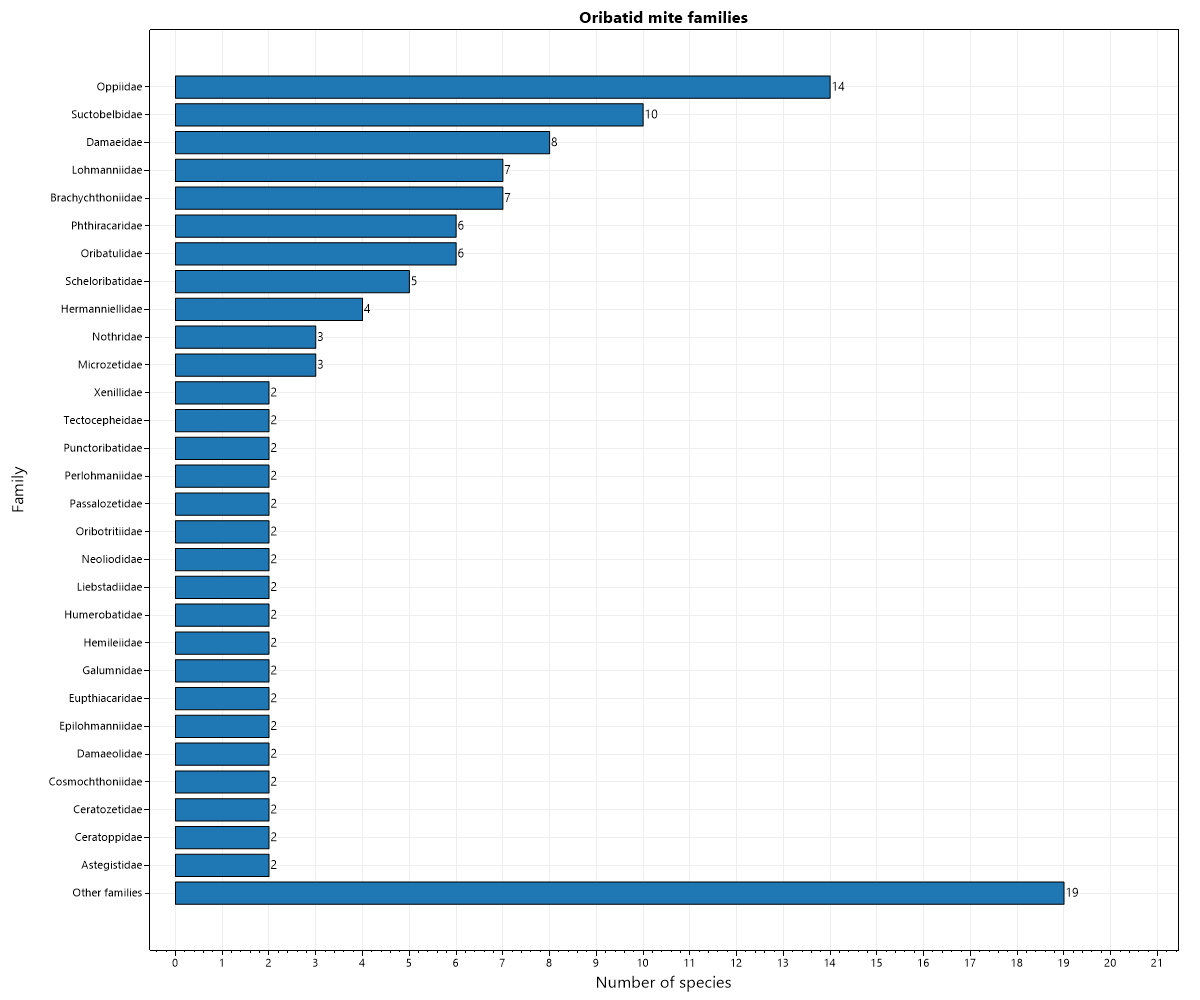
At the family level, nine families — Oppiidae, Suctobelbidae, Damaeidae, Brachychthoniidae, Lohmanniidae, Oribatulidae, Phthiracaridae, Scheloribatidae and Hermanniellidae — contain the highest number of species (Figure 2). Together, these families represent 52.34375% of all recorded oribatid mite species in Uzbekistan. At the genus level, Suctobelbella (9), Oribatula (6), Scheloribates (5), Liochthonius (4), Hermanniella (4), Eubelba (4), Lohmannia (3), Thamnacarus (3), Nothrus (3) and Ramusella (3) are the most species-rich genera, together comprising 34.375% of all species in Uzbekistan.
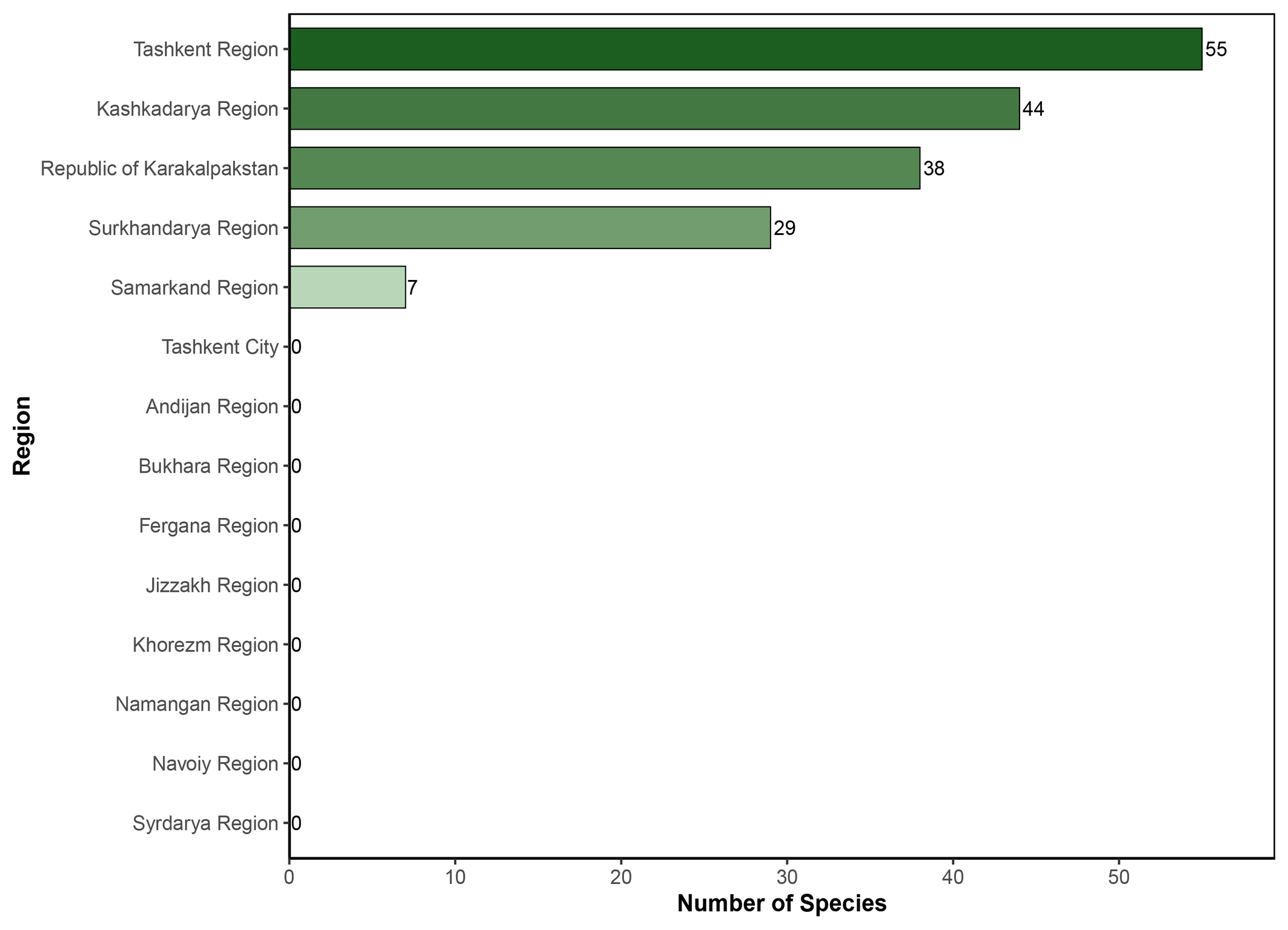
At the regional level, oribatid mite species have been reported from only five of the 14 administrative regions of Uzbekistan (Figure 1 and 3). The highest numbers of different species were recorded from Tashkent region (55 species), Kashkadarya (44 species), Republic of Karakalpakstan (38 species), and Surkhandarya (29 species). Seven species were recorded from Samarkand, while Tashkent city, Andijan, Bukhara, Fergana, Jizzakh, Khorezm, Namangan, Navoiy, and Syrdarya regions currently have no records. Some oribatid mites show localized distributions, such as Eubelba bulanovae and Eubelba flammeisetosa (southern Uzbekistan), Mystroppia rethejumi (Fergana valley), while others, including Suctobelbella (Flagrosuctobelba) quinquedentata, Arenozetes christovi, Scheloribates (Scheloribates) laevigatus, Scheloribates (Scheloribates) pallidulus latipes and Scheloribates (Scheloribates) semidesertus were reported from Uzbekistan in general, without specific localities indicated in the sources.
Acknowledgements
This work was supported by the International Co-Research Project of the Chinese Academy of Sciences (Grant No. 180GJHZ2023016MI), and CAS-ANSO Fellowship (Grant No. CAS-ANSO-FP-2025-11, CAS-ANSO-FP-2025_01). Odiljon Obidov was supported by the Alliance of International Science Organization (ANSO; Grant No. 2024ANSOM067). We express our sincere gratitude to Dr. Cheng-Lin Liu and Dr. Ilya Smelansky for their insightful comments and thorough review of the manuscript. We also thank the anonymous reviewers for their constructive comments, which greatly improved the manuscript.
References
- Akrami M.A. 2015. An annotated checklist of oribatid mites (Acari: Oribatida) of Iran. Zootaxa, 3963(4): 451-501. https://doi.org/10.11646/zootaxa.3963.4.1
- Akrami M.A., Bayartogtokh B. 2023. The first record of Ghilarovus humeridens Krivolutsky (Acari, Oribatida, Zetomotrichidae) from Iran with a supplementary description. Persian J. Acarol., 12(4): 495-504.
- Bayartogtokh B. 2010. Oribatid Mites of Mongolia (Acari: Oribatida). Moscow: KMK Scientific Press. [in Russian]
- Bulanova-Zachvatkina E.M. 1978. New oribatid mites (Oribatei, Mixonomata) from termite nests in central Asia. Entomologicheskoe Obozrenie, 57(4), 918-922. [in Russian]
- Khamraev A.Sh. 2003. Soil organisms and entomocomplexes in Khorezm and Karakalpakstan (Uzbekistan). ZEF Work Papers for Sustainable Development in Central Asia, No. 6, Tashkent, 67 pp.
- Koshanova R.E. 1981. Fauna of mites of agricultural lands in Karakalpakia. Bulletin of the Karakalpak Branch of the Academy of Sciences of the Uzbek SSR, (4), 22-25. [in Russian]
- Koshanova R.E., Krivolutsky D.A. 1984. A new species of armored mites found in Karakalpakia. Bulletin of the Karakalpak Branch of the Academy of Sciences of the Uzbek SSR, (4): 65-67. [in Russian]
- Koshanova R.E. 1986. Free-living mites in the soil fauna of irrigated lands of the Karakalpak ASSR (Abstract of the dissertation for the degree of Candidate of Biological Sciences). Moscow, 26 pp. [in Russian]
- Krivolutsky D.A. 1966. On the armored mites (Oribatei, Acariformes) of the soils of Central Asia. Zool. Zhurn., 45(11), 1628-1638. [in Russian]
- Krivolutsky D.A. 1971. Some new oribatoid mites from Central Asia. Vestnik Ceskoslovenske Spolecnosti Zoologicke, 35(1), 35-39.
- Laskova L.M., Koshanova R.E. 1980. Oribatid mites on irrigated lands of Karakalpakia. Bulletin of the Karakalpak Branch of the Academy of Sciences of the Uzbek SSR, (3): 49-50. [in Russian]
- Liu D., Chen J. 2024. Checklist of oribatid mites (Acari: Oribatida) from China. Syst. Appl. Acarol., 29(7): 891-1026. https://doi.org/10.11158/saa.29.7.8
- Ljaschev A.A., Tolstikov A.V. 1993. Epidamaeus (Akrodamаеus) golosovae: A new species of armored mites (Acariformes: Oribatei) from Central Asia. Zool. Zh., 72(1): 153-157. [in Russian]
- Majidova D.Z., Mamarakhimov O.M., Makhmudova M.M., Turdalieva Kh.S., Shamuratova N.T. 2024. The bioindicator properties of oribatid mites in soil fauna of Kashkadarya region. BIO Web Conf., 118: 02004. https://doi.org/10.1051/bioconf/202411802004
- Nazarova S.A. 1970. Oribatid mites of the desert-pasture zone of Uzbekistan as intermediate hosts of two Moniezia species. In: Oribatids and their role in soil-forming processes. Vilnius, p. 229-233. [in Russian]
- Niedbała W. 2006. New species of Palaearctic Oribotritiidae (Acari, Oribatida). Zootaxa, 1175, 55-68. https://doi.org/10.11646/zootaxa.1175.1.5
- Niedbała W. 2012. Ptyctimous mites (Acari, Oribatida) of the Palaearctic Region. Distribution. Fauna Mundi, 6, 1-348.
- Norton R.A., Behan-Pelletier V.M. 2009. Suborder Oribatida. In: Krantz G.W., Walter D.E. (Eds). A Manual of Acarology, 3rd Edition. Lubbock: Texas Tech University Press, p. 430-564.
- Rakhimov M.S., Elmuratova Z.U., Majidova D.Z. 2021. Type of strength of oribatid mites and their distribution in southern Uzbekistan. Eurasian J. Acad. Res., 1(3): 706. Available from: https://doi.org/10.5281/zenodo.5059903
- Shtanchaeva U.Y., Koshanova R.E. 1984. New species of the Oribatei from Karakalpakia. Zool. Zhurn., (7), 1107-1109. [in Russian]
- Shtanchaeva U.Y., Koshanova R.E. 1987. Variability of the armored mite Epilohmannia cylindrica (Berlese, 1904) within its distribution range. Bulletin of the Karakalpak Branch of the Academy of Sciences of the Uzbek SSR, (3), 30-34. [in Russian]
- Shtanchaeva U.Y. 2001. Catalog of oribatid mites of the Caucasus (Acari, Oribatida). Acarina, 9(2): 177-221.
- Sitnikova L.G. 1973. New species of oribatid mites of the genus Hermanniella Berlese, 1908 (Oribatei, Hermanniellidae) in the Soviet fauna. Entomol. Review, 52 (4), 618-626.
- Subías L.S. 2022. Listado sistemático, sinonímico y biogeográfico de los Ácaros Oribátidos (Acariformes: Oribatida) del mundo (excepto fósiles). Monografias electrónicas, 12: 1-545. http://bba.bioucm.es/cont/docs/RO_1.pdf [Accessed on: 2024-1-1]
- Thor S., 1930. Einige Acarina, besonders Hydracarina aus Turkestan. Zool. Anz., 88: 179-198.
- Tolstikov A.V., Lyashchev A.A. 1995. On the damaeid mite fauna (Acariformes: Oribatei: Damaeidae) of Central Asia. Genus Belba Heyden, 1826. I. Redescription of two Bulanova-Zakhvatkina's species. Acarina, 3, 3-16.
- Tolstikov A.V. 1995. On the damaeid mite fauna (Acariformes: Oribatei: Damaeidae) of Central Asia. Genus Belba Heyden, 1826. II. Description of two new species. Acarina, 3, 17-29.
 to post any comment or correction.


2025-12-04
Date accepted:
2026-04-29
Date published:
2026-05-07
Edited by:
Pfingstl, Tobias

This work is licensed under a Creative Commons Attribution 4.0 International License
2026 Obidov, Odiljon; Kholmatov, Bakhtiyor; Mirzaeva, Gulnara and Chen, Jun
 Download article
Download the citation
RIS with abstract
(Zotero, Endnote, Reference Manager, ProCite, RefWorks, Mendeley)
RIS without abstract
BIB
(Zotero, BibTeX)
TXT
(PubMed, Txt)