


A new species of Spinibdella (Acari: Trombidiformes: Bdellidae) from China, with description of adult and deutonymph
Wu, You-Fang  1
; Chen, Jian-Xin
2
; Yao, Mao-Yuan
3
and Guo, Jian-Jun
4
1
; Chen, Jian-Xin
2
; Yao, Mao-Yuan
3
and Guo, Jian-Jun
4
1College of Chemistry and Chemical Engineering, Anshun University, Anshun 561000, P. R. China.
2College of Agriculture, Anshun University, Anshun, 561000, P. R. China.
3College of Agriculture, Anshun University, Anshun, 561000, P. R. China.
4✉ Institute of Entomology, Guizhou University; Scientific Observing and Experimental Station of Crop Pests in Guiyang, Ministry of Agriculture and Rural Affairs of the P. R. China, Guiyang 550025, P. R. China.
2026 - Volume: 66 Issue: 2 pages: 521-529
https://doi.org/10.24349/qf2v-m92gZooBank LSID: E7C1601B-2D80-4E83-B199-4AFFC3B4DAF3

Original research
Keywords
Abstract
Introduction
The family Bdellidae (Acari: Prostigmata) as predatory mites exhibit significant potential biocontrol agents against various small arthropod pests, such as harmful mites, collembolans, and other tiny insects (Wallace & Walters 1974; Gerson et al. 2003; Hernandes et al. 2015). The family includes 11 genera, five subfamilies and 291 valid species (Hernandes et al. 2016; Paktinat-Saeej et al. 2016; Barbar & Ueckermann 2017; Eghbalian et al. 2017; Wu et al. 2021 a, b; Hamadi & Barar 2024; Wu et al. 2025; Paktinat-Saeij & Kazemi 2025).
Thirty-eight species of the genus Spinibdella Thor, 1930 are currently known as valid species (Hernandes et al. 2016; Eghbalian et al. 2017). There are nine species of Spinibdella are recorded in China (Lin & Zhang 2010). However, only a small number of species have been described (Tseng 1978; Lin et al. 2006; Lin & Zhang 2010), and there remain many gaps in the taxonomic research of this genus.
In this paper, a new species of Spinibdella scobis sp. nov. is described and illustrated base on the adult and deutonymph.
Material and methods
Samples were collected from sawdust from tree holes in Tuanze Town, Huitong County, Hunan Province. Mites were extracted from the samples by using Berlese-Tullgren funnels, mounted on slides in Hoyer′ s medium (Krantz & Walter 2009), and examined under a Nikon Ni E microscope (Nikon, Japan). Line drawings were prepared with the aid of a drawing tube attached to the microscope. All figures were edited with Adobe Photoshop 2022, and all measurements are given in micrometers (µm). The measurements outside of brackets are those of the holotype.
Abbreviations: Prodorsal setae: anterior trichobothria (at), posterior trichobothria (pt), lateral proterosomal setae (lps), median proterosomal setae (mps). Hysterosomal setae: internal humerals (c1 ), external humerals (c2 ), internal dorsals (d1 ), internal lumbals (e1 ), internal sacrals (f1 ), external sacrals (f2 ), internal clunals (h1 ), external clunals (h2 ). Anal region: postanals (ps), anal setae (an, ad); Genital region: aggenital setae (ag), genital setae (g). Ventral hypostomal setae (vh). Dorsal hypostomal setae (DHS). Leg setae: simple tactile seta (sts) attenuate (sharply) solenidion (asl), blunt-pointed rod-like solenidion (bsl), peg-like seta (pe), trichobothria (T). Palp setae: dorsal end seta (DES), and ventral end seta (VES) (Paktinat-Saeej et al. 2016).
Results
Family Bdellidae Dugès, 1834
Subfamily Spinibdellinae Grandjean, 1938
Genus Spinibdella Thor, 1930
Spinibdella scobis sp. nov. Wu & Guo
ZOOBANK: 4BD64855-9048-4CAD-B14A-01FB96BD311C
Diagnosis
Subcapitulum with two pairs of ventral setae, without dorsal hypostomal setae (DHS); pedipalps do not extend beyond gnathosoma; chelicerae without striations and with a slender base, cheliceral setae short, minute; central area of prodorsum with transverse striae, with two pairs of lateral eyes and an unpaired median eye; anal region with five pairs of postanals (ps1–5 ).
Description
Female (n=5; Figures 1–3)

Body length (including gnathosoma) 991 (991–1303), body width 326 (326–441).
Gnathosoma — (Fig. 1). Gnathosoma length 320 (320–412), width 78 (78–87). Subcapitulum buccal cone without striae, transverse at base, with two pairs of ventral hypostomal setae (vh1–2 ) (Fig. 1A), vh1 49 (47–55), vh2 55 (54–61), or 11 (9–12), vh1 –vh1 35 (33–37), vh2 –vh2 20 (18–21), vh1 –vh2 89 (89–102); dorsal hypostomal setae (DHS) absent; cheliceral length 293 (291–338), width 29 (29–35), without striae, and with two short and minute dorsal setae, proximal seta 8 (7–9), distal seta 8 (7–9), distance between proximal and distal setae 76 (76–96); fixed and movable digits smooth (Fig. 1B); Palp five-segmented (Fig. 1C), not extend beyond gnathosoma, total length 212 (212–255), trochanter 13 (10–13), basifemur 107 (107–134), telofemur 25 (25–30), genu 17 (15–22), tibiotarsus 53 (53–61), VES 192 (192–225), DES 200 (200–243), palp chaetotaxy: trochanter 0, basifemur 7 sts, telofemur 1 sts, genu 3 sts, tibiotarsus 4 sts, 1 asl, two long terminal setae (VES and DES).
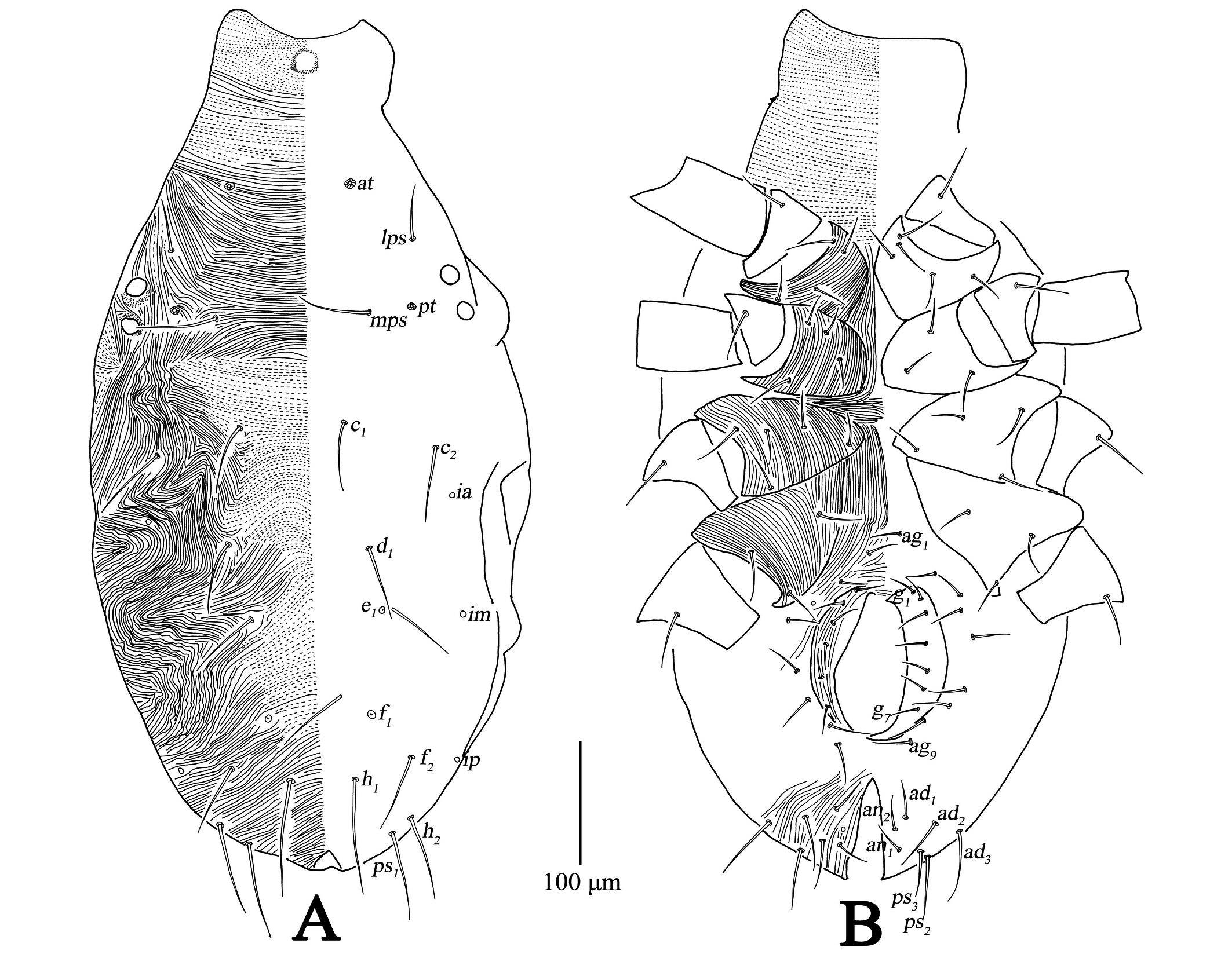
Dorsum — (Fig. 2A). Dorsum with distinct striae, prodorsum with broken striae between at and base of gnathosoma, with continuous transverse striae between pt and at; two pairs of lateral eyes and unpaired median eye present, diameters of anterior one 16 (16–18), and posterior one 15 (12–16), median eye 10 (10–11) and with longitudinal and oblique striae between anterior and posterior lateral eyes; Hysterosoma with broken and transverse striae between setae c1 , c2 , d1 , e1 , h1 and h2 ; Hysterosomal region with three cupules (ia, im and ip). Measurements of dorsal setae as follows: at ?, pt ?, lps 39 (39–55), mps 58 (58–66), c1 55 (55–63), c2 58 (58–72), d1 54 (54–66), e1 60 (54–66), f1 65 (65–74), f2 66 (60–70), h1 94 (90–104), h2 65 (65–77), at–at 92 (92–101), pt–pt 181 (181–211), at–pt 109 (109–125), at–lps 67 (67–79), at–mps 104 (104–123), pt–mps 32 (32–40), pt–lps 49 (36–62), mps–mps 118 (118–139), lps–lps 182 (182–212), lps–mps 65 (65–78), c1 –c2 67 (67–105), c1 –d1 91 (91–130), c2 –d1 86 (86–121), d1 –e1 61 (61–117), e1 –f1 79 (79–129), e1 –f2 119 (118–174), f1 –h1 52 (52–88), f1 –h2 92 (90–137), f2 –h2 44 (40–62), f2 –h1 46 (45–68), f1 –f2 49 (49–62), c1 –c1 80 (75–105), c2 –c2 212 (212–276), d1 –d1 109 (109–137), e1 –e1 98 (98–124), f1 –f1 80 (72–92), f2 –f2 138 (138–166), h1 –h1 50 (47–59), h2 –h2 147 (142–183).
Venter — (Fig. 2B). Venter with longitudinal striae between coxae I–II and between coxae III–IV; Aggenital region with nine setae in the right side and eight setae in the left (ag1–8/9 ); Genital valves with seven pairs of setae (g1–7 ); Anal region with three pairs of postanals (ps1–3 ) and five pairs of anal setae (an1–2 , ad1–3 ).
Ovipositor — (Fig. 1D). Ovipositor with 18 setae.
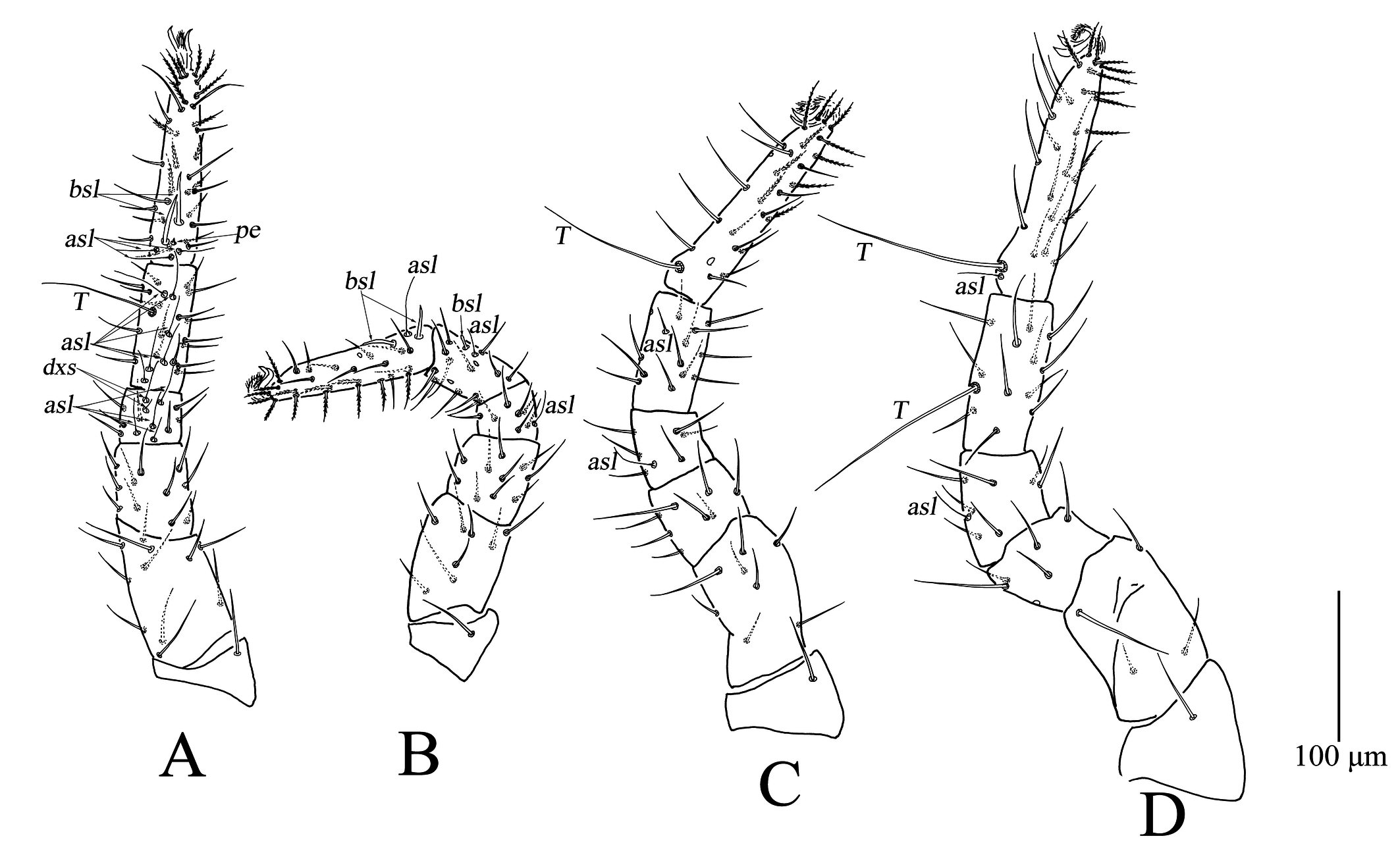
Legs — (Figs. 3). Legs were measured from the ventral insertion of coxae to the base of pretarsi. Measurements of legs as follows: leg I 508 (508–589), leg II 451 (451–534), leg III 544 (544–692), leg IV 679 (679–799); Setal formula of leg segments as follows: coxae I–IV 4/5-4/3-5/4-3 sts; trochanters I–IV 1-1-1-1 sts; basifemora I–IV 11-8-8-4(5) sts; telofemora I–IV 11-10-8-6 sts; genua I–IV 7 sts, 1duplex (dxs), 4 asl-7 sts, 1 asl-6 sts, 1 asl-7 sts, 1 asl; tibiae I–IV 17 sts, 6 asl, 1 T-14 sts, 1 bsl, 1 asl-13 sts, 1 asl-12 sts, 1 T; tarsi I–IV 28 sts, 3 asl, 2 bsl, 1 pe-25 sts, 1 asl, 2 bsl-26 sts, 1 T-24 sts, 1 asl, 1 T.
Deutonymph — (n=1; Figures 4–6)

Body length (including gnathosoma) 735, body width 276.
Gnathosoma — (Fig. 4). Gnathosoma length 204, width 48. Subcapitulum striae, transverse resembling those of female, with two pairs of ventral hypostomal setae (vh1–2 ) (Fig. 4A), vh1 32, vh2 40, or 7, vh1 –vh1 22, vh2 –vh2 12, vh1 –vh2 58; dorsal hypostomal setae (DHS) absent; cheliceral length 190, width 20, without striae, and two dorsal setae short, minute, fixed and movable digits smooth, resembling female (Fig. 4B), proximal seta 4, distal seta 6, distance between proximal and distal setae 69; Palp five-segmented (Fig. 4C), with transverse striae, not extend beyond gnathosoma, total length 143, trochanter 11, basifemur 60, telofemur 18, genu 14, tibiotarsus 36, VES 127, DES 133, palp chaetotaxy: trochanter 0, basifemur 4 sts, telofemur 1 sts, genu 3 sts, tibiotarsus 4 sts, 1 asl, two long terminal setae.

Dorsum — (Fig. 5A). Dorsum with hardly distinguishable striae, two pairs of lateral eyes and unpaired median eye present, the posterior lateral eyes lacking lenses and median eye is not yet fully developed, diameters of anterior one 10, and posterior one 8; Hysterosoma without three cupules (ia, im and ip). Measurements of dorsal setae as follows: at ?, pt ?, lps 26, mps 38, c1 36, c2 38, d1 42, e1 40, f1 54, f2 45, h1 59, h2 61.
Venter — (Fig. 5B). Venter with strain resembling female, faintly; Aggenital region with three pairs of setae (ag1–3 ); Genital valves with one pairs of setae (g1 ); Anal region with three pairs of postanals (ps1–3 ), two pairs of anal setae (ad1–2 ).

Legs — (Figs. 6). Measurements of legs as follows: leg I 311, leg II 289, leg III 342, leg IV 396; Setal formula of leg segments as follows: coxae I–IV 3-2/1-4-2 sts; trochanters I–IV 1-1-1-1 sts; basifemora I–IV 5-4-3-1 sts; telofemora I–IV 5-4-4-4 sts; genua I–IV 4 sts, 1duplex (dxs), 3 asl-5 sts-4 sts, 1 asl-4 sts, 1 asl; tibiae I–IV 7 sts, 5 asl, 1 T-5 sts, 1 asl, 1 bsl-5 sts, 1 asl-4 sts, 1 T; tarsi I–IV 22 sts, 2 asl, 2 bsl, 1 pe-19 sts, 2 bsl-19 sts, 1 T-16 sts, 1 T.
Male and other developmental stages — Unknown.
Etymology
The new species name is derived from its collection habitat ''sawdust in tree hollows''.
Remarks
The new species resembles Spinibdella ankylotricha Omukunda, 2012 and S. tenuirostris (Ewing, 1917) by chelicera with striations absent or poorly visible; cheliceral setae short, minute; palp chaetotaxy: 7-1-3-7, not extend beyond gnathosoma; dorsal setae smooth, central area of prodorsum with transverse striae (Atyeo 1960; Omukunda et al. 2012). However, it is distinguished from S. ankylotricha by: (1) unpaired median eye present in S. scobis, but unpaired median eye absent in S. ankylotricha; (2) trochanters I–IV 1-1-1-1 sts S. scobis, but 1-1-2-1 in S. ankylotricha; (3) tibiae I with 17 sts, 6 asl, 1 T in S. scobis, but 14 (12) sts, 5 asl, 1 pe, 1 T in S. ankylotricha; (4) genital region with seven pairs of setae in S. scobis, but nine pairs in S. ankylotricha.
However, it is distinguished from S. tenuirostris by: (1) unpaired median eye present in S. scobis, but unpaired median eye absent in S. tenuirostris; (2) genital valves with seven pairs of setae, aggenital region with nine pairs of setae in S. scobis, but Genital valves with eight pairs of setae, aggenital region with ten pairs of setae in S. tenuirostris; (3) trochanters I–IV 1-1-1-1 sts S. scobis, but 1-1-2-1 in S. tenuirostris; (4) basifemora I–IV 11-8-8-4(5) sts in S. scobis, but 11-10-9-4(5) sts in S. tenuirostris; (5) tibiae I with 17 sts, 6 asl, 1 T in S. scobis, but 15 sts, 8 asl, 1 pe, 1 T- in S. tenuirostris.
Type material
Holotype female (HN-SP-201708200101-I), four paratype females (HN-SP-201708200102-I–201708200105-I), one deutonymph (HN-SP-201708200106-II), were collected from sawdust in the tree hole, Tuanze Town, Huitong County, Hunan Province, P. R. China (26°87′43″N, 109°86′54″E), collected by Yao Mao-Yuan.
All types are deposited in the Institute of Entomology, Guizhou University, Guiyang, P. R. China (GUGC).
Key to Spinibdella of China
1. One pair of lateral eye lenses present
...... S. depressa (Ewing, 1909)
— Two pairs of lateral eye lenses present
...... 2
2. Unpaired median eye present
...... S. scobis Wu & Guo sp. nov.
— Unpaired median eye absent
...... 3
3. Cheliceral setae long
...... 4
— Chelicera setae short, minute
...... S. tenuirostris(Ewing, 1917)
4. Central area of prodorsum with longitudinal striae
...... 5
— Central area of prodorsum with transverse striae
...... 6
5. Pedipalpal basifemur with 11 setae
...... S. longistriata Tseng, 1978
— Pedipalpal basifemur with 7 setae
...... S. cronini (Baker & Balock, 1944)
6. Tibia II with deeply recessed blunt solenidion
...... 7
— Tibia II without deeply recessed blunt solenidion
...... 8
7. Coxa I with 9 setae; telofemur III with 4 setae
...... S. bifurcata Atyeo, 1960
— Coxa I with 8 or fewer setae; telofemur III with 5 or 6 setae
...... S. smileyi Tseng, 1978
8. Basifemur I with 6 setae; telofemur I with 5 setae
...... S. yeni Tseng, 1978
— Basifemur I with 9 setae; telofemur I with 6 setae
...... S. novemsetosa Tseng, 1978
Acknowledgements
This work was supported by the Natural Science Research Project of Guizhou Provincial Education Department (Youth Science and Technology Talent Development Programs) (Qianjiaoji [2024]215), the Guizhou Provincial Science and Technology Projects (Qiankehe Pingtai Rencai-GCC [2022]029-1), the Anshun Social Development Technology List Project (AnShiKeSheZhong[2023]01) and the specialized Program for Doctoral of Anshun University (Asxybsjj202404).
References
- Atyeo W.T. 1960. A revision of the family Bdellidae in North and Central America (Acarina: Prostigmata). University of Kansas Science Bulletin, 40, 345-499.
- Barbar Z. & Ueckermann E.A. 2017. Two new species and a new record of Bdellidae (Acari: Trombidiformes) from Syria. Acarologia, 57(4): 1089-1102. https://doi.org/10.24349/acarologia/20174221
- Eghbalian A.H., Khanjjani M. & Ueckermann E.A. 2017. Two new species of Spinibdella and Odontoscirus (Acari: Prostigmata: Bdellidae) from Western Iran. Acarologia, 57(4): 779-789. https://doi.org/10.24349/acarologia/20174193
- Gerson U., Smiley R.L. & Ochoa R.A. 2003. Mites (Acari) for pest control. Oxford: Blackwell, 539 pp. https://doi.org/10.1002/9780470750995
- Hamadi A. & Barbar Z. 2024. Two new species of Neomolgus (Acari: Trombidiformes: Bdellidae) from Syria. Acarologia, 64(3): 777-786. https://doi.org/10.24349/vm66-fciz
- Hernandes F.A., Castro T.M.M.G. & Venancio R. 2015. Prostigmata (Acari: Trombidiformes) as biological control agents. pp. 151-184, Chapter 6 in Carrillo, D., Moraes, G.J. & Peña, J.E. (Eds.), Prospects for Biological Control of Plant Feeding Mites and Other Harmful Organisms, Springer. https://doi.org/10.1007/978-3-319-15042-0_6
- Hernandes F.A., Skvarla M.J., Fisher J.R., Dowling, A.P.G., Ochoa, R., Ueckermann, E.A. & Bauchan, G.R. 2016. Catalogue of snout mites (Acariformes: Bdellidae) of the world. Zootaxa, 4152(1): 001-083. https://doi.org/10.11646/zootaxa.4152.1.1
- Krantz G.W., Walter D.E. 2009. Collecting, rearing, and preparing specimens. In: Krantz, G.W. & Walter, D.E. (Eds). A Manual of Acarology. Third Edition. Texas Tech University Press, pp. 83-94.
- Lin J.Z. & Zhang Z.Q. 2010. Bdelloidea of China: a review of progress of systematics and biology, with a checklist of species. Zoosymposia, 4: 42-50. https://doi.org/10.11646/zoosymposia.4.1.3
- Lin J.Z., Zhang Y.X., Ji J. & Chen X. 2006. Five New Records of Bdellidae from China (Acari: Bdellidae). Wuyi Science Journal, 22: 1-31. (in Chinese)
- Omukunda E., Theron P.D. & Ueckermann E.A. 2012. Spinibdella Thor (Acari: Bdellidae) from southern Africa: descriptions of five new species and the redescription of S. thori (Meyer & Ryke). Zootaxa, 3304: 1-24. https://doi.org/10.11646/zootaxa.3304.1.1
- Paktinat-Saeej S., Bagheri M. & Hernandes F.A. 2016. A new species and a record of Bdellidae (Acari: Trombidiformes: Bdelloidea) from Iran. Syst. Appl. Acarol., 21(10): 1346-1354. https://doi.org/10.11158/saa.21.10.5
- Paktinat-Saeij S. & Kazemi S. 2025. Bdellid mites of the southern Caspian Sea coast with description of a new species of Cyta (Acari: Trombidiformes: Prostigmata: Bdellidae). Acarologia, 65(4): 1188-1198. https://doi.org/10.24349/1p9c-gbnw
- Tseng Y.H. 1978. Mites of the family Bdellidae from Taiwan (Acarina: Prostigmata). Journal of the Agricultural Association of China, 104, 25-51 [in Chinese].
- Wallace M.M.H. & Walters M.C. 1974. The introduction of Bdellodes lapidaria (Acari: Bdellidae) from Australia into South Africa for the biological control of Sminthurus viridis (Collembola). Aust. J. Zool. 22(4), 509-517. https://doi.org/10.1071/ZO9740505
- Wu Y.F., Jin D.C., Yi T.C. & Guo J.J. 2021a. Two new species of Bdellidae (Acari: Prostigmata) from China. Acarologia, 61(3): 613-624. https://doi.org/10.24349/YNi9-m8W5
- Wu Y.F., Jin D.C., Yi T.C. & Guo, J.J. 2021b. Chaetotaxy ontogeny of Bdella (Acari: Prostigmata: Bdelloidea) with morphological descriptions of all life stages of B. xini sp. nov. from China. Syst. Appl. Acarol., 26(12): 2338-2357. https://doi.org/10.11158/saa.26.12.12
- Wu Y.F., Chen J.X., Yao M.Y. & Guo J.J. 2025. Two new species and a new record of Odontoscirinae (Acari:Prostigmata: Bdellidae) from China. Syst. Appl. Acarol., 30(10): 1741-1752. https://doi.org/10.11158/saa.30.10.3
to post any comment or correction.


2025-12-16
Date accepted:
2026-04-17
Date published:
2026-06-04
Edited by:
Akashi Hernandes, Fabio

This work is licensed under a Creative Commons Attribution 4.0 International License
2026 Wu, You-Fang; Chen, Jian-Xin; Yao, Mao-Yuan and Guo, Jian-Jun
 Download article
Download the citation
RIS with abstract
(Zotero, Endnote, Reference Manager, ProCite, RefWorks, Mendeley)
RIS without abstract
BIB
(Zotero, BibTeX)
TXT
(PubMed, Txt)