


Five new species of the water mite genus Unionicola (Acari: Unionicolidae) from Jilin Province, China
Ding, Zhu-Hui  1
; Yi, Tian-Ci
2
; Guo, Jian-Jun
3
and Jin, Dao-Chao
4
1
; Yi, Tian-Ci
2
; Guo, Jian-Jun
3
and Jin, Dao-Chao
4
1Anshun University, Anshun 561000, P. R. China.
2Institute of Entomology, Guizhou Provincial Key Laboratory for Agricultural Pest Management of the Mountainous Region, Guizhou University, Guiyang 550025, P. R. China.
3Institute of Entomology, Guizhou Provincial Key Laboratory for Agricultural Pest Management of the Mountainous Region, Guizhou University, Guiyang 550025, P. R. China.
4✉ Institute of Entomology, Guizhou Provincial Key Laboratory for Agricultural Pest Management of the Mountainous Region, Guizhou University, Guiyang 550025, P. R. China.
2026 - Volume: 66 Issue: 2 pages: 341-363
https://doi.org/10.24349/0kdj-mq72ZooBank LSID: B456B8FD-A186-42C6-A561-CB01514BF150

Original research
Keywords
Abstract
Introduction
Research on the genus Unionicola in China dates back to 1938, when the German water mite taxonomist Viets (1938) identified specimens collected by Gee from Suzhou and Guangdong. These early records included two species: the nominate species Unionicola (Hexatax) crassipes (Müller, 1776) and Unionicola (s.str.) ypsilophora (Bonz, 1783). Following a hiatus, Uchida (1941) documented two species, Unionicola (Pentatax) setipes Sokolow, 1931 and U. crassipes, from Jilin and Gansu provinces. Subsequently, Uchida & Imamura (1951) described 21 species from Hunan and Hubei provinces, identifying Unionicola (Hexatax) affinis* Piersig, 1906 among them.
Until the 1990s. Jin (1997) revised the synonyms and historical reports, organizing the genus into four valid species. Over a series of publications, Wen and colleagues described five new species and reported seven known species from China (Wen & Zhu 1996, 1998, 1999; Wen et al. 1998, 2005). Advancements continued with the establishment of the subgenus Vidrinatax and the description of three new species by Wen et al. (2008a, 2008b). Concurrently, Vidrine et al. (2008) reported one new species and one newly recorded species from the Gan River in Jiangxi. More recently, Ding et al. (2019) described three new species from Guizhou, and subsequently established three new subgenera: Micronodus Ding et al. 2024, Vespicola Ding et al. 2024, and Lingshuiatax Ding et al. 2024 (Ding et al. 2024). To date, a total of 27 species spanning 12 subgenera of Unionicola have been documented in China.
In the present paper, based on an expedition to Jilin Province, China, we describe five new species, including Unionicola (s. str.) chungeni sp. nov., and provide detailed morphological descriptions and illustrations. Remarkably, this species was previously misidentified as Unionicola formosa and was historically documented exclusively as parasitic within freshwater mussels such as Sinanodonta woodiana. In contrast, all specimens of U. chungeni sp. nov. in this study were collected directly from natural water bodies, indicating a free-living phase for this species.
Material and methods
The collection, preservation of water mites and preparation of slides followed Gu et al. (2021). All
images were modified and grouped into plates in Adobe Photoshop 2021.
All holotypes and paratypes will be deposited in the Institute of Entomology, Guizhou University, Guiyang, P. R. China (GUGC) (Zhang 2018). The method and terminology used follow Ding et al. (2019), ratios are calculated according to Valdecasas (2022). The following abbreviations are used: asl= above sea level, A1 = preantennal glandularia, A2 = postantennal glandularia, ACG = anterior coxal group (Cx-I + Cx-II), Ac= acetabula, Cx-I–IV = coxae I–IV, D1 –D4 = dorsoglandularia 1–4, C1 –C4 = coxoglandularia 1–4, H = altitude, I-L-1–6 = first–sixth segment of the first leg, L1 –L4 = lateroglandularia 1–4, L = length, LA= length between anterior end of Cx-I and posterior end of posterior apodeme of ACG, LP = length between anterior margin of Cx-III and posterior end of posterior apodeme of Cx-IV, O1 = preocularia, O2 = postocularia, P-1–P-5 = first–fifth segment of palp, PCG = posterior coxal group (Cx-III + Cx-IV), V1 –V4 = ventroglandularia 1–4, W = width. All measurements are given in μm, palp and leg segments are measured along the dorsal margins. Numbers are given as male/female or adult.
Taxonomy
Family Unionicolidae Oudemans, 1909
Genus Unionicola Haldeman, 1842
Subgenus Hexatax Thor, 1926
Unionicola (Hexatax) parviacetabula Ding & Jin sp. nov.
ZOOBANK: 7D10C7D7-C071-4992-8BEF-2B66819F086E
(Figures 1–3)
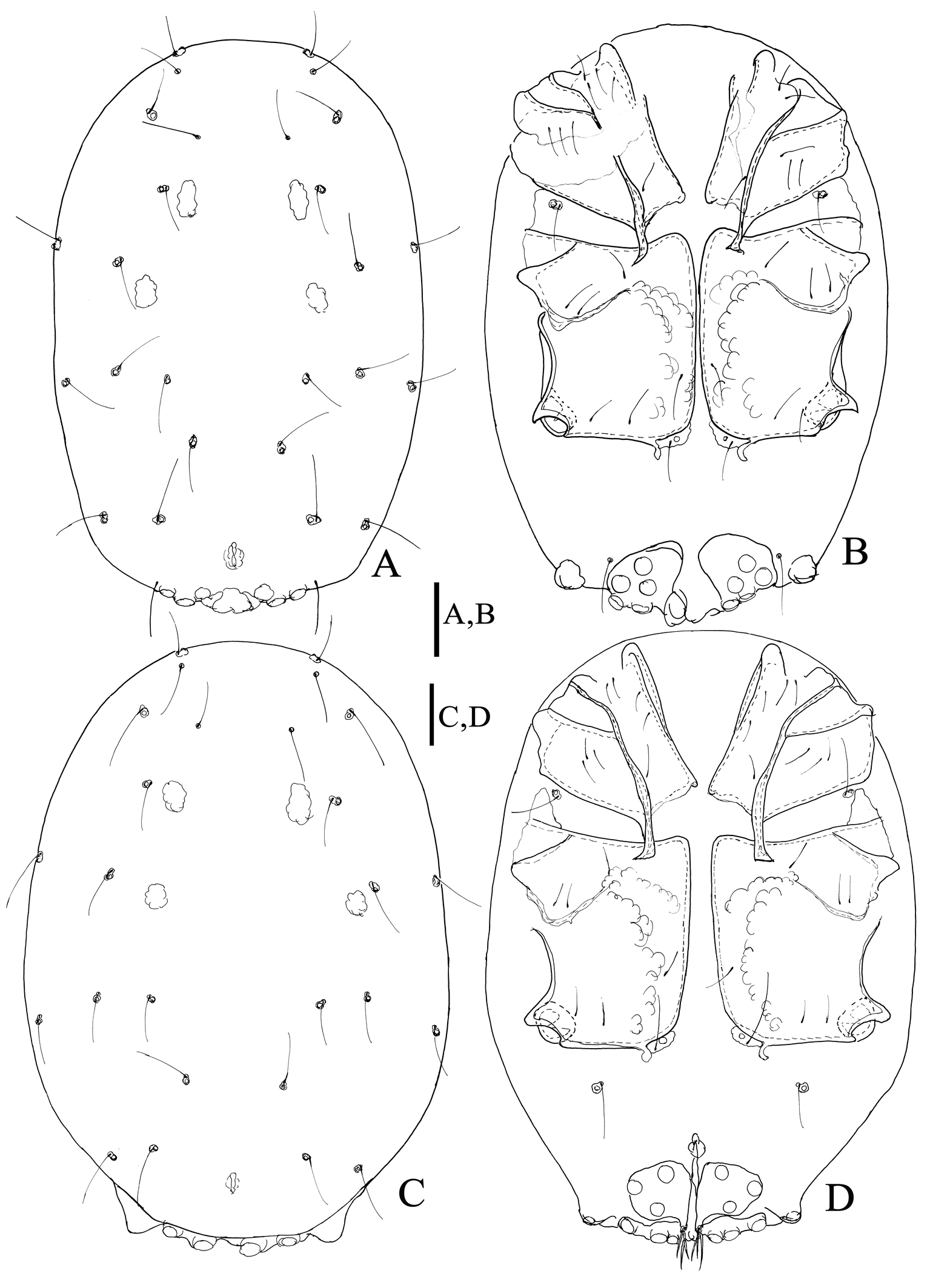
Diagnosis — Idiosoma soft, posterior apodemes of ACG extending to Cx-III, interspace between Cx-II and Cx-III narrow, female coxal group occupies approximately two-thirds of the ventral area, the distance between Ac usually greater than length. P-4 bears three well-developed protrusion on its ventral surface, male ventral protrusion short, whereas females distinctly longer.
Etymology — The specific epithet is from Latin word: ''parv-'' means small , the name of this new species is derived from its small acetabula.
Material examined — Holotype: ♂; slide no. JL-FS-2019073004, Changsheng Village, Fusong County, Jilin Province, China; 42°31′4.6″ N, 127°44′29.9″ E, 785 m a.s.l.; 30 Jul. 2019; Zhu-Hui Ding leg.; GUGC. Paratype: ♀; the same data as the holotype; GUGC.
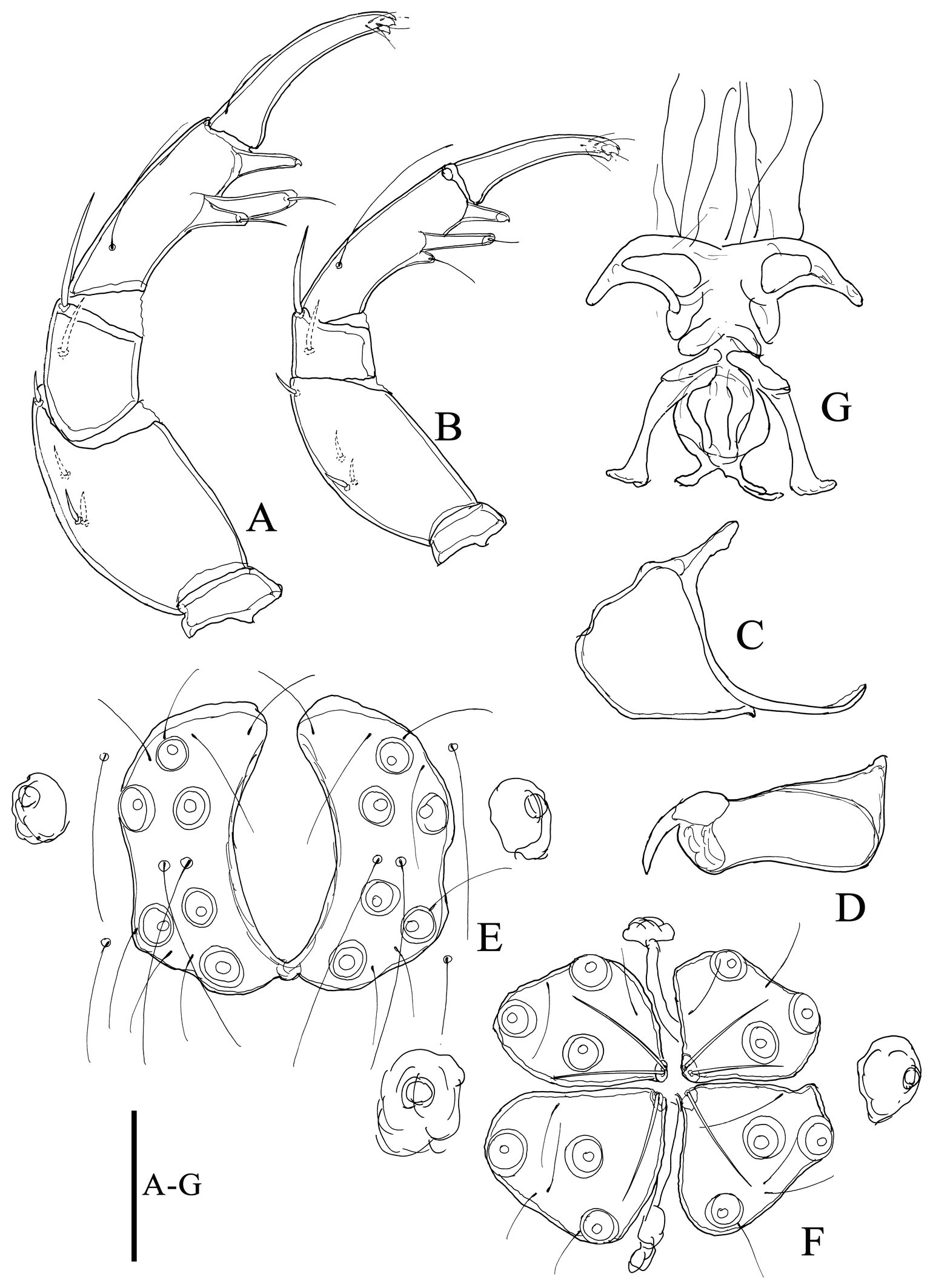
Description — male: integument smooth and soft, dorsum with two pairs of round dorsalia, L4 inflated. Dorsoglandularia without enlargement (Figure 1A). Coxal plates in four groups, interspace between Cx-II and Cx-III narrow, posterior apodemes of the ACG extend only to the medial side of the anterior margin of Cx-III, the intermedian distance of Cx-IV close to zero, posterior projection of Cx-IV hook-shaped (Figure 1B). Acetabular plates terminally located, with poorly developed sclerotized margins. One pair of stout genital setae is situated on the anterior part of acetabular plates. Three pairs of Ac are arranged dorsally and ventrally, separated by two pairs of short, stout setae in the median region. The margin of acetabular plates surrounded by seven pairs of fine genital setae. Ac relatively small, usually shorter than the distance between adjacent Ac, and occupy less than half of acetabular plates (Figure 2E).
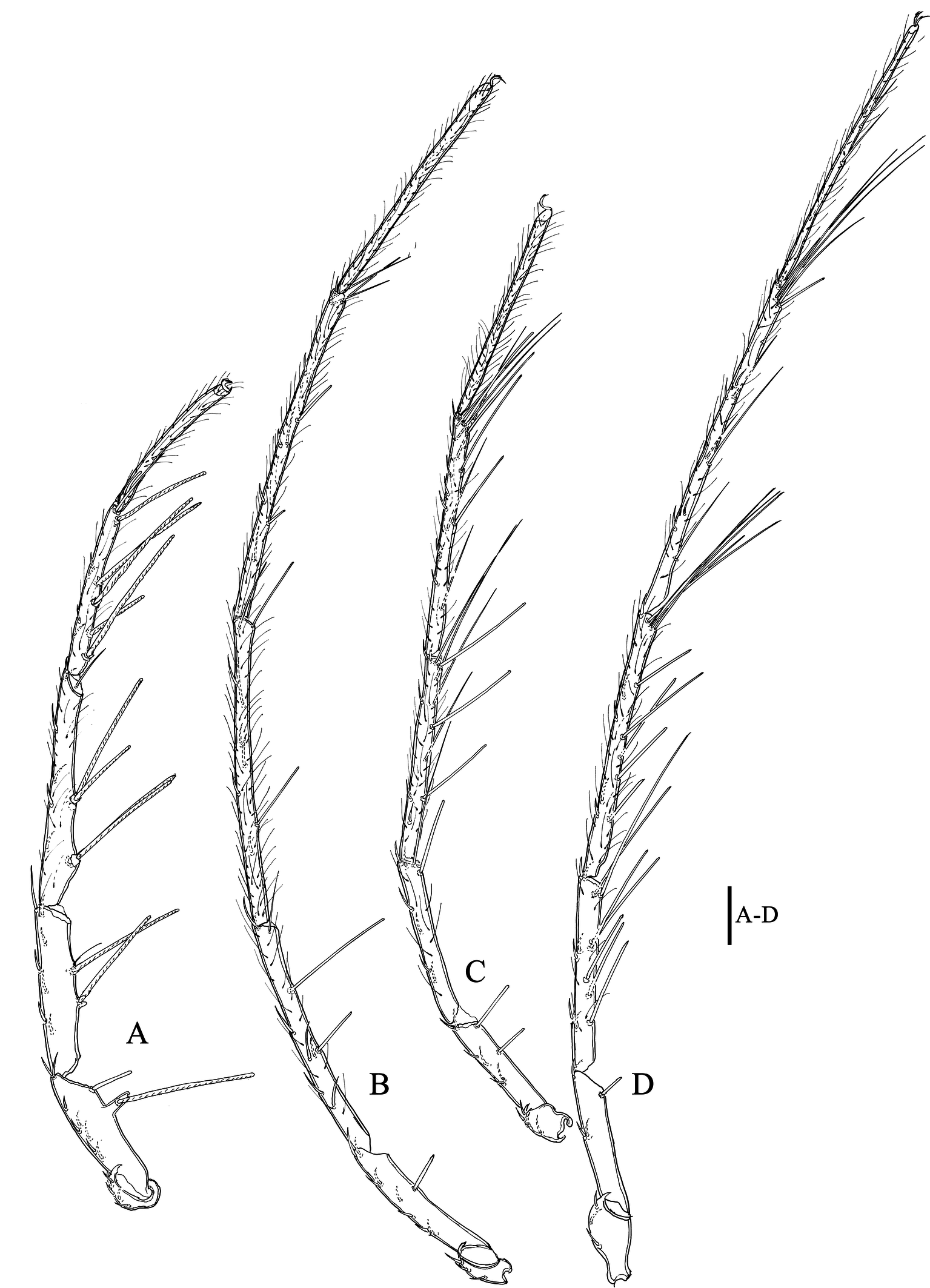
Palp slender, P-2 with a straight ventral margin, with four similar conical setae laterodorsally. P-3 with a large seta situated at its lateral and another large seta terminally, the distal seta longer than the lateral one, P-4 with three elongate protrusions on its posteroventral surface, the lateral protrusion longer than the distal one and the distal protrusion at least twice the length of the ventral one, terminating in a beak-shaped tip, P-5 with three claws and five slender setae distally (Figure 2B). Ventral apodeme of gnathosoma much longer than dorsal apodeme, bearing a finger-like projection basally (Figure 2C). Chelicera with a well-developed claw (Figure 2D). I-L-2–6 ventrally each with movable, large, blunt setae. II-L-4, -5 ventrodistally each with a short swimming seta. III-L-3, -4, -5 distally with one, two, three swimming setae, respectively. IV-L-3, -4, -5 with one, three, three swimming setae, respectively. IV-L-6 ventrally with two setae. Leg I with claws stout and hook-shaped, comprising two irregular small claws; Legs II, III, IV with claws slender and sickle-shaped, consisting of a short dorsal claw and a long ventral claw (Figure 3A–D).
Measurements — Male (n = 1): idiosoma L 776, W 560 (L/W ratio 1.39); acetabular plates L 130, W 221 (L/W ratio 0.59). LA 270; LP 331; medial distance between Cx-IV 6. Gnathosoma L 129. Chelicera L 155. Length of ejaculatory complex 187. Lengths of the palp segments (P-1–5): 23, 142, 48, 132, 95. Lengths of I-L-1–6: 101, 208, 298, 418, 325, 279. Lengths of II-L-1–6: 91, 255, 444, 548, 605, 447. Lengths of III-L-1–6: 90, 206, 301, 370, 434, 401. Lengths of IV-L-1–6: 123, 228, 352, 490, 623, 519.
Female: generally resembles the male but differs as follows: P-4 with the ventral protrusion only slightly shorter than the apical protrusion, distinctly longer than that in the male (Figure 2A). The coxal plates occupy about seven-ninths of the ventral area (Figure 1D). Acetabular plates normal, and with six pairs of Ac; the inner margin of acetabular plates with three pairs of large setae which are relatively short and do not extend beyond the margin of the plates, the plates bearing six pairs of fine genital setae (Figure 2F).
Measurements — Female (n = 1): idiosoma L 989, W 704 (L/W ratio 1.40); acetabular plates L 148, W 202 (L/W ratio 0.73). LA 270; LP 331; medial distance between Cx-IV 6. Gnathosoma L 129. Chelicera L 155. Length of gonopore 200. Lengths of the palp segments (P-1–5): 28, 170, 66, 158, 116. Lengths of I-L-1–6: 101, 236, 353, 506, 361, 338. Lengths of II-L-1–6: 118, 283, 477, 607, 666, 510. Lengths of III-L-1–6: 114, 238, 354, 423, 523, 437. Lengths of IV-L-1–6: 201, 255, 414, 546, 696, 606.
Remarks — The new species is extremely similar to Unionicola (Hexatax) parvipora (Lundblad, 1920) the latter being widely distributed in western continental Europe (Smit 2020). Their similarities include: (1) the distance between the Ac being greater than the length of an Ac, and (2) the setal arrangement of leg IV. However, the two species can be distinguished by the following characters: (1) in U. parvipora, the ventral surface of P-2 is concave (whereas it is straight in the new species); (2) in U. parvipora, the lateral seta and distal seta of P-3 are equal in length (whereas in the new species the distal seta is distinctly longer than the lateral one); and (3) in U. parvipora, the length-to-width ratio of P-4 is \textgreater4.0 (whereas it is >4.0 in the new species). In addition, the new species is characterized by a relatively small genital field and non-elongated palps, which clearly distinguish it from other species within this subgenus.
Distribution — China (Jilin Province), swamp.
Unionicola (Hexatax) aequida sp. nov.
ZOOBANK: EDC09FD8-A872-4CC6-8B23-29CD4B7794D5
(Figures 4–6)
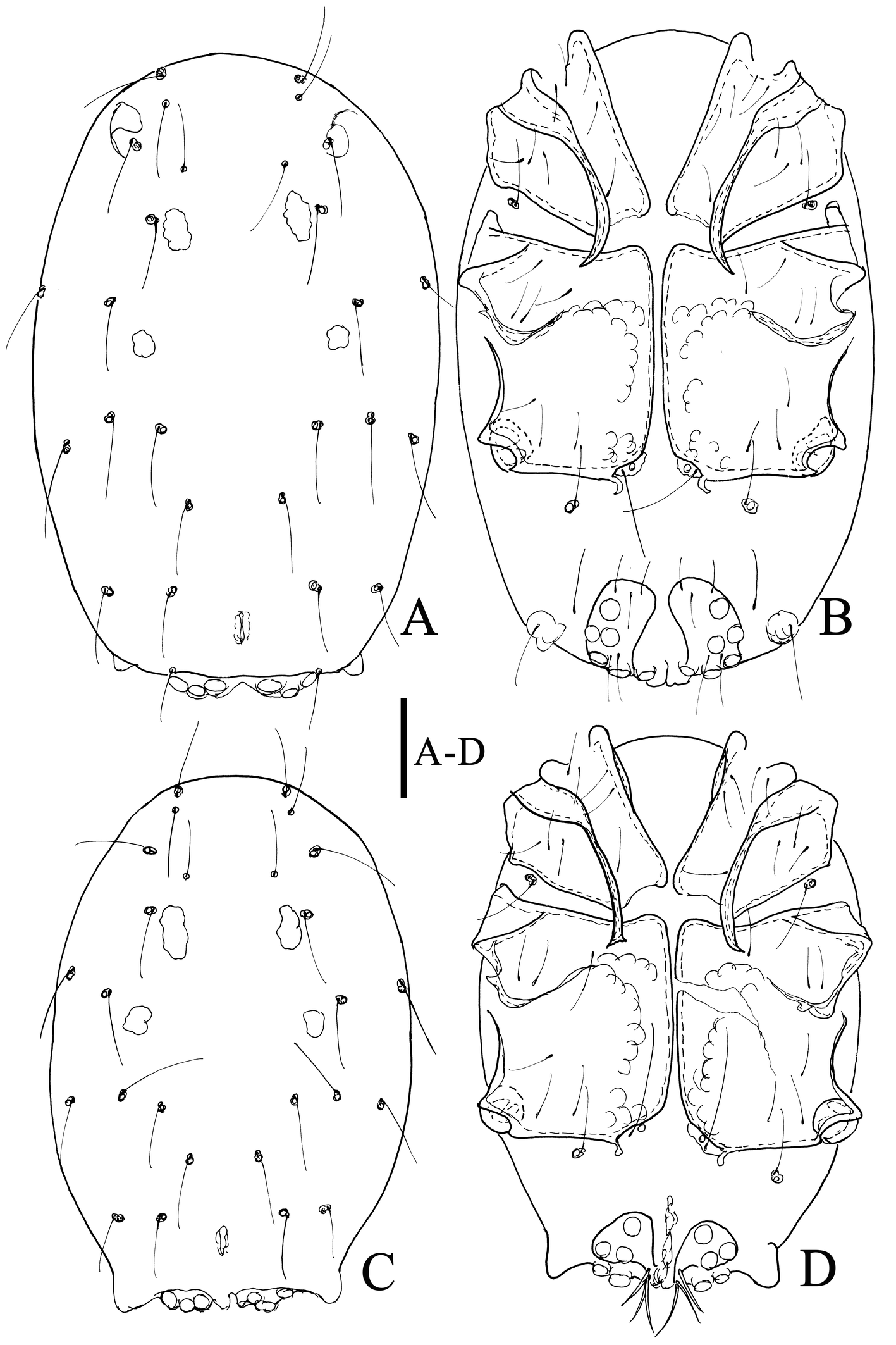
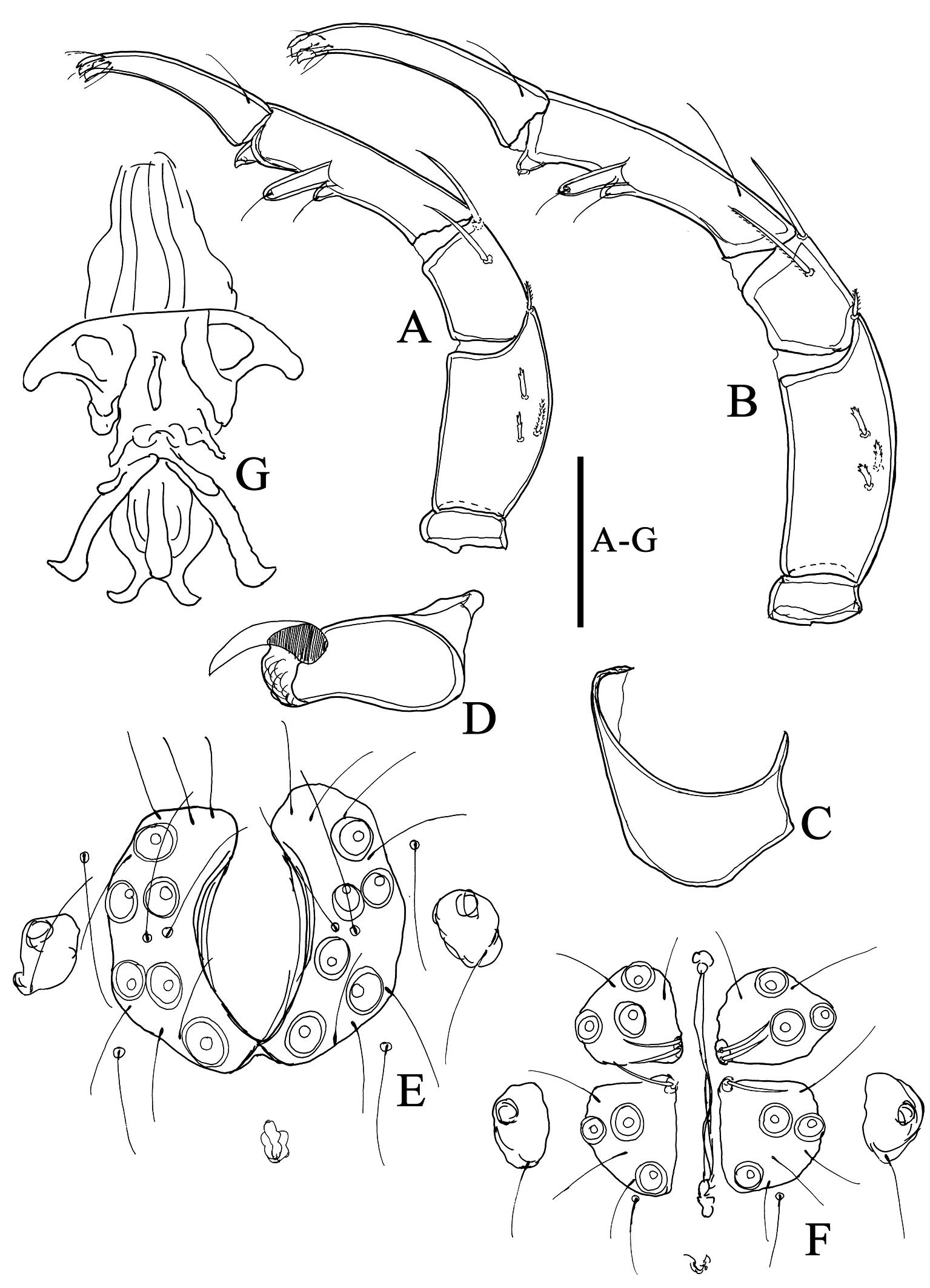
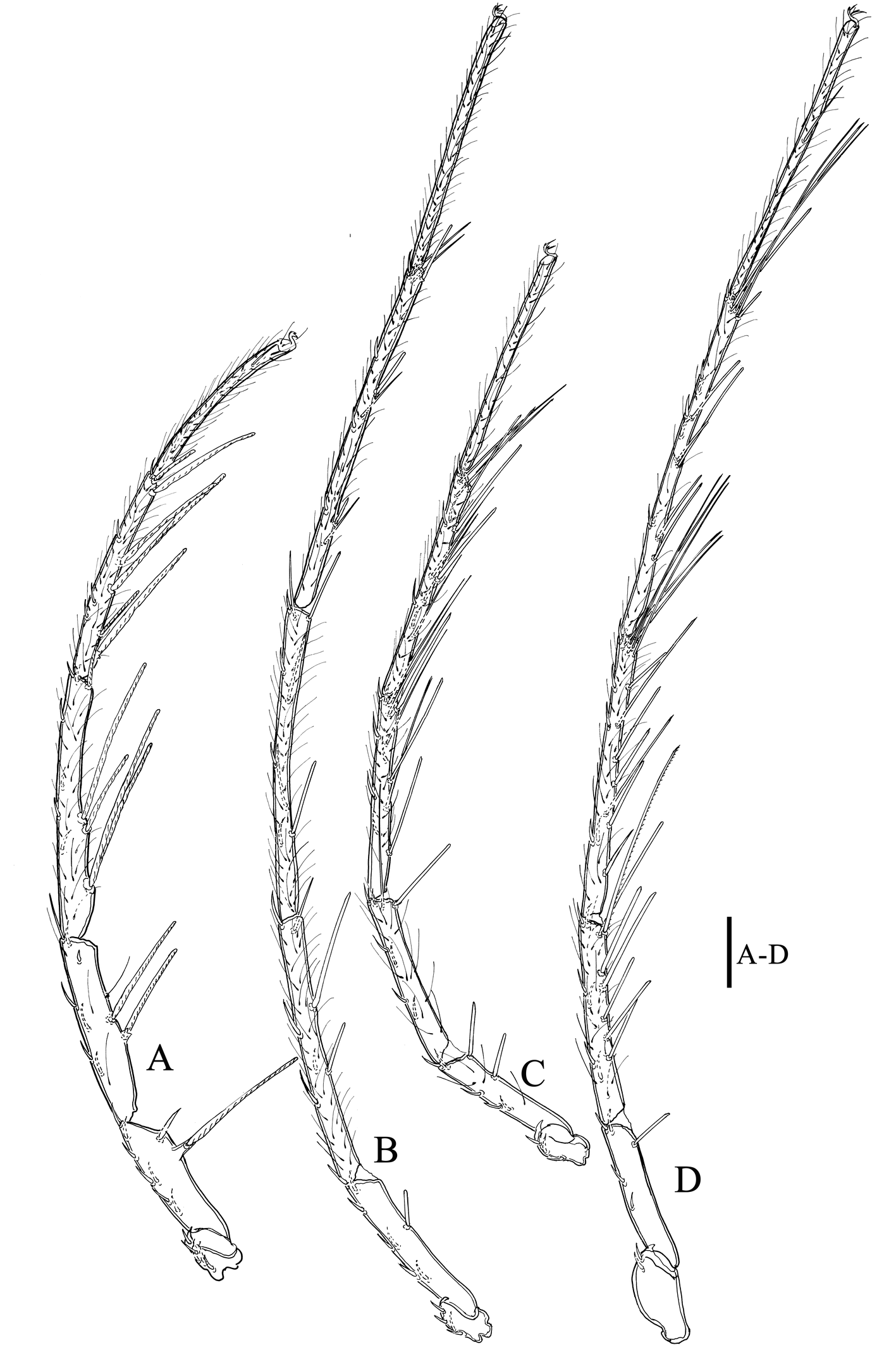
Diagnosis — Idiosoma soft, male and female equal in size. The intermedian distance of Cx-IV close to zero, female coxal group occupies approximately four-fifths of the ventral area. Male palp larger, P-4 with the distal protrusion as long as the ventral one but much smaller than the lateral protrusion, its length-to-width ratio exceeding 4.0. Gnathosoma with the ventral apodeme longer than the dorsal one.
Etymology — The specific epithet is from Latin word: ''aequitas'' means equal, the name of this new species is derived from both sexes are equal in size.
Material examined — Holotype: ♂; slide no. JL-TY-2019072306, Xianghai Township, Tongyu County, Jilin Province, China; 45°0′38.1′′ N, 122°19′32.8′′ E, 185 m a.s.l.; 23 Jul. 2019; Zhu-Hui Ding leg.; GUGC. Paratype: ♀; the same data as the holotype; GUGC.
Description — male: integument smooth and soft, dorsum with two pairs of dorsalia, dorsoglandularia without enlargement, excretory pore weakly sclerotized and situated below a line connecting V2 and L4 (Figure 4A). Coxal plates in four groups, interspace between Cx-II and Cx-III narrow, posterior apodemes of the ACG extend only to the medial side of the anterior margin. of Cx-III, the intermedian distance of Cx-IV close to zero, posterior projection of Cx-IV hook-shaped (Figure 4B). Acetabular plates terminally located, without obvious sclerotized margins. Ac relatively small, usually shorter than the distance between adjacent Ac, and occupy less than half of acetabular plates (Figure 5E).
Palp generally slender and exhibits conspicuous elongation, P-2 with a concave ventral margin, with four similar conical setae laterodorsally. P-3 with two equal setae situated at its lateral and terminally, P-4 with three elongate protrusions on its posteroventral surface, the distal protrusion as long as the ventral one but much smaller than the lateral protrusion and terminating in a beak-shaped tip (Figure 5B). Gnathosoma with the ventral apodeme longer than the dorsal one and its base smooth (Figure 5C). Chelicera with a well-developed claw (Figure 5D). Legs I–IV densely covered by fine setae. I-L-2–6 ventrally each with movable, large, blunt setae. II-L-4, -5 ventrodistally each with a short swimming seta. III-L-3, -4, -5 distally with one, three, three swimming setae, respectively. IV-L-3, -4, -5 with one, three, three swimming setae, respectively. IV-L-6 ventrally with one seta (Figure 6A–D).
Measurements — Male (n = 1): idiosoma L 650, W 457 (L/W ratio 1.42); acetabular plates L 148, W 166 (L/W ratio 0.89). LA 248; LP 257; medial distance between Cx-IV 10. Gnathosoma L 102. Chelicera L 149. Length of ejaculatory complex 173. Lengths of the palp segments (P-1–5): 13, 161, 54, 168, 145. Lengths of I-L-1–6: 91, 190, 275, 391, 321, 281. Lengths of II-L-1–6: 91, 228, 394, 461, 512, 376. Lengths of III-L-1–6: 84, 173, 266, 304, 348, 328. Lengths of IV-L-1–6: 135, 193, 310, 416, 520, 443.
Female: general morphology similar to male, however, the palps shorter than in male (Figure 5A). The coxal plates occupy approximately four-fifths of the ventral surface (Figure 4D). Acetabular plates normal, and with six pairs of Ac, three pairs of stout setae present on the inner side of acetabular plates (Figure 5F).
Measurements — Female (n = 1): idiosoma L 568, W 385 (L/W ratio 1.48); acetabular plates L 110, W 148 (L/W ratio 0.74). LA 236; LP 247; medial distance between Cx-IV 18. Gnathosoma L 103. Chelicera L 150. Length of gonopore 195. Lengths of the palp segments (P-1–5): 19, 127, 55, 140, 111. Lengths of I-L-1–6: 83, 159, 248, 344, 267, 243. Lengths of II-L-1–6: 78, 194, 341, 400, 448, 344. Lengths of III-L-1–6: 82, 150, 237, 282, 339, 291. Lengths of IV-L-1–6: 113, 67, 283, 357, 456, 348.
Remarks — The new species can be distinguished from Unionicola (Hexatax) gracilipalpis (Viets, 1908) by the following characters: (1) U. gracilipalpis has relatively large Ac (whereas smaller in the new species); (2) in U. gracilipalpis, the lateral protrusion of P-4 is short and does not reach the distal protrusion (whereas in the new species the lateral protrusion is elongate and reaches the distal protrusion); and (3) U. gracilipalpis is larger in body size, and the palps of the female are generally longer than in male (whereas the new species is smaller, with relatively longer palps in male).
Compared with Unionicola (Hexatax) tenuis (Lundblad, 1935), which is distributed in Mexico and Haiti, the new species differs in the following respects: (1) U. tenuis possesses larger Ac (whereas they are smaller in the new species); (2) U. tenuis has a wide intermedian distance of Cx-IV (whereas close to zero in the new species); and (3) in U. tenuis, the lateral protrusions of P-4 is short and does not reach the terminal projection (whereas in the new species the lateral protrusions is elongate and reaches the distal protrusion).
Distribution — China (Jilin Province), swamp.
Unionicola (Hexatax) octopodicola sp. nov.
ZOOBANK: D37E9F2B-5A85-4653-8E06-BAF7318D8B9C
(Figures 7–9)
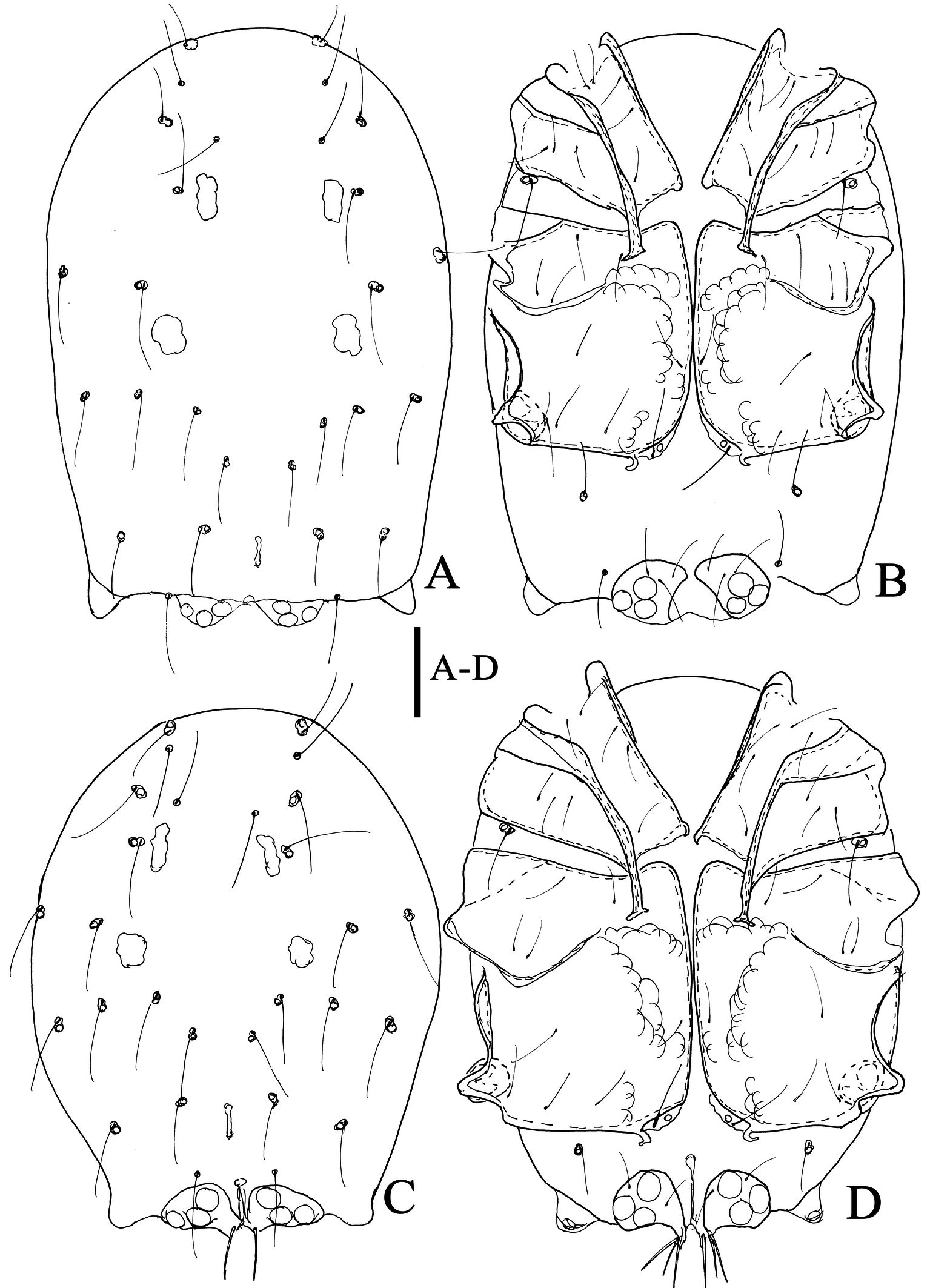
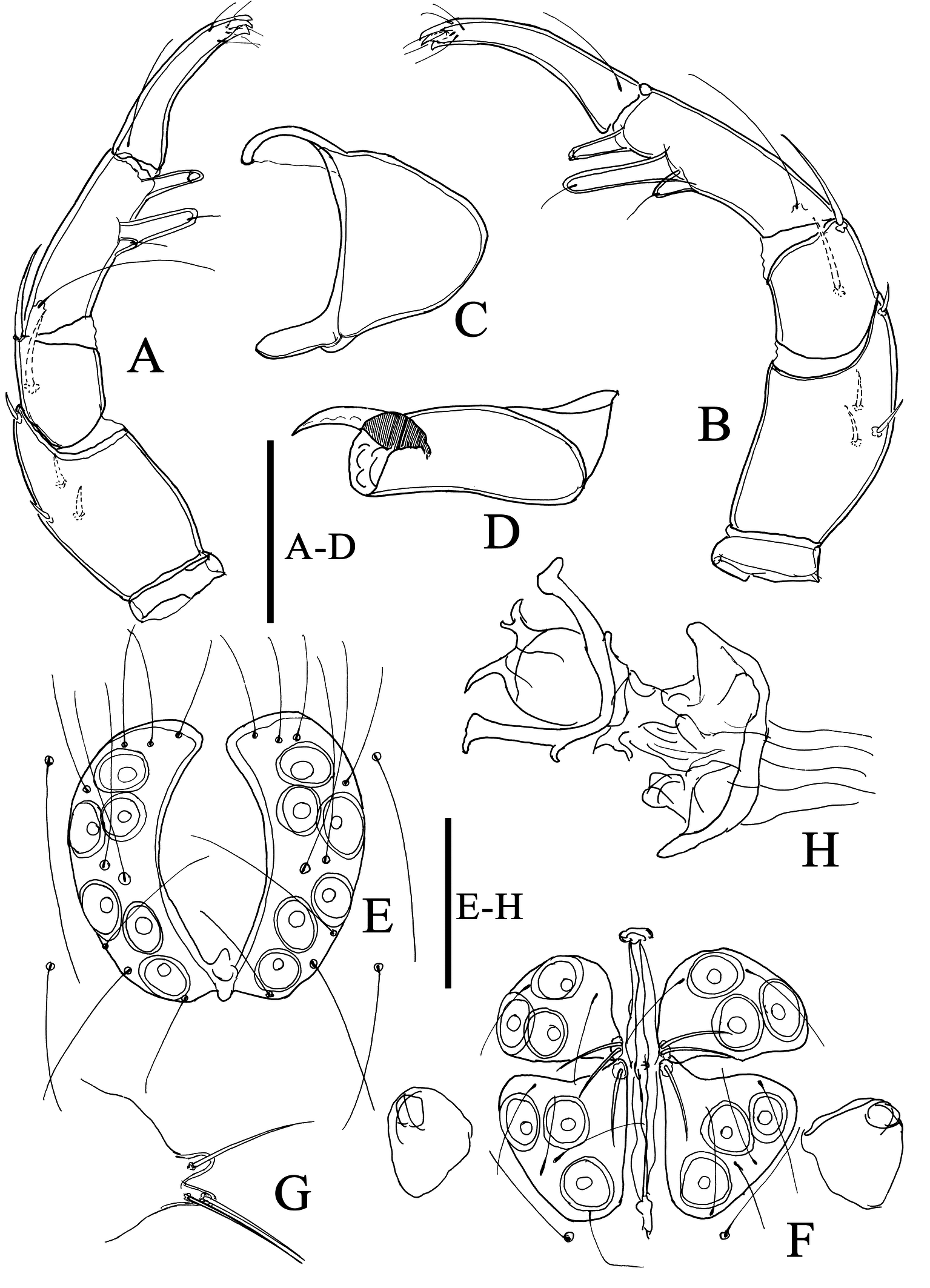
Diagnosis — Idiosoma soft. Excretory pore situated between V2 and L4 , posterior apodemes of ACG extending to about half of Cx-III. P-4 with the lateral protrusion longer than the terminal one and the distal protrusion much longer than the ventral one
Etymology — The specific epithet is from Latin word: ''octopod-'' means octopus, the name of this new species is derived from its short body and four pairs of long, slender legs reminiscent of octopus tentacles.
Material examined — Holotype: ♂; slide no. JL-TY-2019072303, Xianghai Township, Tongyu County, Jilin Province, China; 45°0′38.1′′ N, 122°19′32.8′′ E, 185 m a.s.l.; 23 Jul. 2019; Zhu-Hui Ding leg.; GUGC. Paratypes: 3♂, 1♀; the same data as the holotype; GUGC.
Description — male: integument smooth and soft, dorsum with two pairs of dorsalia, the anterior pair situated medial to the D1 line. Excretory pore weakly sclerotized and situated between V2 and L4 (Figure 7A). Coxal plates in four groups, interspace between Cx-II and Cx-III extreme narrow, posterior apodemes of ACG extending to about half of Cx-III, medial margins of Cx-IV in contact, posterior projection of Cx-IV hook-shaped (Figure 7B). Acetabular plates terminally located and extend dorsally. Ac normal, occupy about three-fourths of acetabular plates (Figure 8E).
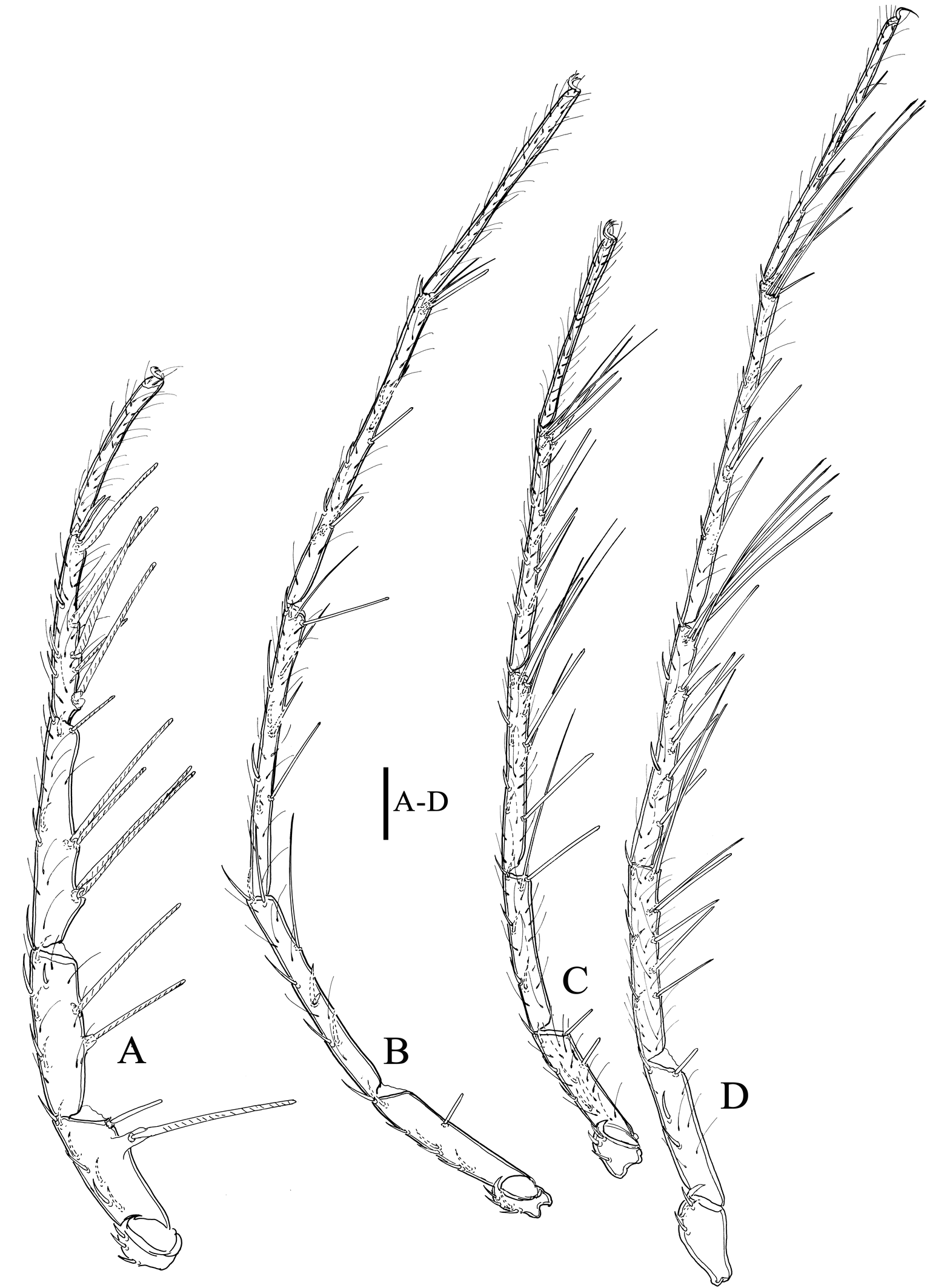
Palp generally slender, venter of P-2 slightly humped. P-3 with two stout setae of equal length, both shorter than P-3, P-4 with three elongate protrusions on its posteroventral surface, the lateral protrusion longer than the terminal one, and the ventral protrusion short and much shorter than the terminal one, with the distal protrusion bearing a blunt projection at its tip (Figure 8B). Dorsal apodeme of gnathosoma lanceolate and as long as ventral apodeme, and the ventral protrusion smooth at its base (Figure 8C). Chelicera with a well-developed claw (Figure 8D). I-L-2–6 ventrally each with movable, large, blunt setae. II-L-4, -5 ventrodistally with one and two short swimming setae, respectively. III-L-3, -4, -5 distally with one, three, three swimming setae, respectively. IV-L-3, -4, -5 with one, three, three swimming setae, respectively. IV-L-6 ventrally with three heavy setae (Figure 9A–D).
Measurements — Male (n = 3): idiosoma L 660–706, W 449–486 (L/W ratio 1.45–1.47); acetabular plates L 140–149, W 172–185 (L/W ratio 0.80–0.87). LA 258–284; LP 272–322; medial distance between Cx-IV 7–10. Gnathosoma L 99–103. Chelicera L 165–180. Length of ejaculatory complex 164–176. Lengths of the palp segments (P-1–5): 24–26, 115–145, 46–48, 113–130, 93–98. Lengths of I-L-1–6: 93–99, 181–197, 250–294, 346–410, 277–302, 257–299. Lengths of II-L-1–6: 79–91, 204–221, 334–381, 423–463, 471–518, 365–400. Lengths of III-L-1–6: 83–87, 161–182, 242–260, 283–314, 361–373, 289–321. Lengths of IV-L-1–6: 138–152, 199–217, 190–322, 358–418, 497–557, 412–465.
Female: general morphology similar to male. The genital field is normal and bears six pairs of Ac. Three pairs of stout setae are present on the inner side of acetabular plates; in anterior view, these setae are short and just reach the Ac closest to the center of acetabular plates. Acetabular plates bear six pairs of fine genital setae (Figure 8F).
Measurements — Female (n = 1): idiosoma L 640, W 493 (L/W ratio 1.30); acetabular plates L 116, W 173 (L/W ratio 0.73). LA 282; LP 325; medial distance between Cx-IV 4. Gnathosoma L 110. Chelicera L 159. Length of gonopore 146. Lengths of the palp segments (P-1–5): 28, 138, 56, 129, 106. Lengths of I-L-1–6: 101, 204, 293, 409, 321, 303. Lengths of II-L-1–6: 91, 235, 385, 489, 546, 408. Lengths of III-L-1–6: 106, 179, 271, 327, 400, 335. Lengths of IV-L-1–6: 172, 225, 326, 413, 558, 486.
Remarks — The new species differs from Unionicola (Hexatax) pollicigera Viets, 1921 (Hevers, 2010), which is distributed in Africa, in the following characters: (1) in U. pollicigera, the ventral protrusion of P-4 is relatively short (whereas slender and elongate in the new species); (2) in U. pollicigera, the setae of P-3 are longer than the length of P-3 (whereas shorter than P-3 in the new species); and (3) in U. pollicigera, the free genital setae of the male are located along the median line of genital field (whereas distributed on the anterolateral part of the genital field in the new species).
Distribution — China (Jilin Province), lake.
Unionicola (Hexatax) nihisetus sp. nov.
ZOOBANK: 6D9A4EA7-5B4F-4B9F-B5E0-34D3D133F3DC
(Figures 10–12)
Diagnosis — Idiosoma soft, integument smooth. Excretory pore weakly sclerotized and aligned only with L4 . P-4 with three well-developed protrusions, the lateral protrusion approximately twice the length of the ventral one. IV-L-2 distally without setae.
Etymology — The specific epithet is from Latin word: ''nihi-'' means none, ''seta'' means hair, the name of this new species is derived from the absence of setae on the ventral surface of IV‑L‑2 in the new species.
Material examined — Holotype: ♂; slide no. JL-FS-2019073003, Changsheng Village, Fusong County, Jilin Province, China; 42°31′4.6′′ N, 127°44′29.9′′ E, 785 m a.s.l.; 30 Jul. 2019; Zhu-Hui Ding leg.; GUGC. Paratypes: 1♂, 1♀; the same data as the holotype; GUGC.
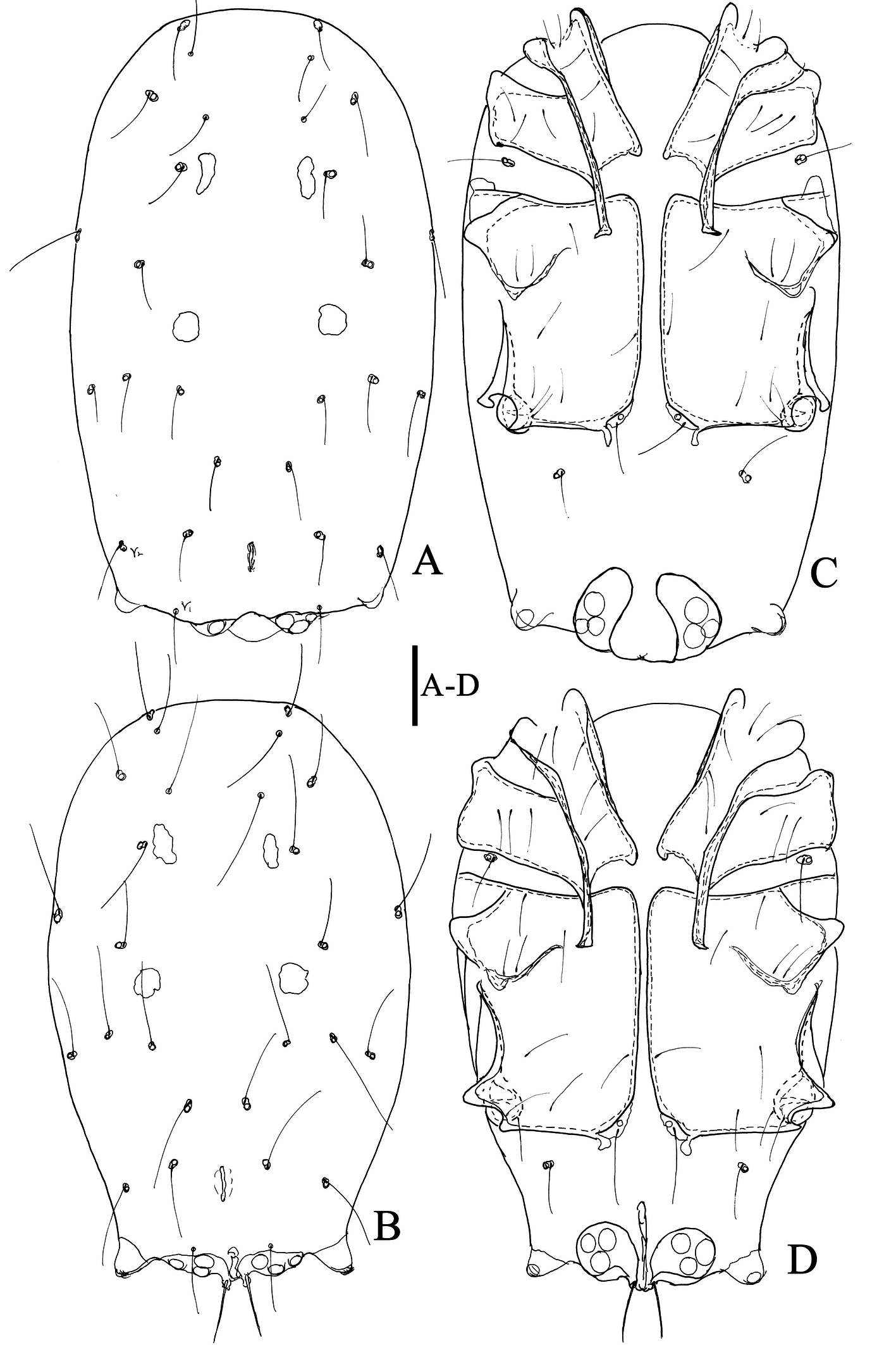
Description — male: integument smooth and soft, dorsum with two pairs of dorsalia. Excretory pore weakly sclerotized and aligned only with L4 (Figure 10A). Coxal plates in four groups, interspace between Cx-II and Cx-III narrow, posterior apodemes of ACG extending to about half of Cx-III, medial margins of Cx-IV narrowly spaced, posterior projection of Cx-IV hook-shaped (Figure 10B). Acetabular plates terminally located and extend dorsally. Ac normal, occupy about half of acetabular plates (Figure 11D).
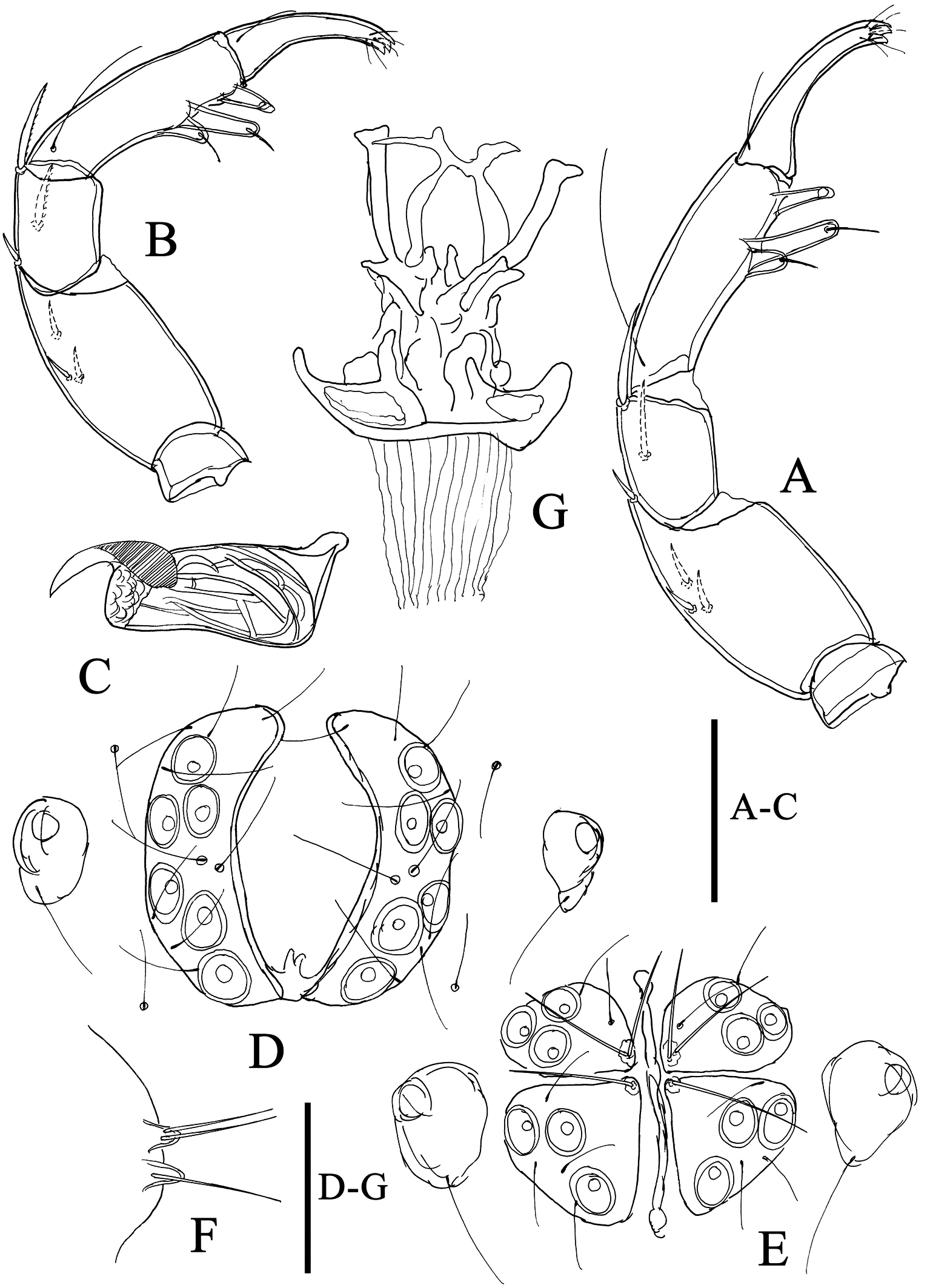
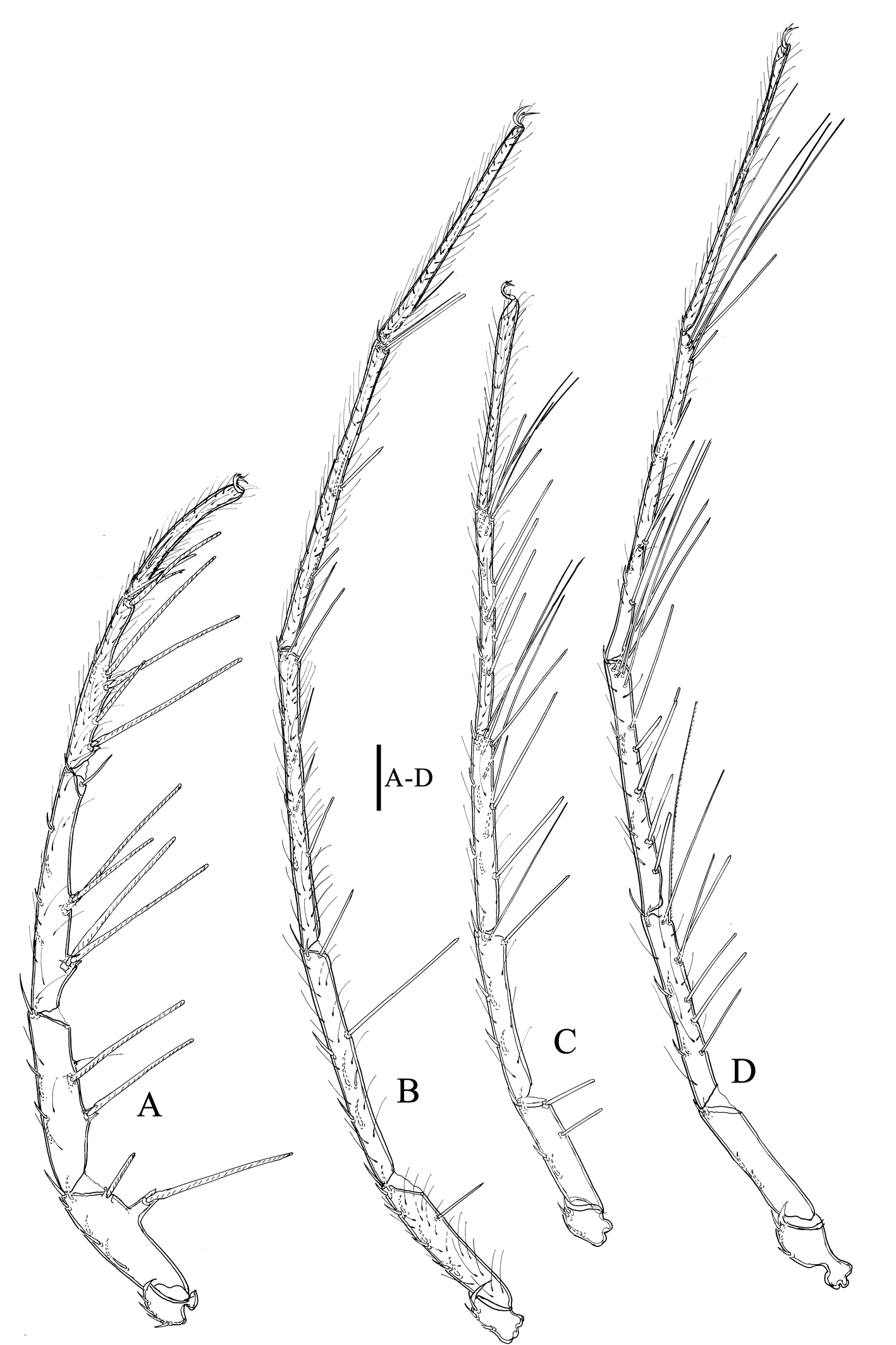
Palp generally slender, venter of P-2 straight. P-3 with two setae, the distal seta longer than the lateral one, P-4 with three elongate protrusions on its posteroventral surface, the lateral protrusion longer than the terminal one, and the distal protrusion longer than the ventral one, with the distal protrusion bearing a blunt projection at its tip (Figure 11B). Chelicera with a well-developed claw and covered by a reticulated pattern (Figure 11C). IV-L-2 distally without setae, IV-L-3, -4, -5 with one, three, three swimming setae, respectively. IV-L-6 ventrally with two heavy setae (Figure 12A–D).
Measurements — Male (n = 3): idiosoma L 677–813, W 482–498 (L/W ratio 1.40–1.63); acetabular plates L 134–154, W 182–187 (L/W ratio 0.74–0.82). LA 296–289; LP 330–334; medial distance between Cx-IV 0–18. Gnathosoma L 149–162. Chelicera L 149–162. Length of ejaculatory complex 190–232. Lengths of the palp segments (P-1–5): 18–28, 119–138, 48–72, 137–139, 84–86. Lengths of I-L-1–6: 76–104, 195–218, 195–302, 386–402, 190–304, 233–238. Lengths of II-L-1–6: 90–93, 221–230, 394–402, 471–476, 505–509, 398–404. Lengths of III-L-1–6: 88–91, 180–182, 273–276, 308–317, 354–363, 318–325. Lengths of IV-L-1–6: 112–145, 202–203, 323–329, 404–410, 540–542, 469–476.
Female: general morphology similar to male. The coxal plates occupy approximately seven-ninths of venter. The genital field is normal and bears six pairs of Ac. Three pairs of stout setae present on the inner side of acetabular plates; the main shafts of these setae relatively short, with the distal portions elongate and hair-like (Figure 11F). The margin of acetabular plates bears six pairs of fine genital setae (Figure 11E).
Measurements — Female (n = 1): idiosoma L 770, W 501 (L/W ratio 1.54); acetabular plates L 142, W 173 (L/W ratio 0.82). LA 337; LP 350; medial distance between Cx-IV 6. Gnathosoma L 132. Chelicera L 170. Length of gonopore 146. Lengths of the palp segments (P-1–5): 23, 145, 50, 147, 97. Lengths of I-L-1–6: 102, 239, 391, 470, 503, 415. Lengths of II-L-1–6: 102, 239, 391, 470, 503, 415. Lengths of III-L-1–6: 101, 193, 288, 326, 392, 352. Lengths of IV-L-1–6: 165, 205, 328, 402, 536, 490.
Remarks — The new species can be readily distinguished from other species in the subgenus by the following combination of characters: 1) the distal part of the venter of IV-L-2 lacks setae (whereas clavate setae are typically present in other species of the subgenus); 2) the large setae in the female genital field terminate in hair-like elongations (in contrast to the evenly tapering setae typically found in congeners).
Distribution — China (Jilin Province), pond.
Subgenus Unionicola s. str. Haldeman, 1842
Unionicola (s. str.) chungeni sp. nov.
ZOOBANK: 0FBF22C2-5BE8-4313-A7BE-80517451D76E
(Figures 13–15)
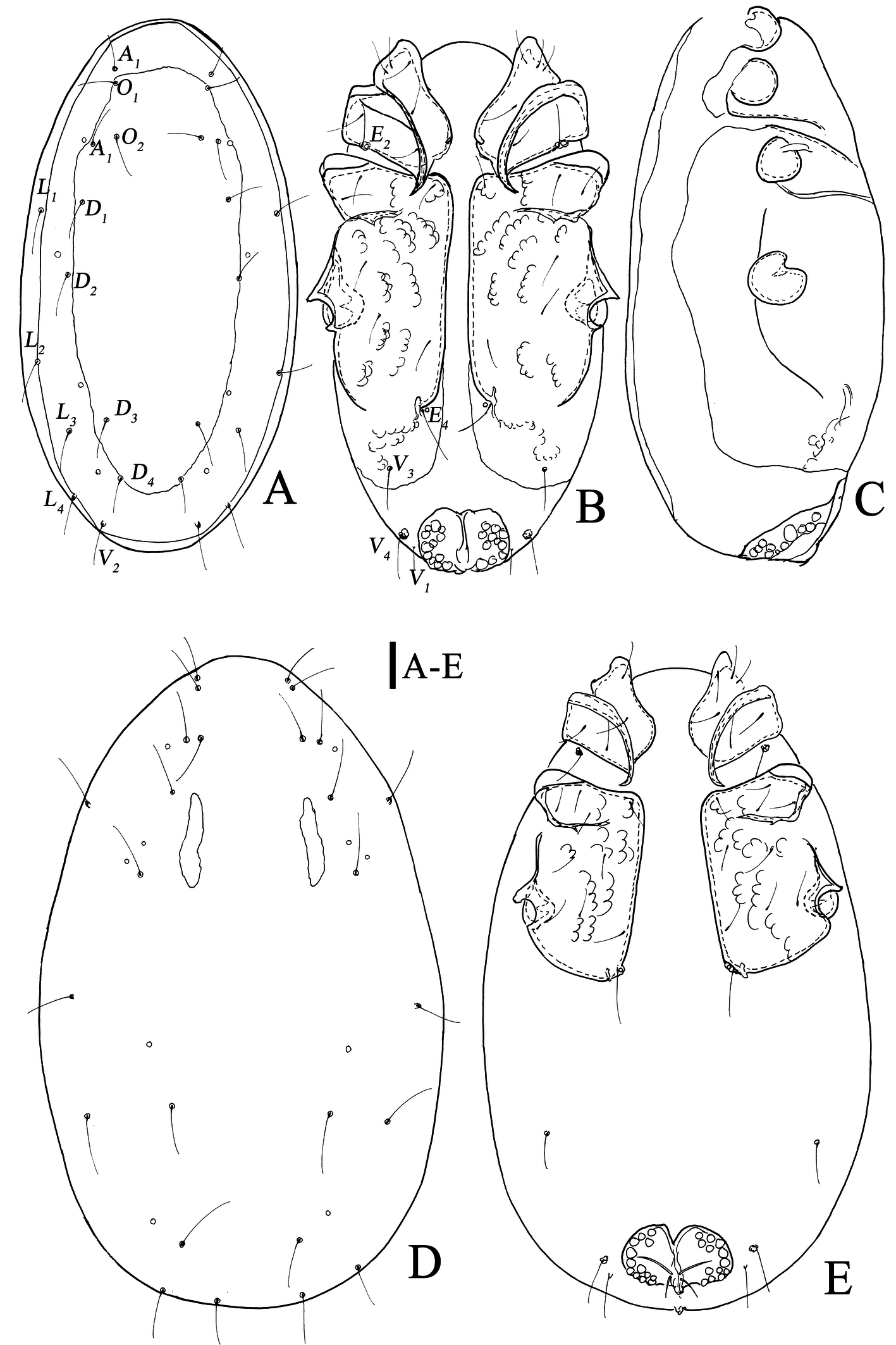
Diagnosis — Males with a large dorsalia, females with a pair of small dorsalia. Females PCG with distinct posterior margin and lacks a conspicuous secondary sclerotized rim. Males PCG with a well-developed, broadly weakly sclerotized border and an indistinct posterior margin. P 3 with the lateral seta slightly longer than the dorsodistal one; P 4 with poorly developed protrusions on its posteroventral surface.
Etymology — The specific epithet is from the Latinized masculine given name ''Chungen'' (Chun-Gen), with the genitive suffix ''-i'' added; The new species is named in honor of Mr. Wen Chun-Gen, who first discovered this species.
Material examined — Holotype: ♂; slide no. JL-FS-2019072901, Changsheng Village, Fusong County, Jilin Province, China; 42°31′4.6′′ N, 127°44′29.9′′ E, 785 m a.s.l.; 29 Jul. 2019; Zhu-Hui Ding leg.; GUGC. Paratypes: 3♂, 4♀; the same data as the holotype; GUGC.
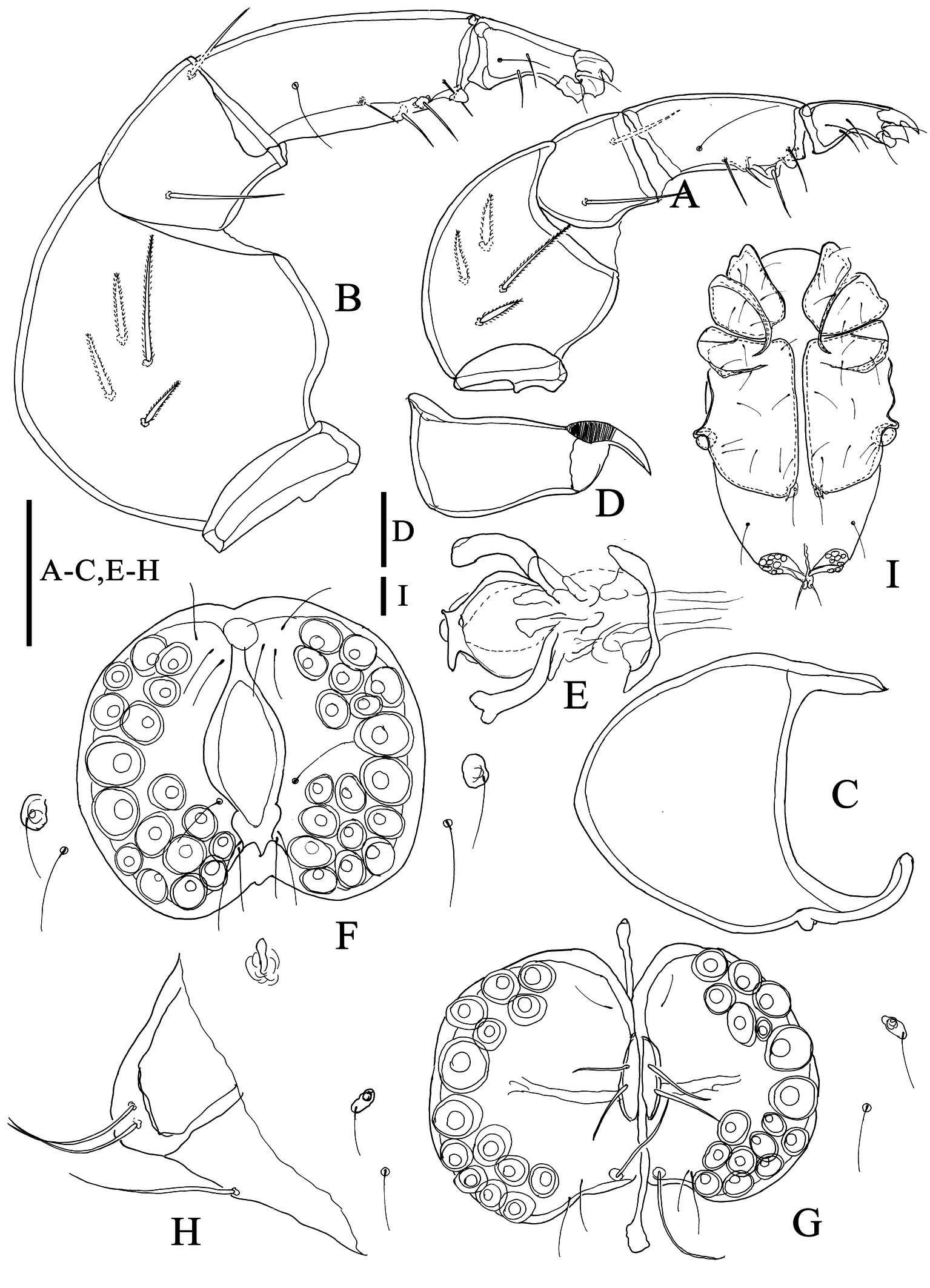
Description — male: idiosoma elongate-oval and soft; glands absent except E2 , E4 , and V4 . Dorsum with a large dorsalia encompassing O1 , A2 , O2 , D1 –D4* (Figure 13A), excretory pore weakly sclerotized and terminally located (Figure 13C). Coxal plates in four groups, suture between Cx-III/IV incomplete, extending approximately half the width of Cx-III; Cx-IV without a conspicuous posterior projection, bearing a hammer-shaped structure near E4* with a notch on its lower extension, its posterior demarcation indistinct and accompanied by an extensive secondary sclerotized margin that encapsulates V3 . Lateral projections of Cx-IIV narrow and pointed (Figure 13B). Acetabular plates terminally located, with a pair of acetabular plates. In lateral view each plate bearing a small, protruding inner lobe medially (Figure 13C), which carries one pair of genital setae, and with three pairs and two pairs of genital setae on its upper and distal portion respectively, and with 18 pairs of Ac; V4 slightly larger than the others and situated along the mid-line of genital field (Figure 14F).
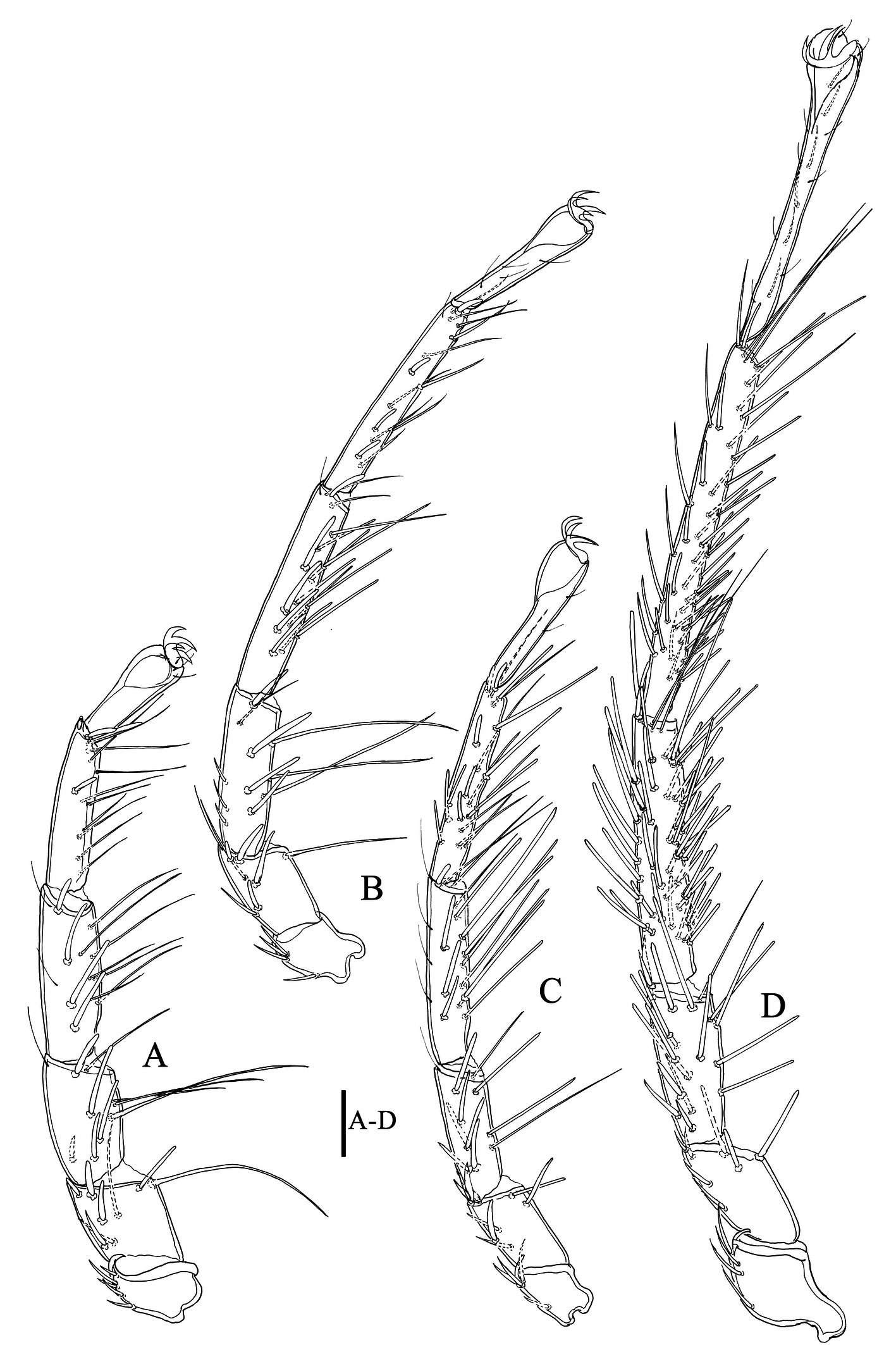
Palp generally stout; P-2 conspicuously inflated, P 3 with the lateral seta slightly longer than the dorsodistal one, P-4 with three poorly developed protrusions, the two near its middle each bearing one stout seta and terminating in a blunt projection, venter of P-5 concave, bearing three slender setae and two stout setae laterally, and distally trigeminal (Figure 14B). Ventral apodeme of gnathosoma longer than dorsal one, curved upward throughout, and bearing a rounded projection at its base; the dorsal apodeme with a broad terminal end (Figure 14C). The chelicera stout and with a well-developed but relatively small claw (Figure 14D). Legs I–IV each with a Y shaped dividing line on segment six, IV-L-3, -4, -5 distally with one, three, three swimming setae, respectively. IV-L-6 ventrally with six setae, legs I–IV each with a pair of rake like claws distally (Figure 15A–D).
Measurements — Male (n = 4): idiosoma L 1069–1267, W 569–701 (L/W ratio 1.81–1.88); acetabular plates L 99–154, W 207–242 (L/W ratio 0.48–0.64). LA 316–336; LP 560–650; medial distance between Cx-IV 8–24. Gnathosoma L 100–153. Chelicera L 283–318. Length of ejaculatory complex 130–146. Lengths of the palp segments (P-1–5): 21–33, 205–253, 96–103, 174–190, 76–90. Lengths of I-L-1–6: 120–141, 125–155, 171–190, 240–267, 232–262, 159–168. Lengths of II-L-1–6: 111–125, 135–173, 216–253, 320–362, 323–345, 238–255. Lengths of III-L-1–6: 115–121, 124–142, 183–232, 269–195, 194–310, 238–250. Lengths of IV-L-1–6: 172–224, 154–182, 250–266, 393–426, 556–607, 485–209.
Female: idiosoma differs slightly from male, dorsum with a pair of elongate small dorsalia situated medial to D1 and D2 (Figure 13D). Cx‑IV with a distinct posterior margin and lacking a thin secondary sclerotized rim laterally (Figure 13E). Genital field with a pair of acetabular plates, Ac closely arranged along both lateral sides, numbering 14–17 pairs (Figure 14G), in lateral view, a large, nearly right‑triangular projecting inner lobe present medially, its summit bearing two pairs of stout setae, and one pair situated on the mid‑posterior slope (Figure 14H); palp generally small (Figure 14A).
In newly emerged adult mites, the idiosoma appears slenderer due to incomplete development, with the coxal group occupying a large area of the venter; posterior apodemes of ACG extend into the middle of Cx-III; interspace between Cx-II and Cx-III very narrowly, and PCG has a narrow medial margin (Figure 14I).
Measurements — Female (n = 4): idiosoma L 1370–1387, W 867–915 (L/W ratio 1.50–1.60); acetabular plates L 139–146, W 271–275 (L/W ratio 0.51–0.54). LA 255–266; LP 447–482; medial distance between Cx-IV 116–157. Gnathosoma L 129–131. Chelicera L 210–239. Length of gonopore 156–160. Lengths of the palp segments (P-1–5): 20–25, 176–207, 54–57, 121–143, 69–79. Lengths of I-L-1–6: 99–115, 107–116, 148–166, 201–203, 188–219, 136–149. Lengths of II-L-1–6: 98–107, 127–139, 217–236, 300–329, 281–302, 217–240. Lengths of III-L-1–6: 108–111, 125–127, 194–217, 271–299, 275–313, 217–234. Lengths of IV-L-1–6: 188–212, 143–166, 250–272, 406–434, 546–576, 463–512.
Remarks —This new species was first collected from the freshwater mussel Sinanodonta woodiana and reported by Wen and Zhu in 1999. However, it was misidentified as Unionicola (s. str.) formosa at that time. U. formosa is widely distributed in North America (Chapurina et al. 2022, Edwards & Vidrine 2013) and shows substantial morphological differences from the new species. Morphologically, the new species belongs to a group of similar mites and is most closely related to Unionicola (s. str.) primoryensis Tuzovskij & Semenchenko, 2015. Nevertheless, it can be reliably distinguished from U. primoryensis by the following features: (1) in U. primoryensis, that dorsal shield covers almost the entire idiosoma in males, whereas it occupies a less extensive area in the new species; (2) the inner margins of Cx-IV are interconnected in U. primoryensis, whereas they are distinctly separated in the new species; and (3) in U. primoryensis, the swimming setae on IV-L-1 and IV-L-2 are short, while those on IV-L-3–5 are long, whereas the exact opposite pattern is observed in the new species.
Distribution — China (Jiangxi Province, Sinanodonta woodiana; Jilin Province, Lakes).
Acknowledgments
The authors are grateful to Dr. Harry Smit (Naturalis Biodiversity Center, Leiden, the Netherlands) for providing research literature. This research was supported by 2025 Basic Research Youth Guiding Project (Qiankehe jichu QN [2025] 206) and Guizhou Provincial Basic Research Program (General Project), 2026 (Qiankehe jichu MS [2026] 006).
References
- Chapurina Y.E., Konopleva E.S., Vidrine M.F., Vikhrev I.V., Lunn Z., Chan N., Win T., Kondakov A.V., Zubri N.A., Bespalaya Y.V., Aksenova O.V., Gofarov M.Y., Bolotov I.N. 2022. New molecular-based phylogeny of mussel-associated mites reveals a new subgenus and three new species representing an example of a host-driven radiation in Indochina and confirms the concept of division of the genus Unionicola Haldeman, 1842 (Acari: Unionicolidae) into numerous subgenera. Diversity, 14, 848. https://doi.org/10.3390/d14100848
- Ding Z.H., Jin D.C., Guo J.J., Yi T.C. 2019. Three new species of the subgenus Unionicola Haldeman, 1842 (Acari, Hydrachnidia, Unionicolidae) from Guizhou, China. Zootaxa, 4658(1): 141-154. https://doi.org/10.11646/zootaxa.4658.1.6
- Ding Z.H., Jin D.C., Guo J.J., Yi T.C. 2024. Three new subgenera of the genus Unionicola Haldeman, 1842 (Acari, Hydrachnidia, Unionicolidae) from China. Int. J. Acarol., 50(2): 129-142. https://doi.org/10.1080/01647954.2024.2305285
- Edwards D.D., Vidrine M.F. 2013. Mites of freshwater mollusks. LA: Eunice. M.F. Vidrine. pp. 1-331.
- Gu X.Y., Li H.T., Jin D.C., Guo J.J. 2021. Collection and preservation of water mites and preparation of slide specimens. Bio-101e1010676. (in Chinese). https://doi.org/10.21769/BioProtoc.1010676
- Jin D.C. 1997. Hydrachnellae - morphology, systematics. A primary study of Chinese fauna. Guiyang: Guizhou Sci. Technol. Press. pp. 1-356. (in Chinese with abstract of taxonomy in English)
- Smit H. 2020. Water mites of the world, with keys to the families, subfamilies, genera and subgenera (Acari: Hydrachnidia). Leiden: Monogr. Ned. Entomol. Ver., 12. pp. 1-774.
- Uchida T. 1941. Water mites from Manchoukuo. Bull. Biogeogr. Soc. Japan, 11(15): 117-119.
- Uchida T, Imamura T. 1951. Some water mites from China. J. Fac. Sci. Hokkaido Univ. Ser. VI Zool., 10(3-4): 324-358.
- Valdecasas A.G. 2022. A cautionary note on linear measurements and their ratios in taxonomy. Taxonomy, 3(1): 1-9. https://doi.org/10.3390/taxonomy3010001
- Viets K. 1938. Über einige wassermilben aus China. Zool. Anz., 124: 286-287.
- Vidrine M.F., Joubert D., Thomas L.B., Bogan A.E., Wu X.P. 2008. Unionicola (Wolcottatax) weni n. sp. and U. (Wolcottatax) arcuatoides Vidrine (Acari: Unionicolidae) from freshwater mussels in China. Int. J. Acarol., 34(4): 389-392. https://doi.org/10.1080/17088180809434782
- Wen C.G., Zhu Z.M. 1996. One new species and one unrecorded species of water mites from China (Acari: Hydrachneliae: Unionicolidae). Acta Arachnol. Sin., 5(2): 91-95. (in Chinese with abstract of taxonomy in English)
- Wen C.G., Zhu Z.M., Xia B. 1998. Description of a new species of the genus Unionicola from China (Acari: Unionicolidae). Acta Arachnol. Sin., 7(1): 2-4. (in Chinese with abstract of taxonomy in English)
- Wen C.G., Zhu Z.M. 1998. A new species of the genus Unionicola from China (Acari: Unionicolidae). Syst. Appl. Acarol., 3: 171-174. https://doi.org/10.11158/saa.3.1.26
- Wen C.G., Zhu Z.M. 1999. Seven species of water mites in the genus Unionicola from Jiangxi (Acari: Unionicolidae). Acta Zootaxon. Sin., 7(1): 2-4. (in Chinese with abstract of taxonomy in English)
- Wen C.G., Gao Q., Zhu Z.M. 2005. Seven species of water mites in the genus Unionicola from Jiangxi (Acari: Unionicolidae). Acta Zootaxon. Sin., 30(3): 535-537. (in Chinese with abstract of taxonomy in English)
- Wen C.G., Wu H. B., Zhu Z.M. 2008a. A new species of water mites in the genus Unionicola (Acari: Unionicolidae) from China. Acta Arachnol. Sin., 17(1): 10-12. (in Chinese with abstract of taxonomy in English)
- Wen C.G., Hu B.Y., Zhu Z.Z. 2008b. A new subgenus Vidrinatax (Acari: Unionicolidae: Unionicola) with description of two new species of water mites in the genus Unionicola from China. Acarologia, 53(4): 383-415.
- Zhang Z.Q. 2018. Repositories for mite and tick specimens: acronyms and their nomenclature. Syst. Appl. Acarol., 23(12): 2432-2446. https://doi.org/10.11158/saa.23.12.12
to post any comment or correction.


2026-02-04
Date accepted:
2026-04-10
Date published:
2026-04-16
Edited by:
Mąkol, Joanna

This work is licensed under a Creative Commons Attribution 4.0 International License
2026 Ding, Zhu-Hui; Yi, Tian-Ci; Guo, Jian-Jun and Jin, Dao-Chao
 Download article Download low definition
Download the citation
RIS with abstract
(Zotero, Endnote, Reference Manager, ProCite, RefWorks, Mendeley)
RIS without abstract
BIB
(Zotero, BibTeX)
TXT
(PubMed, Txt)