


Annotated translation of two papers on Mesostigmata from the Democratic People's Republic of Korea
Oh, Jaeseok  1
; Lee, Seunghwan
2
and Halliday, Bruce
3
1
; Lee, Seunghwan
2
and Halliday, Bruce
3
1Laboratory of Insect Biosystematics, Department of Agricultural Biotechnology, Seoul National University, Gwanak-ro 599, Gwanak-gu, Seoul, 151-742, Korea.
2✉ Laboratory of Insect Biosystematics, Department of Agricultural Biotechnology, Seoul National University, Gwanak-ro 599, Gwanak-gu, Seoul, 151-742, Korea & Research Institute of Agriculture and Life Sciences, Seoul National University, Gwanak-ro 599, Gwanak-gu, Seoul, 151-742, Korea.
3Australian National Insect Collection, CSIRO, Canberra, Australia.
2026 - Volume: 66 Issue: 1 pages: 224-262
https://doi.org/10.24349/sm3q-ucuuReview
Keywords
Abstract
Introduction
Since 1953, the Korean Peninsula has been divided politically into the Democratic People's Republic of Korea (North Korea, DPRK) and the Republic of Korea (South Korea, ROK). The known fauna of the whole Korean Peninsula is documented in the National Species List of Korea (NSLK) (NIBR 2024) which is updated annually. It includes information derived from literature surveys, collaboration with foreign researchers, and study of DPRK specimens that were deposited in foreign museums (Athias-Henriot 1977; Błaszak 1976a, 1976b,1976c; Kontschán et al. 2012, 2014). The NSLK currently contains 335 species of mites in the Suborder Mesostigmata, placed in 115 genera and 34 families (NIBR 2024), including 72 species with collection records from DPRK (NIBR 2019). However, the available taxonomic information from the DPRK remains very incomplete because it has been difficult to obtain copies of the relevant literature. We recently obtained copies of three important publications on the mite fauna of DPRK. In this paper we present translations of those papers, and discuss the taxonomic and nomenclatural validity of the listed species. Our purpose is to make this information more readily accessible so it can be incorporated into systematic studies of the relevant families of mites.
Materials and methods
We examined two papers published in the journal Saengmurhak (or Saengmulhak), which may be translated as Biology. It is published in Pyongyang by the Kwahak Paekkwa Sajeon Chulpansa (Science and Encyclopedia Publishing House). Information about the journal is available in Mercado (2025). The papers by Seo (1966) and Seo and Che (1966) present data on 50 species of Mesostigmata, including descriptions of 19 new species and four new genera. In the third publication, Seo (1983) reviews the mite fauna of DPRK, including data on 10 species of Ixodida, 59 species of Mesostigmata, 39 species of Trombidiformes, and 6 species of Sarcoptiformes.
In the translation procedure, we referred to the Standard Korean Language Dictionary (https://stdict.korean.go.kr  ) for unfamiliar Korean words that were derived from cultural features of the DPRK, which do not use English words. Text translated from Seo (1966), Seo and Che (1966), and Seo (1983) is enclosed by quotation marks below.
We have not reproduced the complete list of references from Seo (1966) and Seo and Che (1966), but only the references necessary to identify the species mentioned in the text.
Many of the taxa discussed here have names followed by the notation ''sp. nov.'' or ''gen. nov.'' Those notations refer to names in Seo (1966) and Seo and Che (1966), and do not indicate the description of any new taxa in this publication.
The illustrations are taken from scanned copies of the original journals. We acknowledge the regrettable variation in their quality, but they are the best versions available to us. We reproduce them here in unedited form to avoid any mistakes in interpretation of the original author's intent. If any, the captions have been re-typed, with the original figure numbers. The tables were also reproduced in digital form without any arbitrary changes. We do not provide explanations for the column headings in the tables since the authors did not provide them in the original papers. Table 4 is new and summarises the status of all the species that are discussed below.
Some scientific names are spelled incorrectly in Seo (1966), Seo and Che (1966), and Seo (1983). Those names are reproduced here verbatim with an added asterisk *.
Review of Seo (1966), Species composition of mites (Gamasoidea) in Korea (Part I)
The first paper (Seo 1966) presents information on 50 species of Mesostigmata, with details of their collecting localities and relative abundance, and their associations with vertebrate hosts. We have not attempted a complete translation of this paper. The information relevant to the host associations and geographic occurrence of the species, their taxonomic placement, and the nomenclatural status of their names, is repeated in the second paper (Seo and Che 1966), and is included in our treatment of that paper below.
The species listed in Seo (1966) include 26 species previously described by other authors, five species identified only to the family level, and 19 species referred to as new. Those 19 new species names are not accompanied by any descriptive information, so they are nomina nuda in that paper. Ten of the species listed in Seo (1966) are not included in Seo and Che (1966). The information summarised here for these ten species was extracted from Tables 2 and 3 in Seo (1966), with our comments added under the heading Notes.
''Haemolaelaps glasgowi (Ewing, 1925)
Hosts: Rattus norvegicus; Mus musculus; Micromys minutus; Cricetulus triton; Apodemus sp.; Microtus fortis; Crocidura suaveolens; Talpa micrura; Apodemus agrarius; etc.''
Notes — This name is now considered as a synonym of Androlaelaps fahrenholzi (Berlese, 1911) (see Moraes et al. 2022). Seo (1983, page 101) includes an illustrated diagnosis of this species.
''Eulaelaps stabularis (C.L. Koch, 1836)
Hosts: Rattus norvegicus; Mus musculus; Micromys minutus; Cricetulus triton; Apodemus sp.; Microtus fortis; Crocidura suaveolens; Talpa micrura; Apodemus agrarius; etc.''
Notes — The host range and distribution of this species were reviewed by Vinarski and Korallo-Vinarskaya (2017). The correct date of publication of the original description is C.L. Koch, 1840 (Nagel and Grieder 2019). Seo (1983, page 111) includes an illustrated diagnosis of this species.
''Laelaps echidninus Berlese, 1887
Hosts: Rodent nest.''
Notes — The host range and distribution of this species were reviewed by Vinarski and Korallo-Vinarskaya (2016). Seo (1983, page 120) includes an illustrated diagnosis of this species. Its original description is in Berlese (1887).
''Laelaps nuttalli Hirst, 1915
Hosts: Rattus norvegicus; Mus musculus; etc.''
Notes — The host range and distribution of this species were reviewed by Vinarski and Korallo-Vinarskaya (2016). Seo (1983, 122) includes an illustrated diagnosis of this species.
''Laelaps clethrionomydis Lange, 1955
Hosts: Cricetulus triton; Microtus fortis; Apodemus agrarius.''
Notes — The host range and distribution of this species were reviewed by Vinarski and Korallo-Vinarskaya (2016). Seo (1983, page 124) includes an illustrated diagnosis of this species.
''Oryctolaelaps bibikovae Lange, 1955
Hosts: Talpa micrura; Apodemus agrarius.''
Notes — The host range and distribution of this species were reviewed by Vinarski and Korallo-Vinarskaya (2016). Seo (1983, page 131) includes an illustrated diagnosis of this species.
''Hirstionyssus isabellinus Oudemans, 1913
Hosts: Rattus norvegicus; Mus musculus; Apodemus sp.; Microtus fortis; Crocidura suaveolens; Apodemus agrarius.''
Notes — The host range and distribution of this species were reviewed by Vinarski and Korallo-Vinarskaya (2020). Authorship of its name should be shown as Hirstionyssus isabellinus (Oudemans, 1913). Seo (1983, page 135) includes an illustrated diagnosis of this species.
''Ornithonyssus bacoti (Hirst, 1913)
Hosts: Rattus norvegicus; Mus musculus; Micromys minutus; Crocidura suaveolens; Apodemus agrarius.''
Notes — The host range and medical importance of this species were reviewed by Beck (2008) and Dumitrache et al. (2023). Seo (1983, page 149) includes an illustrated diagnosis of this species.
''Dermanyssus gallinae (Redi, 1674)
Hosts: Birds.''
Notes — The host range and distribution of this species were reviewed by Sparagano et al. (2014). Its authorship should be shown as Dermanyssus gallinae (de Geer, 1778). Seo (1983, page 158) includes an illustrated diagnosis of this species.
''Spinturnix vespertilionis L.
Hosts: Bats.''
Notes — This citation appears to refer to a species originally described as Pediculus vespertilionis Linnaeus, 1758, page 611. This name is the subject of great nomenclatural and taxonomic confusion and has been formally invalidated. According to the ICZN (1936), S. myoti (Kolenati, 1856) was designated as the type species of Spinturnix, and the specific name ''vespertilionis'' was invalidated for this and several other genera (Stiles 1929; Musgrave 1930; ICZN 1936). Seo (1983, page 163) includes an illustrated diagnosis of this species, but the authorship of its name is incorrectly cited as Linnaeus, 1862.
Review of Seo and Che (1966), Species composition of mites (Gamasoidea) in Korea (Part II)
The second paper (Seo and Che 1966) adds more information about 40 of the previously described species listed in Seo (1966), and adds descriptions of the new genera and species. The paper begins with a brief introduction followed by a numbered list of 21 previously known species newly recorded from Korea, and descriptions of 19 new species. Each species is accompanied by information about the number of specimens collected, the collecting localities, and two numbers (in parentheses) that appear to show the year and month of each collection, for example, (1962, 4). For each species, we present the heading reproduced verbatim, and an English translation of the data in Seo and Che (1966), followed by a section headed Notes, with our interpretation of the taxonomic and nomenclatural status of the species.
''Introduction
In this study, detailed descriptions are only provided for new genera and new species, not for the newly recorded species, while Korean common names were provided for all.
I. Newly recorded Gamasoidea in Korea
1. Eugamasus oudemansi Berlese, 1903
Collected: 9 individuals.
Host: nest of wild rat.
Collection site: Pyeonggang-gun (1962, 4), Wonsan-si (1960, 4).''
Notes — Collecting details appear in Seo (1966, page 28) and Seo and Che (1966, page 28). The species was originally described as Gamasus (Eugamasus) oudemansi Berlese, 1904. It is currently placed in the Parasitidae as Vulgarogamasus oudemansi (Berlese, 1904) (see Hyatt 1980). Seo (1983, page 49) includes an illustrated diagnosis of this species.
''2. Eurypasitus emarginatus (C.L. Koch, 1839) (= Gamasus emarginatus C.L. Koch, 1839 = G. terribilis Michael, 1886 = Euryparasitus terribilis Oudemans, 1903; Tragardh, 1912; Heselhaus, 1913 = E. emarginatus Oudemans, 1913)
Collected: 32 individuals.
Host: Nest of Apodemus agrarius.
Collection site: Gimhwa-gun (1959, 10), Wonsan-si (1960, 2), Jungju-si (1964, 9, 10).''
Notes — Collecting details appear in Seo (1966, page 29) and Seo and Che (1966, page 28). The genus name in the paragraph heading in Seo and Che (1966) is spelled incorrectly as Eurypasitus. Seo (1966) and Seo (1983) placed Euryparasitus in the Ascidae, but in modern classifications it is placed in the Ologamasidae (Castilho et al. 2016). The paper cited as Heselhaus (1913) actually refers to Heselhaus and Sittard (1913). Seo (1983, page 55) includes an illustrated diagnosis of this species.
''3. Macrocheles glaver* (Müll.), 1860. [(= Holostaspis glaver* Müll., 1860; = Gamasus stercorarius Kramer, 1876; = H. badius Berlese, 1889; = H. marginatus var littoralis Halbert, 1915; = Macrocheles (Coprholaspis) glaver* Berlese, 1921; = M. veterrimus Sellnick, 1940; = C. glaver* Vitzthum, 1941; = C. anglicus Turk, 1946; = M. veterrimus Leitner, 1946; = C. glaver* Schweizer, 1949; = M. stercorarius Sellnick, 1955; = M. glaver* Evans, 1956)]
Collected: 11 individuals.
Host: Mus musculus, Apodemus agrarius, Cricetulus triton, Crocidura lasiura, Nyctalus noctula.
Collection site: Pyeonggang-gun (1962, 8, 9), Haeju-si (1964, 8), Jangpung-gun (1964, 9), Wonsan-si (1964, 8), Sangwon-gun (1962, 2).''
Notes — Collecting details appear in Seo (1966, page 29) and Seo and Che (1966, page 28). The taxa referred to in the synonymy are Macrocheles glaber (Müller, 1860) (= Holostaspis glaber Müller, 1860); Gamasus stercorarius Kramer, 1876; Holostaspis badius Koch as cited by Berlese (1889); Holostaspis marginatus (Hermann) var. littoralis Halbert, 1915; Macrocheles (Coprholaspis) glaber (Müller) as cited by Berlese (1921); Macrocheles veterrimus Sellnick, 1940; Coprholaspis glabra Müller as cited by Vitzthum (1942); Coprholaspis anglicus Turk, 1945; Macrocheles veterrimus Sellnick as cited by Leitner, (1946); Coprholaspis glaber (Müller) as cited by Schweizer (1949); M. stercorarius (Kramer) as cited by Sellnick (1955); Macrocheles glaber (Müller) as cited by Evans and Browning (1956). Seo (1983, page 60) includes an illustrated diagnosis of this species. The synonymies and identifications proposed by Seo and Che (1966) are consistent with those in Evans and Browning (1956).
''4. Macrocheles nataliae Breg. et Korol., 1960
Collected: 2 individuals.
Host: Apodemus agrarius.
Collection site: Haeju-si (1964, 9).''
Notes — Collecting details appear in Seo (1966, page 29) and Seo and Che (1966, page 28). The species was described as Macrocheles nataliae Bregetova & Koroleva, 1960. Seo (1983, page 66) includes an illustrated diagnosis of this species.
''5. Phytoseiidae Gen. sp. (I)
Collected: 41 individuals.
Host: Rattus norvegicus, Apodemus agrarius, Microtus fortis, nest of wild rat, nest of Apodemus agrarius.
Collection site: Haeju-si (1964, 6, 7), Jungju-si (1964, 6, 10), Hamheung-si (1964, 4, 8, 9, 10), Wonsan-si (1960, 3, 1964, 9, 11).''
Notes — An unidentified species placed in Phytoseiidae by Seo (1966, page 29) and Seo and Che (1966, page 28). This species was re-identified as Cheylephytoseus koreicus Seo, 1966 by Seo (1983, page 72). Those two species were recognised as conspecific based on the fact that Phytoseiidae gen. sp. (I) and C. koreicus have the same Korean common name in all papers.
''6. Phytoseiidae Gen. sp. (II)
Collected: 8 individuals.
Host: Rattus norvegicus, Apodemus agrarius.
Collection site: Pyeonggang-gun (1964, 4), Haeju-si (1964, 7).''
Notes — An unidentified species placed in Phytoseiidae by Seo (1966, page 29) and Seo and Che (1966, page 28). This species was re-identified as Phytoseus* koreicus Seo, 1966 by Seo (1983, page 71). These two species were recognised as conspecific based on the fact that Phytoseiidae gen. sp. (II) and P. koreicus have the same Korean common name in all papers.
''7. Phytoseiidae Gen. sp. (III)
Collected: 9 individuals.
Host: Rattus norvegicus, Apodemus agrarius.
Collection site: Hamheung-si (1964, 5), Wonsan-si (1964, 9).''
Notes — An unidentified species placed in Phytoseiidae by Seo (1966, page 29) and Seo and Che (1966, page 28).
''8. Phytoseiidae Gen. sp. (IV)
Collected: 1 individual.
Host: nest of Apodemus agrarius.
Collection site: Jungju-si (1964, 9).''
Notes — An unidentified species placed in Phytoseiidae by Seo (1966, page 29) and Seo and Che (1966, page 29).
''9. Phytoseiidae Gen. sp. (V)
Collected: 1 individual.
Host: Apodemus agrarius.
Collection site: Jangheung (1964, 10).''
Notes — An unidentified species placed in Phytoseiidae by Seo (1966, page 29) and Seo and Che (1966, page 29).
''10. Haemogamasus dauricus Bregetova, 1950
Collected: 315 individuals.
Host: Rattus norvegicus, Mus musculus, Apodemus agrarius, Micromys minutus, Microtus fortis, Cricetulus triton, Crocidura lasiura thomasi, Crocidura lasiura.
Collection site: Gaesung-si (1959), Gimhwa-gun (1959), Pyeonggang-gun (1961-1964), Wonsan-si (1960, 1964), Jangheung (1964), Onsung-gun, Hwangpa, Dokso (1963), Cheolwon-gun (1963), Jungju-si (1964).''
Notes — Collecting details appear in Seo (1966, page 29) and Seo and Che (1966, page 29). Seo (1966) and Seo (1983) placed Haemogamasus in the Haemogamasidae. However, Haemogamasidae is often treated as a subfamily of Laelapidae in current taxonomy (Krantz and Walter 2009; Moraes et al. 2022). Vinarski and Korallo-Vinarskaya (2017) placed Haemogamasus in the Haemogamasidae and provided a detailed synonymy of H. dauricus. Seo (1983, page 80) includes an illustrated diagnosis of this species.
''11. Haemogamasus serdjukovae Bregetova, 1949 (Euhamogamasus serdjukovae Bregetova, 1949)
Collected: 113 individuals.
Host: Rattus norvegicus, Apodemus agrarius, Cricetulus triton, Crocidura lasiura thomasi, Microtus fortis, Crocidura lasiura, Talpa micrura coreana.
Collection site: Gimhwa-gun (1959), Cheolwon-gun (1961, 1963), Pyeonggang-gun (1961-1964), Wonsan-si (1960, 1964), Jangheung (1964), Jungju-si (1964).''
Notes — Collecting details appear in Seo (1966, page 29) and Seo and Che (1966, page 29). Seo (1966) and Seo (1983) placed Haemogamasus in the Haemogamasidae. However, Haemogamasidae is often treated as a subfamily of Laelapidae in current taxonomy (Krantz and Walter 2009; Moraes et al. 2022). Vinarski and Korallo-Vinarskaya (2017) placed Haemogamasus in the Haemogamasidae and provided a detailed synonymy of H. serdjukovae. Seo (1983, page 79) includes an illustrated diagnosis of this species.
''12. Haemogamasus mandchuricus Vitzthum, 1930
Collected: 1 individual.
Host: Apodemus agrarius.
Collection site: Pyeonggang-gun (1964, 5).''
Notes — Collecting details appear in Seo (1966, page 29) and Seo and Che (1966, page 29). Seo (1966) and Seo (1983) placed Haemogamasus in the Haemogamasidae. However, Haemogamasidae is often treated as a subfamily of Laelapidae in current taxonomy (Krantz and Walter 2009; Moraes et al. 2022). Vinarski and Korallo-Vinarskaya (2017) placed Haemogamasus in the Haemogamasidae and provided a detailed synonymy of this species, under the name Haemogamasus mandshuricus. Seo (1983, page 82) includes an illustrated diagnosis of this species. The original spelling of the species name was Haemogamasus mandschuricus Vitzthum, 1930.
''13. Hypoaspis aculeifer (Canestrini, 1883)
Collected: 1 individual.
Host: nest of Apodemus agrarius.
Collection site: Jungju-si (1964, 10).''
Notes — Collecting details appear in Seo (1966, page 29, as H. aculeiper*) and Seo and Che (1966, page 29). This species is now placed in Gaeolaelaps following Beaulieu (2009) and other authors. Moraes et al. (2022) provide a detailed synonymy of this species. The original description of this species is presented in Canestrini (1884). Seo (1983, page 95) includes an illustrated diagnosis of this species.
''14. Hypoaspis murinus Strandtman et Menzies, 1948
Collected: 2 individuals.
Host: Apodemus agrarius.
Collection site: Pyeonggang-gun (1962, 8), Jungju-si (1964, 10).''
Notes — Collecting details appear in Seo (1966, page 29) and Seo and Che (1966, page 29). This species is now considered to be a synonym of Hypoaspisella lubrica (Oudemans & Voigts, in Voigts and Oudemans 1904) (Moraes et al. 2022). Seo (1983, page 97) includes an illustrated diagnosis of this species.
''15. Androlaelaps pavlovskii Bregetova, 1955
Collected: 35 individuals.
Host: Rattus norvegicus, Mus musculus, Apodemus agrarius.
Collection site: Gimhwa-gun (1959, 10), Wonsan-si (1960, 4, 1964, 5), Pyeonggang-gun (1961, 5), Cheolwon-gun (1963, 4, 5), Goam (1964, 4, 9), Hamheung-si (1964, 5, 6, 7, 9), Haeju-si (1964, 4), Jungju-si (1964, 4).''
Notes — Collecting details appear in Seo (1966, page 29) and Seo and Che (1966, page 29). Moraes et al. (2022) listed this species as Euandrolaelaps pavlovskii (Bregetova, 1955) and Oh and Lee (2025) also referred to it as Eu. pavlovskii (Bregetova). Seo (1983, page 90) includes an illustrated diagnosis of this species.
''16. Haemolaelaps casalis (Berlese, 1887)
Collected: 1 individual.
Host: Mus musculus.
Collection site: Pyeonggang-gun (1962, 4).''
Notes — Collecting details appear in Seo (1966, page 29) and Seo and Che (1966, page 29). Till (1963) and Moraes et al. (2022) list this species as Androlaelaps casalis (Berlese, 1887). Seo (1983, page 104) includes an illustrated diagnosis of this species.
''17. Haemolaelaps razumovae Bregetova, 1952
Collected: 5 individuals.
Host: Apodemus agrarius, Mus musculus, wild rat.
Collection site: Haeju-si, Jungju-si (1965, 8), Pyeonggang-gun (1962, 7, 1965, 8).''
Notes — Collecting details appear in Seo (1966, page 30) and Seo and Che (1966, page 29). Till (1963) and Moraes et al. (2022) list this species as Androlaelaps razumovae (Bregetova, 1952). Seo (1983, page 106) includes an illustrated diagnosis of this species.
''18. Laelaps pavlovskyi Zachvatkin, 1948
Collected: 2819 individuals.
Host: Rattus norvegicus, Mus musculus, Apodemus agrarius, Apodemus speciosus, Micromys minutus, Cricetulus triton, Cricetulus barabensis, Crocidura lasiura thomasi, Microtus fortis, Crocidura lasiura, Talpa micrura coreana.
Collection site: All of the northern part of the nation (DPRK).''
Notes — Collecting details appear in Seo (1966, page 30) and Seo and Che (1966, page 29). Vinarski and Korallo-Vinarskaya (2016) discussed this species in detail, and explained the taxonomic ambiguity surrounding its identification. Seo (1983, page 117) includes an illustrated diagnosis of this species.
19. ''Hyperlaelaps arvalis (Zachvatkin, 1948) (Laelaps arvalis Lange, 1947)
Collected: 240 individuals.
Host: Microtus fortis, Apodemus agrarius, Cricetulus triton.
Collection site: Pyeonggang-gun (1961–1964), Cheolwon-gun (1963), Wonsan-si (1960, 1964).''
Notes — Collecting details appear in Seo (1966, page 30) and Seo and Che (1966, page 30). Evans and Till (1966) consider this species as a synonym of Hyperlaelaps microti (Ewing, 1933). Vinarski and Korallo-Vinarskaya (2016) provided a detailed synonymy of this species under the name Hyperlaelaps microti (Ewing, 1933). Seo (1983, page 129) includes an illustrated diagnosis of this species. We were unable to locate the description of Laelaps arvalis Lange, 1947.
''20. Hirstinyssus* musculi (Johnston, 1849) = (Dermanyssus musculi (Johnston, 1849; Koch, 1836); = Hi. proc Berwick; = Macronyssus johnstoni Oudemans, 1936; Hi. musculi Bregetova, 1953; Bregetova, 1956)
Collected: 332 individuals.
Host: Rattus norvegicus, Mus musculus, Apodemus agrarius, Apodemus speciosus, Microtus fortis, Cricetulus triton, Crocidura lasiura, nest of wild rat.
Collection site: Gimhwa-gun (1959), Cheolwon-gun (1961, 1963), Pyeonggang-gun (1961-1964), Wonsan-si (1960, 1964), Jangheung (1964), Yuryeung, Dokso, Seusura, Manpo, Donglim, Chodo (1963), Jungju-si, Haeju-si (1964).''
Notes — Collecting details appear in Seo (1966, page 30) and Seo and Che (1966, page 30). The genus name Hirstionyssus is misspelled as Hirstinyssus* in the heading in Seo and Che (1966). Seo (1966) and Seo (1983) place Hirstionyssus in the Liponyssidae, but Hirstionyssus is placed in the Laelapidae and synonymised with Echinonyssus in modern classifications (Tenorio and Radovsky 1979; Krantz and Walter 2009; Moraes et al. 2022). Seo (1983, page 137) includes an illustrated diagnosis of this species. Vinarski and Korallo-Vinarskaya (2020) placed Hirstionyssus in the Hirstionyssidae. Evans and Till (1966) provided a detailed explanation of the confusion surrounding the name Hirstionyssus musculi. The meaning of the name ''Hi. proc Berwick'' is enigmatic, but may refer to Dermanyssus musculi as cited by Johnston (1849).
''21. Ichoronyssus flavus (Kolenati, 1858)
Collected: 484 individuals.
Host: Murina sp., Nyctalus lasiopterus, Nyctalus noctula.
Collection site: Sangwon-gun (1961, 12, 1962, 2).''
Notes — Collecting details appear in Seo (1966, page 30) and Seo and Che (1966, page 30). Seo (1966) and Seo (1983) placed the genus Ichoronyssus in the Liponyssidae. Radovsky (1966) placed Ichoronyssus in the Macronyssidae, Domrow (1988) transferred it to Laelapidae, and Radovsky (2010) referred to this species as ''Macronyssus flavus'' (Kolenati, 1856). Seo (1983, page 146) includes an illustrated diagnosis of this species.
''II. Descriptions of new genera and new species
Parasitidae Oudemans, 1902
Pergamasus Berlese, 1906
1. Pergamasus pheongkangensis Seo & Che sp. nov.
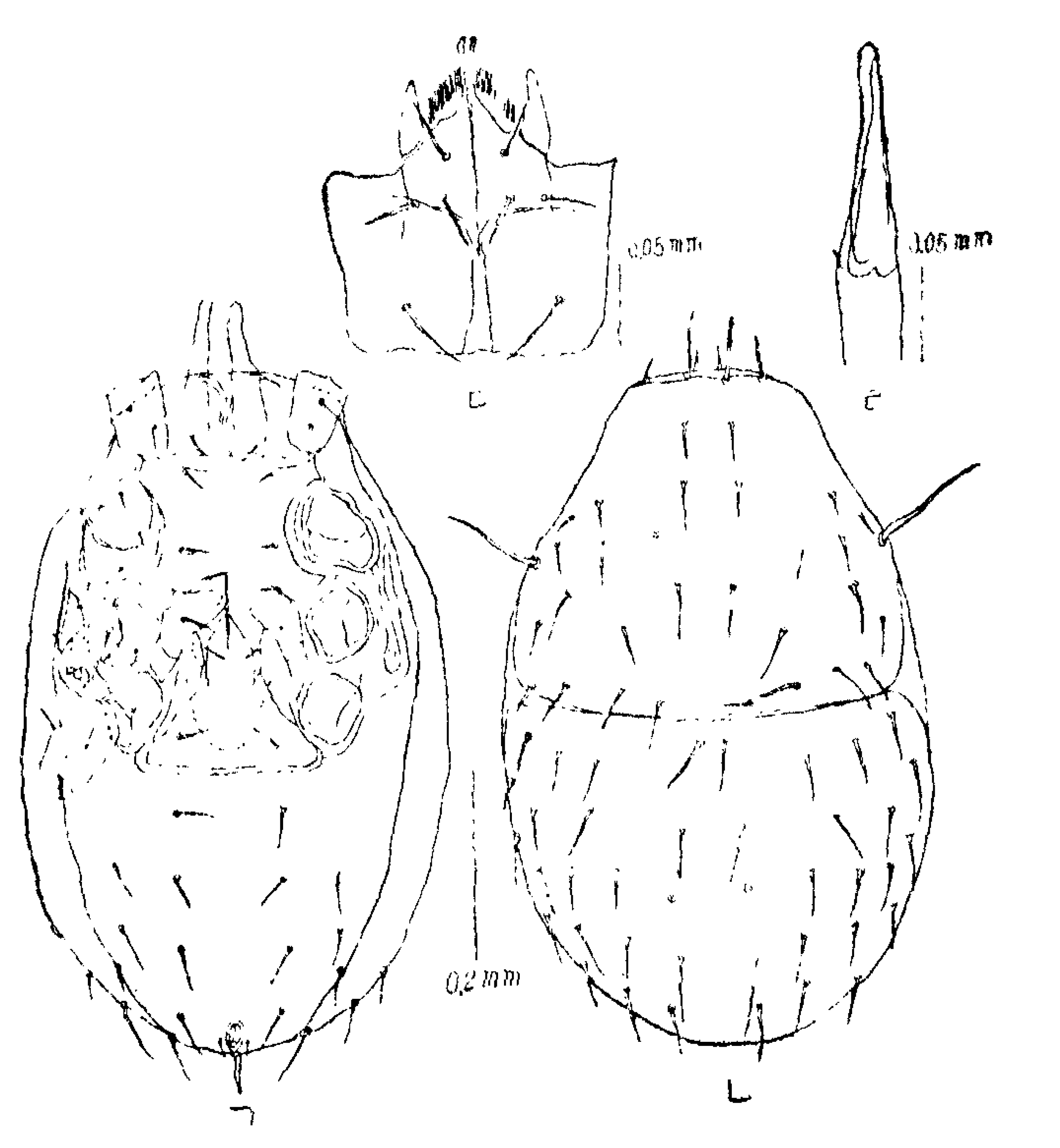
Collected: 6 individuals.
Host: Cricetulus triton, wild rat, nest of Apodemus agrarius.
Collection site: Icheon-gun (1961), Jungju-si (1964, 10).
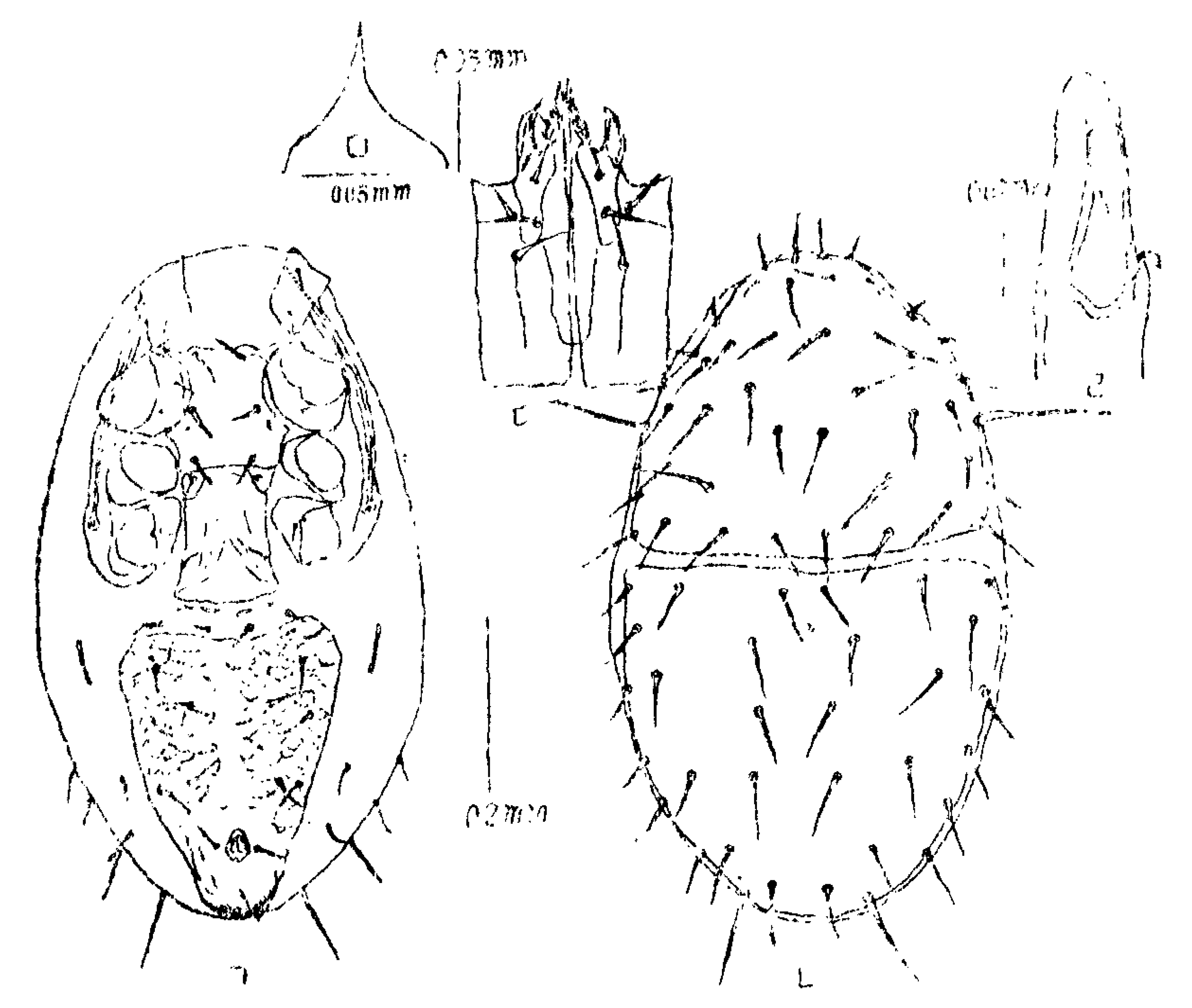
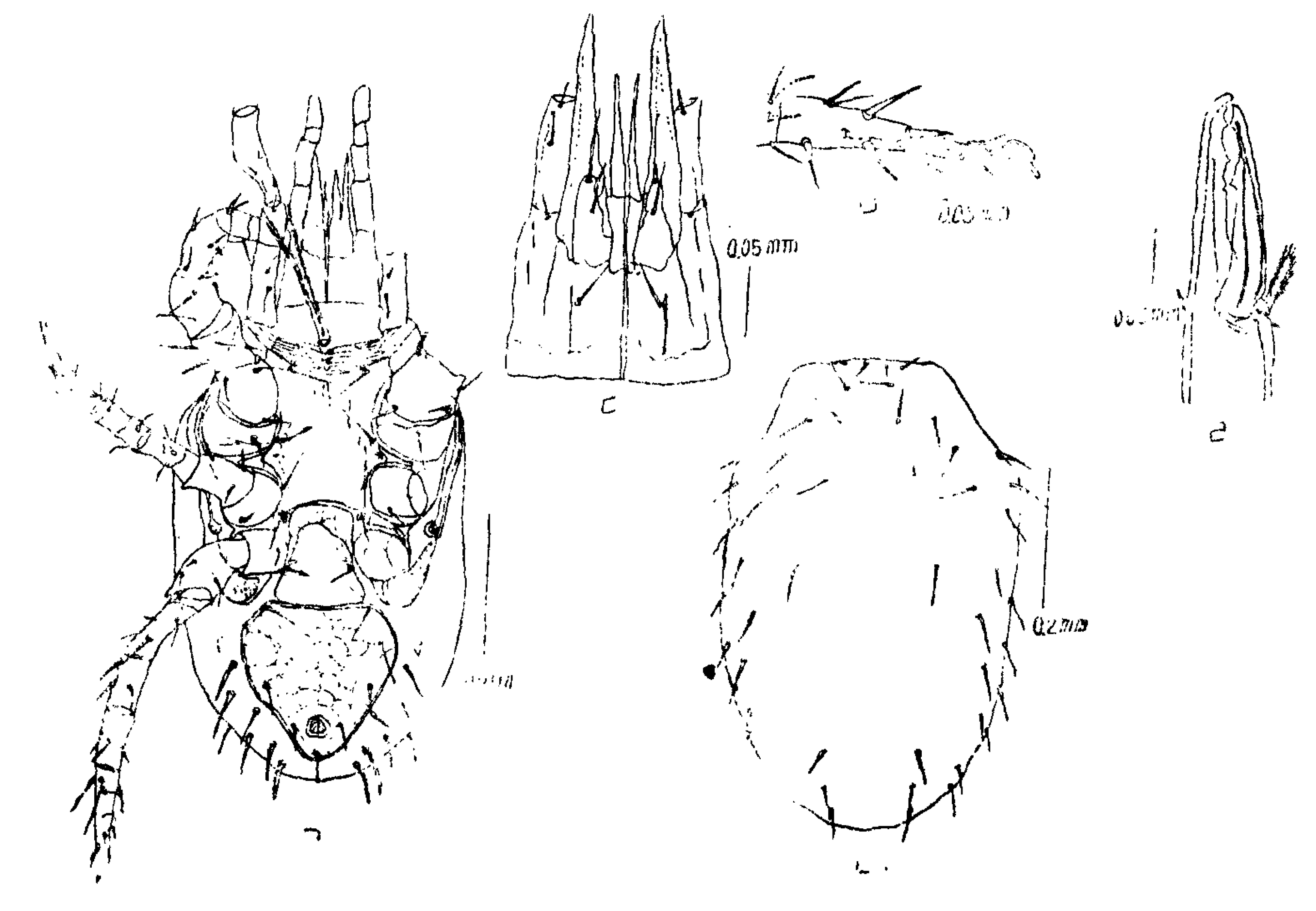
[Description] Female body 0.708–0.780 mm long x 0.466–0.500 mm wide. Sternal shield with three pairs of fine setae; anterior margin straight, posterior margin strongly concaved; metasternal shield large, elongated rectangular-shaped; closely abutting posterior margin of sternal shield. Genital shield triangular-shaped, posterior margin closely abutting anterior margin of ventrianal shield; with a pair of (VI1 ) setae on shield. Ventrianal shield large, well-developed, with eight pairs of fine setae; anterolateral corners extended forward. Anal area located in posterior part of ventrianal shield, para-anal setae shorter than anal orifice. Peritrematal plates slightly expanded at level of coxa III (Fig. 1). Dorsal shield divided into two parts, with 36 pairs of setae on shield (Fig. 1). Shape of subcapitulum and cheliceral digits as in Figure 1.
This species is quite similar to Pergamasus sp. as described in Bregetova's paper, except for the shape of the metasternal shield, the shape and location of the peritrematal plates, and the position of the setae on the ventrianal shield. And also, compared to the type species of the genus Pergamasus from the Soviet Union, P. decipiens Berlese, 1903, the shape and position of presternal plates and tritosternum are different. (We do not provide specific measurements in this study).
The only known identification key of the genus Pergamasus is made by Vitzthum (1929) based on the male specimens.''
Notes — The name Pergamasus pheongkangensis is a nomen nudum in Seo (1966). The description and illustrations appear in Seo and Che (1966, pages 30–31). The information in Seo and Che (1966) shows that this species belongs to the Parasitidae, but the presence of a divided dorsal shield is characteristic of Parasitinae rather than Pergamasinae. The absence of key diagnostic characters such as the chelicera, epistome, palp digits, and male morphology makes it impossible to determine its genus. This species is included in Edwards et al. (1974) but is not listed in the National Species List of Korea (NIBR 2024). We have not found any other published reference to this species. The correct author of the name Parasitidae is Oudemans (1901), not ''Oudemans (1902)''.
The description of this species refers to ''the type species of the genus Pergamasus from the Soviet Union, P. decipiens Berlese, 1903''. The meaning of this statement is not clear, since the type species of Pergamasus is Acarus crassipes Linnaeus. Pergamasus decipiens Berlese, 1903 was described from Italy.
''Parasitus Latreille, 1795 (Gamasus Latreille, 1802)
2. P. zangpungensis Seo et Che. sp. nov.
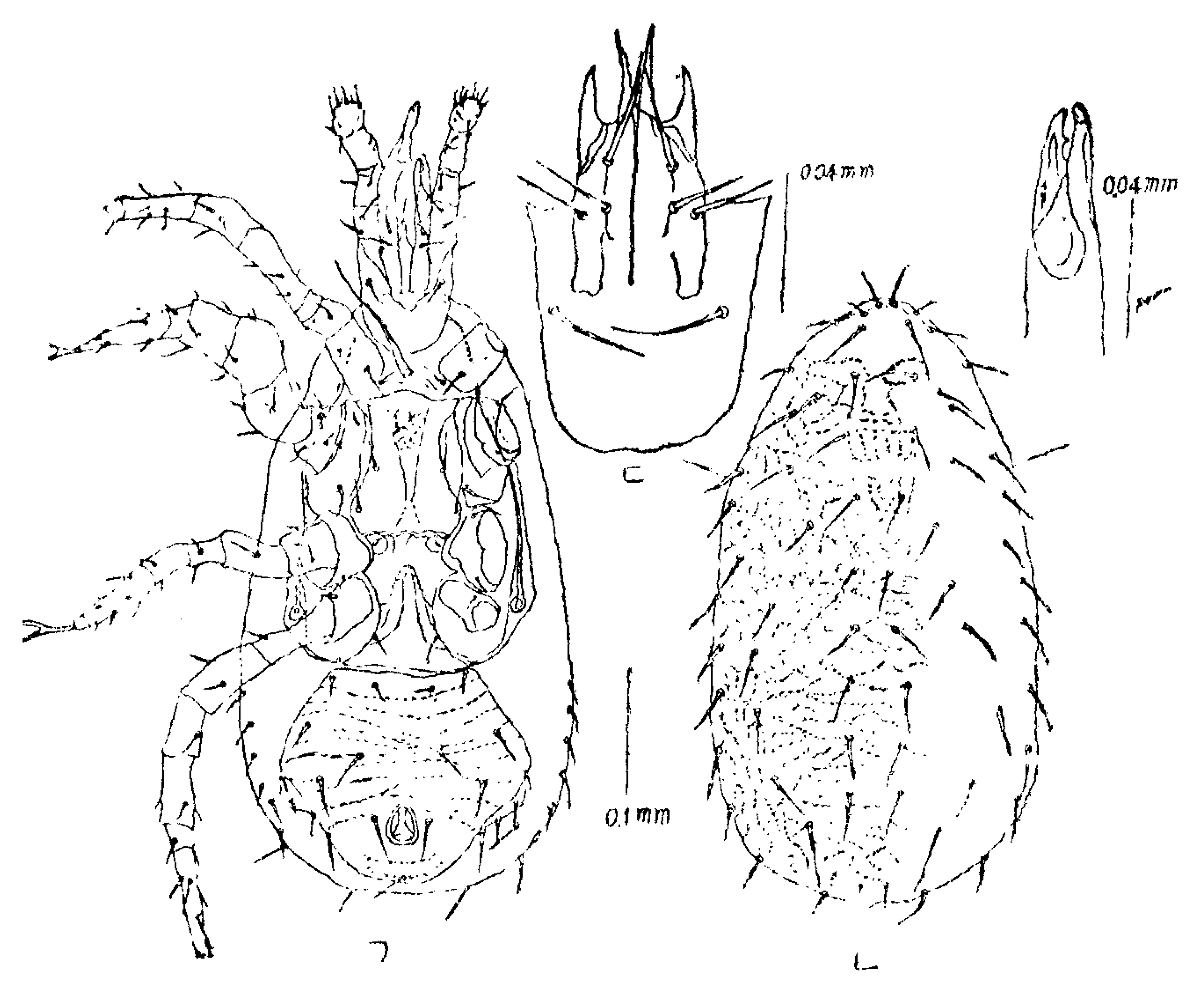
Collected: 2 individuals.
Host: Apodemus agrarius.
Collection site: Jangpung-gun (1962, 6, 7).
[Description] Female body egg-shaped, 0.455 mm long x 0.239 mm wide. Sternal shield 1.5 times longer than wide; three pairs of fine setae present on shield, posterior margin straight; metasternal shield small, marginal outline indistinct. Genital shield triangular-shaped with a pair of setae. Ventrianal shield with five ventral setae and three anal setae; anterior margin straight, lateral margin widely expanded at level of VI5 –VI6 ; two pairs of ventral setae (VI2 , VI3 ) located horizontal to its anterior margin. Para-anal setae much longer than anal orifice. Peritrematal plate fused with outer margin of parapodal plate (Fig. 2). In gnathosomal parts, corniculi divided into two parts (Fig. 2), fixed digit with small teeth (Fig. 2). We do not provide specific measurements in this study.
We presume that this species belongs to genus Parasitus, based on the shape of the genital shield, structure of subcapitulum, and fragmented corniculi. Compare to the P. coleoptratorum which was described by Bregetova, the ratio of width and length of sternal shield, shape of ventrianal shield, and shape of corniculi are different. Until now, no available identification key of the genus Parasitus are published, only a few of species lists are reported. For those reasons, we described this mite as a new species.''
Notes — The name Parasitus zangpungensis is a nomen nudum in Seo (1966). The description and illustrations appear in Seo and Che (1966, pages 30–31). Seo and Che (1966) placed this species in the family Parasitidae, but that appears unlikely. The general habitus and the structure of the ventral shields suggest that this species might belong to the Blattisociidae, possibly Lasioseius, but there is not enough information to place it in a genus with any confidence. This species is not listed in the National Species List of Korea (NIBR 2024). We have not found any other published reference to this species.
''Veigaidae* Oudemans, 1939
Veigaia Oudemans, 1905
3. V. wonsanensis Seo et Che, sp. nov.
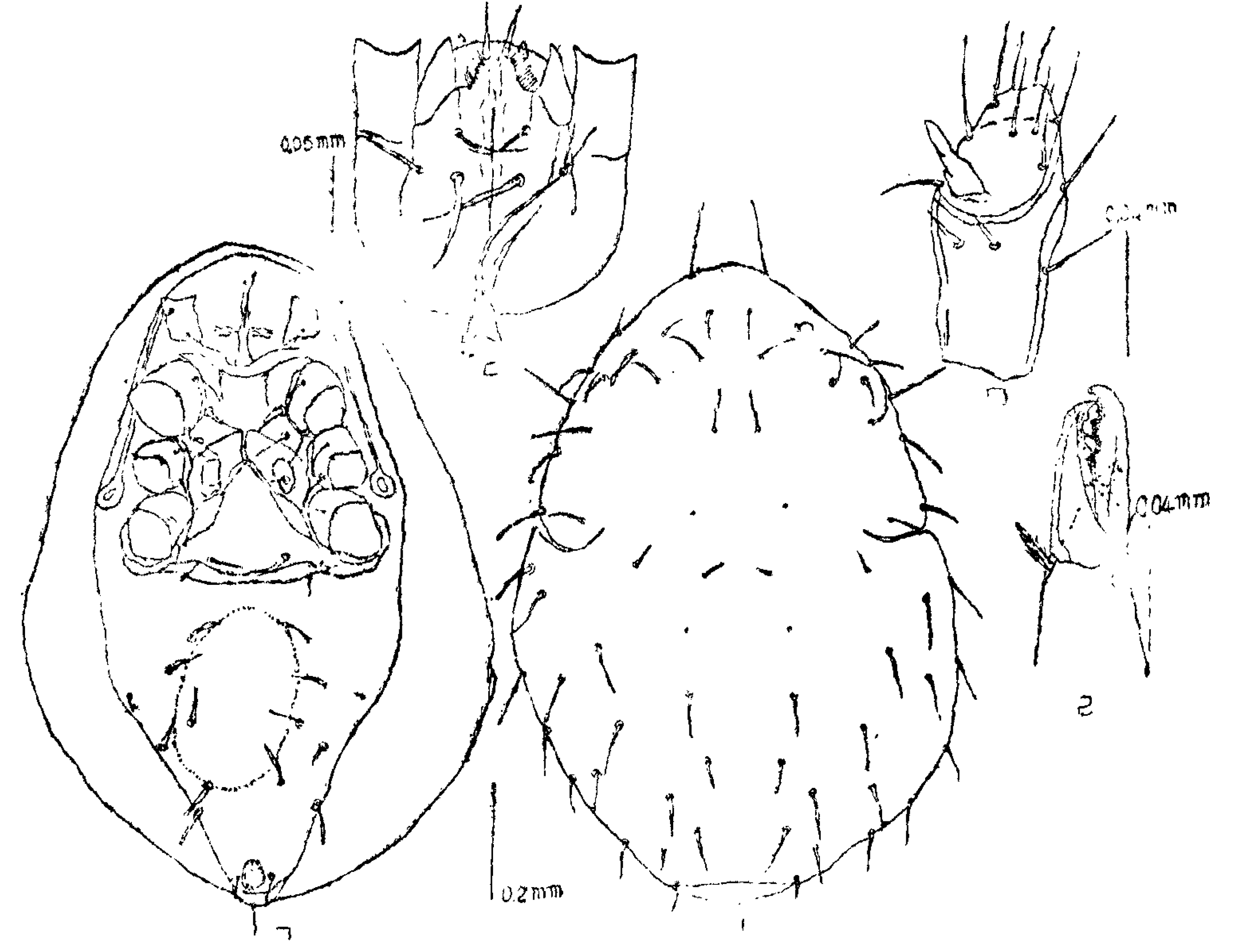
Collected: 4 individuals
Host: Apodemus agrarius, Microtus fortis
Collection site: Wonsan-si (1964, 4)
[Description] Body wide, egg-shaped, 1.140 mm long x 0.814 mm wide. Sternal shield wider than long, anterior margin strongly concave, each anterolateral arm extended to between coxa I and II; metasternal shield oval-shaped. Genital shield triangular-shaped, every margin not straight. Endopodal plates located between sternal and genital shields. Ventrianal shield with eight pairs of ventral setae plus anal setae; anterolateral corners of ventrianal shield extended forward, covering whole ventrum. Length of para-anal setae shorter than other ventral setae and nearly the same as the anal orifice. Longitudinal gap located between genital and ventrianal shield, a pair of VI1 seta present right behind the gap. Peritrematal plates roundly expanded at level of coxa III (Fig. 3). Holodorsal shield slightly incised at mid-level, 35 pairs of dorsal shield present on shield, length of dorsal setae variable (especially D3, D8, Sa, S8, I1, and M11 1/2–1/3 shorter than others) (Fig. 3). Shape of subcapitulum as in Fig. 3. Movable digit with three teeth, fixed digit with five teeth; other characteristics of cheliceral digit as in Fig. 3. We do not provide specific measurements in this study.
This species belongs to the genus Veigaia based on the shape of the genital shield and ventral shields. Also, our sample is fairly different from 16 Soviet Union species that were described by Bregetova (1961), for example, in the Bregetova's species the ventral and anal shields are not fused, the dorsal shield is separated into two parts or deeply incised, and the length of the dorsal setae also different.''
Notes — The name Veigaia wonsanensis is a nomen nudum in Seo (1966). The description and illustrations appear in Seo and Che (1966, pages 32–33). Keum and Jung (2019) included this species in their list of Veigaiidae from the Korean Peninsula, but did not refer to the original description. The enlarged metasternal shields and triangular-shaped genital shield suggest that this is a species of Parasitidae, not Veigaiidae. Seo (1983, page 51) includes an illustrated diagnosis of this species. It is listed in Edwards et al. (1974), but we have not found any other published reference to this species.
''Ascaidae* Oudemans, 1905 (=Ascaidae* Oudms + Gamasolaelaptidae* Oudms + Allolaelaptidae* Oudms)
Asca Heyden, 1826
4. Asca gouvensis Seo et Che, sp. nov.
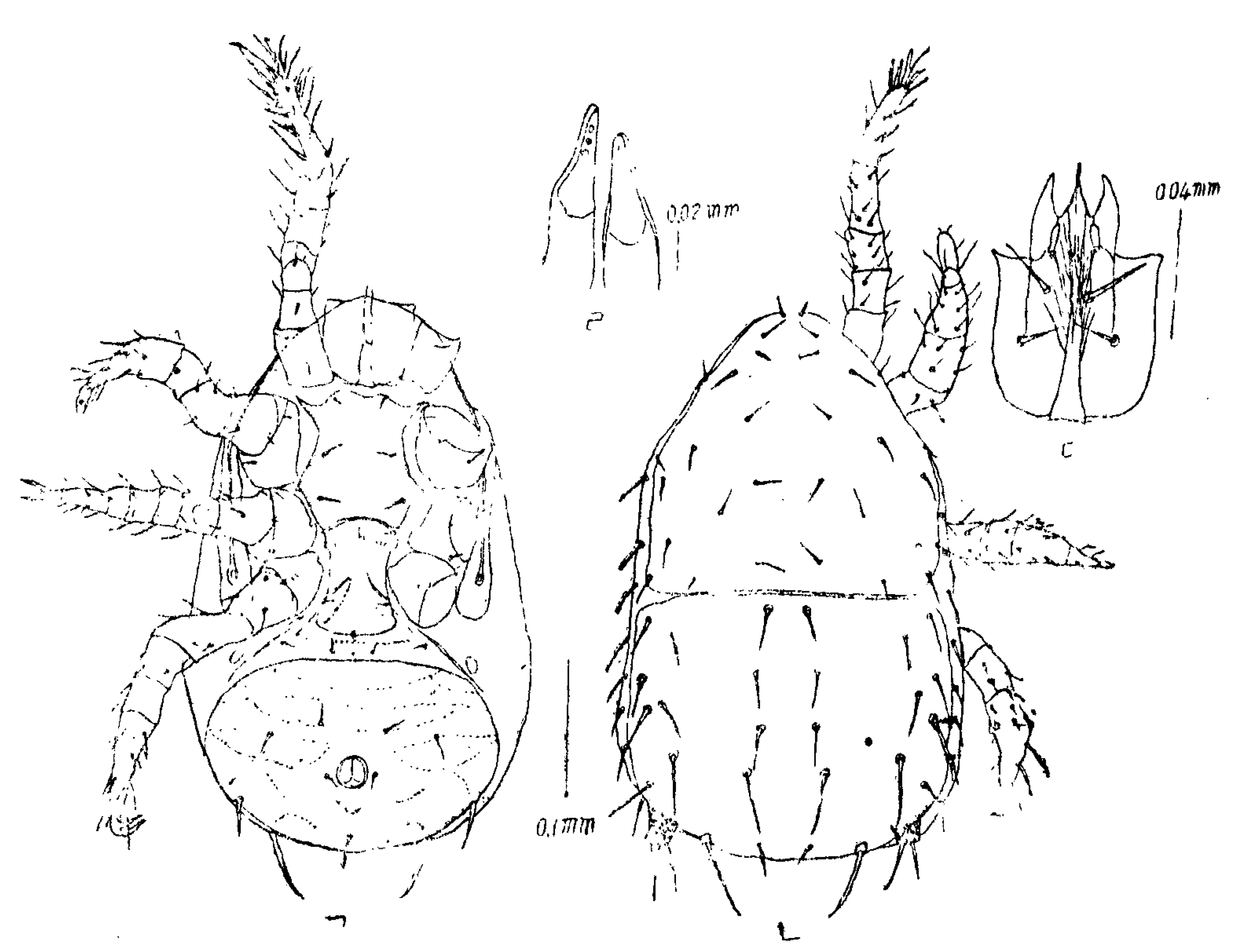
Collected: 2 individuals.
Host: nest of Apodemus agrarius.
Collection site: Jungju-si (1964, 10).
[Description] Female body tiny, egg-shaped, 0.371–0.388 mm long x 0.239 mm wide. Sternal shield longer than wide, bearing three pairs of sternal setae; posterior margin slightly concave. Genital shield small, cylindrical-shaped, bearing a pair of short setae (VI1 ). Ventrianal shield round-shaped, bearing three pairs of ventral setae and three anal setae; VI2 , VI3 inserted on soft cuticle horizontally between genital shield and ventrianal shield. Metapodal plates round-shaped (Fig. 4). Dorsal shield divided into two parts; a pair of horn-shaped projections located on posterior part of opisthonotal region, two pairs of setae inserted in each projection; 31 pairs of various sized dorsal setae inserted on shield, length of podonotal setae shorter than opisthonotal setae (D1, S8, S7, and M7–M11 setae twice or triple length of others) (Fig. 4). Hook-like seta present on femur III (Fig. 4). Other characteristics shown as in Fig. 4. We do not provide specific measurements in this study.
Size of dorsal setae and dorsal chaetotaxy of this species are different from A. bicornis (Canestrini et Fanzago, 1877) and A. aphidioides (Linnaeus, 1758) (= Zercon bicornis Berl.) as described by Xuyeize (1948).''
Notes — The name of this species is spelled Asca goudensis in Seo (1966), as a nomen nudum. The description and illustrations of Asca gouvensis appear in Seo and Che (1966, pages 33–34). The information in Seo and Che (1966) shows that this species is correctly placed in the Ascidae and Asca. This species is not listed in the National Species List of Korea (NIBR 2024). Seo (1983, page 53) includes an illustrated diagnosis of this species under the name Asca goubensis*. We have not found any other published reference to this species.
Several species of Asca have been described or recorded from the Korean Peninsula (Lee et al. 1997; Kaczmarek and Lee 2000; Kontschán et al. 2014; Keum and Jung 2018), but we have not located the publication by Xuyeize (1948). The family Ascidae was originally described as Ascainae Voigts & Oudemans (1905).
''Euryparasitus Oudemans, 1902
5. E. zeongzuensis Che et Seo, sp. nov.
Collected: 4 individuals.
Host: Apodemus agrarius, nest of Apodemus agrarius.
Collection site: Jungju-si (1964, 10).
[Description] Female 0.745 mm long x 0.466 mm wide. Sternal shield with three pairs of setae; metasternal shield with a pair of setae (Mst), shield connected with posterior margin of sternal shield. Genital shield small, not expanded, with a pair of setae (VI1 ). Ventrianal shield with five pairs of ventral setae and three anal setae; anterior margin of ventrianal shield slightly concave and gradually tapered from anterior to posterior part; four platelets and two pairs of ventral setae (VI2 , VI3 ) situated between genital and ventrianal shields. Other characteristics as in Fig. 5. Dorsal shield divided into two parts, with 37 pairs of setae of varying length (only D3, M3, and M11 thick and elongated) (Fig. 5). Shape of subcapitulum, epistome, and cheliceral digits as in Figure 5.
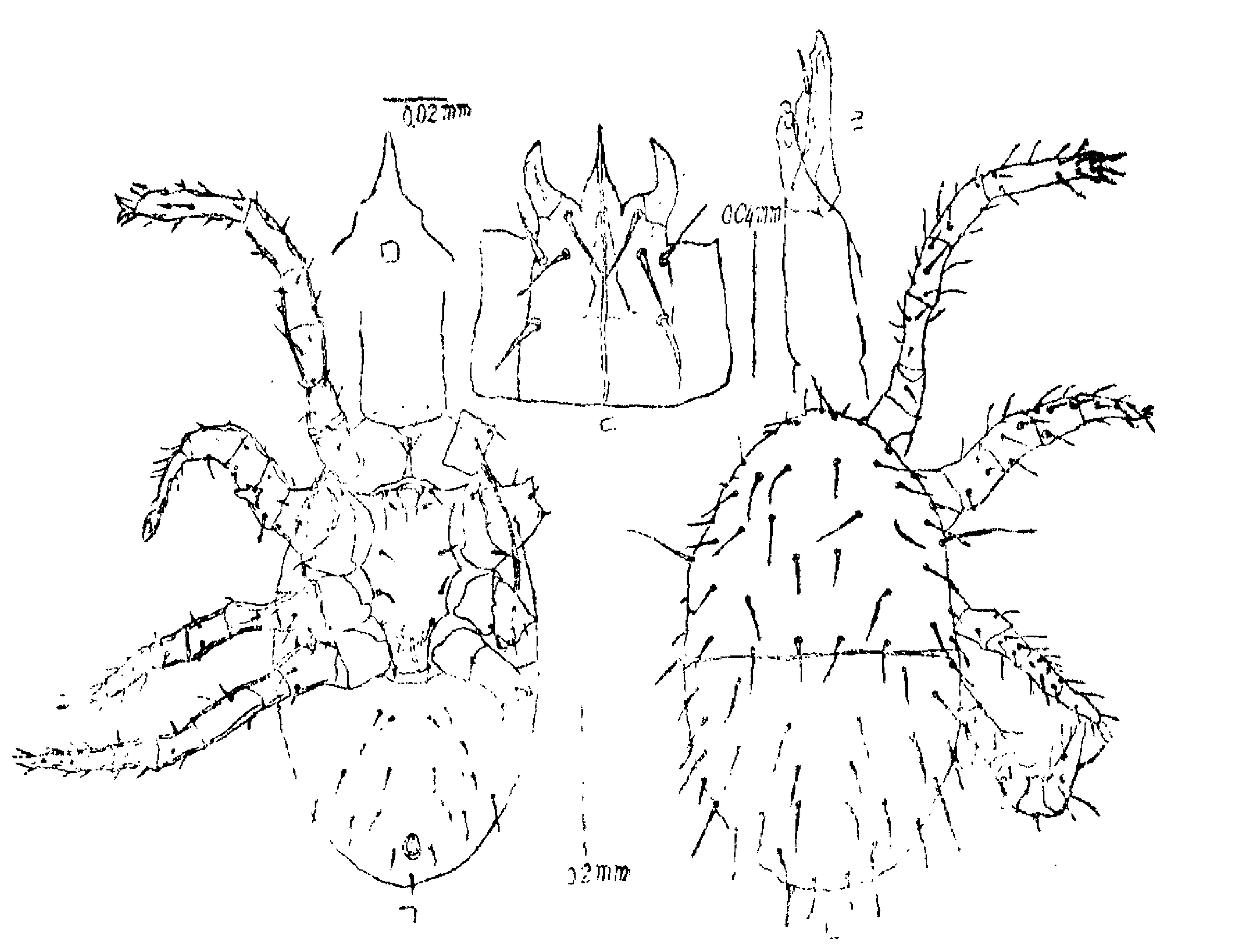
Male 0.592 mm–0.603 mm long x 0.327 mm–0.349 mm wide. Ventral shield divided into two parts, VI1 inserted on the posterior margin of upper shield; both ventral shields of same length; 10 pairs of setae (st1–st3, Mst, and VI1 –VI6 ) plus three anal setae and three pairs of additional setae. Spur-like seta and thickened seta inserted on femur II, a pair of thick and small setae on genu II (Fig. 6). Dorsal shield divided into two parts (Fig. 6). Shape of subcapitulum and epistome as in female (Fig. 6). Movable digit larger than fixed digit, fused with awl-shaped spermatodactyl in basal part, (Fig. 6). We do not provide specific measurements in this study.
According to N.G. Bregetova, E. emarginatus is the only recorded species among the genus Euryparasitus Oudemans. Compared to E. emarginatus, body size, shape of sternal shield, number of setae, location of VI2 –VI3 , and shape and setal position of ventrianal shield are different. For those reasons, we described this species as a new species.''
Notes — The name Euryparasitus zeongzuensis is a nomen nudum in Seo (1966). The description and illustrations appear in Seo and Che (1966, page 34), including descriptions of the adult female and male. Seo (1966) and Keum et al. (2015) placed this species in the Ascidae, but Euryparasitus is now placed in the Ologamasidae (Castilho et al. 2016). Seo (1983, page 57) includes an illustrated diagnosis of this species. The reference to Bregetova probably refers to Bregetova (1953), which records Euryparasitus emarginatus in the former USSR. We have not found any other published reference to this species.
''Eurygamasus Seo et Che, gen. nov.
Without additional platelets between genital shield and ventral shield, dorsal shield with feather-like setae.
6. E. koreicus Seo et Che, sp. nov.
Collected: 1 individual.
Host: nest of Apodemus agrarius.
Collection site: Jungju-si (1964, 10).
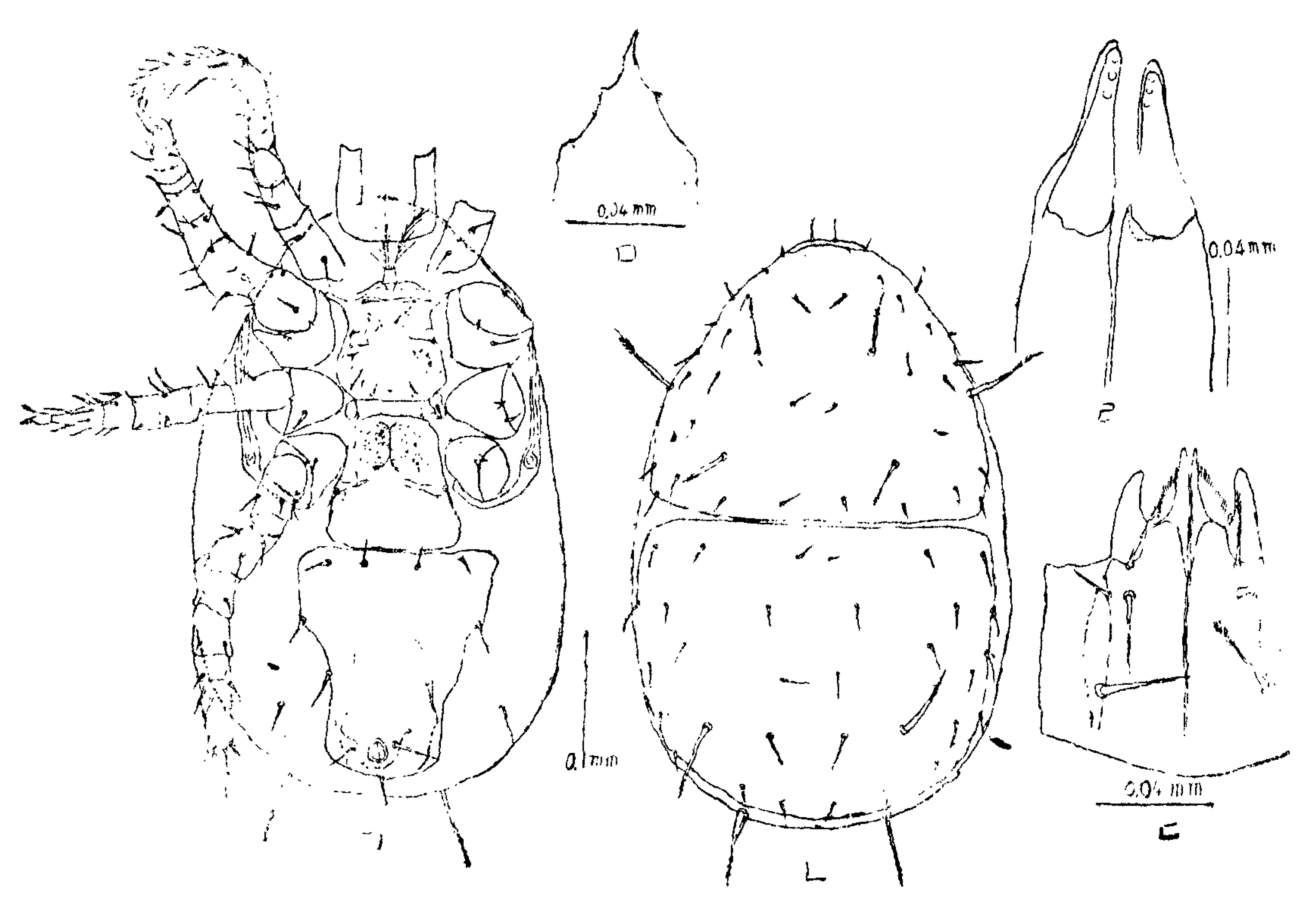
[Description] Female body 0.530 mm long x 0. 319 mm wide. Sternal shield almost the same in length and width; posterior margin straight; st3 shorter than st1 and st2. Genital shield much larger than sternal shield; posterior margin straight, closely abutting ventrianal shield. Ventrianal shield with five pairs of setae (VI2 –VI6 ) and anal setae, VI2 and VI3 located on anterior margin; anterior margin of shield straight, gradually tapered posteriorly; para-anal setae much longer than anal orifice; metapodal plates absent; a pair of additional ventral setae located on soft cuticle. Peritrematal plate not expanded. Tarsus I without stout setae (Fig. 7). Dorsal shield divided into two parts; 37 pairs of various sized setae located on shield, F1 setae thin and short, D1 , D3 , S7 , and M3 setae 2 to 4 times longer than others and thick, feather-like (Fig. 7). We do not provide specific measurements in this study.
We suggest that this species is belongs to the family Ascaidae based on the shape of the subcapitulum and epistome. However, it totally different from the genus Asca due to the lack of cylindrical-shaped projections on dorsal shield, and also, different from the genus Euryparasitus based on the lack of platelets between genital and ventrianal shield, shape and size of dorsal setae, and shape of sternal shield (straight posterior margin). Additionally, this species does not fit into the genus Cyrtolaelaps Berlese, 1887. For those reasons, we designate this species as the new genus and new species of the family Ascaidae.''
Notes — The names Eurygamasus and Eurygamasus koreicus are nomina nuda in Seo (1966). Eurygamasus Seo & Che, 1966 is described as a new genus, with type species Eurygamasus koreicus Seo & Che, 1966 by monotypy, in Seo and Che (1966, pages 34–35). Seo (1966) placed Eurygamasus in the Ascidae, but the description and illustrations are not consistent with that interpretation. The limited available information suggests this species could belong to the Ologamasidae based on the shape of the dorsal shield and epistome. One of the key diagnostic characteristics of that family is the presence four pairs of sternal setae on the shield (Castilho et al., 2016). However, Seo (1983, page 54) includes an illustrated diagnosis of this species and states that ''setae st4 bearing on small metasternal shield and shorter than st3'', so further re-identification of this species is required.
In the National Species List of Korea, this species appears to be listed as ''Euryparasitus koreicus'', not Eurygamasus koreicus. This is probably a mistake because those two species have the same Korean name in Seo and Che (1966), Seo (1983), and NIBR (2024). We have not found any other published reference to this species.
''Macrochelidae Vitzthum, 1930
Macrocheles Latreille, 1829
7. M. aviaton Seo, sp. nov.
Collected: 2 individuals.
Host: Nyctalus lasiopterus.
Collection site: Sangwon-gun (1982, 2).
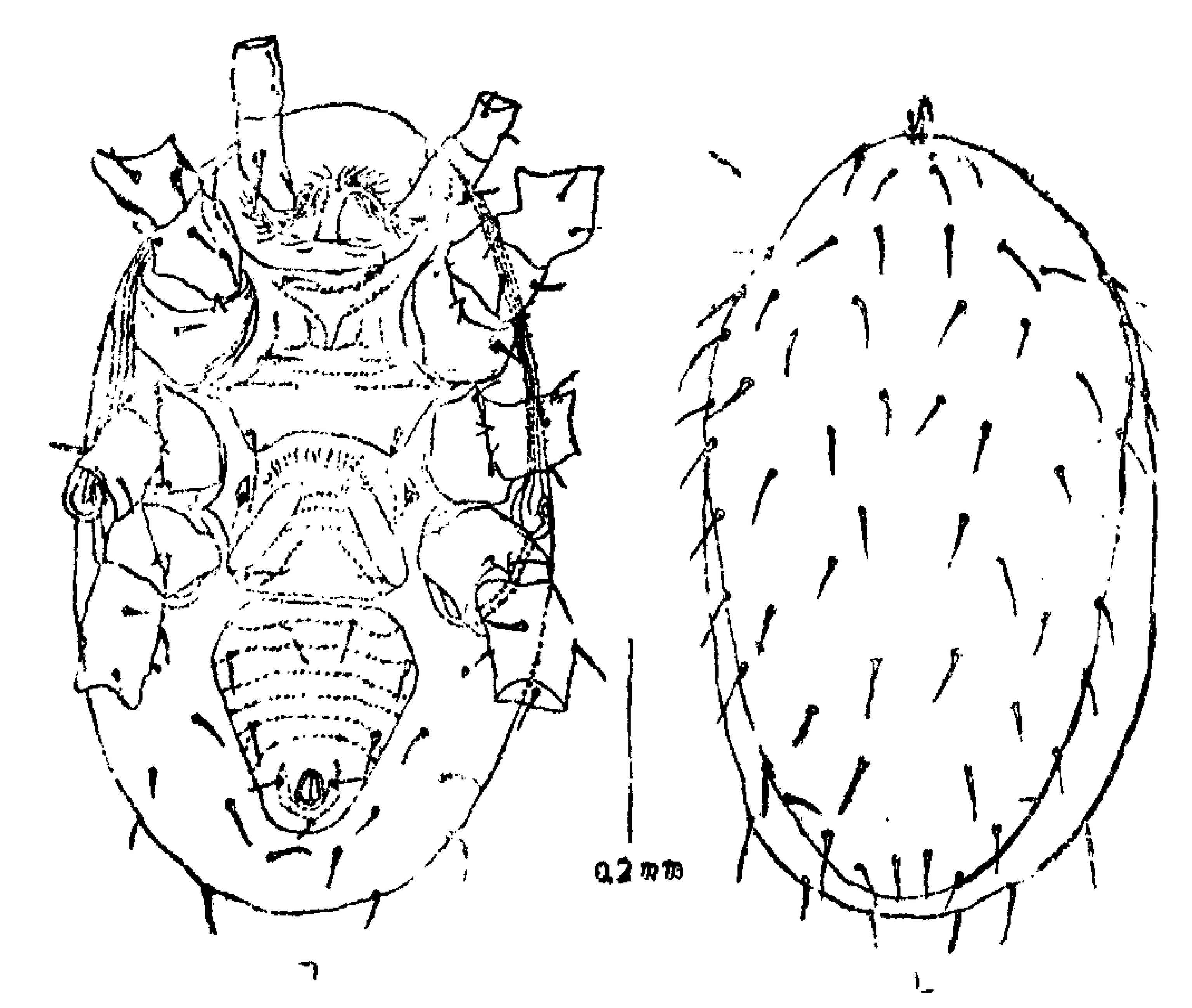
[Description] Female, 0.720 mm long x 0.466 mm wide. Sternal shield shaped as M. glaver (Müll) without reticulation; metasternal shield small, spindle-shaped. Lateral margin of genital shield weakly sclerotised, anterior margin without reticulation. Ventrianal shield longer than width. Body shape similar as in M. subbadius (Berlese). Metapodal plates round and small (Fig. 8). 31 pairs of setae bearing on dorsal shield, only F1 setae feather-shaped (Fig. 8). Other characteristics shown as in Figure 8. We do not provide specific measurements in this study.''
Notes — The name Macrocheles aviaton is a nomen nudum in Seo (1966). The description and illustrations appear in Seo and Che (1966, pages 35–36). The description and illustrations show a species very similar to Macrocheles glaber (Müller, 1860). Seo (1983, page 67) includes an illustrated diagnosis of this species. We have not found any other published reference to this species.
''Parholaspulus Evans, 1956
8. P. koreicus Che et Seo, sp. nov.
Collected: 6 individuals
Host: nest of Apodemus agrarius
Collection site: Jungju-si (1964, 10)
[Description] Female 0.663 mm–0.696 mm long x 0.384 mm–0.441 mm wide. Sternal shield much longer than wide; anterior part concave, each lateral arm cut straight vertically; posterior margin extended to level of coxa III; presternal platelets in three pairs. Genital shield relatively small, bearing a pair of setae; posterior margin relatively straight. Three pairs of ventral setae plus three anal setae located on ventrianal shield; shape of ventrianal shield similar to Macrocheles, shield closely abutting genital shield. Metapodal plates elongated, parapodal plates broadened, well-developed. Peritrematal plates straight from coxa II to coxa IV; slightly pectinate setae located on posterior part of ventral idiosoma (Fig. 9). Dorsal shield with 29 pairs of thin and relatively short setae; anterior margin of shield truncated, widest at level of sc setae (Fig. 9). Shape of subcapitulum and cheliceral digit as in Figure 9. All legs thin except leg II, tarsus II with stout setae (Fig. 9).
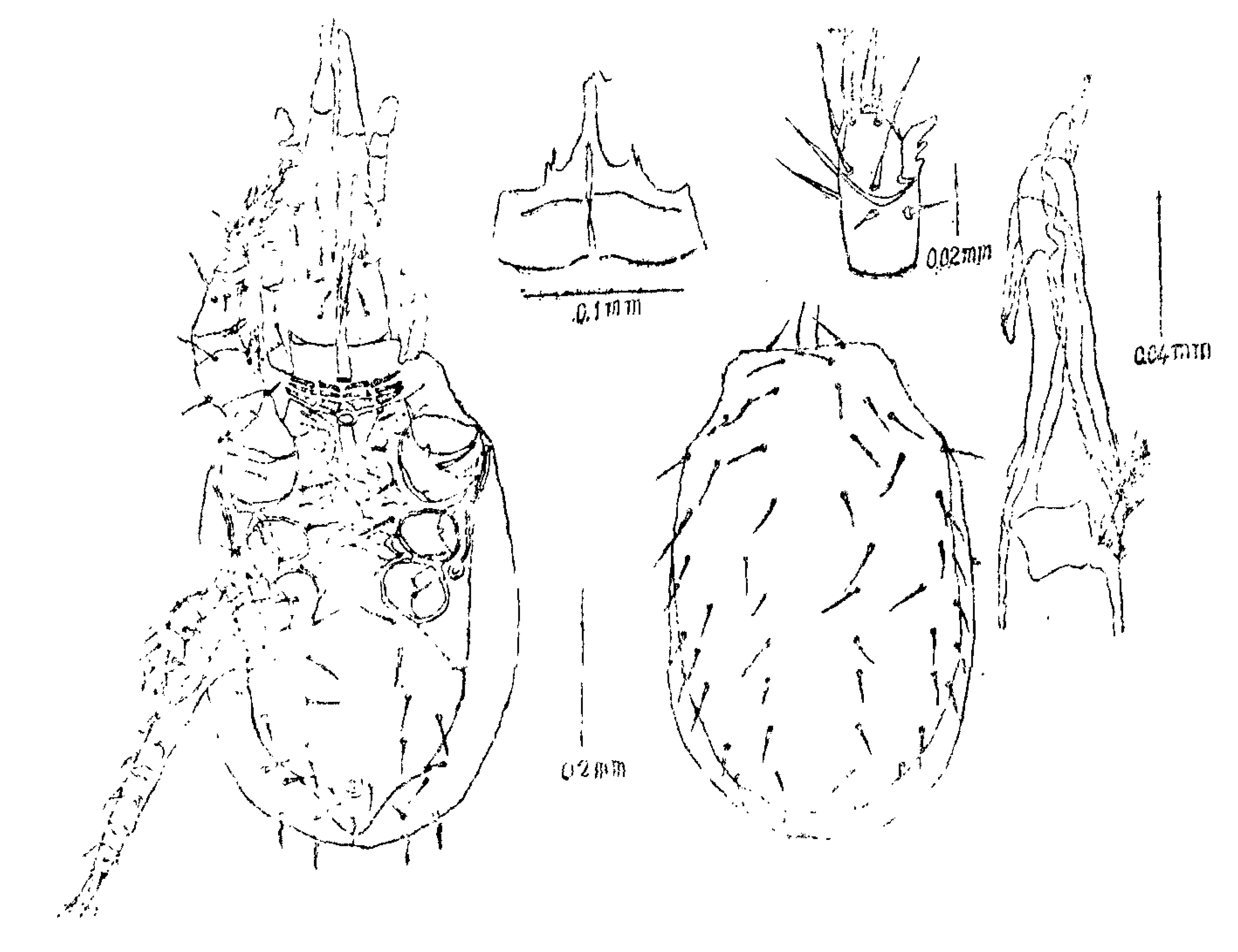
Male 0.580 mm–0.651 mm long x 0.338 mm–0.371 mm wide. Nine pairs of setae plus three anal setae located on holoventral shield. Other characteristics as in Figure 10. Dorsal shield also same as in female (Fig. 10). Spermatodactyl longer than movable digit, curved downward (Fig. 10). Epistome with three projections, middle one elongated with thin projection on apical tip, a pair of lateral projections slightly serrated (Fig. 10). Spur-like setae on femur II and genu II. We do not provide specific measurements in this study.
In comparison with P. alstoni Evans, 1956 which was reported by Evans, the shape and size of the epistome, shape of the ventral setae, and structural features of the legs are different. Since Evans reported a single species of this genus, no new species have been reported.''
Notes — The name Parholaspulus koreicus is a nomen nudum in Seo (1966). The description and illustrations appear in Seo and Che (1966, pages 36–37). The description and illustrations appear to show a species of Parholaspididae, probably Holaspina. In NIBR (2024), this species is listed as ''Holaspina koreicus''. Seo (1983, page 68) includes an illustrated diagnosis of this species. We have not found any other published reference to this species.
''Geholaspulus Che et Seo, gen. nov.
9. G. wonsanensis Che et Seo, sp. nov.
Collected: 2 individuals.
Host: nest of rats.
Collection site: Wonsan-si (1960, 3).
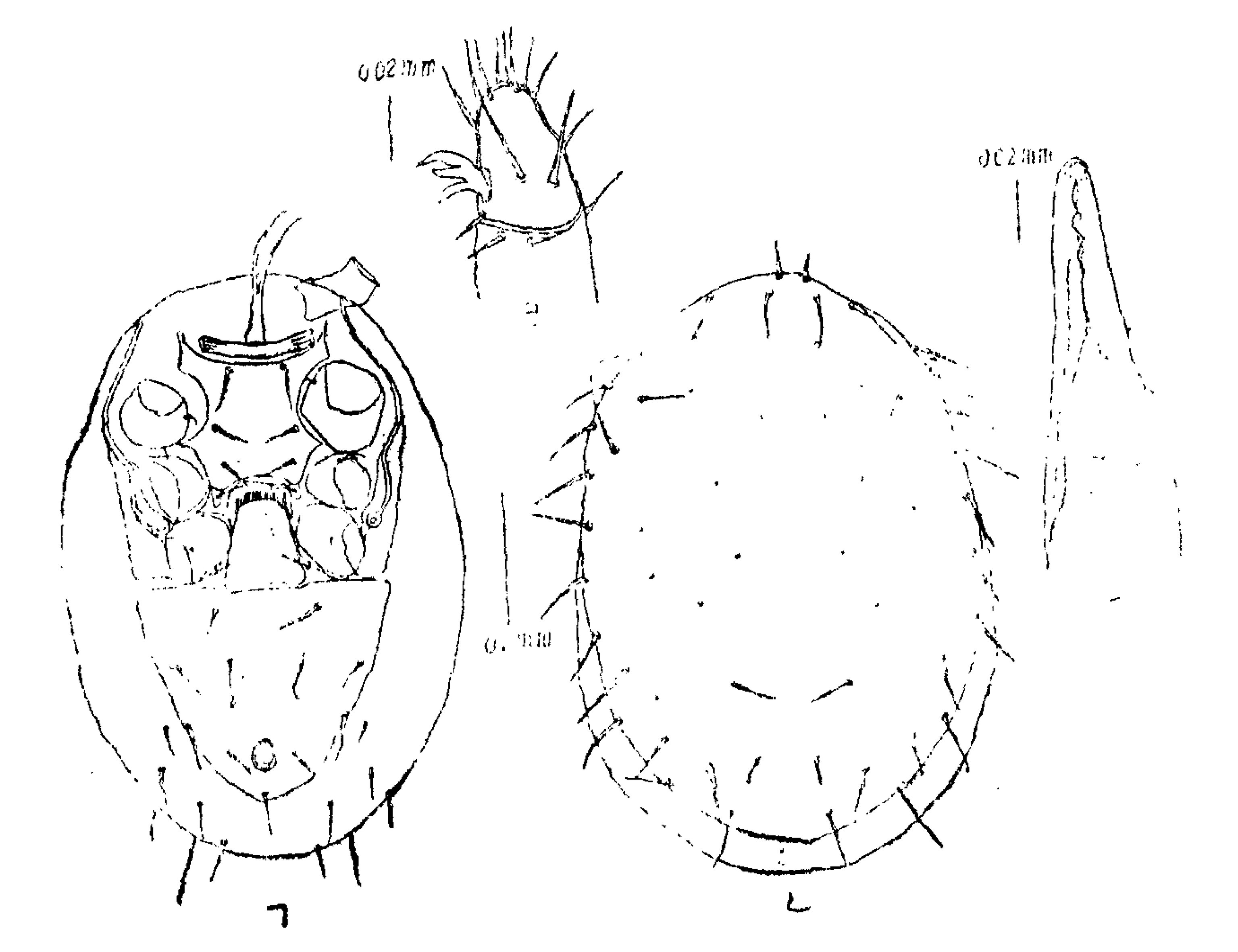
[Description] Female, 0.912 long x 0.627 wide. Sternal shield longer than wide; each lateral arm cut straight vertically, posterior margin concave; presternal platelet not paired, parallel with anterior margin of sternal shield. Genital shield small; posterior margin straight, VI1 located on soft cuticle beside genital shield. Ventrianal shield triangular-shaped with five pairs of setae; anterior margin straight and broad, posterior part gradually tapered. Other characteristics as in Figure 11. Holodorsal shield with 30 pairs of setae (Fig. 11). Cheliceral digit with two large teeth (Fig. 11). Spur-like projections present on femur IV and tarsus I without claws. We do not provide specific measurements in this study.
According to those characteristics, we suggest that this species belongs to the family Macrochelidae. However, compared to other genera of the family, the shape of endopodal and exopodal plates and the structure of the ventral shield are different. Likewise, genital shield, ventrianal shield, and peritrematal plates are different with the genus Macrocheles and also, ventrianal shield, ventral setae, and dorsal shield are different with the genus Geholaspis. None of the other genera fit with this species.''
Notes — The names Geholaspulus and Geholaspulus wosnanensis are nomina nuda in Seo (1966). The descriptions of the new genus and species appear in Seo and Che (1966, pages 37–38), and appear to show a species of Parholaspididae, in a genus similar to Parholaspis. This species is not listed in the National Species List of Korea (NIBR 2024). We have not found any other published reference to this species or genus.
''Pachylaelapidae Vitzthum, 1931
Pachygamasus Che et Seo, gen. nov.
10. P. agrarius Che et Seo, sp. nov.
Collected: 3 individuals.
Host: Apodemus agrarius.
Collection site: Jangpung-gun (1962, 9).
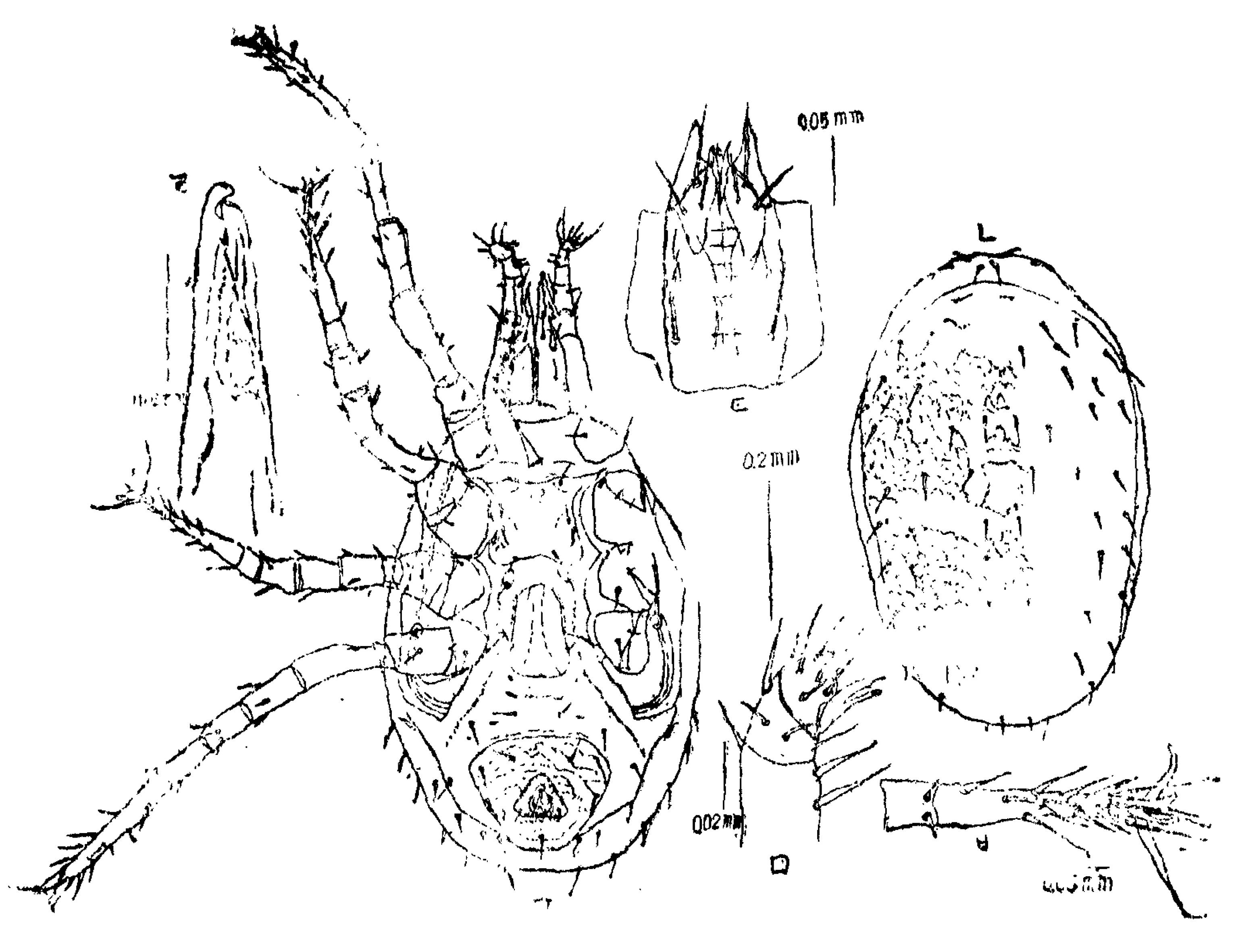
[Description] Female 0.558 mm–0.684 mm long x 0.381 mm–0.500 mm wide. Sternal shield with three pairs of fine and small setae; anterior margin straight, posterior margin slightly concave; length and width nearly similar. Genital shield small, elongated; anterior margin round, weakly sclerotised; a pair of VI1 setae located on its surface. Ventrianal shield relatively small, irregular hexagonal-shaped; anterior margin straight; two pairs of ventral setae and three anal setae located on its surface. Two pairs of setae located on soft cuticle between genital and ventrianal shield, three pairs of platelets situated forward and backward of setae. Peritrematal plates fused with other endopodal and exopodal plates (Fig. 12). Dorsal shield egg-shaped, not covered whole dorsum; 30 pairs of fine and short setae located on shield, F1 and F2 setae located on soft cuticle (Fig. 12). Stout spine-like setae bearing on tarsus (the setae are even larger than the claw, and it looks like 4 claws) (Fig. 12).
Based on the largely sclerotised shields and legs' tarsal structures, we suggest that this species belongs to the family Pachylaelapidae. However, the shape of shields and their connections are different from the type genus Pachylaelaps Berlese, 1888. Notably, the structure of tarsus II is fairly different. For those reasons, we designated this species as a new genus and new species (only a few researches about the genus and species of this family exist).''
Notes — The names Pachygamasus and Pachygamasus agrarius are nomina nuda in Seo (1966). The description and illustrations of the new genus and species appear in Seo and Che (1966, pages 38–40). The very wide peritrematal shields and elongated paradactyli suggest this is a species of Platyseiinae, probably Cheiroseius, with ventral setae Zv1 between the genital and ventrianal shields. This species is not listed in the National Species List of Korea (NIBR 2024). We have not found any other published reference to this species or genus. The correct author of the family name Pachylaelapidae is Berlese (1913).
''Laelaptidae* Berlese, 1892
Cosmolaelaps Berlese, 1903
11. C. koreicus Che et Seo, sp. nov.
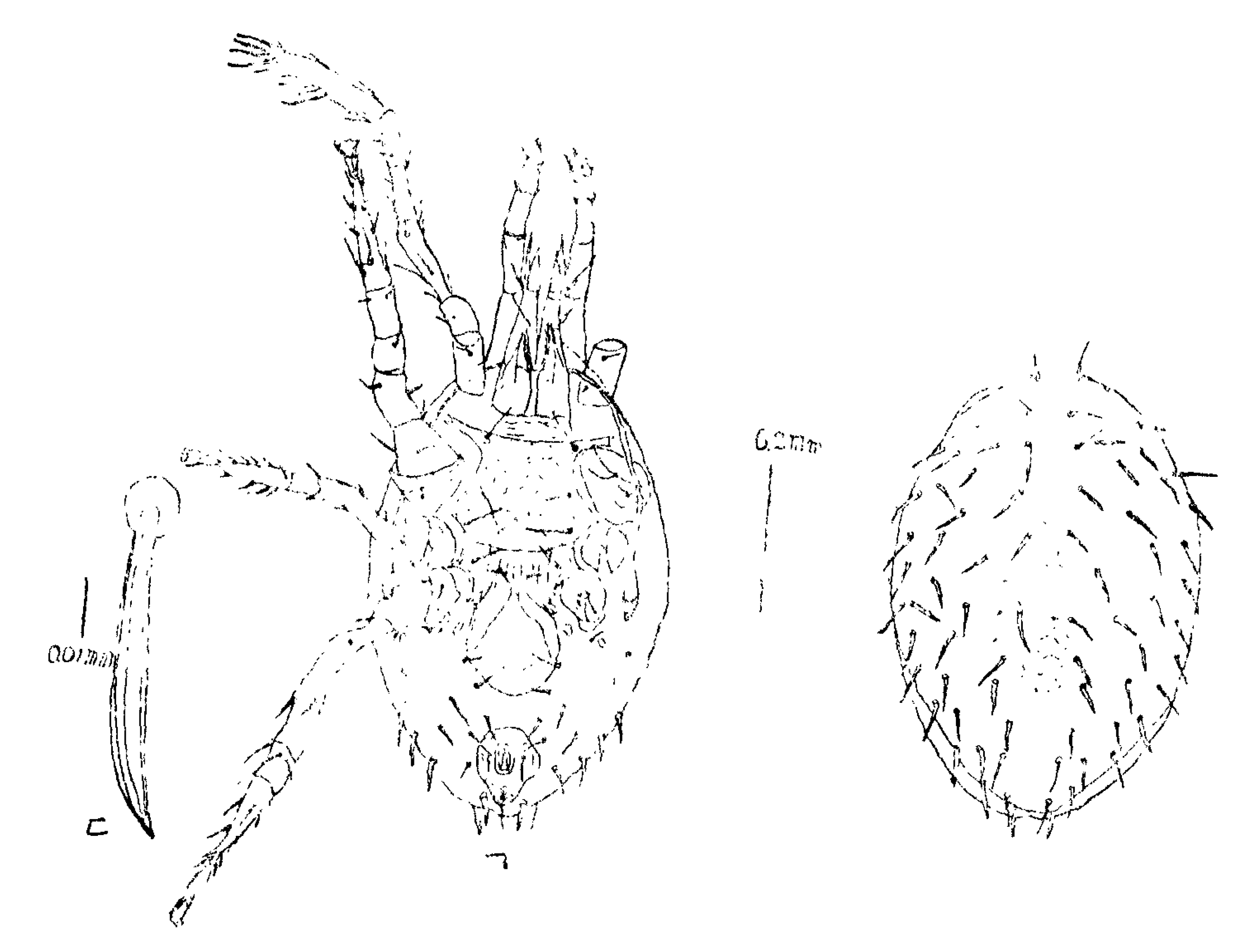
Collected: 62 individuals.
Host: Rattus norvegicus, Mus musculus, Apodemus agrarius, Cricetulus triton, Microtus fortis, Crocidura lasiura, nest of Apodemus agrarius.
Collection site: Pyeonggang-gun (1961, 5; 1962, 6; 1964, 4), Haeju-si (1964, 4, 6, 7), Wonsan-si (1960, 4, 6; 1964, 4, 9), Jangheung-ri (1964, 4), Cheolwon-gun (1963, 10), Jungju-si (1964, 9).
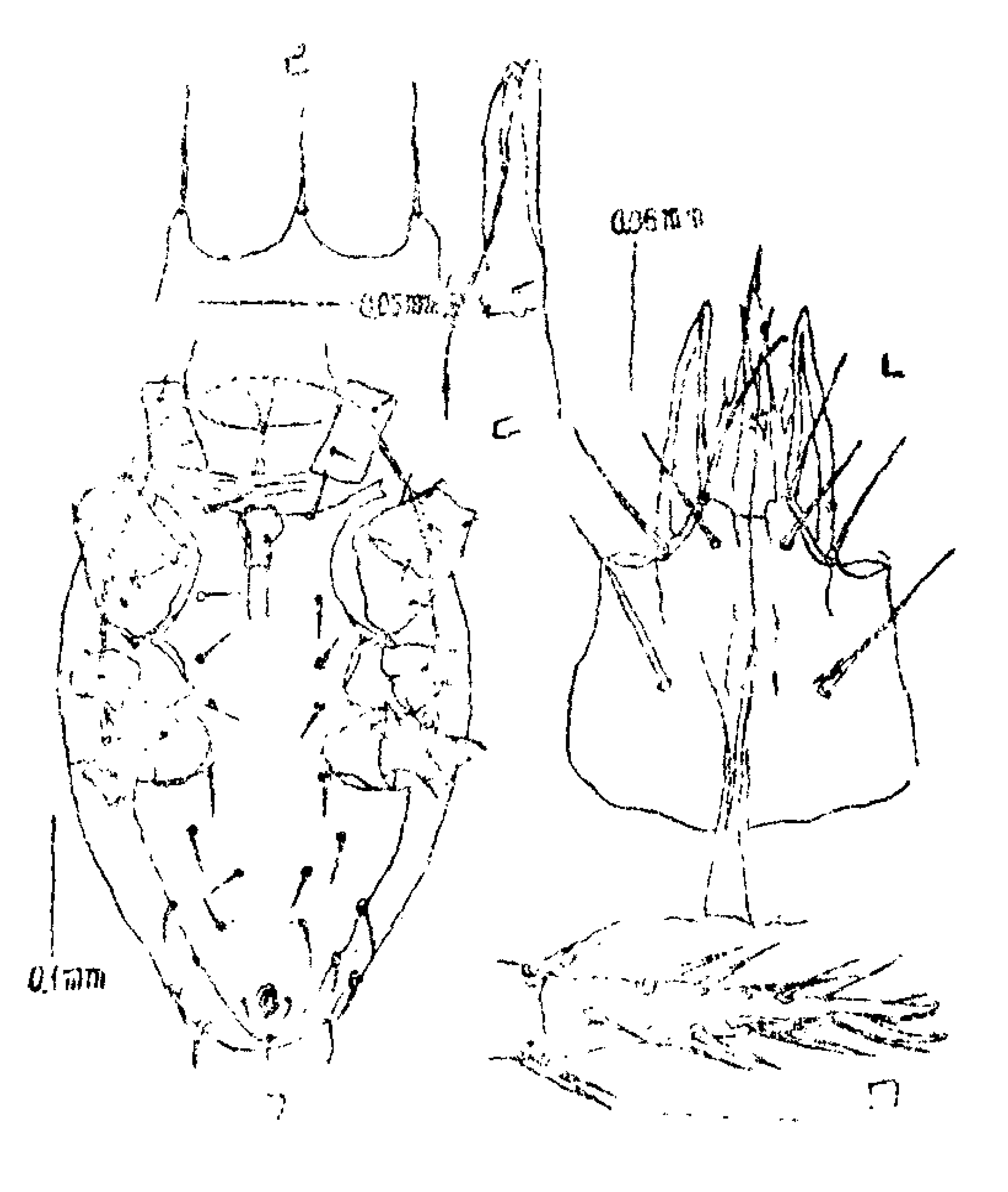
[Description] Body egg-shaped. In female, 0.570–0.710 mm long x 0.290–0.512 mm wide. Sternal shield largely expanded, anterior margin nearly straight or slightly concave, posterior margin round; anterolateral corner extended to nearly abutted peritremes; sternal shield bearing three pairs of thin and long setae, metasternal shield absent (only Mst present). Genital shield fused with ventral shield, slightly expanded at level of VI1 ; shield bearing a pair of setae. Other ventral setae bearing out of genital shield symmetrically; six pairs of additional setae bearing ventral integument (two pairs are acicular-shaped, four pairs are expanded sword-shaped). Anal shield triangular-shaped, anterior margin round. Metapodal plates circular or oval-shaped (Fig. 13). Dorsal shield bearing 37 pairs of setae including a pair of medial setae (I) (Fig. 13). Male, 0.490–0.507mm in length and 0.256–0.274mm in width. Holoventral shield expanded at level of VI1 (means Zv1); shield with 10 pairs of setae (four pairs of sternal setae, six pairs of ventral setae) and three anal setae. Paraanal setae 1/2 length of other ventral setae, shorter than anal orifice. modified setae bearing on posterior region of ventral integument (Fig. 14). Dorsal shield same as in female. Subcapitulum large, corniculi extended (Fig. 14). Cheliceral digit large as in female, hook-like spermatodactyl not long, movable digit with a setal-shaped transparent appendage (Fig. 14). Epistome with three projections (Fig. 14). Tarsus II with stout spine-like setae (Fig. 14) (Table 1).
Download as
Min–Max
Mo
M ± m
σ
Standard–410
Dorsal shiled
L
558–615
584
581 ± 4.2
18.9
580
M
290–371
354
330 ± 5.7
25
349
Sternal shield
L
116–163
144
138 ± 2.3
10.2
116
W
116–128
123
118 ± 1.1
4.8
128
St1~ ~W
81–104
104
99 ± 1.6
7
104
St2 W
104–116
111
107 ± 1.1
4.8
104
St3 W
104–128
124
118 ± 1.4
6.1
116
Genital shield
L
186–244
210
211 ± 2.7
11.6
210
VI2 – W
81–104
93
105 ± 1.0
4.6
93
VI2 – W
116–140
123
121 ± 1.6
7
116
Anal shield
L
58–93
79
78 ± 2.4
10.6
93
W
70–104
93
86 ± 2.3
10.2
93
According to Bregetova, three Cosmolaelaps species were recorded in the Soviet Union, and numerous species were reported from Europe, South America, Africa, etc. Among the three Soviet Union species, only C. robustus (Berlese, 1905) was collected in the far-east region, and no other collections were reported over the North-Eastern region of China. Our species is different from the previously recorded species.''
Notes — The name Cosmolaelaps koreicus is a nomen nudum in Seo (1966). The description and illustrations appear in Seo and Che (1966, pages 40–41). Oh et al. (2025) suggested moving this species into the genus Stratiolaelaps, based on the information in Seo (1983). The original description of the female and male in Seo and Che (1966) confirmed that this species belongs to Stratiolaelaps, based on the spatulate dorsal shield setae, elongate corniculi, the presternal platelets, the anterolateral arms of sternal shield, and the shape of the epistome. This species is listed as ''Cosmolaelaps koreicus Che & Seo (Laelaptidae)'' in Edwards et al. (1974), Cho et al. (1995), and Park et al. (2011). Seo (1983, page 87) includes an illustrated diagnosis of this species. We have not found any other published reference to this species. The correct author of the name Laelapidae is Canestrini, 1891, not Berlese, 1892.
''Hypoaspis G. Canestrini, 1885
12. H. heselhausoides Che et Seo, sp. nov.
Collected: 6 individuals.
Host: Apodemus agrarius, nest of Apodemus agrarius.
Collection site: Cheolwon-gun, Wonsan-si, Jungju-si.
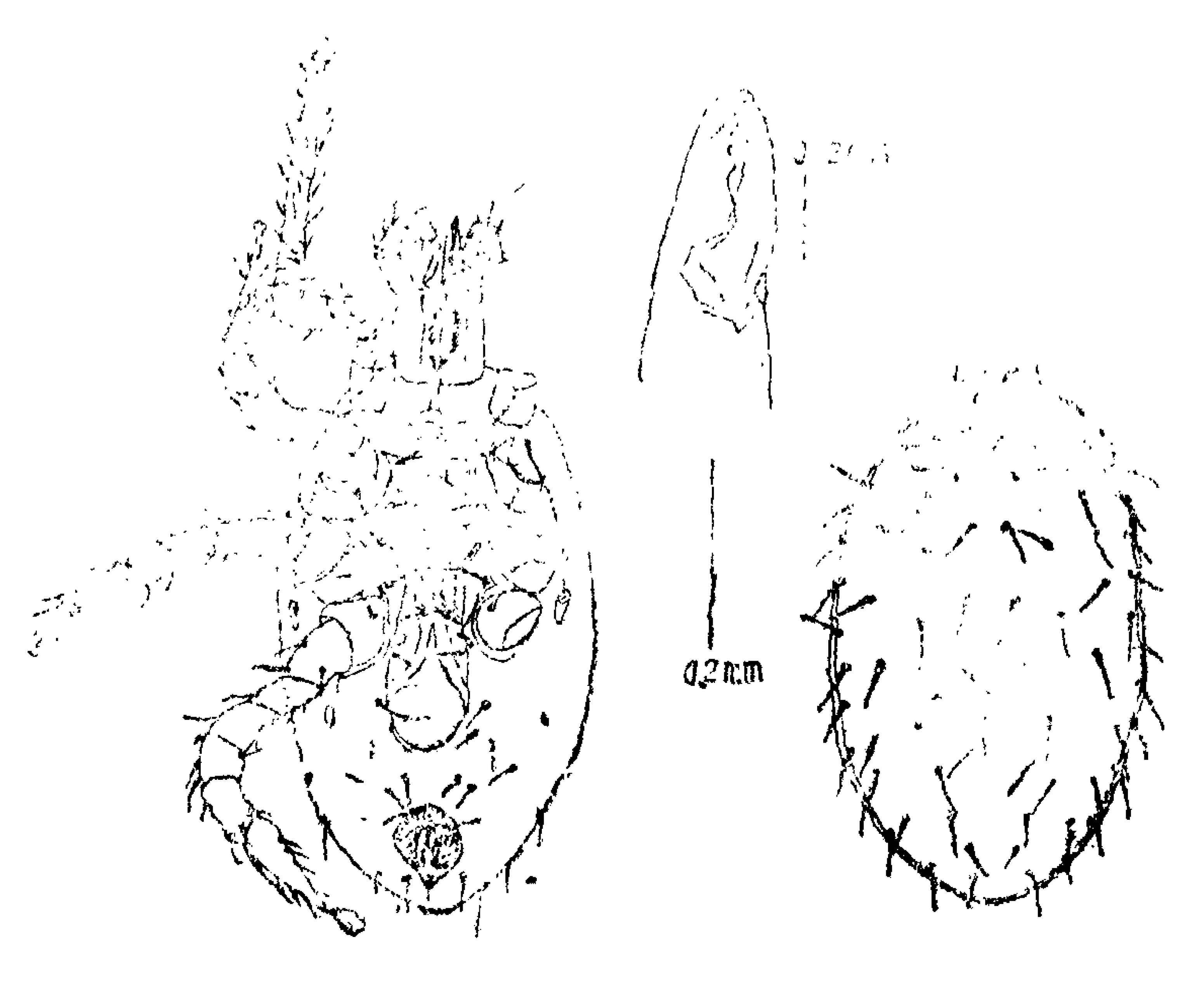
[Description] Female body 0.535–0.587 mm long x 0.313–0.342 mm wide. Both anterior and posterior margins of sternal shield straight, longer than wide; three pairs of fine and short sternal setae located on shield. Genital shield narrow and extended, bearing a pair of setae (VI1 ). Ventral setae VI2 and VI3 situated just beside the genital shield symmetrically. Anal shield small, anterior margin round; para-anal setae subequal in length with anal orifice (Fig. 15). Dorsal shield egg-shaped covering whole dorsum; bearing 39 pairs of setae + one additional seta (at level of D6 ). All dorsal setae thin, long, and subequal in length (Fig. 15). Movable digit with two moderate teeth; fixed digit with three large teeth, setal-shaped transparent appendage on it (Fig. 15). We do not provide specific measurements in this study
This species looks similar to H. heselhausi Oudemans, but the shape and size of the genital shield, the shape and size of the anal shield, and the setation and chaetotaxy of dorsal shield are different. Compared to the other species of the genus, it is completely different.''
Notes — The name Hypoaspis heselhausoides is a nomen nudum in Seo (1966). The description and illustrations appear in Seo and Che (1966, page 42). This species was mentioned in Keum et al. (2016) in list of Hypoaspis species in Korea without any extra information. Moraes et al. (2022) considered this name as a nomen nudum based on Seo (1966). This species is listed as Hypoaspis heselhausoides Seo (Laelaptidae) in Cho et al. (1995) and Park et al. (2011). The information in Seo and Che (1966) shows that this species is better placed in Gaeolaelaps, based on the subequal length of the dorsal shield setae (setae Z4 are elongate in Hypoaspis) (Moraes et al., 2022). Seo (1983, page 94) includes an illustrated diagnosis of this species. We have not found any other published reference to this species.
''13. H. kiminwani Che et Seo, sp. nov.
Collected: 36 individuals.
Host: Rattus norvegicus, Apodemus agrarius, Mus musculus.
Collection site: Pyeonggang-gun, Hamheung-si, Haeju-si, Jungju-si, Wonsan-si.
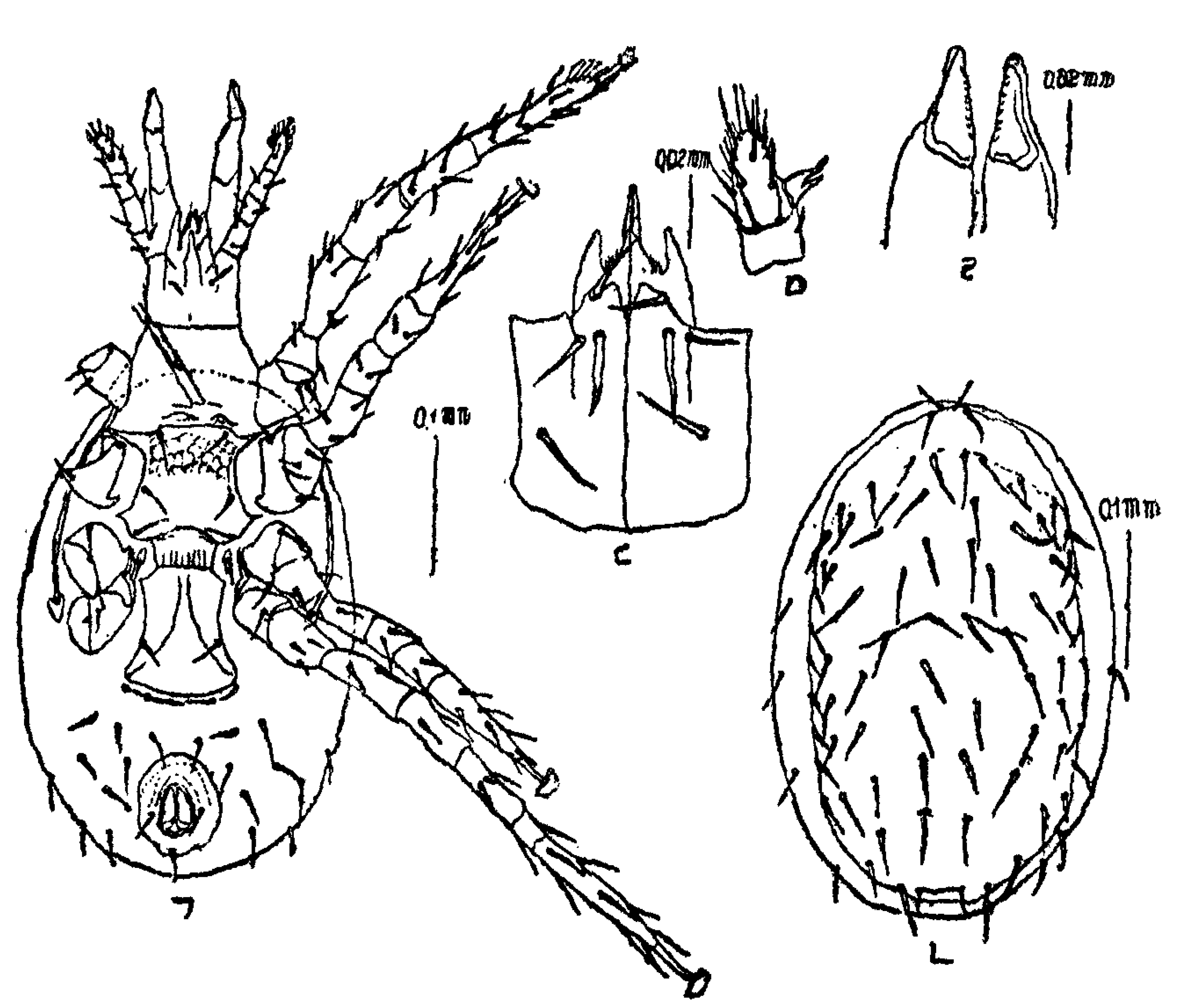
[Description] Female, body 0.308–0.416 mm long x 0.171–0.256 mm wide. Sternal shield relatively larger than other shields; anterior margin nearly straight and posterior margin concaved; three pairs of thin, acicular-shaped setae bearing on sternal shield. Genital shield slightly expanded at level of behind coxa IV; only a pair of setae (VI1 ) located on genital shield. Ventral setae VI2 and VI3 situated just beneath posterior margin of genital shield horizontally. Anal shield circular-shaped; anal orifice 1.5 times longer than para-anal setae. Metapodal plates absent. pretrematal plate relatively narrow (Fig. 16). Dorsal shield elongated, bearing 41 pairs of fine and long setae, with five pairs of medial setae; all length of setae subequal (Fig. 16). Structures of subcapitulum and cheliceral digits as in Fig. 16 (Table 2).
Download as
Min–Max
Mo
M ± m
σ
Standard–412
Dorsal shield
L
302–410
354
350 ± 5.9
25.8
342
M
171–256
202
206 ± 4.7
20.5
188
Sternla shield
L
68–92
85
80 ± 1.5
6.5
80
W
63–92
82
79 ± 3.3
13.4
80
St1 W
40–69
54
51 ± 1.6
6.7
51
St2 W
57–81
73
69 ± 0.2
1.8
69
St3 W
69–97
84
82 ± 1.9
8.5
80
Genital shield
L
97–139
106
116 ± 2.0
8.6
120
VI1 W
46–62
60
58 ± 0.9
4.1
57
Ma W
62–125
99
91 ± 1.5
6.5
80
Anal shield
L
57–91
70
69 ± 1.8
8.1
69
W
57–80
71
69 ± 1.4
6.1
69
This species looks simiar to Haemolaelaps Berlese by a pair of genital setae, laciniae of tritosternum not feather-shaped, peritrematal shield narrow and expanded as triangular-shaped. However, the shape and size of the sternal, genital shields, the presternal plate present, the anal shield circular-shaped, and the thin legs are different to Haemolaelaps.
This species belongs to Hypoaspis, based on the subcapitulum, cheliceral digits, shape and size of the sternal shield, and dorsal setation. However, compare to the other species, our new species have different shape of genital shield, anal shield, and number of dorsal setae.''
Notes — The name Hypoaspis kiminwani is a nomen nudum in Seo (1966). The description and illustrations appear in Seo and Che (1966, pages 42–43). This species was mentioned in Keum et al. (2016) in a list of Hypoaspis species in Korea without any extra information. Moraes et al. (2022) listed its name as a nomen nudum based on Seo (1966). This species is listed as Hypoaspis kimunwani* Seo (Laelaptidae) in Cho et al. (1995), Park et al. (2011) and NIBR (2024), and as Hypoaspis kiminwani in Edwards et al. (1974). The description and illustrations in Seo and Che (1966), show that this is a species of Proctolaelaps Berlese, 1923 (Melicharidae), based on the oval anal shield, enlarged anus, and axe-shaped genital shield. Seo (1983, page 99) includes an illustrated diagnosis of this species. We have not found any other published reference to this species.
''Haemolaelaps Berlese, 1910
14. H. minutus Seo et Che. sp. nov.
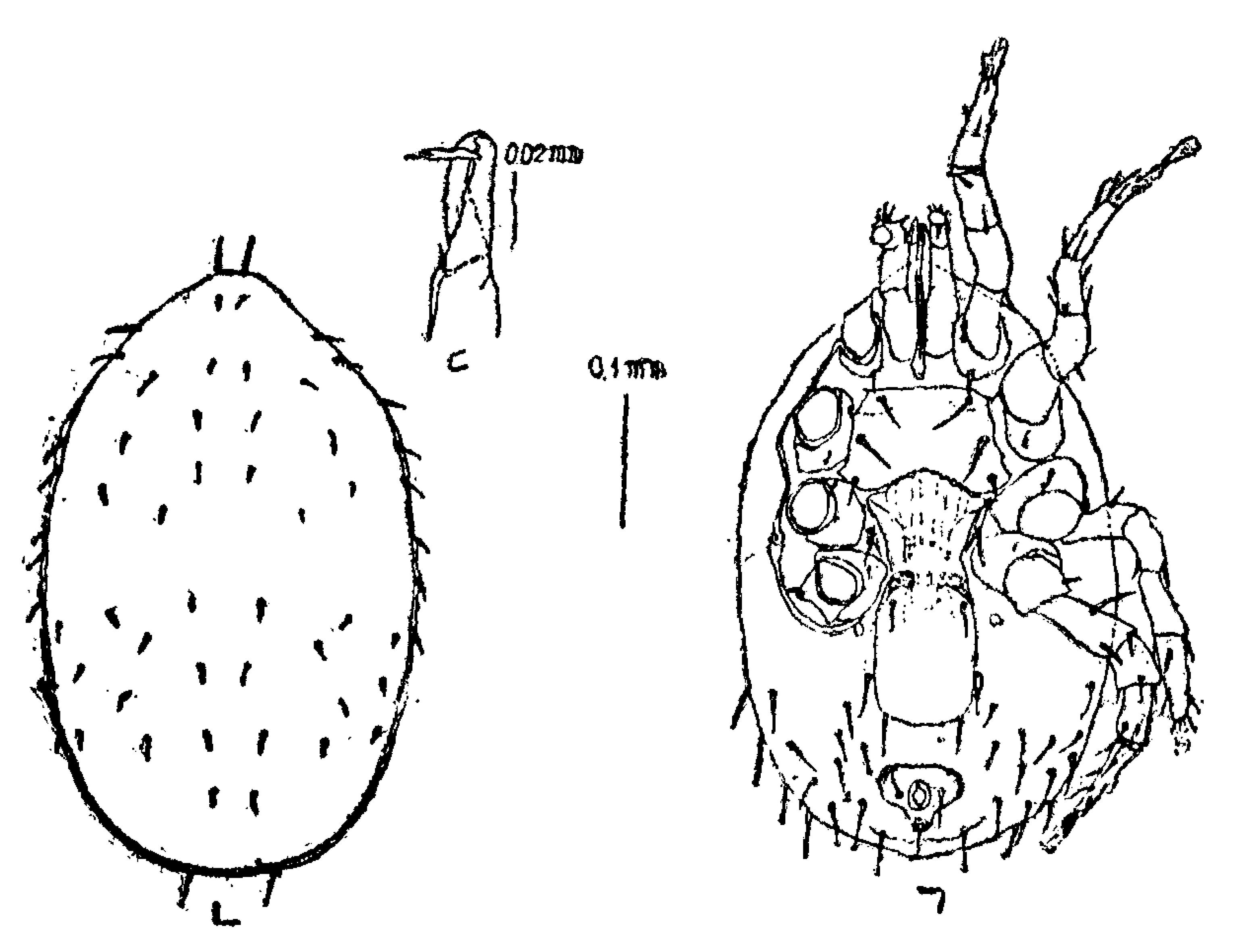
Collected: 1 individual.
Host: Apodemus agrarius.
Collection site: Pyeonggang-gun (1961, 4).
[Description] Female body 0.52 mm long x 0.273 mm wide. Anterior margin of sternal shield straight, anterolateral corners not projecting; posterior margin of sternal shield deeply concave; sternal shield bearing three pairs of fine and short setae. Genital shield not expanded, a pair of VI1 setae fine and short. Anal shield triangular-shaped, wider than long; anterior margin of anal shield straight, posterior part strongly narrowed. Metapodal plates small and circular-shaped. Peritrematal plates narrow, fused with parapodal plates posterior to coxa IV (Fig. 17). Dorsal shield large, egg-shaped; bearing 28 pairs of fine and short setae (Fig. 17). Cheliceral digit small; apical tip of fixed digit with two-tined transparent appendage. We do not provide specific measurements in this study.
This species looks like the genus Haemolaelaps based on the dorsal chaetotaxy and appendages and the shape of the cheliceral digits. However, this species can be distinguished by the shape of cheliceral appendage, and the chaetotaxy of the dorsal shield.''
Notes — The name Haemolaelaps minutus is a nomen nudum in Seo (1966). The description and illustrations appear in Seo and Che (1966, pages 43–44). The inflated pilus dentilis on the chelicera suggests that this species should probably be placed in Androlaelaps, following Shaw (2014). This species is not listed in the National Species List of Korea (NIBR 2024). We have not found any other published reference to this species.
''Dipolaelaps A. Zem. et Piont, 1960
15. D. koreicus Seo, sp. nov.
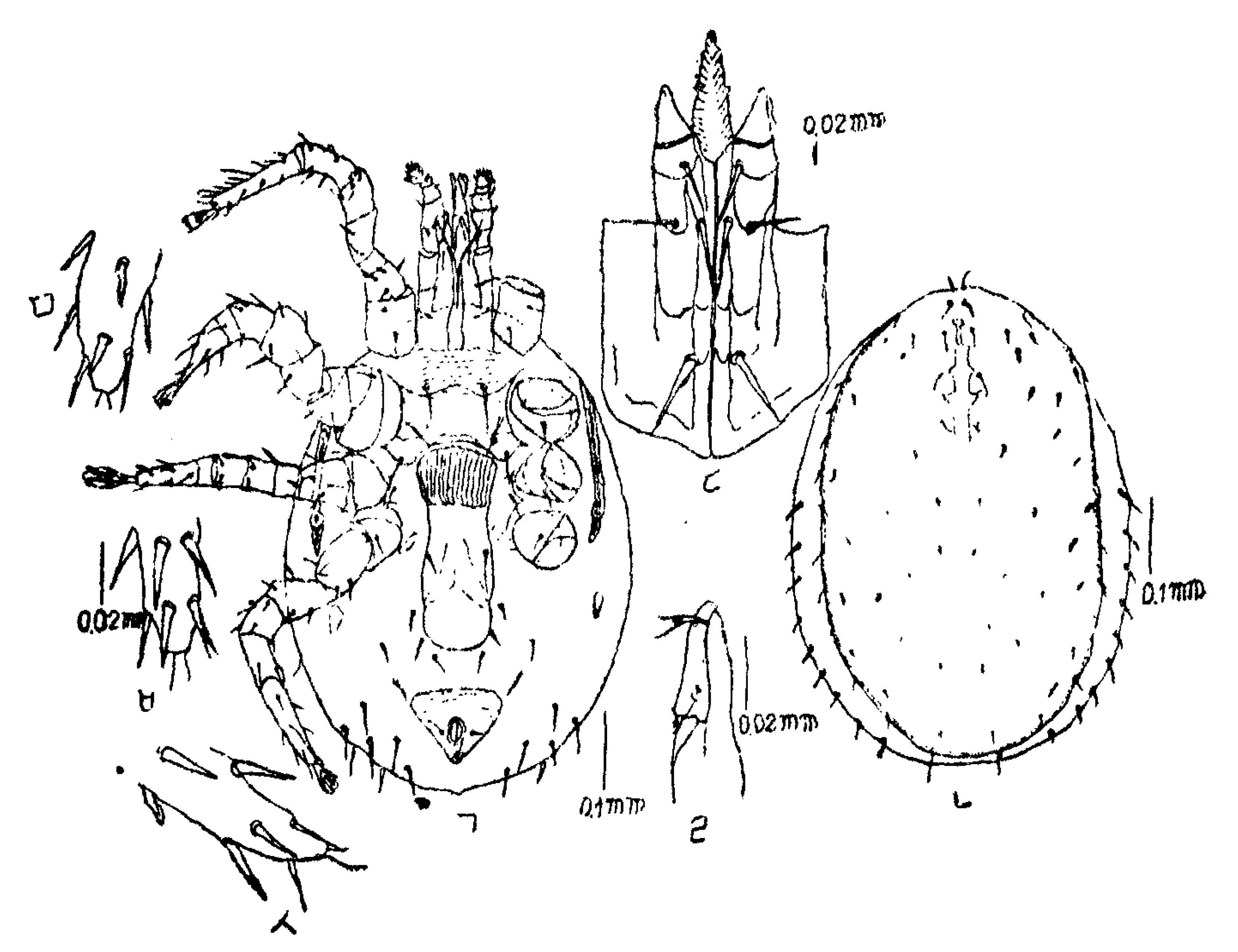
Collected: 1 individual.
Host: Tscherskia triton.
Collection site: Pyeonggang-gun.
[Description] Female body egg-shaped, 0.57mm long x 0.48mm wide. Length of sternal shield is 1/2 its width; anterior margin of sternal shield convex, posterior margin concave; two pairs of setae located on shield, st1 situated on the presternal region; all sternal setae fine and short (setal length is 1/2 length of sternal shield). Genital shield not expanded, only extended in length; genital shield with a pair of setae (VI1 ), five pairs of additional setae located on ventral integument. Anal shield triangular-shaped; anterior margin straight, width of anal shield wider than genital shield; para-anal setae shorter than anal orifice. Metapodal plates spindle-shaped. Peritrematal shield not expanded (Fig. 18). Dorsal shield with 39 pairs of short acicular-shaped setae; F1 and F3 slightly tickened, M11 longer than the others (Fig. 18). Corniculi short and stout, labrum thick and horn-shaped (Fig. 18). Fixed digit narrow, movable digit slightly wider than fixed digit and with three tiny teeth; fixed digit with two tined transparent appendages (Fig. 18). Tarsus II–IV with spine-like setae (Fig. 18).
Compare to this species and D. ubsunuris A. Zem. & Piont., 1960, number of leg setae and spine-like setae, shape of genital shield, shape of anal shield, and host are different.''
Notes — The name Dipolaelaps koreicus is a nomen nudum in Seo (1966). The description and illustrations appear in Seo and Che (1966, pages 43–45). This species was described in the genus Dipolaelaps Zemskaya & Piontkovskaya, 1960. It is similar to the type species Dipolaelaps ubsunuris Zemskaya & Piontkovskaya, 1960, but appears to differ in the shape of the anal shield. This species is listed as Dipolaelaps koreicus Seo (Laelaptidae) in Edwards et al. (1974), Cho et al. (1995), and Park et al. (2011). Seo (1983, page 89) includes an illustrated diagnosis of this species. We have not found any other published reference to this species.
''Liponyssidae Ewing, 1923 (=Macronyssidae Oudemans, 1936)
Hirstionyssus Fonseca, 1948 (= Liponyssus Kolenati, 1858)
16. Hi. musculoides Che et Seo, sp. nov.
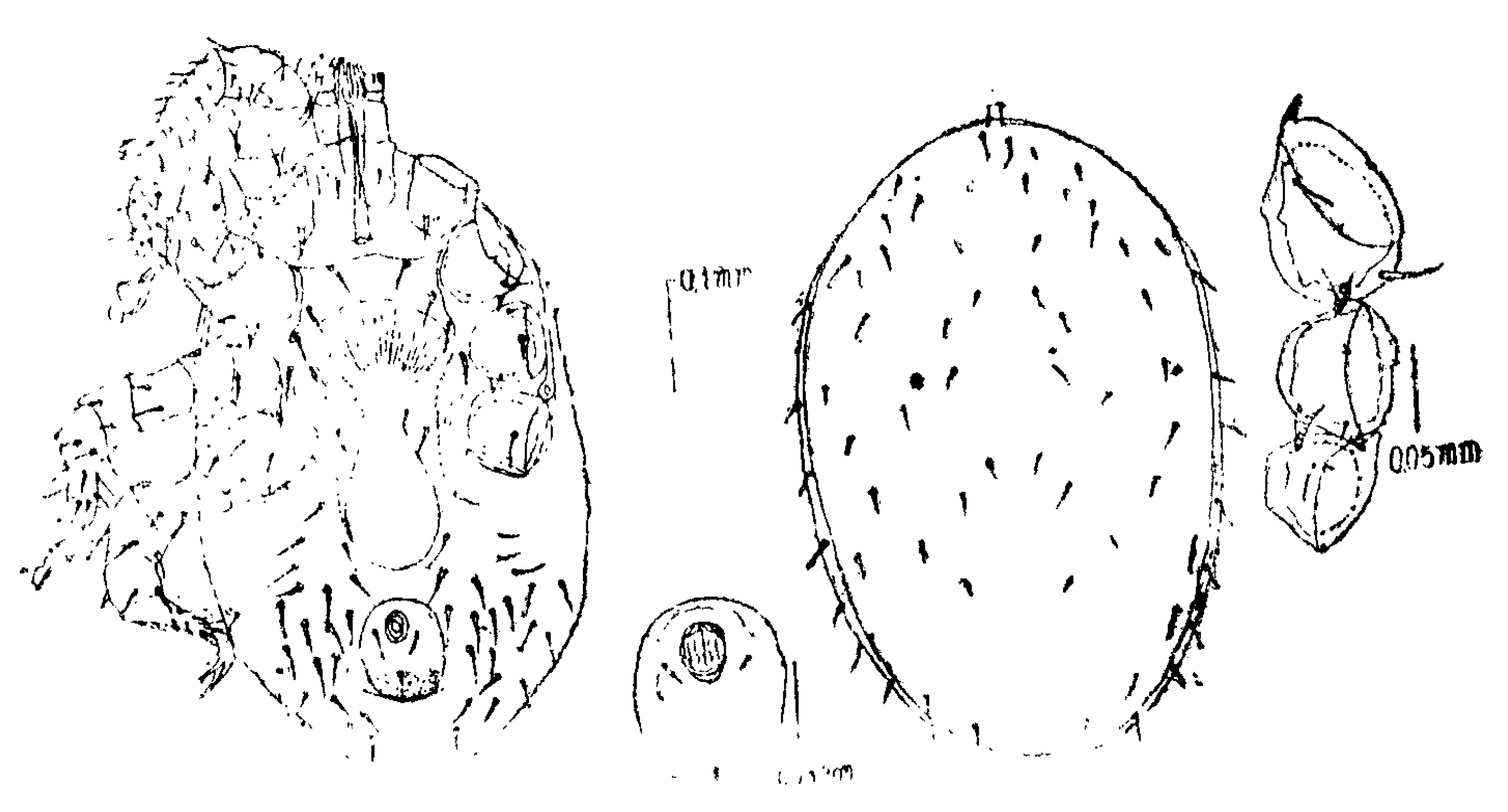
Collected: 43 individuals.
Host: Rattus norvegicus, Apodemus agrarius, Tscherskia triton, Microtus fortis, Crocidura lasiura.
Collection site: Gaesung-si, Gimhwa-gun, Cheolwon-gun, Pyeonggang-gun, Wonsan-si, Jangheung-ri, Yousun-gun, Onsung-gun.
[Description] Female body 0.512–0.541 mm long x 0.285–0.320 mm wide. Length of sternal shield slightly longer than Hi. musculi. Anal shield egg-shaped. The other characteristics are the same as in Hi. musculi (Fig. 19). Dorsal shield expanded oval-shaped, 26 pairs of setae located on shield (Fig. 19). Coxae IV without setae or not observed, coxae I–III with the same number of setae as in Hi. musculi (Fig. 19). We do not provide specific measurements in this study
We compared our new species and Hi. musculi that we also collected from the field. Setation of coxae, shape of anal shield, and shape of dorsal shields are very different. Here, we provide a measurement table between those two species (Table 3). The dorsal shield and anal shield are completely different between two species.
Download as * The stastistic referred to is c = M1 – M2 / √ (m12 + m22)
Hi. musculi M ± m
Hi. musculoides M ± m
Statistic*
Notes
Dorsal shield
L
536 ± 3.50
526 ± 3.20
2.11
Positive
W
308 ± 0.60
293 ± 3.90
3.7
Positive
Sternal shield
L
40 ± 0.72
43 ± 1.63
1.68
Negative
W
119 ± 1.31
121 ± 1.65
0.95
Negative
Genital shield
L
245 ± 1.66
288 ± 2.73
2.19
Positive
W
100 ± 0.80
102 ± 1.65
1.09
Negative
Anal shield
L
98 ± 1.42
90 ± 1.05
4.6
Positive
W
74 ± 0
80 ± 0.00
0
Negative
Additionally, this species can also be compared with Hi. musculi that were described by Bregetova; Ryu Kukbun; Beom Jongmoon. Among the recently described species, Hi. pavlovskii A. Zemskaya is also different in size and chaetotaxy of the dorsal shield.''
Notes — The name Hirstionyssus musculoides is a nomen nudum in Seo (1966). The description and illustrations appear in Seo and Che (1966, pages 45–46). Seo (1966) and Seo and Che (1966), placed the genus Hirstionyssus in the family Liponyssidae. However, Hirstionyssus is placed in the Laelapidae in current taxonomy (Tenorio and Radovsky 1979; Krantz and Walter 2009; Moraes et al. 2022). This species is listed as Hirstionyssus musculoides Seo (Laelaptidae) in Cho et al. (1995) and Park et al. (2011), and as Hirstinyssus (sic) musculoides in Edwards et al. (1974). Seo (1983, page 145) includes an illustrated diagnosis of this species. We have not found any other published reference to this species.
''Ichoronyssus Kolenati, 1858 (=Lepronyssus Kolenati, 1858; = Spinolaelaps Radford, 1940; = Chiroptonyssus Auguston, 1945)
17. I. koreicus Seo, sp. nov.
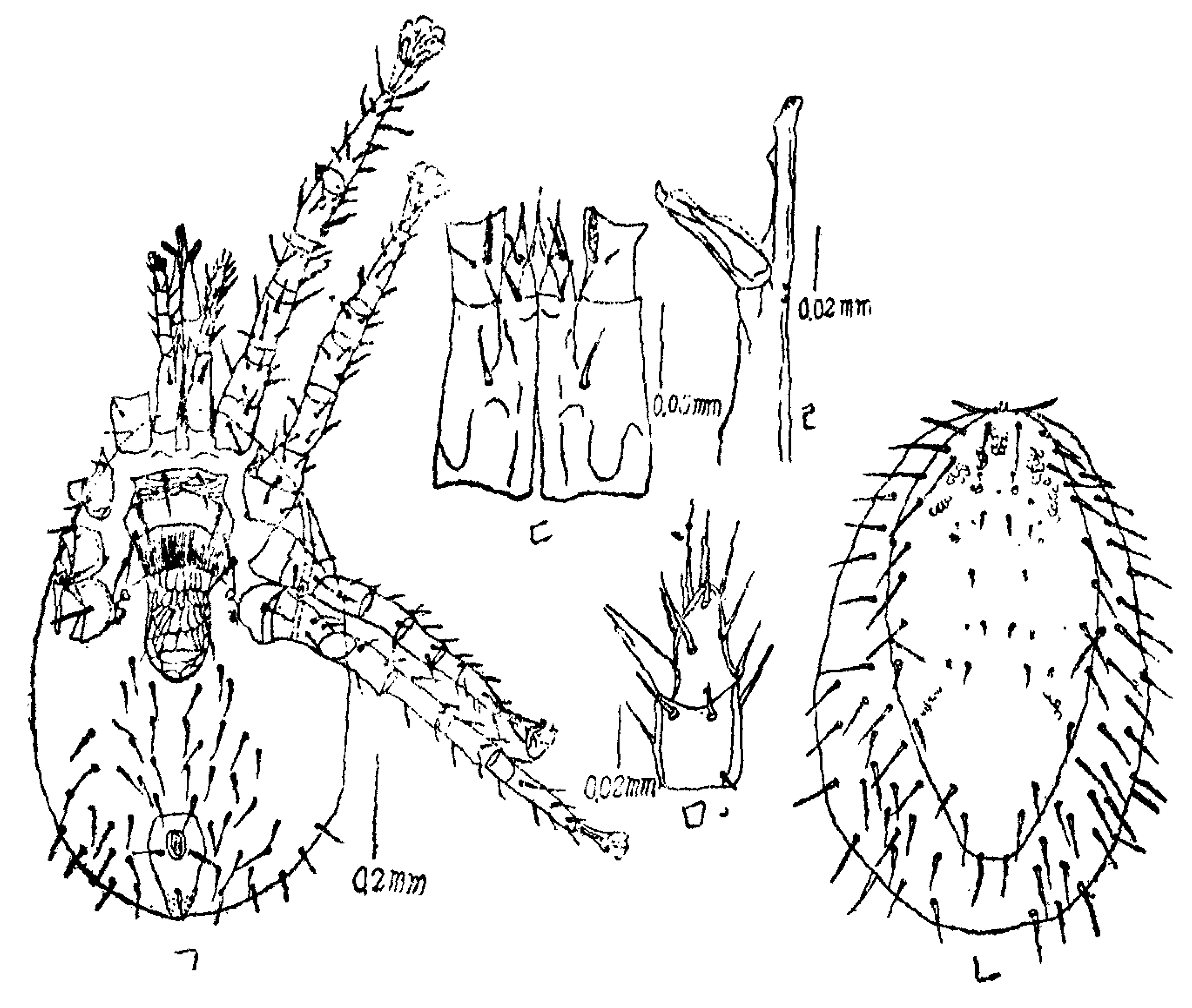
Collected: 5 individuals.
Host: Nyctalus noctula.
Collection site: Sangwon-gun (1962, 2).
[Description] Female 1.048 mm–1.603 mm long x 0.684 mm–1.138 mm wide. Sternal shield with three pairs setae, all setae shorter than sternal shield length; anterior margin nearly straight, posterior margin concaved; width of sternal shield almost twice of its length. Genital shield short, far apart from anal shield; anterior margin covered with round hyaline membrane, posterior margin round. Anal shield elongated pear-shaped, para-anal setae longer than anal orifice. 19 pairs of setae bearing on ventral soft cuticle. Peritrematal plates not enlarged. Tiny spine situated on Coxa II (Fig. 20). Dorsal shield elongated, tapered posteriorly; 22 pairs of various sized setae bearing on shield, D1–D6 tiny, others thin and elongated (Fig. 20). Shape of subcapitulum and cheliceral digit described as in Fig. 20; transparent wave-like membranous structure present on movable digit. In male, 0.63 mm long x 0.45 mm wide. Ventral shield divided into two parts, five pairs of setae on anterior part, six pairs of setae on posterior part (asymmetric setal position) (Fig. 21). Dorsal shield same as in female. Cheliceral digit sissor-shaped, spermatodactyl moderate (Fig. 21). We do not provide specific measurements in this study.
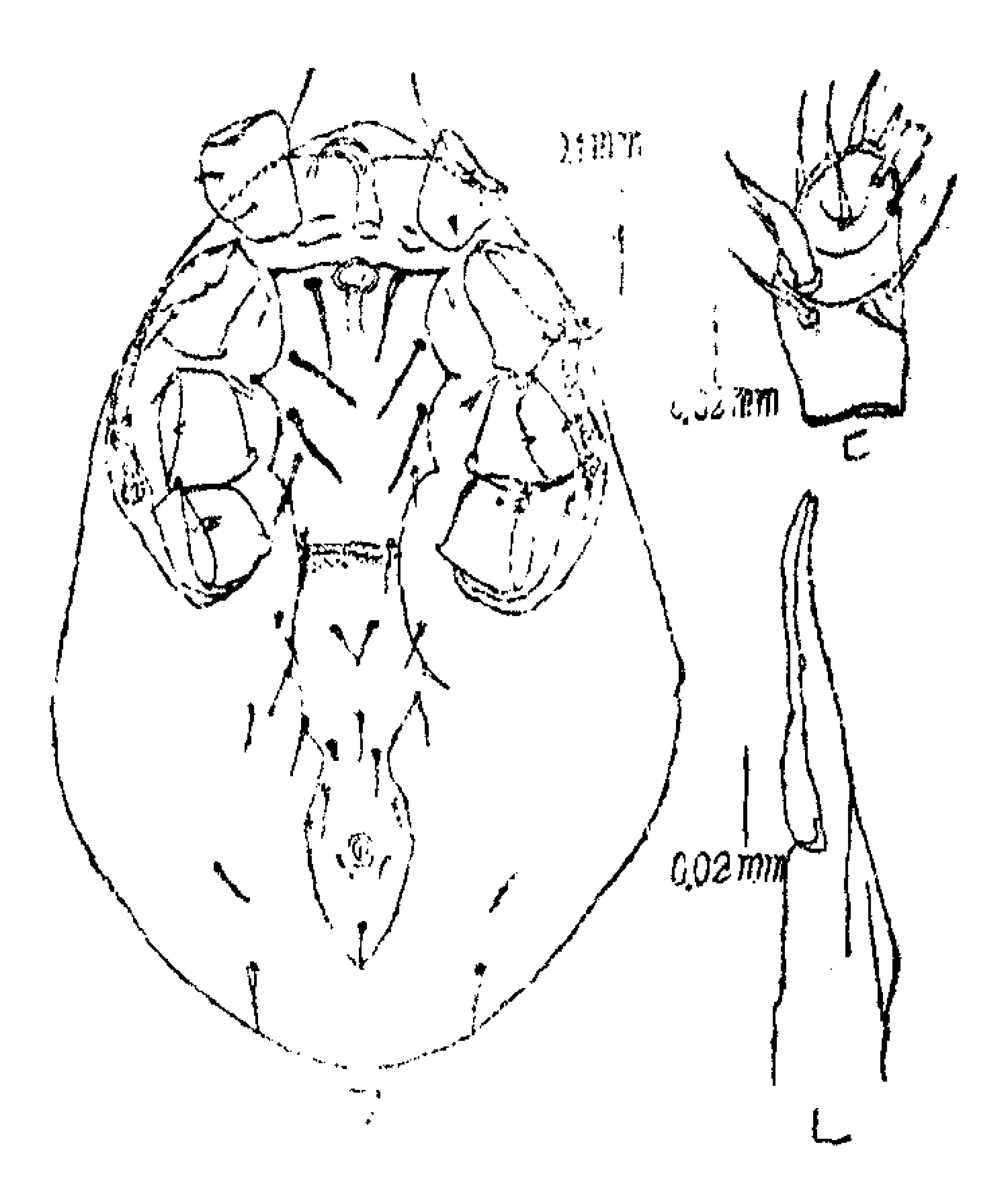
This species is fairly different from I. flavus (Kol., 1858), which is designated as the type species of its genus based on the shape of the sternal shield, shape and number of ventral setae, number and position of ventral setae of the male, and structure of the cheliceral digit. According to Won Heung Gu, their host, Nyctalus noctula is distributed in the Korean peninsula, the northeastern part of China, downstream of the river. Jang-gang, and Japan. For these reasons, we can assume that this species has a restricted distribution. And also, no other species of the genus Ichoronyssus have been reported yet.''
Notes — The name Ichoronyssus koreicus is a nomen nudum in Seo (1966). The description and illustrations appear in Seo and Che (1966, pages 46–47). Seo (1966), placed the genus Ichoronyssus in the family Liponyssidae, but Ichoronyssus is placed in the Macronyssidae in the current taxonomy (Radovsky, 1966). This species is listed as Ichoronyssus koreicus Seo (Macronyssidae) in Cho et al. (1995) and Park et al. (2011). Seo (1983, page 147) includes an illustrated diagnosis of this species. We have not found any other published reference to this species. The paper cited as Auguston (1945) is Augustson (1945).
''Spinturnicidae Oudemans, 1901
Spinturnix Heyden, 1826 (= Pteroptus Dufour, 1832; = Diplostaspis Kolenati, 1857)
18. S. aviaton Seo sp. nov.
Collected: 1 individual.
Host: Nyctalus aviator.
Collection site: Sangwon-gun (1962, 2).
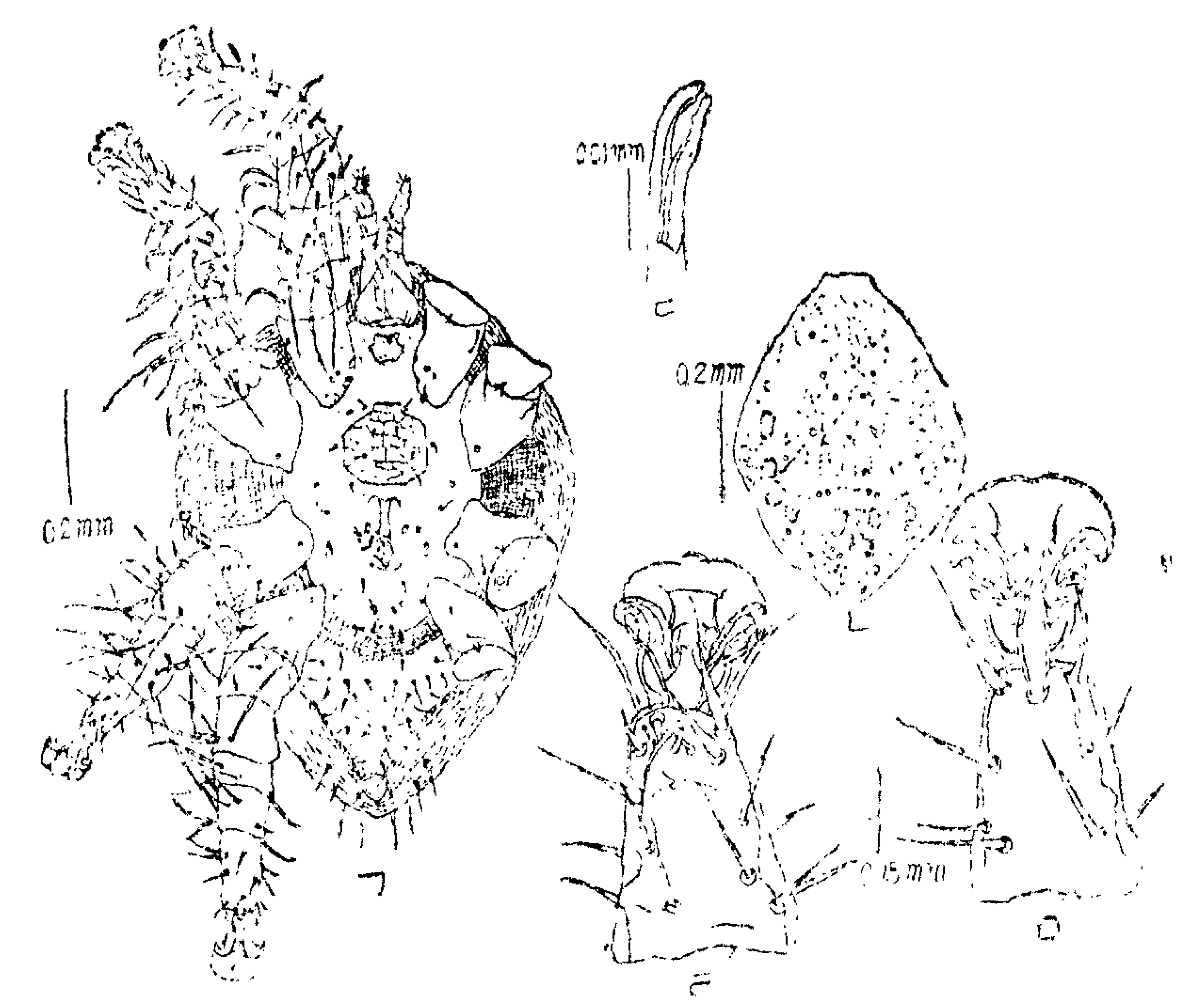
[Description] Female body 1.083 mm long x 0.730 mm wide. Tritosternum polygonal-shaped. Sternal shield octagonal-shaped with small projection on the anterior margin, located between coxae II, all margins straight; sternal setae (st1–st3) located on soft cuticle, only bearing two pairs of pores on sternal shield; metasternal shield absent, Mst located far from sternal shield. Genital shield small and narrow without setae on surface, setae VI1 –VI4 located on soft cuticle. Ventral shield absent; small, elongated metapodal plates located between coxae III. Anal shield cylindrical-shaped with three short anal setae near shield. Many short setae located between coxae IV, four pairs of setae located on posterior part of body. Peritrematal shield extended to level of anterior margin of coxa III and slightly bent ventrally. Ventral soft cuticle and all coxae with orange-coloured, circular-shaped swellings (Fig. 22). Dorsal shield similar to the male of S. vespertilionis, without dorsal setae but with 11 pairs of orange-coloured swellings (Fig. 22). Gnathosoma small, nearly triangular-shaped; cheliceral digits scissor-shaped, narrow, with tiny single tooth (Fig. 22). Tarsus I–IV with thick and stout setae; pulvilli large, claws anchor-shaped (Fig. 22).
Our new species is similar to the type species of its genus S. vespertilionis Linne (female), based on the peritremes, anal shield, and legs. However, the setal position and the shape of the sternal and genital shields are fairly different. For those reasons, herein we describe this species as a new species. In the references the authors mentioned only males, not females. We collected 9 females and 11 males from the Susa Cave in Sangwon-gun in Feb. 1962 (it will be published separately).''
Notes — The name Spinturnix aviaton is a nomen nudum in Seo (1966). The description and illustrations appear in Seo and Che (1966, page 47). Seo (1983, page 165) includes an illustrated diagnosis of this species. Beron (2020) referred to this species as ''species dubia''. We have not found any other published reference to this species.
''Microspinturnix Seo, gen. nov.
19. M. koreicus Seo, sp. nov.
Collected: 1 individual.
Host: Murina sp.
Collection site: Sangwon-gun (1962, 1).
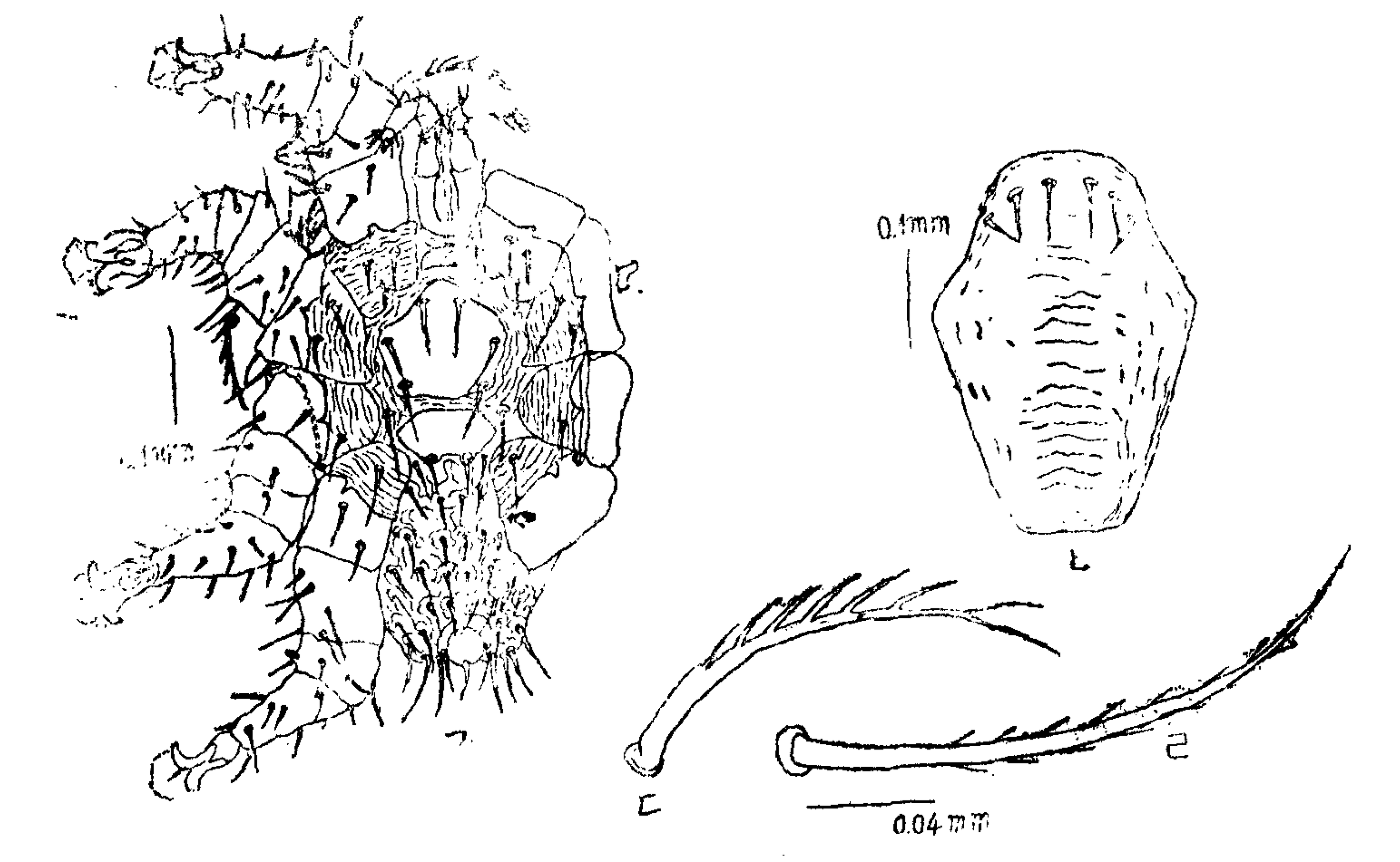
[Description] Female body 0.558 mm long x 0.342 mm wide. Tritosternum rectangular-shaped, twice as wide as long. Sternal shield large, pentagonal-shaped, with three pairs of thick and elongtaed setae; metasternal shield absent, only Mst located on soft cuticle; length and shape of all sternal setae similar. Genital shield moderate-sized, twice as wide as long, hexogonal-shaped; anterior and posterior margins straight, a pair of setae located on posterior corners. Anal shield circular-shaped, three anal setae longer than shield. With 14 pairs of fine and short setae located between coxae IV; four pairs of slightly longer and thick setae located in posterior part of body (Fig. 23). Dorsal shield irregular, hexagonal-shaped; anterior and posterior margins straight, three pairs of stout setae located on anterior margin without swellings (Fig. 23). All legs thick and robuste, leg setae fine and short (Fig. 23); three setae located on coxa I and coxa II; a long pectinated seta located on dorsal portion of femur I–II; femur I with additional bipectinated seta (Fig. 23). Other leg's characteristics same as in S. aviaton sp. nov.
This new species belongs to Spinturnicidae based on the leg chaetotaxy, shape of the claws and pulvilli, and the size of the peritrematal shield. However, the body size, shape of the dorsal shield, dorsal chaetotaxy, length of the leg setae, the pectinated setae on femur I–II, and shape and chaetotaxy of the ventral shield are fairly different from the genus Spinturnix which is designated as type genus of the family. For those reasons, we report this species as a new species and also establish a new genus.''
Notes — The names Microspinturnix and Microspinturnix koreicus are nomina nuda in Seo (1966). The description and illustrations appear in Seo and Che (1966, pages 47–48). Seo (1983, page 166) includes an illustrated diagnosis of this species. Beron (2020) referred to this species as follows – ''A new genus and species, Microspinturnix koreicus, recorded from North Korea by Seo Tai Whan (1966), also seems undescribed (described in Korean in Sen Tai Whan and Chai Tak Jen, 1966, p.47–48).'' It is correct that this name appeared without a description in Seo (1966), but the species was described in Seo and Che (1966). We have not found any other published reference to this species.
Additional taxa listed in Seo (1983)
Most of the species of Mesostigmata listed in Seo (1983) are referred to above, in the analysis of Seo (1966) and Seo and Che (1966). However, Seo (1983) adds illustrated redescriptions of some species that are not mentioned in Seo (1966) and Seo and Che (1966), based on collections from the Democratic People's Republic of Korea – Macrocheles decoloratus (C.L. Koch, 1840a); Macrocheles muscaedomesticae (Scopoli, 1772); Haemogamasus liponyssoides Ewing, 1925; Haemogamasus kitanoi Asanuma, 1948; Hypoaspis heselhausi Oudemans, 1912; Haemolaelaps semidesertus Bregetova, 1952; Haemolaelaps androgynus Bregetova, 1952; Eulaelaps cricetuli Vitzthum, 1930; Laelaps agilis C.L. Koch, 1836; Laelaps jettmari Vitzthum, 1930; Laelaps micromydis (Zachvatkin, 1948); Hirstionyssus criceti (Sulzer, 1774); Hirstionyssus blanchardi (Trouessart, 1904); Hirstionyssus eusoricis (Bregetova, 1956); Hirstionyssus eversmanni Zemskaja, 1955; Sauronyssus saurarum (Oudemans, 1902); Ophionyssus natricis (Gervais, 1844).
Seo (1983) also includes illustrated descriptions of a new genus and two new species that he placed in the Phytoseiidae. We here present translations of those descriptions, followed by our Notes as before.
Genus Phytoseus*
Sternal shield small and relatively square shape. Dorsal setae short. Anterior margin of ventrianal shield convex; ventral setae short. 19 pairs of dorsal setae located on shield.
Phytoseus* koreicus Seo, 1966
[Shape] Egg-shaped body, yellowish colour.
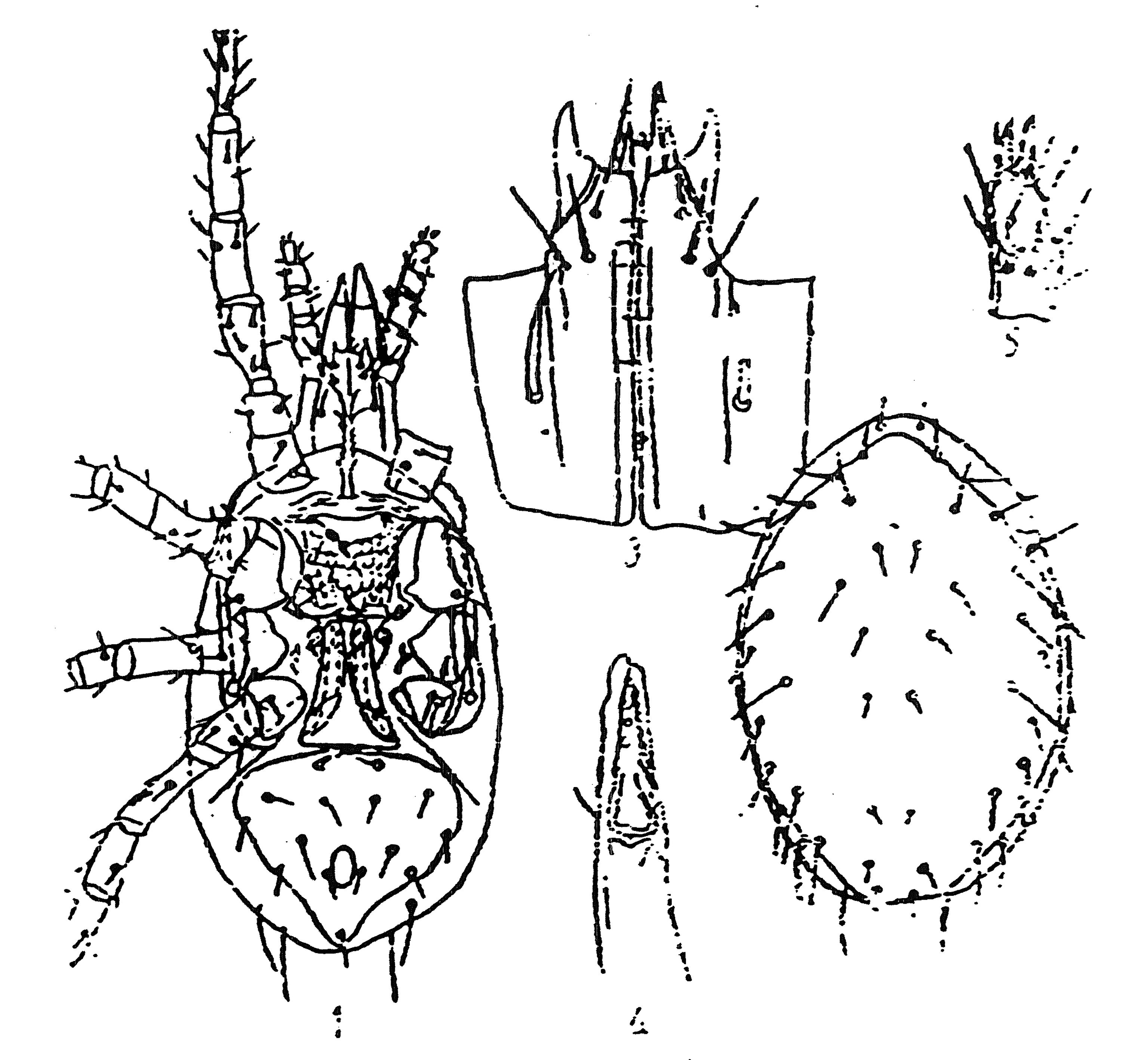
Female: Body 0.43–0.46 mm long x 0.28–0.30 mm wide. Length of sternal shield nearly equal to or slightly wider than width; mid-region of anterior margin concave, posterior margin straight; three pairs of fine and short setae located on sternal shield; well-sclerotised metasternal shield oval-shaped; covered with punctate pattern, bearing a fine seta. Genital shield small; anterior region covered with indistinct hyaline margin, posterior margin straight and broad (twice as wide as anterior margin); a pair of fine and small setae located on its surface. Ventrianal shield large; anterior region round, broad, and gradually tapered, posterior tip pointed; six pairs of ventral setae and three anal setae located on its surface, para-anal setae shorter than anal orifice, post-anal seta much longer and far apart from the orifice. A pair of narrow and elongated ridges located between coxa IV and anterolateral margin of ventrianal shield. Peritrematal plates arise and curved around coxa IV. Short, feather-like setae located on posterior part of dorsum. Mid-sternal setae long, feather-like. Dorsal shield not covereing entire dorsum; anterior margin pointed, both lateral margins parallel; 19 pairs of setae located on shield, D1, D3, D4, D7, D8, and S8 (inner dorsal setae) especially short. Cheliceral digits moderate-sized; corniculi robust; deutosternal grooves with tiny teeth; four pairs of hypostomal setae relatively long. Palp apotele two-tined. Legs thin and elongated, all inner parts of coxae projecting (Fig. 32).
[Ecology] Attached to the body surface of Rattus norvegicus and Apodemus agrarius.
Notes — This species was mentioned in Seo (1966) as ''Phytoseiidae Gen. sp. II''. It was not named there, so the name Phytoseus* koreicus has the authorship Seo, 1983, not Seo, 1966. We presume the intended genus was Phytoseius Ribaga, 1902, but the shape of the ventral shields and the presternal region show this species cannot be a Phytoseiid. It is more reasonable to suggest it is a Lasioseius Berlese, 1916 (Blattisociidae).
Genus Cheylephytoseus
Sternal shield square-shaped, both anterior and posterior margins straight, all corners blunt; two pairs of setae on shield. Genital shield bell-shaped or lampshade-shaped. Length and width of ventrianal shield subequal, a few tiny ventral setae; setae posterior to anus feather-like. Dorsal shield egg-shaped, relatively large, and bearing 18 pairs of feather-like setae except S8 (not feather-like and relatively tiny).
Cheylephytoseus koreicus Seo, 1966
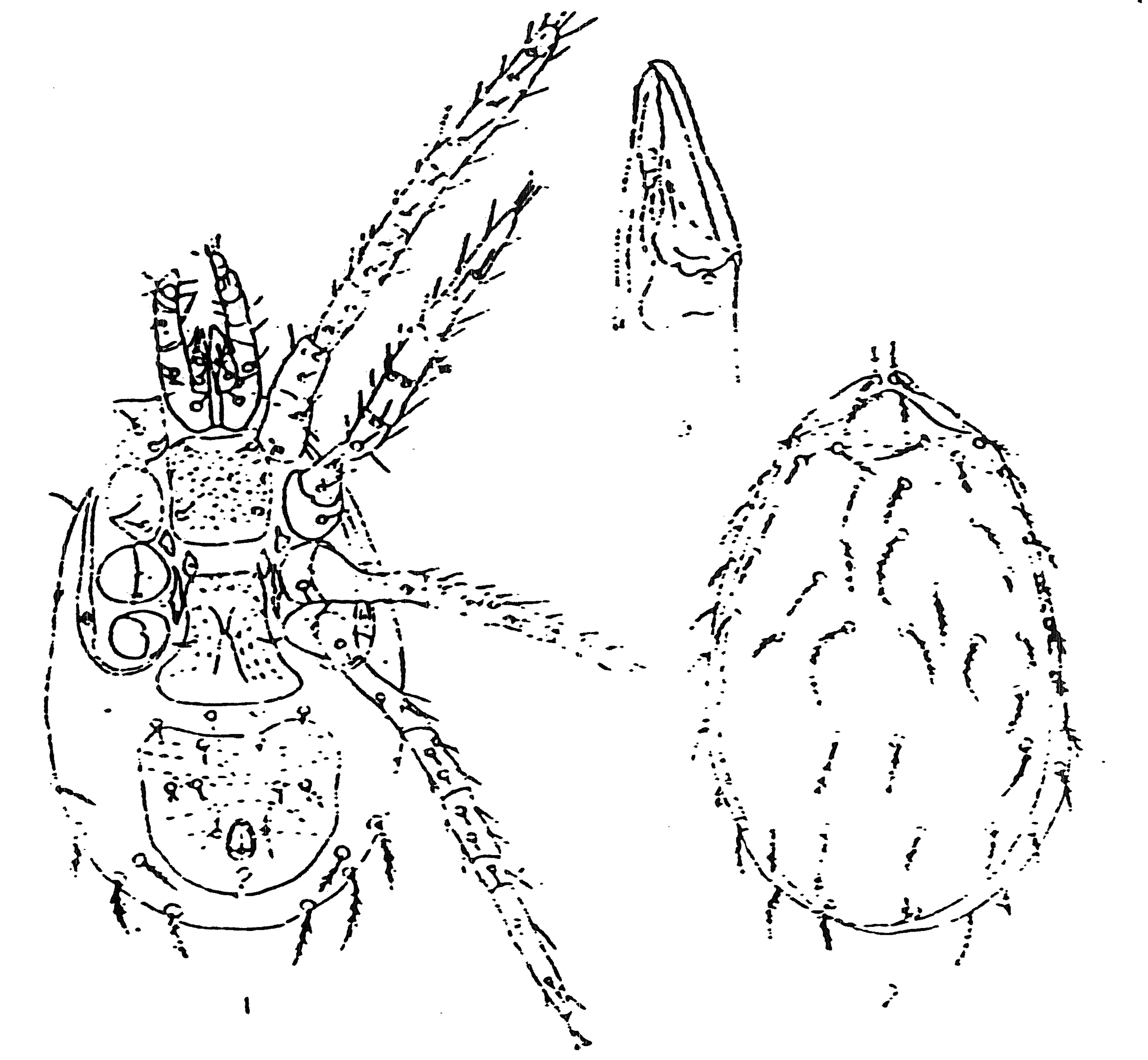
[Harm] Unknown
[Shape] Egg-shaped body, yellowish colour
Female: Body 0.38–0.43 long x 0.25–0.28 wide. Sternal shield square-shaped, both anterior and posterior margins straight, all corners rounded; sternal shield covered with reticulations, two pairs of tiny setae located on surface, st1 missing; well-sclerotised metasternal shield rhombus-shaped, with a pair of small setae. Endopodal plates II/III triangular-shaped. Genital shield bell-shaped or elongated lampshade-shaped, posterior margin straight, shield gradually expanded at level of genital setae (twice as wide as anterior margin). Ventrianal shield slightly separated from genital shield; length and width nearly subequal, square-shaped; mid-region of anterior margin slightly concaved, posterior margin round; three pairs of tiny ventral setae and three anal setae locatyed on its surface. Para-anal setae shorter than anal orifice, post-anal setae large, feather-like. Two pairs of thin and small ventral setae bearing between genital and ventianal shield horizontally. A pair of large, feather-like setae on outer region of ventrianal shield, plus other posterior ventral setae. Peritrematal plates not enlarged. Mid-dorsal setae feather-shaped and small. Dorsal shield egg-shaped; anterior margin pointed forward; 18 pairs of setae located on shield; only S8 very small, other dorsal setae thick, elongate, feather-shaped. Cheliceral digit moderate-sized. Legs long and thin (Fig. 33).
Male: Body 0.38 mm long x 0.24 mm wide. Ventral idiosoma with two enlarged shields. Sternal shield long rectangular-shaped, genital orifice located on anterior margin, posterior margin straight; four pairs of small setae located on shield, metasternal setae absent. Ventrianal shield broadly expanded with round anterior margin; surface covered with reticulations, three pairs of fine and small ventral setae plus three anal setae located on shield; para-anal setae tiny, post-anal setae also tiny or slightly smaller than para-anal setae; anal orifice large. Peritrematal plates slightly expanded. A pair of small ventral setae located between sternal and ventrianal shields; a pair of thick, feather-like setae situated on posterior part of body. Mid-dorsal setae small, acicular-shaped. Dorsal shield as in female. Corniculi not pointed but trifurcated. Brush-like spermatodactyl fused with movable digit. Palp digit with two-tined apolete (Fig. 34).
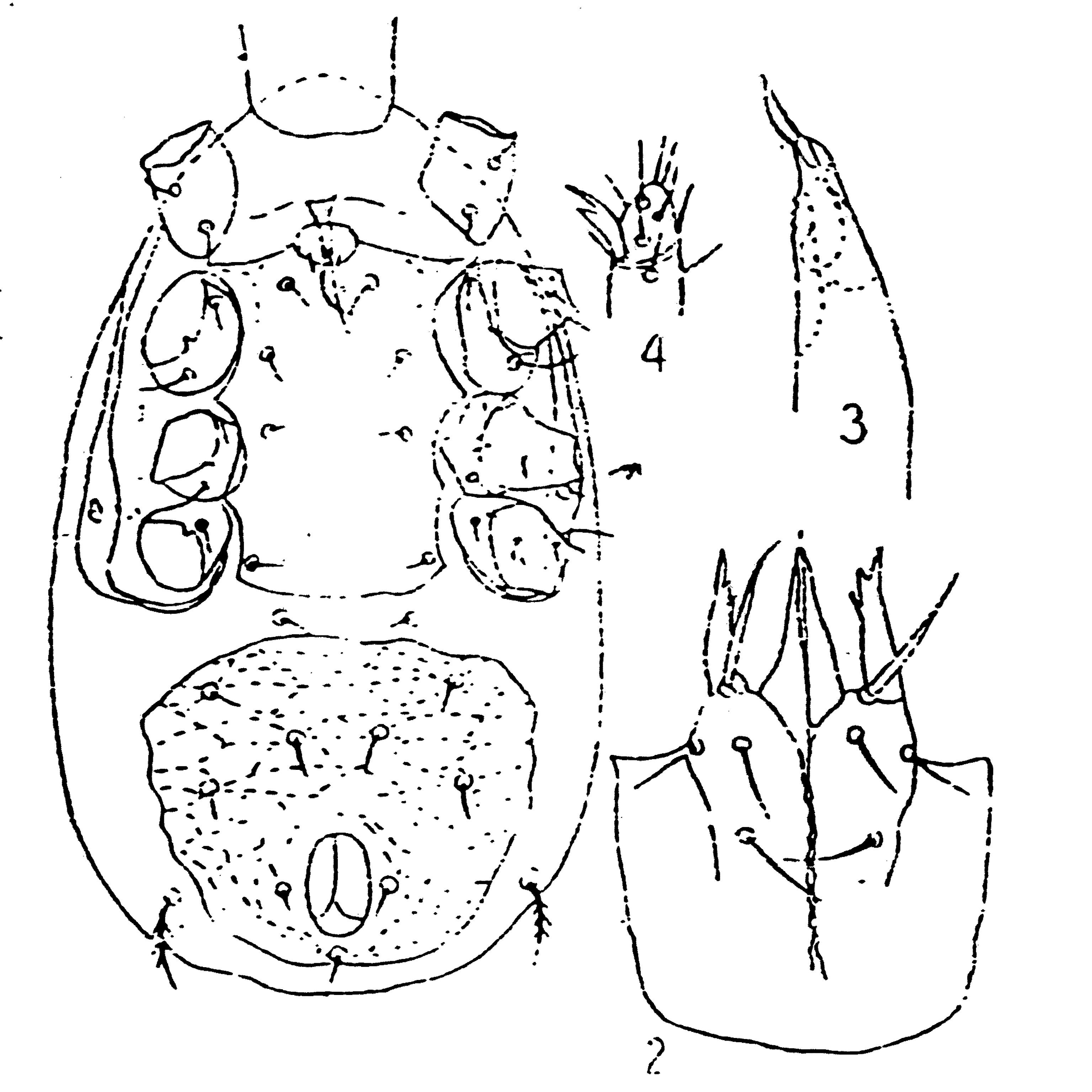
[Ecology] This species is found in the nest of rodents. It can be observed through April to November, but is most frequent in September. The hosts are Rattus norvegicus, Apodemus agrarius, and Microtus fortis.
Notes — This species was mentioned in Seo (1966) as Phytoseiidae Gen. sp. I. It was not named there so its authorship is Seo, 1983, not Seo, 1966. Seo (1983) describes the new genus Cheylephytoseus, with type species Cheylephytoseus koreicus by monotypy. The genus was described in the family Phytoseiidae. The presence of two pairs of sternal setae (female), divided corniculi (male), and strongly plumose dorsal setae (both sexes) indicate that this species belongs to the Ameroseiidae, but it is not possible to identify it to the genus level on the basis of the available information.
Download as
Family (Seo and Che)
Species (Seo and Che)
Seo (1966)
Seo & Che (1966)
Seo (1983)
Current placement
Figure
Laelaptidae
Androlaelaps pavlovskii Bregetova, 1955
cited
cited
diagnosed
Laelapidae
nil
Euandrolaelaps
Ascaidae
Asca gouvensis Seo & Che, 1966
nomen nudum
described
diagnosed
Ascidae
4
(as goudensis)
(as goubensis)
Asca
Laelaptidae
Cosmolaelaps koreicus Che & Seo, 1966
nomen nudum
described
diagnosed
Laelapidae
13, 14
Stratiolaelaps?
Dermanyssidae
Dermanyssus gallinae de Geer, 1778 (as Redi, 1674)
cited
not cited
diagnosed
Dermanyssidae
nil
Dermanyssus
Laelaptidae
Dipolaelaps koreicus Seo, 1966
nomen nudum
described
diagnosed
Laelapidae
18
Dipolaelaps
Parasitidae
Eugamasus oudemansi Berlese, 1903
cited
cited
diagnosed
Parasitidae
nil
Vulgarogamasus
Laelaptidae
Eulaelaps cricetuli Vitzthum, 1930
not cited
not cited
diagnosed
Laelapidae
nil
Eulaelaps
Laelaptidae
Eulaelaps stabularis (C.L. Koch, 1836)
cited
not cited
diagnosed
Laelapidae
nil
Eulaelaps
Ascaidae
#Eurygamasus koreicus Seo & Che, 1966
nomen nudum
described
diagnosed
Ologamasidae?
7
Ascaidae
Euryparasitus emarginatus (C.L. Koch, 1839)
cited
cited
diagnosed
Ologamasidae
nil
Euryparasitus
Ascaidae
Euryparasitus zeongzuensis Che & Seo, 1966
nomen nudum
described
diagnosed
Ologamasidae
5, 6
Euryparasitus
Macrochelidae
#Geholaspulus wonsanensis Che & Seo, 1966
nomen nudum
described
not cited
Parholaspididae
11
Parholaspis?
Haemogamasidae
Haemogamasus dauricus Bregetova, 1950
cited
cited
diagnosed
Laelapidae
nil
Haemogamasus
Haemogamasidae
Haemogamasus kitanoi Asanuma, 1948
not cited
not cited
diagnosed
Laelapidae
nil
Haemogamasus
Haemogamasidae
Haemogamasus liponyssoides Ewing, 1925
not cited
not cited
diagnosed
Laelapidae
nil
Haemogamasus
Haemogamasidae
Haemogamasus mandchuricus Vitzthum, 1930
cited
cited
diagnosed
Laelapidae
nil
Haemogamasus
Haemogamasidae
Haemogamasus serdjukovae Bregetova, 1949
cited
cited
diagnosed
Laelapidae
nil
Haemogamasus
Laelaptidae
Haemolaelaps androgynus Bregetova, 1952
not cited
not cited
diagnosed
Laelapidae
nil
Androlaelaps androgynus
Laelaptidae
Haemolaelaps casalis (Berlese, 1887)
cited
cited
diagnosed
Laelapidae
nil
Androlaelaps
Laelaptidae
Haemolaelaps glasgowi (Ewing, 1925)
cited
not cited
diagnosed
Laelapidae
nil
Androlaelaps
Laelaptidae
Haemolaelaps minutus Seo & Che, 1966
nomen nudum
described
not cited
Laelapidae
17
Androlaelaps?
Laelaptidae
Haemolaelaps razumovae Bregetova, 1952
cited
cited
diagnosed
Laelapidae
nil
Androlaelaps
Laelaptidae
Haemolaelaps semidesertus Bregetova, 1952
not cited
not cited
diagnosed
Laelapidae
nil
Androlaelaps semidesertus
Liponyssidae
Hirstionyssus blanchardi (Trouessart, 1904)
not cited
not cited
diagnosed
Laelapidae
nil
Echinonyssus
Liponyssidae
Hirstionyssus criceti (Sulzer, 1774)
not cited
not cited
diagnosed
Laelapidae
nil
Echinonyssus
Liponyssidae
Hirstionyssus eusoricis (Bregetova, 1956)
not cited
not cited
diagnosed
Laelapidae
nil
Echinonyssus
Liponyssidae
Hirstionyssus eversmanni Zemskaja, 1955
not cited
not cited
diagnosed
Laelapidae
nil
Echinonyssus
Liponyssidae
Hirstionyssus isabellinus Oudeman, 1913
cited
not cited
diagnosed
Laelapidae
nil
Echinonyssus
Liponyssidae
Hirstionyssus musculi (Johnston, 1849)
cited
cited
diagnosed
Laelapidae
nil
Echinonyssus
Liponyssidae
Hirstionyssus musculoides Che & Seo, 1966
nomen nudum
described
diagnosed
Laelapidae
19
Echinonyssus
Laelaptidae
Hyperlaelaps arvalis (Zachvatkin, 1948)
cited
cited
diagnosed
Laelapidae
nil
Hyperlaelaps microti
Laelaptidae
Hypoaspis aculeifer (Canestrini, 1883)
cited
cited
diagnosed
Laelapidae
nil
(as aculeiper)
Gaeolaelaps
Laelaptidae
Hypoaspis heselhausi Oudemans, 1912
not cited
not cited
diagnosed
Laelapidae
nil
(Moraes et al., 2022)
Laelaptidae
Hypoaspis heselhausoides Che & Seo, 1966
nomen nudum
described
diagnosed
Laelapidae
15
Gaeolaelaps?
(Moraes et al., 2022)
Laelaptidae
Hypoaspis kiminwani Che & Seo, 1966
nomen nudum
described
diagnosed
Melicharidae?
16
Proctolaelaps?
(Moraes et al., 2022)
Laelaptidae
Hypoaspis murinus Strandtman & Menzies, 1948
cited
cited
diagnosed
Laelapidae
nil
Hypoaspisella lubrica
Liponyssidae
Ichoronyssus flavus (Kolenati, 1858)
cited
cited
diagnosed
Macronyssidae
nil
Ichoronyssus
Liponyssidae
Ichoronyssus koreicus Seo, 1966
nomen nudum
described
diagnosed
Macronyssidae
20, 21
Ichoronyssus
Laelaptidae
Laelaps agilis C.L. Koch, 1836
not cited
not cited
diagnosed
Laelapidae
nil
Laelaps
Laelaptidae
Laelaps clethrionomydis Lange, 1955
cited
not cited
diagnosed
Laelapidae
nil
Laelaps
Laelaptidae
Laelaps echidninus Berlese, 1887
cited
not cited
diagnosed
Laelapidae
nil
Laelaps
Laelaptidae
Laelaps jettmari Vitzthum, 1930
not cited
not cited
diagnosed
Laelapidae
nil
Laelaps
Laelaptidae
Laelaps micromydis (Zachvatkin, 1948)
not cited
not cited
diagnosed
Laelapidae
nil
Laelaps
Laelaptidae
Laelaps nuttalli Hirst, 1915
cited
not cited
diagnosed
Laelapidae
nil
Laelaps
Laelaptidae
Laelaps pavlovskyi Zachvatkin, 1948
cited
cited
diagnosed
Laelapidae
nil
Laelaps
Macrochelidae
Macrocheles aviaton Seo, 1966
nomen nudum
described
diagnosed
Macrochelidae
8
Macrocheles
Macrochelidae
Macrocheles decoloratus (C.L. Koch, 1840)
not cited
not cited
diagnosed
Macrochelidae
nil
Macrocheles
Macrochelidae
Macrocheles glaber (Mull, 1860)
cited
cited
diagnosed
Macrochelidae
nil
(as glaver)
(as glaver)
(as glaver)
Macrocheles
Macrochelidae
Macrocheles muscaedomesticae (Scopoli, 1772)
not cited
not cited
diagnosed
Macrochelidae
nil
Macrocheles
Macrochelidae
Macrocheles nataliae Breg. & Korol., 1960
cited
cited
diagnosed
Macrochelidae
nil
Macrocheles
Spinturnicidae
#Microspinturnix koreicus Seo, 1966
nomen nudum
described
diagnosed
Spinturnicidae?
23
Liponyssidae
Ophionyssus natricis (Gervais, 1844)
not cited
not cited
diagnosed
Macronyssidae
nil
Ophionyssus
Liponyssidae
Ornithonyssus bacoti (Hirst, 1913)
cited
not cited
diagnosed
Macronyssidae
nil
Ornithonyssus
Laelaptidae
Oryctolaelaps bibikovae Lange, 1955
cited
not cited
diagnosed
Laelapidae
nil
Oryctolaelaps
Pachylaelapidae
#Pachygamasus agrarius Che & Seo, 1966
nomen nudum
described
not cited
Ascidae?
12
Cheiroseius?
Parasitidae
Parasitus zangpungensis Seo & Che, 1966
nomen nudum
described
not cited
Blattisociidae?
2
Macrochelidae
Parholaspulus koreicus Che & Seo, 1966
nomen nudum
described
diagnosed
Parholaspididae
9, 10
Holaspina?
Parasitidae
Pergamasus pheongkangensis Seo & Che, 1966
nomen nudum
described
not cited
Parasitidae
1
Parasitina?
Phytoseiidae
Phytoseiidae Gen. sp. (I)
not named
not named
described
Ameroseiidae?
33, 34
(#Cheylephytoseus koreicus Seo, 1983)
Phytoseiidae
Phytoseiidae Gen. sp. (II)
not named
not named
described
Blattisociidae?
32
(Phytoseius koreicus Seo, 1983)
Lasioseius?
Phytoseiidae
Phytoseiidae Gen. sp. (III)
not named
not named
not cited
unknown
nil
Phytoseiidae
Phytoseiidae Gen. sp. (IV)
not named
not named
not cited
unknown
nil
Phytoseiidae
Phytoseiidae Gen. sp. (V)
not named
not named
not cited
unknown
nil
Liponyssidae
Sauronyssus saurarum (Oudemans, 1902)
not cited
not cited
diagnosed
Macronyssidae
nil
Sauronyssus
Spinturnicidae
Spinturnix aviaton Seo, 1966
nomen nudum
described
diagnosed
Spinturnicidae
22
Spinturnix
Spinturnicidae
Spinturnix vespertilionis L.
cited
not cited
diagnosed
Invalid name (ICZN, 1936)
nil
Veigaiaidae
Veigaia wonsanensis Seo & Che, 1966
nomen nudum
described
diagnosed
Parasitidae?
3
Discussion
The papers by Seo (1966), Seo and Che (1966), and Seo (1983) include data on 67 species of Mesostigmata from the Democratic People's Republic of Korea. The status of these species is summarised in Table 4. It is not clear whether these records are supported by specimens deposited in a reference collection. The descriptions and illustrations of the new species and genera are brief, and lack some important details needed for the confident recognition of the relevant taxa. All the new species described by Seo and Che (1966) and Seo (1983) should be considered as incertae sedis until they can be redescribed based on the type specimens or newly-collected specimens. The names of these new species and genera may be synonyms of taxa described from surrounding countries such as Japan, China, and the Republic of Korea.
Acknowledgements
We are very grateful to the staff of the CSIRO library service for their help in finding copies of Seo (1966) and Seo and Che (1966), and to Professor Kun-Suk Woo of Seoul National University for sharing a copy of Seo (1983). We also thank the reviewers for their very valuable comments.
Data availability
The original materials are available upon request to the authors for academic purposes.
References
- Athias-Henriot C. 1977. Untersuchungen über die Gattung Neogamasus Tikhomirov mit zwölf neuen Arten aus Korea (Acari, Parasitiformes, Gamasida). Ann. Hist.-Nat. Mus. Natl. Hung., 69: 311-341.
- Augustson G.F. 1945. A new genus, new species of dermanyssid mite (Acarina) from Texas. Bull. South. Calif. Acad. Sci., 44: 46-48.
- Beaulieu F. 2009. Review of the mite genus Gaeolaelaps Evans & Till (Acari: Laelapdiae), and description of a new species from North America, G. gillespiei n. sp. Zootaxa, 2158(1): 33-49. https://doi.org/10.11646/zootaxa.2158.1.3
- Beck W. 2008. Occurrence of a house-infesting tropical rat mite (Ornithonyssus bacoti) on murides and human beings. Travel Med Infect Di, 6: 245-249. https://doi.org/10.1016/j.tmaid.2008.01.002
- Berlese A. 1887. Acari, Myriopoda et Scorpiones hucusque in Italia reperta. Padova, Tipografia del Seminario, 39: 17 text pages + 10 Plates.
- Berlese A. 1903. Diagnosi di alcuni nuove specie di Acari italiani, mirmecofili e liberi. Zool. Anz., 27: 12-28.
- Berlese A. 1913. Acarotheca Italica. Firenze : Ricci. pp. 221.
- Berlese A. 1921. Acari, Myriopoda et Pseudoscorpiones hucusque in Italia reperta. Indice sinonimico dei generi e delle specie illustrate nei fascicoli 1 a 101. Redia, 14: 77-105.
- Beron P. 2020. Acarorum Catalogus VI. Order Mesostigmata Gamasina: Dermanyssoidea (Rhinonyssidae, Spinturnicidae). Sofia, Pensoft, pp. 265. https://doi.org/10.3897/ab.e54206
- Błaszak C. 1976a. A revision of the family Zerconidae (Acari, Mesostigmata) (Systematic studies on family Zerconidae - I). Acarologia, 17: 553-569.
- Błaszak C. 1976b. Systematic studies on family Zerconidae II. North Korean Zerconidae (Acari, Mesostigmata). Acta Zool. Cracov., 21: 527-552.
- Błaszak C. 1976c. Xenozercon glaber gen. nov., sp., nov. (Acari, Zerconidae) from North Korea. Bull. Pol. Acad. Sci., 24: 33-36.
- Bregetova N.G. 1952. New species of mites of the genus Haemolaelaps (Gamasoidea, Laelaptidae) parasitizing rodents. Zool. Zhurnal, 31: 866-874. (in Russian)
- Bregetova N.G. 1953. On the fauna of gamasid mites of the Far East. Parazitologicheskii Sbornik Zoologicheskii Institut Akademii Nauk SSSR, 15: 302-308. (in Russian)
- Canestrini G. 1884. Acari nuovi o poco noti. I. Acari Italiani. II. Acari dell′Australia. Atti del Reale Istituto Veneto di Scienze, Lettere ed Arti, 2 (6): 693-724.
- Castilho R.C., Silva E.S., de Moraes G.J., Halliday B. 2016. Catalogue of the family Ologamasidae Ryke (Acari: Mesostigmata). Zootaxa, 4197 (1): 1-147. https://doi.org/10.11646/zootaxa.4197.1.1
- Cho S., Eom K., Kang Y., Kim S., Baek B., Son W., Shin D., Yang Y., Ok M., Lee O., Lee J., Lee H., Cho Y., Joo J. 1995. The Korean Terminology of Parasitology (II). (Korean Society of Parasitology). pp. 64.
- Domrow R. 1988. Acari Mesostigmata parasitic on Australian vertebrates: an annotated checklist, keys and bibliography. Invert. Taxon., 1: 817-948. https://doi.org/10.1071/IT9870817
- Dumitrache M.O., Györke A., Julien F., Kondratjeva J., Cadiergues M-C. 2023. Case report: Identification of the tropical rat mite (Ornithonyssus bacoti) on a domestic donkey in France. Fronteirs in Veterinary Science, 10: 1141290. https://doi.org/10.3389/fvets.2023.1141290
- Edwards S.J., Kirby M.D., Crawley L.R., Rayburn J.D., Shaw J.H., Walker M.L. 1974. Index-Catalogue of Medical and Veterinary Zoology. Supplement 18, part 7. Parasite-Subject Catalogue : Hosts. United States Department of Agriculture, Agricultural Research Service, Animal Parasitology Institute, Washington. pp. 672.
- Evans G.O., Browning E. 1956. British mites of the subfamily Macrochelinae Trägårdh (Gamasina - Macrochelidae). Bull. Br. Mus. Nat. Hist. Zool., 4 (1): 1-55 + Plates I-IV.
- Evans G.O., Till W.M. 1966. Studies on the British Dermanyssidae (Acari: Mesostigmata) Part II. Classification. Bull. Br. Mus. Nat. Hist. Zool., 14: 107-370.
- Heselhaus F., Sittard S.I. 1913. Uber Arthropoden in Maulwurfsnestern. Tijdschr. Entomol., 56: 195-237 + Plate 7.
- Hyatt K.H. 1980. Mites of the subfamily Parasitinae (Mesostigmata : Parasitidae) in the British Isles. Bull. Br. Mus. Nat. Hist. Zool., 38: 237-378. https://doi.org/10.5962/p.12620
- International Commission on Zoological Nomenclature (ICZN). 1936. Opinion 128. Nycteribia, 1796, Pupipara, and Spinturnix, 1826, Acarine. Smithsonian Misc. Collect., 73: 493-495. https://doi.org/10.5962/p.388659
- Johnston G. 1849. The acarides of Berwickshire specifically described. Hist. Berwicksh. Nat. Club., 1842-1849: 362-373.
- Kaczmarek S., Lee J.H. 2000. Gamasida (Acari) in the soil of some forest habitats in South Korea. Acta Zool. Cracov., 43: 293-302.
- Keum E., Jung C. 2018. A new record of Asca bicornis Canestrini & Fanzago, 1877 (Acari, Mesostigmata, Ascidae) from Hallasan Mountain in the Republic of Korea. Korean J. Appl. Entomol., 57: 191-197.
- Keum E., Jung C. 2019. Redescription of Veigaia tibbetsi Farrier, 1957 (Acari: Mesostigmata: Veigaiidae) based on the specimens found from the Korean Peninsula. JSR 8: 233-237.
- Keum E., Kang M., Jung C. 2015. New record of Arctoseius cetratus (Sellnick, 1940) (Mesostigmata: Ascidae) phoretic to sciarid fly from mushroom culture in Korea. Korean J. Environ. Biol., 33: 209-214. https://doi.org/10.11626/KJEB.2015.33.2.209
- Keum E., Kaczmarek S., Jung C. 2016. A new record of Hypoaspis sardous (Canestrini, 1884) (Acari: Mesostigmata: Laelapidae) from Korea. JSR, 5: 477-482. https://doi.org/10.12651/JSR.2016.5.3.477
- Koch C.L. 1840. Deutschlands Crustaceen, Myriapoden und Arachniden. Ein Beitrag zur Deutschen Fauna. Regensberg, Montag & Weiss, Heft 27: 36 unnumbered text pages + 24 plates.
- Kontschán J., Park S.J., Yoon T.J., Choi W.Y. 2012. New Uropodina records and species from the Korean Peninsula (Acari: Mesostigmata). Opusc. Zool., 43: 169-177.
- Kontschán J., Park S.J., Lim J.W., Hwang J.M., Seo H.Y. 2014. New Mesostigmata records and species from the Korean Peninsula. Opusc. Zool., 45: 17-23.
- Krantz G.W., Walter D.E. 2009. A Manual of Acarology. 3rd edition. Lubbock Texas, Texas Tech University Press. pp 807.
- Lee W.-K., Lee S.-Y., Ryu M.-O. 1997. Taxonomic studies on the genus Asca (Ascidae: Mesostigmata) in Korea II. Description of teo new species. Korean J. Syst. Zool., 13: 37-44.
- Leitner E. 1946. Zur Kenntnis der Milbenfauna auf Düngerstätten. Zentralbl. Gesamtgeb. Entomol., 3: 75-96.
- Mercado S. 2025. Biology/Saengmurhak. https://www.38north.org/biology (date of access 15 June 2025).
- Moraes G.J., Moreira G.F., Freire R.A.P., Beaulieu F., Klompen H., Halliday B. 2022. Catalogue of the free-living and arthropod-associated Laelapidae Canestrini (Acari: Mesostigmata), with revised generic concepts and a key to genera. Zootaxa, 5184 (1): 1-509. https://doi.org/10.11646/zootaxa.5184.1.1
- Musgrave, A. 1930. Zoological Nomenclature: Acarine or Insect? Nature, 3150(125), 414. https://doi.org/10.1038/125414c0
- Nagel P., Grieder L. 2019. Herrich‐Schäffer's Deutschlands Insecten .... (1829-1844), the associate publication of Koch's Deutschlands Crustaceen ... (1835-1844), and Heft 110 (1823) of Panzer's Faunae Insectorum Germanicae ... : bibliographic notes and dating. Sherbornia, 5 (1): 1-156.
- National Institute of Biological Resources (NIBR). 2019. National Species List of Korea. Invertebrates of Democratic People's Republic of Korea. Seoul, Hana Welfare Society Printing Office. pp. 317.
- National Institute of Biological Resources (NIBR). 2024. National List of Korea. National Institute of Biological Resources, Incheon, Korea. http://www.Biodiversity Statistics > National Species List of Korea (date of access 15 June 2025).
- Oh J., Joharchi O., Lee S., Jung C. 2025. New species and new records of Cosmolaelaps Berlese (Acari: Laelapidae) from the Republic of Korea, with a review of the Korean species of the genus. Zootaxa, 5569 (1): 55-92. https://doi.org/10.11646/zootaxa.5569.1.2
- Oh J., Lee S. 2025. Review of genus Euandrolaelaps Bregetova (Acari: Laelapidae) in the Korean Peninsula. Korean J. Appl. Entomol., 64 (2): 131-141.
- Oudemans A.C. 1901. Notes on Acari. Third series. Tijdschr. Ned. Dierkd. Ver., 7: 50-88 + Plates I-III.
- Park G., Gong H., Kim D., Kim S., Kim J., Kim S., Park B., Lee G., Hong S. 2011. The Korean Terminology of Parasites (IV). (The Korean Society for Parasitology). pp. 74.
- Radovsky F.J. 1966. Revision of the macronyssid and laelapid mites of bats: outline of classification with descriptions of new genera and new type species. J. Med. Entomol., 3: 93-99. https://doi.org/10.1093/jmedent/3.1.93
- Radovsky F.J. 2010. Revision of Genera of the Parasitic Mite Family Macronyssidae (Mesostigmata: Dermanyssoidea) of the World. Indira Publishing House, Michigan. pp. 170.
- Schweizer J, 1949. Die Landmilben des Schweizerischen Nationalparkes. I. Teil: Parasitiformes Reuter 1909. Résultats des Recherches Scientifiques Enterprises au Parc National Suisse, 2: 1-99.
- Sellnick M. 1955. Berichtigungen and Klarstellungen zu einigen meiner bisher beschriebenen Gattungen und Arten der Acari. Entomol. Tidskr., 76: 60-63.
- Seo D.W. 1966. Species composition of mites (Gamasoidea) in Korea (Part I). Saengmulhak, 5 (3): 27-33. (in Korean)
- Seo D.W. 1983. Tick. Pyeongyang, Science and Encyclopedia Publishing House. pp 216. (in Korean).
- Seo D.W., Che, T.J. 1966. Species composition of mites (Gamasoidea) in Korea (Part II). Saengmulhak, 5 (4): 28-48. (in Korean)
- Shaw M.D. 2014. Haemolaelaps Berlese removed from synonomy with Androlaelaps Berlese (Acari: Laelapidae). Zootaxa 3841(2): 285-292. https://doi.org/10.11646/zootaxa.3841.2.7
- Sparagano O.A.E., George D.R., Harrington D.W.J., Giangaspero A. 2014. Significance and control of the poultry red mite, Dermanyssus gallinae. Annu. Rev. Entomol., 59: 447-466. https://doi.org/10.1146/annurev-ento-011613-162101
- Stiles, C.W. 1929. Zoological Nomenclature. Nature, 3093(123), 207. https://doi.org/10.1038/123207b0
- Tenorio J.M., Radovsky F.J. 1979. Review of the Subfamily Hirstionyssinae, synonymy of Echinonyssus Hirst and Hirstionyssus Fonseca, and descriptions of four new species of Echinonyssus (Acari: Laelapidae). J. Med. Entomol., 16: 370-412. https://doi.org/10.1093/jmedent/16.5.370
- Till W.M. 1963. Ethiopian mites of the genus Androlaelaps Berlese s. lat. (Acari: Mesostigmata). Bull. Br. Mus. Nat. Hist. Zool., 10: 1-104. https://doi.org/10.5962/bhl.part.20524
- Vinarski M.V., Korallo-Vinarskaya N.P. 2016. An annotated catalogue of the gamasid mites associated with small mammals in Asiatic Russia. The family Laelapidae s. str. (Acari: Mesostigmata: Gamasina). Zootaxa, 4111 (3): 223-245. https://doi.org/10.11646/zootaxa.4111.3.2
- Vinarski M.V., Korallo-Vinarskaya N.P. 2017. An annotated catalogue of the gamasid mites associated with small mammals in Asiatic Russia. The family Haemogamasidae (Acari: Mesostigmata: Gamasina). Zootaxa, 4273 (1): 1-018. https://doi.org/10.11646/zootaxa.4273.1.1
- Vinarski M.V., Korallo-Vinarskaya N.P. 2020. An annotated catalogue of the gamasid mites associated with small mammals in Asiatic Russia. The family Hirstionyssidae (Acari: Mesostigmata: Gamasina). Zootaxa, 4838 (1): 102-118. https://doi.org/10.11646/zootaxa.4838.1.5
- Vitzthum H. 1929. Ordnung Milben, Acari. Die Tierwelt Mitteleuropas, 3 (3): 1-112 + Plates 1-12.
- Vitzthum H. 1940-1943. Acarina. Bronn's Klassen & Ordnungen des Tierreichs, 5, Abteilung 4, Buch 5, Lief 5, pp. 1011.
- Voigts H., Oudemans A.C. 1904. Neue Milben aus der Umgegend von Bremen. Zool. Anz., 27: 651-656.
- Voigts H., Oudemans A.C. 1905. Zur Kenntnis der Milben-Fauna von Bremen. Abhandlungen herausgegeben vom Naturwissenschaftlichen Verein zu Bremen, 18: 199-253 + Plates XII-XIX. https://doi.org/10.5962/bhl.part.27528
to post any comment or correction.


2025-11-07
Date accepted:
2026-03-03
Date published:
2026-03-24
Edited by:
Faraji, Farid

This work is licensed under a Creative Commons Attribution 4.0 International License
2026 Oh, Jaeseok; Lee, Seunghwan and Halliday, Bruce
 Download article
Download the citation
RIS with abstract
(Zotero, Endnote, Reference Manager, ProCite, RefWorks, Mendeley)
RIS without abstract
BIB
(Zotero, BibTeX)
TXT
(PubMed, Txt)