


Blattisocius cakmaki n. sp. (Acari: Mesostigmata: Blattisociidae), a mite invading phytoseiid mass-rearing, with a key to the world Blattisocius species
Khanjani, Mohammad  1
; Safiarian, Mohammad Bagher
2
and Khanjani, Ali
3
1
; Safiarian, Mohammad Bagher
2
and Khanjani, Ali
3
1✉ Department of Plant Protection, Faculty of Agriculture, Bu Ali Sina University of Hamedan, Iran.
2Department of Plant Protection, Faculty of Agriculture, Bu Ali Sina University of Hamedan, Iran.
3Avamel Mahare Zisti Co., Hamedan, Iran.
2026 - Volume: 66 Issue: 1 pages: 157-170
https://doi.org/10.24349/9zp3-bpekZooBank LSID: A38BAB89-D102-4979-9275-890FD769F0B3

Original research
Keywords
Abstract
Introduction
Within the Phytoseioidea, mites of the family Blattisociidae can be recognized by having two-tined palp-tarsal apotele, podonotal and opisthonotal shields fused and up to 20 pairs of setae on the unsclerotized lateral integument surrounding the dorsal shield (Moraes et al., 2016). The family is divided into two subfamilies (Blattisociinae and Platyseiinae), which together encompass a total of 15 genera (Lindquist and Moraza, 2010; Moraza and Lindquist, 2025). The first of those subfamilies comprises 11 genera, with Blattisocius containing the largest number of species. Blattisocius is characterized by having palp-trochanter with two setae; peritrematic plate usually well-developed but slender, only slightly wider than the stigma in area between coxae III and IV; corniculi narrowly separated and typically slender; anterior margin of tectum convex and smooth; fixed cheliceral digit well developed or reduced and with few or no teeth; and female typically with setae r3 inserted in soft cuticle beside dorsal shield; dorsal shield without midlateral incisions; opisthonotal region of dorsal shield with 15 pairs of setae; setae st3 on the sternal shield; ventrianal shield bearing 2–7 pairs of opisthogastric setae in addition to circumanal setae; and no metasternal plates; male leg IV without enlarged, spine-like setae (Moraza and Lindquist, 2025).
Blattisociid mites are known as predators of mites and other small arthropods that inhabit dark environments (Lindquist and Moraza, 2010). A newly discovered species of Blattisocius is known to infest colonies of Neoseiulus californicus (McGregor) in Iran. This species has been successfully reared in the laboratory on the astigmatid mite Carpoglyphus lactis (L.), suggesting it potential as a biological control of stored pests, such as the Mediterranean flour moth, Ephestia kuehniella Zeller, found in stored products (personal observations of the senior author). Therefore, the predator has also been observed feeding on the eggs and other immature stages of N. californicus in mass-rearing cages, creating a significant problem in that process (personal observation of the senior author). This study highlights a novel and economically significant aspect of their biology: their detrimental role as inhibitors in the mass rearing of predatory phytoseiid mites, specifically N. californicus. This is the sixth species of this genus reported from Iran, in addition to B. dentriticus (Berlese, 1918), B. keegani (Fox, 1947), B. tarsalis (Berlese, 1918), B. damghaniae Shams, Kazemi & Saboori, 2016 and B. mali (Oudemans, 1929) (Asgari et al, 2023).
Material and methods
Mite samples were collected from a colony of N. californicus, mounted on microscope slides in Hoyer's medium (Krantz & Walter, 2009) and examined using a phase-contrast microscope (OLYMPUS, BX51). Measurements were taken with a graded eyepiece and illustrations were done with a drawing tube attached to the microscope. The identification of the genus within Blattisociidae was primarily based on Britto et al. (2012). Setal nomenclature adheres to Lindquist and Evans (1965) and Lindquist (1994), while pore and lyrifissure identification follows Athias-Henriot (1969) and Krantz and Redmond (1987). Leg setal notation follows Evans (1963) and Haines (1979). Average measurements of each structure are reported in micrometers, followed by the respective range (in parentheses) for variable measurements.
Results and discussion
Family Blattisociidae Garman, 1948
Genus Blattisocius Keegan, 1944
Blattisocius cakmaki Khanjani & Safiarian n. sp.
ZOOBANK: B672F210-BF69-40F8-9597-1DF63BE21CF0
Diagnosis
Females and males: corniculi convergent to each other; leg setae simple and smooth. Females: with podonotal and opisthonotal regions of the dorsal shield bearing respectively 18 and 15 pairs of setae; unsclerotized cuticle laterad those regions bearing respectively five and 12 pairs of setae; three pairs of setae on sternal shield; two pairs of narrow metapodal plates; peritreme 102-108 long, ventrianal shield bearing three pairs of pre-anal setae in addition to circumanals; fixed cheliceral digit much shorter than movable digit, the first toothless and with prominent pilus dentilis and the second with four teeth in addition to the apical hook. Males: peritreme 80; with a transversely ridged structure (40 long) parallel to the base of the peritreme, ventrianal shield with six pairs of setae in addition to circumanals.
Female (n = 11)
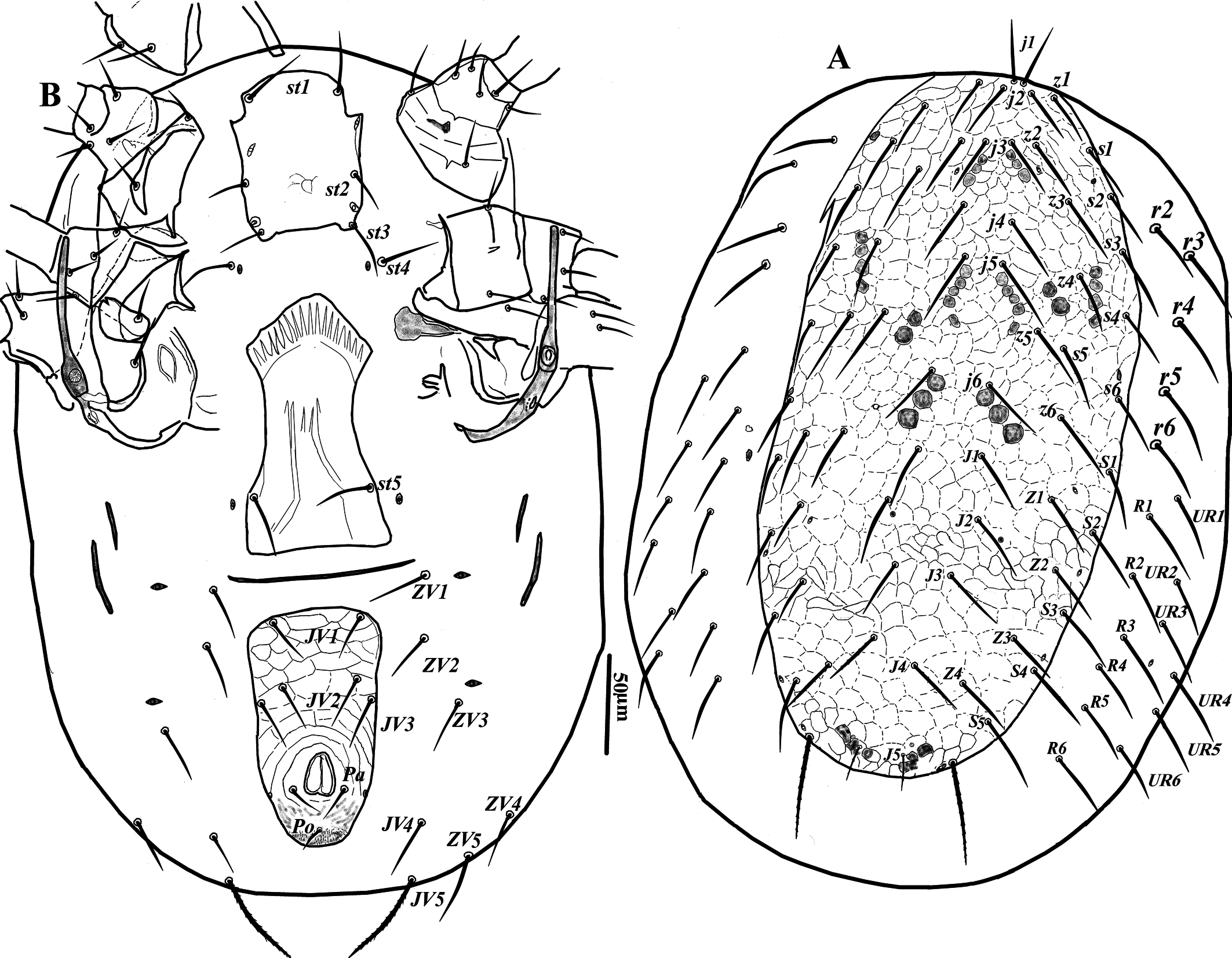
Dorsal idiosoma — (Fig. 1A). Female dorsal shield 575 (500–650) long and 250 (232–265) wide at the level of setae R2; mostly reticulate. Podonotal region of dorsal shield with 18 pairs of setae, two pairs of poroids and one pair of gland pores. Opisthonotal region of the dorsal shield with 15 pairs of setae, four pairs of poroids and two pairs of gland pores. Measurements of dorsal setae: j1 38 (36–40), j2 44 (43–45), j3 55 (51–59), j4 45 (42–48), j5 42, j6 46 (43–50), J1 45, J2 51, J3 44, J4 46 (46–47), J5 28, z1 22 (20–24), z2 43 (42–45), z3 47 (43–51), z4 50 (49– 51), z5 51, z6 51 (47–50), Z1 52 (51–53), Z2 45 (44–46), Z3 41 (40–42), Z4 45 (44–47), Z5 82 (81-84), s1 38 (35–41), s2 40 (36–44), s3 52 (50–53), s4 49 (46–52), s5 44 (42–46), s6 46 (43–47), S1 51 (51–52), S2 47 (42–52), S3 50 (48–52), S4 53 (52–54), S5 58 (58–64). Lateral unsclerotized cuticle with 11 pairs of marginal (r-R) and six pairs of submarginal (UR) setae, and one pair of poroid. Measurements of setae on unsclerotized cuticle as follows: r2 43 (42–44), r3 50 (48–53), r4 53 (52–55), r5 51 (50–52), r6 49 (46–52), R1 48 (46–50), R2 43 (42–44), R3 42 (41–44), R4 45 (44–46), R5 42 (46–48), R6 52 (52–53), UR1 45 (45–46), UR2 40 (39–42), UR3 44 (42–46), UR4 44 (43–46), UR5 45 (42–45), UR6 44 (43–46). Dorsal and lateral setae acicular and sparsely serrate, but Z5 slightly stouter than other dorsal setae (Fig. 1A).
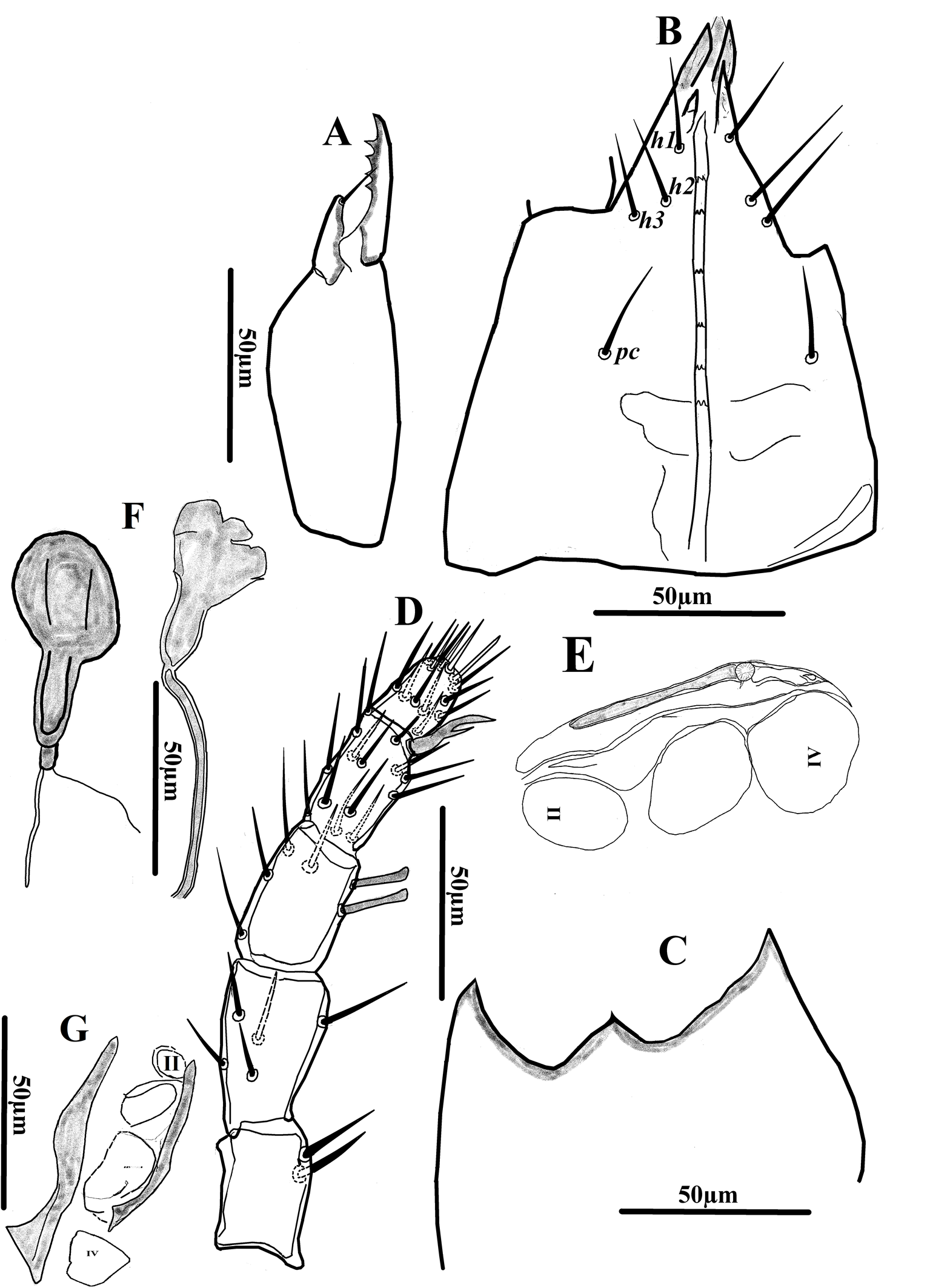
Venter idiosoma — (Fig. 1B). All shields lightly sclerotized. Sternal shield smooth; with three pairs of setae and two pairs of poroids; setal measurements: st1 61 (60–62), st2 63 (60– 66), st3 57 (55–60); distances st1–st3 87 (82–92), st2–st2 80 (76–85); posterior margin of sternal shield aligned with posterior margin of coxa II. Metasternal plates absent; seta st4 48 (42–55), on unsclerotized cuticle. Genital shield mostly smooth, lateral margins moderately concave, posteriorly truncated, and bearing genital seta st5 46 (42–50); distance st5–st5 77 (70–84); para-genital poroid (iv5) on unsclerotized cuticle posterolaterad genital setae. Ventrianal shield reticulate 115 (113–117) long, 87 (86–88) wide at the level of JV3 and 92 (91–93) at the anus level; barely narrowing behind JV3; with three pairs of pre-anal setae (JV1-JV3) in addition to circumanal setae. Unsclerotized section of opisthogaster with seven pairs of setae (JV4-JV5, ZV1-ZV5); setal measurements: JV1 46 (45–47), JV2 45 (44–46), JV3 48 (47–50), JV4 52 (52–53), JV5 71 (68–75), ZV1 51 (48–54), ZV2 46 (38–54), ZV3 41 (40–43) ZV4 51 (48–55), ZV5 55 (54–57); post-anal seta 32 (25–32); para-anal setae 38 (32–40), inserted in line with the posterior margin of anus. Ventral setae acicular and smooth, except JV5, slightly stouter than other neighboring setae and sparsely serrate. Two pairs of narrow metapodal platelets. The anterior platelet is half the length of the posterior. The exopodal plate is depicted as a narrow plate that expands between coxae II and coxae IV (Fig. 2G). Peritreme anteriorly reaching anterior margin of coxa III, 102 (101-105) long (Fig. 2E); peritrematic plate not connected to the dorsal shield.
Spermatheca — (Fig. 2F). Major duct leading to a well sclerotized cup-shaped calyx, which is 25 (24–26) long and 8 (7–9) in diameter; minor duct long, rather thin, and sometimes difficult to recognize, 32 (30-34) long.
Gnathosoma — (Figs 2A-D). Cheliceral shaft, excluding basal article and movable digit, 59 (58–60) long; fixed cheliceral digit smooth 19 (19–20) long, with long, acicular and well prominent pilus dentilis (about 12 long) (Fig.
2A); movable digit 37 (37–38) long, with four teeth in addition to apical hook. Epistome anterior margin with three projections, laterally convex (Fig. 2C). Deutosternum narrow, with six connected transverse denticulate lines; most distal with one denticle; second to fifth with two denticles each (Fig. 2B). Corniculi convergent. Palpus (Fig. 2D) 122 (120–125) long, number of setae from trochanter to tarsus: 2, 5, 6 (al1-2 stout, slightly enlarged distally); apotele two-tined. Subcapitular setae (Fig. 2B) acicular, h1 30 (27–33), h2 32 (30–35), h3 30 (29–32) and pc 38 (36–40); distances between infracapitular setae h1-h1 11 (11-12), h2-h2 51 (50-53), h3-h3 22 (21-23) and pc-pc 51 (50-52).
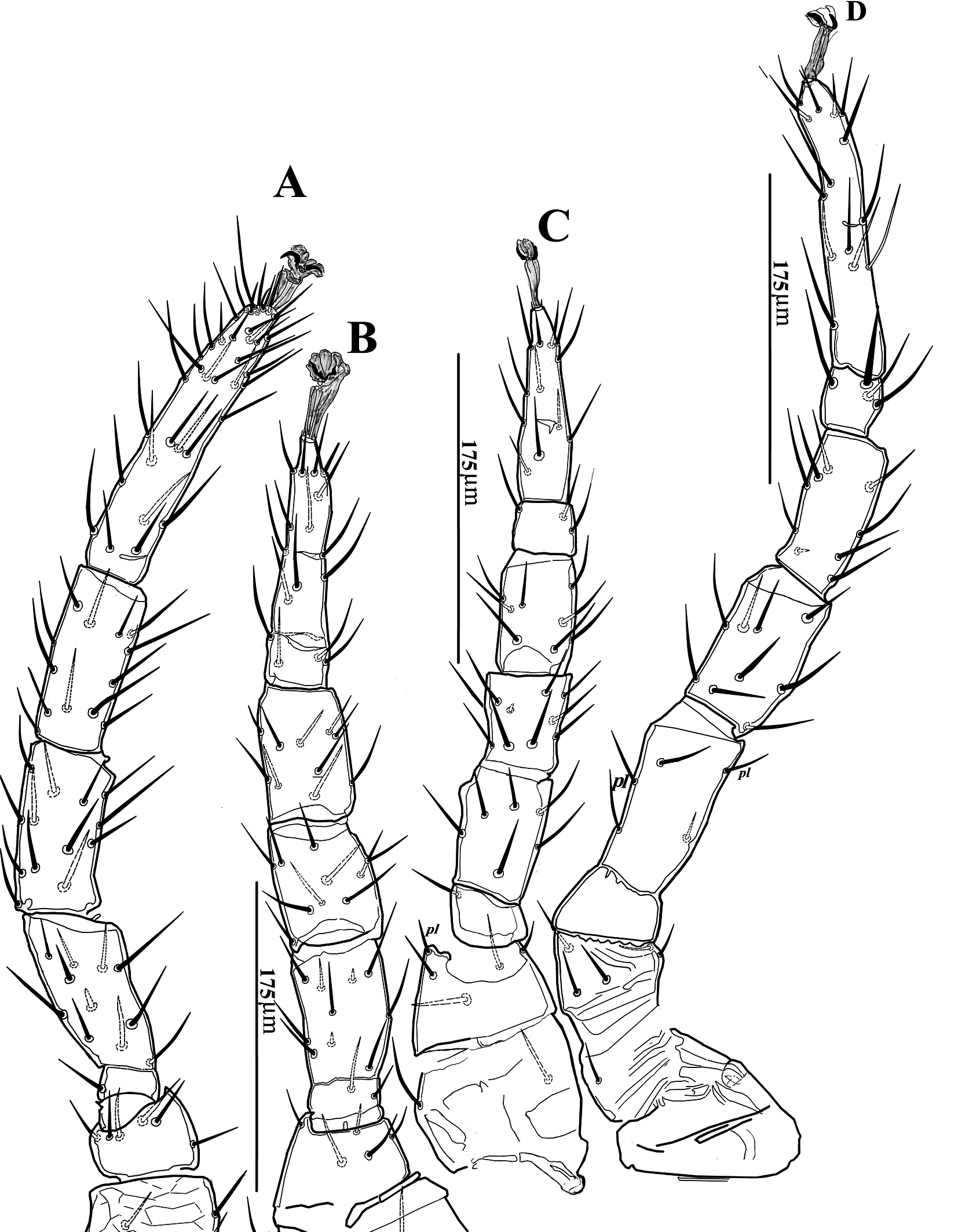
Legs — (Figs 3A–D). Legs I–IV with paired claws and a rounded central lobe of pulvillus. Leg lengths (from base of coxa to apex of tarsus): I: 479 (459–500); II: 421 (412–430); III: 373 (368–378); IV: 486 (475–498 Most setae slender and smooth; chaetotaxy of legs I–IV: coxae: 2, 2, 2, 1; trochanters: 0 1/ 2 1/1 1; 1 0/1 1/1 1; 1 1/1 1/1 0; 1 1/1 1/1 0; femora: 2 3/2 2/2 1; 1 3/2 3/2 1; 1 2/1 1/0 1; 1 0/1 1/0 2; genua: 2 3/2 3/1 2; 2 3/2 2/1 1; 2 2/1 2/1 1; 1 2/0 3/1 2; tibiae: 2 3/2 3/1 2; 2 3/1 1/2 1; 2 1/1 2/1 1; 1 2/1 1/2 2; tarsi II-IV: 18, 18, 18; legs I- IV without macrosetae or spur-like setae (Figs 4A-D).
Male (n = 10)
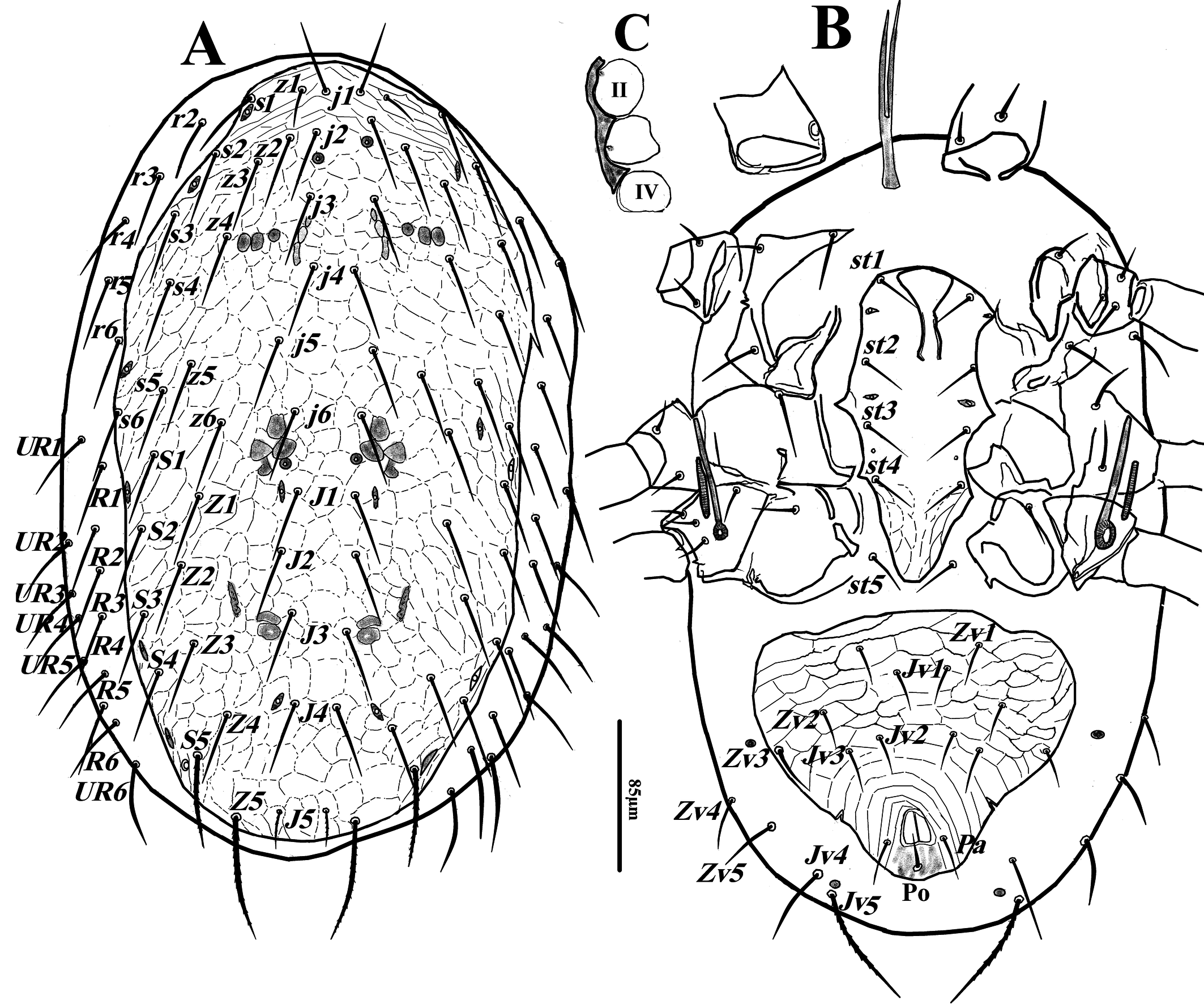
Dorsum of idiosoma — (Fig. 4A). Dorsal shield reticulate, 438–465 long and 290–293 wide at the level of s6. Podonotal region of dorsal shield with 18 pairs of setae, four pairs of poroids, and one pair of gland pores. Opisthonotal region of the dorsal shield with 15 pairs of setae, four pairs of poroids, and two pairs of gland pores. Measurements of dorsal setae: j1 (34–36), j2 (34–37), j3 (34–35), j4 (30–32), j5 (30–32), j6 (36–38), J1 (35–38), J2 (37–38), J3 (42–44), J4 (37–39), J5 (25–26), z1 (23–25), z2 (42–45), z3 (40–42), z4 (40– 42), z5 (37–40), z6 (36–38), Z1 (41–44), Z2 (42–44), Z3 (40–43), Z4 (38–40), Z5 (65–75), s1 (37–41), s2 (37–41), s3 (42–45), s4 (40–45), s5 (37–45), s6 (42–46), S1 (41–44), S2 (42–46), S3 (34–44), S4 (50–52), S5 (50–52). Lateral unsclerotized cuticle with 11 pairs of marginal and six pairs of submarginal setae. Measurements of setae on unsclerotized cuticle: r2 (41–44), r3 (41–42), r4 (40–42), r5 (47–50), r6 (42–46), R1 (40–41), R2 (41–42), R3 (32–40), R4 (32–36), R5 (36–38), R6 (32–38), UR1 (32–36), UR2 (31–32), UR3 (32–36), UR4 (33–36), UR5 (33–35), UR6 (33–36). Dorsal and lateral setae acicular and smooth, except S5 and Z5, slightly stouter than other setae and serrate.
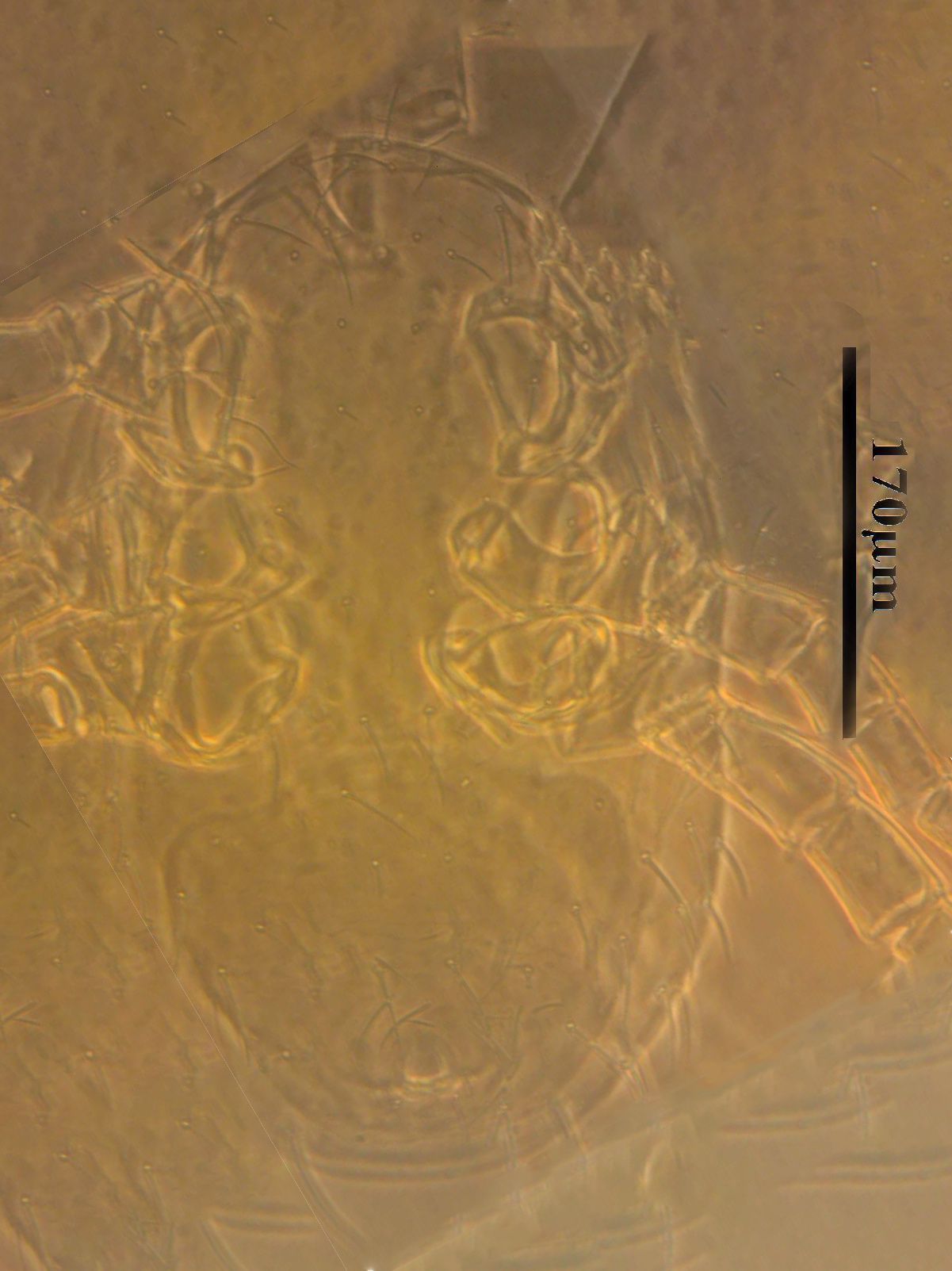
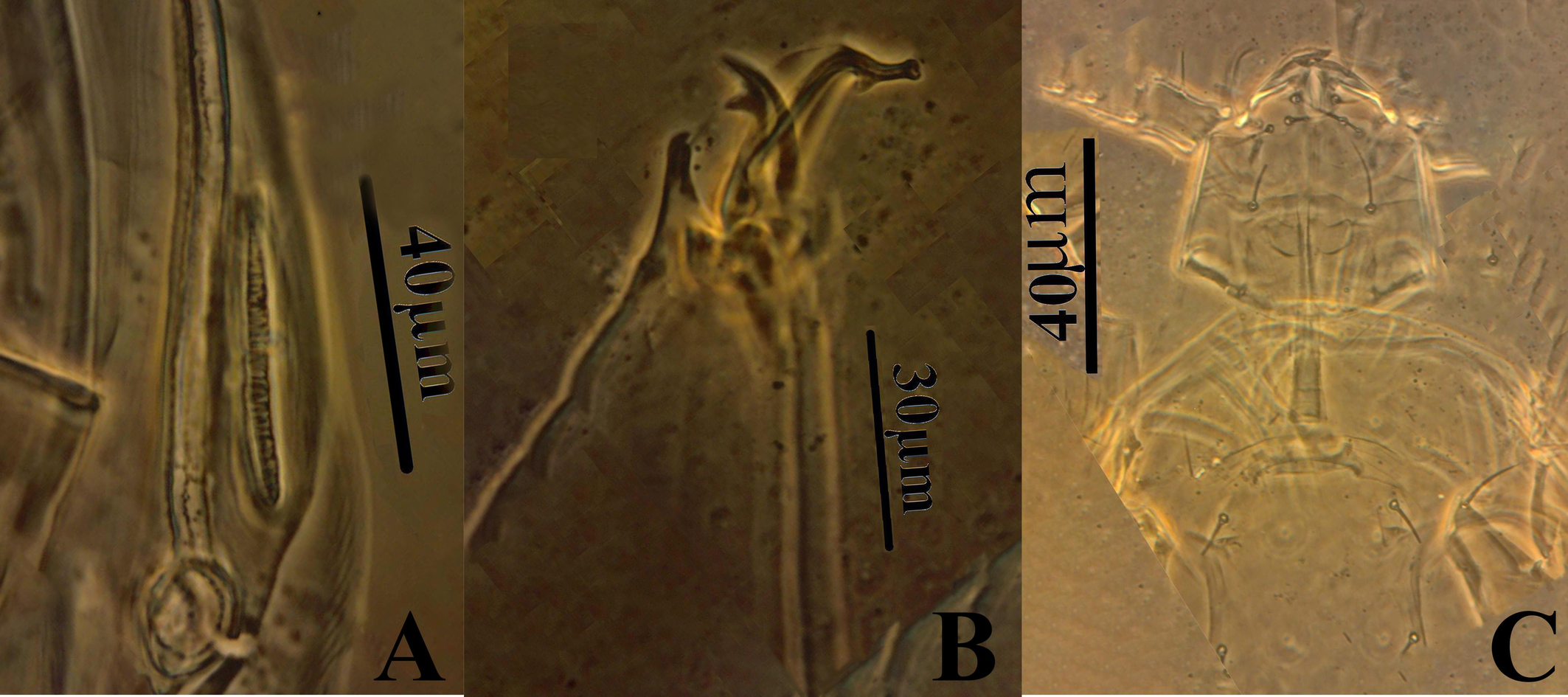
Venter of idiosoma — (Figs. 4B-C, 5, 6E, 7A, 7C). Base of tritosternum (25–27) long and (8–11) wide; laciniae free for approximately 65% of their total length of 85–86 (Figs. 5, 7C). Sternogenital shield mostly smooth, with sparse reticulation behind st4, 205–207 long and 77–79 wide at level of st2, with pronounced constriction behind st4; with four pairs of setae and two pairs of poroids, behind st1 and st3, respectively; setae st5 on unsclerotised cuticle. Exopodal plate narrow between coxae II and IV (Fig. 4C). Distance between sternogenital seta: st1-st1 (58-60), st2-st2 (68-60), st3-st3 (68-71), st4-st4 (65-67), st5-st5 (63-65), st1-st3 (84-86). Ventrianal shield subtriangular, with sinuous lateral margins, reticulate, (177–179) long and (194–196) wide at the level of anterolateral angles; with six pairs of setae (JV1–JV3; ZV1–ZV3) and one pair of marginal pores about in line with anterior margin of anus; para-anal setae (23–28) about as long as post-anal seta (22–24), unsclerotized cuticle around ventrianal shield with four pairs of opisthogastric setae (JV4, JV5, ZV4, ZV5) and three pairs of poroids. Discrete endopodal shield absent (Fig. 5). With a transversely ridged structure parallel to the base of the peritreme and about 35 long (Figs. 6E1 7A). Setal measurements: st1 (37-38), st2 (38-40), st3 (36-38), st4 (38-40), st5 (40- 42); JV1 (38-40), JV2 (38-40), JV3 (36-38), JV4 (35-38), JV5 (65-72), ZV1 (40-42), ZV2 (38-40), ZV3 (34-36), ZV4 (34-35), ZV5 (40-42) (Fig. 5B). Ventral setae acicular and smooth.
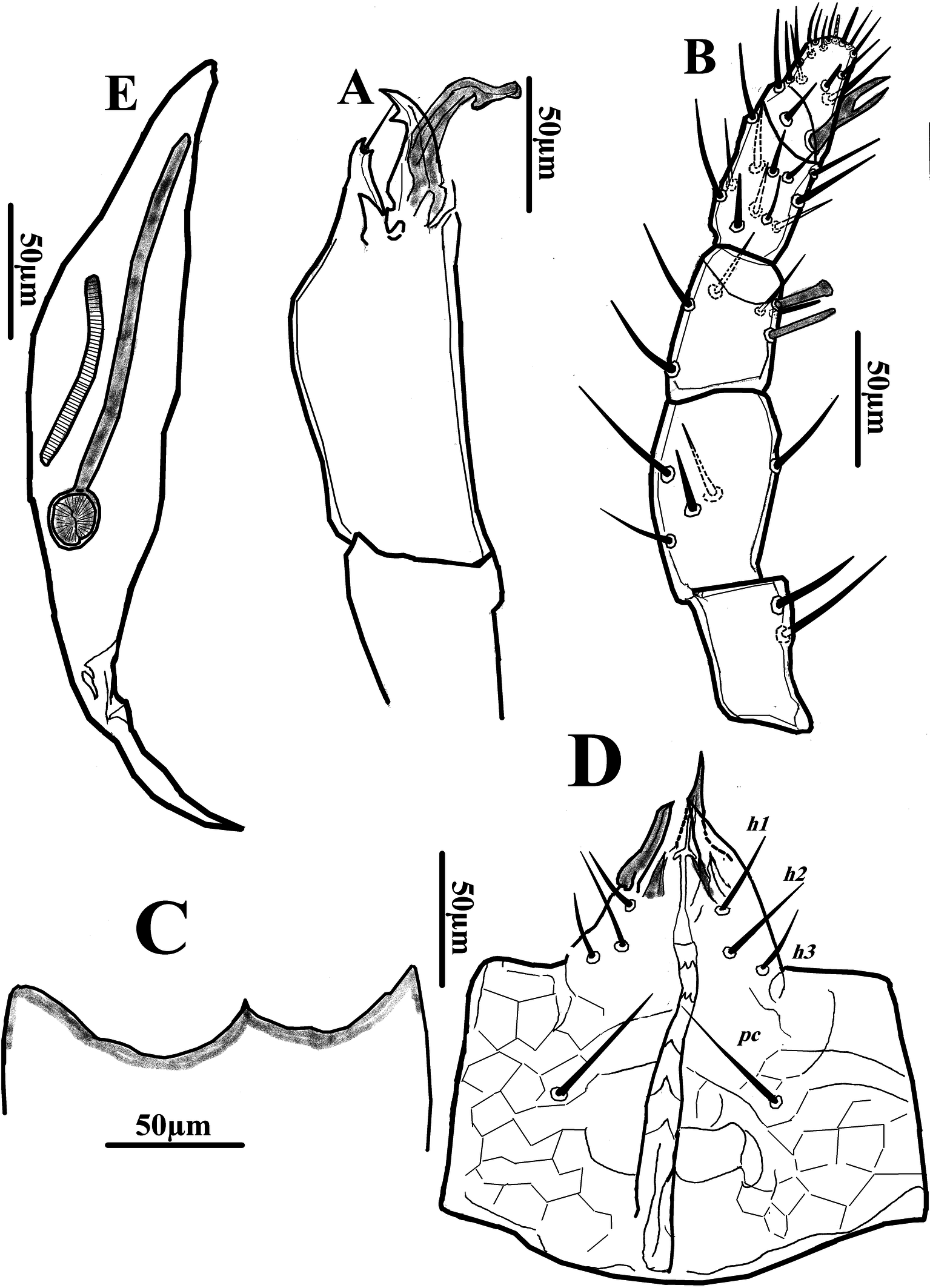
Gnathosoma — (Figs. 6A-D). Hypostomal seta: h1 24 (23–35), h2 27 (27–28), h3 22 (20–23), pc 30 (28–33). Distance of hyposomal seta: h1-h1 35 (30–40), h2-h2 21 (20–22), h3-h3 35 (35–36) and pc-pc 41 (40–42) (Fig. 6D). Chelicera: fixed digit 21 (20–22), with one tooth in addition to the apical tooth and prominent setiform pilus dentilis (Fig. 6A); movable digit 25 (24–26) long, with one tooth in addition to apical tooth, spermatodactyl geniculate curved ventrally, with subterminal spine-like projection, facing backward, 17–19 long (Figs. 6A, 7B). Epistome as in adult female (Fig. 6C). Corniculi more widely spaced than in adult female, convergent; with six rows of deutosternal denticles, each with 1–2 teeth (Figs. 6D, 7C). Numbers of setae of palp segments, hypostome, and subcapitular setae as in adult female; numbers of setae from palp trochanter to tarsus as follows: 2, 5, 6,14, 14; two-tined apotele (Fig. 6B).
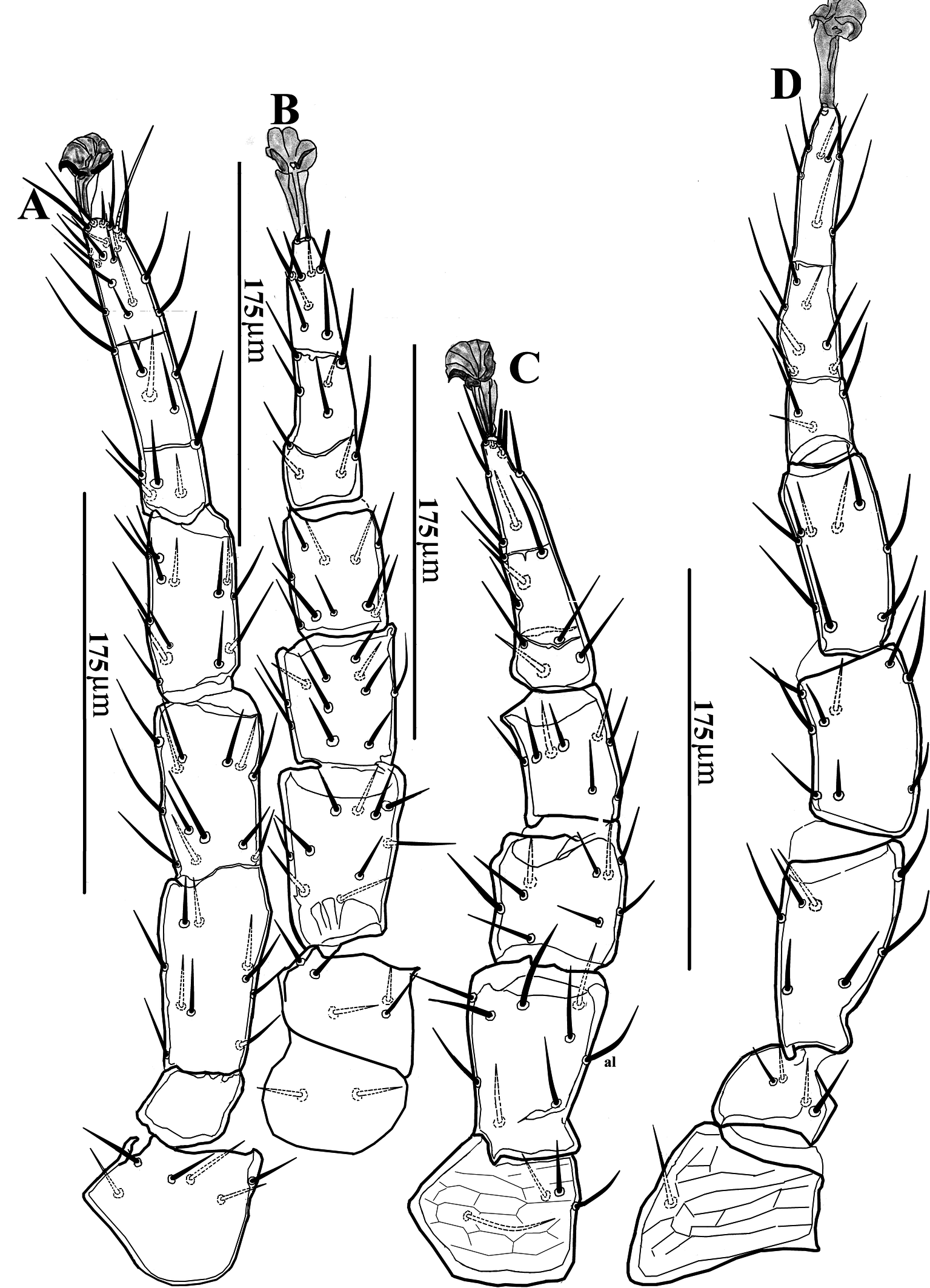
Legs — (Figs. 8A-D). Length of legs: I: 375–380; II: 325–388; III: 300–305; IV: 390–412. Numbers of setae on leg segments as in adult females; without macrosetae.
Type material
Holotype female, ten paratype females and ten paratype males collected by M.B. Safiarian on 8 December 2024 from a mass-rearing colony of N. californicus belonging to Avamel Mahar Zisti Co., Hamedan, Iran. All type specimens deposited at the mite reference collection of Acarological Laboratory of Bu-Ali Sina University, Hamedan, Iran.
Remarks
The female of B. tarsalis resembles that of the new species by the shape of the ventral shield, short peritreme, and short fixed cheliceral digit. However, females of B. tarsalis differ from the new species by having: a) peritreme extending to coxa II; b) movable cheliceral digit with three teeth; c) dorsal shield smooth. The male of B. tarsalis resembles those of the new species by the reduced peritreme (not extending beyond coxae II), differing by having: a) genital seta (st5) on the sterno-genital shield; b) no narrow, transversely ridged structure parallel to the base of preritreme.
The new species resembles B. damghaniae in having three pairs of pre-anal setae and a short fixed cheliceral digit. However, B. damghaniae differs from the new species as follows: 1) the preritreme reaches the middle of coxae III; 2) the posterior corner of the sternal shield has a prominent projection; 3) the movable digit has one tooth; 4) the anterior margin of the epistome is subtriangular, smooth, and features a short, blunt median projection. The new species also resembles B. everti Britto, Lopes & Moraes, 2012 in having the transversely ridged structure parallel to the base of the male peritreme; however, B. everti females differ by having: a) cheliceral digits of similar lengths; b) fixed and movable cheliceral digits respectively with two teeth and one tooth, c) epistome with a blunt projection; d) sternal shield with long lateral extension between coxae I-II.
Etymology
The new species is named in honor of Prof. Dr. İbrahim Çakmak, the well-known acarologist of Türkiye, Department of Plant Protection, Faculty of Agriculture, Aydin University, Aydin, Türkiye.
Key to the world Blattisocius species, based on females
1. Dorsal shield with 31 pairs of setae, setae z1 absent
...... B. apisassociae Chinniah & Mohanasundaram, 1995
— Dorsal shield with at least 32 pairs of setae, setae z1 present
...... 2
2. Seta JV1 not on ventrianal shield
...... B. migratoriae (Abo-Shnaf et al., 2020)
— Seta JV1 on ventrianal shield
...... 3
3. Ventrianal shield with three pairs of pre-anal setae
...... 4
— Ventrianal shield with four pairs of pre-anal setae
...... 13
4. Movable and fixed cheliceral digits similar in length
...... 5
— Movable digit longer than fixed digit
...... 6
5. Peritreme extending beyond coxa I
...... B. daci (Narayanan & Ghai, 1961)
— Peritreme not extending beyond posterior margin of coxa III
...... B. everti Britto et al., 2012
6. Most dorsal setae flagellate, longer than the distance to the subsequent setae of the same series
...... B. flagellatus (Hassan, Ali & Nasr, 2020)
— Few or no dorsal setae longer than the distance to the subsequent setae of the same series
...... 7
7. Movable digit toothless
...... B. patagiorum Treat, 1966
— Movable digit with 1–3 teeth
...... 8
8. Fixed cheliceral digit toothless; pilus dentilis distal; peritreme extending to posterior margin of coxa II
...... B. tarsalis (Berlese, 1918)
— Fixed cheliceral digit with 1-3 teeth; pilus dentilis not distal; peritreme extending to middle of coxa III
...... 9
9. Dorsal shield mostly smooth, with few transverse striae on opisthonotal region; seta JV4 absent
...... B. capsicum Basha & Yousef, 2000
— Dorsal shield reticulate; seta JV4 present
...... 10
10. Movable cheliceral digit with four teeth; peritreme longer than diameter of coxa III
...... B. cakmaki n. sp. Khanjani & Safiarian
— Movable cheliceral digit with one tooth; peritreme shorter than diameter of coxa III
...... 11
\cledetermination{11. Most dorsal shield setae longer than distance to subsequent setae of the same series}{B.
keegani Fox, 1947}
— Most dorsal shield setae distinctly shorter than distance to subsequent setae of the same series
...... 12
12. Dorsal shield transversely striate
...... B. apis Basha & Yousef, 2000
— Dorsal shield reticulate
...... B. damghaniae Shamsi, Kazemi & Saboori, 2016
13. Movable cheliceral digit toothless
...... 14
— Movable digit with at least one tooth in addition to apical hook
...... 15
14. Dorsal shield setae about as long as distance to subsequent setae of the same series; setae st4 on a diagonally elongate platelets abutting sternal shield
...... B. edentatus (Karg, 1976)
— Dorsal shield setae longer than distance to subsequent setae of the same series; setae st4 on unsclerotized cuticle
...... B. aegypticus Nasr, Nawar & Afifi, 1988
15. Setae st3–st4 of each side on a common platelet attached to the sternal shield
...... 16
— Setae st3 of each side on sternal shield or on a discrete platelet, setae st4 on unsclerotized cuticule
...... 18
16. Fixed cheliceral digit with one tooth in addition to apical hook
...... B. incisus (Bhattacharyya, 1977)
— Fixed cheliceral digit with at least two teeth in addition to apical hook
...... 17
17. Fixed cheliceral digit with 2–3 teeth and movable digit with one tooth in addition to apical hooks; setae j3, j6, J2 and Z4 about as long or slightly longer than distance to subsequent setae
...... B. dentriticus (Berlese, 1918)
— Fixed cheliceral digit with over ten and movable digit with two teeth in addition to apical hook; setae j3, j6, J2 and Z4 at least 1.5× as long as distance to subsequent setae
...... B. dolichus Ma, 2006
18. Most dorsal shield setae longer than the distance to subsequent setae of the same series; setae st3 on a discrete platelet; movable cheliceral digit with three teeth in addition to apical hook
...... B. quadridentatus (Haines, 1979)
— Most dorsal shield setae shorter than distance to subsequent setae; setae st3 on sternal shield; movable cheliceral digit with 2–3 teeth in addition to apical hook
...... 19
19. Dorsal shield with 34 pairs of setae
...... B. mali (Oudemans, 1929)
— Dorsal shield with 36 pairs of setae
...... 20
20. Twenty pairs of dorsal setae stout, trifurcate; fixed cheliceral digit with 12 teeth in addition to apical hook
...... B. trifuricpilus (Xion, Yi & Jin, 2023)
— All dorsal shield setae needle-shaped; fixed cheliceral digit with three teeth in addition to apical hook
...... 21
21. Distance Z5-Z5 about twice length of Z5; seta S5 about as long as most other dorsal shield setae
...... B. thaicocofloris (Oliveira, Chandrapatya & Moraes, 2015)
— Distance Z5-Z5 about as long as length of Z5; seta S5 much longer than most other dorsal shield setae
...... B. changjiangensis (Ma, 2006)
Acknowledgements
We thank Professor Gilberto J. de Moraes, Departamento de Entomologia e Acarologia of Escola Superior de Agricultura ''Luiz de Queiroz'', Universidade de São Paulo, Piracicaba, SP, 13418-900, Brazil, and undisclosed reviewers for their valuable comments, recommendations, and suggestions that enriched this work.
References
- Abo-Shnaf R.I.A., El-Dydamony M.K., Said S.M. 2020. A new species of Blattisocius (Acari: Mesostigmata: Blattisociidae) from Egypt. Internat. J. Acarol., 46: 9-13. https://doi.org/10.1080/01647954.2019.1687583
- Asgari F., Safavi S.A., Sarraf-Moayeri H. 2023. An investigation on demographic parameters of the predatory mite Blattisocius mali (Blattisociidae) fed on eggs of the fungus gnat Lycoriella auripila (Sciaridae). J. Appl. Res. Plant. Prot., 13: 1-14.
- Athias-Henriot, C. 1974. Un problème arachnologiques: l′interprétation phylogenétique des deux états idiosomaux des gamasides- Protoadénie et Eunéoadénie (Parasitiformes). Proc. 4th Internat. Congr. Acarol., 443- 445
- Bash A.A. & Yousef A.T. 2001. New species of Laelapidae and Ascidae from Egypt: genera Androlaelaps and Blattisocius (Acari: Gamasida). Acarologia, 41: 395-402.
- Berlese, A. 1918. Centuria quarta di Acari nuovi. Redia.13: 115-192.
- Bhattacharyya S.K. 1977. A new Blattisocius and first record of Gamasholaspis browningi (Acarina: Mesostigmata) from the Kumaon Himalaya. Internat. J. Acarol, 2: 21-23.
- Britto E.P.J., Lopes P.C., Moraes G.J. de. 2012. Blattisocius (Acari, Blattisociidae) species from Brazil, with description of a new species, redescription of Blattisocius keegani, and a key for the separation of the world species of the genus. Zootaxa, 3479: 33-51. https://doi.org/10.11646/zootaxa.3479.1.2
- Chinniah C., Mohanasundaram M. 1995. Record of new ascid mites (Ascidae: Acari) infesting insects in Tamil Nadu. Indian J. Entomol., 20: 233-236.
- Evans G.O. 1963. Observations on the chaetotaxy of the legs in the free-living Gamasina (Acari: Mesostigmata). Bull. Br. Mus. Nat., 10: 275-303. https://doi.org/10.5962/bhl.part.20528
- Fox, I. 1947. Seven new mites from rats in Puerto Rico. Ann. Entomol. Soc. Am., 40: 598-603. https://doi.org/10.1093/aesa/40.4.598
- Haines, C.P. 1979. A revision of the genus Blattisocius Keegan (Mesostigmata: Ascidae) with special reference to B. tarsalis (Berlese) and the description of a new species. Acarologia, 20: 19-38.
- Hassan M.F., Samir A.F., Korashy N.M. 2020. A new species of Blattisocius from Egypt (Acari, Blattisociidae). Zootaxa, 4820: 391-397. doi: 10.11646/zootaxa 4820.2.13. https://doi.org/10.11646/zootaxa.4820.2.13
- Krantz G.W., Redmond B.L. 1987. Identification of glandular and poroidal idionotal systems in Macrocheles perglaber F. & P. (Acari: Macrochelidae). Exp. Appl. Acarol., 3: 243-253. https://doi.org/10.1007/BF01270460
- Lindquist E.E. 1994. Some observations on the chaetotaxy of the caudal body region of gamasine mites (Acari; Mesostigmata), with a modified notation for some ventrolateral body setae. Acarologia, 35: 323-326.
- Lindquist E.E., Evans G.O. 1965. Taxonomic concepts in the Ascidae, with a modified setal nomenclature for the idiosoma of the Gamasina (Acarina: Mesostigmata). Mem. Entomol. Soc. Can., 47: 1-64. https://doi.org/10.4039/entm9747fv
- Lindquist E.E., Moraza M.L. 2010. Revised diagnosis of the family Blattisociidae (Acari: Mesostigmata: Phytoseioidea), with a key to its genera and description of a new fungus-inhabiting genus from Costa Rica. Zootaxa, 2479: 1-21. https://doi.org/10.11646/zootaxa.2479.1.1
- Ma L.M. 2006. Three new species of the family Aceosejidae (Acari: Gamasinae) from China. Acta Arachnologica Sinica, 15(2), 70-74.
- Moraes G.J. de., Britto E.P.J., Mineiro J.L.D.C., Halliday B. 2016. Catalogue of the mite families Ascidae Voigts & Oudemans, Blattisociidae Garman and Melicharidae Hirschmann (Acari: Mesostigmata). Zootaxa. 4112:1-299. https://doi.org/10.11646/zootaxa.4112.1.1
- Moraes, G.J. de, Venancio, R., dos Santos V. L., Paschoal A.D. 2015. Potential of Ascidae, Blattisociidae and Melicharidae (Acari: Mesostigmata) as biological control agents of pest organisms. pp. 33-75. In: Carrillo D., Moraes G.J. & Peña, J.E. (Eds.) Prospects for biological control of plant feeding mites and other harmful organisms. 328 pp. Springer, Cham. https://doi.org/10.1007/978-3-319-15042-0_2
- Moraza M.L., Lindquist E.E. 2025. Review of the genus Zercoseius Berlese, 1916, with first description of a deutonymph, and seven new species (Acari: Blattisociidae). Syst. Appl. Acarol., 30(10), 1681-1727. https://doi.org/10.11158/saa.30.10.1
- Narayanan E.S., Ghai S. 1961. A new species of Melichares (Blattisocius) Keegan (Aceosejinae). Proc. Natl. Inst. Sci. India, 27B.
- Nasr A.K., Nawar M.S., Afifi A.M. 1988. A new species of the genus Blattisocius Keegan from Egypt (Acarina, Mesostigmata: Ascidae). Bull. Fac. Agric., Cairo Univ., 39: 937-946.
- Oliveira D., Chandrapatya A., Moraes G.J. de. 2015. A new species of Blattisocius (Acari: Mesostigmata: Blattisociidae), with a new characterization of the genus. Zootaxa, 4040: 93-199. https://doi.org/10.11646/zootaxa.4040.1.8
- Oudemans A.C. 1929. Acarologische Aanteekeningen C. Entomol. Ber., 8: 28-36.
- Shamsi M.H., Kazemi S., Saboori A. 2016. A new species of the genus Blattisocius Keegan (Acari: Mesostigmata: Blattisociidae) from Iran. Syst. Appl. Acarol., 21: 139-145. https://doi.org/10.11158/saa.21.1.9
- Treat A.E. 1966. A new Blattisocius (Acari: Mesostigmata) from noctuid moths. J. N. Y. Entomol. Soc., 74: 143-159.
- Xiong H-N, Yi T-C, Jin, D.C. 2023. A new species of Blattisocius (Acari: Mesostigmata: Blattisociidae) from China, with a key to species of the genus recorded from that country. Internat. J. Acarol., 49 (1): 1-7. https://doi.org/10.1080/01647954.2023.2168752
to post any comment or correction.


2025-08-18
Date accepted:
2026-02-13
Date published:
2026-03-10
Edited by:
Kreiter, Serge

This work is licensed under a Creative Commons Attribution 4.0 International License
2026 Khanjani, Mohammad; Safiarian, Mohammad Bagher and Khanjani, Ali
 Download article
Download the citation
RIS with abstract
(Zotero, Endnote, Reference Manager, ProCite, RefWorks, Mendeley)
RIS without abstract
BIB
(Zotero, BibTeX)
TXT
(PubMed, Txt)