


New data on Gryllochyzeria hojjati and Nothrotrombidium sadeghii (Trombidiformes: Chyzeriidae, Trombellidae) from Hormozgan Province, Iran
Sedghi, Ali1
; Saboori, Alireza  2
; Hakimitabar, Masoud
3
; Allahyari, Hossein
4
and Bagheri, Abdoolnabi
5
2
; Hakimitabar, Masoud
3
; Allahyari, Hossein
4
and Bagheri, Abdoolnabi
5
1Department of Plant Protection, Faculty of Agriculture, University of Tehran, Karaj, Iran.
2✉ Department of Plant Protection, Faculty of Agriculture, University of Tehran, Karaj, Iran & Department of Plant Protection, Faculty of Agriculture, Aydin Adnan Menderes University, Aydin, Türkiye.
3Department of Horticulture and Plant Protection, College of Agriculture, University of Shahrood, Shahrood, Iran.
4Department of Plant Protection, Faculty of Agriculture, University of Tehran, Karaj, Iran.
5Hormozgan Agricultural and Natural Resources Research and Education Center, Agricultural Research Education and Extension Organization (AREEO), Bandar Abbas, Iran.
2026 - Volume: 66 Issue: 1 pages: 28-34
https://doi.org/10.24349/wp8m-kyhdZooBank LSID: 1D647007-A067-4CA5-BA29-2E7EC79717A0

Original research
Keywords
Abstract
Introduction
The family Chyzeriidae includes three subfamilies and nine genera as follows: Ralphaudyninae Southcott, 1987 (Ralphaudyna Vercammen-Grandjean et al., 1974 and Gryllochyzeria Saboori, Zhang & Nemati, 2005), Pteridopinae Southcott, 1987 (Parawenhoekia Paoli, 1937, Pteridopus Newell & Vercammen-Grandjean, 1964, Cretessenia Haitlinger, 1999, Perumaropta Haitlinger, 1999, and Iberochyzeria Mayoral, Welbourn & Barranco, 2018) and Chyzeriinae Womersley, 1954 (Chyzeria Canestrini, 1897 and Nothotrombicula Dumbleton, 1947), (Mayoral et al. 2018).
Southcott (1987) proposed the subfamily Ralphaudyninae based on Ralphaudyna amamiensis Vercammen-Grandjean et al., 1974. Later, a second species, R. iranensis Zhang & Saboori, 1995 was described from Iran (Zhang and Saboori 1995, Noei et al. 2013). Ralphaudyninae is a member of the family Chyzeriidae based on the definition of Mayoral et al. (2018): palpal tibial claw bifid; anal sclerite usually present with 1 to 2 pairs of ps setae; 1 or 2 pairs of prodorsal trichobothria; supracoxal setae e and eI present; tarsi legs I–III elongated; pretarsus with paired claws and clawlike empodium; fnCx = 2-1-1; fnTr = 1-1-1; fnTF = 5-5-4; fnGe = 4-4-4; fnTi = 6-6-6.
Gryllochyzeria was described based on one larval specimen ectoparasite on Melanogryllus desertus (Pallas) (Orthoptera: Gryllidae) from Ahwaz city, Iran (Saboori et al. 2005). This genus was originally placed in the subfamily Chyzeriinae, but Mayoral et al. (2018) tentatively transferred it to the subfamily Ralphaudyninae due to absence of numerous small teeth on the cheliceral blades.
The genus Nothrotrombidium Womersley, 1954 (Trombidioidea: Trombellidae) consists of eight species, four of which are based on larva: N. otiorum (Berlese, 1902) from Italy, Austria, France, Norway, Romania, Sardinia, and Spain; N. treati Southcott, 1987 ectoparasitic on Spaelotis clandestina (Harris) (Lepidoptera: Noctuidae) from USA, N. birjandensis Noei, 2017 extracted from forest soil in Iran and N. sadeghii Noei and Kohansal, 2023 ectoparasitic on Erebidae, Noctuidae, Geometridae, Plutellidae (Lepidoptera) and Tettigoniidae (Orthoptera) in Birjand city, South Khorasan Province, Iran (Feider 1958; Southcott 1987; Mąkol and Wohltmann 2012, 2013; Noei 2017; Noei and Rabieh 2019; Kohansal et al. 2023).
In this paper, a redefinition of Ralphaudyninae is presented, G. hojjati and N. sadeghii are recorded from Hormozgan Province, Iran and new data are given.
Material and methods
Four specimens of Gryllochyzeria hojjati were collected by Ali Sedghi, from Rodan city, 27°78.49′N, 57°19.16′E, 190 m a.s.l., on 4 April 2021 and removed from the head, thorax, leg and abdomen of M. desertus with a minute insect pin. The host of G. hojjati specimens was collected by an insect net. Also, three specimens of Nothrotrombidium sadeghii were collected by Ali Sedghi from Hormozgan Province. One of them was removed from Dichagyris flammatra (Denis and Schiffermüller) (Lepidoptera: Noctuidae), collected in Hajiabad city, 28°30.97′N, 55°90.52′E, 945 m a.s.l., on 4 April 2021. Two additional off-host specimens were collected in Rodan city, 27°78.49′N, 57°19.16′E, 190 m a.s.l., and Minab city, 26°99.74′N, 57°37.23′E, 90 m a.s.l., on 6 and 8 Aril 2021, respectively. The insect host of N. sadeghii specimens was collected by a light trap.
All mite specimens were preserved in 75% ethanol, cleared in Nesbitt's fluid and mounted using Faure's medium on glass microscope slides (Krantz 1978). Measurements (given in micrometers) were made using a BM-180N Sairan microscope. The terminology and abbreviations are adapted from Robaux (1974), Southcott (1993) and Wohltmann et al. (2006).
Systematics
Superfamily Trombidioidea Leach, 1815 sensu Söller et al. (2001)
Epifamily Trombelloidae Thor, 1935
Family Chyzeriidae Womersley, 1954
Subfamily Ralphaudyninae Southcott, 1987
Diagnosis (larva)
Cheliceral blades only with one subterminal tooth or one subterminal and one median tooth; palpal tibial odontus bifid; a pair of anal valves present, each valve with 1–2 setae; scutum subtriangular with two pairs of sensillary setae and two pairs of nonsensillary setae (AL and PL scutalae thumb-like in Gryllochyzeria but normal in Ralphaudyna); fnBFe II-III = 2-2; fnTFe = 5-5-4; fnTi = 6-6-6.
Key to genera of Ralphaudyninae (larva)
1. AL and PL normal, basifemur I with one seta, solenidia on Ge I-III 4-3-3
...... Ralphaudyna Vercammen-Grandjean et al., 1974
—AL and PL thumb-like, basifemur I with two setae, solenidia on Ge I-III 3-1-1
...... Gryllochyzeria Saboori, Zhang & Nemati, 2005
Type species
Gryllochyzeria hojjati Saboori, Zhang & Nemati, 2005, by original designation.
Diagnosis (larva, updated from Saboori et al. 2005)
Scutum subtriangular with four pairs of setae (thumb-like AL and PL setae, and AM and S sensillary setae with bothridial bases); posterior sensillary setae (S) bases between AL and PL bases (closer to AL than PL); ocular sclerites lateral to posterolateral angles of the scutum and with two eye lenses; cheliceral blades with one subterminal and one median tooth; Ge I with three solenidia and Ge II and III each with one solenidion; anal plate with one pair of setae; fnBFe = 2-2-2; fnTFe = 5-5-4; fnTi = 6-6-6; fSol = I (0-3-2-1), II (0-1-2-1), III (0-1-1-0), fκ = I (1-1), II (1-0), III (0-0); fζ = 2-1-0; fε = 1-1-0.
Gryllochyzeria hojjati Saboori et al., 2005
Saboori et al. (2005) described this species based on a single specimen from Ahwaz city, Iran. The new materials agree well the original description, with a few differences. The original description stated eyes were absent but after reexamining the holotype and additional collected specimens, we confirm the presence of eyes (Figure 1). The morphometric data collected from new material is similar to the original description of the species (Table 1). We consider differences as intraspecific variations. Additionally, we present new meristic data which show intraspecific variation.
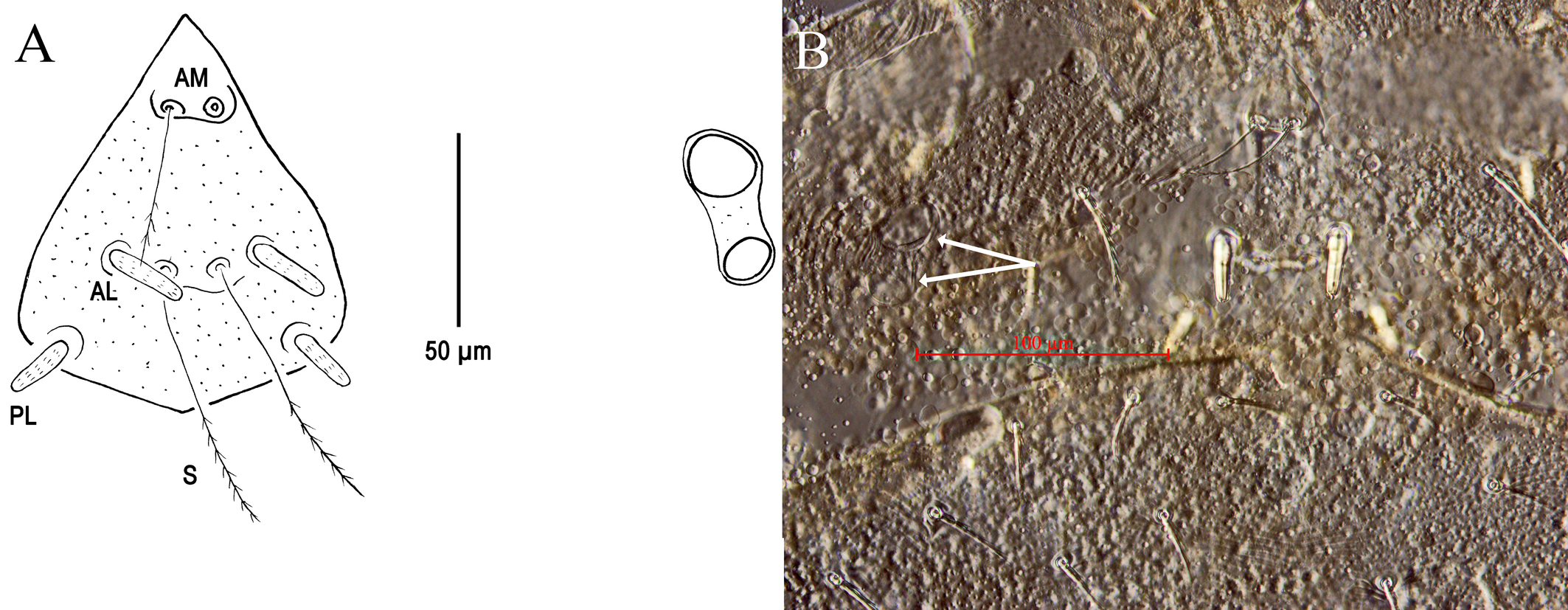
Download as
Character
H
02a
02b
02c
02d
Range
LN
30
30
31
29
32
29–32
MA
52
52
50
49
50
49–52
AW
45
47
42
45
40
40–47
PW
77
75
68
72
72
68–77
MS
54
54
55
57
52
52–57
ASB
82
84
80
82
80
80–85
PSB
47
47
50
47
48
47–50
SD
129
131
130
129
128
125–132
W
104
100
100
100
102
100–104
AP
32
30
27
30
32
27–32
AM
57
55
52
52
50
50–57
S
87
92
88
88
94
60–92
AL
25
25
25
25
25
25
PL
25
22
22
22
22
22–25
AA
12
12
12
12
12
12
SB
17
17
17
17
17
17
DS
30–54
52
45
47
55
30–55
PDS
64–65
62
60
60
64
60–65
1a
17
17
17
18
17
17–18
1b
20
20
22
20
20
20–22
2b
62
62
60
63
60
60–63
3b
20
20
21
23
20
20–23
cs
7
7
8
7
9
7–9
bs
47
47
48
50
50
47–50
PaScFed
27
27
30
26
27
26–30
PaScGed
17
17
15
18
17
15–18
Cx I
69
52
57
65
62
52–69
Tr I
30
37
37
32
38
30–38
BFe I
25
37
32
37
35
25–37
TFe I
32
47
42
40
40
32–47
Ge I
40
45
38
42
40
38–45
Ti I
50
50
42
47
45
42–50
Ta I
99
87
90
100
92
87–100
Leg I
345
355
338
363
352
338–363
Cx II
74
62
62
67
65
62–74
Tr II
37
35
32
45
40
32–40
BFe II
29
30
32
42
45
29–45
TFe II
37
45
37
37
45
37-45
Ge II
40
37
37
37
35
35–40
Ti II
49
45
42
42
42
42–49
Ta II
99
90
95
97
95
90–90
Leg II
365
344
337
367
367
337–367
Cx III
69
72
70
62
67
62–72
Tr III
50
50
50
50
52
50–52
BFe III
45
45
40
37
37
37–45
TFe III
50
42
42
50
50
42–50
Ge III
50
52
45
50
50
45–52
Ti III
74
72
65
70
67
65–74
Ta III
126
117
115
117
120
115–126
Leg III
464
450
427
436
443
427–464
IP
1174
1149
1102
1166
1162
1102–1174
Leg segmentation formula (based on the holotype and new specimens): 7-7-7 (femur divided). Leg setal formula: Leg I: Ta- 1ω, 1ε, 2ζ, 1Cp, 18n; Ti- 2φ, 1κ, 6n; Ge- 3σ, 1κ, 4n; TFe- 5n; BFe- 2n; Tr- 1n; Cx- 1n. Leg II: Ta- 1ω, 1ε, 1ζ, 18n (17n in one side of symmetry axis in two specimens, JAZM-AC-Chy-02a and 02c); Ti- 2φ, 6n; Ge- 1σ, 1κ, 4n; TFe- 5n, BFe- 2n; Tr- 1n; Cx- 1n. Leg III: Ta- 13n (14n in one side of symmetry axis in one specimen, JAZM-AC-Chy- 02c 13/14n), Ti- 1φ, 6n; Ge- 1σ, 4n; TFe- 4n, BFe- 2n; Tr- 1n; Cx- 1n. Tarsus I-III with two lateral claws and a foliate empodium. All setae on legs barbed. Measurements are given in Table 1.
Distribution
Iran (Khuzestan and Hormozgan provinces). New record for Hormozgan Province.
Deposition
Four specimens (JAZM-AC-Chy-02a, 02b, 02c, 02d) are deposited in the Acarological Collection, Jalal Afshar Zoological Museum (JAZM), Department of Plant Protection, Faculty of Agriculture, University of Tehran, Karaj, Iran.
Remarks
The host of G. hojjati, M. desertus is distributed in several countries, including Algeria, Morocco, Spain, France, Liechtenstein, Austria, Croatia, Slovakia, Hungary, Poland, Romania, Serbia, Bulgaria, Türkiye, Kazakhstan, Uzbekistan, Mongolia, Iraq, Italy (Sardinia) and Iran (Guilan, Mazandaran, East Azarbaijan, Kurdistan, Khuzestan and Hormozgan provinces) (Cigliano et al. 2025) and consequently, it is likely that this ectoparasitic mite can also be found in these regions.
The subfamily Ralphaudyninae was previously defined based on a single genus Ralphaudyna (Southcott 1987). The discovery and new data on the genus Gryllochyzeria expand the morphological diversity of the group. Gryllochyzeria hojjati shows characters intermediate between Chyzeriinae and Ralphaudyninae (e.g. shape of scutum, and the number of cheliceral teeth is similar to Ralphaudyninae but fnBFe, fnTFe and the number of setae on palpal femur differ; the number of setae on palpal femur is similar to Pterodopinae but fnBFe, fnTFe and fnTi differ), supporting the taxonomic transfer by Mayoral et al. (2018) whereas it has some setae between coxae II and III which is not reported in other Chyzeriidae. The presence of eyes in G. hojjati was confirmed in our study, contradicting the original description. The new records of G. hojjati and N. sadeghii from Hormozgan Province represent range extensions and highlight the need for additional surveys in southern Iran.
Family Trombellidae Thor, 1935
Subfamily Trombellinae Thor, 1935
Genus Nothrotrombidium Womersley, 1954
Nothrotrombidium sadeghii Noei & Kohansal, 2023
Kohansal et al. (2023) described this species based on 15 specimens collected ectoparasitic on Platycleis intermedia (Tettigoniidae), and different species of Lepidoptera. Meristic data of new materials fit with type specimens. For metric data, new materials expand the minimum or maximum limits of the ranges for certain characters (see Table 2).
Leg femora entire. Leg setal formula (only based on new three specimens, for original data see Kohansal et al. 2023): Leg I: Ta- 1ω, 1ɛ, 1ζ, 31n; Ti- 2φ, 1κ, 8n; Ge- 6σ, 1κ, 4n; Fe- 3θ, 6n; Tr- 1n; Cx- 1n. Leg II: Ta- 1ω, 1ɛ , 1ζ, 26/27n; Ti- 2φ, 7n; Ge- 5-6/5-7σ, 1κ, 4n; Fe- 4/6θ, 7n, Tr- 1n; Cx- 1n. Leg III: Ta- 24n , Ti- 1φ, 7n; Ge- 9-10σ, 4n; Fe- 8/9θ, 6n, Tr- 1n; Cx- 1n. Measurements are given in Table 2.
Download as
Character
Type specimens
01a
01b
01c
Range
SD
105–117
117
125
127
105–127
W
58–70
70
70
80
58–80
AW
37–47
40
42
45
37–47
PW
50–62
50
55
57
50–62
SB
12–18
12
15
15
12–18
ASB
62–75
62
75
75
62–75
PSB
32–50
45
42
43
32–50
MA
32–40
32
37
37
32–40
AP
32–41
42
37
37
32–42
LN
20–27
22
27
25
20–27
MSA=MS
32–37
32
35
37
32–37
SA
15–18
17
15
18
15–18
SP
25–33
28
33
32
25–33
AL
17–25
15
17
17
15–25
PL
25–35
25
40
40
25–40
AM
30–42
45
25
30
25–45
S
100–107
100
102
100
100–107
DS min.
20–42
37
40
37
20–42
DS max.
47–57
50
47
45
45–57
1a
37–45
40
37
42
37–45
1b
45–62
52
50
55
45–62
2b
45–52
50
52
52
45–52
3a
30–45
37
40
42
30–45
3b
27–37
30
32
32
27–37
cs
8–10
8
10
10
8–10
bs
35–50
42
40
45
35–50
GL
100–112
105
105
102
100–112
PaScFed
37–45
37
37
42
37–45
PaScGed
12–22
20
15
17
12–22
Cx I
50–62
50
50
45
45–62
Tr I
40–50
37
42
37
37–50
Ge I
53–67
52
60
57
52–67
Ti I
95–121
105
100
105
95–121
Ta I
135–162
150
142
150
135–162
Leg I
482–566
495
475
500
475–566
Cx II
52–62
50
50
50
50–62
Tr II
42–50
42
37
37
37–50
Fe II
90–110
95
100
97
90–110
Ge II
52–58
50
55
50
50–58
Ti II
81–98
87
85
87
81–98
Ta II
115–137
130
127
132
115–137
Leg II
440–510
455
455
455
440–510
Cx III
52–67
60
50
57
50–67
Tr III
55–62
52
42
45
42–62
Fe III
112–137
117
117
125
112–137
Ge III
63–75
62
67
67
62–75
Ti III
145–167
157
150
155
145–167
Ta III
130–162
147
145
150
130–162
Leg III
564–670
597
572
600
564–670
IP
1486–1746
1547
1502
1555
1486–1746
fD
30–34
32
32
32
30–34
fV
30–45
40
41
40
30–45
NDV
62–77
72
73
72
62–77
Material examined
Three larvae, 1 from Dichagyris flammatra (Denis & Schiffermüller, 1775) (Lepidoptera, Noctuidae), 2 collected off-host from gardens in Rodan and Minab cities, Hormozgan Province, Iran.
Distribution
Iran (South Khorasan and Hormozgan provinces).
Deposition
Three specimens (JAZM-AC-Trom-01a, 01b and 01c) are deposited in the Acarological Collection, Jalal Afshar Zoological Museum (JAZM), Department of Plant Protection, Faculty of Agriculture, University of Tehran, Karaj, Iran.
Remarks
The genus Nothrotrombidium comprises four larval species, two of which have been reported from Iran (Birjand). This genus appears to have a preference for lepidopteran hosts; for example, N. sadeghii was collected from several Lepidoptera families as well as from Tettigoniidae (Orthoptera).
The fauna of terrestrial Parasitengona ectoparasites on butterflies and moths is poorly studied in Iran, though the topic is of interest. For instance, the family Achaemenothrombiidae has been found on moths (Saboori et al. 2010; Noei and Rabieh 2021; Kohansal et al. 2022).
Nothrotrombidium sadeghii was previously reported from eastern Iran; its later collection in Rodan and Minab (Hormozgan Province, southern Iran) suggests a wider distribution and makes it plausible that the species occurs in neighboring countries such as Afghanistan and Pakistan.
Funding
This work was supported by the University of Tehran.
Conflict of interests
The authors declare that there is no conflict of interest regarding the publication of this paper.
Acknowledgments
We are very grateful to four anonymous referees who their comments and corrections highly improved the manuscript. The research was supported by the University of Tehran under grant number 7110018/6/32 which is greatly appreciated. Also, we are grateful to Mr. Mehdi Turk (Jalal Afshar Zoological Museum, Department of Plant Protection, Faculty of Agriculture, University of Tehran, Karaj, Iran) for identification of M. desertus and Dr. Asghar Shirvani (Department of Plant Protection, College of Agriculture, Shahid Bahonar University of Kerman, Kerman, Iran) for identification of Lepidoptera.
References
- Cigliano M.M., Braun H., Eades D.C., Otte D. Melanogryllus desertus (Pallas, 1771). Retrieved on 2025-11-04 from https://orthoptera.speciesfile.org/otus/829751/overview.
- Feider Z. 1958. Prima larvă din familia Trombellidae (Acarina) obţinută prin cultură şi despre noua caracterizare a familiei. Acad. Repub. Pop. Rom., Fil. Iasi, Stud. Cercet. Stiint., Biol. Stiinte Agric., 9: 265-282.
- Kohansal M., Ramroodi S., Noei J., Rakhshani E., Rabieh M.M. 2022. Description of Achaemenothrombium khashayarshahi sp. nov. (Prostigmata: Achaemenothrombiidae) from Iran with new host records. Syst. Appl. Acarol., 27(3): 581-592. https://doi.org/10.11158/saa.27.3.13
- Kohansal M., Ramroodi S., Noei J., Saboori A. 2023. A new larval species of Nothrotrombidium (Acari, Trombellidae) from Iran, with new host records. Syst. Appl. Acarol., 28(4): 656-666. https://doi.org/10.11158/saa.28.4.3
- Krantz G.W. 1978. A manual of Acarology, 2nd ed. Oregon State University Book Stores Inc., Corvallis, Oregon U.S.A., 509 pp.
- Mąkol J., Wohltmann A. 2012. An annotated checklist of terrestrial Parasitengona (Actinotrichida, Prostigmata) of the world, excluding Trombiculidae and Walchiidae. Ann. Zool., 62: 359-562. https://doi.org/10.3161/000345412X656671
- Mąkol J., Wohltmann A. 2013. Corrections and additions to the checklist of terrestrial Parasitengona (Actinotrichida: Prostigmata) of the world, excluding Trombiculidae and Walchiidae. Ann. Zool., 63: 15-27. h https://doi.org/10.3161/000345413X666075
- Mayoral J., Welbourn W., Barranco P. 2018. A revision of the Pteridopodinae (Acari: Parasitengonina, Chyzeriidae) with the description of a new genus from South Spain and key to the Pteridopodinae. Syst. Appl. Acarol., 23(6): 1125-1137. https://doi.org/10.11158/saa.23.6.8
- Noei J. 2017. A new larval species of Nothrotrombidium (Acari, Trombellidae) from Iran, with a key to world species. Persian J. Acarol., 6: 161-171. https://dx.doi.org/10.22073/pja.v6i3.29594
- Noei J., Rabieh M.M. 2019. New data on Nothrotrombidium, Southcottella and Eatoniana larvae (Acari, Trombellidae, Neothrombiidae, Erythraeidae) from Iran. Persian J. Acarol., 8(3): 179-187. https://dx.doi.org/10.22073/pja.v8i3.46776
- Noei J., Rabieh M.M. 2021. A new species of larval Achaemenothrombium (Prostigmata: Achaemenothrombiidae) from Iran with new host records. Internat. J. Acarol., 47(2): 79-88. https://doi.org/10.1080/01647954.2020.1870551
- Noei J., Saboori A., Hajizadeh J. 2013. Redescription of the little known species, Ralphaudyna iranensis (Acari, Chyzeriidae). Persian J. Acarol., 2(1): 57−62.
- Robaux P. 1974. Recherchessur le dévelopementet la biologie des acariens `Thrombidiidae'. Mém. Mus. Natl. Hist. Nat. (Sér. A Zool.), 85: 1-186.
- Saboori A., Zhang Z.-Q., Nemati A. 2005. A new genus and species of larval Chyzeriidae (Acari, Prostigmata, Chyzeroidea) from Iran. Internat. J. Acarol., 31(1): 51-56. https://doi.org/10.1080/01647950508684416
- Söller R., Wohltmann A., Witte H., Blohm D. 2001. Phylogenetic relationships within terrestrial mites (Acari: Prostigmata, Parasitengona) inferred from comparative DNA sequence analysis of the mitochondrial cytochrome oxidase subunit I Gene. Mol. Phylogenet. Evol., 18(1): 47-53. https://doi.org/10.1006/mpev.2000.0855
- Southcott R.V. 1987. The classification of the mite families Trombellidae and Johnstonianidae and related groups, with the description of a new larva (Acarina, Trombellidae, Nothotrombidium) from North America. Trans. R. Soc. S. Aust., 111: 25-42.
- Southcott R.V. 1993. Revision of the taxonomy of the larvae of the subfamily Eutrombidiinae (Acarina, Microtrombidiidae). Invert. Taxon., 7: 885-959. https://doi.org/10.1071/IT9930885
- Thor S. 1935. Übersicht und Einteilung der Familie Trombidiidae W. E. Leach 1814 in Unterfamilien. Zool. Anz., 109 (5-6): 107-112.
- Wohltmann A., Gabryś G., Mąkol J. 2006 [2007]. Terrestrial Parasitengona inhabiting transient biotopes. In: Gerecke, R. (Ed.), Süßwasser fauna Mitteleuropa, Vol. 7/2-1, Chelicerata, Acari I. 2007. Spektrum Elsevier, München, pp. 158-240. https://doi.org/10.1007/978-3-662-55958-1_6
- Womersley H. 1954. On the subfamily Trombellidae Sig Thor 1935 (Acarina, Trombidiidae) with a diagnosis of the nymph of Audyana thompsoni Womersley, 1954. Rec. S. Austral. Mus., 11(2): 121-128.
- Zhang Z.-Q., Saboori A. 1995. A new record of the little known genus Ralphaudyna (Acari, Chyzeriidae) from Iran, with description of a new species. Internat. J. Acarol., 21(1): 11-15. https://doi.org/10.1080/01647959508684037
to post any comment or correction.


2025-09-04
Date accepted:
2026-01-15
Date published:
2026-01-21
Edited by:
Mąkol, Joanna

This work is licensed under a Creative Commons Attribution 4.0 International License
2026 Sedghi, Ali; Saboori, Alireza; Hakimitabar, Masoud; Allahyari, Hossein and Bagheri, Abdoolnabi
 Download article
Download the citation
RIS with abstract
(Zotero, Endnote, Reference Manager, ProCite, RefWorks, Mendeley)
RIS without abstract
BIB
(Zotero, BibTeX)
TXT
(PubMed, Txt)