


Contributions to the feather mite fauna (Acariformes: Astigmata) of birds (Aves) in Türkiye
Eren, Gökhan  1
and Dik, Bilal
2
1
and Dik, Bilal
2
1✉ Department of Aquatic Animal Health, Mediterranean Fisheries Research, Production and Training Institute, General Directorate of Agricultural Research and Policies, Antalya, Türkiye.
2Beyhekim neighborhood, Karakoçlar street, 18/12, Selçuklu, Konya, Türkiye.
2025 - Volume: 65 Issue: 4 pages: 1302-1330
https://doi.org/10.24349/oxyf-grt1Original research
Keywords
Abstract
Introduction
Feather mites (Astigmata: Analgoidea and Pterolichoidea) are that commensal or parasitic organisms living mainly on the feathers of birds and more rarely on the skin (Dermationidae, Epidermoptidae, and Laminosioptidae), and in the respiratory system (Cytoditidae and Turbinoptidae) of these hosts (Gaud and Atyeo 1996; Dabert and Mironov 1999; Proctor 2003). Feather mites are generally highly host-specific species like other ectosymbionts of bird (e.g., chewing lice, parasitic mites).
Research on the biodiversity, taxonomy, and host-parasite associations of feather mites in Türkiye began much later compared to most other parts of the world (Doña et al. 2016; Eren et al. 2023). In recent years, the increasing interest in wildlife and parasites of wild vertebrate animals (such as mammals, birds, and reptiles) in the Turkish parasitological community (Keskin et al. 2017; Dik et al. 2023; Zerek et al. 2023; Eren and Açıcı 2025) has also raised studies on feather mites.
The present study reports the feather mites detected in the process of the ectoparasitical studies of on birds in Türkiye conducted in 2009–2021. Feather mite species detected in the present study along with those reported in previous faunistic studies on these mites (Gürler et al. 2013; Özkan et al. 2017; Per and Aktaş 2018; Eren et al. 2021; Eren and Açıcı 2022; Eren et al. 2022, 2023, 2025), make the currently known feather mite fauna of Türkiye exceeding one hundred species.
Materials and methods
The material for this study consists of mites collected from avian hosts during ecto-parasitological studies conducted in seven different provinces of Türkiye in 2009–2021. Most of the collected mite specimens were stored in Eppendorf tubes with 70% ethanol and were not identified. A tiny portion of the mite specimens was mounted on permanent glass slides and stored in the laboratory of the Department of Parasitology, Faculty of Veterinary Medicine, Selçuk University (Konya, Türkiye). In the current study, all of these materials were carefully examined. The previously prepared permanent slides were directly examined under a light microscope, while the mite specimens preserved in ethanol were first cleared with lactophenol and then mounted on permanent slides using Hoyer's medium. Finally, all mite specimens were identified under a light microscope (CX23 Binocular Microscope, Olympus Corporation, Tokyo, Japan) based on identification keys and illustrations from the relevant acarological literature (Hull 1934; Dubinin and Dubinina 1940; Dubinin 1951, 1953, 1956; Atyeo and Braasch 1966; Gaud 1966, 1968, 1980; Santana 1976; Černý 1982; Dabert 1987; Mironov 1981, 1985, 2002; Vasyukova and Mironov 1991; Mironov and Wauthy 2006; Burdejnaja and Kivganov 2009a; Mironov et al. 2015).
All feather mite specimens detected throughout the study were photographed with a camera integrated into the light microscope. In addition, representative permanent glass slides of each feather mite are deposited in the personal collections of Prof. Dr. B. Dik and Dr. G. Eren, the authors of this paper.
Results and discussion
Download as Remarks: * — new record for the fauna of Türkiye;
C — contamination.
Host species
Host family
Feather mite species
Location
Collection date
Passeriformes
Aegithalos caudatus
Aegithalidae
Anhemialges sp.
Samsun
20.05.2015
Proctophyllodes clavatus
Melanocorypha calandra
Alaudidae
Analges scleropus*
Iğdır
22.10.2009
Emberiza schoeniclus
Emberizidae
Analges nitzschi*
Kars
25.09.2009
Proctophyllodes caulifer,C*
Proctophyllodes poublani,C*
Hirundo rustica
Hirundinidae
Scutulanyssus hirundicola
Kars
07.05.2016
Trouessartia appendiculata*
Trouessartia crucifera*
Trouessartia microcaudata
Anthus spinoletta
Motacillidae
Analges sp.
Kars
19.09.2009
Proctophyllodes schwerinensis*
Motacilla flava
Analges oscinum*
Kayseri
06.07.2015
Proctophyllodes motacillae*
Erithacus rubecula
Muscicapidae
Trouessartia rubecula
Samsun
04.04.2015
Luscinia luscinia
Analges lusciniae*
Kars
08.05.2016
Proctophyllodes lusciniae
Trouessartia swidwiensis*
Oriolus oriolus
Oriolidae
Grallobia sp.C
Iğdır
12.05.2021
Panurus biarmicus
Panuridae
Analges dubinini*
Kayseri
07.07.2015
Passer hispaniolensis
Passeridae
Analges berlesei,C*
Kayseri
06.07.2015
Pastor roseus
Sturnidae
Sturnotrogus pastoris*
Kars
30.05.2016
Sturnus vulgaris
Trouessartia rosterii*
Iğdır
14.05.2021
Konya
11.01.2015
Acrocephalus arundinaceus
Sylviidae
Analges berlesei*
Kars
28.05.2016
Dolichodectes edwardsi
Trouessartia trouessarti
Acrocephalus melanopogon
Proctophyllodes clavatus
Kars
27.05.2015
Trouessartia bifurcata
Acrocephalus schoenobaenus
Analges acanthitibius*
Kars
26.05.2016
Dolichodectes edwardsi
Proctophyllodes clavatus
Acrocephalus scirpaceus
Proctophyllodes clavatus
Kayseri
05.07.2015
Locustella luscinioides
Trouessartia kratochvili
Kars
25.09.2009
Sylvia melanocephala
Proctophyllodes sp.
Samsun
08.05.2015
Trouessartia inexpectata
Turdus merula
Turdidae
Proctophyllodes weigoldi*
Samsun
31.03.2015
Piciformes
Dendrocopos syriacus
Picidae
Pteronyssus robini*
Iğdır
07.05.2016
Strigiformes
Athene noctua
Strigidae
Dermonoton parallelus
Eskişehir
20.04.2017
Kramerella lunulata
Ciconiiformes
Ciconia nigra
Ciconiidae
Freyanopterolichus pelargicus*
Konya
10.06.2016
Suliformes
Phalacrocorax carbo
Phalacrocoracidae
Scutomegninia phalacrocoracis
Konya
12.12.2018
Charadriiformes
Chlidonias leucopterus
Laridae
Alloptes (Sternalloptes) gracilobus
Kars
25.09.2009
Calidris pugnax
Scolopacidae
Avenzoaria philomachii*
Kars
17.09.2009
Ingrassia philomachi*
Calidris minuta
Ingrassia tringae*
Kars
17.09.2009
Calidris temminckii
Avenzoaria calidridis*
Kars
22.09.2009
Dichobrephosceles actitidis*
Tringa glareola
Avenzoaria totani
Kars
30.09.2009
Tringa ochropus
Pseudavenzoaria ochropodis*
Kayseri
05.07.2015
Gruiformes
Crex crex
Rallidae
Grallobia rallorum*
Konya
25.04.2016
Metanalges crexi*
Gallinula chloropus
Grallolichus proctogamus*
Konya
22.03.2016
Metanalges grossus*
Megniniella gallinulae*
Cuculiformes
Cuculus canorus
Cuculidae
Coraciacarus cuculi*
Kars
26.05.2015
Iğdır
05.05.2021
Podicipediformes
Podiceps cristatus
Podicipedidae
Ptiloxenus major
Konya
15.10.2015
Galliformes
Alectoris chukar
Phasianidae
Pseudolichus solutocurtus
Eskişehir
15.12.2015
Anseriformes
Anas penelope
Anatidae
Vingrassia velata*
Konya
12.06.2016
Aythya ferina
Freyana nyrocae
Konya
12.06.2016
Melanitta fusca
Ptiloxenus majorC
Konya
01.11.2015
Spatula clypeata
Freyana anatina*
Adana
20.12.2016
Download as
Family
Genus
Species
Analgidae
Analges
Analges acanthitibius Mironov, 1985, A. berlesei Mironov, 1985, A. dubinini Mironov, 1985, A. lusciniae Mironov, 1985, A. nitzschi Haller, 1877, A. oscinum Koch, 1841, A. scleropus Gaud, 1974, and Analges sp.
Anhemialges
Anhemialges sp.
Megniniella
Megniniella gallinulae (Buchholz, 1869)* *
Metanalges
Metanalges crexi Mironov, 1981, and* M. grossus* (Berlese, 1898)
Alloptidae
Alloptes
Alloptes (Sternalloptes) gracilobus Vasyukova & Mironov, 1991
Dichobrephosceles
Dichobrephosceles actitidis (Canestrini, 1878)* *
Avenzoariidae
Avenzoaria
Avenzoaria calidridis (Oudemans, 1904), A. philomachii Dubinin, 1951, A. totani (Canestrini, 1878)
Pseudavenzoaria
Pseudavenzoaria ochropodis (Hull, 1934)* *
Scutomegninia
Scutomegninia phalacrocoracis Dubinin and Dubinina, 1940
Proctophyllodidae
Dolichodectes
Dolichodectes edwardsi (Trouessart, 1885)
Proctophyllodes
Proctophyllodes caulifer Trouessart, 1887,* P. motacillae Gaud, 1953, P. poublani Gaud, 1957, P. schwerinensis Černý, 1982, P. weigoldi Vitzthum, 1922, and Proctophyllodes *sp.
Pteronyssidae
Pteronyssus
Pteronyssus robini (Faccini and Atyeo, 1981)
Scutulanyssus
Scutulanyssus hirundicola Mironov, 1985
Sturnotrogus
Sturnotrogus pastoris (Mironov, 1987)
Trouessartiidae
Trouessartia
Trouessartia appendiculata (Berlese, 1886), T. bifurcata (Trouessart, 1884), T. crucifera Gaud, 1957, T. inexpectata Gaud, 1957, T. kratochvili Černý, 1979, T. microcaudata Mironov, 1983, T. rosterii (Berlese, 1883), T. rubecula Jabłońska, 1968,* T. swidwiensis Jabłońska, 1968, T. trouessarti *Oudemans, 1904
Xolalgidae
Ingrassia
Ingrassia philomachi Gaud, 1972,* I. tringae Vitzthum, 1922 *
Vingrassia
Vingrassia velata (Mégnin, 1877)
Freyanidae
Freyana
Freyana anatina (Koch, 1844),* F. nyrocae *Dubinin, 1950
Gabuciniidae
Coraciacarus
Coraciacarus cuculi (Mégnin & Trouessart, 1884)
Kramerellidae
Dermonoton
Dermonoton parallelus (Mégnin & Trouessart, 1884)
Freyanopterolichus
Freyanopterolichus pelargicus (Megnin & Trouessart, 1884)
Kramerella
Kramerella lunulata (Haller, 1878)
Pterolichidae
Grallobia
Grallobia rallorum (Robin & Megnin, 1877),* Grallobia *sp.
Grallolichus
Grallolichus proctogamus (Trouessart, 1885)
Pseudolichus
Pseudolichus solutocurtus (Dubinin, 1956)* *
Ptiloxenidae
Ptiloxenus
Ptiloxenus major (Mégnin and Trouessart, 1884)
As a result of the microscopic examination of feather mites collected from 39 bird species representing 23 families belonging to 11 orders, 55 mite taxa were identified, including 50 at the species level and five at the genus level. The 55 identified feather mite taxa represent 12 families, and 30 species are new records for the feather mite fauna in Türkiye (Tables 1, 2).
Family Alloptidae Gaud, 1957
The family, includes species that cause infestation in birds belonging to the orders Charadriiformes, Ciconiiformes, Gaviiformes, Gruiformes, Pelecaniformes and Procellariiformes, and this family includes over 170 species in 29 genera, and four subfamilies (Gaud and Atyeo 1996; Schatz et al. 2011). In the present study, were identified taxa from the genera Alloptes Canestrini, 1879 and Dichobrephosceles Peterson & Atyeo, 1968.
Genus Alloptes Canestrini, 1879
The genus Alloptes currently contains over 50 species so far associated with birds of the families Alcidae, Chionididae, Dromadidae, Haematopodidae, Laridae, Recurvirostridae, Scolopacidae, and Stercorariidae (Charadriiformes) (Hernandes and Brito 2022; Han et al. 2021, 2022b) and is divided in four subgenera (Gaud 1972; Kivganov and Mironov 1992). Mites of the subgenus Sternalloptes are restricted to Laridae and Stercorariidae. In this study, a single female specimen collected from the white-winged tern C. leucopterus was identified as Alloptes (Sternalloptes) gracilobus (Fig. 1: A). This species has previously been reported from the same host in Yakutia (Russia) and along the coast of the Black Sea (Vasyukova and Mironov 1991; Kivganov 1996).
Genus Dichobrephosceles Peterson & Atyeo, 1968
This genus consists of two species, Dichobrephosceles actitidis and D. eroliae. Both species were reported from members of the family Scolopacidae (Charadriiformes) (Peterson and Atyeo 1968). In the present study, Dichobrephosceles actitidis, was first detected on the Temminck's stint (C. temminckii) in Türkiye (Figs. 1: B-C). This mite species was originally described in Europe from the common sandpiper (A. hypoleucos) by Canestrini (1878). Later on, it was also reported in three Calidris species (Calidris alpina, C. minuta, and C. temminckii) in Europe (Trouessart 1885), and further on the Temminck's stint in Cameroon (Gaud and Mouchet 1957) and Korea (Han et al. 2022a).

Family Analgidae Trouessart & Mégnin, 1884
Mites of this family, associated with hosts belonging to a very wide spectrum of orders, ranging from the most archaic (Apterygiformes) to passerines (Passeriformes). More than 200 species in 34 genera and seven subfamilies have been described in studies conducted so far (Gaud and Atyeo 1996; Mironov 2019; Schatz et al. 2011; Mironov 2021; Waki et al. 2024; Mironov et al. 2024). In the present study, ten species-level taxa and two genus-level taxa from four genera of this family were identified (Tables 1 and 2).
Genus Analges Nitzsch, 1818
This genus includes over 60 species associated exclusively with birds of the order Passeriformes (Mironov 2019). To date, four species, Analges mucronatus from the great tit Parus major, A. passerinus from the Eurasian siskin Carduelis spinus and the common chaffinch Fringilla coelebs, A. spiniger from Cetti's warbler Cettia cetti and typical warblers (Sylvia atricapilla, S. borin, and S. communis), A. turdinus from Eurasian Blackbird Turdus merula, and one unidentified Analges sp. from the European goldfinch Carduelis carduelis and the coal tit Periparus ater have been previously reported from Türkiye (Gürler et al. 2013; Per and Aktaş 2018; Eren and Açıcı 2022; Eren et al. 2022, 2025; Eren 2025). Seven Analges species identified in the present study are new records for the feather mite fauna of Türkiye. Analges acanthitibius, detected on the sedge warbler Acrocephalus schoenobaenus in this study (Figs. 2: A-B), has also been reported on the same host in Bulgaria, Czechia, and Russia (Mironov 1985; Černý 1990; Kolarova and Mitov 2008). Analges berlesei (Figs. 2: C-D) was detected on the great reed warbler Acrocephalus arundinaceus and the Spanish sparrow Passer hispaniolensis in this study; however, the record from the Spanish sparrow was obviously the case of contamination. In previous studies, this species has been reported from the same host in Bulgaria, Czechia, and Russia (Mironov 1985; Černý 1990; Kolarova and Mitov 2008). Analges dubinini, detected on the bearded reedling Panurus biarmicus in this study (Figs. 3: A-B), has also been reported from Czechia and Russia on the same host in previous studies (Mironov 1985; Černý 1990). Analges lusciniae reported in this study from the thrush nightingale (Luscinia luscinia) (Fig. 3: C), was originally described from the same host in Russia (Mironov 1985). Analges nitzschi is a mite associated with birds of the genus Emberiza. This species, previously reported from various Emberiza species across many regions worldwide (Europe, Asia, and Oceania) (Haller 1882; Trouessart 1885; Chirov and Mironov 1983; Shumilo and Mironov 1984; Mironov 1996; Mironov and Galloway 2002b; Rubtsov and Yakimenko 2012; Mironov et al. 2023), was detected in this study on the common reed bunting Emberiza schoeniclus (Fig. 3: D). Analges oscinum is a mite associated with wagtails of the genus Motacilla. This species, previously reported from various wagtail species in many countries of Europe and Asia (Černy 1965; McClure et al. 1973; Arutunjan and Mironov 1983; Chirov and Mironov 1983; Shumilo and Mironov 1984; Černy 1990; Mironov, 1996; Mironov and Galloway 2002b; Rubtsov and Yakimenko 2012; Mironov et al. 2023), was also detected in this study on the Western yellow wagtail Motacilla flava (Fig. 4: A). Analges scleropus was first described by Gaud (1974) based on specimens collected from the crested lark Galerida cristata in Morocco. In the same study, it was also reported that specimens of this species were collected from the horned lark Eremophila alpestris. The association of A. scleropus with the calandra lark Melanocorypha calandra reported in this study represents a new host–parasite association for both Türkiye and the world (Fig. 4: B).


Genus Anhemialges Gaud, 1958
This genus currently comprises 11 species associated with birds of the order Passeriformes (Chang et al. 2018). As of now, there are no records of any species from this genus in the acarological literature of Türkiye. Due to the specimen being a deformed female, Anhemialges was identified only at the genus level (Fig. 5: A). However, considering the lengths and proportions of the dorsal macrosetae (d2 and e2) of the female specimen, it is highly likely that this specimen represents Anhemialges aegithalos Chang, Wang & Liu, 2018, or a species very close to this species.

Genus Megniniella Gaud, 1958
This genus comprises 10 species associated with members of the families Rallidae, Gruidae, and Musophagidae within the order Gruiformes (Mironov and Galloway 2002a; Mironov and Malovichko 2023). In the present study, Megniniella gallinulae was recorded for the first time in Türkiye on the common moorhen Gallinula chloropus (Figs. 5: B-C). In previous studies, this species has been reported from the same host in Europe, the Democratic Republic of the Congo, Rwanda, South Africa, and the Mariana Islands (Buchholz 1869; Bonnet 1924; Černý 1961; Gaud 1968; Siepel et al. 2016). Moreover, M. gallinulae has also been documented on the common gallinule Gallinula galeata in Cuba and Brazil (Černý 1967; Pedroso and Hernandes 2016) and on the lesser moorhen Paragallinula angulata in Cameroon, the Democratic Republic of the Congo, and Zimbabwe (Gaud 1968).
Genus Metanalges Trouessart, 1919
The genus Metanalges comprises 13 species associated with crakes and rails (Gruiformes: Rallidae) (Waki et al. 2024). Mites of this genus are reported herein for the first time in Türkiye. Metanalges crexi was recorded on the corn crake Crex crex in Türkiye (Figs. 5: D-E). In previous studies, this species has been reported from the same host in the European part of Russia (Mironov 1981). Metanalges grossus (Fig. 5: F), identified in this study on the common moorhen G. chloropus has previously been reported from the same host in Europe, the Democratic Republic of the Congo, and South Africa (Berlese 1898; Bonnet 1924; Gaud 1968; Mironov 1981).
Family Avenzoariidae Oudemans, 1905
According to traditional and widely accepted taxonomic classification, this family is divided into three subfamilies, including Avenzoariinae (11 genera, approximately 50 species), Bonnetellinae (8 genera, approximately 45 species), and Pteronyssinae (18 genera, approximately 130 species) (Gaud and Atyeo 1981; Faccini and Atyeo 1981; Gaud and Atyeo 1996; Dabert and Mironov 1999). However, recently, the subfamily Pteronyssinae has also been considered as a separate family (family Pteronyssidae) (Mironov 1991; Dabert et al. 2001). From this perspective, members of the subfamilies Avenzoariinae and Bonnetellinae infest hosts belonging to aquatic orders such as Charadriiformes, Procellariiformes, Pelecaniformes, and Ciconiiformes (Mironov 1991). In the present study, species from the two genera Avenzoaria, and Pseudavenzoaria, were identified.
Genus Avenzoaria Oudemans, 1905
The genus includes 15 species associated with birds from the families Scolopacidae and Rostratulidae within the order Charadriiformes (Mironov and Dabert 1995; Badek and Dabert 2005). Three species were identified from this genus, two of which represent new records for the fauna of Türkiye: Avenzoaria calidridis (Figs. 6: A-B) from the Temminck's stint Calidris temminckii and A. philomachii (Fig. 6: C) from the ruff Calidris pugnax. The third species recovered by the present study (Table 1), Avenzoaria totani, has been reported from the wood sandpiper Tringa glareola in Türkiye two previous studies (Gürler et al. 2013; Eren et al. 2025). The Avenzoaria calidridis mite is common on sandpipers of the Calidris genus and has been reported from many sandpiper species from different geographies of the world (Dubinin 1951, 1956; Vasyukova and Mironov 1990, 1991; Dabert 2000; Sajakova 2000; Badek and Dabert 2005; Kivganov and Chernichko 2007; Gomes et al. 2015). Avenzoaria philomachii is a monoxenous mite associated with the ruff Calidris pugnax and has been reported so far only from the territory of the former USSR and Russia (Dubinin 1951, 1956; Vasyukova and Mironov 1990, 1991; Kivganov and Chernichko 2007).

Genus Pseudavenzoaria Dubinin, 1951
Pseudavenzoaria, the second genus detected in this family, comprises two species, P. ochropodis and P. indica (Dubinin 1951; Dabert 2000). In the present study, P. ochropodis has been reported for the first time in Türkiye on its common host, the green sandpiper T. ochropus (Fig. 6: D). This mite species has been previously reported on the green sandpiper in Russia (Dubinin 1951, 1956; Vasyukova and Mironov, 1990), Kazakhstan (Sajakova 2000; Vasyukova and Mironov, 1990), and Turkmenistan (Kurbanova 1984).
Genus Scutomegninia Dubinin, 1951
This genus includes 28 species identified in association with birds in the orders Pelecaniformes and Suliformes (Dubinin 1951; Mironov 1990; Gaud and Atyeo 1996; Mironov 2000). In previous studies, only one species from this genus has been reported in Türkiye, Scutomegninia phalacrocoracis on the grey heron (Ardea cinerea) (Eren et al. 2023). This finding is considered a case of contamination. In the present study, S. phalacrocoracis has been detected on its natural host, the great cormorant Phalacrocorax carbo. This mite species has been reported many times from the great cormorant conducted worldwide (Dubinin and Dubinina 1940; Dubinin and Sosnina 1952; Mironov 1990, 2000; Han et al. 2017; Siepel et al. 2023).
Family Proctophyllodidae Trouessart & Mégnin, 1884
This family is the largest feather mite family with over 500 species in 50 genera and two subfamilies (Proctophyllodinae and Pterodectinae) (Mironov 2009, 2012; Hernandes and Valim 2014). Proctophyllodidae is the feather mite family with the highest number of species reported in Türkiye (Eren and Açıcı 2022; Eren et al. 2025). In the present study, only representatives of the genera Dolichodectes Park et Atyeo, 1971 and Proctophyllodes Mégnin, 1877 have been recovered.
Genus Dolichodectes Park & Atyeo, 1971
The genus Dolichodectes contains 11 currently identified species, all associated with birds of the order Passeriformes in the Old World (Africa, Asia and Europe). Among these species, only D. edwardsi (Trouessart, 1885), D. hispanicus, Park & Atyeo, 1971, and D. sibiricus Mironov, 2023 are distributed in the Palearctic region (Mironov et al. 2010, 2015; Mironov 2023a; Constantinescu et al. 2018). Dolichodectes edwardsi detected in the present study is commonly associated with warblers of the genera Acrocephalus (Acrocephalidae) and Phylloscopus (Phylloscopidae) species (Park and Atyeo 1971; Mironov 1996). As in many studies in Europe and Africa (Gaud and Mouchet 1957; Gaud and Till 1961; Mironov 1996; Kolarova and Mitov 2008), D. edwardsi has previously been reported in Türkiye from the Acrocephalus arundinaceus and A. schoenobaenus (Gürler et al. 2013; Per and Aktaş 2018; Eren et al. 2025). In addition to these records, several unusual hosts were reported for this mite in Türkiye (Cettia cetti and Sylvia melanocephala) (Gürler et al. 2013) and Iran (Passer montanus and Iduna pallida) (Moodi et al. 2024).
Genus Proctophyllodes Mégnin, 1877
The most specious genus of all feather mites, Proctophyllodes, contains over 170 species mainly associated with passerine hosts (Atyeo and Braasch 1966; Mironov 2012; Klimov et al. 2017). Among the identified species in the present study, five species, Proctophyllodes caulifer, P. motacillae, P. poublani, P. schwerinensis and P. weigoldi are new records for the feather mite fauna of Türkiye. It is necessary to note that Proctophyllodes caulifer (Figs. 7: A-B) and P. poublani (Fig. 7: C) detected on the common reed bunting (Emberiza schoeniclus) in this study are definitely a contamination, because P. poublani commonly occurs only on pipits (Motacillidae: Anthus spp.) and P. caulifer on the bluethroat Luscinia svecica (Atyeo and Braasch 1966). Proctophyllodes motacillae is common to wagtails of the genus Motacilla (Atyeo and Braasch 1966; Mironov et al. 2023); in this study, it was detected on the western yellow wagtail Motacilla flava (Fig. 7: D). Proctophyllodes schwerinensis is also associated with pipits (Černý 1982), and in the present study, was also detected on the water pipit Anthus spinoletta (Fig. 7: E). In this study, P. weigoldi found on a blackbird T. merula has been recorded for the first time in Türkiye (Fig. 7: F); this mite has previously been reported on various thrushes of genus of Turdus worldwide (Atyeo and Braasch 1966; Wang and Fan 2010; Siepel et al. 2016; Metwally et al. 2019).
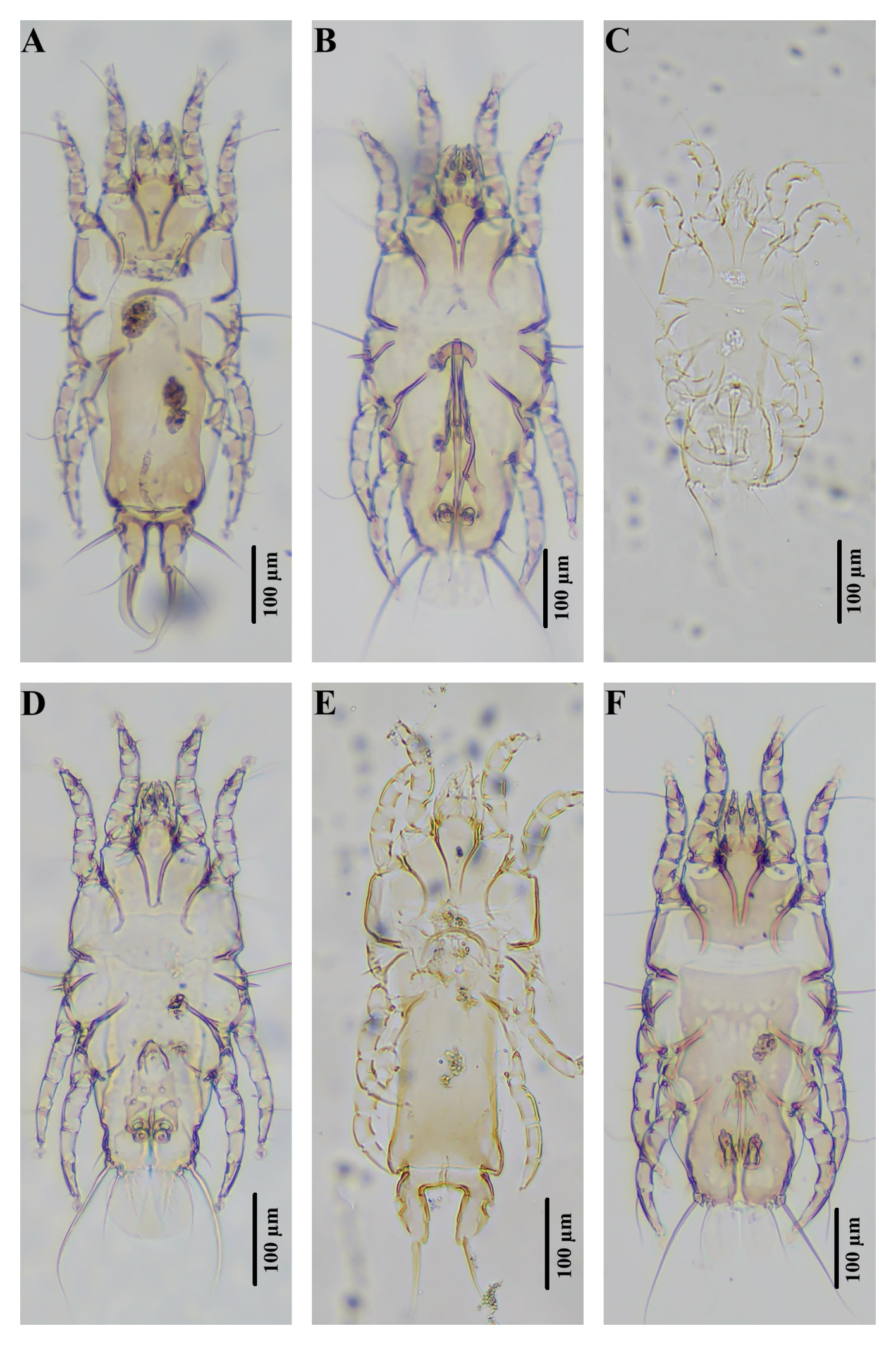
Family Pteronyssidae Oudemans, 1941
This family includes approximately 150 species within 23 genera, which are associated with birds of the orders Passeriformes, Piciformes, and Coraciiformes (Gaud and Atyeo 1996; Mironov 2003; Mironov and Wauthy 2005, 2006, 2008). In the present study, species from the three genera of this family, Pteronyssus, Scutulanyssus, and Sturnotrogus, have been detected.
Genus Pteronyssus Robin, 1877
The genus Pteronyssus contains six currently recognised species associated with four woodpecker genera, including Dendrocopos, Melanerpes, Picus, and Picoides (Faccini and Atyeo 1981; Mironov 2002; Mironov and Galloway 2006). Pteronyssus robini, which we detected on the Syrian woodpecker (Dendrocopos syriacus), was previously recorded on the lesser spotted woodpecker (Dryobates minor) in a study conducted in Türkiye by Eren et al. (2025). This mite has previously been reported on various woodpeckers (Dendrocopos spp., Dryobates spp., and Picus spp.) in Switzerland, Moldova, and Russia (Mironov 2002).
Genus Scutulanyssus Mironov, 1985
This genus comprises approximately 15 described species associated with swallows from both the Old World and the New World (Mironov 1985, 1989; Gaud and Atyeo 1985; Mironov and Galloway 2006), and is represented by two species in Türkiye, including Scutulanyssus hirundicola on the barn swallow Hirundo rustica and S. ottuki on the Western house martin Delichon urbicum (Gürler et al. 2013; Eren 2025).
Genus Sturnotrogus Mironov, 1989
The genus Sturnotrogus consists of 13 species associated with starlings (Passeriformes: Sturnidae) (Mironov 1989). In this study, Sturnotrogus pastoris detected on the rosy starling Pastor roseus is reported for the first time in Türkiye (Figs. 8: A-B). In previous studies, this species has been reported on the rosy starling in Kazakhstan, Tajikistan, and Turkmenistan and on the white-cheeked starling Spodiopsar cineraceus in the Russian Far East (Mironov 1987; Mironov and Wauthy 2006).
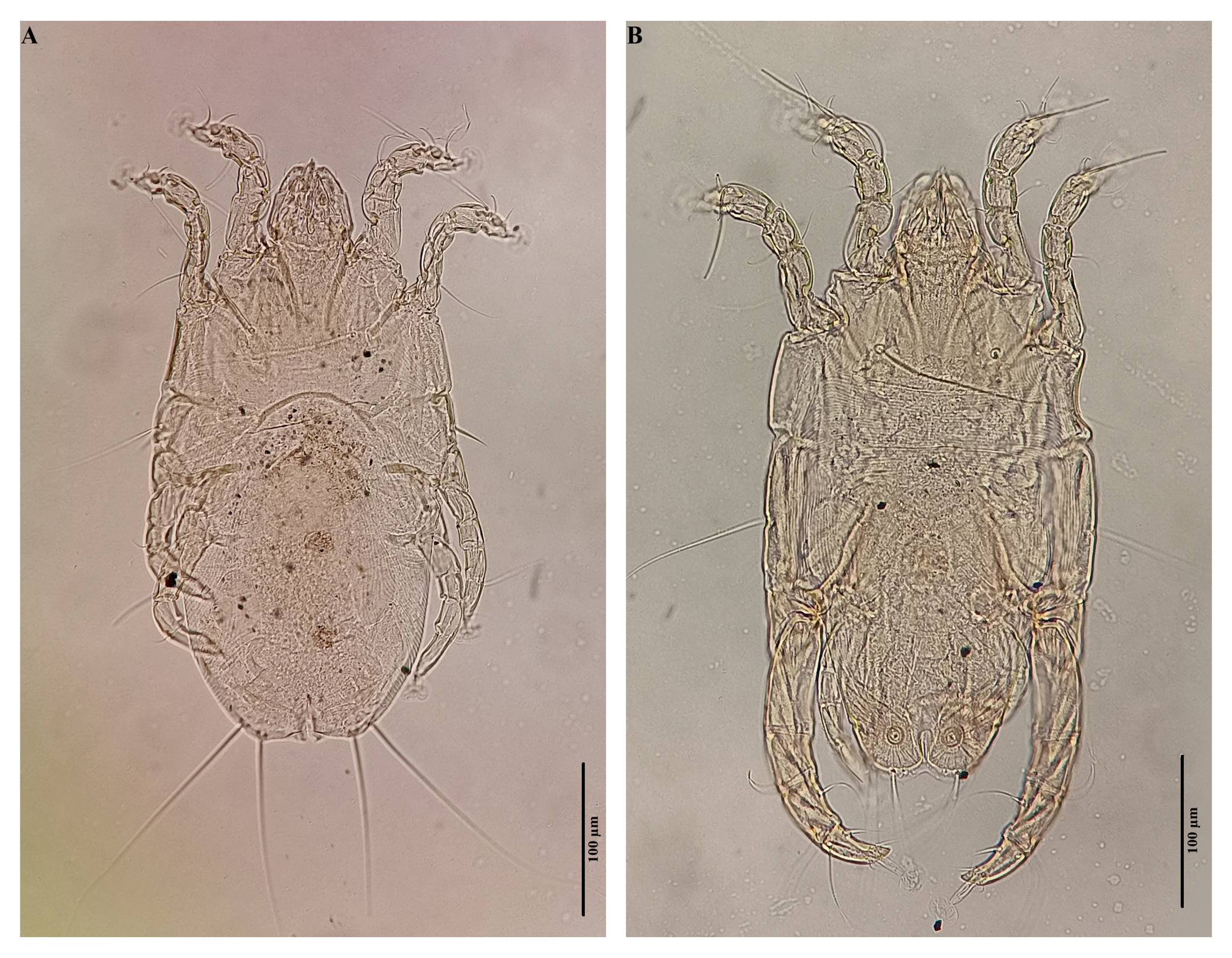
Family Trouessartiidae Gaud, 1957
This family is one of the largest feather mite families, comprising over 217 described species in 11 genera, found mainly on hosts of the order Passeriformes, and also on birds from several non-passerine avian orders (Orwig 1968; Santana 1976; Gaud and Atyeo 1996; Mironov 2022, 2023b; Mironov et al. 2023; Constantinescu et al. 2024; Mironov and Heleno 2025). A single genus Trouessartia currently represents this family in Türkiye. Only species of this genus was detected in this study.
Genus Trouessartia Canestrini, 1899
This genus includes around 155 species, mostly monoxenous and mainly associated with passerines (Passeriformes) (Mironov 2022; Mironov and Galloway 2019; Mironov and Chandler 2020; Mironov and Dmitryukov 2025). Trouessartia is the second most genus after Proctophyllodes by the number of species reported from Türkiye. To date, eight species from this genus have been recorded in Türkiye: Trouessartia bifurcata, T. inexpectata, T. jedliczkai, T. kratochvili, T. microcaudata, T. reguli, T. rubecula, and T. trouessarti (Gürler et al. 2013; Per and Aktaş 2018; Eren 2025; Eren et al. 2025). Four of ten species identified in the present study represent new records for the fauna of Türkiye: Trouessartia appendiculata (Fig. 9: A) and T. crucifera (Fig. 9: B) from the barn swallow Hirundo rustica; Trouessartia rosterii from the European starling Sturnus vulgaris (Figs. 9: C-D); and T. swidwiensis from the thrush nightingale Luscinia luscinia (Figs. 9: E-F). T. rosterii has previously been reported on the European starling in various parts of the world, including Europe (Bulgaria, Czechia, France, Italy, Germany, the Netherlands, and Ukraine), Asia (Russia, India), Africa (Morocco, South Africa), and North America (USA, Cuba) (Canestrini and Kramer 1899; Bedford 1932; Bonnet and Timon-David 1934; Boyd 1951; Gaud, 1957; Černý 1964, 1967; Vassilev and Kolebinova 1965; Santana 1976; Burdejnaja and Kivganov 2009b; Mironov et al. 2023). Similarly, T. swidwiensis has been reported on the bluethroat Luscinia svecica, the common redstart Phoenicurus phoenicurus, and the thrush nightingale in many regions of the world, including Europe (Italy, Poland, Spain, Sweden, and Ukraine), Africa (Algeria), and Asia (Russia) (Černý 1965; Jabłońska 1970; Santana 1976; Burdejnaja and Kivganov 2009b; Mironov et al. 2023). Trouessartia appendiculata is a widespread species associated with swallows of the genus Hirundo, and it has been reported from many regions of the world, mainly on the barn swallow Hirundo rustica (Santana 1976; Gaud and Atyeo 1986; Mironov and Galloway 2019). Similarly, Trouessartia crucifera has also been reported on the barn swallow in many regions of the world (Gaud 1957; Santana 1976; Arutunjan and Mironov 1983; Gaud and Atyeo 1986; Mironov and Galloway 2019).
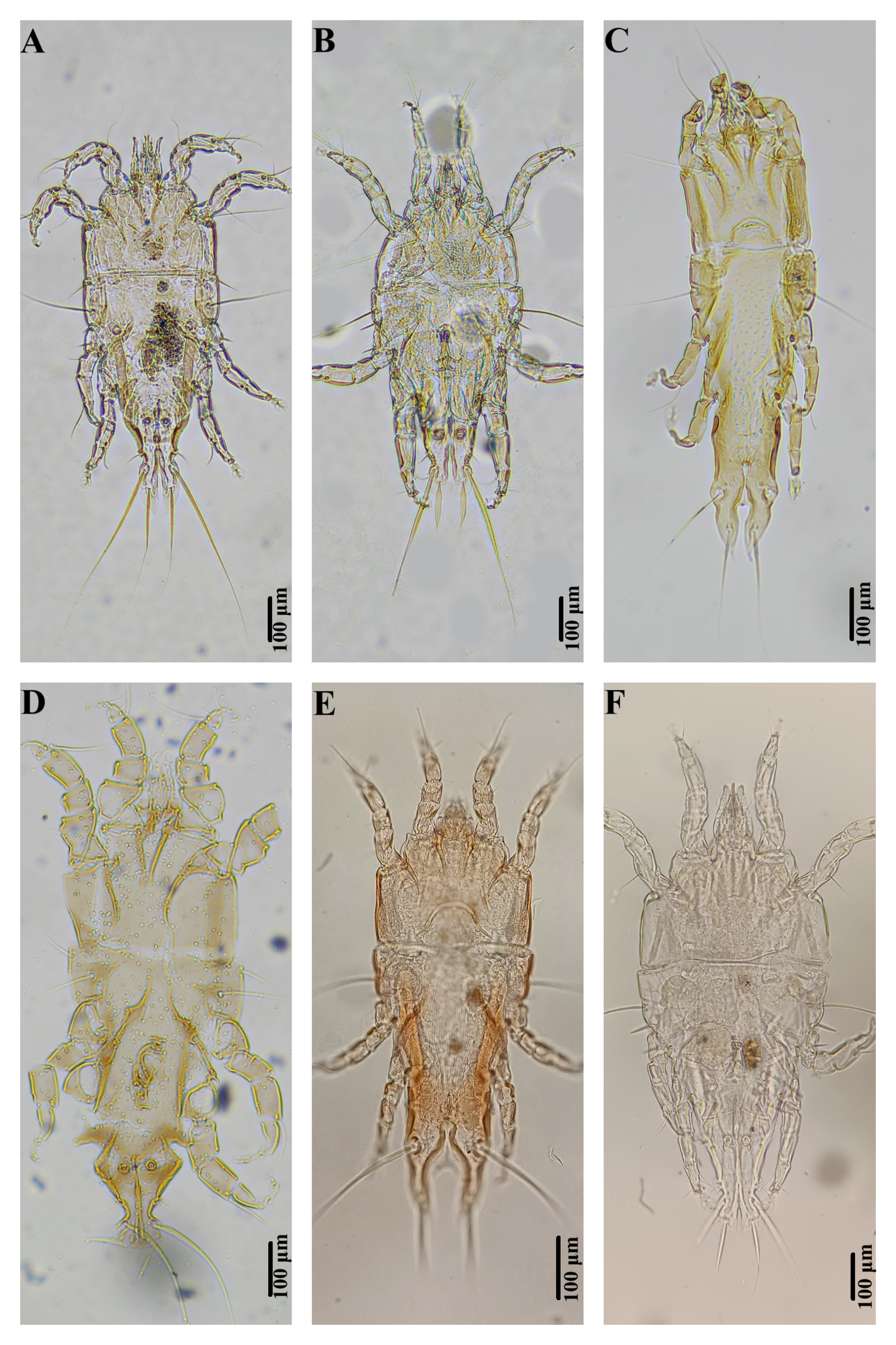
Family Xolalgidae Dubinin, 1953
The family includes over 150 species in 27 genera and three subfamilies (Ingrassiinae, Xolalginae, and Zumptiinae). Mites of this family are associated with hosts of many bird orders, both aquatic and terrestrial ones (Gaud and Atyeo 1981, 1996; Schatz et al. 2011). In the present study, species from the genera Ingrassia and Vingrassia have been identified.
Genus Ingrassia Oudemans, 1905
The genus includes 30 species associated with hosts in the aquatic bird orders Anseriformes, Charadriiformes, Pelecaniformes, Podicipediformes, Procellariiformes, and Sphenisciformes (Gaud and Atyeo 1996; Stefan et al. 2013; Mironov et al., 2025). Ingrassia philomachi, which we detected for the first time in Türkiye on the ruff Calidris pugnax (Fig. 10: A), was originally described on the same host in Cameroon (Gaud, 1972). Later, it was reported on this host in Kyrgyzstan (Chirov, 1979; Chirov and Mironov 1990), the Baltic countries (Mironov 1981), Russia (Vasyukova and Mironov 1991) and Ukraine (Kivganov and Chernichko 2007). In the present study, Ingrassia tringae, which we detected for the first time in Türkiye on the little stint C. minuta (Fig. 10: B), had previously been reported on this host in Russia (Vasyukova and Mironov 1990) and Ukraine (Kivganov and Chernichko 2007).

Genus Vingrassia Vasyukova & Mironov, 1991
The genus includes two species associated with birds of the family Anatidae (Anseriformes): Vingrassia velata and V. cygni (Vasyukova and Mironov 1991; Mironov and Galloway 2002a; Galloway et al. 2014). In this study, we detected V. velata on the Eurasian wigeon A. penelope for the first time in Türkiye (Figs. 10: C-D). In previous studies, V. velata has been reported on the domestic duck Anas platyrynchus domesticus in Taiwan (Wang and Fan 2010), Chile (Salazar-Silva et al. 2025), Canada (Galloway et al. 2014), Russia (Vasyukova and Mironov 1990), Germany (Kutzer et al. 1965) and the Netherlands (Siepel et al. 2016).
Family Freyanidae Dubinin, 1953
This feather mite family currently includes about 80 species in 17 genera and four subfamilies (Burhinacarinae, Diomedacarinae, Freyaninae, and Michaeliinae). These mites infest birds belonging to the order Anseriformes, Charadriiformes, Gruiformes, Pelecaniformes, and Procellariiformes (Dubinin 1950; Gaud and Atyeo 1982, 1985, 1996; Schatz et al. 2011). Only two species, Freyana anatina and F. nyrocae, belonging to this family were detected in the present study.
Genus Freyana Haller, 1877
The genus is the largest in the family and includes nearly 35 described species associated with hosts family Anatidae (ducks, geese, and swans) (Gaud and Atyeo 1985; Calder 1986; Budde 1991; Vasyukova and Mironov 1991). The mite Freyana anatina has a cosmopolitan distribution because of association with ducks of the genus Anas sensu lato (Anas, Mareca, Sibirionetta, and Spatula). This mite species has been previously reported on various wild ducks (Anas sp.) in Türkiye (Aksın 2007). The record of F. anatina in the present study on the northern shoveler Spatula clypeata, is a new host-parasite association of this mite in Türkiye. Up to now, F. anatina has been almost worldwide, in Europe, Asia, North and South America, Africa, and Oceania (Dubinin 1953; Calder 1986; Dabert 1987; Budde 1991; Vasyukova and Mironov 1990, 1991; Mironov 1997; Dabert 2000; Mironov and Galloway 2002b; Galloway et al. 2014; Han et al. 2023). Freyana nyrocae has been reported in Türkiye on the red-crested pochard Netta rufina by Gürler et al. (2013). We in Türkiye, F. nyrocae on the common pochard (A. ferina) that is a new host-parasite association for this mite fauna in Türkiye. The Freyana nyrocae mite has a wide duck host range, similar to F. anatina. Freyana nyrocae has been reported from various species of diving duck of the genera Aythya and Netta almost worldwide Africa, Asia, Europe, North and South America, and Oceania (Dubinin 1953; Calder 1986; Vasyukova and Mironov 1990, 1991; Galloway et al. 2014).
Family Gabuciniidae Gaud & Atyeo, 1975
This feather mite family, comprising over 80 species in 16 genera, primarily infests hosts from the orders Accipitriformes and Falconiformes; however, members of some genera have been recorded on hosts belonging to the orders Caprimulgiformes, Coraciiformes, Cuculiformes, Musophagiformes, Otidiformes, Passeriformes, and Piciformes (Gaud and Atyeo 1975, 1996; Dabert and Alberti 2008; Mironov et al. 2014; Hernandes 2020). Only on species representing this family, Coraciacarus cuculi, has been found in the present study in Türkiye.
Genus Coraciacarus Dubinin, 1956
The host range of the genus Coraciacarus, currently including nine species, is quite broad, and includes hosts belonging to the orders Cuculiformes, Coraciiformes, Musophagiformes, and Passeriformes (Gaud and Atyeo 1975; Dabert and Alberti 2008). In the present study, only Coraciacarus cuculi has been detected, and this is a new record for the fauna of Türkiye (Fig. 11: A). In studies conducted to date, Coraciacarus cuculi has been reported from 19 cuckoo species from both hemispheres and belonging to the families Centropidae (Centropus spp.) (Radford 1958; Gaud and Mouchet 1959; Gaud and Till 1961; Gaud 1966) and Cuculidae (Ceuthmochares, Chrysococcyx, Clamator, Cuculus, and Oxylophus) (Mégnin and Trouessart 1884a; Hull 1934; Radford 1953, 1958; Dubinin 1956; Gaud and Mouchet 1959; Gaud and Till 1961; Gaud 1966; Gaud and Atyeo 1975; de Alzuet et al. 1988).

Family Kramerellidae Gaud & Mouchet, 1961
The family consists of over 50 species in seven genera, and members of this family are associated with birds belonging to the orders Ciconiiformes, Falconiformes, Gruiformes, Pelecaniformes, and Strigiformes (Gaud and Atyeo 1996). In the present study, three species representing three genera (Dermonoton, Freyanopterolichus, and Kramerella) were identified from this family.
Genus Dermonoton Gaud & Mouchet, 1959
The genus Dermonoton comprises six species associated exclusively to owls (Strigiformes) (Mégnin and Trouessart 1884b; Gaud and Mouchet 1959; Gaud 1980). Dermonoton parallelus, which we detected on the little owl Athene noctua in the present study, was also reported in this host in previous studies conducted in Türkiye (Eren et al. 2025). This mite was originally described from Eurasian scops owl Otus scops (Canestrini and Kramer, 1899; Gaud 1980), and in the following years, it has also been reported on some large owl species (Asio spp. and Bubo spp.) in Africa (Gaud 1980; Philips 2000).
Genus Freyanopterolichus Dubinin, 1953
The genus Freyanopterolichus currently includes 10 species associated with birds from the orders Ciconiiformes (Ciconiidae), Gruiformes (Gruidae), and Pelecaniformes (Scopidae and Threskiornithidae) (Mégnin and Trouessart 1884c; Trouessart and Mégnin 1885; Dubinin 1953; Gaud and Mouchet 1959; Gaud 1982a, 1982b; Waki and Shimano 2022). In the present study, Freyanopterolichus pelargicus was detected on the black stork C. nigra, representing a new record for the feather mite fauna of Türkiye (Figs. 11: B-C). To date, this species has also been reported on various stork species (Ciconia spp.) worldwide (Dubinin 1953).
Genus Kramerella Trouessart, 1916
Kramerella, the third kramerellid genus we detected, currently includes 10 species associated excusively with birds of the order Strigiformes (Dubinin 1953; Gaud 1980; Černý and Wiesner 1992). This genus is represented in Türkiye by two species: Kramerella aluconis and K. lunulata (Eren et al. 2023); in the present study we detected only the latter.
Family Pterolichidae Trouessart & Mégnin, 1884
The family Pterolichidae, is one of the largest feather mite families, comprising approximately 400 species in 122 genera and four subfamilies. Members of this family infest birds belonging to the orders Charadriiformes, Ciconiiformes, Coraciiformes, Cuculiformes, Falconiformes, Galliformes, Musophagiformes, and Psittaciformes (Gaud and Atyeo 1996; Schatz et al. 2011). In the present study, only three genera from this family were identified: Grallobia, Grallolichus and Pseudolichus (Table 2).
Genus Grallobia Hull, 1934
The genus Grallobia includes 10 species associated with rails and crakes of the families Rallidae and Sarothruridae (Gruiformes) (Gaud 1968). To date, this genus was represented in Türkiye by a single species Grallobia fulicae, which was reported from is common host the Eurasian coot Fulica atra (Eren and Eren 2025). In this study, Grallobia rallorum has been detected on the corn crake C. crex that is a new record for the feather mite fauna of Türkiye (Fig. 11: D). This species has been reported from the same host species in previous studies in Europe, Asia and Africa (Bedford 1936; Dubinin 1951; Gaud 1968; Kolarova 2021).
Genus Grallolichus Gaud, 1960
The genus Grallolichus consists of 16 species associated with members of the order Gruiformes (Heliornithidae, Rallidae and Sarothruridae) and Charadriiformes (Jacanidae) (Dabert 2024). This genus is represented by two species in Türkiye: Grallolichus minutus from the western swamphen P. porphyrio (Gürler et al. 2013) and G. proctogamus from the Eurasian coot F. atra (Eren and Eren 2025). In this study, Grallolichus proctogamus, which we detected on the common moorhen G. chloropus, is a new host-parasite association for the fauna of Türkiye. Grallolichus proctogamus has been mainly reported from the Eurasian coot in previous studies: Russia (Dubinin 1956), Bulgaria (Vassilev 1958), Czechia (Černý 1961), France (Gaud and Mouchet 1963), Botswana (formerly Bechuanaland) and Rwanda (Gaud 1968), and Korea (Han and Min 2017). It was also reported on the common moorhen by Gaud (1968).
Genus Pseudolichus Atyeo & Gaud, 1992
The genus Pseudolichus includes two species associated with members of the family Phasianidae (Galliformes) (Atyeo and Gaud 1992; Mironov 1997). The genus is represented by a single species, Pseudolichus solutocurtus from the ″wild partridge» (apparently Alectoris chukar as in the present study) (Aksın and Erdoğmuş 2005). It has also been reported from partridges in the genera Alectoris and Perdix in Eurasia (Atyeo and Gaud 1992; Mironov 1997).
Family Ptiloxenidae Gaud 1982
This feather mite family is non-specious and includes 18 species in four genera. Representatives of this family inhabit on birds of the orders Charadriiformes, Phoenicopteriformes and Podicipediformes (Gaud and Atyeo 1996; Dabert and Ehrnsberger 1998; Schatz et al. 2011).
Genus Ptiloxenus Hull, 1934
The genus Ptiloxenus includes two species associated with grebes (Podicipediformes) (Dubinin 1956; Dabert and Ehrnsberger 1998). Of the two species currently recognised Ptiloxenus major has been detected on the great crested grebe (Podiceps cristatus) in this study. This species was previously reported from the same host in Türkiye by Eren et al. (2022). In studies ongoing to date, P. major has been reported worldwide on grebe species of the genera Podiceps and Rollandia (Dubinin 1956; Dabert and Ehrnsberger 1998).
The results of our study are important contribution to the knowledge of feather mite fauna in Türkiye. A total of 50 feather mite species were identified on the examined avian hosts, 30 of which are new records for the fauna of Türkiye. Compared to previous feather mite studies conducted in Türkiye (Gürler et al. 2013; Eren et al. 2023; 2025), this study appears to be the most comprehensive to date. However, for uncovering the feather mite fauna associated with birds in Türkiye and for better understanding host-parasite relationships, extensive ectoparasitic studies of many unexamined avian hosts from different geographical regions of Türkiye are needed.
Acknowledgements
The authors of this article are grateful to Dr. Sergey V. Mironov (Zoological Institute of the Russian Academy of Sciences, St. Petersburg, Russia) for his assistance in diagnosing feather mites, as well as for his support in providing with acarological literature we needed during the preparation of the article. In addition to this, we thank Dr. Fabio Akashi Hernandes (Departamento de Ecologia e Zoologia, CCB/ECZ, Trindade, Universidade Federal de Santa Catarina, Florianópolis, Santa Catarina, Brazil) and Dr. Jacek Dabert (Department of Animal Morphology, Faculty of Biology, Adam Mickiewicz University, Poznań, Poland) for their positive responses to our literature requests.
References
- Aksın N. 2007. Freyana anatina (Koch, 1844) feather mites (Acarina, Freyanoidea) recorded for the first time on wild ducks (Subfamily, Anatinae) in Turkey. Turkiye Parazitol Derg., 31(4): 302-305.
- Aksın N., Erdoğmuş Z. 2005. Pseudolichus solutocurtus Dubinin, 1956 (Acarina, Pterolichoidea) and Harpyrhynchus sp. (Acarina, Harpyrhynchidae Dubinin, 1957) species recorded for the first time on wild partridges in Turkey. Turk J Vet Anim Sci., 29(5): 1149-1156.
- Arutunjan E.S., Mironov S.V., 1983. New and little known species of feather mites (Analgoidea). Zool. Sbornik Inst. Zool. Akad. Nauk ArmSSR 19: 319-336. [In Russian]
- Atyeo W.T., Braasch N.L. 1966. The feather mite genus Proctophyllodes (Sarcoptiformes: Proctophyllodidae). Bull Univ Nebr State Mus., 5: 1-354.
- Atyeo W.T., Gaud J. 1992. The identity of Pterolichus obtusus Robin, 1877 with descriptions of new genera and species of feather mites (Acarina, Pterolichidae) from the Galliformes (Aves). Acarologia, 33(2): 193-206.
- Badek A., Dabert J. 2005. A new species of the genus Avenzoaria Oudemans, 1905 (Acari: Avenzoariidae) from the red knot, Calidris canutus (L.) (Aves, Charadriiformes). Ent. Mitt. Zool. Mus. Hamburg., 14(171): 237-243.
- Bedford G.A.H. 1932. A synoptic check-list and host-list of ectoparasites found on South African Mammalia, Aves, and Reptilia. Report of the Director of Veterinary Service and Animal Industry, Union of South Africa, p. 223-523.
- Bedford G.A.H. 1936. A synoptic check-list and host-list of the ectoparasites found on South African Mammalia, Aves, and Reptilia. Onderstepoort J Vet Sci Anim Ind., 7(1): 69-110.
- Berlese A. 1898. Megninia grossa Berl. n. sp. Acari, Myriopoda et Scorpiones hucusque in Italia reperta 87(4).
- Bonnet A. 1924. Révision des genres Megninia, Mesalges et genres voisins de la sous-famille des Sarcoptides plumicoles (Première partie). Bull. Soc. Zool. Fr., 49: 146-188. [In French]
- Bonnet A., Timon-David J. 1934. Recherches sur les acariens plumicoles (Troisième note). Ann. Parasitol. Hum. Comp., 12(4): 257-266. [In French] https://doi.org/10.1051/parasite/1934124257
- Boyd E.M. 1951. A survey of parasitism of the starling Sturnus vulgaris L. in North America. J. Parasitol., 37(1): 56-84. https://doi.org/10.2307/3273522
- Buchholz R. 1869. Bemerkungen über die Arten der Gattung Dermaleichus Koch. Dresden, E. Blochmann & Sohn. 56 pp. + 7 pls. [In German]
- Budde J.E. 1991. Heteromorphism among selected feather mite species (Analgoidea: Freyanidae) of the genus Freyana Haller, 1877. [Phd Thesis]. Ohio: Department of Biological Science, Youngstown State University. pp. 154.
- Burdejnaja S., Kivganov D. 2009a. A new species of the genus Proctophyllodes (Analgoidea, Proctophyllodidae) from Ukraine. Vestn. Zool., 43(4): e15-e18. https://doi.org/10.2478/v10058-009-0015-9
- Burdejnaja S., Kivganov D. A. 2009b. Feather mites of the genus Trouessartia Canestrini, 1899 (Acari: Trouessartiidae) passerine birds of Ukraine. Visnyk Odes' kogo Nacional'nogo Universytetu, 14: 75-80. [In Ukrainian]
- Calder B.S. 1986. Revision of the Feather Mite Genus Freyana (Freyanidae; Analgoidea). [Phd Thesis]. Ohio: Department of Biological Science, Youngstown State University. pp. 134.
- Canestrini G. 1878. Nouve specie del genre Dermaleichus. Atti I.R. Ist. Veneto Sci. Lett. Arti., 5: 43-70. [In Italian]
- Canestrini G. and Kramer P. 1899. Demodicidae und Sarcoptidae. Das Tierreich, 7: 1-193. https://doi.org/10.5962/bhl.title.69280
- Černý V, 1961. Contributions à la connaissance des acariens plumicoles (Analgesoidea) de La Tchêcoslovaquie. Acta Soc. Entomol. Cech., 58: 288-293. [In French]
- Černý V. 1964. Contributions to the knowledge of feather mites (Analgesoidea) from Czechoslovakia II. Československá Parasitologie, 11: 65-69.
- Černý V. 1965. Feather mites (Analgesoidea) from birds trapped at the Falsterbo bird station, Southern Sweden. Acta Univ. Lund. Sect., 2(8): 1-8.
- Černý V. 1967. Catalogo de la fauna Cubana. XX. Lista de los acaros parasitos de Aves reportadas de Cuba. Trabajos de Divulgacion. Museo "Felipe Poey» de la Academia de Ciencias de Cuba, 45: 1-23. [In Spanish]
- Černý V. 1982. Proctophyllodes schwerinensis sp. n., a new feather mite of Anthus spinoletta. Angew Parasitol., 23(3):158-159. [In German]
- Černý V. 1990. Faunistic records from Czechoslovakia. Acta Entomol. Bohemoslov., 87(2): 159-160.
- Černý V., Wiesner J. 1992. Kramerella glaucidii spec. nov. (Acari, Sarcoptiformes, Kramerellidae) - eine neue Milbenart vom Sperlingskauz. Anz. Ver. Thüring. Ornithol., 1(2): 85-87. [In German]
- Chang H.Q., Wang Z.Y., Liu H. 2018. Four new feather mite species of the genus Anhemialges Gaud, 1958 (Astigmata: Analgidae) from China. Zootaxa, 4531(2): 251-265. https://doi.org/10.11646/zootaxa.4531.2
- Chirov P.A. 1979. Mites of the superfamily Analgoidea living on birds of Kyrgyzstan. In: Fauna and ecology of insects of Kyrgyzstan. 13: 49-54. [In Russian]
- Chirov P.A., Mironov S.V. 1983. New species of feather mites (Analgoidea) from Passerine birds of Kirghizia. Parazitologiya, 17: 47-56. [In Russian]
- Chirov P.A., Mironov S.V. 1990. Feather mites of the subfamily Ingrassiinae of waders and ducks of Kyrgyzstan // Publ. Academy of Sciences of the Kirghiz USSR.- No. 3, Series. Chemical Engineering and Biological Sciences. p. 77-83. [In Russian]
- Constantinescu I.C., Chişamera G.B., Petrescu A., Costică A. 2018. Two new species of feather mites (Acarina: Psoroptidia) from the oriental magpie-robin, Copsychus saularis (Passeriformes: Muscicapidae). Acarologia, 58(2): 313-331. https://doi.org/10.24349/acarologia/20184244
- Constantinescu, I.C., Adam, C., Chișamera, G.B., Gavril, V.D., Motoc, R., Mukhim, D.K.B., Dobre, D.S. Cobzaru, I. 2024. Two new species of feather mites (Acarina: Psoroptidia) from Old World flycatchers (Passeriformes: Muscicapidae) in India. Acarologia, 64(4): 1213-1231. https://doi.org/10.24349/eb9q-pjy9
- Dabert J. 1987. Morphological analysis of Freyana anatina (Koch, 1844), feather mites (Acari: Freyanoidea). Acta Parasitol. Pol., 32: 239-263.
- Dabert J. 2000. Feather mites (Acari, Astigmata) of water birds of the Slonsk Nature Reserve with the description of a new species. Biol. Bull. Poznan., 37: 303-316.
- Dabert J. 2024. A new species of the feather mite genus Grallolichus Gaud, 1960 (Acariformes: Pterolichidae): first report of a commensal mite specific to the sungrebe (Heliornis fulica). Animals, 14: 3035. https://doi.org/10.3390/ani14203035
- Dabert J., Ehrnsberger R. 1998. Phylogeny of the feather mite family Ptiloxenidae Gaud, 1982 (Acari: Pterolichoidea). In: Arthropod Biology: Contribution to morphology, ecology and systematics, Ebermann, E. (Ed.). Vienna: Biosystematics and Ecology series 14. Austrian Academy of Sciences. p. 145-178.
- Dabert J., Mironov S.V. 1999. Origin and evolution of feather mites (Astigmata). Exp. Appl. Acarol., 23: 437-454. https://doi.org/10.1023/A:1006180705101
- Dabert J., Alberti G. 2008. A new species of the genus Coraciacarus (Gabuciniidae, Pterolichoidea) from the huia Heteralocha acutirostris (Callaeatidae, Passeriformes), an extinct bird species from New Zealand. J. Nat. Hist., 42(43-44): 2763-2776. https://doi.org/10.1080/00222930802354142
- Dabert J., Dabert M., Mironov S.V. 2001. Phylogeny of feather mite subfamily Avenzoariinae (Acari: Analgoidea: Avenzoariidae) inferred from combined analyses of molecular and morphological data. Mol Phylogenet Evol., 20(1): 124-135. https://doi.org/10.1006/mpev.2001.0948
- de Alzuet A.D.B., Cicchino A.C., Abrahamovich A.H. 1988. Consideraciones taxonomicas y relaciones hospedatorias de los generos Coraciacarus Dubinin 1956, Piciformobia Gaud y Atyeo 1975 y Capitolichus Gaud y Atyeo 1975 (Acari, Astigmata, Gabuciniidae), con descripcion de tres nuevas especies. Rev. Asoc. Cienc. Nat. Litoral., 19: 49-67. [In Spanish] https://doi.org/10.14409/natura.v1i19.3550
- Dik B., Erciyas-Yavuz K., Bal M., Özsemir A.C., Yavuz, N., Davulcu, D.S. 2023. Chewing lice (Phthiraptera, Amblycera, Ischnocera) from shorebirds (Aves, Charadriiformes) in the Kızılırmak Delta, Turkey. Travaux du Muséum National d'Histoire Naturelle ''Grigore Antipa'', 66(2): 225-262. https://doi.org/10.3897/travaux.66.e97526
- Doña J., Proctor H., Mironov S., Serrano D., Jovani R. 2016. Global associations between birds and vane‐dwelling feather mites. Ecology, 97(11): 3242-3242. https://doi.org/10.1002/ecy.1528
- Dubinin V.B. 1950. Feather mites of wintering birds of the Lenkoranskian lowlands. Trudy lnstituta zoologii, Akademiya nauk Azerbaidzhaskoi SSR, 14: 58-75. [In Russian].
- Dubinin V.B. 1951. Feather mites of birds of the Baraba Steppe. Report I. Feather mites of waterfowl and wading birds of the orders of rails, grebes, palmipedes, anserines, herons, gulls, and limicoles. Parazitol. Sb., 13: 120-256. [In Russian].
- Dubinin V.B. 1953. Feather mites (Analgesoidea). Part II. Families Epidermoptidae and Freyanidae. Fauna SSSR, Paukoobraznye, Vol. 6, fasc. 6. Publisher: Akademiya Nauk SSSR, Moscow-Leningrad. pp. 411. [In Russian]
- Dubinin, V.B. 1956. Feather mites (Analgesoidea). Part III. Family Pterolichidae. Fauna SSSR, Paukoobraznye, Vol. 6, fasc. 7. Publisher: Akademiya Nauk SSSR, Moscow-Leningrad. pp. 813. [In Russian]
- Dubinin V.B., Dubinina M.N. 1940. Parasite fauna of colonical birds of the Astrakhan Preserve. Trudy Astrakhanskogo Gosudarstvennogo Zapovednika, 3: 190-298. [In Russian]
- Dubinin V.B., Sosnina E.F. 1952. Feather mites of birds wintering in the southern Tadjikistan. Trudy Akademii Nauk Tadjikskoi SSR. 5: 97-108. [In Russian]
- Eren G. 2025. Feather mites (Acariformes, Astigmata) detected on some birds in Türkiye: new records and new host-parasite associations. Travaux du Muséum National d'Histoire Naturelle ''Grigore Antipa'', 68(1): 7-27. https://doi.org/10.3897/travaux.68.e129458
- Eren G., Açıcı M. 2022. A contribution to avian ectoparasite fauna of Turkey: the reports of feather mites and tick on the Great tit (Parus major L.). Acarological Studies, 4(1): 21-27. https://doi.org/10.47121/acarolstud.970440
- Eren G., Açıcı M. 2025. An updated checklist of ticks and mites (Acari) reported on reptiles of Türkiye: New records and new host-parasite associations. Acarological Studies, 7(1): 12-41. https://doi.org/10.47121/acarolstud.1554694
- Eren G., Eren F. 2025. Notifications of feather mites (Astigmata: Pterolichidae) from the Eurasian coot Fulica atra (Gruiformes: Rallidae) in Türkiye: Grallobia fulicae (Trouessart, 1885) and Grallolichus proctogamus (Trouessart, 1885). Folia Veterinaria, 69(1): 37-40. https://doi.org/10.2478/fv-2025-0005
- Eren G., Özkoç Ö.Ü. Açıcı M. 2022. New record of three feather mites (Acariformes: Astigmata) from Turkey. Second International Congress on Biological and Health Sciences Abstract Book, Türkiye, p. 280.
- Eren G., Açıcı M., Özkoç Ö.Ü. Gürler A.T. 2021. First record of Pelargodacna heteromorpha Perez & Atyeo, 1992 (Pterolichidae, Xoloptopidinae) on a black stork (Ciconia nigra) from Turkey. Eduvet International Veterinary Science Congress, 25-27 June 2021, Türkiye, p. 292-293.
- Eren G., Kızılkaya E., Karaardıç H., Karaca M. 2025. A preliminary report with new records of feather mites (Acariformes: Astigmata) collected from birds ringed at Boğazkent Bird Ringing Station (Antalya, Türkiye). Acarological Studies, 7(1): 50-57. https://doi.org/10.47121/acarolstud.1544692
- Eren G., Öztürk M., Mironov S.V., Nisbet H.Ö., Açıcı M. 2023. New records of feather mites (Sarcoptiformes: Astigmata) from some birds in Türkiye. Acarological Studies, 5(2): 58-68. https://doi.org/10.47121/acarolstud.1244323
- Faccini J.L.H. Atyeo W.T. 1981. Generic revisions of the Pteronyssinae and Hyonyssinae (Analgoidea: Avenzoariidae). Proc. Acad. Nat. Sci. Phila., 133: 20-72.
- Galloway T.D., Proctor H.C., Mironov S.V. 2014. Chewing Lice (Insecta: Phthiraptera: Amblycera, Ischnocera) and Feather Mites (Acari: Astigmatina: Analgoidea, Pterolichoidea): Ectosymbionts of Grassland Birds in Canada. In: Cárcamo H.A., Giberson D.J. (Eds). Arthropods of Canadian Grasslands: Biodiversity and Systematics. Ottawa: Biological Survey of Canada. 3(1): 139-188. https://doi.org/10.3752/9780968932162.ch5
- Gaud J. 1957. Acariens plumicoles (Analgesoidea) parasites des oiseaux du Maroc. I. Proctophyllodidae. Bull. Soc. Sci. Nat. Maroc., 37: 105-136. [In French]
- Gaud J. 1966. Sarcoptiformes plumicoles (Analgoidea) parasites sur les oiseaux Cuculiformes d'Afrique. Rev. Zool. Bot. Afr., 73: 317-338. [In French]
- Gaud J. 1968. Acariens Sarcoptiformes plumicoles (Analgoidea) parasites sur les oiseaux Ralliformes et Gruifomes d'Afrique. Annales du Musée royale de l'Afrique centrale, Sér. In-8, Science zoologique, 164: 1-101. [In French]
- Gaud J, 1972. Acariens sarcoptiformes plumicoles (Analgoidea): parasites sur les oiseaux Charadriiformes d'Afrique. Annales du Musée Royal de l'Afrique Centrale, Serie 8: Sciences Zoologiques, 193:1-116. [In French]
- Gaud, J. (1973) 1974. Quelques espèces nouvelles de Sarcoptiformes Plumicoles (Analgidae and Dermoglyphidae) parasites d'oiseaux d'Europe. Acarologia, 15: 727-758. [In French]
- Gaud J. 1980. Acariens Sarcoptiformes plumicoles parasites sur les oiseaux Psittaciformes, Strigiformes et Caprimulgiformes en Afrique. Annales-Musée Royal de l'Afrique Centrale (Belgium). Serie in-8-Sciences Zoologiques. no. 230. [In French]
- Gaud J. 1982a. Acariens Sarcoptiformes plumicoles des oiseaux Ciconiiformes d'Afrique II. Parasites des Threskiornithidae. Rev. Zool. Afric., 96: 335-357. [In French]
- Gaud J. 1982b. Acariens Sarcoptiformes plumicoles des oiseaux Ciconiiformes d'Afrique III. Parasites des Threskiornithidae. Rev. Zool. Afric., 96: 701-730. [In French]
- Gaud J., Mouchet J, 1957. Acariens plumicoles (Analgesoidea) des oiseaux du Cameroun. I. Proctophyllodidae. Ann. Parasitol. Hum. Comp., 32: 491-546. [In French]
- Gaud J., Mouchet J. 1959. Acariens plumicoles des oiseaux du Cameroun V. Pterolichidae (1re Partie). Ann. Parasitol., 33: 493-545. [In French]
- Gaud J., Mouchet J. 1963. Révision des genres Grallobia Hull et Grallolichus Gaud (Pterolichidae, Sarcoptiformes). Acarologia, 5: 628-643. [In French]
- Gaud J., Till W.M. 1961. Suborder Sarcoptiformes Reuter. In: Zumpt F. (Ed.). The arthropod parasites of vertebrates in Africa south of the Sahara (Ethiopian Region). Vol. I (Chelicerata). Johannesburg, Publications of the South African Institute for Medical Research, No 1 (Vol. IX). p. 180-352.
- Gaud J., Atyeo W.T. (1974) 1975. Gabuciniidae, famille nouvelle de sarcoptiformes plumicoles. Acarologia, 16: 522-561.
- Gaud J., Atyeo W.T. 1981. The feather mite family Xolalgidae, Dubinin, new status (feather mites, Sarcoptiforms, Analgoidea) - The subfamily Ingrassiinae, n. sub-fam. Acarologia 22: 63-79.
- Gaud J., Atyeo W.T. 1982. The feather mite family Freyanidae, Dubinin. 2. The subfamily Michaeliinae. Acarologia, 23(2): 177-187.
- Gaud J., Atyeo W.T. 1985. La famille Freyanidae, Dubinin (Sarcoptiformes plumicoles, Freyanoidea) III. Sous-famille Frayaninae. Acarologia, 26: 387-392.
- Gaud J., Atyeo W. T. 1986. Les Trouessartia (Analgoidea, Trouessartiidae) parasites des hirondelles de 1'Ancien Monde. I. Le groupe appendiculata. Acarologia, 27: 263-274. [In French]
- Gaud J., Atyeo W.T. 1996. Feather mites of the World (Acarina, Astigmata): the supraspecific taxa. Musée Royal de l'Afrique Centrale, Annales, Sciences Zoologiques, 277, 1-193 (Part 1, text), 1-436 (Part 2, illustrations).
- Gomes S.N., Pesenti T.C., Cirne M.P., Müller G. 2015. Feather mites of Calidris fuscicollis (Aves: Scolopacidae) in Brazil. Braz. J. Biol., 75(4): 1027-1029. https://doi.org/10.1590/1519-6984.05914
- Gürler A.T., Mironov S.V., Erciyes-Yavuz K. 2013. Avian feather mites (Acari: Astigmata) of Samsun, Turkey. Acarologia, 53(1): 17-23. https://doi.org/10.1051/acarologia/20132078
- Han Y.D., Min G.S. 2017. New record of four Korean feather mites (Acari: Sarcoptiformes: Pterolichidae) isolated from the birds in the family Rallidae. J. Species Res., 6: 152-163. https://doi.org/10.12651/JSR.2017.6(S).152
- Han Y.D., Choe S., Eom K.S., Min, G.S. 2017. New record of two Korean feather mites (Acari: Sarcoptiformes: Astigmata) isolated from water birds. J. Species Res., 6: 177-184. https://doi.org/10.12651/JSR.2017.6(S).177
- Han Y.D., Mironov S.V., Kim J.H., Min G.S. 2021. Feather mites (Acariformes, Astigmata) from marine birds of the Barton Peninsula (King George Island, Antarctica), with descriptions of two new species. ZooKeys, 1061: 109. https://doi.org/10.3897/zookeys.1061.71212
- Han Y.D., Mironov S.V., Min G.S. 2022a. New Records of Four Feather Mites (Acariformes: Astigmata) from Waders (Charadriiformes: Scolopacidae) in Korea. Anim. Syst. Evol. Divers., 38(3): 130-139. https://doi.org/10.5635/ASED.2022.38.3.021
- Han Y.D., Mironov S.V., Min G.S. 2022b. Two new species of feather mites (Acariformes, Astigmata) from the black-tailed godwit, Limosa limosa (Charadriiformes, Scolopacidae), in Korea. ZooKeys, 1088: 81-97. https://doi.org/10.3897/zookeys.1088.80307
- Han Y.D., Mironov, S.V., Min G.S. 2023. The first report of two feather mites (Acariformes: Astigmata) from the Eastern spot-billed duck, Anas zonorhyncha (Anseriformes: Anatidae), in Korea. Anim. Syst. Evol. Divers., 39(4): 254-263. https://doi.org/10.5635/ASED.2023.39.4.031
- Haller G. 1882. Zur Kenntniss der Dermaleichiden. Archiv für Naturgeschicte, 48: 47-79.
- Hernandes F.A. 2020. A review of the feather mite family Gabuciniidae Gaud & Atyeo (Acariformes: Astigmata: Pterolichoidea) of Brazil, with descriptions of eleven new species. Zootaxa, 4747(1): 1-53. https://doi.org/10.11646/zootaxa.4747.1.1
- Hernandes F.A., Brito G. 2022. Feather mites (Acariformes: Astigmata) of the brown noddy, Anous stolidus (L.) (Charadriiformes: Laridae), with description of two new species from Brazil. Acarologia, 62(2): 317-331. https://doi.org/10.24349/rblu-98ly
- Hernandes F.A., Valim M.P. 2014. On the identity of two species of Proctophyllodidae (Acari: Astigmata: Analgoidea) described by Herbert F. Berla in Brazil, with a description of Lamellodectes gen. nov. and a new species. Zootaxa, 3794(1): 179-200. https://doi.org/10.11646/zootaxa.3794.1.8
- Hull J.E. 1934. Concerning British Analgidae (Feather mites). Transactions of the Northern Naturalists' Union, I: 200-206.
- Jabłońska J. 1970. The occurrence of Analgesoidea mites (Acarina) on turdid birds (Turdidae) during the spring and autumn migration on their hosts in Poland. Acta Parasitol. Pol., 18(47): 521-550.
- Keskin A., Selçuk A.Y., Kefelioğlu H. 2017. Ticks (Acari: Ixodidae) infesting some small mammals from Northern Turkey with new tick-host associations and locality records. Exp. Appl. Acarol., 73: 521-526. https://doi.org/10.1007/s10493-017-0182-2
- Kivganov D.A. 1996. A review of feather mites associated with terns (Charadriiformes: Laridae) living in the Black Sea north-western coastal region and a description of a new species of the genus Alloptes (Analgoidea: Alloptidae). Parazitologiya, 30: 302-306. [In Russian]
- Kivganov D.A., Mironov S.V. 1992. A new subgenus and three new species of the feather mite genus Alloptes (Analgoidea: Alloptidae) from terns of the Black Sea. Parazitologiya, 26(3): 198-208. [In Russian]
- Kivganov A.D., Chernichko I.E. 2007. The feather mites of waders of Sivash. Branta: Transactions of the Azov-Black Sea Ornithological Station, 10: 65-73. [In Russian]
- Klimov P.B., Mironov S.V., OConnor B.M. 2017. Convergent and unidirectional evolution of extremely long aedeagi in the largest feather mite genus, Proctophyllodes (Acari: Proctophyllodidae): evidence from comparative molecular and morphological phylogenetics. Mol. Phyl. Evol. Mol., 114: 212-224. https://doi.org/10.1016/j.ympev.2017.06.008
- Kolarova N. 2021. New data for feather mites (Acari: Astigmata) from birds in South Dobrudzha, Bulgaria. ZooNotes, 180: 1-3.
- Kolarova N., Mitov P. 2008. Feather mites of the Superfamily Analgoidea (Acari: Astigmata) from Passerines (Aves: Passeriformes) in South Dobrudzha, Bulgaria. Acta Zool. Bulg., 2: 91-102.
- Kurbanova D. 1984. Feather mites of migratory birds. Izvestiya of the Academy of Sciences of the Turkmen SSR, Biological Series, 6: 44-48. [In Russian]
- Kutzer E., Gräfner G., Betke P. 1965. Zur Bedeutung der Federmilben beim Hausgeflügel. Zentralblatt für Veterinärmedizin Reihe B, 12(5): 444-454. https://doi.org/10.1111/j.1439-0450.1965.tb01409.x
- McClure H.E., Ratanaworabhan N., Emerson K.C., Atyeo W.T., Hoogstraal H., Maa T.C., Nadchatram N., Wilson N., Kwanyuen P., Wayupong L. 1973. Some ectoparasites of the birds of Asia. Jintana Printing Ltd., Bangkok. pp. 219.
- Mégnin P., Trouessart E.L. 1884a. Les Sarcoptides plumicoles. Révision du groupe des Analgesinae, et description des espéces et genres nouveaux de la collection du Musée d'Angers. (Suite) (1). J. Microsc., 8: 331-338.
- Mégnin P., Trouessart E.L. 1884b. Les sarcoptides plumicoles. J. Microsc., 8: 257-266.
- Mégnin P., Trouessart E.L. 1884c. Diagnoses des espéces et genres nouveaux de Sarcoptides plumicoles. Analgesinae, de la collection du Musée d'Angers. La Naturaliste, 2(6): 394-397.
- Metwally A.M., Abd-Elhameed W.F., Barakat N.M. 2019. Ectoparasites (feather mites) on wild birds at some localities in Egypt. Acarines: Journal of the Egyptian Society of Acarology, 13(1): 47-52. https://doi.org/10.21608/ajesa.2019.164154
- Mironov S.V. 1981. Feather mites of the genus Metanalges (Sarcoptiformes, Analgoidea) of the USSR fauna. Parazitologiya, 15: 459-468. [In Russian]
- Mironov S.V. 1985. Feather mites of the genera Analges and Pteronyssoides from the European part of the USSR (Sarcoptiformes, Analgoidea). Parazitol. Sb., 33: 159-208. [In Russian]
- Mironov S.V. 1987. Three new feather mite species of the family Avenzoariidae (Sarcoptiformes: Analgoidea). Parazitologiya, 21: 528-536. [In Russian]
- Mironov S.V. 1989. A review of feather mites of the subfamily Pteronyssinae from the USSR (Analgoidea, Avenzoariidae), Parazitol. Sb., 35: 96-124.
- Mironov S.V. 1990. A review of species of feather mites in the genus Scutomegninia (Analgoidea, Avenzoariidae) from cormorants. Parazitologiya, 24(1): 43-55. [In Russian]
- Mironov S.V. 1991. Co-evolutionary relationships between mites of the family Avenzoariidae (Acariformes: Analgoidea) and birds. Parazitologiya, 25(6): 473-493.
- Mironov S.V. 1996. Feather mites of the passerines of the North-West of Russia. Parazitologiya, 30: 521-539.
- Mironov S.V. 1997. Contribution to the feather mites of Switzerland with descriptions of five new species (Acarina: Sarcoptiformes). Schweiz. Entomol. Ges., 70: 455-471. https://doi.org/10.5169/seals-402691
- Mironov S.V. 2000. A review of the feather mite genus Scutomegninia Dubinin, 1951 (Acarina: Analgoidea: Avenzoariidae). Acarina, 8(1): 9-58.
- Mironov S.V. 2002. Taxonomic corrections to the feather mite genera Pteronyssus Robin, 1877 and Parapteronyssus Faccini et Atyeo, 1981 (Analgoidea, Pteronyssidae). Acarina, 10(2): 137-147.
- Mironov S.V. 2003. A review of feather mites of the genus Neopteronyssus (Astigmata: Pteronyssidae) associated with woodpeckers (Piciformes: Picidae) of the Old World. Belg. J. Entomol., 5: 37-77.
- Mironov S.V. 2009. Phylogeny of feather mites of the subfamily Pterodectinae (Astigmata: Proctophyllodidae) and their host associations with passerines (Aves: Passeriformes). Proc. Zool. Inst. Russ. Acad. Sci., 313: 97-118. doi:10.31610/trudyzin/2009.313.2.97 https://doi.org/10.31610/trudyzin/2009.313.2.97
- Mironov S.V. 2012. New species of the feather mite genus Proctophyllodes Robin, 1877 (Acari: Analgoidea: Proctophyllodidae) from European passerines (Aves: Passeriformes), with an updated checklist of the genus. Acarina, 20(2): 130-158. https://doi.org/10.21684/0132-8077-2019-27-1-19-43
- Mironov S.V. 2019. A new species of the feather mite genus Analges Nitzsch, 1818 (Acariformes: Analgidae) from the streaked spiderhunter Arachnothera magna (Passeriformes: Nectariniidae), with a renewed diagnosis and world checklist to the genus. Acarina, 27(1): 19-43. https://doi.org/10.21684/0132-8077-2019-27-1-19-43
- Mironov S.V. 2021. The identity of Plesialges mimus Trouessart, 1919 and taxonomic notes on the feather mite genus Hemialges Trouessart, 1895 (Acariformes: Analgidae). Acarologia, 61(3): 626-640. https://doi.org/10.24349/Pejc-x0bN
- Mironov S.V. 2022. Notes on the systematics of the feather mite genus Trouessartia Canestrini, 1899 (Acariformes: Trouessartiidae) with an updated world checklist. Acarina, 30(2): 157-180. https://doi.org/10.21684/0132-8077-2022-30-2-157-180
- Mironov S.V. 2023a. A new species of the feather mite genus Dolichodectes (Acariformes: Proctophyllodidae) from the Dark-sided Flycatcher Muscicapa sibirica (Passeriformes: Muscicapidae) from Buryatia. Acarina, 31(2): 213-223. https://doi.org/10.21684/0132-8077-2023-31-2-213-223
- Mironov S. V. 2023b. Two new species of the feather mite genus Trouessartia (Acariformes: Trouessartiidae) from passerines (Passeriformes) from Asian Russia. Acarina, 31(1): 15-30. https://doi.org/10.21684/0132-8077-2023-31-1-15-30
- Mironov S.V., Dabert J. 1995. New species of feather mites of the subfamily Avenzoariinae from waders (Aves: Charadriiformes) of the New World (Acarina: Analgoidea). Genus, Wroclaw, 6(2): 201-223.
- Mironov S.V., Galloway T.D. 2002a. Four new species of feather mites (Acari: Analgoidea). Can. Ent., 134: 605-618. https://doi.org/10.4039/Ent134605-5
- Mironov S.V., Galloway T.D. 2002b. New feather mite taxa (Acari: Analgoidea) and mites collected from native and introduced birds of New Zealand. Acarologia, 42: 185-201.
- Mironov S.V., Galloway T.D. 2006. New and little-known species of feather mites (Acari: Analgoidea: Pteronyssidae) from birds in North America. Can. Entomol., 138(2): 165-188. https://doi.org/10.4039/n05-047
- Mironov S.V., Wauthy G. 2005. A review of the feather mite genus Pteronyssoides Hull, 1931 (Astigmata: Pteronyssidae) from African and European passerines (Aves: Passeriformes) with analysis of mite phylogeny and host associations. Bull. Inst. R. Sci. Nat. Belg., Entomol., 75: 155-214.
- Mironov S.V., Wauthy G. 2006. Systematic review of feather mites of the genus Sturnotrogus Mironov, 1989 (Astigmata: Pteronyssidae) from starlings (Passeriformes: Sturnidae) in Africa and Europe. Bull. Inst. R. Sci. Nat. Belg., Entomol., 76: 55-81.
- Mironov S.V., Wauthy G. 2008. A systematic review of the feather mite genus Pteroherpus Gaud, 1981 (Astigmata: Pteronyssidae). Bull. Inst. R. Sci. Nat. Belg., Entomol., 78: 155-200.
- Mironov S.V., Galloway T.D. 2019. Feather mites of the genus Trouessartia Canestrini (Acariformes: Trouessartiidae) from swallows (Passeriformes: Hirundinidae) in Canada. Zootaxa, 4568(1): 1-39. https://doi.org/10.11646/zootaxa.4568.1.1
- Mironov S.V., Chandler C.R. 2020. Feather mites of the genus Trouessartia (Acariformes: Trouessartiidae) from passerines (Aves: Passeriformes) in Georgia, USA. Zootaxa, 4860(1): 1-54. https://doi.org/10.11646/zootaxa.4860.1.1
- Mironov S.V., Malovichko L.V. 2023. A new feather mite of the genus Megniniella (Acariformes: Analgidae) from the Common Crane Grus grus (Gruiformes: Gruidae). Syst. Appl. Acarol., 28(9): 1553-1564. https://doi.org/10.11158/saa.28.9.8
- Mironov, S.V. Heleno, R.H. 2025. New species and records of feather mites (Acariformes: Analgoidea) from endemic passerines (Aves: Passeriformes) in the Seychelles. Syst. Appl. Acarol., 30(1), 88-120. https://doi.org/10.11158/saa30.1.7
- Mironov S.V. Dmitryukov A.V. 2025. Three new species of the feather mite genus Trouessartia (Acariformes: Trouessartiidae) from passerines (Passeriformes) in the Asian part of Russia. Zootaxa, 5661(2): 178-200. https://doi.org/10.11646/zootaxa.5661.2.2
- Mironov S.V., Literák I., Čapek M., Koubek P. 2010. New species of the feather mite subfamily Pterodectinae (Astigmata, Proctophyllodidae) from passerines in Senegal. Acta Parasitol., 55: 399-413. https://doi.org/10.2478/s11686-010-0051-1
- Mironov S., Literak I., Sychra O., Capek M. 2014. Two new species of the feather mite family Gabuciniidae (Acariformes: Pterolichoidea) from wrens (Passeriformes: Troglodytidae). Acta Parasitol., 59(4): 568-579. https://doi.org/10.2478/s11686-014-0287-2
- Mironov S., Doña J., Jovani R. 2015. A new feather mite of the genus Dolichodectes (Astigmata: Proctophyllodidae) from Hippolais polyglotta (Passeriformes: Acrocephalidae) in Spain. Folia Parasitol., 62: 032. https://doi.org/10.14411/fp.2015.032
- Mironov S.V., Zabashta A.V., Malyshev L.L. 2023. Biodiversity of Feather Mites Parasitizing Passerines of the Lower Don Area and Quantitative Characteristics of Their Invasion. Entomol. Rev., 103(5): 573-599. https://doi.org/10.1134/S0013873823060081
- Mironov S.V., Haarder S., Galloway T.D. 2024. A new feather mite species of the genus Temnalges (Acariformes: Psoroptoididae) from coots, Fulica spp. (Gruiformes: Rallidae). Acarologia, 64(4): 1106-1116. https://doi.org/10.24349/i1su-eqk9
- Mironov S.V., Stormer H., Proctor H.C. 2025. Redescription of the feather mite Ingrassia aequinoctialis (Trouessart, 1899) (Acariformes: Xolalgidae) with notes on systematics and host associations of the Ingrassia genus-group. Acarologia, 65(2): 482-496. https://doi.org/10.24349/f5zx-leve
- Moodi B., Aliabadian M., Moshaverinia A., Kakhki O.M., Faraji F. 2014. Mites associated with passerine birds in eastern Iran. Int. J. Acarol., 40(2): 133-137. https://doi.org/10.1080/01647954.2014.888094
- Orwig, K.R. 1968. The genera and species of the feather mite subfamily Trouessartinae except Trouessartia (Acarina: Proctophyllodidae). Bull. Univ. Neb. St. Mus., 8(1): 1-187.
- Özkan L., Yukarı B.A., Adanır R. 2017. Parasites of Spur-Winged Lapwings Vanellus spinosus at a colony on the south coast of Turkey. Wader Study, 124: 75-77. https://doi.org/10.18194/ws.00063
- Park C.K., Atyeo W.T. 1971. A generic revision of the Pterodectinae, a new subfamily of feather mites (Sarcoptiformes: Analgoidea). Bull. Univ. Neb. St. Mus., 9: 39-88.
- Pedroso L.G. Hernandes F.A. 2016. New records of feather mites (Acariformes: Astigmata) from non-passerine birds (Aves) in Brazil. Check List, 12(6): 1-25. https://doi.org/10.15560/12.6.2000
- Per E., Aktaş M. 2018. The monitoring of feather mites (Acari, Astigmata) of the Warbler (Aves: Sylviidae) species in the Kızılırmak delta, Samsun, Turkey. Turk. J. Zool., 42(4): 394-401. https://doi.org/10.3906/zoo-1711-12
- Peterson P.C., Atyeo W.T. 1968. New genera related to the genus Brephosceles Hull, 1934 (Acarina: Proctophyllodidae). Bull. Univ. Neb. St. Mus., 8: 217-236.
- Philips J.R. 2000. A review and checklist of the parasitic mites. J. Raptor Res., 34(3): 210-231.
- Proctor H.C. 2003. Feather mites (Acari: Astigmata): Ecology, behavior, and evolution. Annu. Rev. Entomol., 48: 185-209. https://doi.org/10.1146/annurev.ento.48.091801.112725
- Radford C.D. 1953. The mites (Acarina: Analgesidae) living on or in the feathers of birds. Parasitol., 42:199-216. https://doi.org/10.1017/S0031182000084468
- Radford C.D. 1958. The host-parasite relationships of the feather mites (Acarina: Analgesoidea). Rev. Bras. Biol., 8: 107-170.
- Rubtsov GA., Yakimenko V.V. 2012. The feather mite (Astigmata) fauna of some passerine birds (Passeriformes) in the south of Western Siberia. Entomol. Rev., 92(9): 1020-1031. https://doi.org/10.1134/S0013873812090096
- Sajakova Z.Z. 2000. On the fauna of the feather mites family Avenzoariidae (Acariformes, Analgoidea) from plovers (Charadriidae) in the Alakol Lake depression region (southeastern Kazakhstan). TETHYS Entomological Research, 2: 29-34. [In Russian]
- Salazar-Silva C.H., Aravena L., Zamorano-Uribe M., Andrade-Hernández J., de la Fuente M. C. S., Cicchino A., Mironov S., Moreno L., Oyarzún-Ruiz P. 2025. The parasitic fauna of the Chiloe wigeon Mareca sibilatrix (Anseriformes: Anatidae) from Ñuble region, Chile. Vet. Parasitol. Reg. Stud. Reports, 101197. https://doi.org/10.1016/j.vprsr.2025.101197
- Santana F.J. 1976. A review of the genus Trouessartia (Analgoidea: Alloptidae). J. Med. Entomol., 13(1): 1-125. https://doi.org/10.1093/jmedent/13.Suppl1.1
- Schatz H., Behan-Pelletier V.M., O'Connor, B.M., Norton, R.A. 2011. Suborder Oribatida van der Hammen, 1968. In: Zhang, Z.Q. (Ed), Animal biodiversity: An outline of higher-level classification and survey of taxonomic richness. Zootaxa, 3148: 141-148. https://doi.org/10.11646/zootaxa.3148.1.26
- Shumilo R.P., Mironov S.V. 1984. Feather mites (Acariformes: Analgoidea) from passerine birds of Moldavia. Izv. Akad. Nauk Mold. SSR, 2: 75-76. [In Russian]
- Siepel H., Cremers H., Vierbergen G. 2016. Provisional checklist of the astigmatic mites of the Netherlands (Acari: Oribatida: Astigmatina). Nederlandse Faunistische Mededelingen, 47: 49-87.
- Siepel H., Cremers H.J.W.M., Hiemstra A.F. 2023. First supplement to the checklist of the astigmatic mites of the Netherlands (Acari: Oribatida: Astigmatina). Nederlandse Faunistische Mededelingen, 61: 51-64.
- Stefan L.M., Gomez-Diaz E., Mironov S.V. 2013. Three new species of the feather mite subfamily Ingrassiinae (Acariformes: Xolalgidae) from shearwaters and petrels (Procellariiformes: Procellariidae). Zootaxa 3682(1): 105-120. https://doi.org/10.11646/zootaxa.3682.1.4
- Trouessart E.L. 1885. Note sur la classification des Analgésiens et diagnoses d'éspeces et de genres nouveau. Bull. Soc. étud. Scient. Angers., 14: 46-88.
- Trouessert E.L., Mégnin P. 1885. Monographie du genre Freyana et description des espéces nouvelles du Mesée d'Angers. Bull. Soc. étud. Scient. Angers., 14: 28-45.
- Vassilev I.D. 1958. Feather mites (Analgesoidea)-ectoparasites of birds of the Lake Srebrensk near the town of Silestra in Bulgaria. Zool. Zhurnal., 37: 1325-1338.
- Vassilev I.D. and Kolebinova, M. 1965. Feather mites on starlings in the Sofia area. Izv. Zool. Inst. Mus. (Sofia), 19: 189-202. [In Bulgarian and Russian]
- Vasyukova T., Mironov S.V. 1990. Fauna and ecology of feather mites of Anseriformes and Charadriiformes of Yakutia. Yakutskii Nauchnyi Tsentr, Sibirskoye Otdelenie Akademii Nauk SSSR, Yakutsk, pp. 98. [In Russian]
- Vasyukova T.T., Mironov S.V. 1991. Feather mites of Anseriformes and Charadriiformes of Yakutia. Systematics. Nauka, Siberian Dept, Novosibirsk, pp. 200. [In Russian]
- Zerek A., Erdem I., Yaman M., Altuğ M.E., Orkun Ö. 2023. Ixodid ticks (Ixodoidea: Ixodidae) infesting wild animals in Hatay, Türkiye. Kafkas Univ. Vet. Fak. Derg., 29(6): 641-647. https://doi.org/10.9775/kvfd.2023.30132
- Waki T., Shimano S. 2022. Redescription of two parasitic feather mites sampled from the last two Crested Ibises, Nipponia nippon (Temminck, 1835) (Pelecaniformes: Threskiornithidae), lived in Japan. Zootaxa, 5116(1): 136-150. https://doi.org/10.11646/zootaxa.5116.1.7
- Waki T., Mironov S., Nakaya Y., Nagamine T., Shimano S. 2024. A New Feather Mite Species of the Genus Metanalges (Acariformes: Analgidae) from the Okinawa Rail, Hypotaenidia okinawae (Gruiformes: Rallidae), in Okinawa Island, Japan. Species Diversity, 29(1): 161-169. https://doi.org/10.12782/specdiv.29.161
- Wang Z.Y., Fan Q.H. 2010. Psoroptidia (Acari: Astigmatina) of China: a review of research progress. In: Zhang, Z.-Q., Hong, X.-Y. & Fan, Q.-H. (eds). Xin Jie-Liu Centenary: Progress in Chinese Acarology. Zoosymposia 4: 260-271. https://doi.org/10.11646/zoosymposia.4.1.16
 to post any comment or correction.


2025-03-07
Date accepted:
2025-10-14
Date published:
2025-12-19
Edited by:
Akashi Hernandes, Fabio

This work is licensed under a Creative Commons Attribution 4.0 International License
2025 Eren, Gökhan and Dik, Bilal
 Download article Download low definition
Download the citation
RIS with abstract
(Zotero, Endnote, Reference Manager, ProCite, RefWorks, Mendeley)
RIS without abstract
BIB
(Zotero, BibTeX)
TXT
(PubMed, Txt)