


Schizosthetus Athias-Henriot, 1982 (Parasitiformes: Parasitidae): the description of a new species from China
Yao, Mao-Yuan  1
; Ren, Rong
2
; Chen, Jian-Xin
3
; Yi, Tian-Ci
4
and Jin, Dao-Chao
5
1
; Ren, Rong
2
; Chen, Jian-Xin
3
; Yi, Tian-Ci
4
and Jin, Dao-Chao
5
1College of Agriculture, Anshun University, Anshun, 561000, P. R. China.
2Institute of Entomology, Guizhou University, Guiyang 550025, P. R. China.
3College of Agriculture, Anshun University, Anshun, 561000, P. R. China.
4Institute of Entomology, Guizhou University, and Guizhou Provincial Key Laboratory for Plant Pest Management of Mountainous Region, Guiyang 550025, P. R. China.
5✉ Institute of Entomology, Guizhou University, and Guizhou Provincial Key Laboratory for Plant Pest Management of Mountainous Region, Guiyang 550025, P. R. China.
2026 - Volume: 66 Issue: 1 pages: 149-156
https://doi.org/10.24349/xgzr-ms7ZooBank LSID: C75DA8A2-0A12-4811-89D8-28E0471B27DD

Original research
Keywords
Abstract
Introduction
The family Parasitidae comprises 47 genera in two subfamilies, Parasitinae Oudemans, 1901 and Pergamasinae Juvara-Bals, 1972 (Yao et al. 2024). The genus Schizosthetus, belonging to the subfamily Parasitinae, was erected by Athias-Henriot (1982) with Eugamasus lyriformis McGraw and Farrier, 1969 as its type species. The mites of Schizosthetus are easily separated from other genera of Parasitinae by unusual form of sternal shield in the female split axially into separate left and right parts, or from the posterior margin up to the level of sternal pores iv1. To date, four species of Schizosthetus, S. lyriformis (McGraw and Farrier, 1969), S. simulatrix Athias-Henriot, 1982, S. vicarius Athias-Henriot, 1982 and S. baixuelii Zhang, Xie and Yan, 2024, have been described worldwide (McGraw and Farrier 1969; Athias-Henriot 1982; Al-Atawi et al. 2002; Zhang et al. 2024).
Herein, we describe a new species, Schizosthetus yunnanensis Ren and Yi n. sp., based on the female and provide an identification key to the world species of Schizosthetus.
Material and methods
Species were extracted from the decomposing leaves of pine tree by Tullgren funnels for 12–24 hours, and collected into 75% alcohol. Mites were cleared in Nesbitt's solution and then mounted on slides in Hoyer's medium. Specimens were observed and illustrated under a Nikon DS–Ri2 microscope, and figures were edited with Adobe Photoshop CC2021. The measuring follows Yao et al. (2020). All measurements are given in micrometres (μm). Measurements for holotype are followed by the range in the paratypes.
The system of idiosomal setal nomenclature follows Hyatt (1980). Terminology for the leg chaetotaxy follows Evans (1963a), palp chaetotaxy follows Evans (1963b) and adenotaxy and poroidotaxy follows Athias-Henriot (1971, 1975).
Results
Family Parasitidae Oudemans, 1901
Subfamily Parasitinae Oudemans, 1901
Genus Schizosthetus Athias-Henriot, 1982
Type species: Eugamasus lyriformis McGraw and Farrier, 1969, by original diagnosis.
Diagnosis of the genus
Both sexes — Setae z5 of dorsal hexagon similar to j5 and j6 in form (smooth). Tritosternum biramous. Seta al of palp femur comb-like, al1 and al2 of palp genu entire and spatulate distally. Corniculi small. Epistome trispinate.
Female — Podonotal shield with 21–22 pairs of setae, and opisthonotal shield with 15–29 pairs of setae (44 pairs in S. yunnanensis n. sp.). Sternal shield split axially into separate left and right parts (in S. baixuelii), or from the posterior margin up to the level of sternal pores iv1 or setae st2. Genital shield triangular or subtriangular. Peritrematal shield posteriorly fused to opisthogastric shield (free in S. simulatrix and S. yunnanensis n. sp.). Movable digit of chelicerae with three or four teeth. Setae av1 and av2 on femur II, av1 on genu II and tibia II acicular.
Male — Holodorsal shield and transverse suture in central region. Setae av1 and av2 on femur II modified into spurs fused at base; seta av1 on genu II and tibia II each modified into spur.
Schizosthetus yunnanensis Ren and Yi n. sp.
ZOOBANK: 5DA27FAA-C769-4D9F-A8DC-96AB292132D8
Material examined
Holotype — ♀, collected by Ye-Yi Shuai from decomposing leaves of pine tree, Shuotang Town Xinnuolun Road (1562 m a.s.l., N 24°5′9″, E 101°30′56″), Xinping Yi and Dai Autonomous County, Yuxi City, Yunnan Province, China, June 19, 2019.
Paratypes — 3 ♀♀, collected by Mao-Yuan Yao and Xue-Song Zhang from decomposing leaves of pine tree, Wangtianshu Scenic Area (651 m a.s.l., N 21°37′37″, E 101°52′49″), Xishuangbanna, Yunnan Province, China, April 24, 2019; 3 ♀♀, collected by Hu-Die He and Ren Rong from decomposing leaves of pine tree, Kashang Village (1842 m a.s.l., N 22°51′54″, E 104°0′1″), Maguan County, Wenshan Zhuang and Miao Autonomous Prefecture, Yunnan Province, China, May 13, 2024.
Type material deposition
All specimens are deposited in the Institute of Entomology, Guizhou University, Guiyang, China (GUGC).
Diagnosis
Female — Podonotal shield bearing 21 pairs of setae; opisthonotal shield bearing 44 pairs of setae; anterior lateral lobes of sternal shield absent; sternal shield axially split from the posterior margin up to the level of setae st2; parametasternal shield (pmss) irregular triangle; opisthogastric shield bearing eight pairs of setae; setae SV1 absent; opisthogastric soft cuticle with four pairs of setae; peritrematal shields posteriorly free.
Description
Female — (n=7) (Figures 1–4) Idiosoma well sclerotized, length 691 (682–691), width 409 (390–409).
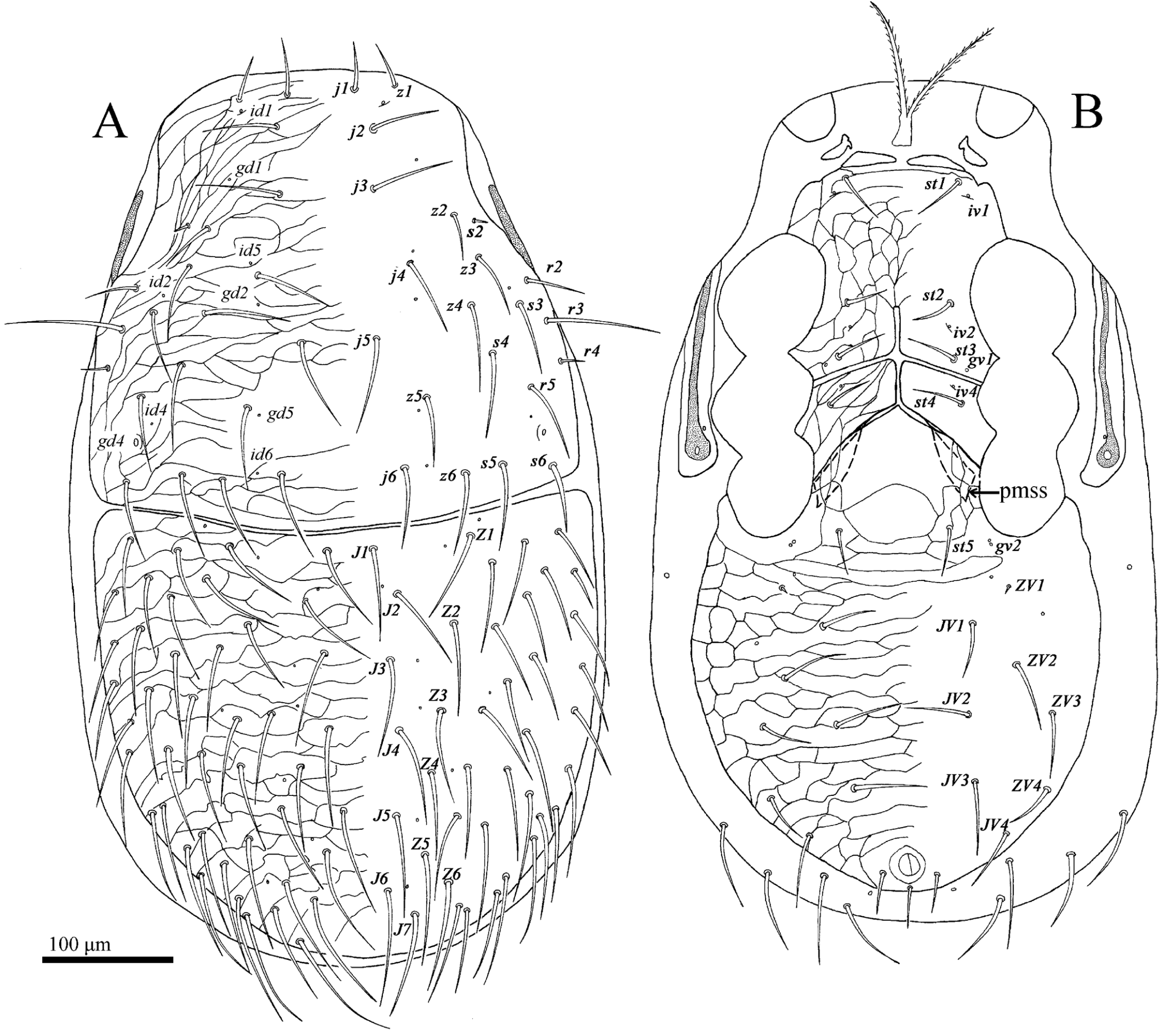
Dorsal idiosoma – (Figure 1A). Dorsum covered by two reticulated shields. Podonotal shield bearing 21 pairs of setae, which of s2 and r4 shorter than others. Lengths of setae on the podonotal shield: j1 46 (44–46), j2 55 (55–58), j3 64 (60–64), j4 62 (60–63), j5 76 (74–76), j6 68 (65–68), z1 35 (33–35), z2 37 (35–37), z3 52 (50–52), z4 68 (64–68), z5 61 (57–61), z6 67 (64–67), s2 11 (8–11), s3 64 (60–64), s4 72 (70–72), s5 68 (65–68), s6 61 (57–61), r2 47 (45–47), r3 88 (86–89), r4 20 (18–21), r5 63 (60–63). Opisthonotal shield bearing 44 pairs of setae, the vast majority of setae almost equal in length (76–82). All dorsal setae simple and smooth.
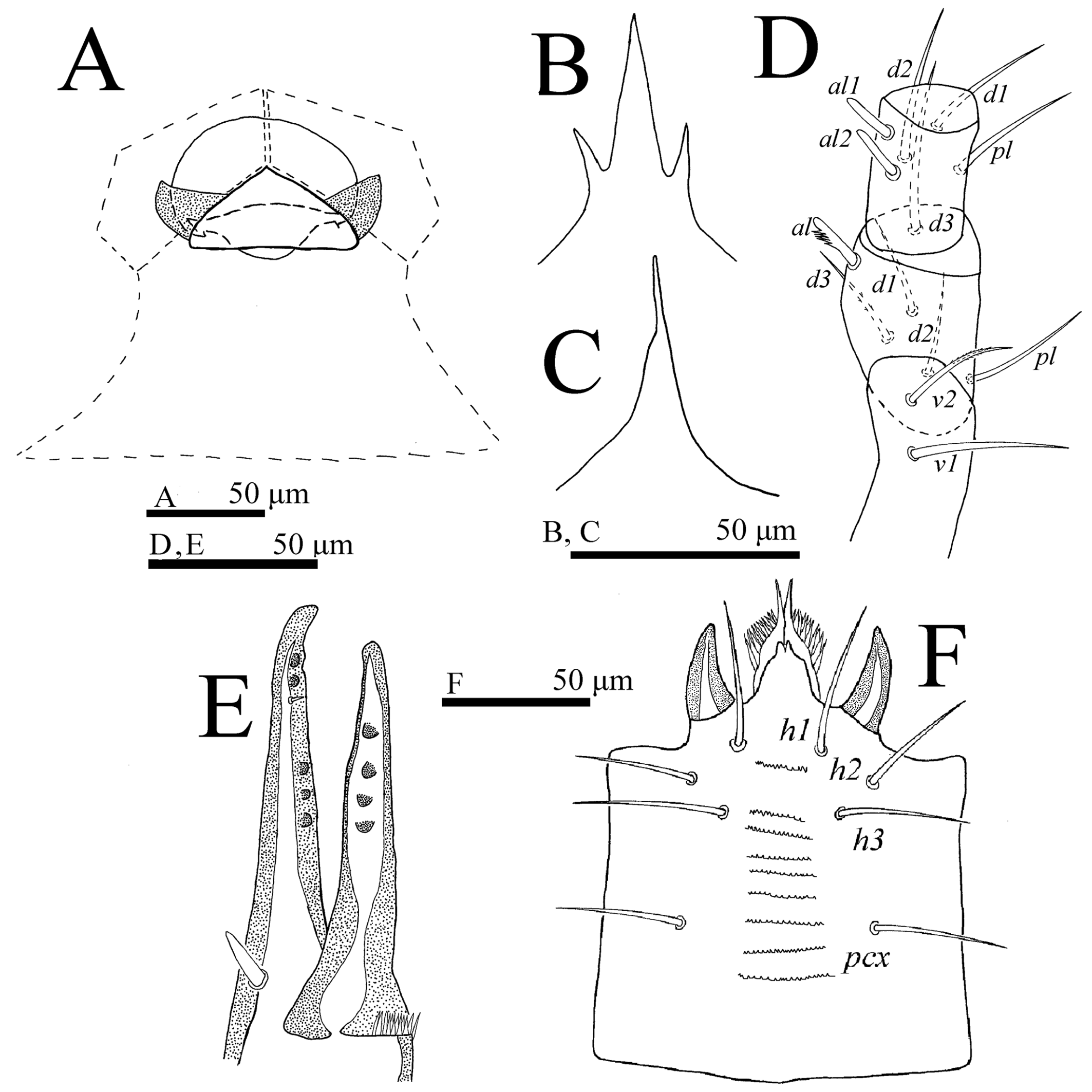
Ventral idiosoma – (Figure 1B). Tritosternum with pilose laciniae, base flanked by two pairs of presternal platelets, of which postero-medial one clearly larger than antero-lateral one. Anterior lateral lobes absent (Figure 1B). Sternal shield reticulated and axially split from the posterior margin up to the level of setae st2, bearing two pairs of poroids (iv1, iv2), a pair of gland pores (gv1) and three pairs of setae (st1–st3), setae st2 shorter than st1 and st3. Metasternal shields completely detached from sternal shield, bearing seta st4 and poroids iv3. Parametasternal shield (Fig. 1B: pmss) irregular triangle. Epigynal shield subtriangular, posterior margin fused to opisthogastric shield, gland pores gv2 with two openings. Endogynium with a subtriangular structure, of which each side has a subtriangular lamella structure, and the posterior part has an irregular large sac (Figure 2A). Opisthogastric shield bearing eight pairs of setae and three circum-anal setae. Seta ZV1 fine and very short. Opisthogastric soft cuticle with four pairs of setae. All ventral setae simple. Peritreme, length 245 (245–262), extending anteriorly to the anterior edge of coxa II. Peritrematal shields posteriorly free. Lengths of ventral setae on the shields: st1 41 (39–41), st2 35 (31–35), st3 40 (39–42), st4 40 (39–40), st5 37 (35–37), JV1 44 (42–45), JV2 56 (53–56), JV3 58 (57–60), JV4 52 (50–52), ZV1 7 (6–7), ZV2 54 (53–56), ZV3 51 (49–52), ZV4 40 (39–41), pa 30 (27–30), po 30 (29–30).
Gnathosoma – (Figure 2B–2F). Gnathotectum anterior margin with three prongs pointed apically, central one longer than lateral ones (Figure 2B); in one specimen only one prong (Figure 2C). Palp length 222 (222–266), seta v2 on the trochanter pilose distally, al on femur comb-like, al1 and al2 on the genu rod-like (Figure 2D). Fixed digit of chelicera with five teeth of similar size, two of them ahead of pilus dentilis, three behind pilus dentilis, movable digit bearing four teeth (Figure 2E). Corniculus horn-shaped, stout and relatively short, length 28 (28–32); deutosternal groove with nine denticulate rows; seta h1 52 (51–55), h2 41 (39–42), h3 55 (55–59) and pcx 45 (41–45) simple (Figure 2F).
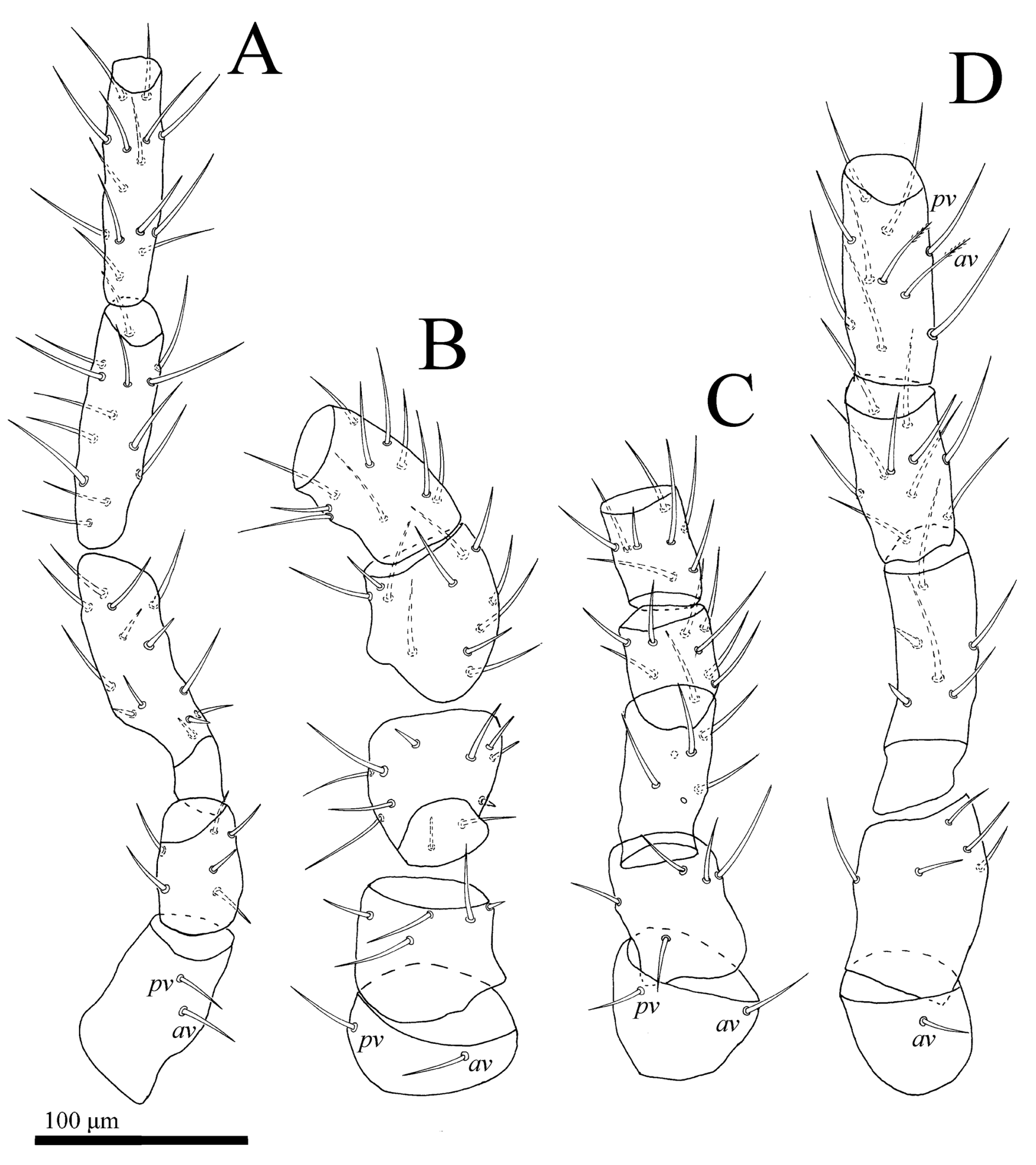
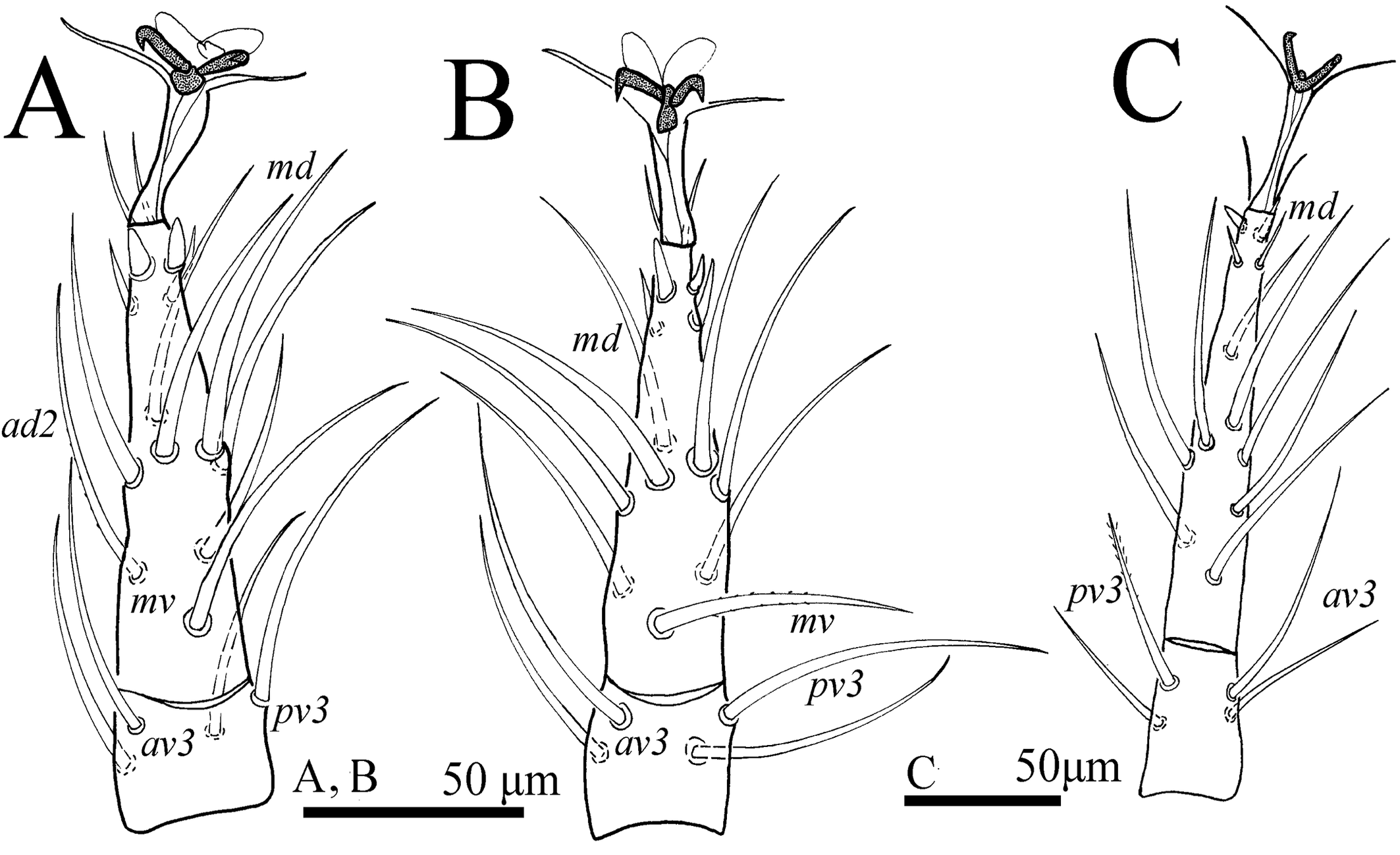
Legs – (Figures 3–4). Lengths of legs Ⅰ–Ⅳ: 658 (648–671), 437 (398–437), 397 (376–397), 643 (643–682), respectively. Most leg setae smooth. Setae av and pv on tibiae IV and pv3 on tarsi Ⅳ barbed. Setae av1, al1, pv1 and pl1 on tarsi Ⅱ–Ⅳ modified to short and thick spurs (Figure 4).
Other stages — Unknown.
Etymology
The new species name is derived from the type locality Yunnan province, China.
Remarks
The female of S. yunnanensis n. sp. is morphologically similar to S. simulatrix both in terms of the setal number on the podonotal shield and in having a free peritrematal shield. However, it differs from S. simulatrix as follows: (1) opisthonotal shield bearing 44 pairs of setae, vs. 15–16 pairs in S. simulatrix; (2) opisthogastric shield bearing 8 pairs of setae, vs. 6–7 pairs in S. simulatrix; (3) Setae SV1 absent, vs. present in S. simulatrix; (4) anterior lateral lobes absent, vs. present in S. simulatrix; (5) axially split on sternal shield from the posterior margin up to the level of setae st2, vs. split up to the level of poroid iv1 in S. simulatrix.
The most important feature distinguishing the female of S. yunnanensis n. sp. from S. baixuelii, S. lyriformis and S. vicarius is the posterior margin of the peritrematal shield. Specifically, the posterior margin of the peritrematal shield is free in S. yunnanensis n. sp., while in S. baixuelii, S. lyriformis and S. vicarius, it is fused to the opisthogastric shield. The anterior lateral lobes also differ among these species. The anterior lateral lobes of S. yunnanensis n. sp. is absent, while it is present in S. baixuelii, S. lyriformis and S. vicarius. The more differences among these species are shown in Table 1.
Download as -: the character not mentioned in the original description.
Mite
Setal number on podonotal shield
Setal number on opisthonotal shield
Setal number on opisthogastric shield
Setae SV1
Gland pores gd5
Deutosternal groove
Posterior of peritrematal shields
S. baixuelii
22 pairs
25 pairs
8 pairs
absence
absence
11 rows
fused to opisthogastric shield
S. lyriformis
22 pairs
15–17 pairs
8–9 pairs
presence
presence
9 rows
fused to opisthogastric shield
S. simulatrix
21 pairs
15–16 pairs
6–7 pairs
presence
presence
9 rows
free
S. vicarius
22 pairs
28–29 pairs
8–9 pairs
absence
absence
-
fused to opisthogastric shield
S. yunnanensisi n.sp.
21 pairs
44 pairs
8 pairs
absence
presence
9 rows
free
Key to the females of Schizosthetus
1. Peritrematal shields posteriorly free
...... 2
— Peritrematal shields posteriorly fused to opisthogastric shield
...... 3
2. Opisthogastric shield bearing 6–7 pairs of setae; seta SV1 present
...... S. simulatrix
— Opisthogastric shield bearing eight pairs of setae; seta SV1 absent
...... S. yunnanensis n. sp.
3. Seta SV1 and gland pore gd5 absent, more than 20 pairs of opisthonotal setae
...... 4
— Seta SV1 and gland pore gd5 present, less than 20 pairs of opisthonotal setae
...... S. lyriformis
4. Seta al on palp femur trifurcate; opisthonotal shield with 28–29 pairs of setae
...... .S. vicarius
— Seta al on palp femur comb-like; opisthonotal shield with 25 pairs of setae
...... S. baixuelii
Acknowledgement
This work was supported by the Guizhou Provincial Science and Technology Projects (QKH-MS[2026]007, QKHJC[2024]youth 289 and 410, QKHJCZK[2023]023), National Natural Science Foundation of China (No. 31872275 and 32160118), Key Laboratory of Plants Protection Informatization for Featured and Efficient Agriculture in Central Guizhou Province (Qianjiaoji KY[2022]No. 052).
References
- Al-Atawi F., Klompen H., Moser J.C. 2002. Redescription of Schizosthetus lyriformis (McGraw and Farrier, 1969) (Parasitiformes: Parasitidae), with revision of the genus. Int. J. Acarol., 28: 341-360. https://doi.org/10.1080/01647950208684310
- Athias-Henriot C. 1971. La divergence néotaxique des Gamasides (Arachnides). Bull. Sci. Bourgogne, 28: 93-106.
- Athias-Henriot C. 1975. Nouvelles notes sur les Amblyseiini II. Le relevé organotaxique de la face dorsale adulte (Gamasides, Protoadenique, Phytoseiidae). Acarologia, 17: 20-29. https://doi.org/10.1080/00222936308651393
- Athias-Henriot C. 1982. Schizosthetus n. g. (type Eugamasus lyriformis McGr. and Farr., 1969) with two new species (Parasitiformes, Parasitidae). Acarologia, 23: 207-214.
- Evans G.O. 1963a. Observation on the chaetotaxy of the legs in the free-living Gamasina (Acari: Mesostigmata). Bull. br. Mus. nat. Hist. Zool., 10: 275-303. https://doi.org/10.5962/bhl.part.20528
- Evans G.O. 1963b. Some observations on the chaetotaxy of the pedipalps in the Mesostigmata (Acari). J. Nat. Hist., 6(69): 513-527. https://doi.org/10.1080/00222936308651393
- Hyatt K.H. 1980. Mites of the subfamily Parasitinae (Mesostigmata: Parasitidae) in the British Isles. Bull. Br. mus. nat. hist., 38(5): 237-378. https://doi.org/10.5962/p.12620
- McGraw J.R., Farrier M.H. 1969. Mites of the superfamily Parasitoidea (Acarina-Mesostigmata) associated with Dendroctonus and Ips (Coleoptera: Scolytidae). Tech. Bull. (N.C. Agric. Exp. Stn), 192: 1-162.
- Yao M.Y., Yi T.C., Guo J.J., Jin D.C. 2020. Description of Cornigamasus allotritosternus sp. nov. (Mesostigmata: Parasitidae) from China, with an emphasis on the ontogenetic development of setae. Zootaxa, 4821(3): 462-486. https://doi.org/10.11646/zootaxa.4821.3.3
- Yao M.Y., Chen J.X. Yi T.C., Jin D.C. 2024. Cerogamasus, a new genus of Parasitinae mites, with description of four new species from China (Acari: Parasitiformes: Parasitidae). Animals, 14(15): 2260. https://doi.org/10.3390/ani14152260
- Zhang S., Xie L., Wang H., Dong M., Yan Y. 2024. Schizosthetus Athias-Henriot, 1982 (Mesostigmata: Parasitidae): the description of a new species from China. Zootaxa, 5403(2): 279-286. https://doi.org/10.11646/zootaxa.5403.2.6
to post any comment or correction.


2025-10-23
Date accepted:
2025-12-04
Date published:
2026-03-10
Edited by:
Faraji, Farid

This work is licensed under a Creative Commons Attribution 4.0 International License
2026 Yao, Mao-Yuan; Ren, Rong; Chen, Jian-Xin; Yi, Tian-Ci and Jin, Dao-Chao
 Download article
Download the citation
RIS with abstract
(Zotero, Endnote, Reference Manager, ProCite, RefWorks, Mendeley)
RIS without abstract
BIB
(Zotero, BibTeX)
TXT
(PubMed, Txt)