


New records and taxonomic notes on the genus Mediolata Canestrini (Acari: Stigmaeidae) from Greece
Stathakis, Theodoros I.  1
and Kapaxidi, Eleftheria V.
2
1
and Kapaxidi, Eleftheria V.
2
1✉ Laboratory of Agricultural Zoology and Entomology, Faculty of Crop Science, Agricultural University of Athens, 75 Iera Odos str., 11855, Athens, Greece and Laboratory of Acarology and Agricultural Zoology, Scientific Directorate of Entomology and Agricultural Zoology, Benaki Phytopathological Institute, 8 St. Delta Str., Kifissia, Greece.
2Laboratory of Acarology and Agricultural Zoology, Scientific Directorate of Entomology and Agricultural Zoology, Benaki Phytopathological Institute, 8 St. Delta Str., Kifissia, Greece
2025 - Volume: 65 Issue: 4 pages: 1136-1157
https://doi.org/10.24349/jgnq-xm2yZooBank LSID: FA4E9364-28CB-4CF8-8918-1575816FCCD2

Original research
Keywords
Abstract
Introduction
Species of the genus Mediolata Canestrini (Trombidiformes: Stigmaeidae) have been reported from a wide range of habitats, including plants, leaf mold, moss, lichen, soil, and litter (Doğan and Ayyıldız 2004; Dönel and Doğan 2012). This genus is among the most frequently encountered stigmaeid mites in the foliage of orchard trees, along with Agistemus Summers and Zetzellia Oudemans (Hussey and Huffaker 1976). Members of Mediolata are predominantly predatory, feeding on spider mites and other small arthropods (Fan and Zhang 2005; Faraji and Ueckermann 2006).
The only known fossil representative of the family Stigmaeidae is Mediolata eocenica, described from Late Eocene Rovno amber by Kuznetsov et al. (2010). Beron (2020) listed 38 valid species within the genus. However, there has been long-standing taxonomic confusion regarding the placement of certain species, which have at times been assigned either to the genus Mediolata or to genera belonging to the family Eupalopsellidae. The most recently described species of the genus is M. neocalifornica (Khaustov 2022).
To date, 42 stigmaeid species have been recorded from Greece, belonging to the genera Agistemus, Eustigmaeus Berlese, Postumius Kuznetsov, Stigmaeus Koch, Storchia Oudemans, and Zetzellia (González-Rodríguez 1965; Papaioannou-Souliotis et al. 1994; Kapaxidi and Papadoulis 1999; Kapaxidi et al. 2013; Stathakis et al. 2014, 2016, 2019). The present study aims to contribute to the knowledge of the stigmaeid fauna of Greece by providing new records of the genus Mediolata.
Material and methods
Plant samples were collected by the authors, during 2009–2023 from many localities of Greece. Mites were extracted using the Berlese-Tullgren funnels and stored in 70% ethanol. Permanent mounts were made using Hoyer's medium. Additionally, unidentified specimens, previously collected by Dr. E.V. Kapaxidi and deposited in the Acari collection of Laboratory of Agricultural Zoology and Entomology, Agricultural University of Athens, were examined.
Drawings were made in pencil using a drawing tube (camera lucida) attached to a Zeiss Axioskop 2 microscope and inked with Rotring rapidograph pens. For preparation of the digital illustrations CorelDRAW X8 was used. Photos were taken with an Euromex Camera model CMEX 5.0 adapted to the microscope. Measurements were made from slide-mounted specimens using stage calibrated ocular micrometers. The length of the idiosoma was measured from the anterior margin to the posterior margin, the width at its broadest part. Body length was measured from the anterior margin of idiosoma to its posterior one, and the width at its broadest part. Setae were measured from the center of the alveoli to their tips; distances between setae were measured as the distance from the center of one setal base to the other. Legs were measured from the base of coxae to the base of tarsal claws. The measurements are followed by the range in parentheses. All measurements are given in micrometres (μm).
For the descriptions, the palp, leg and idiosomal chaetotaxy follows Grandjean (1944, 1946) as adapted by Kethley (1990).
All specimens are deposited in LAZAU (The Acari collection of Laboratory of Agricultural Zoology and Entomology, Agricultural University of Athens, Greece).
Taxonomy
Family Stigmaeidae Oudemans, 1931
Genus Mediolata Canestrini, 1889
Type species: Stigmaeus longirostris Berlese, 1887
Mediolata pini Canestrini
(Figures 1–3)
Mediolata pini Canestrini, 1889: 525
Eupalopsis pini — Berlese, 1882: 54
Eupalopsis pinicola Oudemans, 1923: 149 (Synonymy by Summers, 1960: 121)
Eupalopsis punctulata Oudemans, 1923: 149 (Synonymy by Summers, 1960: 121)
Eupalopsis reticulata Berlese, 1910: 208 (Synonymy by Oudemans, 1923: 149)
Redescription
Female — Six specimens measured 300–355 long (excluding gnathosoma), 220–240 wide.
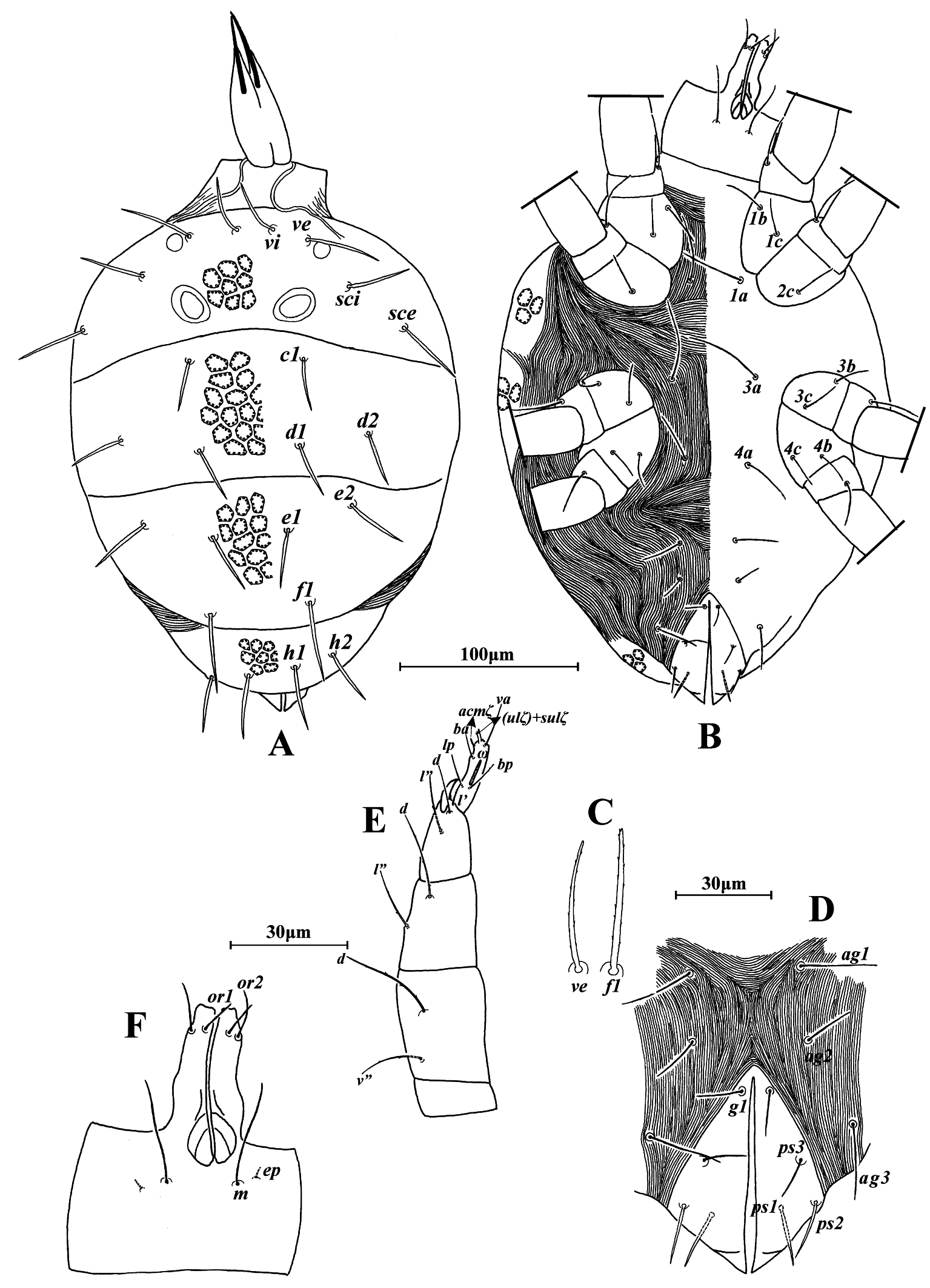
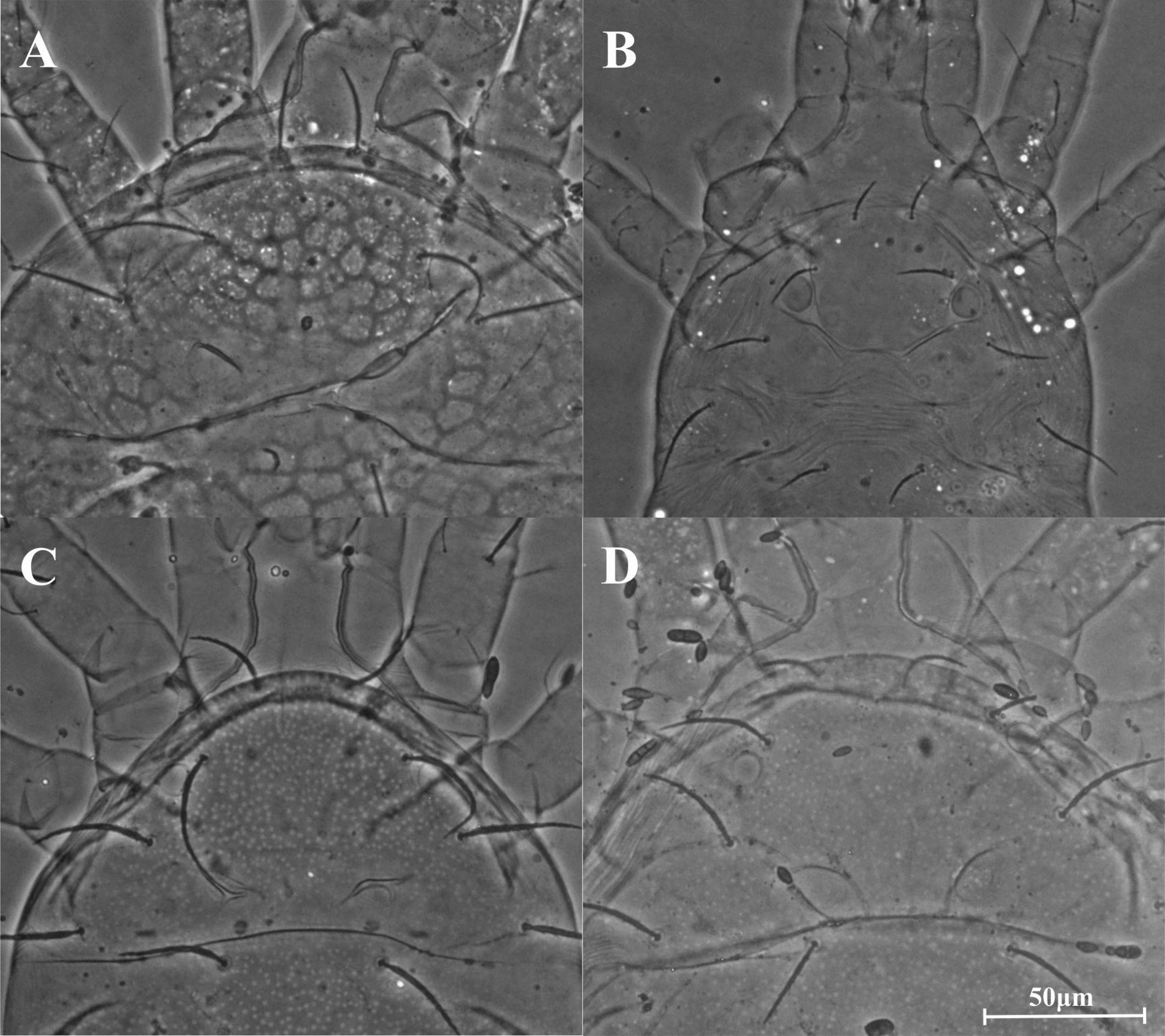
Dorsum (Figure 1Α) – Oval. Dorsal shields entirely cover dorsum, ornamented with polygonal dimples. Each dimple with row of vacuoles around periphery of crater. Dorsal setae rod-like with few spines (Fig. 1C). Prodorsal shield with four pairs of setae, vi 28–34, ve 38–44, sci 36–38, sce 42–44, one pair of eyes 10–14 and one pair of postocular bodies (pob) 24–26 in diameter (Fig. 11A). Dorsal hysterosomal area C–F covered with two transversally divided shields (CD and EF). Shield CD with three pairs of setae, c1 32–36, d1 32–34 and d2 32–36; shield EF with three pairs of setae, e1 32–36, e2 36–40 and f1 46–50. Suranal shield (H) with two pairs of setae, h1 34–38 and h2 32–38. Distances between setae: vi–vi 20–26, ve–ve 63–75, sci–sci 110–125, sce–sce 170–195, vi–ve 30–40, ve–sci 30–38, sci–sce 42–50, c1–c1 63–71, d1–d1 61–67, d2–d2 110–160, e1–e1 46–53, e2–e2 125–130, f1–f1 61–65, h1–h1 24–50, h2–h2 61–77, c1–d1 55–59, c1–d2 63–69, d1–d2 42–51, e1–e2 40–46, h1–h2 28–28.
Venter (Figures 1Β,D) – Ventral setae 1a 39–54, 3a 46–62 and 4a 23–31 in length. Aggenital area, with three pairs of aggenital setae, ag1 15–23, ag2 15 and ag3 19–23; anogenital valves with one pair of genital setae, g1 12–15 and three pairs of pseudanal setae, ps1 17–19, ps2 15–19 and ps3 12–15.
Gnathosoma Movable cheliceral digits 42–46 in length. Palp 98–105 in length. Counts of setae and solenidia from palptrochanter to palptarsus: 0, 2 (d, v″), 2 (d, l″), 3 (d, l′, l″) + 1 claw, 8 (fused ul′ζ, ul″ζ and sulζ, acmζ, ba, bp, lp, va)+ 1ω (Fig. 1E). Subcapitulum bearing supracoxal setae (ep), two pairs of adoral setae (or1, or2) and one pair of subcapitular setae, m 27–31 (Fig. 1F). Distance between subcapitular setae: m–m 18–22.
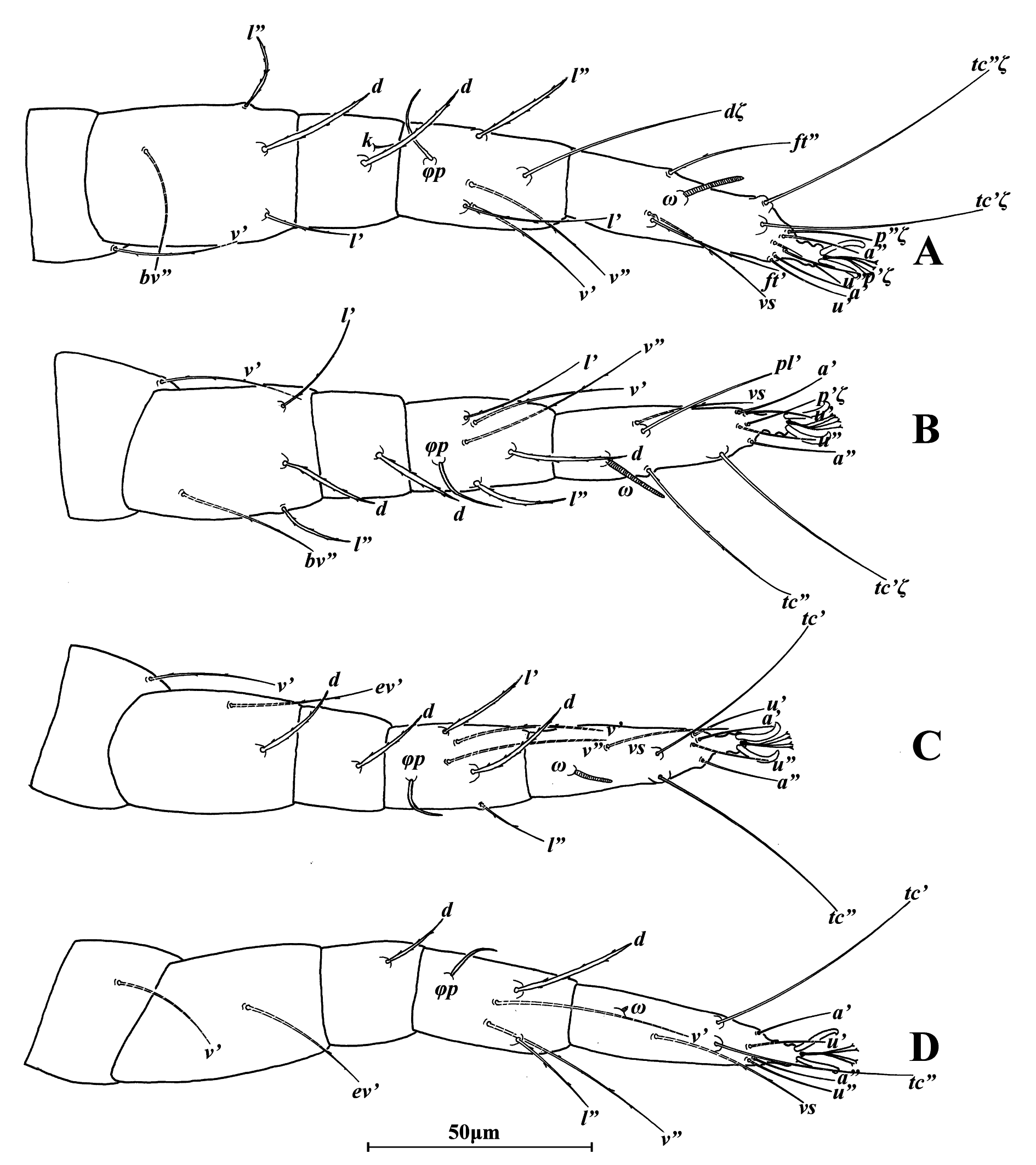
Legs (Figures 2A–D) – Length of legs: leg I 200–210, leg II 180–190, leg III 165–180, leg IV 190–205. Counts of setae and solenidia on legs I–IV: coxae 2 (1b, 1c)+el, 1 (2c), 2 (3b, 3c), 2 (4b, 4c); trochanters 1 (v′), 1 (v′), 1 (v′), 1 (v′); femora 4 (d, l′, l″, bv″), 4 (d, l′, l″, bv″), 2 (d, ev′), 1 (ev′); genua 2 (d, k), 1 (d), 1 (d), 1 (d); tibiae 5 (dζ, l′, l″, v′, v″)+1φp, 5 (d, l′, l″, v′, v″)+1φp, 5 (d, l′, l″, v′, v″)+1φp, 4 (d, l″, v′, v″)+1φp; tarsi 11 (p′ζ, p″ζ, tc′ζ, tc″ζ, ft′, ft″, u′, u″, a′, a″, vs)+1ω, 9 (p′ζ, tc′ζ, tc″, u′, u″, a′, a″, pl′, vs)+1ω, 7 (tc′, tc″, u′, u″, a′, a″, vs)+1ω, 7 (tc′, tc″, u′, u″, a′, a″, vs)+1ω. Length of famuli and solenidia: kI 5, φpI 17–19, φpII 15–19, φpIII 10–11, φpIV 11–12, ωI 12–14, ωII 12–15, ωIII 6–9, ωIV 2.
Male — One specimen measured, 300 long (excluding gnathosoma), 200 wide.
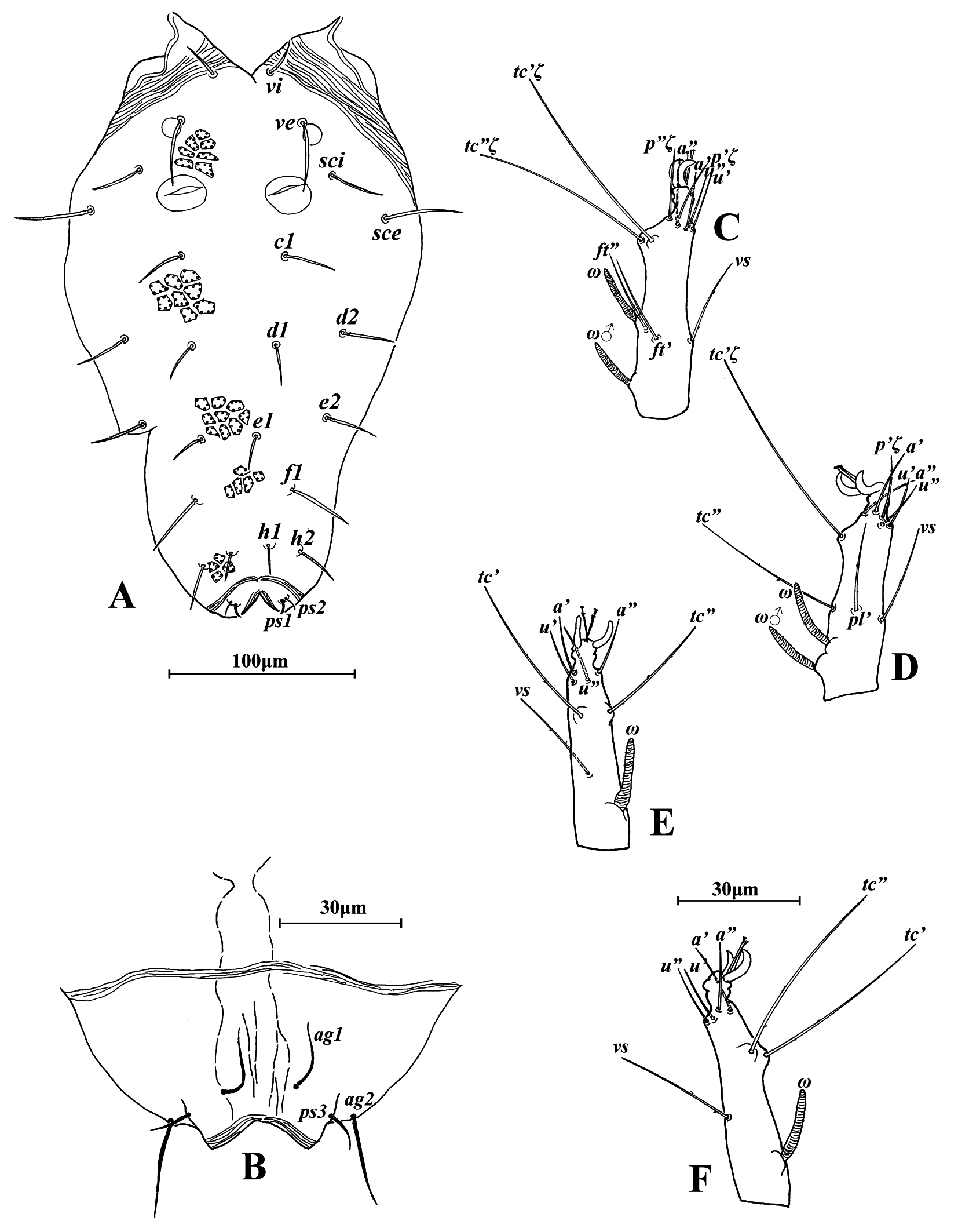
Dorsum (Figure 3Α) – Oval. Dorsal ornamentation and setae as in female. Sutures on dorsal surface are indistinct due to mounting process. Prodorsal area with four pairs of setae, vi 20, ve 36, sci 28, sce 40, one pair of eyes 10 and one pair of postocular bodies (pob) 28 in diameter. Dorsal hysterosomal area with eight pairs of setae, c1 26, d1 24, d2 30, e1 20, e2 30, f1 40, h1 16 and h2 26. Distances between setae: vi–vi 30, ve–ve 67, sci–sci 110, sce–sce 165, vi–ve 32, ve–sci 34, sci–sce 38, c1–c1 60, d1–d1 48, d2–d2 125, e1–e1 28, e2–e2 105, f1–f1 55, h1–h1 22, h2–h2 55, c1–d1 48, c1–d2 53, d1–d2 40, e1–e2 40, h1–h2 18.
Venter (Figure 3Β) – Ventral setae 1a 31, 3a 39 and 4a 31 in length. Aggenital area, with two pairs of aggenital setae, ag1 19 and ag2 31; anal valves with three pairs of pseudanal setae, ps1 6, ps2 8 and ps3 12.
Gnathosoma – Movable cheliceral digits 36 in length. Palp 90 in length. Counts of setae and solenidia as in female. Subcapitulum bearing supracoxal setae (ep), two pairs of adoral setae (or1, or2) and one pair of subcapitular setae, m 31. Distance between subcapitular setae: m–m 16.
Legs (Figures 3C–F) – Length of legs: leg I 185, leg II 180, leg III 175, leg IV 185. Counts of setae and solenidia as in female, except for additional male solenidia on tarsi I–II: Length of famuli and solenidia: kI 3, φpI 16, φpII 16, φpIII 10, φpIV 11, ωI 15, ωII 15, ωIII 15, ωIV 15, ωI♂ 13, ωII♂ 15.
Material examined
Five females and 1 male ex litter under Juniperus sp. (Cupressaceae), Voras Mountain, Co. Pella (N40°58′48.1″ E21°54′56.8″, 791m), 22 Jul. 1994. 1 female ex moss, Dasiko Chorio, Co. Xanthi (N41°19′10.3″ E24°42′11.5″, 1188m), 23 May 2015.
Distribution
Holarctic: Austria, Azerbaijan, Canada, Crimea, Egypt, Italy, Latvia, Moldavia, Poland, Russia, Switzerland, Türkiye, Ukraine, USA (Beron 2020; Khaustov 2022) and Greece (this study).
Remarks
Mediolata pini Canestrini is recorded for the first time from Greece. Morphological features and measurements of the Greek specimens are very close to those in the re-descriptions provided by Summers (1960), Dilkaraoğlu et al. (2016a) and Khaustov (2022). The species is linked to forest ecosystems and is predominantly encountered in coniferous litter (e.g., pine, fir, juniper, spruce), on tree trunks, and within mosses (Summers 1960; Gonzalez-Rodriguez 1965; Dilkaraoğlu et al. 2016a; Khaustov 2022).
Mediolata polinae Kuznetsov
(Figures 4, 5)
Mediolata polinae Kuznetsov, 1978: 52
Redescription
Female — Seven specimens measured 260–330 long (excluding gnathosoma), 130–170 wide.
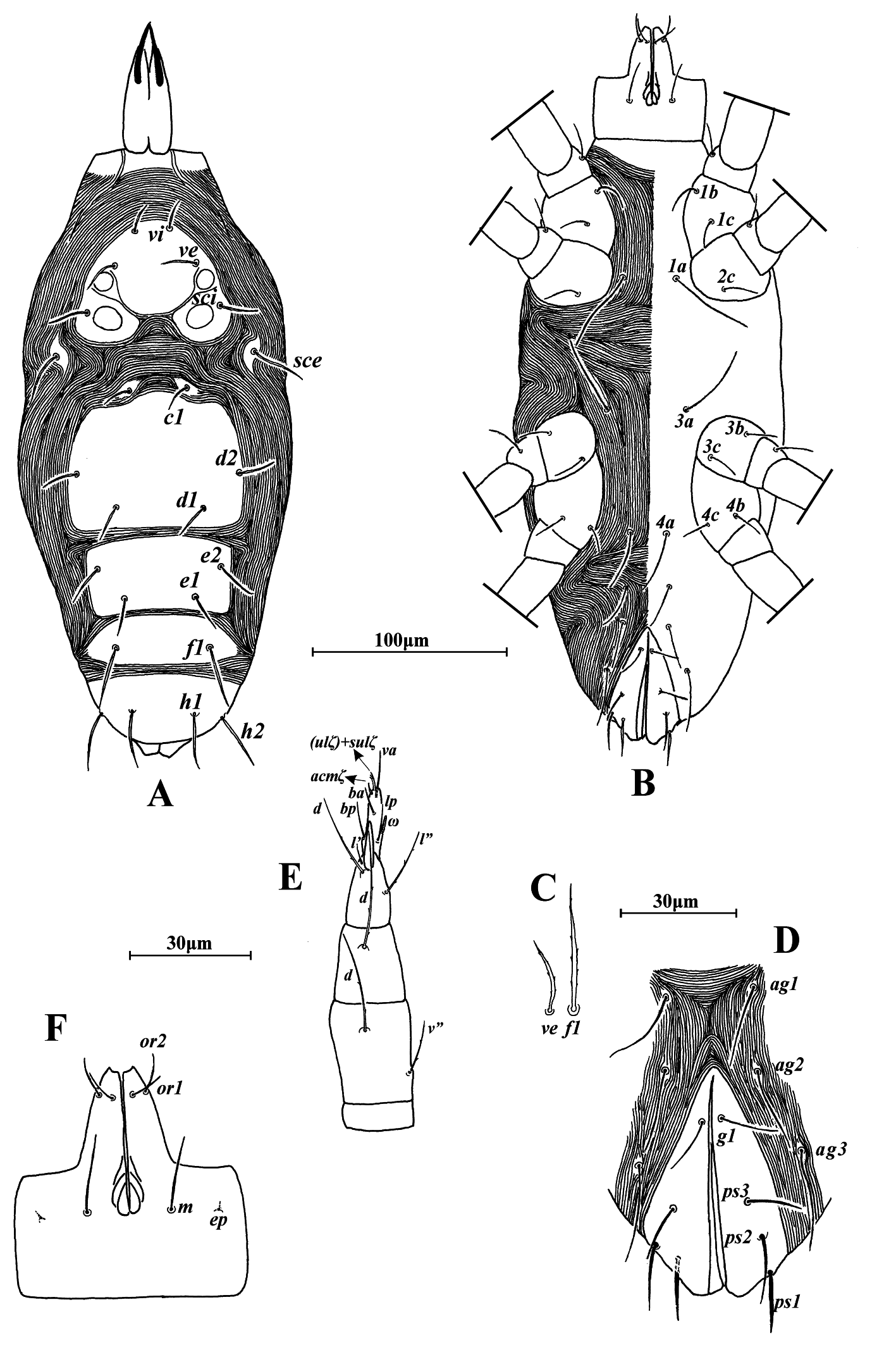
Dorsum (Figure 4Α) – Fusiform. Dorsal shields partially cover dorsum, smooth. Dorsal setae lanceolate, serrate (Fig. 4C). Prodorsal shield with three pairs of setae, vi 16–18, ve 18–22, sci 20–24, one pair of eyes 10 and one pair of postocular bodies (pob), 14 in diameter. Setae sce 28–32 on auxiliary platelets (Fig. 11B). Dorsal hysterosomal area C–F covered with three transversally divided shields (CD, E and F). Shield CD with two pairs of setae, d1 18–20 and d2 18–20, setae c1 16–20 on small individual platelets. Shield E with two pairs of setae, e1 18–20 and e2 18–22. Shield F with setae f1 30–32. Suranal shield (H) with two pairs of setae, h1 24–28 and h2 28–30. Distances between setae: vi–vi 18–22, ve–ve 40–44, sci–sci 63–73, sce–sce 91–120, vi–ve 22–24, ve–sci 23–24, sci–sce 26–34, c1–c1 30–36, d1–d1 46–57, d2–d2 79–95, e1–e1 34–40, e2–e2 65–77, f1–f1 48–57, h1–h1 24–32, h2–h2 53–67, c1–d1 53–61, c1–d2 44–53, d1–d2 24–26, e1–e2 20–24, h1–h2 16–18.
Venter (Figures 4Β,D) – Ventral setae 1a 31–46, 3a 35–54 and 4a 23 in length. Aggenital area, with three pairs of aggenital setae, ag1 15–19, ag2 19 and ag3 23–27; anogenital valves with one pair of genital setae, g1 15 and three pairs of pseudanal setae, ps1 15, ps2 15–19 and ps3 15–17.
Gnathosoma – Movable cheliceral digits 30 in length. Counts of setae and solenidia from palptrochanter to palptarsus: 0, 2 (d, v″), 1 (d), 3 (d, l′, l″) + 1 claw, 8 (fused ul′ζ, ul″ζ and sulζ, acmζ, ba, bp, lp, va)+ 1ω (Fig. 4Ε). Subcapitulum bearing supracoxal setae (ep), two pairs of adoral setae (or1, or2) and one pair of subcapitular setae, m 19–23 (Fig. 4F). Distance between subcapitular setae: m–m 19–23.
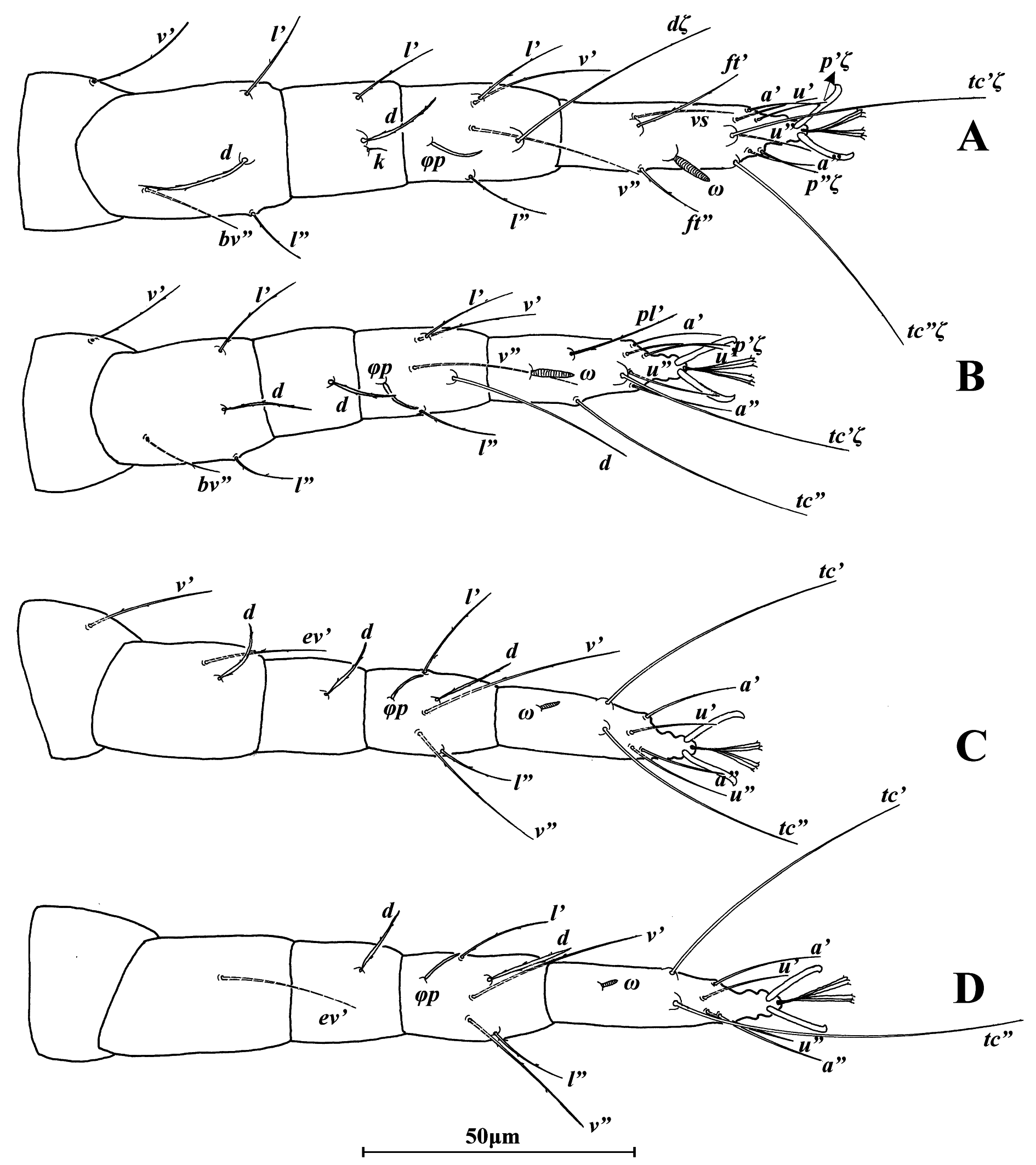
Legs (Figures 5A–D) – Length of legs: leg I 145–160, leg II 130–135, leg III 125–135), leg IV 145–160. Counts of setae and solenidia on legs I–IV: coxae 2 (1b, 1c)+el, 1 (2c), 2 (3b, 3c), 2 (4b, 4c); trochanters 1 (v′), 1 (v′), 1 (v′), 0; femora 4 (d, l′, l″, bv″), 4 (d, l′, l″, bv″), 2 (d, ev′), 1 (ev′); genua 3 (d, l′, k), 1 (d), 1 (d), 1 (d); tibiae 5 (dζ, l′, l″, v′, v″)+1φp, 5 (d, l′, l″, v′, v″)+1φp, 5 (d, l′, l″, v′, v″)+1φp, 5 (d, l′, l″, v′, v″)+1φp; tarsi 11 (p′ζ, p″ζ, tc′ζ, tc″ζ, ft′, ft″, u′, u″, a′, a″, vs)+1ω, 8 (p′ζ, tc′ζ, tc″, u′, u″, a′, a″, pl′)+1ω, 6 (tc′, tc″, u′, u″, a′, a″)+1ω, 6 (tc′, tc″, u′, u″, a′, a″)+1ω. Length of spines and solenidia: kI 4, φpI 9–10, φpII 6–8, φpIII 6–7, φpIV 6–7, ωI 8, ωII 6–8, ωIII 4, ωIV 3–4.
Male — Not found.
Material examined
One female ex Quercus sp. (Fagaceae), Voras Mountain, Co. Pella (N40°58′48.1″ E21°54′56.8″, 635m), 29 Jul. 1995. 1 female ex Acer sempervirens L. (Sapindaceae), Omalos, Co. Chania, Crete Island (N35°18′44.3″E23°55′02.8″, 1280m), 4 Jun. 2010. 1 female ex Arbutus unedo L. (Ericaceae), Milia, Co. Chania, Crete Island (N35°24′46.7″ E23°39′46.2″, 536m), 15 Sep. 2010. 1 female ex Hedera helix L. (Araliaceae), Sirikari, Co. Chania, Crete Island (N35°24′59.5″ E23°38′42.1″, 497m), 25 Apr. 2011. 1 female ex Quercus pubescens Willd., Vigla, Co. Florina (N40°46′31.1″ E21°16′04.1″, 1553m), 2 Jul. 2011. 1 female ex Cercis siliquastrum L. (Fabaceae), Dafnos, Co. Fokida (N38°38′18.3″ E22°05′38.8″, 1072m), 23 Jul. 2011. 1 female ex Cornus mas L. (Cornaceae), Velouchi Mountain, Co. Evrytania (N38°55′30.2″ E21°48′23.7″, 1472m), 6 Apr. 2013.
Distribution
Palearctic: Armenia (Kuznetsov 1978) and Greece (this study).
Remarks
Mediolata polinae Kuznetsov is reported from Greece for the first time. This arboreal species was originally described from apple leaves in Armenia (Kuznetsov 1978). In the present study, it was collected from various species of deciduous trees and shrubs. The morphological features and measurements of the Greek specimens closely match those of the original description, with the exception of the number of aggenital setae. While Kuznetsov (1978) reported four pairs of aggenital setae in the female holotype—an observation that contradicts the generic diagnosis of Mediolata, in which females possess two or three pairs—it is likely that the holotype represented an individual exhibiting a rare variation. Although the holotype shows an unusual aggenital setal count, such deviations can be considered within the spectrum of intraspecific morphological variation observed in Stigmaeidae.
Mediolata aegyptiaca (Zaher & Soliman)
(Figures 6–8)
Eupalopsis aegyptiaca Zaher & Soliman, 1966: 421
Mediolata aegyptiaca — Yousef and Shehata 1971: 367
Eupalopsis pentascuta Zaher & Gomaa, 1979: 549 (Synonymy by Faraji and Ueckermann 2006)
Redescription
Female — Ten specimens measured 280–315 long (excluding gnathosoma), 175–190 wide.
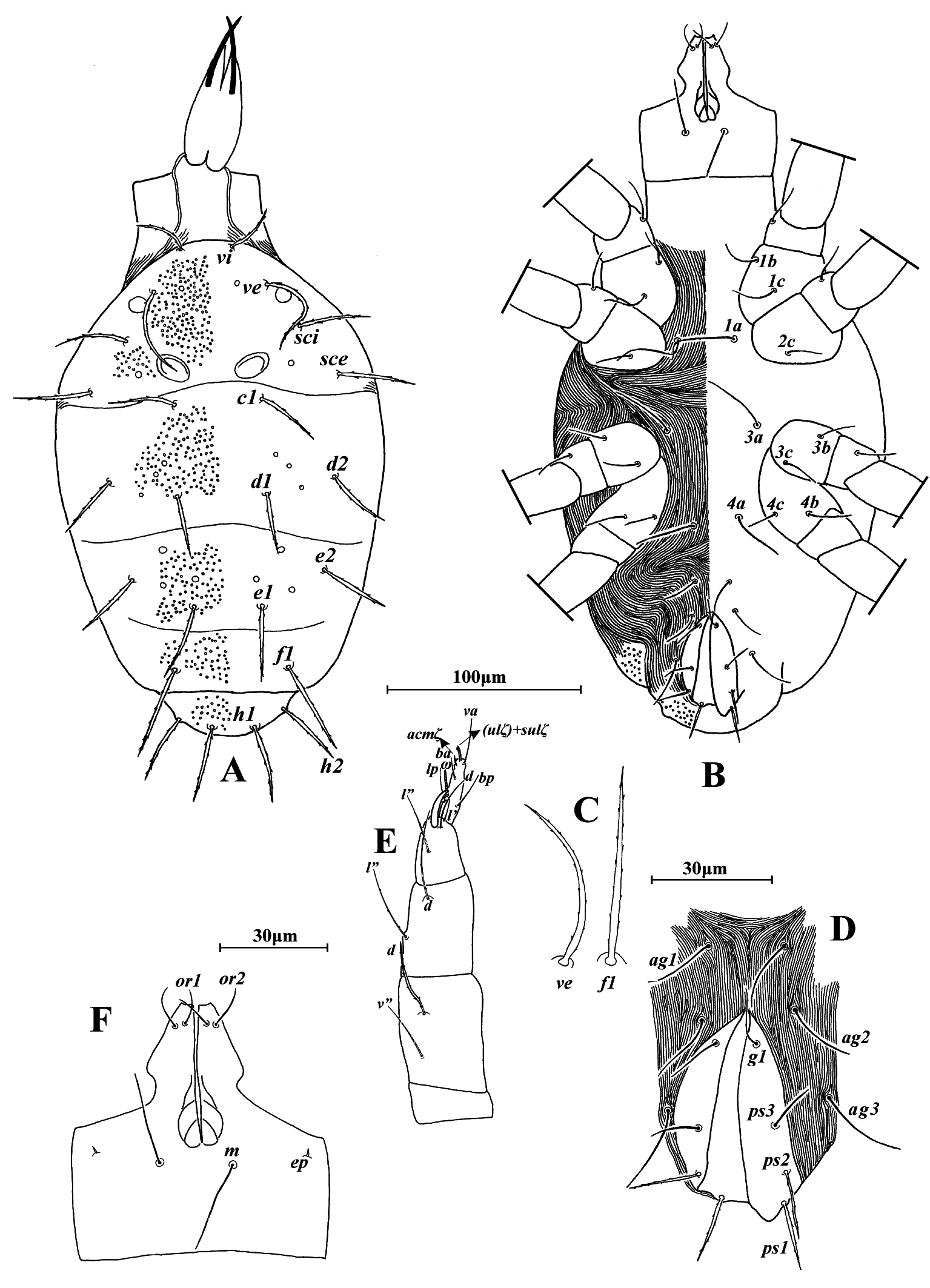
Dorsum (Figure 6Α) – Oval; length of body (excluding gnathosoma) 280–315, width 175–190. Dorsal shields entirely cover dorsum, ornamented with numerous and densely arranged vacuoles. Dorsal setae lanceolate, serrate (Fig. 6C). Prodorsal shield with four pairs of setae, vi 28–30, ve 40–46, sci 36–44, sce 40–46, one pair of eyes 10 and one pair of postocular bodies (pob), 20 in diameter (Fig. 11C). Dorsal hysterosomal area C–F covered with three incompletely divided shields (CD, E and F). Shield CD with three pairs of setae, c1 30–38, d1 32–38 and d2 34–36. Shield E with two pairs of setae, e1 40–42 and e2 40–44. Shield F with setae f1 46–51. Suranal shield (H) with two pairs of setae, h1 36–42 and h2 32–36. Distances between setae: vi–vi 22–30, ve–ve 57–67, sci–sci 87–99, sce–sce 140–155, vi–ve 24–32, ve–sci 30–34, sci–sce 32–42, c1–c1 48–55, d1–d1 48–53, d2–d2 120–140, e1–e1 36–44, e2–e2 95–105, f1–f1 51–61, h1–h1 22–28, h2–h2 46–59, c1–d1 50–55, c1–d2 53–63, d1–d2 34–42, e1–e2 36–40, h1–h2 18–20.
Venter (Figures 6Β,D) – Ventral setae 1a 39–54, 3a 39–50 and 4a 23–31 in length. Aggenital area, with three pairs of aggenital setae, ag1 19–23, ag2 19 and ag3 23–31; anogenital valves with one pair of genital setae, g1 13–15 and three pairs of pseudanal setae, ps1 17–19, ps2 15–19 and ps3 12–15.
Gnathosoma – Movable cheliceral digits 40–44 in length. Counts of setae and solenidia from palptrochanter to palptarsus: 0, 2 (d, v″), 2 (d, l″), 3 (d, l′, l″) + 1 claw, 8 (fused ul′ζ, ul″ζ and sulζ, acmζ, ba, bp, lp, va)+ 1ω (Fig. 6Ε). Subcapitulum bearing supracoxal setae (ep), two pairs of adoral setae (or1, or2) and one pair of subcapitular setae, m 27–31 (Fig. 6F). Distance between subcapitular setae: m–m 19–23.
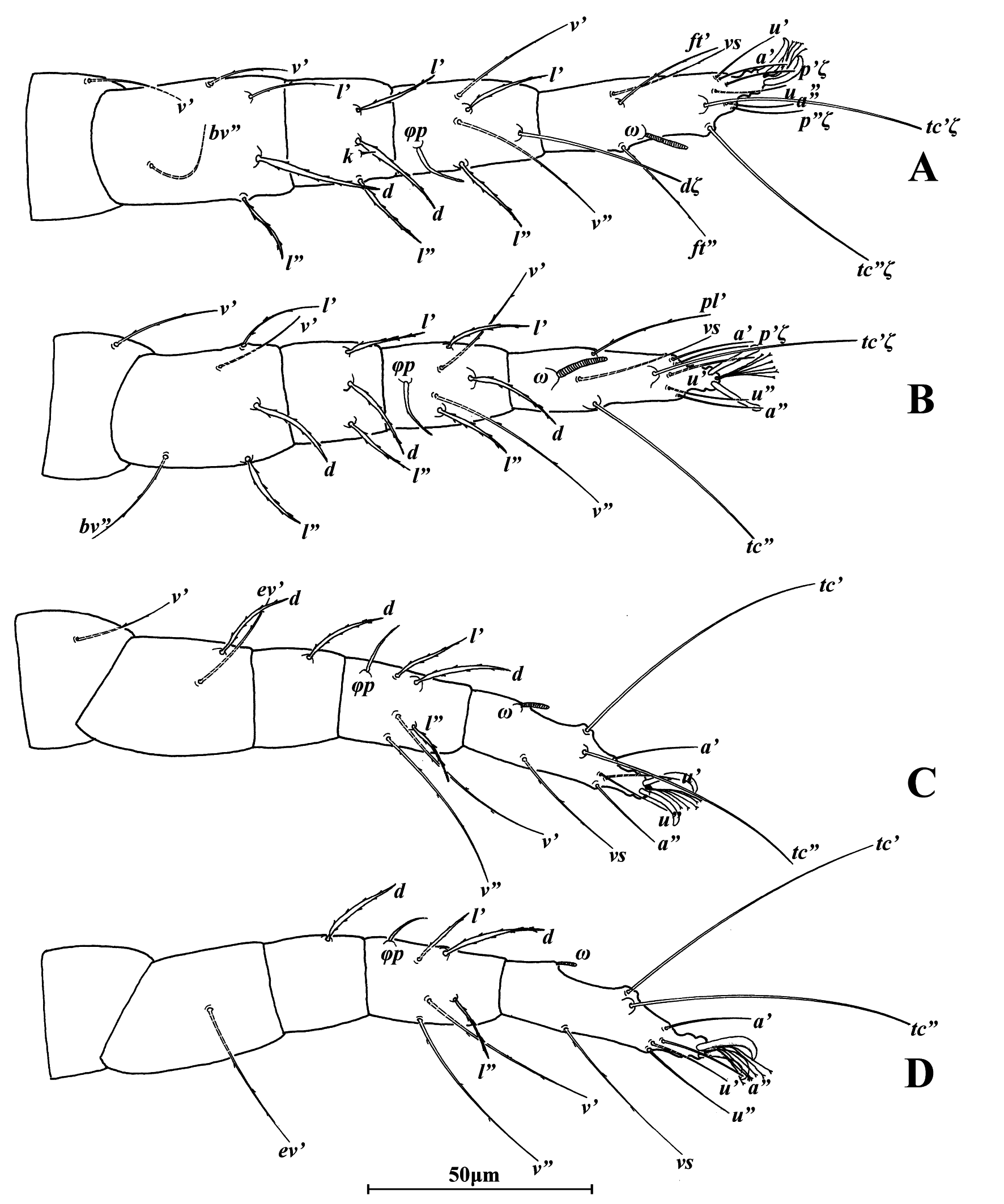
Legs (Figures 7A–D) – Length of legs: leg I 185–205, leg II 160–190, leg III 160–170, leg IV 180–195. Counts of setae and solenidia on legs I–IV: coxae 2 (1b, 1c)+el, 1 (2c), 2 (3b, 3c), 2 (4b, 4c); trochanters 1 (v′), 1 (v′), 1 (v′), 0; femora 5 (d, l′, l″, v′, bv″), 5 (d, l′, l″, v′, bv″), 2 (d, ev′), 1 (ev′); genua 4 (d, l′, l″, k), 3 (d, l′, l″), 1 (d), 1 (d); tibiae 5 (dζ, l′, l″, v′, v″)+1φp, 5 (d, l′, l″, v′, v″)+1φp, 5 (d, l′, l″, v′, v″)+1φp, 5 (d, l′, l″, v′, v″)+1φp; tarsi 11 (p′ζ, p″ζ, tc′ζ, tc″ζ, ft′, ft″, u′, u″, a′, a″, vs)+1ω, 9 (p′ζ, tc′ζ, tc″, u′, u″, a′, a″, pl′, vs)+1ω, 7 (tc′, tc″, u′, u″, a′, a″, vs)+1ω, 7 (tc′, tc″, u′, u″, a′, a″, vs)+1ω. Length of spines and solenidia: κI 4–5, φpI 13–15, φpII 11–14, φpIII 9–12, φpIV 9–10, ωI 8–10, ωII 8–12, ωIII 5–8, ωIV 4–5.
MALE. Three specimens measured 235–260 long (excluding gnathosoma), 160–180 wide.
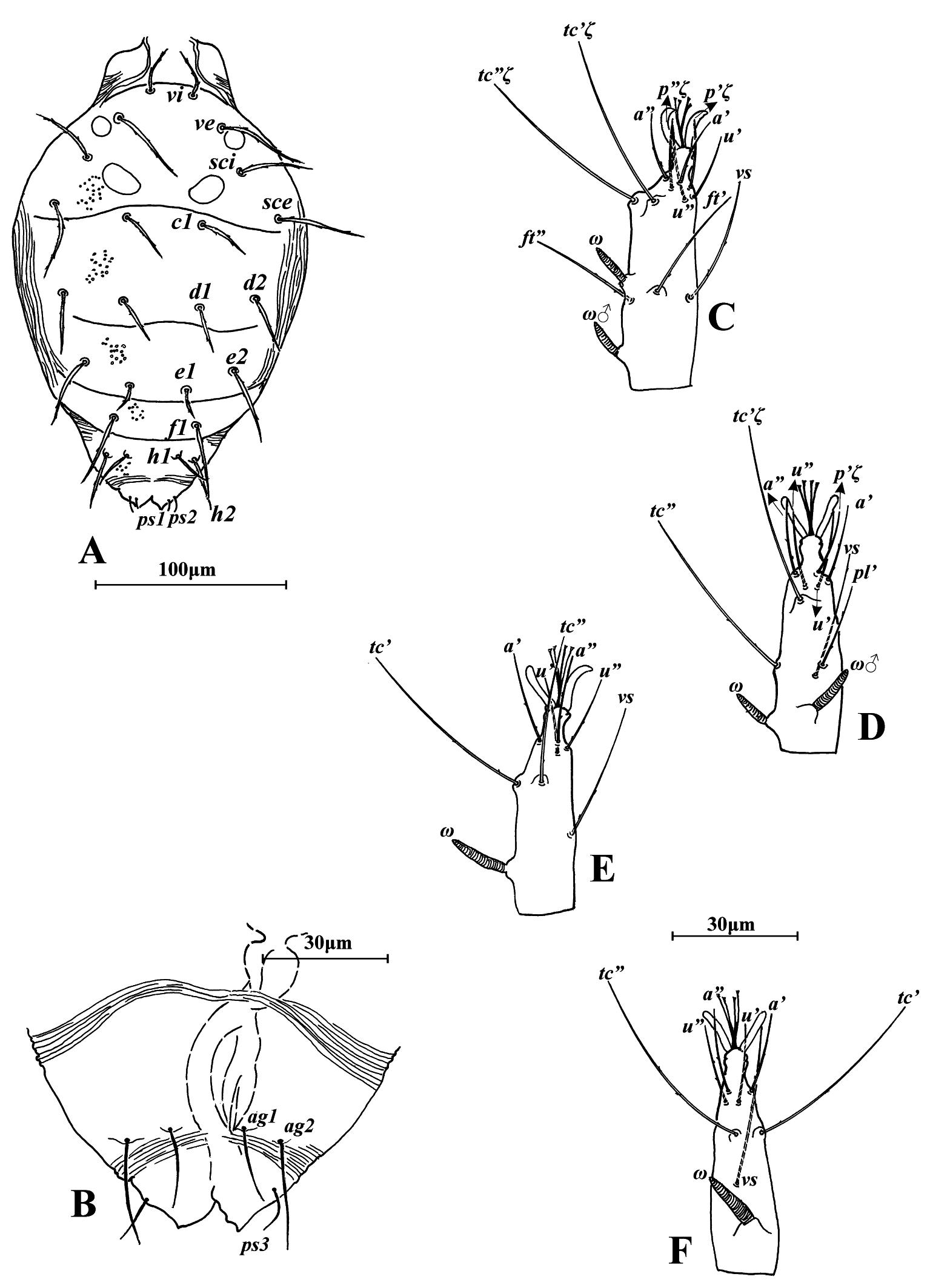
Dorsum (Figure 8Α) – Oval. Dorsal ornamentation and setae as in female. Prodorsal shield with four pairs of setae, vi 24–28, ve 42, sci 34–40, sce 40, one pair of eyes 12 and one pair of postocular bodies (pob) 18–20 in diameter. Dorsal hysterosomal area C–F covered with three transversally divided shields (CD, E and F). Shield CD with three pairs of setae, c1 30–34, d1 28–32 and d2 32–34. Shield E with two pairs of setae, e1 16–22, e2 38–42. Shield F with one pair of setae f1 40–46. Suranal shield (H) with two pairs of setae, h1 20–24 and h2 32–34. Distances between setae: vi–vi 24–28, ve–ve 57–61, sci–sci 85–97, sce–sce 115–125, vi–ve 22–24, ve–sci 26–30, sci–sce 30–32, c1–c1 42–48, d1–d1 40–42, d2–d2 105–110, e1–e1 32–34, e2–e2 83–90, f1–f1 44–46, h1–h1 28–30, h2–h2 42–50, c1–d1 44–48, c1–d2 50–55, d1–d2 32–34, e1–e2 28–30, h1–h2 10–12.
Venter (Figure 8Β) – Ventral setae 1a 35–42, 3a 30–40 and 4a 23 in length. Aggenital area, with two pairs of aggenital setae, ag1 17–19 and ag2 23–25; anal valves with three pairs of pseudanal setae, ps1 5, ps2 8 and ps3 10.
Gnathosoma – Movable cheliceral digits 36 in length. Palp 90–95 in length. Counts of setae and solenidia as in female. Subcapitulum bearing supracoxal setae (ep), two pairs of adoral setae (or1, or2) and one pair of subcapitular setae, m 23–27. Distance between subcapitular setae: m–m 17.
Legs (Figures 8C–F) – Length of legs: leg I 180–200, leg II 160–170, leg III 165–170, leg IV 180. Counts of setae and solenidia as in female, except for additional male solenidia on tarsi I–II: Length of famuli and solenidia: kI 4, φpI 12–13, φpII 11–12, φpIII 9–10, φpIV 8–10, ωI 9–12, ωII 9–11, ωIII 13–14, ωIV 12–15, ωI♂ 8–10, ωII♂ 12.
Material examined
One female ex Populus alba L. (Salicaceae), Aliakmonas River, Co. Kozani (N40°19′06.7″ E21°25′15.2″, 553m), 2 Jul. 2011. 1 female ex Pyrus amygdaliformis Vill. (Rosaceae), Anthiro, Co. Karditsa (N39°20′50.3″ E21°27′39.9″, 710m), 23 Jul. 2011. 1 female ex Quercus coccifera L., Mantoudi, Co. Evia (N38°47′48.5″ E23°28′12.2″, 47m), 3 Dec. 2011. 2 females ex Olea europea L. (Oleaceae), Peza, Co. Heraklion, Crete Island (N35°13′13.3″ E25°11′36.8″, 286m), 28 Jun. 2012. 1 female ex Q. coccifera, Aghios Petros, Lefkada Island (N38°39′37.8″ E20°36′00.1″, 287m), 10 May 2015. 4 females and 1 male ex Actinidia chinensis Planch. (Actinidiaceae), and 1 female ex Cydonia oblonga Mill. (Rosaceae), Litochoro, Co. Pieria (N40°05′52.0″ E22°30′43.1″, 263m), 8 Nov. 2021. 1 female ex A. chinensis, Prodromos, Co. Imathia (N40°32′53.3″ E22°24′12.0″, 16m), 9 Nov. 2021. 3 females ex A. chinensis, Episkopi, Co. Imathia (N40°35′10.5″ E22°22′01.0″, 11m), 11 Nov. 2021. 4 females and 2 males ex A. chinensis, Arta, Co. Arta (N39°08′49.0″ E20°58′30.8″, 17m), 7 Apr. 2022. 1 female ex A. chinensis, Kopanos, Co. Imathia (N40°38′06.2″ E22°08′07.1″ 70m), 10 Nov. 2023.
Distribution
Mediterranean: Egypt (Zaher and Soliman 1966), Türkiye (Doğan and Doğan 2020) and Greece (this study).
Remarks
Mediolata aegyptiaca (Zaher & Soliman) is reported from Greece for the first time. The original description of the species lacks key morphological details, including palp and leg chaetotaxy, as well as setal measurements. A subsequent redescription by Zaher and Gomaa (1979) included setal measurements that closely correspond to those of the Greek specimens. M. aegyptiaca was recently recorded from Türkiye by Doğan and Doğan (2020), who provided detailed information on palp and leg chaetotaxy. Our observations are largely consistent with their findings, with the exception of the presence of the k famulus on genu I in the Greek specimens, a feature not reported in the Turkish material.
This species appears to be widely distributed in Mediterranean fruit orchards, having previously been found on apple, pear, banana, and citrus trees, often in association with scale insects (Zaher and Soliman 1966; Yousef and Shehata 1971; Rasmy et al. 1972; Zaher and Gomaa 1979). In the present study, M. aegyptiaca was collected from olive, quince, and kiwifruit trees, where it was associated with phytophagous mites, including flat mites and eriophyoid mites. These findings suggest that M. aegyptiaca may play a role in the biological control of economically important pests in Mediterranean agroecosystems.
Mediolata granaria González-Rodríguez
(Figures 9, 10)
Mediolata granaria González-Rodríguez, 1965: 14
Redescription
Female — Four specimens measured 290–335 long (excluding gnathosoma), 200–215 wide.
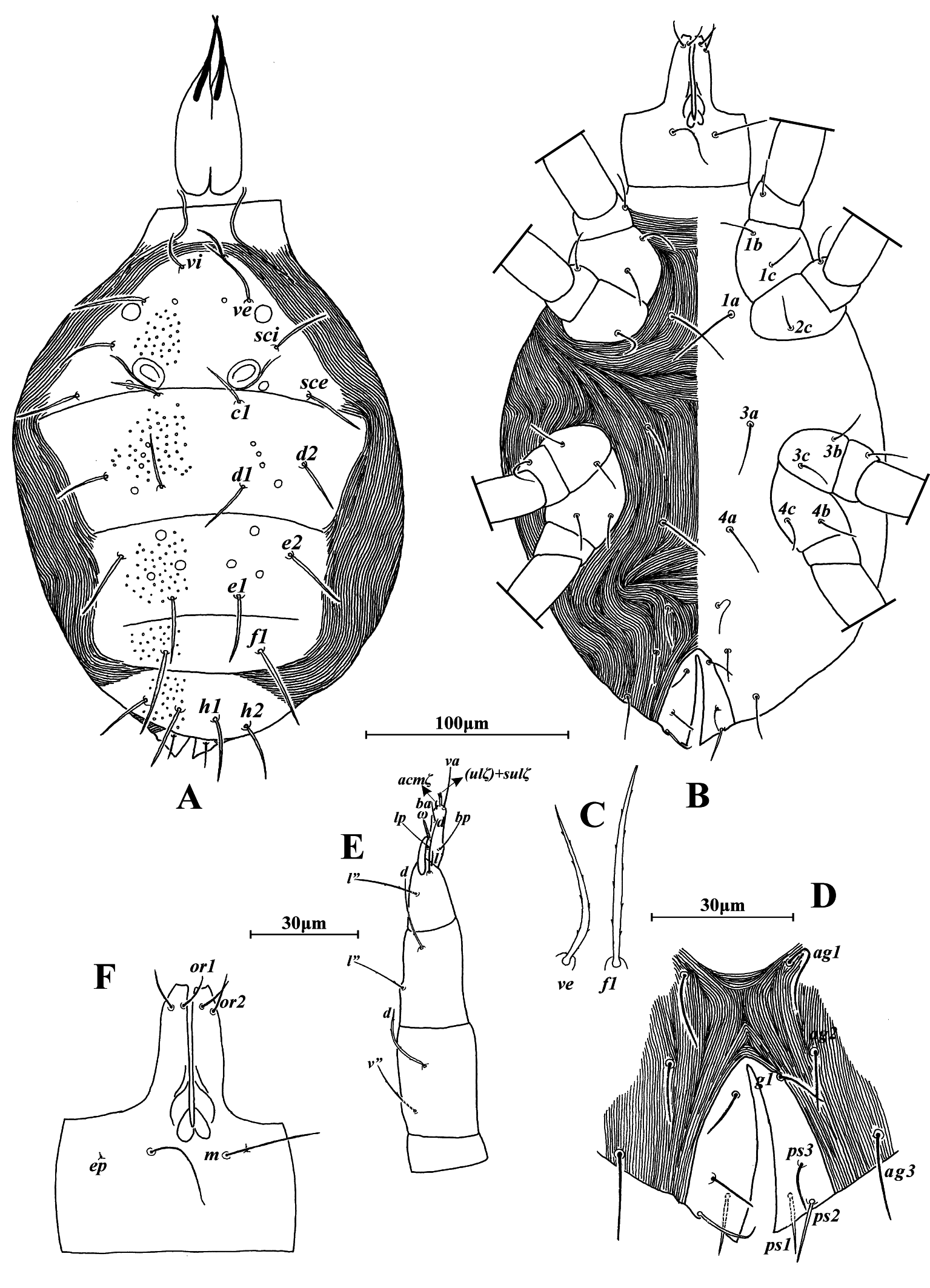
Dorsum (Figure 9Α) – Oval. Dorsal shields partially cover dorsum, ornamented with numerous and sparsely arranged vacuoles. Dorsal setae lanceolate, serrate (Fig. 9C). Prodorsal shield with four pairs of setae, vi 22–28, ve 36–44, sci 32–40, sce 34–44, one pair of eyes 10 and one pair of postocular bodies (pob) 22 in diameter (Fig. 11D). Dorsal hysterosomal area C–F covered with three incompletely divided shields (CD, E and F). Shield CD with three pairs of setae, c1 26–32, d1 30–32 and d2 30–36. Shield E with two pairs of setae, e1 36–44 and e2 36–42. Shield F with setae f1 44–46. Suranal shield (H) with two pairs of setae, h1 34–38 and h2 30–36. Distances between setae: vi–vi 22–28, ve–ve 53–69, sci–sci 85–105, sce–sce 120–155, vi–ve 22–30, ve–sci 28–36, sci–sce 30–38, c1–c1 44–59, d1–d1 44–53, d2–d2 105–135, e1–e1 34–42, e2–e2 89–115, f1–f1 46–59, h1–h1 20–28, h2–h2 53–69, c1–d1 46–55, c1–d2 48–61, d1–d2 34–42, e1–e2 34–44, h1–h2 16–26.
Venter (Figures 9Β,D) – Ventral setae 1a 35–46, 3a 31–46 and 4a 31 in length. Aggenital area, with three pairs of aggenital setae, ag1 19–23, ag2 15–19 and ag3 23; anogenital valves with one pair of genital setae, g1 13–15 and three pairs of pseudanal setae, ps1 15–19, ps2 18–19 and ps3 13–15.
Gnathosoma – Movable cheliceral digits 40 in length. Counts of setae and solenidia from palptrochanter to palptarsus: 0, 2 (d, v″), 2 (d, l″), 3 (d, l′, l″) + 1 claw, 8 (fused ul′ζ, ul″ζ and sulζ, acmζ, ba, bp, lp, va)+ 1ω (Fig. 9Ε). Subcapitulum bearing supracoxal setae (ep), two pairs of adoral setae (or1, or2) and one pair of subcapitular setae, m 23–27 (Fig. 9F). Distance between subcapitular setae: m–m 19–23.
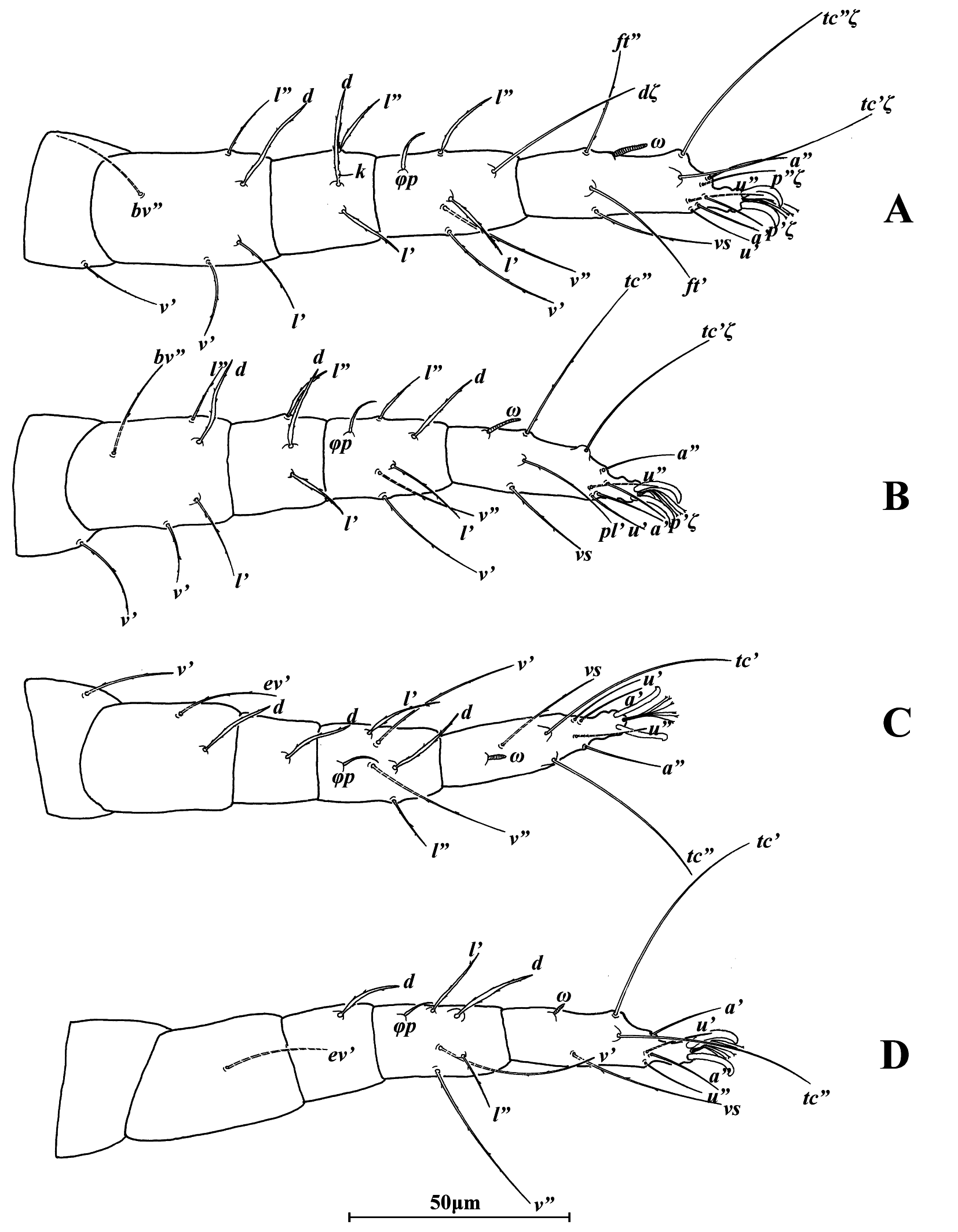
Legs (Figures 10A–D) – Length of legs: leg I 175–210, leg II 150–185, leg III 155–180, leg IV 175–190. Counts of setae and solenidia on legs I–IV: coxae 2 (1b, 1c)+el, 1 (2c), 2 (3b, 3c), 2 (4b, 4c); trochanters 1 (v′), 1 (v′), 1 (v′), 0; femora 5 (d, l′, l″, v′, bv″), 5 (d, l′, l″, v′, bv″), 2 (d, ev′), 1 (ev′); genua 4 (d, l′, l″, k), 3 (d, l′, l″), 1 (d), 1 (d); tibiae 5 (dζ, l′, l″, v′, v″)+1φp, 5 (d, l′, l″, v′, v″)+1φp, 5 (d, l′, l″, v′, v″)+1φp, 5 (d, l′, l″, v′, v″)+1φp; tarsi 11 (p′ζ, p″ζ, tc′ζ, tc″ζ, ft′, ft″, u′, u″, a′, a″, vs)+1ω, 9 (p′ζ, tc′ζ, tc″, u′, u″, a′, a″, pl′, vs)+1ω, 7 (tc′, tc″, u′, u″, a′, a″, vs)+1ω, 7 (tc′, tc″, u′, u″, a′, a″, vs)+1ω. Length of spines and solenidia: κI 4, φpI 10–15, φpII 9–13, φpIII 9–10, φpIV 8–9, ωI 8–9, ωII 8–10, ωIII 5–8, ωIV 4–5.
Male — Not found.
Material examined
One female ex Robinia pseudoacacia L. (Fabaceae), Baltouma, Co. Ioannina (N39°41′44.4″ E20°59′51.3″, 482m), 3 Jul. 2011. 1 female ex lichen, Lechovo, Co. Florina (N40°35′11.7″ E21°29′11.7″, 907), 25 Feb. 2014. 1 female ex Q. coccifera, Sarantaporo, Co. Larissa (N40°03′50.4″ E22°02′51.8″, 803m), 25 Mar. 2014. 1 female ex Helichrysum sp. (Asteraceae), Finikounda, Co. Messinia (N36°48′37.5″ E21°48′44.5″, 22), 20 Apr. 2015.
Distribution
Holarctic: Poland, Russia, Türkiye, Ukraine, USA (Beron 2020; Khaustov 2022) and Greece (this study)
Remarks
Mediolata granaria González-Rodríguez is reported from Greece for the first time. Originally described from grain sievings in Oregon, USA, the species has since been recorded on the bark of various forest trees, including pine, oak, and birch (González-Rodríguez 1965; Dönel and Doğan 2012; Khaustov 2022). In the present study, specimens were collected from lichen and plants characteristic of Mediterranean maquis vegetation. The morphological features and measurements of the Greek specimens closely match those of the original description, as well as subsequent redescriptions by Dönel and Doğan (2012) and Khaustov (2022), except for the prodorsal shield, which in other known specimens is concave posteriorly and slightly invaded by striae.
Discussion
The discovery of M. pini, M. polinae, M. aegyptiaca, and M. granaria increases the number of known stigmaeid mite species in Greece to 46.
The differences observed in the number of aggenital setae between the holotype of M. polinae and the Greek specimens are not unique. Similar variations in setal number have been reported in several stigmaeid species, including members of the genera Eustigmaeus, Stigmaeus, and Storchia (Dilkaraoğlu et al. 2016b; Bingül et al. 2017; Khaustov 2019; Doğan et al. 2022). For instance, Eustigmaeus pinnatus (Kuznetsov, 1977) was originally described from European Russia based on two females (Kuznetsov 1977a) and was characterized by the unusual presence of four pairs of pseudanal setae. Examination of the holotype by Khaustov (2019) revealed an abnormal, asymmetrical number of aggenital and pseudanal setae, leading to the designation of this species as a senior synonym of E. ioanninensis Kapaxidi & Papadoulis, 1999, which bears three pairs of aggenital and three pairs of pseudanal setae — a typical pattern for the genus.
In the case of M. polinae, it remains unclear whether the four pairs of aggenital setae exhibit a symmetrical pattern, as only one half of the ventral surface was illustrated and no additional details were provided in the original description. Further examination of the type material is therefore necessary to confirm this. These cases underscore the considerable morphological variability that may occur within the family Stigmaeidae and highlight the importance of recognizing and accounting for such anomalies in both taxonomic and ecological research.
The number of valid species currently assigned to the genus Mediolata differs from that listed by Beron (2020), as several taxonomic revisions have since been proposed. For instance, M. mirus Chaudhri, Akbar & Rasool has been transferred to Exothorhis Summers (Eupalopsellidae) (Faraji & Ueckermann 2006; Khan et al. 2024), while M. olearius (Zaher & Gomaa), originally described as Eupalopsis olearius, was incorrectly placed in Mediolata by Beron (2020) and should instead be considered a member of the family Eupalopsellidae.
In addition, M. serrata Podder et al. (2005) appears to be misassigned to Mediolata due to the dorsomedial position of the propodosomal setae sci. This species most likely belongs to the family Eupalopsellidae; however, the unusual arrangement of the hysterosomal setae and the lack of key diagnostic details, such as the presence or absence of hysterosomal shields, make it impossible to confidently assign it to a specific genus. Examination of the type material is therefore essential to clarify its true taxonomic placement.
Finally, M. pentascuta (Zaher & Gomaa) is considered a junior synonym of M. aegyptiaca (Zaher & Soliman), as confirmed by Z.R. Soliman (Faraji & Ueckermann 2006). Considering all the above, the total number of valid species currently recognized within Mediolata is 35.
Key to world species of the genus Mediolata Canestrini based on adults
Modified after Faraji and Ueckermann 2006 and Khaustov 2022
The fossil species M. eocenica Kuznetsov, Khaustov & Perkovsky and M. ronaldi Laniecka described from deutonymph are excluded from the key.
1. Femur I with 4 setae
...... 2
— Femur I with 5 setae
...... 13
2. Femur III with 3 setae
...... 3
— Femur III with 2 setae
...... 5
3. Tarsus II with 10+1ω
...... M. neocalifornica Khaustov
— Tarsus II with 9+1ω
...... 4
4. Setae f1, h1, h2 on the same opisthosomal shield
...... M. californica González-Rodríguez
— Setae h1 and h2 on separate suranal shield
...... M. turcica Dönel & Doğan
5. Genu I with 2+1k
...... 6
— Genu I with 1+1k
...... 9
6. Palpgenu with 2 setae
...... M. acus (Summers)
— Palpgenu with 1 seta
...... 7
7. Trochanter IV with 1 seta
...... M. mariaefrancae André
— Trochanter IV nude
...... 8
8. Tarsus I with 11+1ω
...... M. polinae Kuznetsov
— Tarsus I with 10+1ω
...... M. chanti González-Rodríguez
9. Trochanter IV nude; palpfemur with 1 seta
...... M. delicata Fan & Zhang
— Trochanter IV with 1 seta; palpfemur with 2 setae
...... 10
10. Two pairs of aggenital setae
...... M. petilus Doğan & Ayyıldız
— Three pairs of aggenital setae
...... 11
11. Hysterosomal area CF covered with a single shield
...... M. obtecta Dönel & Doğan
— Hysterosomal area CF covered with more shields
...... 12
12. Hysterosomal area CF covered with two ornamented shields
...... M. pini Canestrini
— Hysterosomal area CF covered with three smooth shields
...... M. uspenskii Kuznetsov & Sizova
13. Femur II with 5 setae
...... 14
— Femur II with 4 setae
...... 21
14. Palpfemur with 3 setae
...... M. horrida Momen
— Palpfemur with 2 setae
...... 15
15. Tibia IV with 4+1φp
...... M. ozkani Dönel & Doğan
— Tibia IV with 5+1φp
...... 16
16. Genu II with 1 seta
...... M. ornatula González-Rodríguez
— Genu II with more than 1 seta
...... 17
17. Genu II with 2 setae
...... M. conserva Kuznetsov
— Genu II with more than 2 setae
...... 18
18. Genu I with 3 setae (k absent)
...... M. belfieldi Momen
— Genu I with 3+1k
...... 19
19. Dorsal shields ornamented with polygonal dimples with vacuoles
...... M. similans González-Rodríguez
— Dorsal shields ornamented with irregularly scattered vacuoles
...... 20
20. Dorsum completely covered with dorsal shields
...... M. aegyptiaca (Zaher & Soliman)
— Dorsal shields somewhat reduced
...... M. granaria González-Rodríguez
21. Femur III with 3 setae
...... 22
— Femur III with 2 setae
...... 28
22. Trochanter IV with 1 seta
...... 23
— Trochanter IV nude
...... 24
23. Dorsal setae stout; setae ve longer than ve–sci; setae c1 as long as or longer than c1–c1
...... M. favulosa Wood
— Dorsal setae slender; setae ve shorter than ve–sci; setae c1 shorter than c1–c1
...... M. mollis Wood
24. Palpgenu with 2 setae
...... M. robusta González-Rodríguez
— Palpgenu with 1 seta
...... 25
25. Dorsal shields ornamented with polygonal dimples with vacuoles
...... 26
— Dorsal shields ornamented with polygonal reticulum without vacuoles
...... 27
26. Setae c1 and d1 longer than c1–c1 and d1–d1 respectively
...... M. woodi Fan & Zhang
— Setae c1 and d1 shorter than c1–c1 and d1–d1 respectively
...... M. oleariae Wood
27. Dorsal setae slender; setae sci about half distance sci–d1
...... M. simplex Wood
— Dorsal setae stout; setae sci reaching base of d1
...... M. polylocularis Fan & Zhang
28. Trochanter IV with 1 seta
...... M. zonaria Fan & Zhang
— Trochanter IV nude
...... 29
29. Genu I with 1+1k
...... M. xerxes Fan & Zhang
— Genu I with 2+1k or 3+1k
...... 30
30. Genu I with 2+1k
...... 31
— Genu I with 3+1k
...... 32
31. Hysterosomal area CF covered with three shields; palpgenu with 2 setae
...... M. roigi Faraji & Ueckermann
— Hysterosomal area CF covered with a single shield; palpgenu with 1 seta
...... M. whenua Fan & Zhang
32. Genu II with 3 setae; palpgenu with 2 setae
...... M. longirostris (Berlese)
— Genu II with 1 seta; palpgenu with 1 seta
...... M. brevisetis Wood
References
- Berlese A. 1882-1893. Acari, Myriopoda et Scorpiones hucusque in Italia reperta. Patavii, Portici. https://doi.org/10.5962/bhl.title.69269
- Berlese A. 1910. Acari Nuovi Manipulus V. Redia, 6: 199-214.
- Beron P. 2020. Acarorum Catalogus VII. Trombidiformes, Prostigmata, Raphignathoidea. Fam. Barbutiidae, Caligonellidae, Camerobiidae, Cryptognathidae, Dasythyreidae, Dytiscacaridae, Eupalopsellidae, Homocaligidae, Mecognathidae, Raphignathidae, Stigmaeidae, Xenocaligonellididae. Pensoft & National Museum of Natural History, Sofia, pp. 306. https://doi.org/10.3897/ab.e55087
- Bingül M., Doğan S., Doğan S. 2017. Morphological abnormalities in some stigmaeid species of Eustigmaeus, Stigmaeus and Storchia (Acari: Raphignathoidea: Stigmaeidae). Syst. Appl. Acarol., 22(12): 2119-2126. https://doi.org/10.11158/saa.22.12.7
- Canestrini G. 1889. Prospetto dell′Acarofauna Italiana. Famiglia dei Tetranychini. Atti del Reale Istituto di Scienze Lettere ed Arti, (Ser. 6), 7: 491-537.
- Dilkaraoğlu S., Doğan S., Erman O., Sevsay S., Adil, S. 2016a. Stigmaeid mites (Acari: Stigmaeidae) of Harşit Valley and Örümcek Forests (Turkey). Erzincan Univ. J. Sci. Tech., 9(special issue 1): 10-72. https://doi.org/10.18185/eufbed.18373
- Dilkaraoğlu S., Doğan S., Erman O., Sevsay S., Adil, S. 2016b. Some morphological variations and abnormalities in females of Stigmaeus longipilis (Canestrini) (Acari: Stigmaeidae). Türk. Entomol. Bült., 6(2): 149-159. https://doi.org/10.16969/teb.06297
- Doğan S., Ayyildiz N. 2004. Two species of raphignathoid mites from Turkey: Eupalopsellus olandicus Sellnick, 1949 (Acari: Eupalopsellidae) and Mediolata petilus sp. nov. (Acari: Stigmaeidae). Syst. Appl. Acarol., 9(1): 89-95. https://doi.org/10.11158/saa.9.1.13
- Doğan S., Doğan S. 2020. Newly recorded stigmaeid mites (Acariformes: Raphignathoidea: Stigmaeidae) for the fauna of Turkey. Acarol. Stud., 2(2): 94-118. https://doi.org/10.47121/acarolstud.696796
- Doğan S., Fan Q.-H., Uğurlu Ş., Erman O. 2022. First detection of numerical variations in aggenital setae of female Eustigmaeus segnis (Koch) (Acariformes: Stigmaeidae). Zoosymposia, 22: 301-303. https://doi.org/10.11646/zoosymposia.22.1.186
- Dönel G., Doğan S. 2012. Three new mite species of the genus Mediolata Canestrini (Acari, Stigmaeidae) from Turkey and re-description of Mediolata granaria Gonzalez-Rodriguez. J. Nat. Hist., 46(11-12): 683-699. https://doi.org/10.1080/00222933.2011.651637
- Fan Q-H, Zhang Z-Q. 2005. Raphignathoidea (Acari: Prostigmata). Fauna of New Zealand, 52, pp. 400.
- Faraji F., Ueckermann E.A. 2006. A new species of Mediolata Canestrini from Spain (Acari: Stigmaeidae), re-description of M. chanti and a key to the known species of Mediolata. Zootaxa, 1151(1): 27-39. https://doi.org/10.11646/zootaxa.1151.1.2
- González-Rodríguez R.H. 1965. A taxonomic study of the genera Mediolata, Zetzellia and Agistemus (Acarina: Stigmaeidae). University of California Publications in Entomology, 41, pp. 64.
- Grandjean F. 1944. Observations sur les acariens de la famille des Stigmaeidae. Arch. Sci. Phys. Nat., 26: 103-131.
- Grandjean F. 1946. Au sujet de l′organe de Claparède, des eupathidies multiples et des taenidies mandibulaires chez les Acariens actinochitineux. Arch. Sci. Phys. Nat., 28: 63-87.
- Hussey N.W., Huffaker, C.B. 1976. Spider mites. In: de Lucchi V.L. (Ed.). Studies in Biological Control. Cambridge University Press. p. 179-228.
- Kapaxidi E.V., and Papadoulis G.Th. 1999. New records of stigmaeid mites from Greece with description of a new species (Acari: Stigmaeidae). Int. J. Acarol., 25(2): 141-144. https://doi.org/10.1080/01647959908683625
- Kapaxidi E.V., Stathakis T.I., Papadoulis G.Th. 2013. New species and new records of the genus Eustigmaeus Berlese (Acari: Stigmaeidae) from Greece. Int. J. Acarol., 39(5): 400-407. https://doi.org/10.1080/01647954.2013.794860
- Kethley J. 1990. Acariformes, Prostigmata. In: Dindal D.L. (Ed.). Soil biology guide. Wiley, New York, p. 667-756.
- Khan E.M., Kamran M., Rehman M.U., Mirza J.H., Alatawi F.J. 2024. Two new species of Eupalopsellidae (Acari: Prostigmata: Raphignathoidea) and key to the world species of Exothorhis Summers. J. Nat. Hist., 58(13-16): 511-526. https://doi.org/10.1080/00222933.2024.2331825
- Khaustov A.A. 2019. Contribution to systematics of the genus Eustigmaeus (Acari: Stigmaeidae) of Russia. Acarologia, 59(1): 152-173. https://doi.org/10.24349/acarologia/20194320
- Khaustov A.A. 2022. Review of the Mediolata (Acari: Stigmaeidae) of Russia. Acarina, 30(1): 29-56. https://doi.org/10.21684/0132-8077-2022-30-1-29-56
- Kuznetsov N.N. 1977. A contribution to the fauna of mites of the family Stigmaeidae (Acariformes) in the central-chernozem zone. Zool. Zh., 56: 953-956.
- Kuznetsov N.N. 1978. New discoveries of Raphignathoidea, Acariformes. Nauchnye Dokl. Vysshei Shkoly Biol. Nauki, 12: 49-54.
- Kuznetsov N.N., Khaustov A.A., Perkovsky E.E. 2010. First record of mites of the family Stigmaeidae (Acari, Raphignathoidea) from Rovno amber with description of a new species of the genus Mediolata. Vestn. Zool., 44(6): 545-547. https://doi.org/10.2478/v10058-010-0037-3
- Oudemans A.C. 1923. Acarologische aanteekeningen LXXI. Entomol. Ber., 6(130): 145-155.
- Oudemans A.C. 1931. Acarologische aanteekeningen CVIII. Entomol. Ber., 8(179): 251-263.
- Papaioannou-Souliotis P., Ragusa S., Tsolakis, P. 1994. Phytophagous mites and their predators observed on cultivated plants in Greece during 1975-1990. Annls Inst. Phytopath. Benaki, 17: 35-87.
- Podder S., Saha G.K., Gupta S.H. 2005. Some new species and new records of dust mites from Kolkata, India. Rec. Zool. Surv. India, 104(3,4): 57-62. https://doi.org/10.26515/rzsi/v104/i3-4/2005/159300
- Rasmy A.H., Zaher M.A., Albagoury M.E. 1972. Mites associated with citrus in the Nile Delta (U.A.R.). Z. Angew. Entomol., 70(1-4): 183-186. https://doi.org/10.1111/j.1439-0418.1972.tb02168.x
- Stathakis T.I., Kapaxidi E.V., Papadoulis G.T. 2014. A new record and a new species of the genus Agistemus Summers (Acari: Stigmaeidae) from Greece. Zootaxa, 3780(1): 153-170. https://doi.org/10.11646/zootaxa.3780.1.6
- Stathakis T.I., Kapaxidi E.V., Papadoulis G.T. 2016. The genus Eustigmaeus Berlese (Acari: Stigmaeidae) from Greece. Zootaxa, 4191(1): 1-102. https://doi.org/10.11646/zootaxa.4191.1.1
- Stathakis T.I., Kapaxidi E.V., Papadoulis G.T. 2019. The genus Stigmaeus Koch (Acari: Stigmaeidae) from Greece. Syst. Appl. Acarol, 24(11): 2010-2093. https://doi.org/10.11158/saa.24.11.4
- Summers F.M. 1960. Eupalopsis and Eupalopsellid mites (Acarina: Stigmaeidae, Eupalopsellidae). Fla. Entomol., 43(3): 119-138. https://doi.org/10.2307/3492677
- Yousef A.E.T.A., Shehata K. 1971. Mites associated with pome fruit trees in the U.A.R. (Acarina). Z. Angew. Entomol., 67(1-4): 360-370. https://doi.org/10.1111/j.1439-0418.1971.tb02135.x
- Zaher M.A., Gomaa E.A. 1979. Incidence of eupalopsellid mites in Egypt, with description of two new species (Eupalopsellidae: Prostigmata). Acarologia, 20(4): 546-555.
- Zaher M.A., Soliman Z.R. 1966. Eupalopsis aegyptiaca n. sp. (Acarina: Stigmaeidae). Acarologia, 8(3): 421-423.
to post any comment or correction.


2025-07-03
Date accepted:
2025-11-10
Date published:
2025-11-14
Edited by:
Faraji, Farid

This work is licensed under a Creative Commons Attribution 4.0 International License
2025 Stathakis, Theodoros I. and Kapaxidi, Eleftheria V.
 Download article Download low definition
Download the citation
RIS with abstract
(Zotero, Endnote, Reference Manager, ProCite, RefWorks, Mendeley)
RIS without abstract
BIB
(Zotero, BibTeX)
TXT
(PubMed, Txt)