


Two new species of Haplozetidae (Acari, Oribatida) from China
Xu, Shu-Jing  1
and Chen, Jun
2
1
and Chen, Jun
2
1Natural History Museum of China, Beijing 100050, China.
2✉ State Key Laboratory of Animal Biodiversity Conservation and Integrated Pest Management, Institute of Zoology, Chinese Academy of Sciences, Beijing 100101, China & College of Life Sciences, University of Chinese Academy of Sciences, Beijing 100049, China.
2025 - Volume: 65 Issue: 2 pages: 547-558
https://doi.org/10.24349/65yf-3udiZooBank LSID: C4145E45-76B6-4950-ADB4-8A09B46FC422

Original research
Keywords
Abstract
Introduction
The genus Setoxylobates (Oribatida, Haplozetidae) was established by Balogh and Mahunka (1967) with Setoxylobates foveolatus Balogh & Mahunka, 1967 found in Vietnam as type species. Ermilov and Liao (2020) revised the genus, providing a generic diagnosis and an identification key for four species. The diagnosis for the genus in Ermilov and Liao (2020) differs from the view of Subías (Subías 2020, 2022, online version 2024; Subías and Shtanchaeva 2023). Subías considered Plenoxylobates Hammer, 1979 and Polyxylobates Hammer, 1973 as subgenera of Setoxylobates (Subías 2020, 2022, online version 2024; Subías and Shtanchaeva 2023) without explanation, while Ermilov and Liao (2020) considered Plenoxylobates a synonym of Setoxylobates, and regarded Polyxylobates as separate genus based on the unique band-like notogastral porose areas. Here, we adopt the view of Ermilov and Liao (2020), and according to that, the genus is comprised of five species, all distributed in the tropics (Subías 2022, online version 2024; Ermilov and Kontschán 2023).
The genus Trachyoribates (Oribatida, Haplozetidae) was established by Berlese (1908) with Oribates ampulla Berlese, 1905 as type species found in Java a few years before. Ermilov (2019) revised the genus, providing a generic diagnosis, an identification key for 22 species and distribution and ecology for the genus. The diagnosis for the genus in Ermilov (2019) differs from the view of Subías (Subías 2020, 2022, online version 2024; Subías and Shtanchaeva 2023). Subías regarded Magyaria Balogh, 1963 as a separate genus (Subías 2020, 2022, online version 2024; Subías and Shtanchaeva 2023) without further explanation, while Ermilov (2019) considered Magyaria as a synonym of Trachyoribates. Here, we adopt the view of Ermilov (2019) and according to that, the genus is comprised of 23 species, distributed in tropics and subtropics (Ermilov 2019; Ermilov et al. 2022).
Prior to the present study, only one species, Setoxylobates taigangensis Ermilov, 2020 in the genus Setoxylobates, was recorded in Taiwan, China (Ermilov and Liao 2020), and only one species, Trachyoribates chinensis Fukuyama & Aoki, 2000, in the genus Trachyoribates, was recorded in Yunnan, China (Fukuyama and Aoki 2000). In this paper, we describe a new species of Setoxylobates and a new species of Trachyoribates from China.
Materials and methods
All specimens are kept in alcohol or mounted on permanent slides and deposited in the National Animal Collection Resource Center of China, Institute of Zoology, Chinese Academy of Sciences (IZAS), Beijing (Zhang 2018).
Observations, figures, measurements and descriptions were based on adult specimens mounted on temporary cavity slides and permanent slides. Drawings were made with a camera lucida using two transmission light microscopes, a ''Leica DM 2500'' and a ''Leica DM 3000''. Photographs were obtained with a Nikon Ni-E Fluorescence microscope with camera.
Body length was measured in lateral (temporary cavity slides) or dorsal (permanent slides) view, from the tip of the rostrum to the posterior edge of the notogaster. Notogastral width refers to the maximum width of the notogaster in dorsal view (posterior to pteromorphs). All body measurements are presented in micrometers. Formulas for leg setation are given in parentheses according to the sequence trochanter-femur-genu-tibia-tarsus (famulus included). Formulas for leg solenidia are given in square brackets according to the sequence genu-tibia-tarsus.
The morphological terminology used in this paper follows that of F. Grandjean (1936) for Haplozetidae, Ermilov and Liao (2020) and Ermilov and Kontschán (2023) for Setoxylobates, Ermilov (2019) and Ermilov et al. (2022) for Trachyoribates. Also, see Norton (1977) for leg setal nomenclature, and Norton and Behan-Pelletier (2009) for an overview.
The following abbreviations are used:
Prodorsum: lam = lamella; slam = sublamella; Al = sublamellar porose area; kf = keel-shaped ridge; tu = tutorium; ro, le, in, bs, ex = rostral, lamellar, interlamellar, bothridial, and exobothridial setae, respectively; Ad = dorsosejugal porose area; D = dorsophragma; P = pleurophragma.
Notogaster: c, da, dm, dp, la, lm, lp, h, p = setae; Aa, A1, A2, A3 = porose areas; Sa, S1, S2, S3 = saccules; ia, im, ip, ih, ips = lyrifissures; gla = opisthonotal gland opening.
Gnathosoma: a, m, h = subcapitular setae; or = adoral seta; d, l, cm, acm, ul, su, lt, vt, inf, sup = palp setae; ω = palp solenidion; cha, chb = cheliceral setae; Tg = Trägårdh's organ.
Epimeral and lateral podosomal regions: 1a, 1b, 1c, 2a, 3a, 3b, 3c, 4a, 4b, 4c = epimeral setae; Ah = humeral porose area; Pd I, Pd II = pedotecta I and II, respectively; dis = discidium; cus = custodium; cir = circumpedal carina.
Anogenital region: g, ag, an, ad = genital, aggenital, anal, and adanal setae, respectively; iad = adanal lyrifissure; p.o. = preanal organ.
Legs: Tr, Fe, Ge, Ti, Ta = trochanter, femur, genu, tibia, and tarsus, respectively; p.a. = porose area; ω, σ, φ = solenidia; ɛ = famulus; d, l, v, ev, bv, ft, tc, it, p, u, a, s, pv, pl = setae.
Taxonomy
Haplozetidae Grandjean, 1936
Genus Setoxylobates Balogh & Mahunka, 1967
Setoxylobates Balogh & Mahunka, 1967: 59.
Plenoxylobates Hammer, 1979: 58; Ermilov and Liao 2020: 1523 (synonymy).
Type species — Setoxylobates foveolatus Balogh & Mahunka, 1967
Distribution — The genus contains six species mainly distributed in the tropics (two in China, two in India, two in Java, two in Mexico, and one in Vietnam), including a new species described below.
Setoxylobates medogensis sp. nov. 墨脱毛单翼甲螨
ZOOBANK: C252850A-CA39-452E-82DD-B6A0FB42D5D4
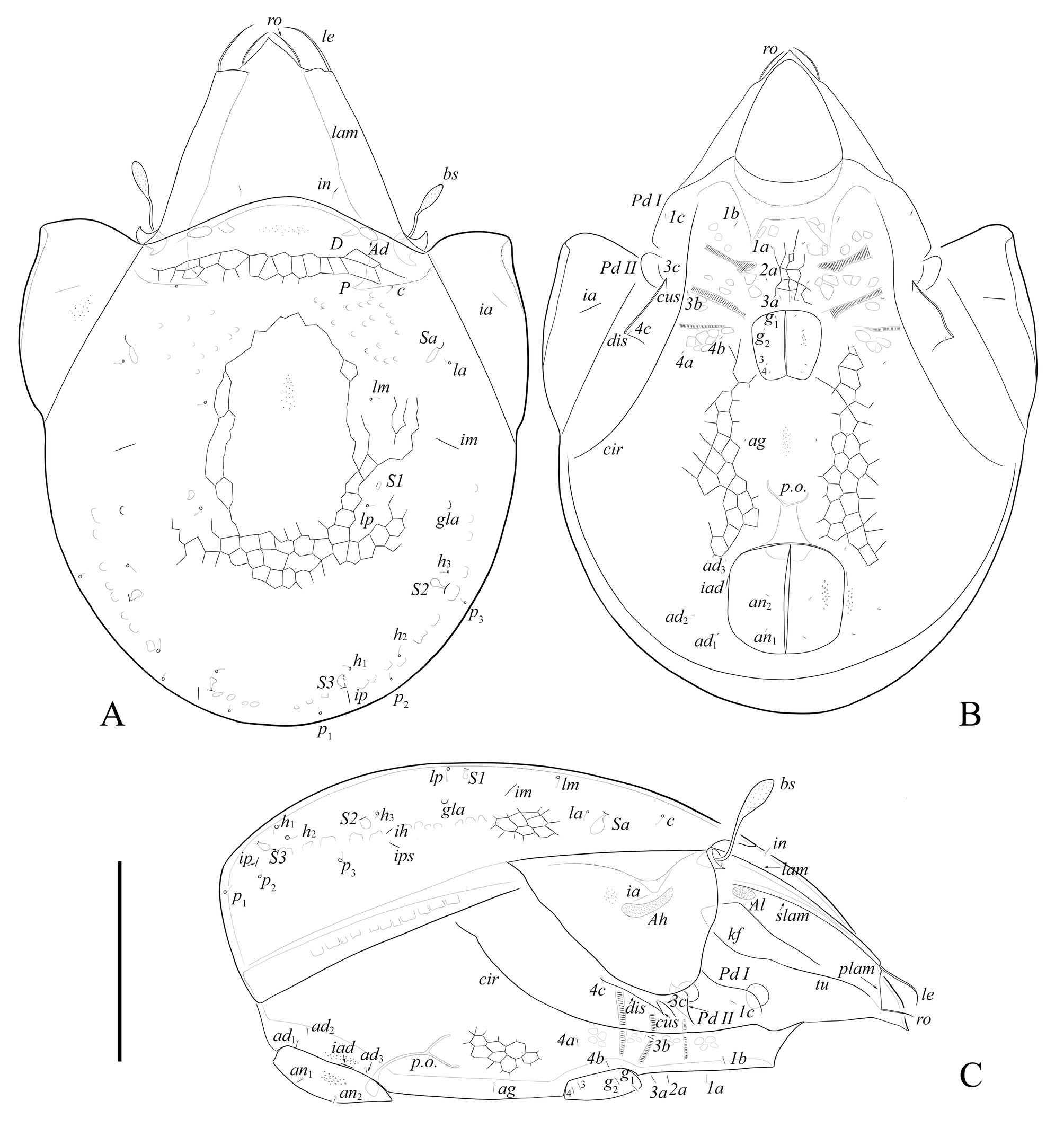
Figs 1, 2, Table 1
Type material
Holotype. Male, LR-17-134, in alcohol, China, Tibet, Mêdog County, Zhamo Road 80k [西藏自治区墨脱县扎墨公路80k], 29°39′30″N 95°29′22″E, ca. 2110 m a.s.l., deadwood, 15 Aug. 2017, collected by Rong Li. Paratypes. Two females and four males in alcohol, three females in permanent slides, same data as holotype.
Diagnosis
Body length: 810–920. Rostral, lamellar and interlamellar setae long, setiform, barbed; ro shortest, in longest. Bothridial seta long, setiform, barbed. Thirteen pairs of notogastral setae short, setiform. Four pairs of porose areas oval or rounded, Aa larger than others. Epimeral, genital and aggenital setae, anal setae and adanal seta ad3 setiform, thin, smooth, roughened or slightly barbed; adanal setae ad1 and ad2 setiform, longer and thicker than other anogenital setae, barbed. Legs heterotridactylous.
Description

Measurements — Body length: 810 (holotype), 820–920 (paratypes); notogaster width: 530 (holotype), 520–600 (paratypes). Females usually larger than males: 840–920 versus 810–850.
Integument — Body color light brown to brown. Cuticle smooth. Lateral side of body with microgranulate cerotegument.
Prodorsum — (Fig. 1A, C). Rostrum protruding, rounded. Lamella about one-half length of prodorsum. Sublamella distinct, about one-half length of lamella. Sublamellar porose area oval (25–31 × 15–19), near to sublamella. Tutorium short. Rostral (80–92), lamellar (112–130) and interlamellar (150–170) setae setiform, barbed; le inserted at anterior end of lamella. Bothridial seta (180–200) setiform, unilaterally barbed. Exobothridial seta (20–35) setiform, thin, slightly barbed. Dorsosejugal porose area elongate oval.
Notogaster — (Fig. 1A, C). Anterior notogastral margin slightly convex medially, nearly straight. Thirteen pairs of setae (5–8) setiform, thin, smooth. Four pairs of porose areas, Aa (28–37 × 12–15) oval, others (12–22) rounded; A1 occasionally divided into two on one side. Distance between porose areas A1–A1 shorter than A2–A2. Opisthonotal gland opening and all lyrifissures distinct.

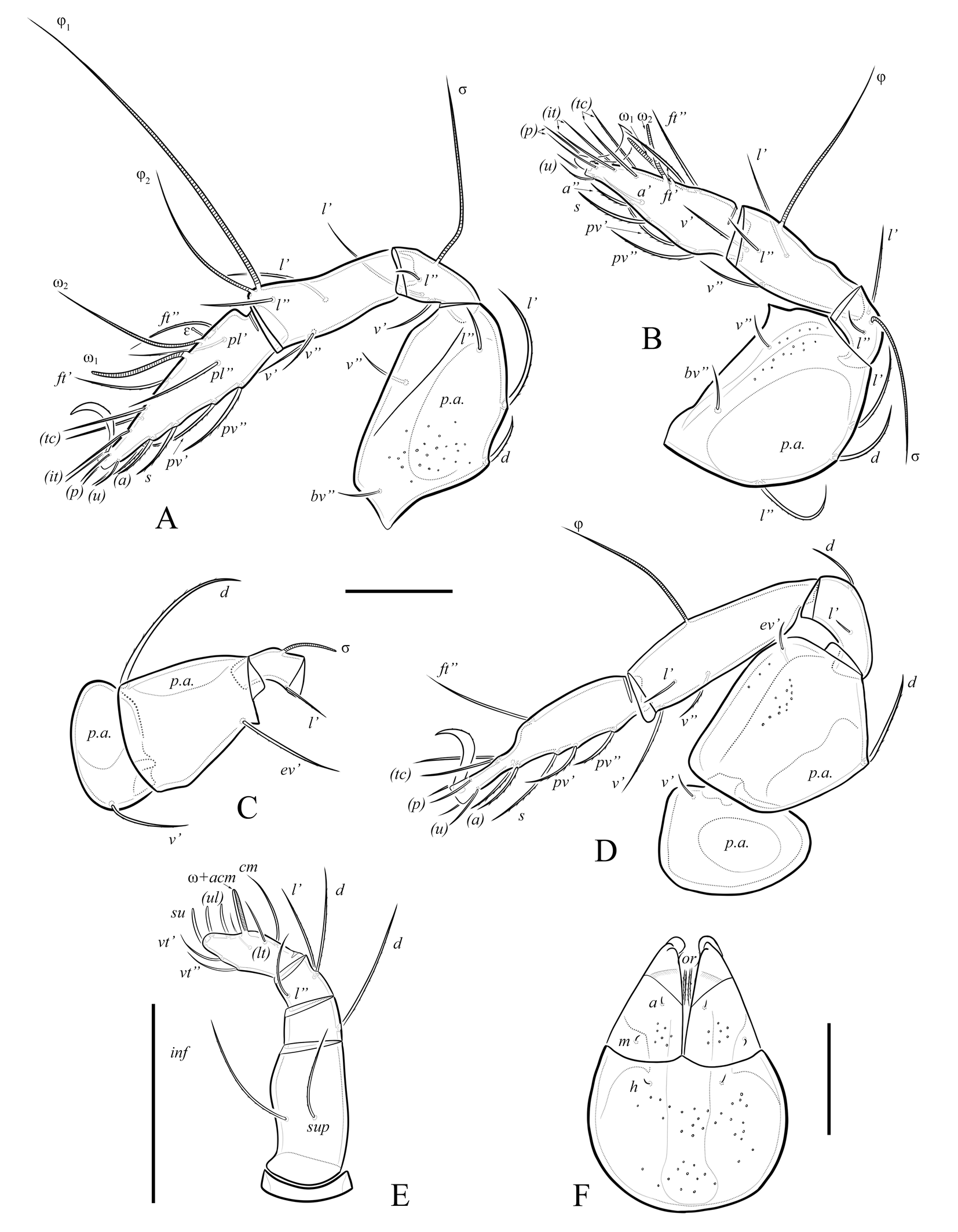
Gnathosoma — (Fig. 2A–C). Subcapitulum size: 187–210 × 125–137. Subcapitular setae (a: 28–38; m: 20–25; h: 52–55) setiform, slightly barbed, m thinnest. Adoral setae (18–25) setiform, densely barbed. Palp (118–125) with typical setation 0-2-1-3-9(+ω). Postpalpal setae (6–8) spiniform, smooth. Chelicera (200–202) with two setiform, barbed setae (cha, 65–70; chb, 40–48).
Epimeral and lateral podosomal regions — (Fig. 1B, C). Epimeral setal formula: 3-1-3-3. All epimeral setae setiform, thin, roughened or slightly barbed, 1b (40–44), 3b (45–50) and 3c (65–68) longer than others (18–32). Discidium broadly triangular. Circumpedal carina short, anteriorly reaching acetabula IV.
Anogenital region — (Fig. 1B, C). Five pairs of genital setae (g1: 25–42; g2–g5: 20–35) setiform, g1 slightly barbed, others smooth or roughed; one pair of aggenital setae (25–30) setiform, smooth; two pairs of anal setae (25–40) setiform, slightly barbed; three pairs of adanal seta (ad1, ad2: 68–90; ad3: 40–60), ad1, and ad2 barbed, longer and thicker than ad3, ad3 smooth or roughed. Adanal lyrifissure close and parallel to anal plates.
Legs — (Fig. 2D–G). Heterotridactylous, median claw thicker than lateral claws, all claws slightly barbed on the dorsal side. Dorsoparaxial porose area on femora I–IV and on trochanters III, IV, and ventrodistal porose area on tibia I–IV and proximoventral porose area on tarsi I–IV well developed. Ventrodistal part of femur II broadly rounded. Formulas of leg setation and solenidia: I (1-5-3-4-20) [1-2-2], II (1-5-3-4-15) [1-1-2], III (2-3-1-3-15) [1-1-0], IV (1-2-2-3-12) [0-1-0]; homology of setae and solenidia indicated in Table 1.
Download as Note: Roman letters refer to normal setae, and Greek letters to solenidia (except ɛ = famulus). A single quotation mark (’) designates setae on the anterior side and a double quotation mark (”) setae on the posterior side of a given leg segment. Parentheses refer to a pair of setae.
Leg
Tr
Fe
Ge
Ti
Ta
I
v’
d, (l), bv”, v”
(l), v’, σ
(l), (v), φ1, φ2
(ft), (tc), (it), (p), (u), (a), s, (pv), (pl),v’, l”, ɛ, ω1, ω2
II
v’
d, (l), bv”, v”
(l), v’, σ
(l), (v), φ
(ft), (tc), (it), (p), (u), (a), s, (pv), ω1, ω2
III
v’, l’
d, l’, ev’
l’, σ
l’, (v), φ
(ft), (tc), (it), (p), (u), (a), s, (pv)
IV
v’
d, ev’
d, l’
l’, (v), φ
ft”, (tc), (p), (u), (a), s, (pv)
Etymology
The species is named after the region, Mêdog County, from where the type specimens were collected.
Distribution
This species is known from Mêdog County in Tibet, China.
Ecology
All the specimens were collected from deadwood.
Remarks
The new species is morphologically similar to Setoxylobates palaciosvargasi Ermilov & Kontschán, 2023 in having a large body size (body length exceeding 700), heterotridactylous legs and minute notogastral setae (shorter than the diameter of the bothridial opening), but differs from the latter by the setiform bothridial seta (versus bothridial seta with unilaterally dilated head), thirteen pairs of notogastral seta (versus fourteen pairs of notogastral setae), and lamellar setae positioned at the end of the lamella (versus lamellar setae positioned posteromedially to end of lamella).
Genus Trachyoribates Berlese, 1908
Trachyoribates Berlese, 1908: 3.
Magyaria Balogh, 1963: 44; Ermilov 2019: 2323 (synonymy).
Type species — Oribates ampulla Berlese, 1905
Distribution — With the new species reported in this paper, the genus includes 24 species mainly distributed in tropics and subtropics.
Trachyoribates concavus sp. nov. 凹纹粗单翼甲螨
ZOOBANK: 8A699F98-CD01-484F-A424-206554710EEC
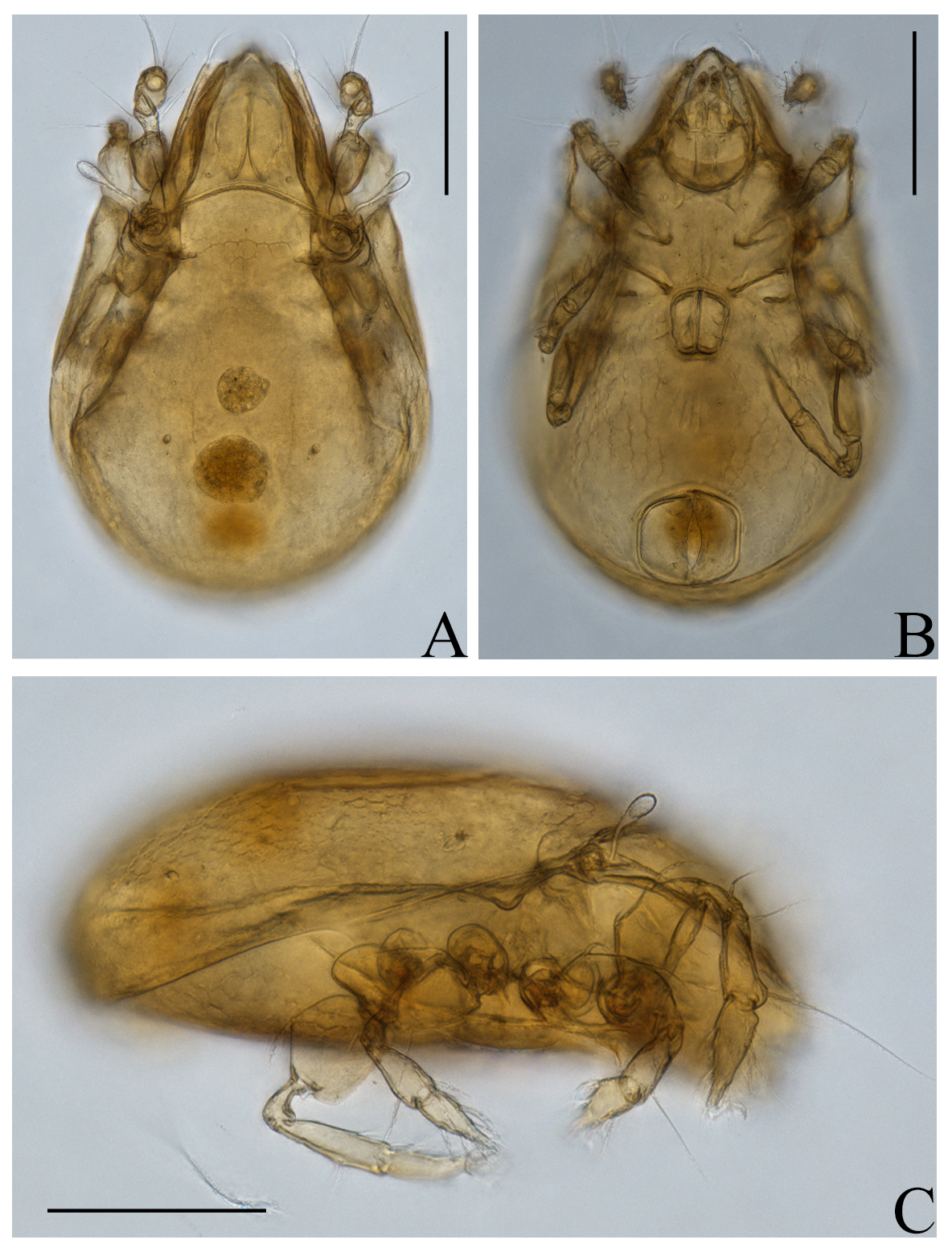
Figs 3–5, Table 2
Type material
Holotype. Male, ZLH-13-071, in alcohol, China, Guangdong, Taishan City, Xiachuan Island, Shuiyang Village [广东省台山市下川岛水洋村], 21°38′31″N 112°34′54″E, ca. 50 m a.s.l., litter under broad-leaved forest, 19 Oct. 2013, collected by Li-Hao Zheng. Paratype. One male in alcohol, two females on permanent slides, same data as holotype.
Diagnosis
Body length: 350–365. Rostrum pointed. Rostral and lamellar setae medium-sized, setiform, barbed; interlamellar seta short, needle-shaped; bothridial seta long, clavate, barbed. Notogaster anteriorly with reticulate pattern in a concave row; medial region in a rectangle not reticulate, medially and posteriorly around the rectangular region reticulate. The medial aera of epimeral region reticulate. Anogenital region (except medial region between genital and anal apertures) reticulate. Ten pairs of notogastral setal alveoli present. Four pairs of genital setae. Legs monodactylous.
Description
Measurements — Body length: 355 (holotype), 350–365 (paratypes); notogaster width: 225 (holotype), 200–235 (paratypes). Females usually slightly larger than males:360–365 versus 350–355.
Integument — Body color light brown to brown. Notogaster anteriorly with reticulate pattern in a concave row; medial region in a rectangle not reticulate, medially and posteriorly around the rectangular region with reticulate pattern. The medial aera of epimeral region with reticulate pattern. Anogenital region (except medial region between genital and anal apertures) with reticulate pattern. Subcapitular mentum and gena, anal plate and its adjacent left and right sides, and antiaxial side on femora I, II and IV foveolate; genital orifice on one plate of one specimen foveolate, the others not. The regions without reticulate ornamentation often microfoveolate.
Prodorsum — (Figs 3A, C, 5A, C). Rostrum pointed. Lamella long (about 3/4 of prodorsum length); cusp with small lateral tooth. Prolamella, sublamella, keel-shaped ridge, and tutorium well visible; tu posteriorly connected to kf. Sublamellar porose area oval (13–18 × 5–6). Rostral (20–25) and lamellar (32–40) setae setiform, barbed; ro inserted close to prolamellar end, le inserted on the lamellar end, thicker than ro. Interlamellar seta (5–6) minute. Bothridial seta (50–55) clavate, with barbed head. Lateral tooth of bothridium well developed. Exobothridial seta not visible. Dorsosejugal porose area oval (12–13 × 5–6). Dorsophragma short.
Notogaster — (Figs 3A, C, 5A, C). Anterior notogastral margin convex medially. Incision on anterior part of pteromorph (posterior to bothridium) absent, with poorly visible short, light ventral groove in its place. Ten pairs of setal alveoli present. Four pairs of sacculi with small opening and drop-like chamber. Distance S1–S1 shorter than S2–S2. Opisthonotal gland opening and all lyrifissures well visible.
Gnathosoma — (Fig. 4E, F). Subcapitulum size: 75–78 × 55–60. Subcapitular setae (a, m, h: 10–13) setiform; adoral setae (10–12) setiform, barbed. Palp (length: 50–55) with setation 0-2-1-3-9(+ω). Postpalpal setae (4) spiniform. Chelicera (length: 80–88) with two setiform, barbed setae (cha: 20–22; chb: 13–15), generally similar to S. medogensis sp. nov.
Epimeral and lateral podosomal regions — (Fig. 3B, C). Epimeral setal formula: 3-1-3-3. Epimeral setae 3c (15–20) setiform, others (4–8) needle-shaped. Discidium triangular. Custodium present. Humeral porose area Ah elongate oval; Am not observed. Circumpedal carina long, extended to pedotectum I.
Anogenital region — (Fig. 3B, C). Four pairs of genital, one pair of aggenital, two pairs of anal and three pairs of adanal setae (4–8), all setae needle-shaped. Adanal lyrifissure always close and parallel to anal plate. Adanal setae laterally, occasionally on the front side of anal plate on one side.
Legs — (Fig. 4A–D). Monodactylous, the claw slightly barbed on the dorsal side. Dorsoparaxial porose area well visible on femora I-IV and on trochanters III, IV. Ventroproximal porose area on all tarsi and ventrodistal porose area on all tibiae not developed. Femur II with pointed process ventrodistally. Femur III with pointed process ventrodistally occasionally. Formulas of leg setation and solenidia: I (1-5-3-4-18) [1-2-2], II (1-5-2-4-15) [1-1-2], III (1-2-1-3-15) [1-1-0], IV (1-2-2-3-12) [0-1-0]; homology of setae and solenidia indicated in Table 2.
Download as Note: Roman letters refer to normal setae, and Greek letters to solenidia (except ɛ = famulus). A single quotation mark (’) designates setae on the anterior side and a double quotation mark (”) setae on the posterior side of a given leg segment. Parentheses refer to a pair of setae.
Leg
Tr
Fe
Ge
Ti
Ta
I
v’
d, (l), bv”, v”
(l), v’, σ
(l), (v), φ1, φ2
(ft), (tc), (it), (p), (u), (a), s, (pv), (pl), ɛ, ω1, ω2
II
v’
d, (l), bv”, v”
(l), σ
(l), (v), φ
(ft), (tc), (it), (p), (u), (a), s, (pv), ω1, ω2
III
v’
d, ev’
l’, σ
l’, (v), φ
(ft), (tc), (it), (p), (u), (a), s, (pv)
IV
v’
d, ev’
d, l’
l’, (v*), φ
ft”, (tc), (p), (u), (a), s, (pv)
Etymology
The species name refers to the concave row of reticulate pattern on the anterior region of the notogaster.
Distribution
This species is known from Taishan in Guangdong, China.
Ecology
All the specimens were collected from broad-leaved forest.
Remarks
The new species is morphologically most similar to Trachyoribates fenestrata (Balogh & Mahunka, 1974) in having monodactylous legs, four pairs of genital setae, minute interlamellar setae, reticulate pattern in a concave row on the anterior notogaster, and the absence of reticulate pattern on the prodorsum and pteromorph. However, the new species differs from the latter in having reticulate pattern on the lateral regions of the notogaster (versus absence of reticulate pattern), pointed rostrum (versus rounded rostrum), and the incision on the anterior part of pteromorph absent (versus present).
Acknowledgements
We cordially thank Dr. Tobias Pfingstl (Institute of Biology, University of Graz, Graz, Austria) and two anonymous reviewers for their valuable comments. We also thank Dr. Christopher Glasby for his valuable linguistic editing suggestions, and Rong Li and Li-Hao Zheng for collecting specimens for the study. This work was supported by the Second Tibetan Plateau Scientific Expedition and Research Program (STEP, #2024QZKK0200), the Biological Resources Programme, Chinese Academy of Sciences (No. CAS-TAX-24-001), the BJAST Budding Talent Program (grant no. 23CE-BGS-04), and the Beijing Government.
References
- Balogh J. 1963. Oribates (Acari) nouveaux d'Angola et du Congo (3ème série). Comp. Diamant. Angola, Lisboa, 68: 33-48.
- Balogh J., Mahunka S. 1967. New oribatids (Acari) from Vietnam. Acta Zool. Acad. Sci. Hung., 13: 39-74.
- Balogh J., Mahunka S. 1974. Oribatid species (Acari) from Malaysian soils. Acta Zool. Acad. Sci. Hung., 20: 243-264.
- Berlese A. 1905. Acari Nuovi. Manipulus IV (Acari di Giava). Redia, 2: 154-176.
- Berlese A. 1908. Elenco di generi e specie nuove di Acari. Redia, 5: 1-15.
- Ermilov S.G. 2019. Contribution to the knowledge of Trachyoribates (Acari, Oribatida, Haplozetidae), with description of Trachyoribates viktortsoii sp. nov. from Malaysia and synonymy of Magyaria. Syst. Appl. Acarol., 24: 2311-2328. https://doi.org/10.11158/saa.24.12.3
- Ermilov S.G., Corpuz-Raros L., Naredo J.C.B., Eusebio O.L. 2022. New faunistical data on oribatid mites from the Philippines, with a description of a new species of the genus Trachyoribates (Acari, Oribatida, Haplozetidae). Acta Zool. Acad. Sci. Hung., 68: 217-229.
- Ermilov S.G., Kontschán J. 2023. New species and records of Oripodoidea (Acari, Oribatida) from Mexico. Syst. Appl. Acarol., 28: 1109-1120. https://doi.org/10.11158/saa.28.6.8
- Ermilov S.G., Liao J.-R. 2020. Taxonomic study of Setoxylobates (Acari, Oribatida, Haplozetidae) and some related taxa. Syst. Appl. Acarol., 25: 1516-1525. https://doi.org/10.11158/saa.25.8.13
- Fukuyama K., Aoki J. 2000. Two new haplozetoid-species (Acari: Oribatida) collected from Yunnan Province in China. In: Aoki J., Yin W.Y., Imadate G. (Eds.). Taxonomical Studies on the Soil Fauna of Yunnan Province in Southwest China. Tokyo: Tokai University Press. p. 23-32.
- Grandjean F. 1936. Observations sur les Acariens (10e Série). Bull. Mus. Natl. Hist. Nat., 2: 246-253.
- Hammer M. 1973. Oribatids from Tongatapu and Eua, the Tonga Islands, and from Upolu, western Samoa. Biol. Skr. Dan. Vid. Selsk., 20: 1-70.
- Hammer M. 1979. Investigations on the oribatid fauna of Java. Biol. Skr. Dan. Vid. Selsk., 22: 1-79.
- Norton R.A. 1977. A review of F. Grandjean's system of leg chaetotaxy in the Oribatei (Acari) and its application to the family Damaeidae. In: Dindal D.L. (Ed.). Biology of Oribatid Mites. Syracuse: SUNY College of Environmental Science and Forestry. p. 33-61.
- Norton R.A., Behan-Pelletier V.M. 2009. Chapter 15. Suborder Oribatida. In: Krantz G.W., Walter D.E. (Eds.). A Manual of Acarology. Lubbock: Texas Tech University Press. p. 430-564.
- Subías L.S. 2020. Adiciones al listado mundial de ácaros oribátidos (Acari, Oribatida) (15ª actualización). Rev. Ibér. Aracnol., 36: 3-12.
- Subías L.S. 2022, online version 2024. Listado sistemático, sinonímico y biogeográfico de los Ácaros Oribátidos (Acariformes, Oribatida) del mundo (Excepto fósiles) (19ª actualización). 1-545. Available from: http://bba.bioucm.es/cont/docs/RO_1.pdf (accessed 9 October 2024)
- Subías L.S., Shtanchaeva U.Y. 2023. Claves de familias, géneros y subgéneros de ácaros oribátidos del mundo (Acari, Oribatida). Monogr. Electr. S.E.A., 13: 1-289.
- Zhang Z.-Q. 2018. Repositories for mite and tick specimens: acronyms and their nomenclature. Syst. Appl. Acarol., 23: 2432-2446. https://doi.org/10.11158/saa.23.12.12
to post any comment or correction.


2025-03-03
Date accepted:
2025-05-19
Date published:
2025-05-26
Edited by:
Pfingstl, Tobias

This work is licensed under a Creative Commons Attribution 4.0 International License
2025 Xu, Shu-Jing and Chen, Jun
 Download article
Download the citation
RIS with abstract
(Zotero, Endnote, Reference Manager, ProCite, RefWorks, Mendeley)
RIS without abstract
BIB
(Zotero, BibTeX)
TXT
(PubMed, Txt)