


Contribution to the taxonomy of the West-African Rotundabaloghiidae (Acari: Uropodina)
Kontschán, Jenő  1
and Ermilov, Sergey G.
2
1
and Ermilov, Sergey G.
2
1✉ Plant Protection Institute, HUN-REN Centre for Agricultural Research, H-1525 Budapest, P.O. Box 102, Hungary & Department of Plant Sciences, Albert Kázmér Faculty of Mosonmagyaróvár, Széchenyi István University, Vár square 2., H-9200 Mosonmagyaróvár, Hungary.
2Institute of Environmental and Agricultural Biology (X-BIO), University of Tyumen, Lenina str. 25, 625000 Tyumen, Russia.
2025 - Volume: 65 Issue: 2 pages: 306-312
https://doi.org/10.24349/5e51-9ewdZooBank LSID: 4C86028A-83AB-49F1-AADC-5230EE524588

Original research
Keywords
Abstract
Introduction
Togo lies in the Western part of Africa among Benin, Burkina Faso, and Ghana. This country belongs to the most scarcely investigated countries of Africa from the Uropodina point of view. Wiśniewski (1993) listed only five Uropodina species from Togo, but all known species are described based on deutonymphal instars; and the adults of these species are unknown. Therefore, validation of these is questionable at the species level. Later, another Uropodina species was reported from Togo the Rotundabaloghia (Circobaloghia) ghanaensis Hirschmann, 1992 from Foret de Konto (Kontschán 2020). The mites from the family Rotundabaloghiidae Kontschán, 2010 are small and very common in tropical soils, leaf litters, and mosses (Kontschán 2010). However, the West African sub-region of the Ethiopian realms seems to be a neglected part of rotundabaloghid mites. Only 17 species were reported from this sub-region, like Cameroon, Ghana, the Republic of Congo, Ivory Coast, Togo, and Sierra Leone (Kontschán 2010, 2109, 2020; Kontschán & Neményi 2020).
During the investigation of the unsorted soil samples of Togo we found a new rotundabaloghid mite species. The main goals of the paper are to describe and illustrate a new species, Rotundabaloghia togoensis n. sp., and to present a list and an identification key to the West African rotundabaloghid mites.
Material and methods
Specimens of the new species were cleared in lactic acid for a week and afterwards were studied with a Leica 1000 scientific microscope with a drawing tube. Specimens examined are stored in 70% ethanol and deposited in the Natural History Museum, Geneva (NHMG). Measurements are given in micrometers (μm). Abbreviations: st = sternal setae, v = ventral setae, h = hypostomal setae, ad = adanal setae, lf = lyriform fissure.
Taxonomy
Rotundabaloghiidae Kontschán, 2010
Rotundabaloghia (Circobaloghia) togoensis n. sp.
ZOOBANK: FB036090-08D4-443F-9BFA-90ED3D22F552
(Figures 1–3)
Diagnosis
Genital shield of female scutiform with peaked apical margin and with oval pits on its surface. Peritremes R-shaped, sternal setae short and needle-like. Setae v2 similar in shape and length to sternal setae; v6, v7 and v8 marginally pilose and situated close to end of pedofossae IV.
Material examined
Holotype — Female, ''Togo, Tchekpo, 16. April 1974, S. Vit coll.''
Paratypes — One female and one male. Locality and date same as holotype.
Description
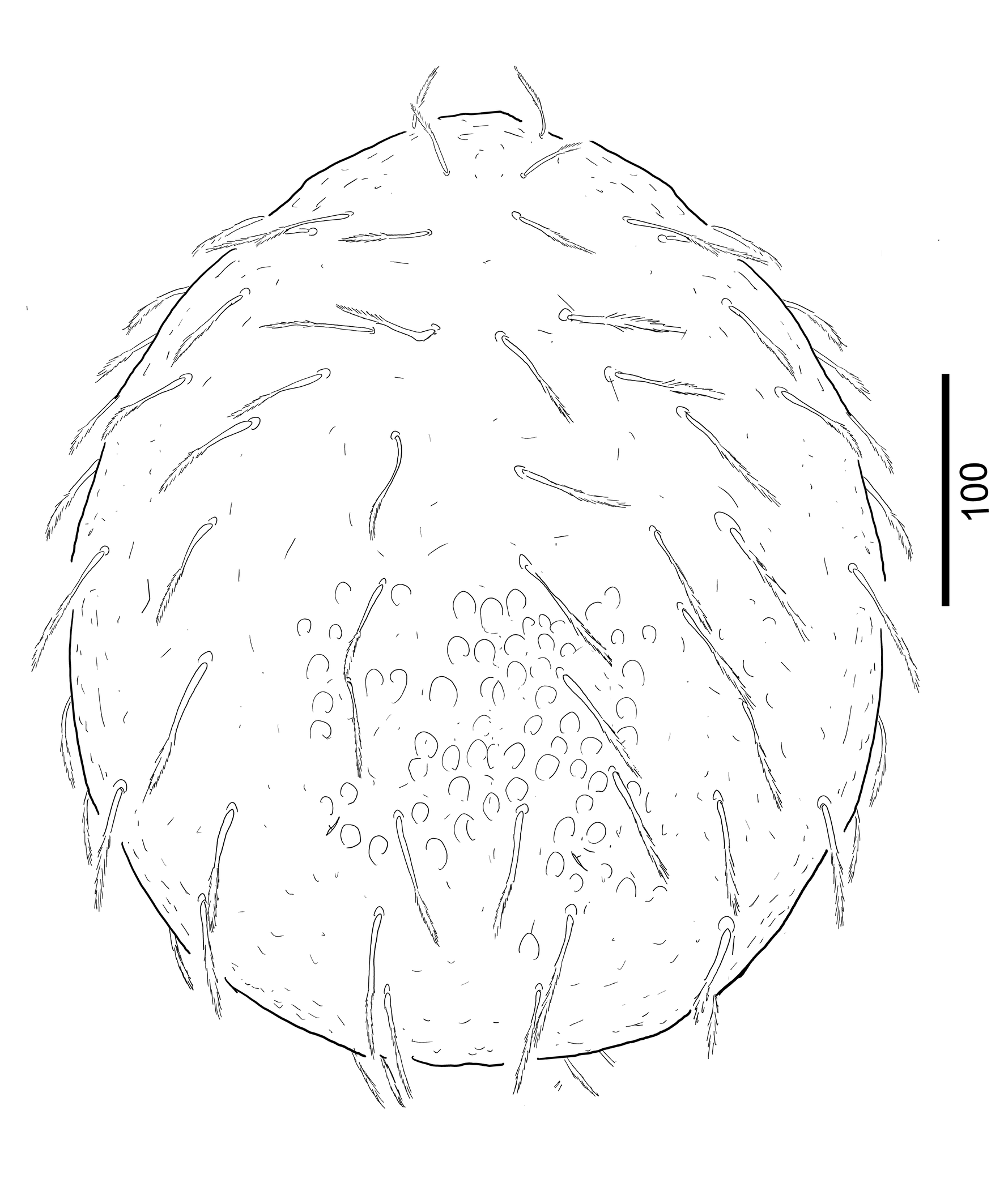
Female — Length of idiosoma 400–405, width at level of coxae IV 340–345 (n=2), color reddish-brown. Shape of idiosoma rounded.
Dorsal idiosoma (Figure 1). Dorsal shield bears long (ca 50–58) and marginally pilose setae and covered by oval (ca 6–10×9–16) pits. One pair of lyriform fissures situated at posterior-central area of dorsal shield.
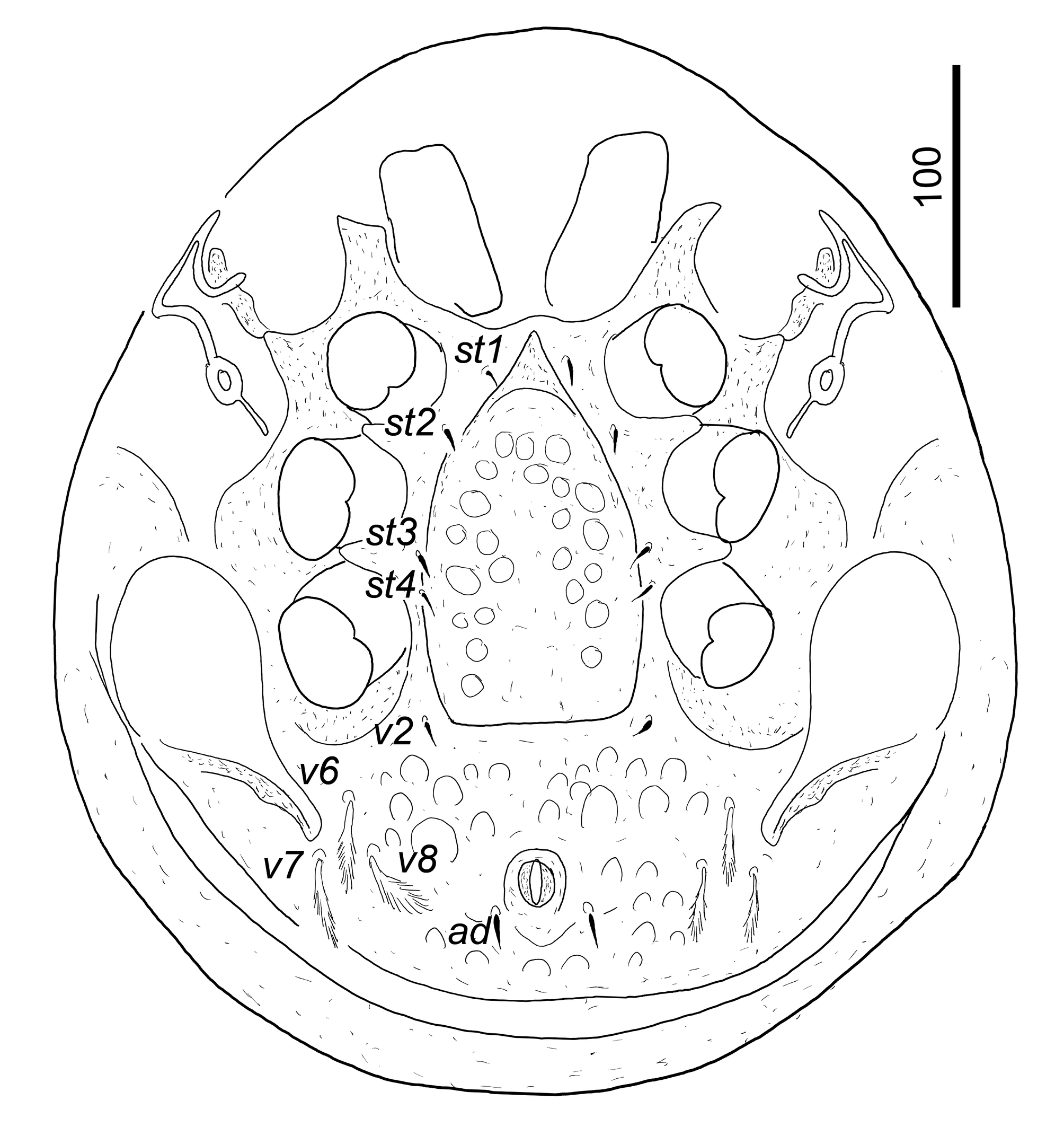
Ventral idiosoma (Figure 2). Surface of sternal shield without sculptural pattern, four pairs of smooth, short (ca 9–11) and needle-like sternal setae presented. Setae st1 situated at level of mid-coxae II, st2 at level of anterior margin of III, st3 at level of posterior margin of coxae III and st4 at level of anterior margin of coxae IV. Setae v2 similar in shape and length to sternal setae and situated close to basal edge of genital shield. Setae v6, v7 and v8 marginally pilose and ca 35–39 long, and located close to posterior end of pedofossae IV. Setae ad situated lateral to anal opening, needle-like and ca 13–14 long. Surface of ventral shield covered by large (ca 15–19×16–17) and small (ca 4–6×7–9) oval pits. Stigmata situated between coxae II and III. Prestigmatid part of peritreme R-shaped, poststigmatid part short and straight. Genital shield scutiform, anterior margin peaked, 162–164 long and 80–84 wide, its surface covered by oval pits (ca 7–10×8–14). Pedofossae deep and smooth, pedofossae IV with separate furrow for tarsi IV. Base of tritosternum narrow, laciniae subdivided into four smooth branches (Figure 3a).
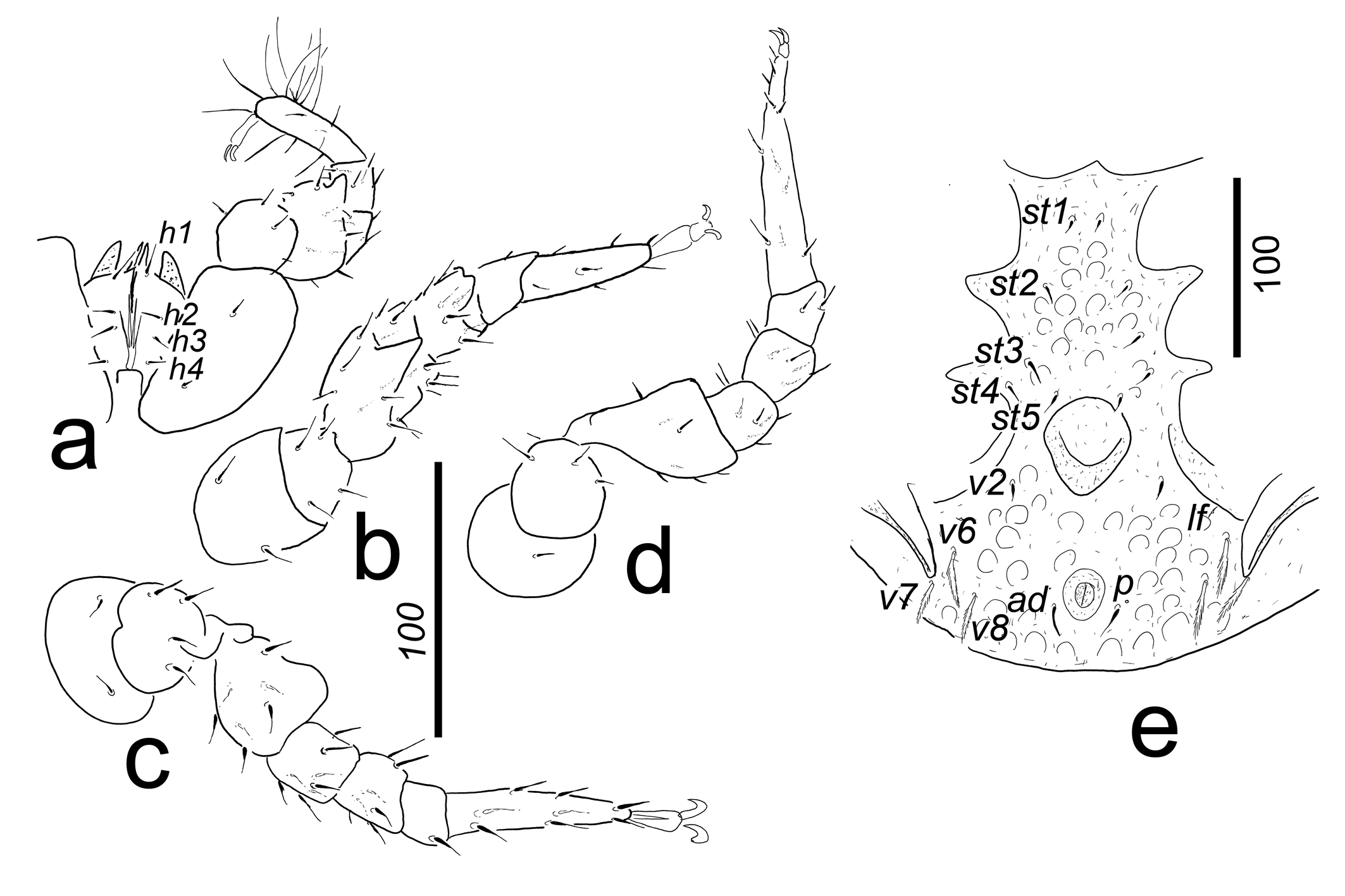
Gnathosoma (Figure 3a). Corniculi horn-like, internal malae smooth, and as long as corniculi. All hypostomal setae smooth and ca 8–11 long. Base of epistome with serrated margin and pilose on its apical part. Palps with smooth and needle-like setae. Chelicerae not clearly visible.
Legs. All legs with a pair of ambulacral claws and with smooth simple setae. Leg I 145–150, leg II 188–192, leg III 210–215, leg IV 218–225 (Figures 3a-d).
Male — Length of idiosoma 390, width at level of coxae IV 330 (n=1), color reddish-brown. Shape of idiosoma rounded.
Dorsal idiosoma. Ornamentation and chaetotaxy of dorsal shield as for female.
Ventral idiosoma (Figure 3e). Five pairs of smooth and needle-like (ca 8–10 long) setae situated on sternal shield. Setae st1–st5 situated anterior to genital opening, position of sternal setae presented on Figure 3e. Position, shape and length of setae v2, v6, v7, v8 and ad as for female. Genital shield egg-like (ca 52–56 long and ca 42–46 wide) and situated between coxae IV.
Gnathosoma. Same as in the females.
Larvae and nymphs are unknown.
Etymology
The name of the new species refers to the country where it was collected.
Notes
Rotundabaloghid mites with apically peaked, and scutiform female genital shields and R-shaped peritremes are not presented from West Africa. Only the male of R. (C.) bueaensis Hirschmann, 1992 from Cameroon, is similar to the male of the new species (female is unknown). The most important differences between the males are the following: (1) the setae st5 are situated at the level of the central area of the genital opening in R. (C.) bueaensis; contrary to new species, where these setae are situated anterior to genital opening, (2) the genital shield of the known species is oval, but it is egg-like in the new species, and (3) setae v6 are situated close to setae v8 in case of R. (C.) bueaensis, and setae v6 are similar distance between setae v7 and v8 on the new species.
List of the species from the family Rotundabaloghiidae in West-African sub-region of Ethiopian realm
- Rotundabaloghia (Circobaloghia) africaguttaseta Hirschmann, 1984
Rotundabaloghia africaguttaseta Hirschmann 1984: 30
Distribution: Cameroon, Mt. Koupe (Hirschmann 1984). - Rotundabaloghia (Circobaloghia) browni Kontschán, 2009
Rotundabaloghia browni Kontschán 2009: 36
Distribution: Ivory Coast (Kontschán 2009) - Rotundabaloghia (Circobaloghia) bueaensis Hirschmann, 1992
Rotundabaloghia bueaensis Hirschmann 1992: 43
Distribution: Cameroon, Buea, Mt. Cameroon (Hirschmann 1992) - Rotundabaloghia (Circobaloghia) camerunis Hirschmann, 1984
Rotundabaloghia camerunis Hirschmann 1984: 31
Distribution: Cameroon, Mount Oku (Hirschmann 1984) - Rotundabaloghia (Circobaloghia) campanellae Hirschmann, 1992
Rotundabaloghia campanellae Hirschmann 1992: 41
Distribution: Cameroon, Mt. Koupe (Hirschmann 1992) - Rotundabaloghia (Circobaloghia) campanellasimilis Hirschmann, 1992
Rotundabaloghia campanellasimilis Hirschmann 1992: 41
Distribution: Cameroon, Mt. Koupe (Hirschmann 1992) - Rotundabaloghia (Circobaloghia) congoensis Hirschmann, 1992
Rotundabaloghia congoensis Hirschmann 1992: 37
Distribution: Republic of Congo, Sibiti (Hirschmann 1992) - Rotundabaloghia (Circobaloghia) daelei Hirschmann, 1984
Rotundabaloghia daelei Hirschmann 1984: 31
Distribution: Cameroon, Mt. Koupe (Hirschmann 1984) - Rotundabaloghia (Circobaloghia) endroedyi Hirschmann, 1992
Rotundabaloghia endroedyi Hirschmann 1992: 39
Distribution: Ghana, Kintampo (Hirschmann 1992) - Rotundabaloghia (Circobaloghia) ghanaensis Hirschmann, 1992
Rotundabaloghia ghanaensis Hirschmann 1992: 41
Rotundabaloghia ghanaensis: Kontschán 2020: 324
Distribution: Ghana, New Longoro (Hirschmann 1992), Togo, Foret Konto (Kontschán 2020) - Rotundabaloghia (Circobaloghia) kintampoensis Hirschmann, 1992
Rotundabaloghia kintampoensis Hirschmann 1992: 41
Distribution: Ghana, Kintampo (Hirschmann 1992) - Rotundabaloghia (Circobaloghia) leonensis Kontschán, 2019
Rotundabaloghia (Circobaloghia) leonensis Kontschán 2019: 20–22
Distribution: Sierra Leone (Kontschán 2019) - Rotundabaloghia (Circobaloghia) masoumbouensis Hirschmann, 1992
Rotundabaloghia masoumbouensis Hirschmann 1992: 31
Distribution: Cameroon, Masoumbou (Hirschmann 1992) - Rotundabaloghia (Circobaloghia) masoumbouoides Hirschmann, 1992
Rotundabaloghia masoumbouoides Hirschmann 1992: 35
Distribution: Cameroon, Masoumbou (Hirschmann 1992) - Rotundabaloghia (Circobaloghia) nagyi Kontschán & Neményi, 2020
Rotundabaloghia (Circobaloghia) nagyi Kontschán & Neményi 2020: 218–221
Distribution: Cameroon (Kontschán & Neményi 2020) - Rotundabaloghia (Circobaloghia) olszanowskii Kontschán, 2020
Rotundabaloghia (Circobaloghia) olszanowskii Kontschán 2020: 322–324
Distribution: Ivory Coast (Kontschán 2020) - Rotundabaloghia (Circobaloghia) perstructura Hirschmann, 1984
Rotundabaloghia perstructura Hirschmann 1984: 29–30
Distribution: Cameroon, Mt. Koupe (Hirschmann 1984)
Key to adult females of Rotundabaloghia (Circobaloghia) species from the West African sub-region of Ethiopian realm
1. Ventral shield with sculptural pattern
...... 4
— Ventral shield without sculptural pattern
...... 2
2. Genital shield with sculptural pattern
...... 3
— Genital shield without sculptural pattern
...... R. (C.) masoumbouensis
3. Setae v6, v7 and v8 pilose
...... R. (C.) masoumbouoides
— Setae v6, v7 and v8 smooth
...... R. (C.) congoensis
4. Setae v7 extremely long and robust
...... R. (C.) africaguttaseta
— Setae v7 not extremely long and not robust
...... 5
5. Setae v6, v7 and v8 smooth
...... 6
— Only one of ventral setae (v6, v7 or v8) pilose
...... 9
6. Setae v6 as long as v7 and v8
...... 7
— Setae v6 shorter than v7 and v8
...... 8
7. Setae st1 and st2 longer than st3 and st4
...... R. (C.) olszanovskii
— Setae st1 and st2 as long as st3 and st4
...... R. (C.) endroedy
8. A short apical prolongation present on anterior margin of genital shield
...... R. (C.) kintampoensis
— Apical prolongation absent on anterior margin of genital shield
...... R. (C.) browni
9. Setae v6 smooth
...... 10
— Setae v6 pilose
...... R. (C.) togoensis
10. Anterior margin of genital shield with spiked anterior process
...... 11
— Anterior margin of genital shield without apical process
...... 12
11. Setae v6 longer than distance between v6 and v8; v7 longer than distance between v7 and v8
...... R. (C.) nagyii
— Setae v6 as long as distance between v6 and v7; v7 as long as distance between v7 and v8
...... R. (C.) endroedy
12. Sternal setae st3 three times longer than st1 and st2; surface of genital shield with oval pits
...... R. (C.) leonensis
— Sternal setae st3 two times longer than st1 and st2; surface of genital shield with irregular pits
...... R. (C.) ghanaensis
Acknowledgements
We are very grateful to Dr. Peter Schwendinger (MHNG) for his kind hospitality during the first author's visit to Geneva. This study was partially supported by the Ministry of Science and Higher Education of the Russian Federation within the framework of the Carbon Measurement Test Area in Tyumen' Region (FEWZ-2024-0016).
References
- Hirschmann W. 1984. Gangsystematik der Parasitiformes. Teil 449. Gang, Teilgänge, Stadien von 6 neuen Rotundabaloghia-Arten aus Rwanda, Kolumbien und Kamerun. Acarologie, 31: 25-31.
- Hirschmann W. 1992. Gangsystematik der Parasitiformes. Teil 534. 26 Rotundabaloghia-Arten aus Afrika (Ghana, Kamerun, Kongo, Rwanda, Tanzania) (Dinychini, Uropodinae). Acarologie, 39: 25-45.
- Kontschán J. 2009. Rotundabaloghia browni spec. nov., a new uropodine mite from Ivory Coast. Spixiana, 32(1): 35-38.
- Kontschán J. 2010. Rotundabaloghid mites of the world (Acari: Mesostigmata: Uropodina). Ad Librum, Budapest, pp. 116.
- Kontschán J. 2019. First record of the rotundabaloghid mites (Acari: Mesostigmata) in Sierra Leone with the description of a new species. Acarol. Stud., 1(1): 20-22.
- Kontschán J. 2020. Rotundabaloghid mites (Acari: Mesostigmata) from West-Africa. Ann. Zool., 70(3): 321-326. https://doi.org/10.3161/00034541ANZ2020.70.3.004
- Kontschán J., Neményi A. 2020. Rotundabaloghia (Circobaloghia) nagyi sp. nov., a new Uropodina mite species from a bamboo thicket (Acari: Mesostigmata). Acta Phytopathol. Entomol. Hung., 55(2): 217-222. https://doi.org/10.1556/038.55.2020.022
- Wiśniewski J. 1993. Gangsystematik der Parasitiformes. Teil 549. Die Uropodiden der Erde nach Zoogeographischen Regionen und Subregionen geordnet (Mit Angabe der Lande). Acarologie, 40: 221-291.
to post any comment or correction.


2024-12-28
Date accepted:
2025-03-11
Date published:
2025-04-10
Edited by:
Faraji, Farid

This work is licensed under a Creative Commons Attribution 4.0 International License
2025 Kontschán, Jenő and Ermilov, Sergey G.
 Download article
Download the citation
RIS with abstract
(Zotero, Endnote, Reference Manager, ProCite, RefWorks, Mendeley)
RIS without abstract
BIB
(Zotero, BibTeX)
TXT
(PubMed, Txt)