


Three new alien spider mites (Prostigmata, Tetranychidae) from south-eastern France
Auger, Philippe  1
; Navia, Denise
2
and Migeon, Alain
3
1
; Navia, Denise
2
and Migeon, Alain
3
1✉ CBGP, Univ Montpellier, CIRAD, INRAE, IRD, Montpellier SupAgro, Montpellier, France.
2CBGP, Univ Montpellier, CIRAD, INRAE, IRD, Montpellier SupAgro, Montpellier, France.
3CBGP, Univ Montpellier, CIRAD, INRAE, IRD, Montpellier SupAgro, Montpellier, France.
2023 - Volume: 63 Issue: 3 pages: 826-833
https://doi.org/10.24349/yeys-kf03Short note
Keywords
Abstract
Introduction
Any of these new alien mite species that manages to establish itself in a new environment is of concern, both for environmental and economic reasons if it feeds on crop plants (see Mack et al., 2000 for a review). Due to their minute size, spider mites are difficult to detect before (interception) and early after their introduction into new environments, which may allow them to become permanently established in the newly colonised area. For this reason, their early detection is one of the important challenges in bioinvasion management allowing the adoption of measures to reduce the spread and the impact of the newly introduced mite.
In this context, because of our territorial alert mission, following the sending of a sample by a private individual, we undertook a survey in the south-east of France.
Now we provide the first evidence of the presence in southern France of three alien spider mites species. We also took advantage of the discovery of a species belonging to the genus Aponychus to fill a gap: to build an identification key for the 21 species belonging to this genus.
Results and discussion
Family Tetranychidae Donnadieu, 1875
Subfamily Tetranychinae Berlese, 1913
Tribe Eurytetranychini Reck, 1950
Genus Aponychus Rimando, 1966
Aponychus Rimando, 1966: 105-113. Type-species: Aponychus corpuzae Rimando
Aponychus corpuzae Rimando, 1966
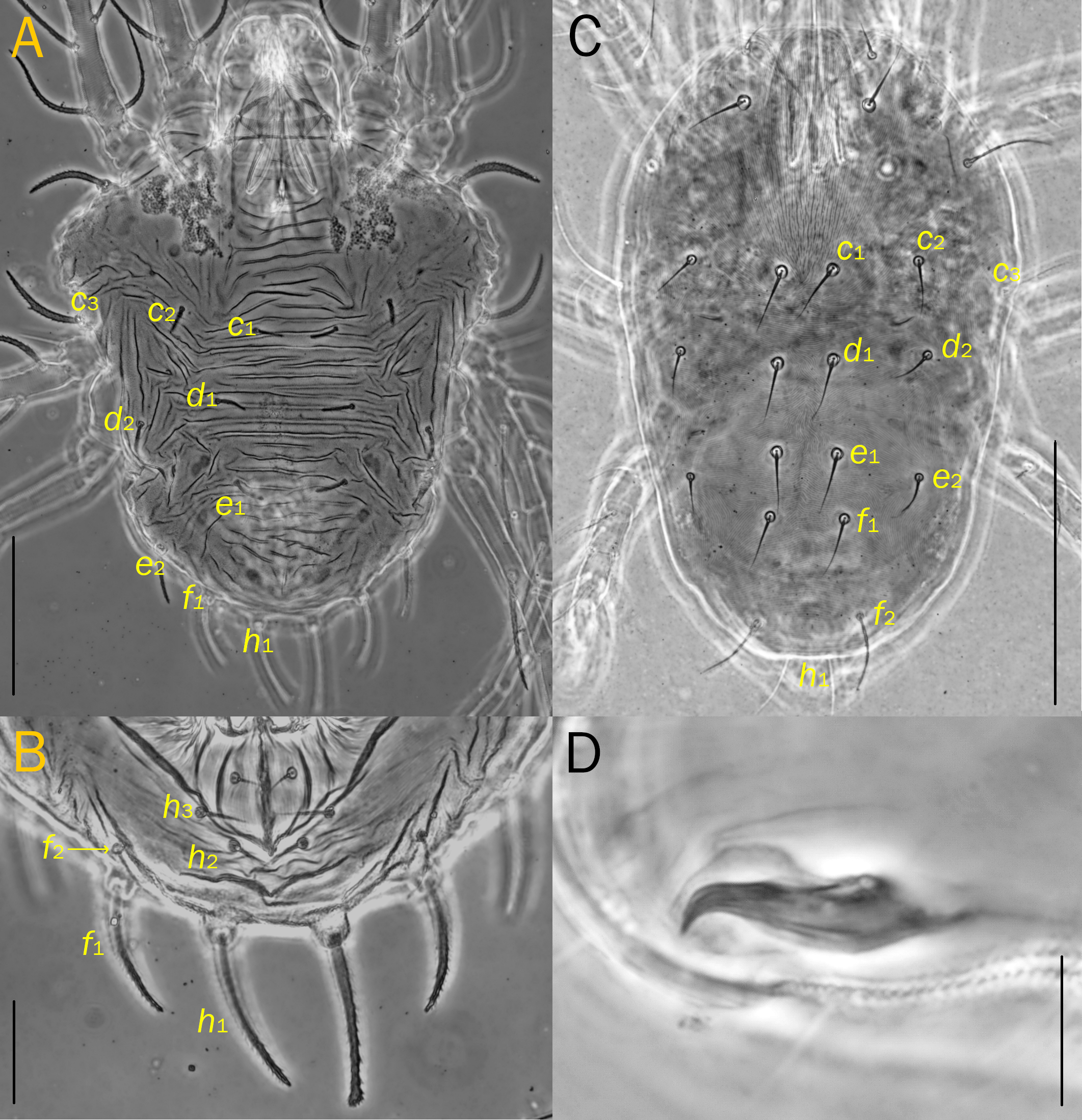
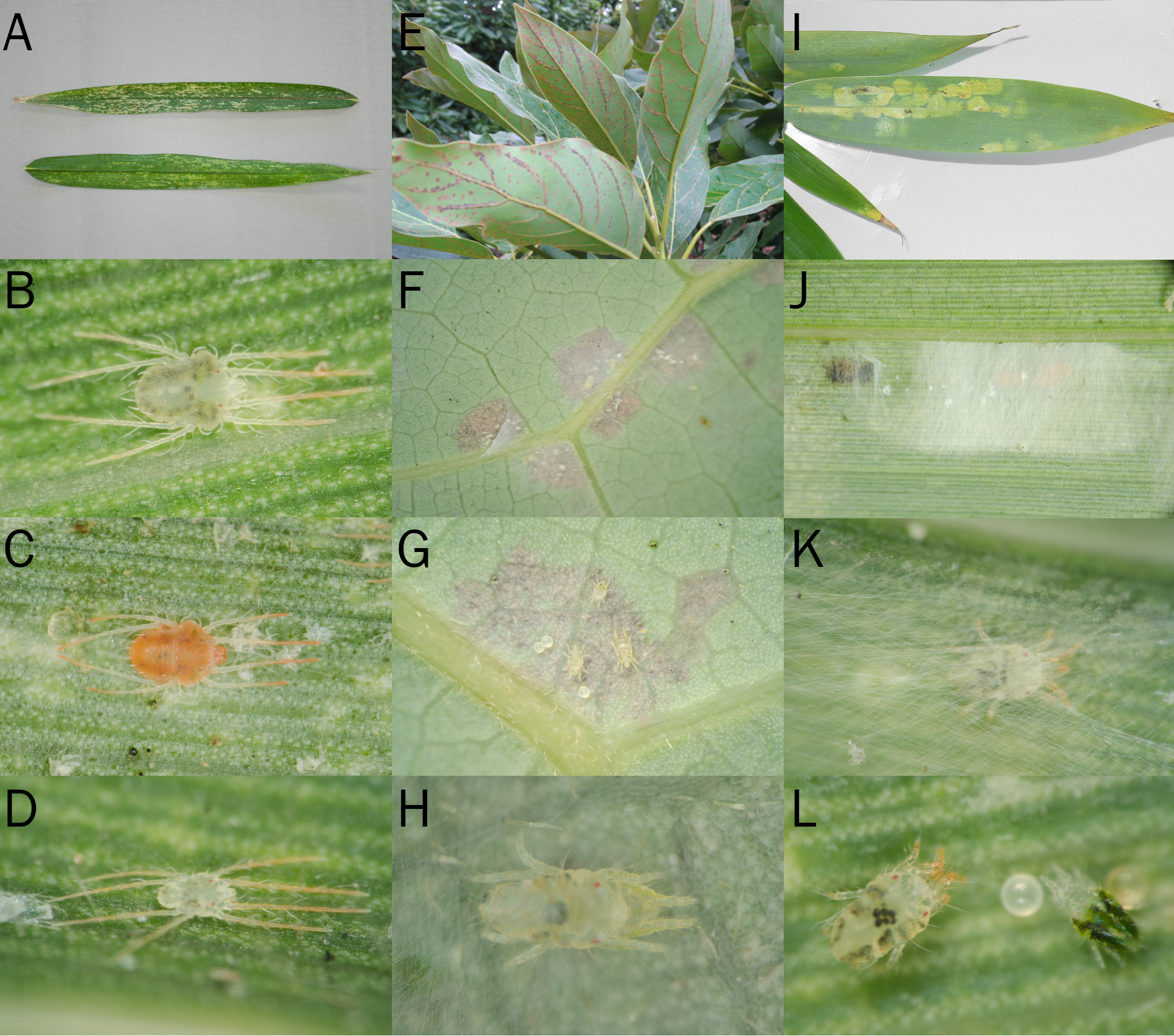
Figures 1A–B, 3A–D
According to Migeon and Dorkeld (2022), this species is only recorded from Oriental and Palearctic regions on Myrtaceae, Poaceae, Rosaceae and Rutaceae plant species. In Palearctic region, A. corpuzae was earlier recorded from China (Wang, 1981), Japan (e.g. Gotoh et al., 2003) and Korea (Lee, 1989). The only hitherto record in Europe is the most recent ones and concerns Italy and Slovenia (Seljak, 2015).
Records: 1 female, 2 males, 1 nymph collected on Phyllostachys sp. (Poaceae), Val Rahmeh Botanical Garden, (43.7847°N 7.5113°E, alt. 45 m a.s.l.), Menton (Alpes-Maritimes), France 30-IX-2019, leg. Auger P. & Migeon A.; 4 females, 1 male collected on Semiarundinaria yashadake Makino (Poaceae), (43.7348°N 3.9804°E, alt. 86 m a.s.l.), Saint-Drézéry (Hérault), France 26-XI-2017, leg. Migeon A.
Like Seljak (2015), overwintering females (female body colour was orange, males and juveniles were not found) (Fig. 3C) were found in November (late autumn), indicating that the species is potentially adapted and probably well established in south France.
Distinctive characters (Fig. 1A, B): females of this species are readily distinguished by their lateral expansions of the propodosoma, by the ventral position of outer sacrals setae (f2), setae f2 being half as long as setae f1, setae sc1, c1, c2, d1, e1 being subequal in length and setae h1 being longer than setae f1.
Note: new species for France and new host record on the bamboo S. yashadake.
Tribe Tetranychini Reck, 1950
Genus Oligonychus Berlese, 1886
Oligonychus Berlese, 1886: 24. Type-species: Heteronychus brevipodus Targioni Tozzetti.
Oligonychus perseae Tuttle, Baker and Abbatiello, 1976
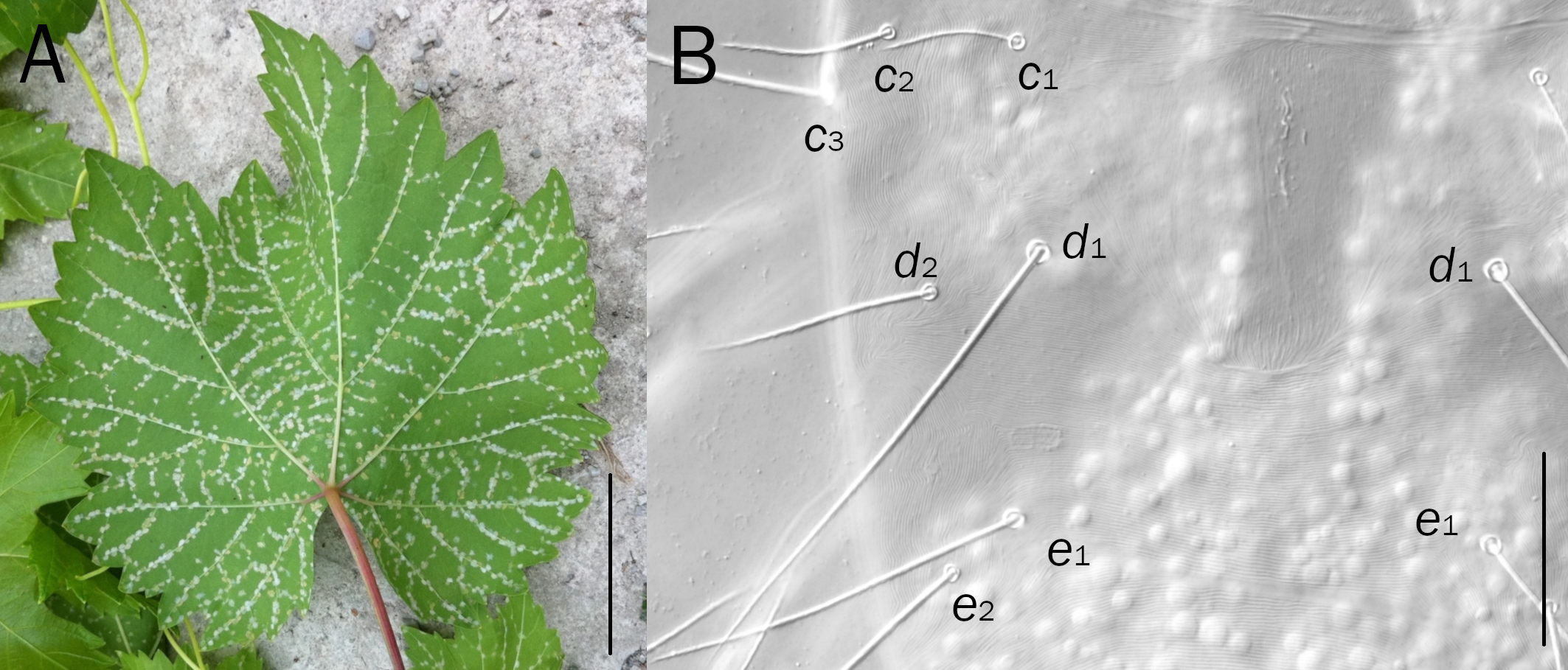
Figures 1C–D, 2A, 3E–H
Native from Central America (Tuttle et al., 1976), the Persea mite, Oligonychus perseae Tuttle, Baker and Abbatiello, 1976 is recorded from Nearctic, Neotropical and Palearctic regions. Considered as an invasive pest, this species was recorded for the first time in Europe in Portugal (Ferreira et al., 2006; Naves et al., 2021), then in Spain (Alcázar et al., 2005) and more recently in Italy (Sicily) (Zappalà et al., 2015).
Records: 6 females, 2 males collected on Persea americana Mill. (Lauraceae), Val Rahmeh Botanical Garden, (43.7847°N 7.5113°E, alt. 45 m a.s.l.), Menton (Alpes-Maritimes), France 30-IX-2019, leg. Auger P., Migeon A.; 4 females, 1 male collected on P. americana, Route de Super Garavan (43.7901°N 7.5169°E, alt. 189 m a.s.l.), Menton (Alpes-Maritimes), France 24-VIII-2016, leg. Dr René d'Agro.
All the specimens of O. perseae were collected on avocado, P. americana, on the French Côte d'Azur, at Menton, near the Italian border. The first sample came from the private garden of Dr René d'Agro who sent us a sample of mite from infested avocado leaves. He also sent some pictures of grapevine leaves, Vitis vinifera L. (Vitaceae), from his neighbor's garden near his own, which were infested by a spider mite whose leaf symptoms were similar (silk nests on the underside of leaves, mainly located along the midrib and main veins) to those produced by O. perseae (Fig. 2A). Although we did not observe under the microscope the mites responsible for these symptoms on grape (we did not have the opportunity to collect mite material because the owner wished to remain anonymous), we also believe that the mite responsible for this damage is O. perseae. However, this possible occurrence of O. perseae will be the third record of this species on grapevine. The first report was in Madeira Island and the second in Algarve, Portugal mainland (Ferreira et al. 2006, 2007). A second sample was collected in the botanical garden of Menton and other avocado trees showing symptoms of infestation by O. perseae were also observed [not collected: as the symptoms observed were typical of O. persae (see above), we did not consider it necessary to expand the number of samples] here and there in the city.
Distinctive characters (Fig. 1C, D): among the species whose male have an aedeagus which shape is O. ununguis-like, females of this species can be distinguished by: (1) their dorsal striae forming a reversed V-pattern between dorsal setae e1, (2) setae c1 and d1 not reaching the base of the next row whereas the setae e1 reach the base of the setae f1, (3) the combination of their tarsal and tibial leg chaetotaxy (tarsus I with 4 setae and one solenidion proximal to proximal duplex setae, tarsus II with 2 setae proximal to duplex setae).
Note: new species for France.
Remarks: this species can represent a phytosanitary risk in France, taking into account (1) the expansion of avocado crop (its main host plant) in the country (Côte d'Azur, Pyrénées-Orientales and Corse) and (2) the pest status and yield losses reported in production areas in affected countries (e.g. Torres et al. 2023). Although there is no evidence indicating damage to other crops besides avocado, reports of the species on grapevine in Europe as well as observation of symptoms in localities close to the infested avocados (in this study) warn about the possible adaptation and impact that this species could cause in European vineyards under climate change scenarios. According to EFSA pest categorization (European Food Safety Authority 2022), O. persea satisfies the criteria to be regarded as a potential Union quarantine pest and avoiding its spread is important.
Genus Stigmaeopsis Banks, 1917
Stigmaeopsis Banks, 1917: 195. Type-species: Stigmaeopsis celarius Banks
Stigmaeopsis nanjingensis (Ma & Yuan, 1980)
Figures 2B, 3I–L
Stigmaeopsis nanjingensis is known only from Oriental region, from China (Palearctic region probably), and from Europe: in Italy (Pellizzari and Duso, 2009), in Hungary (Kontschan and Nemenyi, 2013) and in mainland Portugal (Naves et al. 2021). According to Migeon and Dorkeld (2022), this species inhabits several bamboos species belonging to the genera Fargesia, Phyllostachys and Pseudosasa.
Records: 7 females, 3 males collected on Phyllostachys sp. (Poaceae) French-Italian Border post, (43.7859°N 7.5277°E, alt. 26 m a.s.l.), Menton (Alpes-Maritimes), France 30-IX-2019, leg. Auger P., Migeon A.
This new occurence is not very surprising as Pellizzari and Duso (2009) previously reported this species in the Italian town of Ventimiglia (Imperia district) which is located close to the French border (less than 10 km).
Distinctive characters (Fig. 2B): (1) in females, the distance between insertions of setae e1 is similar to that found between insertions of setae d1; (2) the setae d1 are longer than the distance between the insertions of setae d1 members (Saito et al. 2018).
Note: this species was erroneously reported as Stigmaeopsis celarius Banks, 1917 by Auger and Migeon (2007) (12 females, 10 males collected on Phyllostachys viridiglaucescens Rivière & C. Rivière (Poaceae), Bambouseraie de Prafrance (44.0718°N, 3.9796°E, alt. 144 m a.s.l), Générargues (Gard), France 16-IX-2003, leg. Migeon A.) and it was previously collected in Southern France but had not been identified until this work (4 females, 1 male collected on S. yashadake, (43.7348°N 3.9805°E, alt. 86 m a.s.l.), Saint Drézéry (Hérault), France 26-XI-2017, leg. Migeon A.); new species for France and new host record on S. yashadake.
Key to the world species of Aponychus females
The key was built according to the valid species mentioned by Migeon and Dorkeld (2022) taking into account that, following the revision by Hernandes (2010), which concluded that several species of Aponychus should probably be synonymized, only A. aequilibris is considered a junior synonym of A. corpuzae (Hernandes and Feres, 2013). As a consequence, twenty-one species are here considered valid.
As we observed some variations in sacral setae labelling in the literature when they are both in dorsal marginal position (e.g. A. chiavegatoi vs. A. mai), we decide to name f2 the closest seta to clunal setae (h1).
1. First 3 pairs of dorsocentral setae (c1, d1, e1) well developed (seta c1 reaching or surpassing well the base of d1), not spatulate, more or less elongate, inserted on obvious or strong tubercles
...... 2
– First 3 pairs of dorsocentral setae (c1, d1, e1) short (seta c1 far from reaching base of d1), not inserted on strong tubercles
...... 9
2. Seta c2 tiny, displaced anteriorly onto the prodorsum
...... A. chiavegatoi Feres & Flechtmann, 1988
— Seta c2 well developed
...... 3
3. Some dorsal setae subspatulate-lanceolate (obviously widened near the middle) to spatulate
...... 4
— All dorsal setae elongate
...... 5
4. Setae sc2, c3 and h1 short, lanceolate; tibia II with 4 tactile setae
...... A. mauritianum Ferla & Ferla, 2020
— Setae sc2, c3 and h1 short, broadly spatulate; tibia II with 5 tactile setae
...... A. schultzi (Blanchard, 1940)
5. Dorsal setae subequal in length (except seta h1, the longest)
...... A. mallotus Ho, 2003
— Some dorsal setae obviously smaller
...... 6
6. Dorsocentral seta c1 surpassing well the base of seta d1 }{7}\cledetermination{— Dorsocentral seta c1 reaching or almost reaching the base of seta d1
...... 8
7. Seta f2 short and subspatulate; tibiae I with 6 setae and II with 4 setae
...... A. taishanicus Wang, 1981
— Seta f2 short and slender, sometimes blunt; tibiae I with 5 setae and II with 3 setae
...... A. spinosus (Banks, 1909)
8. Dorsal setae stout, some of them rounded distally; seta c3 about half the length of c2, h1 about half the length of f1
...... A. pilipinus Corpuz-Raros, 1978
— Dorsal setae tapering acute distally; seta c3 and h1 about 3/4 the length of c2 and f1, respectively
...... A. firmianae (Ma & Yuan, 1965)
9. Seta f1 or f2 very reduced or absent
...... 10
— Setae f1 and f2 present and well developed
...... 13
10. Seta f2 absent
...... A. bambusae Gupta & Gupta, 1990
— Seta f2 present, sometimes in ventral position
...... 11
11. Seta f1 tiny, f2 and h1 subspatulate of same size; seta v2 very short
...... A. sarjui Gupta, 1980
— Seta f1 not tiny, short or elongate
...... 12
12. Seta c1 longer than distance between insertions of c1 members; seta f1 setiform widened to lanceolate sometimes somewhat rounded distally, about 1/4 the length of seta h1; seta f2 enlarged near the middle gradually narrowing distally, subequal in length to seta h1
...... A. mai Pan, Jin & Yi, 2022
— Seta c1 obviously shorter than distance between insertions of c1 members; setae f1 and f2 setiform slender, seta f1 slightly shorter than seta h1; f2 in ventral position, about 1/3 the length of seta h1 or more
...... A. corpuzae Rimando, 1966
13. Seta f2 as long as seta h1, both longer than seta f1
...... A. siamensis Ehara & Wongsiri, 1975
— Seta f2 longer than setae h1 and f1
...... 14
14. Among first 3 pairs of dorsocentral setae (c1, d1 and e1) some being lanceolate to narrowly lanceolate
...... 15
— All first 3 pairs of dorsocentral setae (c1, d1 and e1) spatulate to subspatulate with rounded tip
...... 16
15. Third pair of dorsocentral seta (e1) obviously shorter than first and second pairs (c1 and d1); femur I with 6 setae, femur II with 5 setae
...... A. imperatus Hafaz & EI-Badry, 1980
— Third pair of dorsocentral setae (e1) longer or as long as first and second pairs (c1 and d1); femur I with 9 setae, femur II with 6 setae..
...... A. grandidieri (Gutierrez, 1966)
16. Seta v2 shorter than seta sc1, v2 about 2/3 the length of sc1; tibiae III and IV with 1 solenidion; stylophore shallowly cleft
...... A. solimani Zaher, Gomaa & EI-Enany, 1982
— Seta v2 obviously longer than seta sc1
...... 17
17. Seta c1 shorter than seta e1
...... 18
— Seta c1 longer or as long as seta e1
...... 19
18. Seta sc2 4 times as long as seta sc1; seta e2 twice as long as seta d2; seta d2 less than 1.5 the length of seta c2; seta d1 shorter than the half distance c1– d1
...... A. lupus Chaudhri, 1972
— Seta sc2 about twice as long as seta sc1; seta e2 about 1.25 the length of seta d2; seta d2 twice as long as seta c2; seta d1 longer than the half distance c1– d1
...... A. sulcatus Chaudhri, 1972
19. Seta v2 more than twice longer than seta sc1
...... A. rarus Rimando, 1966
— Seta v2 less than twice longer than seta sc1
...... 20
20. Seta c1 as long as seta d2; seta sc1 as long as seta d1
...... A. expansus Chaudhri, 1972
— Seta c1 shorter than seta d2 (c1 about ¾ to 3/5 the length of d2); seta sc1 slightly longer than seta d1
...... A. parydrus (Meyer, 1987)
Acknowledgements
We would like to thank the Val Rahmeh-Menton Botanical Garden and particularly Mr Christophe Joulin for allowing us to collect plant samples and for assistance during mite collection. Professor Carlos Flechtmann is also deeply acknowledged for providing us with the exhaustive and indispensable documentation on the species belonging to the genus Aponychus. We would also like to thank the anonymous reviewers whose comments helped to improve the manuscript. The present work was supported by the grant from the National Institute for Agronomical Research and Environment, Dpt Plant Protection and Environment (IB 2023 SPE INRAE ; PrepAcari : ''Petits mais Costauds - de la taxonomie intégrative à l′écologie pour se préparer au risque acarien'').
References
- Alcázar M.D., Aranda G., Márquez A.L., Sánchez L., Ruiz C. 2005. Oligonychus persea (Acari: Tetranychidae); una nueva plaga en el aguacate en el Sur de España. IV Congresso Nacional de Entomología Aplicada - X Jornadas Científicas de la SEEA - I Jornadas Portuguesas de Entomologia Aplicada, Bragança - Portugal: 213.
- Auger P., Migeon A. 2007. Les tétranyques des bambous en France. PHM Revue Horticole, 488: 17-19.
- EFSA PLH Panel (EFSA Panel on Plant Health). Bragard C., Baptista P., Chatzivassiliou E., Di Serio F., Gonthier P., Miret J.A.J., Fejer Justesen A-M., MacLeod A., Magnusson C.S., Panagiotis Milonas P., Navas‐Cortes J.A., Parnell S., Potting R., Reignault P.L., Stefani E., Thulke H-H., Van der Werf W., Civera A.V., Yuen J., Zappalà L. 2022. Pest categorisation of Oligonychus perseae. EFSA Journal 20(6):7336. https://doi.org/10.2903/j.efsa.2022.7336
- Ferreira M.A.S., Brazão C.I., Aguiar A.F. 2006. Ocorrência de Oligonychus perseae Tuttle, Baker & Abbatiello (Acari: Tetranychidae) na Ilha da Madeira. Agronomia Lusitana, 51: 219-222.
- Ferreira M.A.S., Ramos N., Soares C., Fernandes J.E. 2007. O ácaro do-abacateiro no Algarve. Frutas, Legumes e Flores, 97: 56-57.
- Gotoh T., Noda H., Hong X.Y. 2003. Wolbachia distribution and cytoplasmic incompatibility based on a survey of 42 spider mite species (Acari: Tetranychidae) in Japan. Heredity, 91: 208-216. https://doi.org/10.1038/sj.hdy.6800329
- Hernandes, F.A. 2010. Revisão taxonômica e análise filogenética de espécies de Aponychus Rimando, Praponychus Gonzáles & Flechtmann e Stylophoronychus Prasad (Acari, Eurytetranychini) [Phd Thesis] - Universidade Estadual Paulista, Instituto de Biociências, Letras e Ciências Exatas, pp. 203
- Hernandes F.A., Feres R.J.F. 2013. Phylogeny and taxonomic revision of the spider mite genera Aponychus, Paraponychus and Stylophoronychus using morphology (Acari : Tetranychidae). Invertebrate Systematics 27(3): 265-281. https://doi.org/10.1071/IS12071
- Kontschan J., Nemenyi A. 2013. An East- Asian tetranychid Bamboo inhabiting mite, Stigmaeopsis nanjingensis (ma & Yuan, 1980) first occurrence in Hungary (Acari: Tetranychidae) . Növényvédelem, 49: 473-477.
- Lee J.S. 1989. A systematic study on the Tetranychoid mites (Order : Acarina) in Korea. Chonju, Chonbuk University: 124.
- Mack R.N., Simberloff D., Lonsdale W.M., Evans H., Clout M., Bazzaz F.A. 2000. Biotic invasions: causes, epidemiology, global consequences, and control. Ecol Appl 10: 689-710. https://doi.org/10.1890/1051-0761(2000)010%5B0689:BICEGC%5D2.0.CO;2
- Migeon A., Dorkeld F. 2022. Spider Mites Web: a comprehensive database for the Tetranychidae. Available from https://www1.montpellier.inrae.fr/CBGP/spmweb/index.php (Accessed 5/12/2022)
- Naves P., Nóbrega F., Auger P. 2021. Updated and annotated review of Tetranychidae occurring in mainland Portugal, the Azores, and Madeira Archipelagos. Acarologia 61(2): 380-393. https://doi.org/10.24349/acarologia/20214437
- Pellizzari G., Duso C. 2009. Occurence of Stigmaeopsis nanjingensis in Europe. Bulletin of Insectology, 62: 149-151.
- Saito Y., Sato Y., Chittenden A. R., Lin J.-Z., Zhang Y.-X. 2018. Description of two new species of Stigmaeopsis, Banks 1917 (Acari, Tetranychidae) inhabiting Miscanthus grasses (Poaceae). Acarologia 58(2): 414-429. https://doi.org/10.24349/acarologia/20184250
- Seljak G. 2015. The bamboo spider mite Aponychus corpuzae Rimando (Acari: Tetranychidae); first record in the West-Palaearctic. EPPO Bulletin, 45: 199-204. https://doi.org/10.1111/epp.12201
- Torres E., Álvarez-Acosta C., del Pino M., Wong M.E., Boyero J.R., Hernández-Suárez E., Vela J.M. 2023. Economic Impact of the Persea Mite in Spanish Avocado Crops. Agronomy, 13(3):668. https://doi.org/10.3390/agronomy13030668
- Tuttle D.M., Baker E.W., Abbatiello M. 1976. Spider mites of Mexico (Acarina : Tetranychidae). International Journal of Acarology, 2: 1-102. https://doi.org/10.1080/01647957608683760
- Wang H.F. 1981. Acariformes: Tetranychoidea. Econ. Insect Fauna China, Science Press, 23: 150 p.
- Zappalà L., Kreiter S., Russo A., Tropea Garzia G., Auger P. 2015. First record of the Persea mite Oligonychus perseae (Acari: Tetranychidae) in Italy with a review of the literature. International Journal of Acarology, 41: 97-99. https://doi.org/10.1080/01647954.2015.1014415
 to post any comment or correction.


2023-04-19
Date accepted:
2023-06-24
Date published:
2023-06-03
Edited by:
Marčić, Dejan

This work is licensed under a Creative Commons Attribution 4.0 International License
2023 Auger, Philippe; Navia, Denise and Migeon, Alain
 Download article
Download the citation
RIS with abstract
(Zotero, Endnote, Reference Manager, ProCite, RefWorks, Mendeley)
RIS without abstract
BIB
(Zotero, BibTeX)
TXT
(PubMed, Txt)