

Introductory remarks to the 2022 EurAAc Symposium in Bari
Ragusa Di Chiara, Salvatore  1
1
1✉ Università degli Studi di Palermo, Dipartimento di Scienze Agrarie e Forestali, Italy.
2023 - Volume: 63 Issue: Suppl pages: 1-3
https://doi.org/10.24349/kvpe-mofcProceedings of the 9th Symposium of the EurAAc, Bari, July, 12th–15th 2022
Dear Colleagues,
I believe we are all very happy to be here in Bari at last and to be able to carry on this ninth EurAAc Symposium in presence. As we all know, we were supposed to be here two years ago, in 2020, but we have gone through many moments of perplexity, worry and great despondency when everything seemed to go against the possibility of holding our conference. We have had to fight enemies we could not foresee: first, the COVID pandemic which has caused so many casualties, has hindered national and international economies and, because of lockdowns, prevented us from meeting as we have been doing since we first established our Association in Amsterdam (Netherlands) in 1987 and there was the first conference in Graz (Austria)) in 1988, under the chairmanship of Professor Rheinard Schuster. Then of course, the Russian-Ukrainian war broke out and it is still shaking our lives.
Together, we have had to make decisions: for example, we have had to decide whether to hold the Symposium in presence or virtually. This second hypothesis was not convincing, because congresses are much more productive when we can meet and discuss the various scientific issues de visu.
Naturally, the trickiest problem was the economic one. Given the situation, we had no idea of how many people would be able to participate and, as you know, the registration of participants is extremely important to decide what founds one can rely on. The fewer the participants, the higher the costs, and we did not want to overload those who would come with an excessive fee. Until the end of April we had doubts about the possibility of undertaking the Symposium, and we certainly were very distressed by this uncertain situation.
That was the reason why we asked you to undertake a near engagement of participation so that we might have a rough idea of the resources we might count on. Your prompt positive answers have really helped the organising committee to decide that this congress was conceivable.
And here we are finally and in presence! We thank all of you for the interest you showed in this ninth EurAAc Symposium which all of us have made possible.
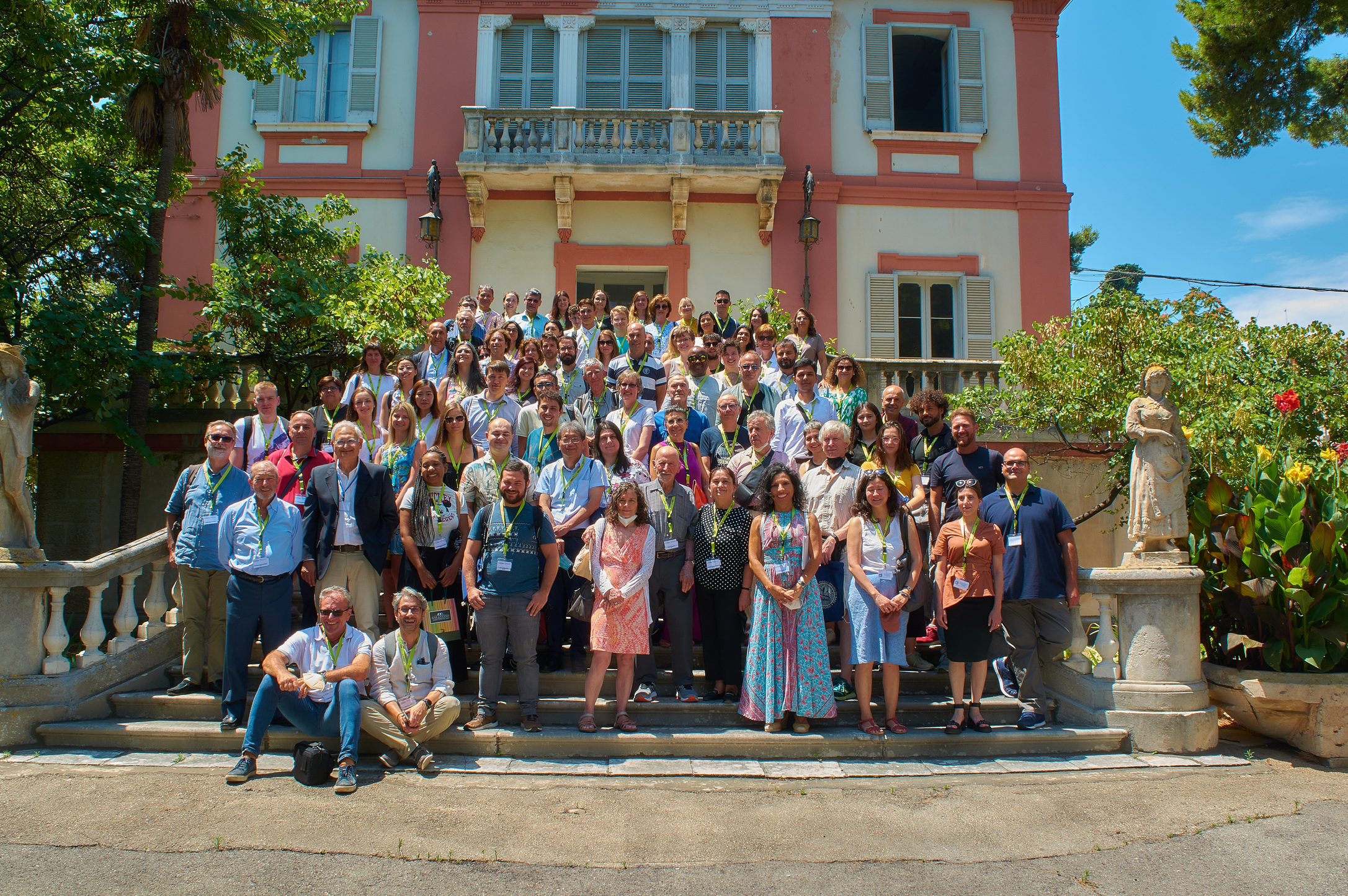
About one hundred acarologists from ten countries are here today. Unfortunately, the number of invited speakers has been drastically reduced, because colleagues who had accepted our invitation in 2020 have had to renounce in 2022 for various reasons, and time was too short to invite other colleagues to substitute them.
However, I believe the programme is very interesting and inspiring. In the following four days, issues connected with the various areas of acarology will be dealt with by our colleagues who will highlight the evolutionary processes of acarology, thus strictly connecting their contributions with the title chosen for the conference ''Acarology 1.0 to 2.0 –Acarology in changing times″.
The congress will be an excellent platform for scientific and cultural exchanges and will certainly provide young acarologists with a great opportunity to meet scientists of great renown who will doubtless widen their knowledge and possibly inspire them. What we strongly wish is that the new generations will continue and improve our work.
If I can share a personal experience with you, I remember my first International Congress of Acarology in Michigan (USA) in 1978, when I had the opportunity of meeting, and talking to, the ′big names' of acarology: McMurtry, Denmark, Krantz, Fletchmann, Schuster, and many others. It was very exciting and stimulating, especially because they were easy-going people, not standing on a pedestal, but sincerely interested in my problems, and above all generous in giving me precious advice. It was as if we had already met many times before and as if we were on the same level. I cannot help remembering Prof. Elihau Swirski, of course, who was also there and who became my master and friend. I do hope young colleagues may have my same fruitful experience in this congress and in other future ones, for the evolution of our research on these small arthropods.
I also have to say that apart from working for the Symposium, the international committee has also worked for another issue of the EurAAc. As a matter of fact, when the Association was founded in 1987, it was founded with, I should say, a private statute, not deposited with the authorities. Therefore, the Association was practically non-existent from a legal point of view. During the pandemic, we decided to fix a statute which has been then deposited with the French authorities, so that the society is now legally recognised.
To conclude, I would like to thank all those who have contributed to ′build' this congress, first the University of Bari Aldo Moro that has let us hold the Symposium here, then the entire Organising Committee, the agency ′Meeting Planner′, and the technicians. Of course, we cannot forget our sponsors who generously helped us financing this event. I am very grateful to all of them for their valuable cooperation.
Last but not least, I would like to express my special thanks to Prof. Enrico De Lillo and Prof. Antonella Di Palma. They have been on my side all the time, suggesting, questioning, discussing each single aspect of the scientific and practical organization of the conference. We have really been suffering together in silence coping with all the obstacles, difficulties and problems we have had to face during this long journey. Without their precious, patient, continuous help, all this would never become real. In trying to reach our goal of holding the Symposium here today, we have been more tenacious than Phytoseiulus persimilis when it wants to reach its prey, the red spider mite.
Once again, I welcome you in Bari and hope you will enjoy your stay in this beautiful historic city. I hope you will appreciate its churches, its monuments, its wonderful food and wine, but I hope you will especially enjoy this ninth EurAAc Symposium. Thank you very much!
The President
 to post any comment or correction.


2023-07-06

This work is licensed under a Creative Commons Attribution 4.0 International License
2023 Ragusa Di Chiara, Salvatore
 Download article
Download the citation
RIS with abstract
(Zotero, Endnote, Reference Manager, ProCite, RefWorks, Mendeley)
RIS without abstract
BIB
(Zotero, BibTeX)
TXT
(PubMed, Txt)